

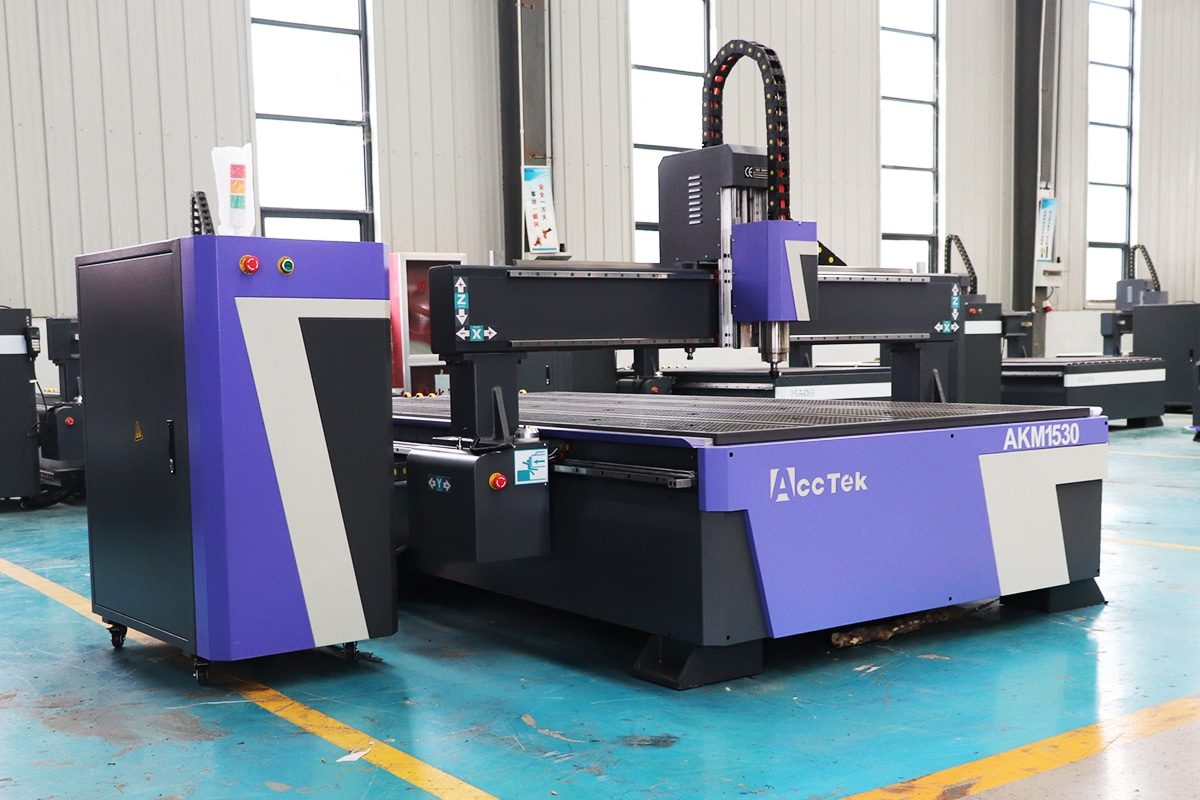
CNC Routers VS Laser Cutting Machines
CNC routers and laser cutting machines are two of the most widely used technologies for cutting, engraving, and shaping materials in modern manufacturing. Both systems use computer-controlled motion to produce accurate parts from digital designs, but they perform their work in fundamentally different ways. CNC routers rely on a rotating cutting tool that physically removes material, while laser cutting machines use a focused beam of light to melt, burn, or vaporize material along a programmed path. This difference affects nearly every aspect of the machining process, including material compatibility, cutting speed, edge quality, achievable detail, maintenance requirements, operating costs, and workplace safety.
CNC routers are commonly used to process wood, plastic, foam, composites, stone, and certain metals. They are particularly suitable for thick materials, deep engraving, three-dimensional relief carving, pocketing, drilling, and other operations requiring controlled material removal. By changing cutting tools, CNC routers can perform multiple machining processes on the same workpiece.
Laser cutting machines are generally preferred for applications requiring narrow kerfs, intricate patterns, high cutting speeds, and minimal mechanical contact. CO2 lasers are widely used for nonmetal materials such as acrylic, wood, fabric, leather, and paper, while fiber lasers are primarily designed for cutting metals, including carbon steel, stainless steel, aluminum, brass, and copper. Because laser cutting is a noncontact process, it eliminates tool wear and reduces the risk of mechanical deformation. However, it can also create heat-affected zones, fumes, and material-specific safety concerns.
Choosing between CNC routers and laser cutting machines requires more than comparing purchase prices or cutting speeds. Manufacturers must consider the materials being processed, required thickness and precision, desired edge finish, production volume, secondary operations, environmental controls, and long-term operating expenses. This article compares CNC routers and laser cutting machines across these important factors, helping businesses determine which technology is better suited to their production requirements.
Table of Contents
Understanding CNC Routers
CNC routers are computer-controlled machining systems designed to cut, drill, engrave, carve, mill, and shape a wide range of materials. Unlike laser cutting machines, which use concentrated thermal energy, CNC routers use rotating cutting tools to remove material through direct mechanical contact. This makes them particularly effective for machining wood, plastics, foam, composites, stone, and certain nonferrous metals.
The capabilities of CNC routers depend on their mechanical structure, spindle power, axis configuration, control system, cutting tools, and workholding method. Machines range from compact desktop models for light-duty engraving to large industrial systems equipped with automatic tool changers, vacuum tables, multi-axis heads, and automated loading systems. Understanding how CNC routers operate and how their configurations differ is essential when comparing them with laser cutting machines.
What Are CNC Routers?
CNC router is an automated cutting machine that follows programmed instructions to move a rotating tool along one or more axes. CNC stands for Computer Numerical Control, referring to the use of numerical data to control the machine’s movements, spindle speed, cutting depth, feed rate, and other operating parameters.
CNC routers are related to CNC milling machines, but they are generally designed with larger working areas and higher travel speeds. They are widely used for processing sheet materials, panels, boards, signs, furniture components, molds, decorative products, and three-dimensional parts. Depending on the machine’s construction and tooling, CNC routers can perform profile cutting, pocketing, slotting, drilling, surface planing, relief carving, edge shaping, and three-dimensional machining.
One of the main advantages of CNC routing is its flexibility. Operators can install different cutting tools to perform different processes. End mills can cut profiles and pockets, ball-nose tools can create curved surfaces and relief carvings, V-bits can engrave lettering, and specialized tools can drill holes or form decorative edges.
Because the tool physically removes material, CNC routers can create features that lasers cannot easily produce, such as deep pockets, stepped surfaces, beveled edges, channels, countersinks, and complex three-dimensional contours. However, mechanical cutting also produces chips, dust, vibration, tool wear, and cutting forces that must be properly managed.
How CNC Routers Work
The CNC routing process normally begins with a digital design created in computer-aided design software. The CAD drawing defines the shape, dimensions, holes, contours, and other features of the finished part. Computer-aided manufacturing software then converts this design into toolpaths and generates machine-readable instructions, usually in the form of G-code.
The G-code tells the CNC controller where and how the cutting tool should move. It may specify the tool position, cutting depth, spindle speed, feed rate, direction of travel, tool-change sequence, and other machining commands. Before production begins, the operator loads the program, installs the correct cutting tools, secures the material, and establishes the workpiece origin and tool-height reference.
During machining, the spindle rotates the cutting tool at high speed while the motion system moves it along the programmed axes. On a standard three-axis router, the X-axis controls movement from side to side, the Y-axis controls movement from front to back, and the Z-axis controls vertical movement. The tool enters the material and removes it gradually according to the programmed cutting depth and path.
Material removal may require one or several passes. Soft or thin materials can often be cut in a single pass, while hard or thick materials may require multiple shallow passes to prevent tool breakage, excessive spindle load, or poor edge quality. The correct combination of spindle speed, feed rate, cutting depth, tool geometry, and toolpath strategy is essential for achieving accurate and consistent results.
Because routing is a contact process, the workpiece must remain securely fixed. T-slot clamps, vacuum adsorption tables, mechanical fixtures, and customized jigs are commonly used for workholding. Dust collectors, extraction systems, chip conveyors, mist cooling, or liquid-cooling systems may also be required, depending on the processed material.
Main Components of CNC Routers
The machine frame and bed provide the structural foundation of CNC routers. A rigid, stable frame helps resist vibration and deformation during machining. Light-duty routers may use aluminum frames, while industrial machines often use welded and stress-relieved steel structures. The machine bed supports the workpiece and may include a T-slot surface, vacuum table, or a combination of both.
The gantry spans the machine bed and supports the moving cutting assembly. Depending on the design, either the gantry moves over a stationary table, or the table moves beneath a fixed gantry. Gantry rigidity directly affects cutting accuracy, surface quality, and the machine’s ability to process harder materials.
The spindle supplies the rotational power required to drive the cutting tool. Spindles are available in different power ratings, speed ranges, and cooling methods. Air-cooled spindles offer relatively simple installation and maintenance, while water-cooled spindles can provide quieter operation and stable cooling during extended machining. Industrial routers may use automatic tool-changing spindles to support continuous multi-process production.
The motion system controls movement along each axis. Stepper motors are commonly used on economical or light-duty machines, while servo motors provide faster acceleration, higher precision, position feedback, and improved performance under changing loads. Motion may be transmitted through rack-and-pinion drives, ball screws, or other mechanisms. Linear guide rails support smooth and accurate axis movement.
The CNC controller interprets the machining program and coordinates spindle operation, motor movement, tool changes, and auxiliary functions. Control systems range from PC-based platforms for basic routing to industrial controllers with touchscreen interfaces, production monitoring, tool management, and advanced multi-axis capabilities.
Cutting tools are another critical part of the system. Tool selection depends on the material, machining operation, required finish, and production speed. Tool diameter, flute count, cutting-edge geometry, coating, and rotation direction can all affect performance.
Additional components may include an automatic tool changer, tool magazine, vacuum pump, dust collector, lubrication system, tool-length sensor, rotary attachment, cooling system, protective enclosure, and automatic loading or unloading equipment. Together, these components determine the CNC router’s productivity, versatility, and suitability for specific applications.
Common CNC Router Configurations
Three-axis CNC routers are the most common configuration. They move along the X, Y, and Z axes and are suitable for panel cutting, engraving, drilling, pocketing, sign making, furniture production, and 2D or 2.5D machining. They offer a practical balance of cost, productivity, and ease of operation.
CNC routers with a rotary fourth axis add a rotating attachment that holds cylindrical or irregularly shaped workpieces. This configuration can process columns, table legs, wooden sculptures, pipes, and other round components. The rotary device usually replaces one linear axis during operation, so it should not always be confused with a fully simultaneous four-axis system.
True four-axis CNC routers allow the cutting tool or workpiece to rotate while the linear axes continue moving. They are useful for machining curved surfaces, side features, angled details, and more complex three-dimensional parts. Four-axis systems can reduce manual repositioning and improve accuracy when several sides of a workpiece require machining.
Five-axis CNC routers provide movement along three linear axes and rotation around two additional axes. This allows the tool to approach the workpiece from multiple angles and machine complex contours, undercuts, molds, prototypes, aerospace components, composite structures, and large three-dimensional parts. Five-axis machines offer exceptional flexibility but require more advanced programming, stronger machine structures, and a higher investment.
Automatic tool changer CNC routers use a linear or carousel-style tool magazine to store multiple cutting tools. The machine changes tools automatically according to the program, allowing cutting, drilling, engraving, and finishing operations to be completed without frequent manual intervention. ATC systems are well suited to cabinet production, furniture manufacturing, mold making, and other multi-process applications.
Multi-spindle CNC routers use two or more spindles to increase productivity. Some machines operate several spindles simultaneously to produce identical parts, while others use independently controlled spindles for different operations. These configurations are commonly selected for repetitive, high-volume manufacturing.
Nested-based CNC routers are optimized for cutting multiple components from full sheets of material. They often include powerful vacuum tables, automatic tool changers, drilling units, labeling systems, and loading or unloading equipment. They are widely used in cabinet, panel furniture, and woodworking production.
Compact desktop CNC routers are designed for small workpieces, engraving, prototyping, education, and light-duty production. Heavy-duty industrial routers, by comparison, use reinforced frames, powerful spindles, servo motors, and advanced control systems to handle thicker materials, demanding cutting conditions, and continuous operation.
CNC routers are versatile computer-controlled machines that remove material with rotating cutting tools. They can cut, drill, engrave, pocket, carve, and shape both flat sheets and three-dimensional workpieces. Their mechanical cutting process makes them especially valuable when an application requires deep machining, variable cutting depths, beveled edges, relief carving, or three-dimensional contours.
Complete CNC routers combine a rigid machine frame, gantry, spindle, motion system, controller, cutting tools, and workholding system. Optional components such as automatic tool changers, rotary attachments, vacuum tables, dust collectors, and automated material-handling systems can further expand its capabilities.
Available configurations range from economical three-axis routers to advanced four-axis and five-axis systems. Manufacturers can also choose compact, multi-spindle, ATC, nested-based, or heavy-duty designs according to their materials, part geometry, production volume, and automation requirements. This range of configurations makes CNC routing suitable for everything from small-scale engraving to continuous industrial manufacturing. However, users must also account for tool wear, dust and chip generation, cutting forces, workpiece clamping, and routine mechanical maintenance when evaluating CNC routers against laser cutting machines.
Understanding Laser Cutting Machines
Laser cutting machines are computer-controlled systems that use a concentrated beam of light to cut, engrave, or process materials. Unlike CNC routers, which remove material with a rotating tool, laser cutting machines perform cutting without direct mechanical contact. The focused laser energy rapidly heats the material until it melts, burns, or vaporizes, while an assist gas helps remove molten material and debris from the cutting path.
Laser cutting technology is valued for its high speed, narrow kerf, precise contours, and ability to produce intricate details. The absence of physical tool contact eliminates cutting-tool wear and reduces mechanical forces on the workpiece. However, laser performance depends heavily on the laser type, wavelength, output power, material properties, thickness, and processing parameters. Understanding the available laser technologies and their main components is therefore essential when comparing laser cutting machines with CNC routers.
What Are Laser Cutting Machines?
Laser cutting machines are automated manufacturing systems that direct a focused laser beam along a programmed path to separate or shape material. The process begins with a digital design prepared using computer-aided design software. Computer-aided manufacturing or nesting software then converts the design into machine instructions that control the laser head, output power, cutting speed, focus position, assist gas, and motion system.
Inside the cutting head, focusing optics concentrate the laser beam into a very small spot. This produces an extremely high energy density at the surface of the material. Depending on the material and cutting method, the laser may melt, vaporize, burn, or chemically react with the material. A stream of compressed air, oxygen, nitrogen, or another process gas blows through the cutting nozzle to remove molten material from the kerf and influence the final edge quality.
Laser cutting is a noncontact process, meaning that the cutting head does not physically press against the workpiece. This reduces mechanical deformation and makes it possible to process thin, delicate, or flexible materials when they are properly supported. Because there is no physical cutting edge, operators do not need to replace worn router bits. However, laser cutting systems still require consumables and maintenance, including protective lenses, nozzles, gases, filters, and cooling-system components.
The capabilities of laser cutting machines depend on the laser source. CO2 lasers are commonly selected for nonmetal materials, while fiber lasers dominate industrial sheet-metal and tube cutting. Diode lasers are generally used for light-duty applications, and specialized laser cutting systems serve applications requiring particular wavelengths, pulse characteristics, or extremely precise thermal control.
Main Types of Laser Cutting Machines
CO2 Laser Cutting Machines
CO2 laser cutting machines generate a beam using a gas mixture that typically contains carbon dioxide, nitrogen, helium, and other gases. Electrical energy excites this mixture inside a sealed laser tube or resonator, producing infrared laser light with a wavelength of approximately 10.6 micrometers. The beam is transmitted to the cutting head through mirrors before being focused onto the material.
This wavelength is readily absorbed by many nonmetal materials. As a result, CO2 lasers are widely used to cut and engrave acrylic, wood, paper, cardboard, fabric, leather, rubber, foam, and certain plastics. They are common in sign making, packaging, garment production, model manufacturing, crafts, decoration, and general nonmetal fabrication.
CO2 lasers can produce smooth, polished-looking edges on many types of acrylic, which is an important advantage over mechanical routing. They can also create fine engraved details without physical tool pressure. However, the heat generated during cutting may discolor or char wood, paper, fabric, and other heat-sensitive materials. Certain plastics, particularly PVC and other chlorine-containing materials, should not be laser cut because they can release corrosive and toxic gases.
High-powered industrial CO2 lasers can cut metals, but they are generally less efficient than modern fiber lasers for most metal-cutting applications. Their mirror-based beam-delivery systems also require careful alignment and maintenance. Compared with fiber sources, CO2 laser cutting systems usually consume more electrical energy and have more beam-path components to inspect.
Fiber Laser Cutting Machines
Fiber laser cutting machines use a solid-state laser source in which the beam is generated and amplified through optical fibers doped with rare-earth elements. The resulting beam is delivered to the cutting head through a flexible fiber-optic cable rather than a series of external mirrors. Most industrial fiber lasers operate near a wavelength of 1.06 to 1.08 micrometers.
Fiber lasers are primarily designed for metal processing. They can cut carbon steel, stainless steel, galvanized steel, aluminum, brass, copper, titanium, and various metal alloys. Their short wavelength is absorbed efficiently by many metals, enabling fast cutting, especially on thin and medium-thickness sheets. Higher-power systems can also process increasingly thick plates when equipped with the appropriate cutting head, gas supply, motion system, and process parameters.
Compared with CO2 lasers, fiber laser cutting systems generally offer higher electro-optical efficiency, lower routine optical maintenance, and faster metal-cutting speeds. They are available in sheet-cutting, tube-cutting, sheet-and-tube combination, coil-fed, bevel-cutting, and fully automated configurations. Automatic loading, unloading, sorting, and storage systems can be integrated to support continuous production.
Fiber lasers are not normally the best choice for cutting common organic materials such as wood, transparent acrylic, fabric, or leather. These materials do not absorb the fiber laser wavelength as effectively and may present fire or process-control risks. Fiber laser cutting machines also require appropriate enclosures because the beam and reflections are hazardous to the eyes and skin.
Diode and Specialized Laser Systems
Diode laser machines generate laser light directly from semiconductor components. Compact diode lasers are commonly used for engraving and light-duty cutting of thin wood, paper, cardboard, leather, and certain dark or coated materials. They are generally smaller and more affordable than industrial CO2 or fiber laser cutting systems, making them popular for hobby use, education, prototyping, and small workshops.
The output power, beam quality, and cutting capability of diode systems are usually more limited than those of industrial laser cutters. Multiple passes may be required to cut relatively thin materials, and some colors or transparent materials may not absorb the wavelength effectively. Open-frame diode machines also require careful attention to eye protection, ventilation, fire prevention, and enclosure design.
Specialized laser systems include technologies created for particular materials or precision requirements. Nd and other solid-state lasers may be used in certain cutting, drilling, welding, and microprocessing applications. Green and ultraviolet lasers use shorter wavelengths that are better absorbed by some reflective, transparent, or heat-sensitive materials. Ultrafast picosecond and femtosecond lasers deliver extremely short pulses, allowing material to be removed with a very small heat-affected zone.
These specialized systems can process thin metals, ceramics, semiconductors, glass, electronic components, medical devices, and other demanding materials. However, they are generally more expensive and are selected for applications in which conventional CO2 or fiber laser cutting technology cannot achieve the required precision, material response, or thermal control.
Main Components of Laser Cutting Machines
The laser source generates the energy used for cutting. Its type, wavelength, output power, beam quality, and operating mode determine which materials the machine can process and how efficiently it can cut them. CO2 laser sources use a gas-filled tube or resonator, fiber lasers use solid-state modules and doped optical fibers, and diode systems use semiconductor emitters.
The beam-delivery system transports laser energy from the source to the workpiece. CO2 laser cutting machines typically use mirrors to guide the beam through the machine, so alignment and mirror cleanliness are important. Fiber machines transmit the beam through a fiber-optic cable, creating a more compact beam path with fewer external optical components.
The laser cutting head contains the collimating and focusing optics that shape and concentrate the beam. It may also include a protective lens, capacitive height sensor, autofocus mechanism, ceramic ring, and cutting nozzle. The autofocus system adjusts the focal position for different materials and thicknesses, while the height sensor maintains a stable distance between the nozzle and material surface.
The cutting nozzle directs the assist gas into the kerf. Nozzle diameter, condition, alignment, and distance from the workpiece influence cutting stability and edge quality. Oxygen can support an exothermic reaction when cutting carbon steel, while nitrogen is commonly used to produce oxide-free edges on stainless steel and aluminum. Compressed air can provide a more economical option for suitable materials and quality requirements.
The motion system moves the cutting head or workpiece along the programmed path. Industrial machines commonly use servo motors, guide rails, gear racks, ball screws, and precision gearboxes. Fast acceleration and accurate positioning are important because laser cutting often involves complex contours and frequent changes in direction.
The machine bed and worktable support the material during processing. Metal-cutting machines frequently use replaceable slats that allow the laser beam, molten metal, sparks, and slag to pass through. Some systems include exchange tables so that one sheet can be loaded while another is being cut. Nonmetal laser cutting machines may use honeycomb or blade-style working tables to support different materials.
The CNC controller coordinates the laser output, axis motion, focus position, assist gas, and other machine functions. Cutting software allows operators to import drawings, create toolpaths, arrange parts, set process parameters, and monitor production. Nesting software can place multiple parts efficiently on a sheet to reduce material waste.
A cooling system removes heat from the laser source and optical components. Industrial machines often use a closed-loop water chiller that maintains a controlled operating temperature. Stable cooling protects the laser source, prevents alarms, and supports consistent beam performance.
The exhaust and filtration system captures smoke, fumes, dust, and airborne particles produced during cutting. Its design should match the material and process. Some applications require high-volume extraction, spark control, HEPA filtration, or activated-carbon filtration. Materials that generate highly toxic, corrosive, or flammable emissions should not be processed unless the machine and extraction system are specifically designed for them.
Additional components include the assist-gas supply, air compressor, pressure regulators, electrical cabinet, voltage stabilizer, lubrication system, sensors, protective enclosure, viewing windows, warning lights, emergency stops, and safety interlocks. Automated machines may also incorporate sheet loaders, unloading devices, storage towers, conveyors, and robotic sorting systems.
Laser cutting machines use focused light energy to cut or engrave materials without direct mechanical contact. Their narrow kerf, high processing speed, and ability to reproduce intricate contours make them valuable in industries ranging from metal fabrication and electronics to advertising, textiles, packaging, and crafts.
CO2 laser cutting machines are primarily suited to nonmetal materials such as acrylic, wood, fabric, leather, and paper. Fiber laser cutting machines are optimized for metals and offer high speed, strong energy efficiency, and relatively low optical maintenance. Diode lasers serve light-duty cutting and engraving applications, while green, ultraviolet, and ultrafast laser systems address specialized material and precision requirements.
Complete laser cutting systems include the laser source, beam-delivery system, cutting head, focusing optics, nozzle, motion system, worktable, controller, cooling equipment, assist-gas supply, and exhaust system. The design and quality of these components directly influence cutting capacity, accuracy, edge quality, reliability, and operating costs.
Laser cutting technology eliminates cutting-tool wear and produces little mechanical force, but it introduces thermal effects, fumes, fire risks, optical hazards, and material compatibility restrictions. Manufacturers should therefore select a machine according to the specific material, thickness, edge requirements, production volume, safety controls, and operating environment rather than considering laser cutting a universal replacement for mechanical routing.
Material Compatibility
Material compatibility is one of the most important differences between CNC routers and laser cutting machines. CNC routers remove material with a rotating cutting tool, so their suitability depends largely on material hardness, rigidity, thickness, heat sensitivity, and the availability of an appropriate router bit. Laser cutting uses concentrated thermal energy, making compatibility dependent on the material’s absorption characteristics, chemical composition, melting behavior, thickness, and response to heat.
CNC routers are especially versatile when processing thick, rigid materials or when the work requires deep cuts, pockets, grooves, beveled edges, drilling, or three-dimensional shaping. Laser cutting machines are generally better for narrow kerfs, intricate contours, small internal details, and noncontact processing. However, no single laser technology is suitable for every material. CO2 lasers are primarily used for nonmetals, fiber lasers are optimized for metals, and specialized laser sources may be required for glass, ceramics, or heat-sensitive materials.
Material selection must also consider safety. Some materials produce toxic, corrosive, or flammable emissions when exposed to a laser beam, while routing can generate hazardous dust and airborne fibers. Before either process is used, the exact material composition, safety data sheet, ventilation requirements, and machine manufacturer’s recommendations should be verified.
Wood and Engineered Wood
CNC routers are highly suitable for solid wood and engineered wood products. They can process hardwood, softwood, plywood, medium-density fiberboard, particleboard, oriented strand board, laminated panels, and many other wood-based materials. By changing the cutting tool, a router can perform profile cutting, pocketing, drilling, grooving, joinery, edge shaping, surface planing, and three-dimensional carving.
Routing is especially advantageous when processing thick boards or producing furniture components that require holes, slots, rebates, mortises, or other features at different depths. Proper tool selection and feed settings help control splintering, tear-out, burning, and edge quality. Because routing generates large amounts of chips and fine dust, an effective dust-collection system is essential.
CO2 laser cutting machines can also process many types of wood. They are particularly effective for thin plywood, veneers, decorative panels, models, signs, puzzles, and products with intricate internal patterns. The narrow laser beam can reproduce fine details that may be difficult to achieve with a router bit.
The main limitation of laser cutting wood is thermal damage. Cut edges usually become darkened or charred, and resinous wood may produce more smoke or residue. Engineered boards can also contain adhesives, coatings, or additives that generate unpleasant or hazardous fumes. For thick wood, CNC routing is generally faster, cleaner at the edge, and more suitable for structural machining. For thin decorative products and detailed designs, CO2 laser cutting may offer greater precision.
Acrylic and Other Transparent Plastics
Acrylic, also known as PMMA, can be processed effectively by both CNC routers and CO2 laser cutting machines. However, each technology produces different results. CNC routers can cut thick acrylic sheets, create pockets, drill holes, machine beveled edges, and produce three-dimensional components. The process does not create a heat-affected zone, but cutting marks may remain on the edge and require sanding, polishing, or flame finishing.
CO2 laser cutting is widely used for acrylic because the material absorbs the CO2 laser wavelength efficiently. The process can create narrow cuts, intricate shapes, and smooth, glossy edges that often require little or no secondary polishing. Cast acrylic generally produces excellent engraved contrast, while extruded acrylic often provides a smoother cut edge.
Laser cutting becomes more difficult as acrylic thickness increases. Excessive heat may cause melting, edge deformation, internal stress, or fire. CNC routing may therefore be more practical for very thick acrylic, close-tolerance mechanical parts, or components requiring pockets and threaded features.
Fiber lasers are generally not suitable for cutting standard transparent acrylic because the material does not efficiently absorb the fiber laser wavelength. Other transparent plastics must be evaluated individually. A transparent appearance does not indicate that a plastic is laser-safe or compatible with a particular wavelength. Its chemical composition, additives, and thermal behavior must always be confirmed before processing.
Engineering Plastics
CNC routers can machine a broad range of engineering plastics, including polycarbonate, acetal, polyethylene, polypropylene, nylon, ABS, PET, PEEK, and other thermoplastics. Routing is useful for producing machine guards, fixtures, gears, insulators, prototypes, seals, and precision mechanical parts. It can create deep pockets, drilled holes, countersinks, and three-dimensional features that cannot be produced through simple profile cutting.
Engineering plastics react differently to mechanical machining. Softer plastics may deform or wrap around the cutting tool, while heat-sensitive plastics may melt if spindle speed is too high or chip evacuation is inadequate. Sharp tools, suitable flute geometry, correct feed rates, compressed-air cooling, and secure workholding help prevent melting and poor surface quality.
Laser compatibility is considerably more restrictive. Some engineering plastics can be cut with a CO2 laser, but others melt excessively, discolor, produce poor edges, ignite easily, or release dangerous decomposition products. Polycarbonate, for example, often yellows, chars, and produces an inferior edge when laser cut, especially at greater thicknesses. ABS can melt and generate unpleasant fumes, while acetal may release formaldehyde-containing emissions.
PVC and other chlorine-containing plastics should not be cut with standard laser cutting systems because they can release hydrogen chloride and other corrosive, hazardous substances. Fluorine-containing polymers may also release highly dangerous decomposition products. When the exact composition is uncertain, mechanical routing is generally the more controllable option, provided that suitable dust and chip extraction is used.
Foams and Cellular Materials
CNC routers can process many rigid and semi-rigid foams, including polyurethane modeling board, polystyrene foam, polyethylene foam, tooling board, and structural foam cores. They are particularly useful for producing molds, prototypes, packaging inserts, composite cores, architectural models, and large three-dimensional shapes. Long cutting tools and multi-axis systems can machine deep contours and complex surfaces.
The low density of foam allows high material-removal rates, but workholding can be challenging. Excessive clamping pressure may crush the material, while lightweight sheets can lift during cutting. Vacuum tables, specialized fixtures, and sharp cutting tools are commonly used to maintain accuracy. Routing can also generate statically charged particles and fine dust that require effective collection.
CO2 lasers can cut certain approved nonchlorinated foams with narrow kerfs and minimal mechanical pressure. This can be useful for thin gaskets, packaging components, insulation shapes, and intricate designs. However, some foams melt, ignite, shrink, or produce dense smoke. The material may also continue smoldering after the beam has passed.
Foams containing PVC or other halogenated compounds should not be processed with conventional laser equipment. This includes PVC-based structural foams such as Divinycell H60. Even when strong exhaust equipment is installed, laser exposure can generate toxic and corrosive gases, contaminate the machine, and damage optical or mechanical components. For these materials, CNC routing, oscillating-knife cutting, or another compatible mechanical process is generally more appropriate.
Composites and Laminated Materials
CNC routers are widely used for machining composites and laminated materials, including fiberglass-reinforced plastic, carbon-fiber-reinforced polymer, aluminum composite panels, high-pressure laminates, honeycomb panels, and sandwich structures. Routing can create profiles, holes, pockets, countersinks, and beveled edges in both thin sheets and thick structural components.
Composite machining requires suitable tooling and process control. Abrasive fibers can wear conventional carbide tools rapidly, so diamond-coated, polycrystalline diamond, or other wear-resistant tools may be necessary. Poor cutting parameters can cause fiber pullout, fraying, delamination, or damage to the surface layer. Carbon-fiber and fiberglass dust can irritate the skin and respiratory system and may damage electrical equipment, making enclosed machining and high-efficiency dust extraction important.
Laser cutting can process some thin laminates and composites, but results depend heavily on the combination of materials. Different layers may absorb heat at different rates, resulting in uneven kerfs, delamination, resin burning, discoloration, or a relatively large heat-affected zone. Composite resins may also release hazardous fumes.
Thin aluminum composite panels can sometimes be processed with CNC routers or properly configured laser cutting systems, depending on their core composition and fire behavior. Unknown laminated materials should never be laser cut without confirming every layer, adhesive, coating, and core material. CNC routing is usually more predictable for thick structural composites, while specialized industrial lasers may be useful for carefully validated thin composite applications.
Metals
The suitability of CNC routers for metal depends on machine rigidity, spindle power, speed range, tool type, lubrication, and workholding. Heavy-duty CNC routers can machine aluminum, brass, copper, and other relatively soft nonferrous metals. They can perform profile cutting, drilling, pocketing, engraving, and three-dimensional milling. Specialized metal CNC routers may also process thin steel, but conventional woodworking routers are not designed for heavy steel machining.
Metal routing creates chips and cutting forces, but it can produce deep features and complex three-dimensional geometry. It is often selected for aluminum plates, molds, signs, electrical components, and parts requiring pockets or countersunk holes. Appropriate cutting fluids, mist cooling, chip evacuation, and rigid clamping may be required to prevent tool breakage, built-up edges, and poor finishes.
Fiber laser cutting machines are generally the preferred choice for fast profile cutting of sheet metal. They can process carbon steel, stainless steel, aluminum, brass, copper, titanium, and various alloys. The process delivers narrow kerfs, high speeds, intricate contours, and minimal mechanical force. It is especially productive when many flat parts must be cut from sheets or when integrated with automated loading, unloading, and sorting systems.
The achievable thickness depends on laser power, material type, beam quality, assist gas, focus control, and required edge quality. Fiber laser cutting does not create pockets or three-dimensional milled surfaces, so secondary machining may still be necessary. High-powered CO2 lasers can also cut metal, but fiber lasers have largely replaced them in many sheet-metal applications because of their higher efficiency and faster cutting speeds.
Paper, Textiles, Leather, and Flexible Materials
CO2 laser cutting machines are well suited to many thin, flexible materials, including paper, cardboard, fabric, felt, leather, and certain synthetic textiles. The noncontact process prevents tool pressure from stretching or distorting the material. It can produce intricate patterns, small openings, and detailed decorative designs at high speed.
When cutting synthetic textiles, laser heat may seal the edges and reduce fraying. Natural fabrics and paper, however, may show darkened or scorched edges if power and speed are not properly controlled. Leather can also develop discoloration and strong odors. Material coatings, fire retardants, dyes, adhesives, and synthetic backing layers should be identified before laser processing because they can affect both cut quality and emission safety.
Conventional spindle-based CNC routers are generally unsuitable for cutting thin paper, textiles, or flexible leather because the rotating tool can pull, tear, or wrap the material. However, some CNC platforms can be equipped with drag knives, rotary knives, or oscillating-knife tools. These attachments allow mechanical cutting without thermal damage, smoke, or sealed edges.
Knife-equipped CNC systems are often preferable for multilayer fabrics, thick leather, corrugated cardboard, gaskets, and materials sensitive to heat. Therefore, the comparison depends on whether the CNC machine is limited to a spindle or configured as a multifunctional digital cutting system.
Glass, Ceramics, and Stone
Stone CNC routers and specialized machining centers can process marble, granite, engineered stone, slate, ceramic materials, and similar hard products. Diamond tools, powerful water-cooled spindles, rigid machine structures, and continuous water flow are commonly required. These machines can engrave lettering, cut profiles, drill sink openings, polish edges, carve reliefs, and produce three-dimensional decorative features.
Conventional CNC routers are less suitable for ordinary glass because mechanical pressure and vibration can cause cracking or chipping. Specialized CNC glass-processing machines use diamond tools, precise feed control, cooling water, and dedicated workholding systems to grind, drill, and shape glass safely. Ceramic materials also require appropriate diamond tooling and a machine designed to control brittle fracture.
Standard CO2 lasers can engrave the surface of some glass products, but conventional laser cutting may create uncontrolled cracking because glass is brittle and sensitive to thermal stress. Fiber lasers are generally unsuitable for cutting transparent glass. Specialized ultraviolet, green, picosecond, or femtosecond laser systems can cut or micromachine certain types of glass and ceramics with greater precision and smaller heat-affected zones, but these systems are considerably more specialized and expensive.
Most natural stone is not efficiently cut through by conventional CO2 or fiber laser cutting machines. Lasers may be used for surface engraving, marking, or decorative texturing, while mechanical CNC machining remains the more practical choice for cutting, drilling, profiling, and carving stone.
CNC routers and laser cutting machines overlap in some material applications, but their compatibility and processing capabilities are not identical. CNC routers are generally the stronger choice for thick, rigid materials and parts requiring pockets, grooves, holes, beveled edges, or three-dimensional machining. They can process wood, engineering plastics, foams, composites, nonferrous metals, and stone when equipped with suitable tools, workholding, and extraction systems.
CO2 laser cutting machines are particularly effective for thin wood, acrylic, paper, textiles, leather, and other approved nonmetals. Fiber lasers are optimized for high-speed sheet-metal cutting, while specialized laser systems address demanding glass, ceramic, and microprocessing applications. Laser cutting provides a narrow kerf and excellent detail but introduces heat-affected zones, fumes, fire hazards, and material-specific chemical risks.
The material name alone is not enough to determine whether routing or laser cutting is appropriate. Thickness, additives, coatings, adhesives, reinforcement fibers, desired edge quality, part geometry, and required production speed must also be considered. Manufacturers should verify the exact material specification and conduct controlled sample tests before full production. When material composition is unknown or potentially hazardous under heat, mechanical routing or another nonthermal cutting method is usually the safer and more predictable choice.
Cutting Thickness and Workpiece Size
Cutting thickness and workpiece size are important considerations when choosing between CNC routers and laser cutting machines. CNC routers physically remove material with rotating tools, so their cutting depth is influenced by tool length, spindle capability, machine rigidity, Z-axis travel, and chip evacuation. Laser cutting machines use focused thermal energy, making their thickness capacity dependent on laser power, material absorption, beam quality, assist gas, focus control, and thermal properties.
A machine’s advertised maximum thickness does not always represent its practical production capacity. A system may technically penetrate a material but operate too slowly, produce unacceptable edges, or require excessive maintenance. Manufacturers should distinguish between the maximum thickness that can be cut under ideal conditions and the thickness that can be processed consistently at the required speed and quality.
Workpiece capacity also involves more than the nominal working area. Material loading space, gantry clearance, Z-axis height, clamping positions, sheet flatness, rotary-axis capacity, and enclosure dimensions can all affect whether a part can actually be processed.
Factors That Limit CNC Router Cutting Depth
The cutting depth of CNC routers is first limited by the cutting tool. The usable cutting length of a router bit must be sufficient to reach through the material without forcing the noncutting shank into the workpiece. The overall tool length should not be confused with its flute or cutting-edge length. Selecting an excessively long tool increases deflection, vibration, and the risk of breakage.
Tool diameter also affects achievable depth. A small-diameter tool may be required for narrow slots or detailed internal corners, but it is less rigid and cannot normally cut as deeply or aggressively as a larger tool. Deep cuts made with thin tools often require reduced feed rates and shallow passes, increasing machining time. Larger-diameter tools provide greater strength and chip clearance but create wider kerfs and larger minimum internal corner radii.
Spindle power and torque determine how effectively the router can remove material. Thick hardwood, dense plastic, composites, aluminum, and stone require more cutting force than soft wood or foam. If the spindle is underpowered, cutting too deeply may cause speed loss, overheating, chatter, poor edge quality, or tool failure. Spindle condition, collet quality, and tool runout also influence deep-cutting stability.
Machine rigidity is another major limitation. Cutting thick or dense material creates higher mechanical loads. A rigid frame, stable gantry, accurate guide rails, and reliable drive system help prevent vibration and positional error. Lightweight routers may be able to hold a long tool, but their structures may not support the cutting forces required for deep machining.
Chip evacuation becomes increasingly difficult as cutting depth increases. Chips trapped inside a deep slot can be recut by the tool, generating heat and reducing edge quality. In plastics, excess heat can melt chips and cause them to adhere to the tool. In wood, poor evacuation may create burning. Suitable flute geometry, dust extraction, compressed air, or cutting fluid may be necessary.
The router’s Z-axis travel and gantry clearance also establish physical limits. The machine must accommodate the material, spoilboard, fixture, tool, collet, dust shoe, and required lifting clearance. A router with sufficient Z-axis travel may still be unable to process a tall workpiece if the gantry or spindle assembly lacks physical clearance.
Workholding becomes more difficult with thick or irregular parts. Clamps must hold the material securely without interfering with the spindle, collet, or cutting tool. Vacuum tables work well for large, flat sheets but may provide insufficient holding force for small parts or porous materials. In these cases, mechanical clamps, tabs, screws, adhesives, or custom fixtures may be required.
Factors That Limit Laser Cutting Thickness
Laser cutting thickness is primarily limited by the amount of energy that can be delivered into the cutting zone. Higher laser power generally supports greater thickness or faster cutting, but power alone does not determine the result. Beam quality, focal spot size, focus position, cutting speed, and material properties all influence whether the beam can create and maintain a stable kerf through the full thickness.
Laser wavelength affects how efficiently a material absorbs energy. Fiber lasers are highly effective for cutting metals but are generally unsuitable for standard transparent acrylic and many organic materials. CO2 lasers are readily absorbed by wood, acrylic, fabric, leather, and other nonmetals. A material that does not absorb the laser wavelength efficiently may reflect or transmit much of the energy, reducing cutting performance and potentially creating safety risks.
Material composition has a major effect on thickness capacity. Carbon steel, stainless steel, aluminum, copper, acrylic, wood, and engineering plastics behave differently when heated. Thermal conductivity determines how quickly heat moves away from the cutting zone. Reflectivity affects initial energy absorption, while melting temperature, vaporization behavior, coatings, and alloy composition influence cutting stability.
Assist gas plays a critical role in removing molten material and supporting the cutting process. Oxygen can increase the effective cutting energy through an exothermic reaction and is often used for thicker carbon steel, although it creates an oxidized edge. Nitrogen produces clean, oxide-free edges on stainless steel and aluminum but may require high pressure and substantial gas flow, especially as thickness increases. Compressed air can reduce operating costs for suitable applications but may not deliver the same edge quality or thickness capacity.
The cutting head, nozzle, and optical system must also match the material and thickness. Incorrect nozzle diameter, poor nozzle alignment, a contaminated protective lens, unstable gas pressure, or an improperly positioned focus can prevent the laser from cutting through consistently. Thicker materials usually have a narrower process window, meaning that small changes in focus or gas flow can cause incomplete cutting, dross, rough edges, or excessive heat accumulation.
Piercing performance may become the limiting factor before straight-line cutting capacity is reached. Thick metal requires more time and energy to pierce, creating a risk of spatter, overheating, or damage to the nozzle and protective lens. Controlled piercing strategies are therefore essential for thick-plate processing.
The advertised maximum thickness should be evaluated carefully. A machine may be able to separate a thick plate at a very low speed while producing rough edges and heavy slag. Its economical production thickness—the range in which it delivers stable quality at an acceptable speed—is usually lower than its absolute maximum.
Single-Pass and Multiple-Pass Processing
CNC routers commonly use multiple passes to cut through thick material. Instead of removing the full thickness at once, the router lowers the tool incrementally and follows the same path at progressively greater depths. The depth of each pass depends on tool diameter, material hardness, spindle power, machine rigidity, feed rate, and desired finish.
Multiple-pass routing reduces cutting forces and helps protect the tool and spindle. It also improves chip evacuation and allows a smaller or lighter-duty machine to process relatively thick material. However, every additional pass increases cycle time. Tool deflection or inaccurate motion can also leave visible step marks along the edge.
A final finishing pass may be added after rough cutting. During roughing, the tool removes most of the material while leaving a small amount along the edge. The finishing pass then removes this remaining allowance with a lighter load, improving dimensional accuracy and surface quality. Tabs or a thin uncut layer may also be left temporarily to prevent small parts from shifting before the final pass.
Single-pass routing is possible when the tool, spindle, machine, and material allow it. It can significantly reduce machining time, but cutting through the entire thickness places greater demand on the tool and machine. Full-depth cutting must be supported by adequate chip clearance and secure workholding.
Industrial laser cutting is normally designed as a single-pass process. After piercing the material, the beam travels along the programmed contour and cuts through the complete thickness. Single-pass operation is one reason laser cutting systems can produce flat parts very quickly.
Multiple laser passes may be used with low-powered diode or CO2 systems when cutting thin nonmetals, or in specialized processes where the goal is to control heat input. However, repeating a laser path does not always provide the same result as increasing laser power. Successive passes can widen the kerf, increase charring, melt the edges, accumulate heat, or create dimensional inconsistency.
For industrial metal cutting, repeated passes are generally not the preferred solution for material beyond the machine’s stable capacity. A higher-powered laser, different assist gas, optimized optics, or an alternative cutting process is usually more productive. Attempting to force a low-powered machine through thick material can create incomplete cuts, excessive dross, poor edge quality, and unnecessary stress on machine components.
Working Area and Part Clearance
The nominal working area defines the maximum X- and Y-axis travel available for machining. Common CNC router sizes are designed around standard sheet dimensions, but machines can also be manufactured with compact, extra-wide, or extended beds. A router with a working area of 1300 × 2500 mm, for example, is generally intended to accommodate a standard full-size panel, but usable capacity may be reduced by clamps, tool-clearance requirements, or machine construction.
Large-format CNC routers are well suited to oversized panels, signs, molds, architectural components, and composite structures. When the workpiece is longer than the bed, some machines support indexed processing. The material is machined in one section, repositioned, aligned, and then processed in the next section. Pass-through designs can make this easier, although accurate repositioning is essential to prevent visible mismatches.
The usable vertical capacity of a router is determined by more than its stated Z-axis travel. The operator must consider the spoilboard, fixture thickness, material height, cutting-tool length, tool holder, dust shoe, and safe retract distance. A long tool may reduce the height of the workpiece that can fit beneath the spindle. Tall clamps can also restrict tool movement or create a collision risk.
Rotary-axis routers have additional size limits. The maximum workpiece diameter depends on the distance between the rotary centerline and surrounding machine structures. Maximum length depends on the spacing between the chuck and tailstock. Heavy or unbalanced cylindrical parts may require additional supports to prevent vibration or loss of accuracy.
Laser cutting machines are also available in many bed sizes, ranging from compact desktop systems to large industrial sheet-processing lines. Flatbed fiber laser cutting machines commonly use exchange tables that allow one sheet to be loaded or unloaded while another is being cut. Large-format machines can process oversized metal sheets, although floor space, loading equipment, material weight, and fume extraction requirements increase with bed size.
The usable laser cutting area may be slightly smaller than the nominal table dimensions because of motion limits, sheet-positioning allowances, edge detection, or automatic loading requirements. Warped or uneven sheets can also reduce practical clearance. If the material rises too close to the nozzle, it can collide with the cutting head. Capacitive height control compensates for moderate surface variation but cannot safely manage severe warping or loose cut parts that tip upward.
Laser cutting machines designed for tubes introduce different capacity measurements, including maximum tube length, diameter, weight, wall thickness, and chuck opening. Round, square, rectangular, oval, and structural profiles may require different support mechanisms. Long tubes need supports or unloading devices to control sagging and movement.
Enclosure dimensions also matter. Fully enclosed laser cutting machines may have a large nominal cutting area but limited door openings or loading access. The manufacturer must consider how sheets or workpieces will be moved into the machine and whether forklifts, cranes, loaders, or storage towers can operate safely around it.
CNC routers and laser cutting machines have different limitations when processing thick or oversized materials. CNC router cutting depth depends on the usable tool length, tool diameter, spindle power, machine rigidity, chip evacuation, workholding, and vertical clearance. Routers can machine very thick materials by using multiple passes, but machining time increases as the number of passes grows.
Laser cutting thickness depends on laser power, wavelength, beam quality, material absorption, thermal behavior, assist gas, focus position, nozzle condition, and piercing performance. Lasers normally cut through the material in a single pass, delivering high productivity for compatible thicknesses. Repeated passes may help with certain thin nonmetals or low-power systems, but they can also increase heat damage and reduce edge quality.
Workpiece size must be evaluated separately from cutting thickness. The nominal bed dimensions do not account for clamps, fixtures, retract space, gantry clearance, sheet warping, loading access, or rotary-device limits. A machine should therefore be selected according to its practical production envelope rather than its largest advertised specification.
Before purchasing either system, manufacturers should test their thickest and largest representative parts using the proposed machine configuration. Sample testing provides a more realistic understanding of cycle time, edge quality, dimensional accuracy, workholding requirements, and operating costs than maximum-capacity figures alone.
Accuracy, Precision, and Repeatability
Accuracy, precision, and repeatability are closely related, but they describe different aspects of machining performance. A machine can return to the same position consistently yet still produce parts that are offset from the intended dimensions. It can also have excellent positioning specifications while delivering unacceptable parts because of tool deflection, kerf variation, thermal effects, poor workholding, or incorrect process parameters.
CNC routers and laser cutting machines can both produce highly accurate components when properly configured and maintained. CNC router accuracy is strongly influenced by mechanical cutting forces, tool condition, spindle runout, machine rigidity, and workholding. Laser cutting accuracy depends on beam quality, focus control, motion performance, heat input, assist gas, and material condition.
Published machine specifications should not be treated as guaranteed part tolerances. Positioning accuracy describes the machine’s motion, while actual part accuracy includes the effects of the entire cutting process. The most reliable comparison is therefore based on representative sample parts produced from the intended materials and measured under realistic production conditions.
Understanding the Different Accuracy Terms
Accuracy describes how closely a measured result matches the intended or programmed value. If a drawing specifies a part width of 100 mm, accuracy indicates how close the finished part is to that dimension. Dimensional accuracy may be affected by machine calibration, tool or kerf compensation, material movement, temperature, and process stability.
Precision describes how closely repeated measurements or results agree with one another. A process can be precise without being accurate. For example, a machine may repeatedly produce parts that are 0.2 mm undersized. The results are consistent, but they are not centered on the target dimension.
Repeatability is the machine’s ability to return to the same position or produce the same result under the same conditions. Manufacturers often specify unidirectional or bidirectional positioning repeatability. Bidirectional testing is more demanding because it includes the effects of reversal, backlash, and drive-system behavior.
Positioning accuracy refers to how closely an axis reaches a commanded coordinate. This is primarily a machine-motion specification and is commonly evaluated through calibrated measurement procedures. It does not automatically represent the dimensional accuracy of a cut part.
Resolution is the smallest movement or command increment that the control system can recognize. High resolution allows small programmed movements, but it does not guarantee that the machine can physically execute those movements with equivalent accuracy. Mechanical stiffness, feedback devices, motor performance, friction, vibration, and control tuning also influence actual motion.
Tolerance is the acceptable variation from a specified dimension or geometry. Tolerances are established by the part designer according to functional requirements. A machine should not be selected merely because its published positioning accuracy appears smaller than the required tolerance. The complete process must be capable of meeting that tolerance consistently.
Other relevant terms include straightness, squareness, flatness, circularity, concentricity, and contouring accuracy. These describe particular geometric characteristics of the finished part or machine motion. A system may perform well on straight cuts but show greater error when producing circles, sharp direction changes, or complex curves.
Factors Affecting CNC Router Accuracy
Machine rigidity is one of the most important factors affecting CNC router accuracy. The frame, gantry, spindle mount, guide rails, and drive components must resist the forces generated during cutting. Structural deflection or vibration can cause dimensional errors, chatter marks, and uneven edges. The effect becomes more noticeable when machining dense materials, making deep cuts, or using long tools.
The motion system also determines how accurately the router follows the programmed path. Ball screws can provide precise movement and low backlash, while properly designed rack-and-pinion systems are well suited to large machines and high travel speeds. Wear, loose couplings, incorrect preload, damaged bearings, poor lubrication, and improper servo tuning can reduce positioning accuracy and repeatability.
Spindle runout causes the cutting tool to rotate slightly off center. Even a small amount of runout can enlarge the effective cutting diameter, increase vibration, accelerate tool wear, and reduce edge quality. Collet cleanliness, tool-holder condition, spindle-bearing health, and correct tool installation all influence runout.
Tool deflection occurs when cutting forces bend the router bit away from its intended path. Small-diameter, long, or excessively extended tools are particularly susceptible. Deflection can make external profiles oversized and internal features undersized, depending on the cutting direction and toolpath. Reducing cutting depth, optimizing feed rate, shortening tool extension, or using a more rigid tool can improve results.
Tool wear gradually changes the effective cutting geometry. A worn tool may produce rough edges, excess heat, dimensional drift, and inconsistent results. Abrasive materials such as fiberglass, carbon-fiber composites, laminates, and engineered wood can wear tools rapidly. Tool-life monitoring and planned replacement are therefore important for maintaining repeatability.
Workholding directly affects part accuracy. If the workpiece shifts, lifts, vibrates, or bows during machining, the finished dimensions will not match the programmed geometry. Vacuum tables are effective for large sheets but may lose holding force around small parts or through-cut areas. Clamps, tabs, fixtures, screws, and adhesive methods may be necessary for stable positioning.
The spoilboard must also be flat and properly surfaced. An uneven spoilboard changes the effective cutting depth across the working area. This is especially important for engraving, shallow pockets, thin sheets, and operations in which consistent depth is critical.
Toolpath strategy, feed rate, spindle speed, cutting direction, and pass depth affect accuracy as well. Roughing passes can remove most of the material, while a light finishing pass reduces tool load and improves the final dimension. Climb cutting and conventional cutting may produce different results depending on machine backlash, material behavior, and edge-finish requirements.
Temperature can influence the machine structure, cutting tool, and workpiece. Long production runs may warm the spindle and mechanical components, while some plastics and metals expand noticeably with temperature. A router should be allowed to stabilize when tight tolerances are required, and measurements should be made under controlled conditions.
Factors Affecting Laser Cutting Accuracy
The motion system establishes the basic positioning and contouring capability of laser cutting machines. Servo motors, guide rails, gear racks, linear motors, encoders, and control algorithms must work together to move the cutting head accurately. High acceleration can improve productivity, but poor tuning or insufficient structural rigidity may create contour errors at corners and during rapid direction changes.
Beam quality and focal spot size influence the width and consistency of the cut. A stable, well-focused beam creates a narrow, controlled kerf. If the focus position is incorrect or changes during cutting, the kerf may widen, cutting speed may decrease, and the edge may become tapered or rough.
The cutting head must maintain the correct distance from the material. Capacitive height control helps the nozzle follow moderate surface variation, but warped, dirty, or uneven sheets can interfere with height sensing. Severe warping may cause focus errors or collisions between the nozzle and workpiece.
Nozzle condition and alignment affect assist-gas flow through the kerf. A damaged, contaminated, or misaligned nozzle can push molten material unevenly, creating dross, rough edges, and dimensional inconsistency. Gas pressure, purity, and flow stability also influence cut quality, particularly when processing thicker metals.
Heat input can change the final dimensions of the workpiece. Thin sheets may distort during cutting, especially when parts are closely nested or long cuts release internal material stresses. Thermal expansion can cause temporary dimensional changes, while uneven cooling may leave permanent deformation. Optimized cutting sequences, suitable lead-ins, micro-joints, and effective nesting strategies can help control movement.
Kerf width must be compensated in the cutting program. The controller offsets the laser path so that the finished edge follows the required geometry. If actual kerf width changes because of material thickness, power, speed, focus, or gas settings, the part dimensions may shift. Separate process parameters and compensation values may therefore be needed for different materials and thicknesses.
Piercing can affect accuracy around small holes and contour starting points. The piercing process may create a larger entry mark, spatter, or localized heat damage. Lead-in positions should be placed where they will have the least effect on critical dimensions and visible edges.
Material quality is another significant factor. Thickness variation, surface coatings, rust, scale, oil, reflectivity, residual stress, and inconsistent alloy composition can change the way the laser interacts with the workpiece. A machine with excellent repeatability may still produce inconsistent parts if the material varies from sheet to sheet.
Small Features and Internal Corners
The smallest feature that CNC routers can create is limited primarily by tool diameter, tool strength, cutting depth, and material behavior. A smaller router bit can produce narrower slots and finer details, but it is also more flexible and easier to break. Deep features with small tools may require shallow passes and slower feed rates.
A rotating circular tool cannot produce a perfectly sharp internal corner in a flat pocket or internal profile. The smallest internal corner radius is related to the radius of the cutting tool. Smaller tools can reduce the radius, but they may increase machining time and decrease rigidity. Designers may use dog-bone or T-bone reliefs when a square component must fit into a routed internal corner.
External corners can be sharp in the programmed geometry, although tool motion, material breakout, and finishing requirements may affect the result. CNC routing is particularly useful when small features must be combined with pockets, countersinks, grooves, or different cutting depths.
Laser cutting generally creates a narrower kerf than CNC routing, allowing it to produce small openings, fine patterns, and tight internal corners. Because there is no physical cutting tool, the minimum corner radius is not limited by router-bit diameter. However, the laser beam still has a finite spot size and kerf width, so a mathematically perfect zero-radius internal corner is not physically possible.
Very small laser-cut features can be affected by heat accumulation. Closely spaced cuts may cause thin sections to melt, warp, discolor, or lose dimensional stability. The control system may reduce speed around corners, which increases local heat input. Corner-power control and optimized cutting parameters are therefore important.
Small holes in thick material are particularly challenging for laser cutting. Piercing occupies a large portion of the feature, and the beam may not have enough distance to reach stable cutting conditions before completing the circumference. The result may include taper, dross, poor circularity, or an enlarged entry area. The practical minimum hole diameter depends on the material, thickness, laser type, cutting head, and required tolerance.
Feature size should therefore be evaluated relative to material thickness rather than by kerf or tool diameter alone. A laser may create finer flat profiles, while CNC routers may be more suitable when the feature requires depth control, counterboring, threading preparation, or three-dimensional geometry.
Verifying Accuracy on Actual Parts
Machine specifications provide a useful starting point, but actual parts should be tested before selecting a process or approving production. The test should use the intended material, thickness, machine configuration, cutting tool or laser parameters, assist gas, workholding method, and production speed.
A representative sample should include more than a simple square. It should contain long and short dimensions, external profiles, internal openings, circles, slots, sharp direction changes, small holes, closely spaced features, and any critical geometry found in the real product. CNC router tests should also include relevant pockets, depths, and tool changes.
Finished parts should be allowed to cool, relax, and reach a stable temperature before final measurement. This is especially important for laser-cut metals, heat-sensitive plastics, and parts released from materials with internal stress. Measuring a hot or temporarily distorted part can produce misleading results.
Measurement tools should match the feature and tolerance. Calipers may be sufficient for general dimensions, while micrometers, bore gauges, pin gauges, height gauges, optical comparators, vision systems, or coordinate measuring machines may be required for tighter tolerances and complex geometry. All measurement equipment should be calibrated, and the measurement method should be consistent.
The inspection should evaluate not only length and width but also squareness, hole diameter, hole position, circularity, corner condition, edge taper, flatness, and cut quality. CNC-routed parts should be checked for tool marks, deflection, burrs, and depth variation. Laser-cut parts should be inspected for kerf variation, dross, heat distortion, piercing damage, and edge taper.
One successful sample does not prove repeatability. Multiple parts should be cut at different times, from different positions on the machine bed, and preferably from more than one material batch. Long production runs can reveal dimensional drift caused by tool wear, thermal change, optical contamination, gas variation, or workholding loss.
For demanding production, measurement results can be recorded and analyzed statistically. Process capability should include the combined effects of the machine, material, operator, tooling, environment, and inspection method. This provides a more realistic basis for setting tolerances than relying only on a manufacturer’s positioning specification.
CNC routers and laser cutting machines can both deliver high levels of accuracy, precision, and repeatability, but they are affected by different variables. CNC router performance depends strongly on mechanical rigidity, backlash, spindle runout, tool deflection, tool wear, cutting forces, and workholding. Laser cutting accuracy depends on motion control, beam quality, focus position, nozzle alignment, assist gas, material flatness, kerf compensation, and thermal behavior.
Laser cutting generally offers a narrower kerf and greater freedom when producing intricate flat profiles, small openings, and tight internal corners. CNC routing is limited by tool diameter at internal corners but provides greater control over depth, pockets, grooves, and three-dimensional features. Neither process is automatically more accurate in every application.
Published positioning and repeatability figures describe machine motion under specific test conditions. They do not include all the variables that affect a finished part. Material properties, process parameters, environmental conditions, and inspection methods must also be considered.
The most reliable way to compare the two technologies is to produce representative sample parts and measure them using calibrated equipment. Testing multiple parts across realistic production conditions reveals actual dimensional capability, consistency, edge quality, and process stability. This allows manufacturers to choose the process that meets functional tolerances rather than simply selecting the machine with the most impressive specification sheet.
Edge Quality and Effects on the Material
Edge quality affects the appearance, dimensional accuracy, assembly performance, and downstream processing of a cut component. CNC routers and laser cutting machines can both produce finished or near-finished edges, but the two processes leave different surface characteristics. CNC routing creates an edge through physical material removal, while laser cutting produces an edge through localized melting, vaporization, burning, or oxidation.
A CNC-routed edge may contain tool marks, burrs, fibers, chips, or minor breakout. A laser-cut edge may show striations, dross, discoloration, oxidation, melting, or a heat-affected zone. The severity of these effects depends on the material, thickness, machine condition, cutting parameters, and required quality level.
A visually smooth edge is not always a functionally acceptable edge. Manufacturers must also consider edge perpendicularity, dimensional consistency, microscopic cracks, residual stress, contamination, oxidation, and suitability for welding, bonding, coating, or assembly. The better process is therefore the one that produces the required edge condition with the least total processing time and secondary finishing.
Surface Finish After CNC Routing
CNC routing produces an edge through repeated contact between rotating cutting edges and the material. Under properly controlled conditions, the process can create smooth, accurate surfaces on wood, acrylic, engineering plastics, composites, aluminum, and many other rigid materials. It is particularly effective when a part requires clean vertical walls, shaped edges, pockets, or three-dimensional surfaces.
The final finish depends heavily on tool geometry. Up-cut tools remove chips efficiently but may lift fibers or chip the upper surface of wood and laminated panels. Down-cut tools press the surface fibers downward and can produce a cleaner top edge, although chip evacuation may become more difficult. Compression tools combine upward and downward cutting action to reduce breakout on both faces of plywood, laminated boards, and similar materials.
Tool sharpness is equally important. A sharp router bit shears material cleanly, while a worn tool generates additional friction, heat, vibration, and tearing. Dull tools may leave fuzzy wood fibers, chipped laminates, melted plastic, frayed composites, or burrs on metal. Abrasive materials can wear cutting edges quickly, so a tool that produces a good finish at the beginning of a production run may gradually lose quality.
Feed rate and spindle speed must be balanced to create an appropriate chip load. If the feed rate is too low relative to spindle speed, the tool may rub instead of cutting efficiently. This can burn wood, melt thermoplastics, and accelerate tool wear. If the feed is too high, cutting forces may increase and produce chatter, deflection, or rough surfaces.
Tool runout, spindle condition, machine rigidity, and tool extension also influence finish quality. Excessive runout causes the cutting edges to remove material unevenly. A long or small-diameter tool may deflect under load, producing tapered walls or visible waviness. Vibration in the gantry, spindle mount, workpiece, or cutting tool can leave repetitive chatter marks.
The direction of cutting can affect the edge. Climb cutting often produces a smoother finish and less rubbing on rigid CNC machines, while conventional cutting may provide greater control in certain materials or on machines with backlash. The best direction should be confirmed through testing because material grain, laminate structure, and machine condition can change the result.
Roughing and finishing passes can improve routed edges. A roughing pass removes most of the material, leaving a small allowance. A lighter finishing pass then removes the remaining material with reduced cutting force and tool deflection. This approach is useful for demanding dimensions, clear acrylic edges, thick plastic, aluminum, composites, and visible wood surfaces.
Surface Finish After Laser Cutting
Laser cutting creates an edge by concentrating thermal energy into a narrow path. The material is melted, burned, vaporized, or chemically assisted, and the resulting material is expelled from the kerf by assist gas. Because there is no physical cutting tool, the process can produce narrow kerfs and fine contours without mechanical tool marks.
On metals, the cut surface normally contains vertical or slightly curved striation lines. Their depth and direction depend on laser power, cutting speed, focus position, assist gas, material thickness, and melt-flow behavior. Fine, consistent striations generally indicate a stable process, while deep or irregular lines may indicate incorrect parameters or unstable gas flow.
Dross can form along the lower edge when molten metal is not completely removed from the kerf. Low-speed dross, high-speed dross, and oxide-related deposits have different causes. Adjustments to cutting speed, focus, gas pressure, nozzle size, nozzle alignment, and laser power may reduce them. Thick materials usually have a narrower parameter range for achieving dross-free cutting.
Edge perpendicularity is another consideration. The kerf may be slightly wider at the top or bottom, creating edge taper. Beam characteristics, focus position, material thickness, and cutting speed all affect taper. For parts requiring highly perpendicular edges or tight mating tolerances, the cut should be measured across the full thickness rather than inspected only from the top surface.
Oxygen-assisted cutting of carbon steel can produce fast cutting speeds and relatively smooth edges, but it leaves an oxide layer. Nitrogen-assisted cutting can create brighter, oxide-free edges on stainless steel, aluminum, and other metals, although it typically requires higher gas pressure and greater gas consumption. Compressed-air cutting may offer a lower operating cost, but edge color and oxidation depend on the material and application.
CO2 laser cutting can produce exceptionally smooth, glossy edges on acrylic. The laser melts the edge in a controlled manner, creating a flame-polished appearance that often requires no additional finishing. However, incorrect power or speed may cause excessive melting, edge rounding, bubbles, internal stress, or dimensional loss.
Wood, paper, leather, and natural textiles frequently show darkened edges after laser cutting. The degree of discoloration depends on material composition, thickness, moisture content, power, speed, and air-assist settings. Plywood and engineered wood may show inconsistent edge color because adhesives and internal layers respond differently to heat.
Thermoplastics may melt, shrink, curl, or form a raised bead along the cut. Some synthetic textiles benefit from heat-sealed edges that resist fraying, but excessive heat can make the edge hard or distorted. Materials with unknown additives, coatings, or adhesives should be evaluated for both cut quality and emission safety before laser processing.
Mechanical Forces and Thermal Effects
CNC routing applies mechanical force directly to the workpiece. The cutting tool pushes against the material, creating forces that can move, bend, vibrate, or damage an inadequately supported part. Thin sheets may lift from the worktable, small parts may shift after being separated, and fragile materials may chip or crack.
Secure workholding is therefore essential. Vacuum tables, clamps, tabs, fixtures, screws, or adhesives may be needed to prevent movement. The holding method must resist cutting forces without deforming the material or obstructing the toolpath.
Mechanical forces can also cause layer separation in composites and laminated products. In wood, the cutting direction may lift fibers and create tear-out. In brittle plastics, an aggressive tool can cause cracking or chipping. In thin metal, insufficient support may allow vibration and chatter.
Although routing is considered a nonthermal cutting process, it still generates heat through friction and chip formation. Poor chip evacuation, worn tools, excessive spindle speed, or insufficient feed can raise temperatures enough to burn wood, melt plastic, soften adhesive layers, or affect tool life. Most of the generated heat should leave the cutting zone with properly formed chips.
Laser cutting avoids direct mechanical forces because the cutting head does not contact the workpiece. This is advantageous for delicate, thin, or flexible materials that might deform under a router bit. The absence of mechanical contact also eliminates tool-induced vibration and reduces the need for heavy clamping in many flat-sheet applications.
However, laser cutting introduces concentrated heat. The heat-affected zone is the region adjacent to the kerf in which the material experiences thermal changes without being completely removed. Its width and significance depend on laser type, power, cutting speed, pulse characteristics, material thickness, and thermal conductivity.
In metals, laser heat can alter microstructure, hardness, residual stress, corrosion behavior, or surface chemistry near the edge. For many general fabrication applications, these effects are small and acceptable. For fatigue-critical, medical, aerospace, or precision components, the heat-affected zone may require detailed evaluation.
Thin metal parts can distort as heat accumulates or internal stresses are released. Closely nested components, long cutting paths, and concentrated processing in one area can increase the risk. Optimized cutting sequences, suitable lead-ins, micro-joints, and adequate spacing can help control movement.
Plastics, foams, wood, and composites may suffer melting, charring, delamination, discoloration, or gas formation. The absence of mechanical force does not make laser cutting harmless to the material. The thermal response and chemical composition must always be considered.
Secondary Finishing Requirements
CNC-routed parts may require deburring, sanding, polishing, trimming, or cleaning after cutting. The specific requirement depends on the material and the selected tool. Wood components may need sanding to remove fibers and tool marks. Laminated panels may require light edge treatment if minor chipping occurs.
Routed acrylic often has a matte or finely machined edge rather than the transparent, glossy finish produced by CO2 laser cutting. Depending on the application, the edge may be sanded, mechanically polished, vapor polished, or flame polished. A carefully selected finishing tool can reduce the amount of post-processing required.
Engineering plastics may need burr removal or edge chamfering. Metal parts may require deburring to remove sharp edges and small projections. Composite components may need sealing, sanding, or edge treatment to remove loose fibers and protect the exposed reinforcement.
Secondary finishing can be reduced through correct tool selection and toolpath planning. Sharp tools, suitable chip loads, stable workholding, and light finishing passes often improve the edge sufficiently to eliminate manual work. Automatic tool-changing routers can also use dedicated finishing or chamfering tools within the same machining cycle.
Laser-cut parts may require dross removal, oxide removal, edge grinding, cleaning, or flattening. Dross can sometimes be removed with a scraper or brush, while strongly attached deposits may require grinding or tumbling. Sharp metal edges may still need deburring even if the laser cut appears smooth.
Oxygen-cut carbon steel often requires removal of the oxide layer before powder coating, adhesive bonding, or certain welding operations. If the oxide layer remains poorly attached, it may reduce coating adhesion or affect downstream quality. Nitrogen cutting can reduce this requirement by producing an oxide-free edge, although operating costs may be higher.
Laser-cut stainless steel and aluminum may need cleaning to remove smoke, residue, or protective-film deposits. Wood and leather may require light sanding or wiping to reduce discoloration and odor. Masking material can help protect visible surfaces, but the masking itself must be confirmed as laser-safe.
Laser-cut acrylic may need little or no edge finishing when cutting parameters are optimized. However, flame-polished edges can retain thermal stress. If the part will be bonded, exposed to solvents, bent, or used in a demanding environment, annealing or another stress-control procedure may be necessary to reduce the risk of crazing.
Secondary finishing should be evaluated as part of the total production process. A faster cutting method may not be more economical if it creates additional grinding, cleaning, polishing, or inspection. Conversely, a slightly slower process that delivers an assembly-ready edge may reduce total labor and lead time.
CNC routers and laser cutting machines produce distinctly different edge conditions. CNC routing creates a mechanically machined surface that may show tool marks, burrs, fibers, chipping, or chatter. Edge quality depends on tool geometry, sharpness, chip load, spindle runout, machine rigidity, workholding, and toolpath strategy. Finishing passes can produce smooth, accurate edges while avoiding a significant heat-affected zone.
Laser cutting produces a narrow thermally formed edge without physical tool marks or cutting forces. It can create highly detailed profiles, polished acrylic edges, and clean metal contours. However, the process may also produce striations, dross, edge taper, oxidation, discoloration, melting, or a heat-affected zone.
CNC routing is often preferable when thermal damage must be minimized or when the part requires pockets, shaped edges, and three-dimensional features. Laser cutting is generally advantageous for fine flat profiles, narrow kerfs, delicate materials, and high-speed sheet processing. Neither process guarantees a finished edge under all conditions.
The final decision should account for both cutting quality and downstream requirements. Manufacturers should evaluate whether the edge will be visible, welded, coated, bonded, polished, or assembled with another component. Sample testing and inspection of actual parts can reveal which technology provides the lowest total cost while meeting dimensional, cosmetic, and functional requirements.
Cutting Speed and Production Efficiency
Cutting speed is an important performance indicator, but it does not by itself determine production efficiency. A machine may move quickly along a straight line while requiring substantial time for material loading, workpiece positioning, tool changes, piercing, multiple passes, unloading, cleaning, and secondary finishing. The most meaningful measurement is therefore the complete cycle time required to produce an acceptable finished part or batch.
CNC routers and laser cutting machines achieve productivity in different ways. CNC routers rely on physical tools and may perform several operations, including cutting, drilling, pocketing, engraving, and edge shaping, within one machining cycle. Laser cutting machines generally excel at high-speed profile cutting, especially when processing thin sheets with optimized nesting and automated material handling.
The faster technology depends on the material, thickness, part geometry, quality requirements, production volume, and level of automation. A laser may cut a simple sheet-metal profile much faster, while CNC routers may complete a complex part more efficiently by performing all required depth-based operations without transferring it to another machine.
Cutting Speed Versus Complete Cycle Time
Cutting speed describes the rate at which a tool or laser beam travels through material while actively cutting. For CNC routers, this is usually expressed as a feed rate. For laser cutting machines, it refers to the programmed motion speed used to maintain complete material separation and acceptable edge quality.
Headline speed figures can be misleading when they are considered without the application conditions. Cutting speeds cannot be compared meaningfully unless the machines are processing the same material, thickness, geometry, and quality requirement. A machine may achieve a high speed on a straight line but slow significantly around small holes, corners, curves, or detailed features.
Complete cycle time includes all productive and nonproductive activities required to make the part. These activities may include loading the material, aligning or locating it, applying vacuum or clamps, measuring tool length, piercing the material, changing tools, moving between contours, cutting multiple passes, unloading parts, removing scrap, cleaning the worktable, and preparing for the next job.
CNC router cycle time may be increased by multiple cutting passes, spindle warm-up, tool changes, tool-length measurement, and the need to leave tabs or an onion-skin layer around small components. After machining, operators may need to separate parts, remove tabs, vacuum dust, and replace or resurface the spoilboard.
Laser cutting machines usually complete through-cuts in a single pass, which can provide a substantial speed advantage. However, piercing time, rapid positioning, height sensing, contour lead-ins, assist-gas changes, exchange-table movement, and unloading must still be included. A part containing hundreds of small holes may spend more time piercing and repositioning than cutting long straight sections.
Production efficiency should therefore be measured using parts per hour, sheets per shift, cost per finished component, or overall equipment effectiveness. These measures provide a more realistic basis for comparing CNC routing and laser cutting than maximum feed speed alone.
Factors Affecting CNC Router Productivity
Material type and thickness have a major influence on CNC router productivity. Soft wood, foam, and some plastics can be processed at high feed rates, while hardwood, composites, aluminum, stone, and dense engineering plastics usually require more conservative parameters. Thick materials may also require several depth passes before the tool cuts through completely.
Spindle power and torque affect how aggressively the machine can remove material. A powerful spindle can support larger tools, deeper passes, and higher material-removal rates when the machine structure is sufficiently rigid. Increasing spindle power alone will not improve productivity if tool strength, workholding, chip evacuation, or machine rigidity becomes the limiting factor.
Tool diameter, flute geometry, coating, and material determine the maximum practical feed rate and cutting depth. Larger tools can often remove material faster, but they cannot produce very small details or narrow internal features. Small tools create finer geometry but may require shallow passes and slower speeds to prevent deflection or breakage.
Tool sharpness must be maintained throughout production. A worn tool creates more friction, heat, and cutting resistance, which may force the operator to reduce speed. It can also produce poor edges that require additional finishing. Monitoring tool life and replacing tools before quality declines helps maintain stable cycle times.
Toolpath strategy is another major factor. Efficient lead-ins, optimized cutting order, reduced air cutting, adaptive clearing, and properly selected roughing and finishing passes can shorten machining time. Excessive retract movements, unnecessary passes, and poorly planned transitions may add considerable time without improving quality.
Automatic tool changers improve productivity when a part requires several operations. The machine can switch between profile cutters, drills, engraving tools, ball-nose tools, and finishing bits without manual intervention. Tool magazines are especially valuable for furniture components, molds, signs, and mechanical parts requiring several machining processes.
Workholding affects both setup time and feed rate. A strong vacuum table allows full sheets to be positioned quickly and held without numerous clamps. However, small parts or porous materials may require additional fixtures, tabs, or surface coverings. If the workpiece is not held securely, the machine must operate more slowly or stop for repositioning.
Dust collection and chip evacuation also influence productivity. Accumulated chips can cause heat, recutting, poor finish, or tool breakage. An effective extraction system reduces cleanup time and allows the router to maintain stable cutting conditions during long production runs.
Factors Affecting Laser Cutting Productivity
Laser power is a major factor in cutting speed, particularly for metals. Higher power can increase speed on suitable thicknesses and expand the machine’s cutting capacity. However, productivity does not increase in direct proportion to power. Beam quality, material absorption, focus control, motion-system performance, and assist-gas delivery must support the additional power.
Material type and thickness strongly affect laser speed. Thin carbon steel, stainless steel, and aluminum can often be cut rapidly with a fiber laser, while thicker materials require lower speeds and longer piercing times. CO2 lasers can cut thin acrylic, wood, paper, fabric, and other approved nonmetals efficiently, but speed decreases as thickness and density increase.
The motion system becomes increasingly important when cutting thin material. On short contours, the machine may never reach its programmed maximum cutting speed because it must repeatedly accelerate, decelerate, and change direction. Fast servo response, high acceleration, rigid construction, and optimized control algorithms can therefore be more important than maximum linear speed.
Piercing strategy has a substantial effect on jobs containing many internal features. Each hole or closed contour usually requires a new pierce. Thick metal takes longer to pierce and may require controlled multi-stage piercing to protect the nozzle and lens. Reducing the number of pierces through optimized toolpaths or common-line cutting can shorten the total cycle.
Assist-gas type, pressure, purity, and supply capacity also affect productivity. Insufficient or unstable gas flow can cause dross, incomplete cutting, and machine stops. Nitrogen cutting may require high gas consumption, while oxygen cutting involves careful control of the oxidation reaction. The gas system must maintain the required flow throughout continuous operation.
Nozzle condition, optical cleanliness, focus position, and height-control performance directly influence process stability. A contaminated protective lens or damaged nozzle may reduce speed and increase rejected parts. Preventive inspection and timely replacement of consumables help avoid unplanned downtime.
Nesting software can improve both material use and production speed. Efficient nesting reduces scrap, travel distance, and unnecessary pierces. Cutting sequence optimization can also control heat accumulation, prevent small parts from tipping upward, and reduce the risk of cutting-head collisions.
Simple Profiles Versus Complex Parts
Laser cutting machines are often extremely productive when making simple flat profiles from thin sheet materials. Straight lines, broad curves, and large contours allow the cutting head to maintain relatively high speeds. Because the laser normally cuts through the entire thickness in one pass, simple 2D components can be produced quickly.
CNC routers may require several depth passes to cut the same type of profile, especially in thick or dense material. The cutting tool also creates greater resistance and may need to follow entry ramps rather than plunge directly into the workpiece. For basic through-cutting of compatible thin sheet materials, laser processing often has the speed advantage.
Complexity changes the comparison. A laser can reproduce intricate 2D patterns without changing tools, and its narrow kerf supports fine details and closely spaced contours. However, jobs containing numerous small holes, short segments, and sharp corners require frequent piercing, acceleration, and deceleration. Actual throughput may therefore be much lower than the specified maximum cutting speed.
CNC routers become more advantageous when complex parts include features at different depths. A router can create pockets, grooves, drilled holes, countersinks, beveled edges, surface contours, and three-dimensional reliefs. Although the machining cycle may be longer, these operations can be completed in one setup.
Laser cutting machines primarily separate or engrave material along a path. If the finished component requires milled pockets, drilled and tapped holes, precision edge shaping, or three-dimensional surfaces, it may need to be transferred to another machine. The additional handling, alignment, and machining time should be included in the total comparison.
Part complexity should therefore be evaluated according to the complete manufacturing process. For complex flat patterns, a laser is often more efficient. For components requiring multiple depths and machining operations, CNC routers may achieve a shorter total production route despite having a lower profile-cutting speed.
Production Volume and Automation
For prototypes and low-volume work, setup flexibility may be more important than maximum cutting speed. CNC routers can process many different materials and perform multiple operations with interchangeable tools. Laser cutting machines can switch quickly between digital designs but may require different gases, parameters, optics, tables, or safety procedures when the material changes.
In high-mix production, software efficiency becomes important. Standardized tool libraries, validated cutting parameters, saved work origins, reusable fixtures, automatic nesting, and digital job management reduce changeover time. Both CNC routers and laser cutting machines benefit from well-organized programming and production data.
For medium- and high-volume CNC routing, productivity can be increased through automatic tool changers, multi-spindle configurations, drill banks, zoned vacuum tables, automatic labeling, conveyor systems, and loading or unloading equipment. Multi-head routers can produce several identical parts simultaneously, while nested-based systems can process complete sheets with limited manual handling.
Laser cutting automation can include shuttle or exchange tables, automatic sheet loaders, unloading systems, material-storage towers, nozzle changers, camera systems, scrap conveyors, and robotic part sorting. These features allow the machine to continue cutting while the previous sheet is unloaded or the next sheet is prepared.
Automation is most effective when it addresses the actual production bottleneck. Installing a faster laser does not improve total output if operators cannot unload and sort the parts quickly enough. Similarly, an automated CNC router cannot operate continuously if tools wear unpredictably, dust collection is inadequate, or small parts lose vacuum during cutting.
Unattended or lightly attended production requires reliable process monitoring. CNC systems may use tool-breakage detection, vacuum monitoring, automatic lubrication, and spindle-load monitoring. Laser cutting systems may use pierce detection, focus monitoring, nozzle inspection, collision protection, and automated consumable management.
Production volume also affects the economic comparison. High-volume flat-sheet cutting may justify a powerful laser with automated loading and sorting. A manufacturer producing varied components with drilling, pocketing, and shaped edges may achieve better utilization from ATC CNC routers. In some factories, the most productive solution is to use both machines, assigning each operation to the technology that performs it most efficiently.
Cutting speed should not be evaluated separately from the complete production cycle. Loading, setup, piercing, multiple passes, tool changes, workholding, unloading, cleaning, inspection, and secondary processing can have a greater effect on output than the machine’s maximum travel or cutting speed.
CNC router productivity depends on material properties, cutting depth, spindle capability, tool selection, tool wear, toolpath efficiency, workholding, and chip evacuation. Routers may process profiles more slowly, but they can perform drilling, pocketing, engraving, edge shaping, and three-dimensional machining in one setup.
Laser cutting productivity depends on laser power, material thickness, beam quality, motion-system acceleration, piercing time, assist gas, focus stability, nozzle condition, and nesting strategy. Lasers are generally faster for compatible flat-sheet profiles, especially when the material can be cut in a single pass.
Simple parts and long contours often allow laser cutting machines to use their speed effectively. Intricate flat patterns remain well suited to laser cutting, although numerous pierces and short movements reduce throughput. CNC routers are often more efficient for complex parts requiring several depths or different machining operations.
The best production system should be selected according to completed parts per shift, total labor, reject rate, material utilization, secondary finishing, and cost per acceptable component. Sample jobs and realistic time studies provide a more dependable comparison than advertised maximum speeds.
Machining Capabilities and Design Flexibility
CNC routers and laser cutting machines can both transform digital designs into physical parts, but their machining capabilities are fundamentally different. CNC routers remove material with rotating tools, allowing them to control not only the outline of a part but also its depth, surface shape, edge geometry, and internal features. Laser cutting machines primarily use focused thermal energy to cut or modify material along a programmed path.
For two-dimensional profile cutting, the two technologies often overlap. The difference becomes more significant when a design includes pockets, grooves, countersinks, stepped surfaces, beveled edges, or three-dimensional contours. CNC routers can produce these features by moving the cutting tool through controlled depths and, on multi-axis machines, approaching the workpiece from different directions.
Laser cutting machines provide their greatest design flexibility when producing intricate flat patterns, narrow slots, detailed cutouts, and fine surface graphics. Their noncontact operation and narrow kerf allow them to reproduce details that may be smaller than those possible with standard router bits. However, conventional flatbed laser cutting machines are not substitutes for true three-dimensional material-removal systems.
Two-Dimensional Profile Cutting
Both CNC routers and laser cutting machines are highly capable of two-dimensional profile cutting. In this process, the machine follows an external or internal contour to separate a component from a sheet, board, plate, or panel.
CNC routers can profile-cut wood, plastics, foam, composites, aluminum, stone, and many other rigid materials. The router follows a programmed toolpath while the cutting tool removes a kerf equal to approximately its effective cutting diameter. Tool-radius compensation positions the tool beside the design contour so that the finished part matches the intended dimensions.
A router can process thick materials through multiple depth passes. It can also leave tabs or a thin uncut layer to prevent small parts from moving before the operation is complete. Although router bits create wider kerfs than most laser beams, the process offers excellent flexibility for thick sheets and parts that require additional machining.
Laser cutting machines are particularly effective for detailed two-dimensional profiles. The narrow laser kerf allows parts to be placed closely together and supports small openings, thin sections, sharp direction changes, and intricate decorative patterns. Because the laser normally cuts through the material in one pass, it can achieve high productivity on compatible sheet materials.
CO2 lasers are commonly used for profile cutting acrylic, wood, cardboard, fabric, leather, and other approved nonmetals. Fiber lasers are optimized for carbon steel, stainless steel, aluminum, brass, copper, and other metals. The selected laser wavelength must match the absorption characteristics and safety requirements of the material.
Lasers generally produce tighter internal corners than CNC routers because the minimum corner radius is not restricted by a physical cutting-tool radius. However, the beam still has a finite spot size and kerf width. Very small features may be affected by heat accumulation, while small router bits may be limited by strength, cutting depth, and chip evacuation.
Engraving, Marking, and Decorative Work
CNC routers can create deep engravings, shallow text, decorative grooves, carved signs, inlays, relief patterns, and V-carved lettering. Different tools produce different visual effects. V-bits create lettering with variable width according to cutting depth, ball-nose tools form smooth relief surfaces, and small end mills produce fine recessed details.
Because a router controls cutting depth mechanically, it can create durable engravings that remain visible even if the surface becomes worn or is refinished. It can also create raised lettering by removing the surrounding material. This is useful for signs, furniture panels, architectural decoration, molds, nameplates, and dimensional artwork.
The minimum routed detail depends on tool diameter, tip geometry, material strength, and engraving depth. Extremely fine tools can reproduce small details, but they are more fragile and may require slower feed rates. Wood grain, composite fibers, and brittle surfaces can also limit the clarity of very small routed features.
Laser cutting systems can create detailed text, photographs, patterns, barcodes, serial numbers, logos, and decorative graphics without physical contact. A laser can engrave by scanning across an area, trace vector lines, or mark surfaces through color change, oxidation, coating removal, or shallow material ablation.
CO2 laser cutting machines can engrave wood, acrylic, leather, paper, glass surfaces, coated metals, and many other nonmetals. Fiber lasers can mark bare and coated metals and certain plastics. The exact result depends on wavelength, laser power, pulse characteristics, material composition, and surface treatment.
Laser engraving generally supports finer graphic detail than conventional routing because the focused spot is much smaller than most router bits. It is also well suited to variable-density artwork and photographs. However, engraving depth may be limited, and deep laser engraving can require many passes, generate additional heat, and take considerable time.
For deep dimensional carving, V-grooves, and physical reliefs, CNC routing is generally more suitable. For fine text, surface graphics, identification codes, and high-resolution decorative patterns, laser processing usually offers greater flexibility. A dedicated laser marking system may be more efficient than a cutting machine when marking is the primary operation.
Pockets, Grooves, and Blind Features
CNC routers have a clear advantage when a design contains pockets, grooves, recesses, channels, slots, and other features that do not pass completely through the material. The tool can be lowered to a programmed depth and moved across the required area while leaving the material beneath the feature intact.
Pockets may have flat, stepped, curved, or contoured bottoms. They can be used for hardware installation, component clearance, joinery, electronic enclosures, molds, fixtures, signs, and decorative inlays. CNC routers can remove material in layers, use a larger tool for roughing, and switch to a smaller tool for finishing internal details.
Grooves can be created with straight, V-shaped, round-nose, dovetail, or specialized cutting tools. This allows the router to produce channels for wiring, seals, joints, sliding components, and decorative features. The depth and width can be changed across the same workpiece through programmed tool changes and Z-axis movements.
The internal corner radius of a routed pocket is limited by the cutter radius. A smaller tool can reduce the radius but may increase cycle time and tool deflection. When a square component must fit into an internal corner, dog-bone or T-bone reliefs can be added to the design.
Conventional laser cutting machines are not well suited to producing deep, accurately controlled pockets. A laser can engrave or ablate the surface through repeated scanning, creating shallow recessed areas. However, the resulting depth may vary with material composition, focus, heat accumulation, and the number of passes.
Laser removal of large pocket volumes is generally slower and less predictable than mechanical routing. It may also leave a melted, charred, rough, or chemically altered surface. Specialized pulsed, ultraviolet, or ultrafast laser systems can perform highly controlled micromachining, but these are different from standard CO2 or fiber profile-cutting machines.
For structural pockets, precise blind features, and large-volume material removal, CNC routing is usually the practical choice. Laser engraving is more appropriate for shallow decorative recesses, textures, and surface identification.
Drilling and Other Hole Features
CNC routers can produce through-holes, blind holes, counterbores, countersinks, recesses, and holes with different diameters and depths. Holes may be created with dedicated drill bits, end mills, or helical toolpaths.
A drill bit is efficient for common standard-diameter holes, while circular interpolation allows an end mill to create different hole sizes without changing tools. A smaller tool can follow a helical path to enlarge the opening gradually. This provides flexibility when a part contains several hole diameters.
CNC routers can also machine counterbores for recessed fastener heads and countersinks for flat-head screws. Suitable machines can create spot faces, stepped holes, and precision bores. Threaded features may require thread milling, tapping equipment, threaded inserts, or a separate operation, depending on the machine and material.
The accuracy of routed or drilled holes depends on tool runout, machine rigidity, workholding, material behavior, and toolpath strategy. Deep holes may require peck drilling, air blasts, lubrication, or other chip-removal methods. Small-diameter tools must be used carefully to avoid deflection and breakage.
Laser cutting machines create through-holes by piercing the material and then cutting a circular or shaped contour. This is highly efficient for sheet-metal components containing many holes, ventilation patterns, grids, or irregular openings. Because the laser is not limited to round geometry, it can produce slots, keyholes, and complex internal cutouts without changing tools.
Very small laser-cut holes can be difficult in thick material. Piercing may occupy much of the feature, while heat accumulation can affect circularity and edge quality. The hole may become tapered, develop dross, or show a larger entry area. Practical minimum hole size depends on the laser type, material, thickness, process parameters, and required tolerance.
Standard laser cutting machines cannot usually produce traditional blind holes, counterbores, countersinks, or depth-controlled bores. Specialized laser drilling systems can create extremely small holes in aerospace, medical, electronic, and filtration components, but their capabilities should not be confused with those of general-purpose sheet-cutting machines.
Three-Dimensional Shapes and Bevels
CNC routers offer substantial flexibility for three-dimensional machining. A standard three-axis router can create relief carvings, curved surfaces, molds, prototypes, and contoured components by moving simultaneously along the X, Y, and Z axes. Ball-nose and tapered tools are commonly used to produce smooth surface transitions.
Three-axis machining is sometimes described as 2.5D when the part contains multiple flat depths but does not require continuous cutting from different tool angles. True three-dimensional machining involves simultaneous axis movement to follow curved surfaces.
A rotary fourth axis allows the router to machine cylindrical workpieces such as columns, table legs, sculptures, pipes, and handles. The workpiece rotates while the cutting tool moves along the programmed path. Some four-axis CNC routers can also change the tool angle to reach side surfaces and machine curved components more efficiently.
Five-axis CNC routers add two rotational axes, allowing the tool to approach the workpiece from multiple directions. They can produce complex molds, composite structures, automotive components, boat parts, aerospace components, sculptures, and other freeform shapes. Five-axis machining also reduces the need to reposition a part manually between operations.
CNC routers can produce bevels and chamfers with angled tools or multi-axis movement. Standard three-axis CNC routers may use a V-bit or chamfer tool to form a fixed edge angle. A four-axis or five-axis system can create varying angles and more complex beveled geometry.
Conventional flatbed laser cutting machines are primarily designed for two-dimensional processing. They can engrave surfaces and cut profiles, but they cannot remove large volumes of material to create sculpted forms, pockets, or freeform three-dimensional surfaces.
Some laser cutting machines use tilting or bevel-cutting heads to produce angled edges on sheet metal. These systems can prepare welding bevels, chamfers, and angled holes without a separate mechanical operation. Tube laser cutting machines may also cut angled ends, slots, notches, and intersections in round or structural profiles.
Robotic and five-axis laser systems can trim formed metal, plastic, or composite components from different directions. They are used for automotive panels, hydroformed tubes, molded components, and other three-dimensional workpieces. However, these machines primarily trim, cut, or ablate surfaces; they do not provide the same volumetric material-removal capability as multi-axis CNC routers.
CNC routers and laser cutting machines both offer considerable design flexibility, but they serve different machining requirements. Laser machines are especially effective for two-dimensional profile cutting, intricate internal patterns, narrow slots, fine engraving, and detailed surface marking. Their small beam size and noncontact operation support complex flat geometry without physical tool changes.
CNC routers provide a broader range of depth-based machining capabilities. They can cut profiles, engrave deeply, create pockets and grooves, drill blind or through-holes, form countersinks and counterbores, shape edges, and machine three-dimensional surfaces. Rotary, four-axis, and five-axis configurations further expand their ability to process cylindrical and freeform components.
For flat parts consisting mainly of external contours, internal openings, and surface graphics, laser cutting may provide greater speed and finer detail. For components containing several depths, recessed features, shaped edges, or three-dimensional geometry, CNC routing is usually more appropriate.
Machine selection should be based on the complete part design rather than its outer profile alone. Features such as pockets, bevels, hole types, surface contours, minimum corner radii, engraving depth, and downstream assembly requirements can determine which technology is more efficient. In some production environments, combining laser cutting with CNC routing provides the greatest flexibility by allowing each system to perform the operations for which it is best suited.
Workholding, Setup, and Material Handling
Workholding, setup, and material handling directly affect machining accuracy, production speed, operator safety, and the risk of damaged parts. CNC routers and laser cutting machines require different support strategies because they apply different forces to the workpiece. CNC routers physically push against the material with a rotating tool, so the workpiece must be held firmly enough to resist cutting forces, vibration, and lifting. Laser cutting is a noncontact process, so the material normally requires support and positioning rather than heavy clamping.
The correct arrangement depends on material size, thickness, weight, porosity, flexibility, geometry, and production volume. Full sheets may be loaded directly onto a vacuum or slat table, while small and irregular parts often need dedicated fixtures or additional retention methods. Workholding must also provide sufficient clearance for the cutting tool, laser beam, debris, assist gas, chips, and fumes.
Setup efficiency is particularly important in high-mix manufacturing. A fast machine can lose much of its productivity if operators spend excessive time loading material, installing fixtures, locating the workpiece, changing tools or nozzles, and removing finished parts. These activities should therefore be included when comparing CNC routers with laser cutting machines.
CNC Router Workholding Methods
Vacuum tables are among the most common workholding systems for CNC routers. A vacuum pump removes air from beneath the sheet, allowing atmospheric pressure to hold it against the worktable. This method is especially effective for large, flat panels and supports fast loading without placing clamps around the cutting area.
Many vacuum tables are divided into independently controlled zones. Operators can activate only the zones located beneath the workpiece, reducing air leakage and improving holding force. Unused areas may be covered with scrap material or sealing sheets to maintain vacuum efficiency.
Nested-based CNC routers often use a porous medium-density fiberboard spoilboard above the vacuum table. Air is drawn through the spoilboard to hold full sheets of plywood, MDF, particleboard, plastic, or similar material. The spoilboard also protects the machine table when the cutting tool passes slightly through the workpiece. It must be resurfaced or replaced when it becomes uneven, damaged, or excessively porous.
Vacuum performance depends on the surface area and permeability of the material. Large sheets are relatively easy to hold because atmospheric pressure acts over a wide area. Small components have less holding area and may become loose after they are separated from the surrounding sheet. Porous wood, foam, and composite cores can also allow excessive air leakage.
T-slot tables provide a flexible alternative. Mechanical clamps, stops, fixtures, and bolts can be positioned in the table slots to secure the workpiece. Mechanical clamping generates strong holding force and works well for thick blocks, irregular components, nonporous materials, and parts with limited vacuum area.
Clamps must be positioned outside the toolpath and below the safe clearance of the spindle, collet, tool holder, and dust shoe. The cutting program should account for every clamp location to prevent collisions. Excessive clamping force must also be avoided because it can deform thin sheets, soft plastics, foam, or delicate components.
Combination T-slot and vacuum tables offer greater flexibility. Vacuum can hold large sheets while clamps or locating pins provide additional support for difficult parts. Dedicated fixtures, vises, pods, and jigs may be used for repeated production or for machining several sides of a component.
Screws, double-sided tape, adhesives, and temporary bonding films can hold parts that are too small for vacuum clamping. These methods can be effective, but the cutting tool must not contact hidden screws or unsuitable adhesive layers. Adhesive residue and removal time should also be considered.
Toolpath strategies can supplement physical workholding. Tabs leave small bridges connecting the finished part to the surrounding material. Onion-skin cutting leaves a thin layer at the bottom of the profile until a final pass removes it. Both methods can prevent small parts from moving during machining, although they usually require separation and edge cleanup afterward.
Rotary-axis CNC routers use chucks, faceplates, centers, or tailstocks to hold cylindrical workpieces. Long or heavy parts may require steady rests or additional supports. Secure and balanced mounting is essential because an eccentric workpiece can vibrate as it rotates.
Laser Cutting Support Methods
Flatbed fiber laser cutting machines commonly use replaceable metal slats to support sheet metal. The narrow contact points minimize interference with the laser beam while allowing molten material, sparks, and slag to fall below the cutting surface. Exhaust zones beneath the bed capture fumes and airborne particles near the active cutting area.
The slats gradually accumulate slag and may bend, burn, or wear. Heavy buildup can prevent sheets from lying flat, increase back reflection, leave marks on the underside, and reduce fume extraction. Slats therefore require routine cleaning, repositioning, or replacement.
CO2 laser cutting machines for nonmetals often use honeycomb or blade-style worktables. Honeycomb beds provide widespread support for thin, flexible materials such as paper, fabric, leather, and thin acrylic. However, the honeycomb structure can accumulate residue and may leave flashback marks on the underside of the workpiece.
Blade or knife-edge tables provide fewer contact points and are often preferred for rigid sheets such as acrylic, wood, and thicker plastic. Reduced contact helps limit backside marks, but small parts may fall between the supports after cutting.
Because laser cutting does not apply significant lateral cutting forces, full sheets often require little or no mechanical clamping. Positioning stops, edge locators, or automatic edge-detection systems are commonly used to establish sheet orientation. Warped, lightweight, or flexible materials may still require flattening or retention.
Some CO2 laser cutting systems use vacuum tables or conveyor beds to support fabric, paper, film, and other flexible materials. Vacuum airflow helps keep the material flat, while a conveyor can move roll-fed material through the cutting area. The exhaust and holding airflow must be balanced so that lightweight material does not shift.
Tube laser cutting machines use front and rear chucks to grip and rotate round, square, rectangular, or irregular profiles. Following supports help control long tubes and reduce sagging, vibration, and whipping. Chuck capacity, tube length, profile size, wall thickness, and weight determine the usable processing range.
Industrial flatbed lasers may use shuttle or exchange tables. One table moves into the cutting enclosure while another remains available for unloading finished parts and loading the next sheet. This arrangement reduces waiting time and separates material handling from active cutting.
Small, Thin, and Irregular Workpieces
Small workpieces are challenging for CNC routers because they provide limited area for vacuum holding. As the tool cuts around the profile, the remaining holding surface becomes even smaller. Cutting forces may then cause the part to move, rotate, lift, or become trapped against the tool.
Tabs, onion-skin passes, adhesive fixtures, custom nests, and sacrificial carrier sheets can improve stability. Another option is to machine critical internal features before cutting the external profile. This keeps the part connected to the larger sheet for most of the cycle.
Thin materials may flex or vibrate under the router tool. A flat spoilboard, distributed vacuum, compression tooling, and properly selected cutting direction can help. Feed rate, pass depth, and spindle speed should be controlled to prevent lifting, tearing, or deformation.
Irregular three-dimensional workpieces usually require custom fixtures. The fixture should locate the part repeatably while supporting it close to the cutting area. Locating pins, shaped nests, clamps, vacuum pods, and probing systems may be combined. If several sides require machining, the fixture must allow accurate repositioning or use a multi-axis system that reduces manual handling.
Laser cutting avoids mechanical tool pressure, making it suitable for many thin or delicate materials. However, assist gas, extraction airflow, and thermal stress can still move or deform the workpiece. Lightweight paper, fabric, film, and thin sheets may lift from the table unless they are supported and retained properly.
Small laser-cut metal parts may fall through the slats or tip upward after separation. A raised part can collide with the cutting head, damage the nozzle, or interrupt production. Micro-joints, optimized cutting sequences, part-catching systems, and suitable slat spacing can reduce this risk.
Closely spaced laser cuts can release internal stress and cause thin sheets to warp. The program may distribute cutting across the sheet instead of concentrating heat in one area. Small internal pieces should generally be removed or allowed to fall safely before they can interfere with later cuts.
Irregular flat workpieces can often be located using edge detection, cameras, reference marks, or custom stops. Preformed three-dimensional parts require a specialized multi-axis or robotic laser cutting system with sufficient clearance and accurate part location. A conventional flatbed laser cannot compensate for large height variations or unknown surface geometry.
Changeover Between Jobs
CNC router changeover may involve removing the previous material, cleaning chips and dust, activating different vacuum zones, installing clamps or fixtures, mounting cutting tools, measuring tool lengths, setting the work origin, and loading a new program. Changes between similar full-sheet jobs may be quick, while irregular parts and custom fixtures require more preparation.
Tool management has a major effect on CNC router setup time. Automatic tool changers store multiple tools and allow the program to select them without manual replacement. Tool-length sensors reduce measurement time, while standardized tool holders and predefined tool libraries improve consistency.
The spoilboard and work surface should be checked during changeover. A damaged or uneven spoilboard can affect cutting depth and vacuum holding. Locating stops, clamps, and fixtures must also be inspected for wear or contamination that could shift the workpiece.
Laser cutting changeover is often faster when moving between jobs that use the same material type and thickness. The operator may only need to load a new sheet, select the correct program and process parameters, verify the nozzle, and establish the sheet position.
Changing material type or thickness can require more preparation. The operator may need to change the nozzle, focus setting, assist gas, gas pressure, cutting parameters, or worktable configuration. The protective lens and nozzle should be inspected, and the correct material data should be confirmed before cutting.
Switching from oxygen-cut carbon steel to nitrogen-cut stainless steel, for example, requires the correct gas supply and validated process settings. Changing between laser-compatible and potentially hazardous nonmetal materials also requires careful review of exhaust, filtration, fire risk, and chemical composition.
Material handling can become the largest part of changeover when sheets are heavy or oversized. Forklifts, cranes, vacuum lifters, loading carts, sheet loaders, conveyors, and storage towers can reduce manual effort and improve safety. Finished parts and scrap must also be unloaded, separated, labeled, and moved to the next process.
For both machine types, digital preparation can reduce downtime. Stored parameter libraries, reusable fixtures, standardized material locations, automatic nesting, barcode job selection, and production-management software help operators change jobs more consistently. Offline programming allows the next job to be prepared while the machine continues running.
CNC routers require workholding systems that resist direct cutting forces. Vacuum tables are efficient for large, flat sheets, while T-slot clamps, fixtures, adhesives, tabs, and onion-skin strategies support small, thick, porous, or irregular parts. Effective workholding prevents movement, vibration, tool breakage, and dimensional error.
Laser cutting machines primarily require stable support, accurate positioning, and clearance for the beam and process debris. Metal slats are common on fiber laser cutting machines, while honeycomb, blade, vacuum, and conveyor tables support different nonmetal materials. Tube lasers use chucks and following supports to control long profiles.
Small and thin parts create challenges for both processes. CNC-routed parts may lose vacuum or shift under tool pressure, while laser-cut parts may tip, fall through the table, warp, or move under gas and exhaust flow. Appropriate fixtures, micro-joints, tabs, cutting sequences, and support surfaces help maintain stability.
Changeover time depends on more than loading a new program. CNC routers may require tool, fixture, spoilboard, and origin changes. Laser cutting machines may require different nozzles, gases, focus settings, extraction arrangements, and material parameters. Automated loading, exchange tables, tool changers, conveyors, and digital job management can reduce noncutting time.
The best system should be evaluated according to complete setup and handling requirements. A machine with a high cutting speed may not provide high overall productivity if material loading, workholding, unloading, or job changeover remains slow and labor-intensive.
Software, Programming, and Operator Skills
CNC routers and laser cutting machines both convert digital designs into coordinated machine movements, but their programming workflows require different decisions. CNC router programs must account for physical cutting tools, cutting depth, spindle speed, feed rate, tool changes, workholding, and possible collisions. Laser programming focuses more heavily on material parameters, laser power, cutting speed, focus position, piercing, assist gas, kerf compensation, and thermal control.
The complexity of the workflow depends on the part. Simple two-dimensional profiles can often be prepared quickly for either machine, while three-dimensional routing, multi-axis machining, dense laser nests, and high-tolerance parts require more advanced programming. Good software can automate many tasks, but it cannot compensate for incorrect material information, unsuitable process parameters, poor workholding, or inadequate operator training.
A reliable digital workflow normally includes CAD design, file inspection, process planning, toolpath or cutting-path generation, simulation, machine setup, trial cutting, and final inspection. Operators must understand both the software and the physical process to produce consistent parts safely.
CAD and File Preparation
Computer-aided design software is used to create or edit the geometry that defines the finished part. Two-dimensional work is commonly prepared using vector drawings, while CNC-routed molds, reliefs, and freeform components may require three-dimensional solid or surface models.
Common two-dimensional file formats include DXF, DWG, SVG, AI, and vector-based PDF. Three-dimensional CNC router projects may use STEP, IGES, STL, or native CAD formats. File compatibility depends on the selected CAM or laser nesting software, so designers should confirm the required format before transferring a job.
The drawing should use the correct units and scale. A file created in inches but interpreted as millimeters can produce a severely undersized part, while the reverse can create a job larger than the available work area. Dimensions should be checked against at least one known measurement after import.
Two-dimensional profiles should contain clean, continuous geometry. Open contours, duplicate lines, overlapping segments, unjoined endpoints, self-intersections, and unnecessary construction lines can cause incorrect toolpaths or repeated cuts. Closed profiles should be clearly defined so the software can distinguish internal openings from external boundaries.
Layer organization can simplify programming. Separate layers or colors may identify profile cuts, engraving, drilling, pocketing, marking, and construction geometry. However, the meaning of each layer should be confirmed rather than assumed, particularly when files come from customers or outside designers.
Text may need to be converted into curves or outlines to prevent missing-font problems. Very small details should be reviewed against the router-bit diameter, laser kerf, material thickness, and required tolerance. A feature visible on the screen may not be physically manufacturable.
The drawing should also consider the limitations of each process. CNC-routed internal corners require a radius related to tool diameter, unless reliefs are added. Laser-cut features require sufficient spacing to control heat and maintain structural stability. Hole sizes, narrow bridges, slots, and closely nested contours should be checked before programming begins.
CAD preparation should define the final part geometry rather than manually offsetting every contour for the cutting process. Tool-radius or kerf compensation is generally handled in CAM or laser programming software. Embedding compensation directly into the design can lead to double offsets and incorrect dimensions.
CNC Router CAM Programming
Computer-aided manufacturing software converts CAD geometry into toolpaths for the CNC router. The programmer selects machining operations, cutting tools, spindle speeds, feed rates, depth settings, cutting directions, entry methods, and work coordinates. The software then generates G-code or another machine-readable program through a compatible postprocessor.
The first step is normally to define the stock. The programmer enters its length, width, thickness, and orientation, then establishes the work origin. The origin may be placed at a corner, the center, or another repeatable reference point. The selected location must match how the operator sets the machine coordinate system.
Tool selection affects speed, finish, feature size, and cutting depth. The CAM tool library may contain information about diameter, flute length, overall length, number of cutting edges, and tool identification. The programmer must still confirm that the physical tool installed in the machine matches the programmed definition.
Feeds and speeds should be selected according to the material, tool geometry, spindle capability, cutting depth, and desired chip load. Excessive spindle speed combined with a low feed rate can cause rubbing, heat, and premature wear. An aggressive feed or pass depth can create chatter, tool deflection, or breakage.
The programmer must define step-down, stepover, and stock allowance. Step-down controls the depth removed in each pass, while stepover controls lateral engagement during pocket clearing or surface machining. Roughing operations may leave a small amount of material for a lighter finishing pass.
Entry and exit strategies are also important. Ramps, helical entries, lead-ins, and lead-outs reduce sudden tool loading and can improve edge quality. Direct plunging should only be used with tools and materials that support it.
Different features require different toolpaths. Profile operations follow external or internal contours. Pocket operations clear recessed areas. Drilling cycles create holes, while engraving and V-carving toolpaths form text and decorative details. Three-dimensional roughing and finishing toolpaths follow surface geometry using ball-nose or specialized tools.
Workholding must be represented in the setup. Clamps, vises, vacuum pods, and fixtures should be included in the CAM model or considered when defining safe movements. Safe Z heights must provide sufficient clearance above the workpiece and every fixture component.
Tabs, onion-skin passes, and cutting order can prevent small parts from moving. Internal features should generally be machined before the external profile releases the component from the surrounding material. When several tools are required, automatic tool changes should be sequenced efficiently.
Simulation allows the programmer to inspect tool motion, material removal, rapid moves, collisions, remaining stock, and estimated cycle time. However, simulation is only reliable when tool dimensions, holder geometry, stock size, fixtures, and machine limits are entered correctly.
The final program must be processed for the specific CNC controller. An incorrect postprocessor may generate unsupported commands, wrong tool-change instructions, or unsafe movements. A new program should be reviewed and, when appropriate, tested through a controlled dry run or reduced-speed first cycle.
Laser Cutting Programming
Laser cutting software converts two-dimensional geometry into cutting paths and assigns process parameters to each feature. The workflow may include drawing cleanup, part nesting, kerf compensation, piercing setup, lead-in placement, cutting-sequence optimization, and material parameter selection.
Nesting arranges one or more parts on the available sheet. Effective nesting reduces material waste while maintaining sufficient spacing for heat control, part stability, and reliable cutting. Parts may be rotated or grouped according to material grain, surface direction, protective film, or downstream bending requirements.
Kerf compensation offsets the laser path from the nominal geometry so that the finished part has the correct dimensions. The required offset depends on material, thickness, laser power, focus, gas, and cutting speed. A compensation value validated for thin carbon steel may not be suitable for thick stainless steel or acrylic.
The programmer selects or verifies process parameters for the specific material and thickness. These may include laser power, cutting speed, pulse settings, focus position, nozzle type, nozzle diameter, stand-off distance, assist-gas type, and gas pressure. Modern machines often provide material libraries, but the values should be validated under actual production conditions.
Piercing parameters are especially important for thick material. The program may use different strategies for fast piercing, controlled piercing, or progressive piercing. Poor piercing can create excessive spatter, enlarge the entry area, contaminate the protective lens, or damage the nozzle.
Lead-ins and lead-outs position the piercing point away from the finished edge. Their length, shape, and location should prevent visible marks or dimensional errors on critical surfaces. Small holes may require specialized starting methods because there may be insufficient space for a conventional lead-in.
Cutting order affects heat distribution, part stability, and collision risk. Internal contours are generally cut before external profiles. Small parts and fine details may be processed before the surrounding sheet loses stiffness. The sequence can also distribute cutting across the sheet to reduce localized heat accumulation and distortion.
Micro-joints may be added to prevent finished parts from tipping upward or falling through the slats. Common-line cutting can reduce path length and material use by allowing adjacent parts to share an edge, but it requires suitable geometry and process control.
Laser software may include automatic edge finding, camera registration, fly cutting, chain cutting, bridge cutting, and automatic remnant-sheet nesting. These functions can improve productivity, but they should be applied according to material behavior and quality requirements.
Before production, the operator should preview the cut sequence and verify the sheet size, part orientation, gas selection, nozzle, focus, nesting clearance, and machine limits. The program should also account for clamps, slats, supports, existing holes, and any damaged or irregular areas of a remnant sheet.
Training and Troubleshooting
Both technologies require operators to understand more than just how to load a file and press the start button. Basic training should cover machine controls, coordinate systems, file preparation, material identification, parameter selection, workholding, inspection, routine maintenance, and emergency procedures.
CNC router operators should understand cutting tools, chip load, spindle speed, feed rate, pass depth, cutting direction, tool deflection, workholding, and dust extraction. They should be able to recognize chatter, burning, melting, fuzzy edges, tool wear, vacuum loss, spindle overload, and abnormal noise.
When a routed part is dimensionally incorrect, the operator should inspect the drawing, tool diameter, compensation direction, machine calibration, work origin, tool runout, workpiece movement, and material temperature. A rough edge may result from a worn tool, incorrect feed rate, excessive tool extension, vibration, or unsuitable flute geometry.
Laser operators should understand the relationship between power, speed, focus, assist gas, nozzle condition, material thickness, and edge quality. They should be able to identify incomplete cutting, dross, excessive striations, burning, charring, edge taper, piercing failure, lens contamination, nozzle misalignment, and unstable height control.
A laser that suddenly loses cutting performance should not automatically be programmed with more power. The operator should first inspect the nozzle, protective lens, focus position, gas pressure, gas purity, material condition, and cutting-head calibration. Increasing power without finding the underlying cause can worsen quality or damage consumable components.
Safety training is essential. CNC router operators must manage rotating tools, flying chips, dust, noise, and workpiece ejection. Laser operators must control optical radiation, fire, fumes, hot parts, pressurized gases, and reflections. Material safety data should be reviewed before processing unfamiliar plastics, coatings, foams, or composites.
Troubleshooting procedures should be documented rather than dependent on individual experience. Standard setup sheets, approved parameter libraries, tool-life records, maintenance checklists, sample inspection plans, and fault histories help operators identify problems consistently.
Training requirements increase with process complexity. Simple two-dimensional jobs may be learned relatively quickly, while multi-axis routing, complex CAM strategies, high-power laser cutting, automated loading, and unattended production require more advanced knowledge. Periodic retraining is also necessary when software, machine configurations, materials, or safety procedures change.
CNC routers and laser cutting machines begin with similar digital designs but require different programming decisions. Accurate CAD preparation is essential for both processes. Drawings should use correct units, clean geometry, closed contours, organized layers, and manufacturable feature sizes.
CNC router CAM programming requires detailed control over tools, spindle speeds, feed rates, cutting depths, stepovers, work coordinates, roughing, finishing, and collision avoidance. The programmer must consider the physical interaction between the tool, material, machine, and workholding system.
Laser programming focuses on nesting, kerf compensation, power, speed, focus, assist gas, piercing, lead-ins, cutting order, heat distribution, and part stability. Material libraries and automated software functions can shorten programming time, but they still require validation.
Neither process is completely automatic from a skills perspective. CNC router operators must understand mechanical cutting behavior and tool management, while laser operators must understand optical, thermal, and gas-assisted processing. Both need the ability to inspect parts, identify process symptoms, and trace problems back to their likely causes.
The best software workflow combines clean design data, validated process parameters, accurate simulation, standardized setup procedures, and trained operators. This combination improves quality and productivity more reliably than depending on machine specifications or automated software alone.
Purchase Costs, Operating Costs, and Return on Investment
The financial comparison between CNC routers and laser cutting machines involves much more than the quoted machine price. The complete investment may include shipping, rigging, electrical upgrades, extraction equipment, compressed air or process gases, software, tooling, installation, training, and automation. After production begins, electricity, labor, consumables, maintenance, material waste, rejected parts, and secondary finishing continue to affect profitability.
CNC routers are available in configurations ranging from compact three-axis machines to large five-axis systems with automatic tool changers and automated material handling. Laser cutting machines vary according to laser type, output power, working area, enclosure, cutting head, motion system, and automation level. Consequently, either technology can represent the lower or higher investment depending on the required application.
The most useful financial measure is the cost per acceptable finished part. This calculation combines ownership, operation, productivity, quality, and material utilization. A machine with a higher purchase price may deliver a better return if it produces more acceptable parts, reduces labor, eliminates secondary operations, or replaces expensive subcontracting.
Initial Machine Investment
The purchase price of CNC routers depends on their working area, frame construction, spindle power, axis configuration, drive system, controller, worktable, and level of automation. Basic three-axis routers with manual tool changes are generally less expensive than a machine equipped with servo motors, an automatic tool changer, multiple spindles, a drill bank, or a rotary axis.
Four-axis and five-axis CNC routers require more advanced mechanical structures, control systems, and CAM software. They also require greater engineering support and operator training. Their higher purchase cost may be justified when they eliminate manual repositioning, specialized fixtures, or separate machining operations.
CNC router options such as vacuum tables, zoned workholding, automatic lubrication, tool-length sensors, dust-collection hoods, loading systems, and safety enclosures should be included in the initial quotation. A low base price may not represent a production-ready configuration if essential workholding or extraction equipment is excluded.
Laser cutting machine prices vary widely according to the laser source. Compact diode systems may have a relatively low entry cost but are intended mainly for light-duty cutting and engraving. CO2 laser prices depend on power, tube or resonator type, working area, optics, motion system, and enclosure. Industrial fiber laser prices are strongly influenced by power, bed size, cutting head, source brand, controller, and automation.
Flatbed laser cutting machines are generally less expensive than an equivalent system equipped with exchange tables, tube-cutting capability, bevel cutting, automatic nozzle changing, material storage, and robotic sorting. Higher laser power can increase cutting capacity and speed, but it also requires appropriately designed optics, cooling, electrical supply, fume extraction, and safety systems.
The initial investment should also include software licenses, optional modules, postprocessors, nesting software, process libraries, warranties, spare parts, and technical support. Buyers should confirm which functions are included and whether future software updates, cloud services, or maintenance contracts require additional fees.
Shipping, import duties, taxes, insurance, and financing charges may represent a significant part of the final investment. These costs vary by location and should be calculated before comparing suppliers. The lowest quoted price is not necessarily the lowest installed cost.
Installation and Supporting Equipment
CNC routers and laser cutting machines require suitable electrical power. Installation may involve new cables, circuit protection, distribution panels, grounding, transformers, voltage stabilizers, or phase conversion. Power requirements should include not only the machine but also supporting equipment operating at the same time.
CNC routers often require a vacuum pump for workholding and a dust collector for chip and dust removal. High-capacity vacuum systems can consume considerable electricity, particularly when they run continuously. Dust collectors may need ductwork, filters, spark-control measures, and safe discharge or collection arrangements.
Metal-routing applications may require mist lubrication, coolant systems, chip containment, or protective enclosures. Stone routers commonly need water circulation, settling tanks, waterproofing, drainage, and slurry management. These supporting systems increase both installation cost and required floor space.
Laser cutting machines normally require a cooling system, fume extraction, and an assist-gas supply. Fiber laser cutting systems may use oxygen, nitrogen, compressed air, or combinations of these gases. Installation can involve gas cylinders, bulk tanks, generators, high-pressure piping, regulators, dryers, filtration, and compressors.
CO2 laser cutting systems also require effective extraction and cooling. Depending on the laser design, they may need mirror alignment, specialized ventilation, and additional maintenance access. When plastics, wood, textiles, or coated materials are processed, the extraction and filtration system must be appropriate for the generated smoke and fumes.
High-power laser cutting machines typically require a fully enclosed working area with safety interlocks and laser-rated viewing windows. Fire detection, extinguishing equipment, spark management, and facility procedures may also be necessary. Local regulations may require inspections, permits, or specific ventilation arrangements.
Machine delivery can involve forklifts, cranes, riggers, door removal, floor reinforcement, or foundation preparation. Large exchange-table lasers and heavy-duty routers need adequate access and service clearance. Material storage, loading, unloading, scrap collection, and finished-part handling also require floor space beyond the machine footprint.
Installation costs should include commissioning, alignment, calibration, acceptance testing, operator training, and sample production. Spare consumables and maintenance tools should be available before regular production begins. An incomplete installation can delay production and extend the effective payback period.
CNC Router Operating Costs
Electricity is one component of CNC router operating costs. The spindle, axis motors, controller, vacuum pump, dust collector, compressor, chiller, and other accessories may operate simultaneously. The spindle’s rated power does not represent the machine’s total electrical consumption, and actual consumption changes with cutting load.
Cutting tools are a major recurring expense. Tool life depends on material abrasiveness, cutting parameters, depth of cut, spindle runout, chip evacuation, and tool quality. Wood and foam may allow long tool life, while composites, laminates, stone, and certain metals can wear tools rapidly.
Tool cost should include breakage and premature wear caused by incorrect programming, poor workholding, or collisions. Collets and tool holders also wear and require cleaning, inspection, and periodic replacement. Excessive runout from a damaged collet can shorten tool life and reduce part quality.
Spoilboards are another routine expense on vacuum-table CNC routers. They must be resurfaced as grooves and uneven areas develop, then replaced when they become too thin or porous. Vacuum seals, hoses, filters, clamps, fixture materials, adhesives, and lubricants also contribute to ongoing costs.
Dust-collection filters need cleaning or replacement, and collected waste must be handled properly. When routing hazardous or abrasive materials, enclosed extraction and high-efficiency filtration may increase filter and disposal expenses.
Maintenance costs may include spindle bearings, vacuum-pump service, guide rails, rack-and-pinion components, ball screws, sensors, lubrication systems, belts, electrical components, and controller repairs. Preventive maintenance reduces unexpected downtime and helps preserve accuracy.
Labor includes machine loading, fixture setup, tool installation, programming, monitoring, unloading, part separation, deburring, sanding, and cleaning. Automatic tool changers and material-handling systems can reduce manual labor, but they also add components that require maintenance.
Scrap and rework should be tracked as operating costs. Tool breakage, vacuum loss, programming errors, workpiece movement, and material defects can ruin parts. Stable processes and trained operators can reduce these hidden expenses significantly.
Laser Cutting Operating Costs
Laser cutting electricity costs include the laser source, motion system, controller, chiller, extraction fans, air compressor, and automated handling equipment. Fiber lasers generally convert electrical energy into laser output more efficiently than CO2 laser cutting systems, but total facility consumption still depends on power level, cutting load, cooling demand, and supporting equipment.
Assist gas can be one of the largest variable expenses in metal laser cutting. Nitrogen is often used when a bright, oxide-free edge is required, but high-pressure cutting can consume substantial volumes. Oxygen generally uses lower flow rates and supports carbon steel cutting through an exothermic reaction, while compressed air may reduce gas expense in suitable applications.
The most economical gas option depends on edge requirements, material thickness, cutting speed, supply method, and downstream processing. A lower gas price does not necessarily produce a lower part cost if it reduces cutting speed or creates edges that require additional finishing.
Common laser consumables include nozzles, protective lenses, ceramic rings, filters, and seals. Their service life depends on piercing conditions, material cleanliness, spatter, nozzle collisions, gas quality, and maintenance practices. A contaminated protective lens can reduce cutting performance and may cause more expensive damage if it is not replaced promptly.
CO2 systems may also require maintenance or replacement of mirrors, focusing optics, gas components, laser tubes, or resonator components, depending on the source design. Fiber laser cutting machines have fewer external beam-delivery optics, but their cutting heads, sources, chillers, and fiber-delivery systems still require correct maintenance.
Metal-cutting beds accumulate slag on their support slats. The slats must be cleaned, rotated, or replaced to maintain flat support and reduce backside marking. Scrap drawers, extraction ducts, and filters also require routine cleaning.
Laser cutting can reduce cutting-tool expenses because there is no physical tool edge. However, this advantage does not eliminate consumable and maintenance costs. Fume-extraction filters, gas-system service, chiller fluids, compressor maintenance, and replacement optical components should all be included.
Labor costs depend on the automation level. A manually loaded machine requires operators to move sheets, remove parts, separate scrap, and monitor cutting. Exchange tables, storage towers, automated loaders, unloaders, and sorting systems can reduce handling labor, but they increase capital cost and require sufficient production volume to justify the investment.
Cost per Acceptable Finished Part
Cost per finished part provides a more useful comparison than hourly machine cost alone. It should include material, programming, setup, machine time, labor, electricity, gas, cutting tools, optical consumables, maintenance, depreciation, financing, scrap, inspection, and secondary finishing.
Material cost is often a major part of the calculation. Kerf width, nesting efficiency, clamp margins, sheet utilization, grain direction, and remnant management determine how many acceptable components can be produced from each sheet. A small improvement in material yield can have a greater financial effect than a modest increase in cutting speed.
Cycle time should include loading, setup, piercing, tool changes, multiple passes, rapid movement, unloading, cleaning, and inspection. Comparing only the time when the router bit or laser beam is actively cutting can produce an inaccurate estimate.
The rejection rate is equally important. A fast process with frequent failed cuts, warped parts, poor edges, tool breakage, or dimensional errors may have a high cost per acceptable component. Cost calculations should divide the total production cost by the number of parts that pass inspection, not by the number originally started.
Secondary operations must also be included. CNC-routed parts may require sanding, polishing, tab removal, or deburring. Laser-cut parts may require dross removal, oxide removal, flattening, edge grinding, or cleaning. A process that produces a slower but assembly-ready part may be more economical overall.
The value of combined operations should be considered. CNC routers may cut the external profile, drill holes, create pockets, and chamfer edges in one setup. A laser may cut a flat profile rapidly but require separate machining for blind holes or depth features. Conversely, a laser’s speed and narrow kerf may make it substantially more economical for large quantities of simple sheet components.
Downtime should be assigned a realistic cost. Preventive maintenance, consumable replacement, cleaning, unplanned repairs, lack of material, and operator shortages reduce available production hours. A machine with lower maintenance requirements may provide a lower effective part cost even if its direct hourly expenses appear similar.
Return on Investment and Machine Utilization
Return on investment measures whether the financial benefits produced by the machine justify its complete cost. Benefits may include increased sales, reduced outsourcing, shorter lead times, lower labor requirements, improved material utilization, fewer rejected parts, new product capabilities, and better control over production schedules.
A basic payback calculation divides the total installed investment by the expected annual incremental cash flow generated or saved by the machine. The estimate should use contribution margin or verified cost savings rather than total sales revenue. Taxes, financing, depreciation, and accounting treatment should be evaluated according to the business and jurisdiction.
Machine utilization has a major effect on payback. A powerful laser or advanced five-axis CNC router may have excellent technical performance but deliver a poor return if there is insufficient work to keep it productive. Fixed costs are spread across fewer parts when utilization is low, increasing the cost assigned to each component.
Utilization should be calculated using productive hours rather than assuming that every scheduled hour is available for cutting. Setup, maintenance, job changes, material shortages, programming delays, operator breaks, and unplanned downtime reduce actual capacity.
The machine should match the company’s product mix. A fiber laser can provide a strong return for manufacturers producing large volumes of flat metal components. Automatic tool-changing CNC routers may be more valuable for businesses producing furniture, plastic components, signs, molds, composites, or parts requiring multiple depths.
Purchasing a machine can also reduce dependence on subcontractors. The financial value may include lower freight costs, smaller batch requirements, faster design revisions, improved confidentiality, and reduced inventory. These benefits can be significant even when the internal hourly rate is not dramatically lower.
Automation can improve utilization by reducing loading, unloading, sorting, and tool-change time. However, automation should be added where production volume and bottlenecks justify it. An expensive loading system will not produce a good return if the machine spends most of its time waiting for programs, orders, or downstream operations.
A realistic ROI analysis should consider several demand scenarios. Expected, conservative, and high-utilization cases help reveal whether the investment remains acceptable if sales volume, material cost, energy prices, or productivity differ from the original forecast.
The total financial difference between CNC routers and laser cutting machines cannot be determined from purchase price alone. Initial investment includes the machine, software, tooling, shipping, installation, training, electrical preparation, extraction, cooling, gas systems, and material-handling equipment.
CNC router operating costs commonly include electricity, cutting tools, collets, spoilboards, vacuum systems, dust-collection filters, lubrication, maintenance, labor, and secondary finishing. Laser operating costs include electricity, assist gases, nozzles, protective lenses, filters, cooling, compressed air, slat maintenance, extraction, and optical or source-related service.
Cost per acceptable finished part provides the clearest comparison. It accounts for material yield, complete cycle time, consumables, labor, rejects, downtime, and downstream operations. A higher-priced machine may be more economical if it produces more acceptable parts with less labor and finishing.
Return on investment depends on how well the machine matches the company’s actual workload. High utilization, appropriate automation, validated demand, and reliable process data shorten the payback period. Oversized or poorly matched equipment may remain underused and increase part costs.
Before purchasing either technology, manufacturers should test representative parts, estimate full installed cost, model realistic operating expenses, and calculate output under expected production conditions. This approach provides a more dependable investment decision than comparing machine prices or maximum cutting speeds in isolation.
Maintenance, Reliability, and Service Life
CNC routers and laser cutting machines can remain productive for many years, but their reliability depends on maintenance quality, operating conditions, component selection, and how closely the machine is matched to its workload. Neither technology is maintenance-free. CNC routers experience mechanical wear from cutting forces, vibration, chips, and dust, while laser cutting systems require careful management of optics, cooling, assist gas, fumes, slag, and thermal loads.
Routine maintenance prevents minor issues from developing into expensive failures. Cleaning, lubrication, inspection, calibration, and timely consumable replacement also help preserve cutting accuracy and edge quality. A machine that continues to operate despite poor maintenance may gradually produce more rejected parts, consume more tools or gas, and require longer periods of unplanned downtime.
Service life should be evaluated at the system level. A heavy machine frame may remain usable long after the spindle, laser source, cutting head, motors, controller, or software platform requires repair or replacement. Long-term ownership therefore depends not only on mechanical durability but also on spare-parts availability, technical support, software compatibility, and upgrade options.
Routine CNC Router Maintenance
CNC router maintenance begins with removing chips, dust, and debris from the work area. Accumulated material can obstruct moving components, reduce vacuum performance, contaminate guide rails, and create fire or respiratory hazards. The machine bed, gantry, spindle area, tool magazine, electrical cabinet filters, and surrounding floor should be cleaned according to the intensity of use.
Linear guide rails, ball screws, rack-and-pinion systems, bearings, and other moving components require inspection and correct lubrication. Some CNC routers use automatic lubrication systems, but the lubricant reservoir, delivery lines, and distribution points still need to be checked. Insufficient lubrication accelerates wear, while excessive or unsuitable lubricant can attract dust and create contamination.
The spindle should be inspected for abnormal noise, vibration, temperature, and runout. Air-cooled spindles require clean cooling passages and unobstructed airflow. Water-cooled spindles need the correct coolant level, circulation, cleanliness, and temperature. Cooling lines should be checked for leaks, blockage, algae, or contamination.
Collets and tool holders require regular cleaning. Dust or resin trapped between the collet, tool shank, and holder can increase runout and reduce clamping force. Worn, cracked, or distorted collets should be replaced rather than tightened excessively. Cutting tools should be checked for wear, chipping, buildup, and correct installation before each job.
Vacuum-table systems require inspection of seals, hoses, valves, filters, pumps, and working zones. Leaks reduce holding force and may allow parts to move during cutting. Spoilboards should be resurfaced when they become uneven and replaced when excessive grooves, damage, or porosity prevent reliable workholding.
Dust-collection systems must maintain adequate airflow. Filters, hoses, separators, collection bags, and dust shoes should be cleaned or replaced when necessary. A blocked extraction system reduces chip removal, increases heat at the cutting edge, and allows abrasive dust to enter machine components.
Drive components should be checked for backlash, looseness, unusual wear, and contamination. Loose pinions, couplings, belts, fasteners, or motor mounts can reduce positioning accuracy. The gantry should remain square to the machine bed, and axis movement should be smooth throughout the complete working area.
Machine calibration should be verified periodically. Work origins, tool-length sensors, axis positioning, squareness, flatness, and rotary-axis alignment may drift over time. Calibration frequency depends on workload, tolerance requirements, machine construction, and environmental stability.
Electrical cabinets should remain clean, dry, and properly ventilated. Cooling fans and filters need inspection, while cables and connectors should be checked for wear or looseness. Electrical troubleshooting and work inside energized cabinets should be performed only by qualified personnel.
Routine Laser Cutting Machine Maintenance
Laser cutting machine maintenance requires close attention to optical cleanliness. The nozzle and protective lens are exposed to smoke, dust, spatter, and fumes. Contamination can absorb laser energy, reduce cutting performance, distort the beam, and cause overheating. Protective lenses should be inspected under suitable conditions and cleaned or replaced according to the manufacturer’s procedure.
Nozzles should be checked for damage, buildup, deformation, and correct centering. A nozzle that appears only slightly damaged can disrupt assist-gas flow and produce dross, incomplete cuts, or inconsistent edges. Nozzle alignment and cutting-head calibration should be verified after collisions or unexpected quality changes.
The ceramic ring, seals, height-sensing system, and cutting-head connections should also be inspected. A cracked ceramic component or unstable capacitive sensor can cause incorrect stand-off distance and cutting-head collisions. Autofocus mechanisms must move smoothly and return to the correct position.
The water chiller protects the laser source, cutting head, and optical components from excessive temperature. Operators should check coolant level, flow, pressure, temperature, filters, and water quality. The specified coolant or deionized water should be used according to the manufacturer’s instructions. In cold environments, freeze protection may be necessary.
Metal-cutting beds require regular slag removal. Buildup on the slats can prevent sheets from lying flat, increase backside marking, interfere with fume extraction, and create reflected heat. Scrap drawers and collection areas should be emptied before accumulated material obstructs airflow or creates a fire risk.
Fume-extraction systems need routine inspection of ducts, fans, dampers, filters, and collection containers. Reduced airflow allows smoke to contaminate optics and moving components. When hazardous materials or coatings are processed, filter condition and disposal procedures become especially important.
Assist-gas systems should be checked for leaks, pressure stability, regulator condition, filtration, and gas purity. Compressed-air systems require clean, dry, oil-free air when specified. Moisture or oil can contaminate optics, damage components, and reduce cut quality.
Fiber laser cutting machines deliver the beam through a fiber-optic cable, which must be protected from excessive bending, crushing, contamination, and impact. The laser source and cutting head contain no user-serviceable optical components in many configurations, so internal repairs should be performed only by authorized or qualified technicians.
CO2 laser cutting machines require maintenance of mirrors, focusing optics, and beam alignment. Mirror contamination or misalignment can reduce delivered power and produce inconsistent cutting across the working area. The cooling and high-voltage systems also require careful inspection by trained personnel.
Safety systems must remain functional. Doors, interlocks, emergency stops, warning lights, protective windows, covers, cameras, and fire-control equipment should be tested according to the maintenance plan. Safety devices should never be bypassed to avoid an alarm or keep production running.
Wear Components and Major Repairs
CNC router wear components include cutting tools, collets, tool holders, spoilboards, vacuum seals, filters, belts, lubrication components, and dust-collection parts. These items are expected to wear and should be stocked according to production demand.
Spindle bearings gradually wear because of speed, cutting load, heat, contamination, and improper tool balance. Warning signs may include increased noise, vibration, runout, temperature, or poor surface finish. Depending on the spindle design, repair may involve bearing replacement, spindle rebuilding, or complete spindle replacement.
Rack-and-pinion drives, ball screws, linear bearings, gearboxes, and guide rails can wear over time. Poor lubrication and abrasive dust accelerate this process. Increasing backlash, uneven motion, repeated positioning errors, or vibration may indicate the need for adjustment or replacement.
Vacuum pumps and dust collectors may require motor, bearing, seal, vane, or filter service. Servo or stepper motors, drives, sensors, cables, power supplies, and controllers can also fail. Electrical components may become difficult to source as the machine ages, making supplier support important.
Common laser consumables include nozzles, protective lenses, ceramic rings, filters, seals, and support slats. CO2 laser cutting machines may additionally consume or periodically require mirrors, focusing lenses, gas components, and laser tubes, depending on the source design.
Major laser repairs may involve the cutting head, autofocus mechanism, laser source, resonator, fiber-delivery cable, chiller, servo system, controller, or electrical power components. These repairs can be expensive and may require specialized service equipment.
Laser source service life varies according to source type, manufacturing quality, output level, duty cycle, cooling, environment, and operating practices. A fiber laser source may provide long service with limited routine optical maintenance, but a source failure is not normally repaired in the same way as a simple consumable replacement. CO2 glass tubes, radio-frequency sources, and industrial resonators have different maintenance and replacement requirements.
The cost of downtime may exceed the price of the failed component. Manufacturers should identify critical spare parts, expected delivery times, remote diagnostic capabilities, and local service availability before purchasing the machine. Stocking selected nozzles, lenses, sensors, tools, filters, and other frequently used components can reduce production interruptions.
Factors Affecting Long-Term Reliability
Machine construction provides the foundation for long-term reliability. A rigid, stress-relieved frame helps maintain alignment and resist vibration. High-quality guide rails, gears, ball screws, motors, bearings, cutting heads, spindles, laser sources, and controllers generally improve durability when correctly integrated.
Correct installation is equally important. An uneven foundation, poor machine leveling, unstable electrical supply, inadequate grounding, insufficient ventilation, or undersized cooling and extraction systems can cause repeated problems. Power quality should be evaluated, particularly in facilities with voltage fluctuations or heavy electrical equipment.
The operating environment affects both technologies. Excessive dust, smoke, humidity, heat, cold, and corrosive fumes can damage mechanical and electrical components. Electronics should be kept within their specified temperature and humidity ranges, while the machine and supporting systems need adequate airflow and service space.
Material selection also influences reliability. Abrasive composites and stone accelerate CNC tool and component wear. Resinous wood can contaminate tools and dust systems. Reflective metals, coated sheets, heavy slag, and high-spatter piercing conditions place additional demands on laser optics and cutting heads. Materials that produce corrosive fumes can severely damage laser cutting machines and should not be processed unless the system is specifically designed for them.
Operating beyond the machine’s practical capacity shortens component life. Excessive router feed, cutting depth, tool extension, or spindle loading can damage tools and bearings. Repeatedly forcing a laser to cut material beyond its stable thickness range can increase piercing stress, lens contamination, nozzle damage, and rejected parts.
Preventive maintenance schedules should be based on operating hours, material conditions, duty cycle, and manufacturer recommendations. High-volume production or harsh materials may require more frequent inspection than occasional light-duty use. Maintenance records help identify recurring problems and predict component replacement.
Operator training has a direct effect on reliability. Incorrect tool installation, collisions, contaminated optics, poor gas selection, bypassed alarms, and inadequate cleaning can cause failures that are not related to the inherent quality of the machine. Operators should know when to stop production and investigate unusual sounds, temperatures, alarms, or quality changes.
Process stability also matters. Validated parameter libraries, controlled tool life, correct consumables, and regular sample inspection reduce stress on the machine. Repeatedly adjusting parameters to compensate for a worn tool, dirty lens, or damaged nozzle can hide the actual problem and lead to more serious damage.
Software and data management affect long-term usability. Machine settings, parameters, calibration records, tool libraries, postprocessors, PLC programs, and controller backups should be protected. Aging software, unsupported operating systems, and unavailable control hardware can limit service life even when the mechanical structure remains sound.
Supplier capability is an important reliability factor. Buyers should evaluate warranty terms, technical documentation, remote support, technician availability, spare-parts inventory, software updates, and long-term component compatibility. A durable machine provides limited value if a minor proprietary part causes months of downtime.
CNC routers and laser cutting machines require different maintenance priorities. CNC router maintenance focuses on cutting tools, collets, spindles, lubrication, drive systems, vacuum workholding, spoilboards, and dust collection. Laser maintenance centers on nozzles, protective lenses, cutting-head calibration, cooling, assist-gas delivery, fume extraction, bed cleaning, and optical-system protection.
Both systems contain routine consumables and higher-cost components. CNC routers may eventually require spindle, bearing, drive, guide, vacuum pump, or control-system repairs. Laser cutting machines may require service to the cutting head, source, resonator, fiber cable, chiller, motion system, or controller.
Long-term reliability depends on machine quality, correct installation, environmental control, operator training, maintenance discipline, and appropriate use. A machine operated within its intended capacity and supported by clean cooling, extraction, lubrication, and electrical systems will generally remain more stable than one pushed beyond its practical limits.
Service life should not be judged by one component alone. Frames, motors, sources, spindles, controls, and software may age at different rates. Availability of parts and technical support can ultimately determine whether repair, upgrade, or replacement is economical.
A documented preventive maintenance program, accurate service records, stocked critical consumables, and trained operators help both technologies deliver consistent quality and reduce unplanned downtime. These factors are just as important as the original machine specifications when evaluating lifetime value.
Safety and Environmental Considerations
CNC routers and laser cutting machines present different combinations of mechanical, electrical, chemical, fire, noise, and material-handling hazards. CNC routers use high-speed rotating tools that generate cutting forces, chips, dust, vibration, and noise. Laser cutting machines use concentrated optical energy and may also involve hot surfaces, molten material, sparks, fumes, compressed gases, high-voltage components, and fire risks.
Neither process should be considered automatically safe because it is computer-controlled. Safe operation depends on machine guarding, interlocks, material identification, effective extraction, operator training, preventive maintenance, emergency procedures, and compliance with applicable regulations. The required controls vary with the machine, material, production environment, and jurisdiction.
Manufacturers should complete a site-specific risk assessment before production begins. Machine manuals, safety data sheets, applicable standards, and local occupational and environmental requirements should form the basis of operating procedures. Safety devices should never be bypassed to increase production speed or simplify setup.
CNC Router Hazards
The rotating spindle and cutting tool are the primary mechanical hazards of CNC routers. Contact with a moving tool can cause severe injury, while broken tools, loose workpieces, chips, and fixture components may be ejected from the cutting area at high speed. Operators should remain outside the guarded area during automatic operation.
Machine guarding should prevent access to rotating tools, drive components, pinch points, and other hazardous moving parts. Enclosures can also contain chips and broken tools. OSHA’s general machine-guarding requirement states that guarding methods must protect operators and other employees from hazards created by points of operation, rotating parts, flying chips, and sparks.
Workpiece ejection is a significant risk. Vacuum loss, inadequate clamping, broken tabs, incorrect toolpaths, or excessive cutting forces can allow material to shift or become caught by the tool. Workholding should be verified before starting the program, and clamps must be positioned to avoid contact with the spindle, tool holder, or dust shoe.
Tool installation requires particular care. A bit inserted too shallowly may pull out of the collet, while excessive extension increases vibration and breakage risk. Damaged tools, dirty collets, incorrect rotation direction, and unsupported feed settings can all cause failure.
CNC routers also create pinch and crush hazards around moving gantries, tool changers, vacuum-table mechanisms, and automatic loading equipment. Operators should not reach into the working area until all motion has stopped and hazardous energy has been isolated. Maintenance requiring access to dangerous components should follow appropriate lockout/tagout procedures; OSHA’s hazardous-energy standard covers servicing in which unexpected startup or stored-energy release could cause injury.
Dust and chips can injure the eyes and respiratory system. Fine wood dust can cause irritation, allergic respiratory effects, and other health problems, while composite, plastic, stone, and metal dusts introduce material-specific hazards. NIOSH identifies inhalation and eye or skin contact as exposure routes for wood dust and recommends controlling workplace exposure.
Fire is another concern. A dull tool, incorrect feed rate, stalled spindle, poor chip evacuation, or accumulated dust can create enough heat to ignite wood, plastic, or other combustible material. CNC routers processing combustible materials should not be left running without the level of monitoring and fire protection required by the machine manufacturer and site risk assessment.
Laser Cutting Machine Hazards
Laser radiation can cause serious eye or skin injury. Industrial laser cutting sources are often high-power systems, even when the completed machine is designed to contain the beam within an interlocked enclosure. Direct exposure and reflected radiation can both be hazardous, and some commonly used wavelengths are invisible.
Engineering controls should include a suitable enclosure, functional access interlocks, guarded beam paths, emergency stops, warning systems, and restricted service access. OSHA guidance recommends enclosing laser operations and using guarding, interlocks, emergency shutoffs, and a formal laser safety program as applicable.
Protective eyewear should not be treated as a universal solution. When laser eyewear is required, it must be selected for the specific wavelength, power, exposure conditions, and required optical density. Operators should not rely on ordinary safety glasses or dark lenses for laser protection. Service tasks that expose an otherwise enclosed beam should be performed only by trained and authorized personnel under an appropriate laser-control procedure.
Fire is a major operational hazard because the laser intentionally heats the material to melting, burning, or vaporization temperatures. Wood, paper, fabric, foam, plastic, protective film, oil, and accumulated residue may ignite. Reflections from metal can also redirect energy toward unintended locations.
Operators should monitor cutting, keep the machine clean, maintain extraction airflow, and ensure that appropriate fire-response equipment is available. The correct extinguisher and response plan depend on the processed material, electrical equipment, gases, and local fire-safety requirements. Opening the enclosure without understanding the fire condition may expose the operator to smoke, flame, or laser radiation.
Molten metal, sparks, slag, and recently cut components can cause burns. Scrap drawers and cutting beds may remain hot after processing. Oxygen-enriched cutting conditions can intensify combustion, while high-pressure nitrogen, oxygen, or compressed air introduces stored-energy hazards. Gas cylinders, bulk supplies, piping, regulators, and hoses require correct installation, separation, inspection, and handling.
Laser cutting machines also contain electrical, thermal, and motion hazards. High-voltage power supplies, laser sources, chillers, capacitors, servo systems, and automated loading devices should be serviced only by qualified personnel. Interlocks should never be bypassed to diagnose or continue production without an approved safety procedure.
Material Identification and Processing Restrictions
Exact material identification is essential before either routing or laser cutting. Trade names, colors, and visual appearance are not enough because products may contain fillers, coatings, adhesives, flame retardants, reinforcing fibers, plasticizers, or surface treatments that change their processing hazards.
Operators should obtain the manufacturer’s technical data and current safety data sheet. The complete structure must be considered, including protective films, laminated layers, printed inks, adhesive backings, coatings, and composite cores. If the composition cannot be confirmed, the material should not be processed until a qualified safety review determines that the operation is acceptable.
Laser cutting is particularly sensitive to chemical composition because heating may decompose a material into hazardous or corrosive gases. General-purpose laser manufacturers commonly prohibit PVC, PTFE, halogen-containing materials, chromium-containing leather, and several resin or composite materials because laser processing can create dangerous gases or dust and damage the equipment.
PVC and unidentified vinyl products should not be assumed safe because an extraction system is installed. Ventilation does not automatically make a chemically incompatible material suitable for laser processing. PVC-based foam boards and structural foams should instead be processed using an approved nonthermal method when possible.
Flame-retardant products require special caution because their formulations may contain brominated or other halogenated compounds. Artificial leather, coated fabrics, electrical laminates, gaskets, and unidentified plastics should be verified with the manufacturer rather than judged by appearance.
CNC routing avoids laser-induced thermal decomposition, but it does not eliminate material hazards. Routing can disperse respirable dust from hardwood, fiberglass, carbon-fiber composites, stone, ceramics, engineered wood, and filled plastics. Silica-containing stone and ceramic materials, beryllium-containing products, lead-containing coatings, and certain composite fibers require specialized controls.
Machining metal may create combustible dust or fine chips, particularly when processing aluminum, magnesium, titanium, or other reactive materials. Dust and chips from different materials should not be mixed unless the collection system has been specifically evaluated for those materials. Wet and dry collection methods are not interchangeable.
Dust Collection and Fume Extraction
CNC router dust should be captured as close as practical to the cutting tool. A properly designed dust shoe, hood, duct system, and collector reduce airborne exposure and prevent chips from accumulating around the machine. The system must provide adequate airflow under actual operating conditions, not only when filters and ducts are new.
Dust collectors require regular inspection. Blocked filters, leaking hoses, open gates, full collection bins, and poorly positioned hoods reduce capture performance. The machine enclosure should complement source extraction rather than allowing dust to escape into the workplace.
Combustible dust can create flash-fire or explosion hazards when fine particles become suspended in air and encounter an ignition source. Wood, plastic, composite, and metal dusts should be evaluated individually. Collection equipment may require grounding, bonding, explosion venting, suppression, isolation, or other engineered protection according to the material and local requirements.
Compressed air should not be used to disperse combustible or hazardous dust around the workplace. Cleaning methods should prevent dust clouds and secondary accumulation on floors, beams, ducts, electrical cabinets, and other elevated surfaces. A vacuum used for hazardous or combustible dust must be rated and configured for that purpose.
Laser cutting requires local fume extraction beneath or around the active cutting area. The system must capture smoke, metal fumes, fine particles, vapors, and decomposition products before they spread into the operator’s breathing zone or contaminate the machine.
The required filtration depends on the process. Particle filters may capture solid contaminants, while activated carbon or another suitable medium may be needed for certain organic vapors. A filter that controls visible smoke may not remove every hazardous gas. Exhaust recirculation should only be used when a qualified assessment confirms that the complete filtration system is appropriate.
Extraction systems should be interlocked with machine operation when required by the machine design. Ducts, dampers, spark traps, filters, fans, and collection containers need scheduled inspection and cleaning. Reduced airflow can increase operator exposure, contaminate optics, worsen cutting quality, and raise fire risk.
Respiratory protection may be necessary when engineering and administrative controls cannot adequately control exposure. However, respirators require hazard evaluation, correct selection, medical evaluation, fit testing, training, and a compliant respiratory-protection program; they should not replace properly designed source extraction.
Noise, Waste, and Energy Consumption
CNC routers can generate substantial noise from the spindle, cutting tool, material vibration, vacuum pump, dust collector, and air compressor. Sound levels vary with tool diameter, spindle speed, feed rate, machine enclosure, and material. High-frequency cutting noise may be especially noticeable when machining metal, composites, or thin panels.
Laser cutting machines do not generate mechanical cutting noise at the kerf, but the overall system may still be loud. Extraction fans, chillers, compressors, gas jets, blowers, shuttle tables, and automated loading systems can all contribute to worker exposure. Noise should be measured under representative production conditions rather than estimated by process type.
Where exposure may be excessive, engineering controls such as enclosures, silencers, isolation mounts, quieter tooling, equipment maintenance, and acoustic barriers should be considered. Administrative controls and correctly selected hearing protection may also be required. Applicable occupational-noise requirements should guide monitoring and hearing-conservation measures.
CNC routing produces chips, dust, worn cutting tools, spoilboard waste, used filters, packaging, and sometimes coolant or lubricant waste. Some clean wood chips may be recyclable or reusable, but material containing adhesives, coatings, plastics, composites, or metals may need separate handling.
Laser cutting produces sheet skeletons, offcuts, slag, dross, dust, spent filters, contaminated wipes, worn nozzles, protective lenses, and other consumables. Metal sheet scrap may retain recycling value, but collected fume particles and filters may require controlled disposal depending on the alloys, coatings, and contaminants involved.
Waste classification should be based on composition rather than appearance. Dust or filters containing chromium, nickel, lead, cadmium, coatings, resins, or other hazardous substances should not be mixed with ordinary waste without an appropriate assessment. Local environmental requirements determine storage, labeling, transport, and disposal.
Energy consumption must include the complete system. CNC router demand may include the spindle, motors, vacuum pump, dust collector, compressor, chiller, and control equipment. Laser demand may include the source, motion system, chiller, extraction system, compressor, gas generation, and automation.
Fiber laser sources are generally more energy-efficient than industrial CO2 laser sources, but machine power alone does not determine environmental performance. Cutting speed, idle time, material yield, rework, consumable use, and secondary finishing all affect energy consumed per acceptable part.
A process with a higher instantaneous power demand may still use less total energy if it completes the job quickly and eliminates additional operations. Energy and environmental comparisons should therefore be based on complete production data rather than source power or spindle rating alone.
CNC routers primarily create hazards through rotating tools, workpiece movement, flying debris, dust, pinch points, noise, and mechanical maintenance. Laser cutting machines introduce optical radiation, heat, fire, fumes, molten material, compressed gases, high-voltage equipment, and automated-motion hazards. Both require effective guarding, emergency controls, training, and hazardous-energy isolation.
Material identification is essential. CNC routing can generate harmful or combustible dust even without heating the material, while laser cutting may chemically decompose plastics, coatings, adhesives, and composites. Unknown materials should not be processed until their complete composition and safety requirements have been verified.
Dust collection and fume extraction should capture contaminants at their source. Systems must be designed for the specific material, maintained regularly, and evaluated for fire, explosion, corrosion, and filtration performance. Personal protective equipment provides an additional layer of protection but does not replace guarding or effective engineering controls.
Environmental performance depends on noise, energy use, material yield, waste generation, filter disposal, consumables, rejected parts, and secondary processing. These factors should be measured across the entire manufacturing cycle.
The safer and more environmentally appropriate technology depends on the material, machine configuration, production environment, and available controls. A documented risk assessment, validated operating procedures, trained personnel, and ongoing exposure monitoring provide a stronger basis for selection than assuming that either mechanical or noncontact cutting is inherently safer.
Typical Industry Applications
CNC routers and laser cutting machines are used across many of the same industries, but they usually perform different types of work. CNC routers are especially valuable when components require substantial material removal, controlled depths, drilled holes, pockets, grooves, shaped edges, or three-dimensional surfaces. Laser cutting machines are generally preferred for fast profile cutting, narrow kerfs, intricate flat patterns, fine engraving, and noncontact processing.
The appropriate system also depends on the laser technology. CO2 lasers are commonly used for acrylic, wood, paper, cardboard, textiles, leather, and other approved nonmetals. Fiber lasers are designed primarily for cutting metal sheets, plates, and tubes. CNC routers can process a broader combination of thick rigid nonmetals and selected metals when equipped with suitable spindles, tools, workholding, and cooling.
Many manufacturers use the two technologies as complementary systems. A laser may cut detailed sheet profiles quickly, while CNC routers complete pockets, drilled holes, countersinks, edge profiles, or three-dimensional features. Evaluating the complete production route helps determine whether one machine or a combination of both provides the best result.
Furniture and Cabinet Manufacturing
CNC routers play a central role in furniture and cabinet manufacturing. Nested-based CNC routers can cut cabinet sides, shelves, doors, drawer components, backs, and other parts from complete sheets of plywood, MDF, particleboard, and laminated panels. Nesting software arranges components efficiently to reduce material waste.
CNC routers can perform several operations during the same setup. It can cut external profiles, drill shelf-pin holes, create grooves for cabinet backs, machine pockets for hardware, form dados and rabbets, and prepare openings for sinks or appliances. Automatic tool changers and drill banks allow different operations to be completed without repeated manual intervention.
Furniture production also uses CNC routers for carved door panels, decorative moldings, table components, curved structures, and solid-wood joinery. Three-axis machines can create reliefs and contoured surfaces, while rotary and five-axis CNC routers can process table legs, chair components, sculptures, and complex architectural woodwork.
CO2 laser cutting machines are more commonly used for thin decorative furniture elements than for structural cabinet production. They can cut veneer, thin plywood, acrylic inserts, decorative patterns, templates, and detailed inlays. Laser engraving can also add logos, textures, numbering, assembly markings, and customized artwork.
Laser heat may darken wood edges or affect adhesives in engineered boards, making it less suitable for some visible or structural components. CNC routing generally remains the better option for thick panels, joinery, hardware preparation, and depth-controlled features. Laser systems provide additional value when fine decorative details or personalization are required.
Fiber laser machines may support furniture production by cutting metal frames, brackets, legs, panels, and decorative screens. In mixed-material furniture manufacturing, CNC routers can process the wood and plastic components while fiber lasers prepare the metal parts.
Signage, Advertising, and Retail Displays
The signage and advertising industry uses both CNC routers and laser cutting machines because projects frequently combine wood, acrylic, plastic, aluminum composite panels, foam, and metal. Material thickness, edge requirements, detail size, and design depth usually determine the preferred technology.
CNC routers are widely used for dimensional letters, sign boards, channel-letter backs, exhibition structures, retail fixtures, and thick acrylic components. They can cut large panels, create recessed lettering, form pockets for lighting, bevel edges, and produce three-dimensional logos.
Router tools can also create V-carved text, raised lettering, sculpted surfaces, and textured backgrounds. Large-format CNC routers are particularly useful for billboard panels, architectural signs, shopfront elements, and oversized display components that exceed the capacity of smaller laser cutting machines.
CO2 lasers excel at cutting detailed acrylic letters, thin wooden decorations, paper graphics, display elements, and intricate patterns. Laser-cut acrylic can have a smooth, glossy edge that often requires little secondary polishing. Fine beam control makes it possible to reproduce small text and detailed internal openings.
Laser engraving is commonly used for nameplates, room signs, control labels, logos, directional signs, and personalized display products. It can create fine graphics that would require fragile, small-diameter tools on CNC routers.
Fiber lasers are used to cut stainless steel, carbon steel, aluminum, brass, and other metals for channel letters, logos, building signs, display frames, and decorative screens. They can also create mounting holes and detailed internal contours in the same cutting cycle.
Some signage materials require careful process selection. PVC, unidentified vinyl, and certain composite or coated products should not be laser processed because they may release hazardous or corrosive emissions. CNC routing is generally the more appropriate method for these materials when suitable dust extraction is provided.
Sign manufacturers frequently use both machines. CNC routers may prepare the sign body, pockets, and mounting features, while a laser cuts fine decorative elements or produces engraved labels. This combination supports a broad range of custom and short-run projects.
Metal Fabrication and Equipment Manufacturing
Fiber laser cutting machines are widely used in metal fabrication because they can cut detailed profiles from carbon steel, stainless steel, aluminum, brass, copper, and other compatible metals. Typical products include brackets, covers, enclosures, machine panels, frames, guards, flanges, cabinets, structural components, and equipment housings.
Laser cutting is particularly productive when many flat components must be cut from complete sheets. Nesting software improves material utilization, while automatic loading, exchange tables, unloading systems, and storage towers support continuous production. Tube laser cutting machines can process round, square, rectangular, and structural profiles for frames and equipment assemblies.
Fiber lasers can create slots, holes, tabs, notches, and other features during profile cutting. These features simplify later bending, positioning, welding, and assembly. Bevel-cutting heads can also prepare angled edges for welding when the machine is designed for that purpose.
CNC routers are less common for general steel fabrication but are useful for machining aluminum, brass, copper, and selected nonferrous materials. They can cut aluminum plates, equipment panels, control panels, instrument faces, busbars, plastic machine guards, and composite enclosures.
The principal advantage of routing is its ability to produce features at different depths. CNC routers can create pockets, counterbores, countersinks, grooves, and surface recesses that a conventional flatbed laser cannot produce. It can also machine the edge or surface of a thicker plate after the basic profile is established.
Equipment manufacturers may therefore use a laser to cut sheet-metal blanks and a CNC machine to add precision bores, threads, sealing surfaces, or recessed features. Selecting the correct process for each operation reduces cycle time and avoids unnecessary secondary work.
Prototyping, Models, and Product Development
CNC routers and laser cutting machines are both valuable for prototyping because they allow digital designs to be converted into physical parts without dedicated molds or dies. Designers can revise a CAD file and produce a new version quickly, making both technologies suitable for iterative development.
Laser cutting is especially effective for flat-pack prototypes, enclosures, architectural models, electronic housings, mechanical linkages, templates, test coupons, and layered assemblies. Thin acrylic, wood, cardboard, paper, fabric, and sheet metal can be cut into detailed shapes rapidly.
The narrow kerf supports fine geometry, while laser engraving can add part numbers, fold lines, alignment marks, labels, or assembly instructions. Designers can use tabs and slots to create self-locating structures that assemble without complex fixtures.
CNC routers are better suited to prototypes requiring thickness, depth, and three-dimensional form. They can produce housings, molds, ergonomic models, fixtures, structural foam components, plastic parts, wood patterns, and aluminum prototypes. CNC routers can also machine several functional features in one setup.
Foam and modeling board can be routed to create large concept models, automotive styling parts, architectural forms, casting patterns, and composite tooling. Three-axis and five-axis machines can reproduce freeform surfaces that cannot be created by conventional flatbed laser cutting.
The material used for a prototype should reflect the purpose of the test. Cardboard or acrylic may be sufficient for checking size and assembly, while engineering plastic or metal may be needed for mechanical testing. The most useful prototyping system is therefore not always the fastest; it is the one capable of reproducing the required functional features.
Product-development workshops often benefit from having access to both technologies. Laser cutting supports rapid flat-part iteration, while CNC routing provides depth machining and three-dimensional capability. Together, they allow designers to explore a broader range of materials and construction methods.
Packaging, Interiors, and Composite Fabrication
CO2 laser cutting machines are widely used for packaging prototypes, paperboard structures, decorative boxes, inserts, labels, and short-run customized packaging. They can create detailed cutouts, perforations, scoring patterns, and engraved graphics without physical cutting-tool pressure.
Laser cutting is especially useful for development work because packaging designs can be changed digitally without manufacturing a new die. However, material thickness, coatings, adhesives, print layers, and fire behavior must be evaluated before processing. For high-volume production, die cutting may still be more economical.
CNC routers are used for thicker packaging materials, reusable transport fixtures, foam inserts, protective cases, pallets, and custom crates. They can create pockets that match the geometry of a product, allowing sensitive equipment to be held securely during shipping.
For interior manufacturing, CNC routers process wall panels, doors, partitions, decorative screens, acoustic panels, furniture components, ceiling elements, and architectural moldings. They can machine grooves, joints, pockets, relief carvings, and three-dimensional textures in wood, MDF, plastic, foam, and composite panels.
CO2 lasers can add fine patterns, engravings, perforations, and decorative cutouts to interior panels and surface elements. Fiber lasers are used for metal screens, elevator panels, partitions, railings, lighting components, and decorative architectural sheets. Laser cutting is particularly effective for repeated geometric patterns and complex flat designs.
Composite fabrication commonly relies on CNC routers for trimming, drilling, slotting, beveling, and profiling fiberglass, carbon-fiber composites, sandwich panels, honeycomb structures, and tooling board. Suitable cutting tools, dust extraction, enclosed machining, and controlled workholding are essential because composite fibers can be abrasive and hazardous.
Five-axis CNC routers can trim molded composite components and machine complex edges without repeated manual repositioning. They are used for boat parts, vehicle panels, aerospace structures, wind-energy components, molds, and industrial enclosures.
Lasers can process certain thin composites and laminates, but compatibility must be verified carefully. Resin burning, delamination, edge damage, and hazardous fumes may make conventional laser cutting unsuitable. Specialized industrial lasers can handle selected composites, but CNC routing remains the more common choice for thick structural composite parts.
CNC routers and laser cutting machines serve many of the same industries but usually perform different manufacturing roles. CNC routers are especially effective for thick rigid materials, depth-controlled features, drilled holes, pockets, grooves, shaped edges, and three-dimensional surfaces. Laser cutting machines excel at detailed flat profiles, narrow kerfs, surface engraving, and high-speed sheet processing.
Furniture and cabinet manufacturers rely heavily on CNC routers for nested panels, joinery, drilling, and decorative carving. Laser cutting systems complement these operations by producing veneer details, engraved elements, acrylic inserts, and metal furniture components.
Sign and display manufacturers use CNC routers for dimensional lettering, large panels, pockets, and thick materials, while lasers produce fine acrylic details, surface graphics, and metal profiles. Metal fabricators primarily use fiber lasers for sheet and tube cutting, with CNC routing or milling used for nonferrous plates and depth-based features.
In prototyping, laser cutting machines provide rapid flat-part production, while CNC routers create functional components and three-dimensional models. Packaging and interior manufacturers select between the technologies according to material thickness, detail, production volume, and required depth. Composite manufacturers generally depend on CNC routing for structural trimming and machining.
The most suitable machine should be selected according to the complete component rather than the industry name alone. Material, thickness, geometry, edge quality, production volume, secondary operations, and safety requirements determine whether CNC routing, laser cutting, or a combination of both offers the most efficient production solution.
Advantages and Limitations of Each Technology
CNC routers and laser cutting machines are both versatile computer-controlled manufacturing systems, but neither technology is universally superior. Their advantages come from fundamentally different processing methods. CNC routers use rotating tools to remove material mechanically, while laser cutting machines use focused light energy to melt, burn, vaporize, or otherwise separate material.
CNC routers provide extensive control over cutting depth, surface geometry, and three-dimensional features. They are especially valuable for thick rigid materials, pockets, grooves, drilled holes, beveled edges, and sculpted surfaces. Laser cutting machines provide narrow kerfs, high processing speeds, fine details, and noncontact operation. They are particularly effective for intricate flat profiles and automated sheet processing.
The relative value of each technology depends on material type, thickness, part geometry, tolerance, production volume, edge requirements, safety controls, and downstream processing. Manufacturers should evaluate these factors together rather than selecting a machine based on speed, power, or purchase price alone.
Main Advantages of CNC Routers
One of the most important advantages of CNC routers is their ability to perform a wide range of material-removal operations. CNC routers can cut external profiles, create pockets, machine grooves, drill holes, engrave text, form joints, bevel edges, and produce three-dimensional surfaces. Several operations can be completed in one setup when the machine is equipped with an automatic tool changer.
CNC routers can process many thick and rigid materials, including solid wood, plywood, MDF, plastics, foam, composites, aluminum, and stone. Tool geometry and cutting parameters can be changed to match the material and desired operation. This provides flexibility when a manufacturer handles a varied product mix.
Mechanical routing is not limited to through-cutting. The tool can remove material to a precisely programmed depth while leaving the remaining thickness intact. This makes CNC routers suitable for blind holes, counterbores, countersinks, recessed mounting areas, channels, relief carvings, and stepped surfaces.
Three-dimensional machining is another major advantage. Standard three-axis CNC routers can produce molds, reliefs, curved surfaces, and contoured components. Rotary-axis machines can process cylindrical workpieces, while four-axis and five-axis systems can machine complex parts from several directions.
CNC routing creates little or no conventional heat-affected zone when process parameters are correct. This is useful for materials that would melt, char, discolor, delaminate, or release hazardous decomposition products under laser heat. Although friction can still generate heat, it is usually manageable through correct chip formation, sharp tools, suitable feed rates, and cooling where necessary.
CNC routers can process materials that may be unsuitable or unsafe for laser cutting. PVC-based products, certain composites, heat-sensitive plastics, and unknown laminated materials may be routed when their dust hazards are properly controlled. Mechanical machining does not make these materials harmless, but it avoids laser-induced thermal decomposition.
CNC routers can also produce shaped and decorative edges. Specialized bits can form chamfers, roundovers, V-grooves, dovetails, and architectural profiles. A laser can cut an angled edge only when equipped with a suitable bevel or multi-axis head, and it cannot reproduce many molded CNC router profiles.
Tooling gives CNC routers substantial process flexibility. One machine can switch between large-diameter roughing tools, small finishing tools, drills, engraving bits, and ball-nose cutters. Manufacturers can adapt the process to different products without replacing the complete machine.
Main Limitations of CNC Routers
CNC routing is a contact process that creates cutting forces. Workpieces must be held securely to prevent movement, lifting, or vibration. Vacuum tables work well for large sheets, but small, porous, thin, or irregular parts may require clamps, tabs, adhesives, or dedicated fixtures.
Cutting tools wear over time. Tool life depends on material abrasiveness, cutting depth, speed, chip load, spindle runout, and cooling. Worn tools reduce accuracy and edge quality, while unexpected breakage can damage parts or interrupt production. Tool purchasing and replacement are recurring operating costs.
The physical size of the cutting tool limits fine details. Internal corners have a radius related to the router-bit diameter, and very narrow slots require small, fragile tools. A smaller tool can improve detail but often requires shallower passes and lower feed rates.
Routing thick material may require multiple passes. These passes reduce cutting forces and protect the tool, but they increase cycle time. A laser may complete a compatible profile in a single pass, giving it a productivity advantage in many flat-sheet applications.
CNC routers generate chips and dust that must be captured and removed. Wood, composite, plastic, metal, and stone dusts can create health, fire, explosion, contamination, and maintenance hazards. Effective extraction can require substantial airflow, filtration, floor space, and energy.
Spindles, cutting tools, vacuum pumps, compressors, and dust collectors can generate significant noise. Operators may require hearing protection, and facilities may need acoustic enclosures or other noise-control measures.
Routed edges may contain tool marks, burrs, fibers, chipping, or chatter. Wood and composites may need sanding, metals may require deburring, and clear acrylic may need polishing when a glossy edge is desired. Correct tooling and finishing passes can reduce but not always eliminate secondary work.
CNC router programming is more complex when a part requires several depths or tools. The programmer must define tool geometry, spindle speed, feed rate, pass depth, stepover, work origin, workholding, safe clearance, and machining sequence. Poor programming can cause collisions, broken tools, or damaged parts.
Main Advantages of Laser Cutting Machines
Laser cutting machines provide a narrow kerf, allowing them to reproduce intricate profiles, small openings, narrow slots, and tight internal corners. Their fine beam size supports design details that may be difficult to create with conventional router bits.
Laser cutting is a noncontact process. The cutting head does not physically push against the workpiece, reducing mechanical deformation and eliminating cutting-tool forces. Thin or delicate materials can therefore be processed without the heavy clamping required by CNC routing.
The absence of a physical cutting edge also eliminates router-bit wear and tool-diameter restrictions. The laser does not become mechanically dull, although nozzles, protective lenses, mirrors, filters, and other components still require inspection and replacement.
Laser cutting systems can achieve high profile-cutting speeds, especially on thin compatible materials. Fiber lasers are highly productive for sheet metal, while CO2 lasers can cut acrylic, wood, paper, fabric, leather, and other approved nonmetals efficiently. Many parts can be cut through their full thickness in a single pass.
Laser cutting is well suited to intricate flat designs. Changing from one profile to another normally requires a new digital program rather than a new physical cutting tool. The machine can create circles, slots, perforations, text, and irregular shapes without changing the cutting head.
Material utilization can be excellent because of the narrow kerf and close nesting. Multiple parts can be arranged efficiently across a sheet, reducing scrap. Common-line cutting and optimized sequencing can further reduce travel distance and processing time in suitable applications.
Laser cutting systems are also highly compatible with automation. Exchange tables, automatic sheet loaders, storage towers, nozzle changers, unloading systems, conveyors, and robotic sorters can support continuous or lightly attended production.
Laser cutting can produce edges that require little secondary finishing. CO2 laser cutting may create glossy, flame-polished edges on acrylic, while nitrogen-assisted fiber laser cutting can produce clean, oxide-free metal edges. The final result depends on material, thickness, parameters, and quality requirements.
Engraving and marking can be integrated with cutting. A laser can add identification codes, logos, alignment marks, decorative patterns, and surface graphics without physical tool contact. This is useful for traceability, personalization, and product branding.
Main Limitations of Laser Cutting Machines
Laser material compatibility is highly dependent on wavelength and chemical composition. CO2 lasers are effective for many nonmetals but are generally not the preferred choice for modern metal fabrication. Fiber lasers are optimized for metals but cannot efficiently cut many transparent or organic materials.
Some materials should not be laser processed because they release hazardous or corrosive emissions. PVC, unidentified vinyl, halogen-containing materials, and certain composites, coatings, and resins require particular caution. A powerful extraction system does not automatically make an incompatible material safe.
Laser cutting introduces thermal effects. Metals may develop a heat-affected zone, oxidation, residual stress, distortion, dross, or edge taper. Wood can char, fabrics may discolor, and plastics can melt, shrink, curl, or form raised edges. The acceptability of these effects depends on the application.
Fire is an inherent risk because the laser heats material to extremely high temperatures. Combustible sheets, residues, protective films, accumulated dust, and unattended cutting can contribute to ignition. Suitable monitoring, extraction, cleaning, and fire-response procedures are essential.
Conventional flatbed lasers are primarily two-dimensional cutting systems. They can engrave surfaces and create through-cuts, but they cannot efficiently produce deep pockets, stepped recesses, blind holes, counterbores, or freeform three-dimensional surfaces. These features normally require secondary mechanical machining.
Cutting thickness is limited by laser power, material absorption, focus depth, beam quality, assist gas, and thermal behavior. A machine’s absolute maximum thickness may be higher than the range in which it produces economical, high-quality parts. Cutting beyond the stable production range can cause rough edges, heavy dross, slow speeds, and incomplete separation.
Laser operating costs may include substantial electricity, assist gas, cooling, compressed air, extraction, nozzles, protective lenses, filters, and bed maintenance. Nitrogen consumption can be particularly important in metal cutting when oxide-free edges are required.
High-power laser cutting systems can require a larger initial investment and more extensive facility preparation. Electrical upgrades, chillers, gas supplies, compressors, fume extraction, safety enclosures, and automated handling equipment may add significantly to the installed cost.
Optical and process conditions require careful maintenance. A damaged nozzle, contaminated protective lens, incorrect focus, unstable gas pressure, or warped sheet can reduce cut quality quickly. Operators must understand the relationship between power, speed, gas, focus, and material condition.
CNC routers provide strong material-removal flexibility. They can produce profiles, pockets, grooves, drilled holes, shaped edges, reliefs, and three-dimensional components. They are particularly suitable for thick rigid materials and applications in which thermal damage must be minimized.
Their main limitations include tool wear, cutting forces, workholding requirements, wider kerfs, rounded internal corners, dust, noise, and potentially slower processing when multiple passes are required. Programming also becomes more involved when several tools and depths are used.
Laser cutting machines provide narrow kerfs, fine detail, high profile-cutting speeds, low mechanical force, and excellent compatibility with automated sheet processing. They are particularly efficient for intricate flat parts and repeated two-dimensional production.
Their limitations include wavelength-dependent material compatibility, thermal effects, fire and fume hazards, assist-gas costs, thickness restrictions, and limited depth-machining capability. Conventional laser cutting machines cannot replace CNC routers for pockets, blind features, shaped edges, or true three-dimensional machining.
The final choice should be based on the complete manufacturing requirement. Laser cutting is generally stronger for fast, detailed flat profiles, while CNC routing is stronger for depth-controlled and three-dimensional features. When products contain both types of geometry, using the technologies together may provide the greatest flexibility, productivity, and overall value.
How to Choose Between CNC Routers and Laser Cutting Machines
Choosing between CNC routers and laser cutting machines should begin with the parts that must be produced, not with a general assumption that one technology is faster or more advanced. The correct machine depends on material composition, thickness, geometry, tolerances, edge requirements, production volume, facility conditions, operator skills, and total cost per acceptable finished part.
CNC routers are generally better suited to thick rigid materials and components requiring pockets, grooves, drilled holes, shaped edges, or three-dimensional surfaces. Laser cutting machines are usually stronger when producing intricate flat profiles, narrow kerfs, fine details, and high volumes of compatible sheet components.
A successful selection process should convert production needs into measurable requirements, compare complete machine configurations, and verify supplier claims through representative sample tests. This approach reduces the risk of purchasing a machine that performs well in a demonstration but cannot deliver the required quality, throughput, or operating cost in actual production.
Define Materials and Thicknesses
Begin by creating a complete list of materials that the machine will process. Record the exact material type, grade, composition, thickness range, sheet size, surface coating, protective film, and frequency of use. General labels such as “plastic,” “wood,” “metal,” or “composite” are not specific enough for reliable equipment selection.
Material compatibility should be evaluated according to the complete structure. A laminated sheet may contain several different face layers, adhesives, coatings, and core materials. These components can respond differently to mechanical cutting or laser heat.
CNC routers can process many types of wood, engineering plastic, foam, composite, aluminum, and stone by changing cutting tools and process parameters. They are particularly useful for thick materials and products that may melt, char, or decompose under laser heat. However, routing creates chips and dust that may require specialized extraction or containment.
Laser compatibility depends on wavelength. CO2 lasers are primarily selected for acrylic, wood, paper, textiles, leather, and other approved nonmetals. Fiber lasers are designed mainly for carbon steel, stainless steel, aluminum, brass, copper, and other metals. One laser source cannot be assumed to process all materials efficiently.
Chemical composition must also be considered. PVC, unidentified vinyl, halogen-containing products, and certain coated or composite materials may generate dangerous and corrosive emissions during laser processing. A strong extraction system does not automatically make an incompatible material safe.
Record the normal thickness range as well as the maximum required thickness. A machine may technically penetrate the thickest material but produce unacceptable edges or operate too slowly for economical production. The most frequently processed thicknesses should have greater influence on the decision than occasional extreme requirements.
If a small percentage of unusually thick or specialized work would require a much more expensive machine, compare the cost of outsourcing those jobs. Purchasing a machine around rare requirements can create unnecessary capital and operating expenses.
Identify Required Part Features
Examine complete part drawings rather than considering only the external profile. Two machines may both be capable of cutting the outline while differing substantially in their ability to produce the remaining features.
Laser cutting is often the stronger choice when components consist mainly of two-dimensional external profiles, internal cutouts, slots, perforations, and detailed flat patterns. Its narrow kerf allows tight internal corners and small features, while noncontact processing reduces mechanical forces.
CNC routing becomes more valuable when parts require different depths. Pockets, recesses, grooves, dados, blind holes, counterbores, countersinks, shaped edges, and surface contours are natural CNC router operations. Laser cutting machines cannot efficiently reproduce most of these features.
Internal corners must also be evaluated. CNC routers produce an internal radius related to the cutter diameter. Smaller tools can reduce the radius but may be slower and more fragile. Laser cutting can produce tighter internal corners, although the beam still has a finite spot size and heat may affect very small features.
Hole requirements should include diameter, depth, position, taper, countersinking, and threading. A laser can produce through-holes and irregular internal openings quickly, but small holes in thick material may have taper or piercing damage. CNC routers can drill, interpolate, counterbore, or countersink holes while controlling depth.
Three-dimensional parts generally favor CNC routing. Three-axis CNC routers can produce reliefs and curved surfaces, while rotary, four-axis, and five-axis systems can machine cylindrical or freeform components. Conventional flatbed laser cutting machines are designed primarily for two-dimensional cutting, although specialized bevel, tube, robotic, and multi-axis laser cutting systems expand their capabilities.
Edge requirements should be defined before selecting the technology. Consider smoothness, perpendicularity, discoloration, oxidation, burrs, tool marks, heat-affected zones, and secondary finishing. The required edge for welding may differ from the edge required for adhesive bonding, visible decoration, or precision assembly.
Establish Production and Delivery Targets
Production planning should define the number of acceptable parts required per hour, shift, week, or month. The estimate should include current demand, reasonable growth, seasonal changes, batch size, and product variety.
Cutting speed alone does not determine output. Complete cycle time includes loading, alignment, workholding, piercing, tool changes, multiple passes, repositioning, unloading, scrap removal, cleaning, inspection, and secondary finishing.
Laser machines generally provide high throughput for flat profiles in compatible sheet materials. Fiber lasers can be particularly productive for metal sheet and tube processing, while CO2 lasers can process thin approved nonmetals efficiently. However, many small holes, short contours, and frequent pierces can reduce actual throughput.
CNC routers may cut profiles more slowly because they often use multiple passes, but they can perform several machining operations in one setup. If CNC routers cut the profile, drill holes, create pockets, and chamfer edges without transferring the part, its total production route may be shorter.
Product mix influences the selection. High-volume production of similar flat parts may justify a laser with automated loading and unloading. High-mix production involving different depths, tools, and materials may benefit from automatic-tool-changing CNC routers.
Delivery targets should include programming and changeover time. A machine that can process one job quickly but requires hours of fixture preparation may be unsuitable for short lead times and small batches. Stored process libraries, reusable fixtures, nesting software, and automation can reduce delays.
Capacity estimates should use realistic utilization rather than assuming continuous cutting throughout every scheduled shift. Maintenance, tool or consumable replacement, setup, training, material shortages, operator breaks, and unplanned downtime reduce available production hours.
Evaluate Facility and Staffing Requirements
Confirm that the facility can support the complete system. The evaluation should include floor space, access doors, foundation, electrical capacity, voltage stability, grounding, ventilation, compressed air, gas storage, cooling, extraction, noise control, waste handling, and material flow.
CNC routers may require a vacuum pump, dust collector, compressor, chiller, coolant system, or water-treatment equipment. Wood, plastic, composite, metal, and stone applications have different extraction and waste-management requirements.
Laser cutting machines commonly require a chiller, fume-extraction system, assist gases, compressors, dryers, filters, and safety enclosures. High-power fiber lasers may require substantial electrical capacity and gas infrastructure. CO2 laser cutting systems require material-appropriate extraction and maintenance access to optical components.
Material handling should be planned around the size and weight of incoming sheets, blocks, tubes, and finished parts. Forklifts, cranes, vacuum lifters, carts, storage racks, exchange tables, or automated loaders may be necessary. The machine footprint does not include all the space needed for loading, service access, scrap removal, and material storage.
Staffing requirements include programming, machine setup, operation, inspection, maintenance, and troubleshooting. CNC router personnel need knowledge of cutting tools, feeds and speeds, chip load, pass depth, workholding, and CAM programming. Laser personnel need to understand power, speed, focus, piercing, nozzle selection, assist gas, material safety, and optical maintenance.
Advanced three-dimensional or five-axis routing requires more CAM expertise than basic profile cutting. High-power laser cutting systems with automated storage and sorting also require trained personnel who can manage material libraries, production scheduling, process alarms, and maintenance.
Local technical support should be considered part of the staffing plan. If in-house technicians cannot service the machine, response time, remote diagnostics, spare-parts availability, and field-engineer coverage become critical.
Compare Complete Supplier Proposals
Supplier proposals should be compared using equivalent configurations and responsibilities. A low machine price may exclude equipment required for normal production, while a higher proposal may include installation, training, software, extraction, gas systems, tooling, spare parts, and automation.
Confirm the working area, Z-axis clearance, laser power or spindle power, drive system, controller, cutting head, tool changer, vacuum table, enclosure, chiller, extraction system, and other major components. Specifications should describe the proposed machine rather than a general product series.
Ask suppliers to separate included items, optional equipment, and customer responsibilities. Shipping, insurance, duties, rigging, foundation work, electrical preparation, gases, compressors, ducting, commissioning, and operator travel can significantly change the installed cost.
Operating costs should be calculated using the expected workload. CNC router estimates should include cutting tools, collets, spoilboards, vacuum electricity, dust filters, maintenance, and finishing. Laser estimates should include electricity, assist gas, nozzles, protective lenses, filters, slats, cooling, and extraction.
Compare warranties in detail. Coverage for the frame, spindle, laser source, cutting head, controller, motors, automation, and third-party components may differ. Confirm labor coverage, travel charges, response times, exclusions, and the procedure for diagnosing warranty problems.
Software licensing and updates should be included in the evaluation. Determine whether the quoted software supports required file formats, nesting, three-dimensional toolpaths, rotary or multi-axis work, automatic loading, production reporting, and future expansion.
Supplier capability matters as much as component brands. Evaluate training quality, documentation, installation experience, spare-parts inventory, remote support, service engineers, references, and long-term compatibility. A machine that cannot be supported reliably may create a higher ownership cost than a more expensive but well-supported system.
Require Representative Sample Tests
A sample test should use actual production material whenever possible. Supplier demonstration material may be easier to process than the customer’s coated, laminated, warped, porous, or compositionally variable stock.
The test set should represent normal, difficult, and maximum expected applications. It should include the most common thickness, the thickest material, the smallest critical feature, tight internal corners, representative holes, long contours, and any required pockets, grooves, bevels, or three-dimensional surfaces.
Provide the original drawing and dimensional requirements. The supplier should document the machine model, configuration, cutting tools or optical setup, parameters, assist gas, cycle time, and secondary finishing. This makes it possible to determine whether the sample was produced under repeatable production conditions.
Inspect more than appearance. Measure critical dimensions, hole position, edge perpendicularity, pocket depth, flatness, corner quality, surface finish, and heat or mechanical damage. Check both the top and bottom edges.
The sample should also be evaluated for downstream operations. Determine whether the part can be welded, bonded, coated, polished, assembled, or formed without additional preparation. An attractive sample may still be unacceptable if the edge interferes with the next process.
One successful part does not demonstrate repeatability. Request several parts or a complete nested sheet when production consistency is important. Repeated testing may reveal tool wear, thermal distortion, vacuum loss, gas instability, or quality variation across the working area.
Record complete cycle time, consumable use, waste, labor, and cleanup. If the machine achieves the required quality only at an uneconomically low speed or with extensive manual finishing, it may not be the correct production solution.
Make an Application-Based Decision
The final decision should be based on the requirements that have the greatest effect on production. These normally include material compatibility, feature capability, thickness, quality, throughput, safety, facility readiness, staffing, installed cost, operating cost, and supplier support.
CNC routers are generally the stronger choice when parts require substantial material removal, multiple depths, blind features, drilled holes, shaped edges, or three-dimensional machining. It is also preferable for many thick rigid materials and applications in which laser heat is unacceptable.
Laser cutting machines are generally the stronger choice when production focuses on detailed flat profiles, narrow kerfs, fine internal features, noncontact processing, and high sheet throughput. CO2 and fiber laser cutting systems should be evaluated separately because they serve different material groups.
Not every business needs to choose only one technology. A laser can cut sheet profiles quickly, while CNC routers complete pockets, countersinks, edge shaping, or three-dimensional features. In other cases, owning one machine and outsourcing the less frequent process may provide the best return.
Avoid selecting equipment primarily according to maximum power, largest working area, or lowest price. Oversized equipment can increase capital and operating costs without improving profitability. Undersized equipment may be unable to meet thickness, speed, or growth requirements.
The preferred machine is the one that consistently produces acceptable parts at the required delivery rate and total cost. Its capabilities should align with the company’s most frequent and valuable work rather than rare applications or impressive demonstration figures.
Choosing between CNC routers and laser cutting machines requires a structured, application-based evaluation. Begin by defining exact materials, thicknesses, sheet sizes, coatings, and production frequency. Then identify every required feature, including profiles, holes, pockets, grooves, internal corners, beveled edges, and three-dimensional surfaces.
Production analysis should consider complete cycle time, batch size, product mix, delivery schedules, secondary operations, and realistic utilization. Facility planning should include power, extraction, gases, cooling, floor space, material handling, waste management, safety, and staffing.
Supplier quotations should be compared as complete installed solutions. Machine configuration, supporting equipment, software, training, warranties, service capability, consumables, and customer responsibilities must all be considered.
Representative sample testing provides the strongest evidence of suitability. Tests should use actual materials, realistic geometry, required tolerances, and production-level parameters. Finished parts should be measured, inspected, and evaluated through downstream processes.
CNC routers are generally best for depth-controlled and three-dimensional machining, while laser cutting machines are generally best for fast and detailed flat profiles. The correct choice is the system—or combination of systems—that meets the company’s actual part requirements with dependable quality, safe operation, sufficient throughput, and an acceptable cost per finished component.
Using CNC Routers and Laser Cutting Machines Together
CNC routers and laser cutting machines do not always have to compete for the same application. In many manufacturing environments, the two technologies complement each other. A laser can produce fast, intricate flat profiles, while CNC routers add pockets, drilled holes, shaped edges, countersinks, grooves, or three-dimensional surfaces.
Using both systems can shorten the complete production route when a finished component contains features that neither machine can produce efficiently by itself. The combination also expands material and design capabilities. A company may use a CO2 laser for detailed acrylic or wood elements, a fiber laser for metal profiles, and CNC routers for thick rigid materials or depth-controlled machining.
However, owning two machines does not automatically improve profitability. Combined production introduces additional programming, handling, alignment, inspection, maintenance, and scheduling requirements. The workflow must be designed so that the advantages of each process exceed the cost and complexity of transferring parts between machines.
Dividing Work Between the Two Technologies
The most effective division of work assigns each feature to the process that can produce it with the required quality at the lowest total cost. The external profile alone should not determine which machine receives the job. Holes, pockets, edge shapes, surface details, tolerances, and downstream operations must also be considered.
Laser cutting is usually the better choice for intricate two-dimensional profiles, narrow slots, detailed internal openings, fine surface graphics, and high-volume sheet cutting. A narrow kerf allows efficient nesting and small feature sizes, while noncontact processing reduces mechanical forces on thin material.
CNC routing is generally better for pockets, grooves, blind holes, counterbores, countersinks, shaped edges, joinery, relief carving, and three-dimensional surfaces. It can remove material to different depths and use several tools within the same program.
In acrylic display production, a CO2 laser may cut fine letters, decorative patterns, and small openings while producing smooth edges. CNC routers can then add mounting pockets, beveled edges, channels for lighting, or holes requiring controlled depth. For thick acrylic, the CNC router may cut the main profile while the laser handles only fine decorative components.
Furniture manufacturers can use CNC routers for panel nesting, drilling, grooves, joints, and hardware preparation. A CO2 laser can produce detailed veneer inlays, engraved logos, templates, and decorative inserts. Fiber lasers may prepare metal brackets, legs, frames, or ornamental screens used in the same product.
In metal fabrication, a fiber laser can cut sheet or tube profiles rapidly. CNC routers or machining systems designed for metal can then add pockets, precision bores, countersinks, sealing surfaces, or other features that conventional laser cutting cannot produce. The laser reduces the amount of material that must be removed mechanically, while the secondary machining operation completes functional details.
Composite and interior projects may also combine the processes. CNC routers can trim thick structural panels and machine attachment features, while a laser creates approved decorative overlays, labels, masks, or thin sheet components. Material compatibility must be evaluated before assigning any composite or laminate to a laser process.
The division should also consider secondary finishing. If laser cutting creates oxidation that must be removed before machining, bonding, or coating, mechanical routing may be preferable for the complete feature. If routing leaves a visible edge that requires extensive polishing, a laser-cut edge may reduce total labor.
Coordinating a Combined Workflow
A combined workflow should begin with a single controlled CAD model or master drawing. Separate CAM or laser programs can then be generated for each machine without creating conflicting versions of the part. Revision control is essential because a design change must be reflected in every related program, fixture, inspection plan, and production document.
The process sequence should be selected carefully. In some cases, laser cutting the profile first is efficient because it rapidly removes the part from the sheet. The routed features can then be added using a dedicated fixture that locates the finished profile.
This sequence may be less suitable when the laser-cut part is small, flexible, irregular, or difficult to clamp. Routing pockets and holes before separating the part from the original sheet may provide better support. The laser can then perform the final profile cut, provided that heat and cutting debris will not damage the machined features.
When routing occurs first, the workpiece may remain attached to a larger sheet through tabs, uncut borders, or a carrier frame. These retained areas provide sufficient holding force during machining and reference surfaces for the laser operation. The final cutting path then releases the completed components.
Reliable registration between machines is critical. Locating holes, dowel pins, machined reference edges, fiducial marks, camera registration, and custom fixtures can help both systems use the same coordinate reference. The selected reference should remain intact until every critical operation is complete.
Tolerances must account for the combined process. Laser kerf variation, thermal distortion, router-tool deflection, fixture clearance, and repositioning error can accumulate. Features created on different machines should be dimensioned from common datums rather than from unrelated cut edges whenever possible.
The fixture should support the part without damaging finished laser edges or blocking router access. For repeated production, a dedicated locating nest can reduce setup time and improve repeatability. Soft jaws, vacuum fixtures, pins, clamps, or sacrificial supports may be used according to the part geometry.
Work instructions should define the processing sequence, machine programs, tools, nozzles, gases, parameters, origins, fixtures, material orientation, and inspection points. Operators should not have to decide the process order independently for every batch.
Parts should be identified throughout the workflow. Engraved part numbers, labels, barcodes, containers, or digital job travelers can prevent mixing different revisions or materials. Identification becomes especially important when several similar components move between two production areas.
Intermediate inspection can prevent defective parts from consuming additional machine time. After the first process, critical dimensions, flatness, edge condition, and reference features should be checked before the batch moves to the second machine. The inspection level should reflect part value and the risk of producing additional scrap.
Production scheduling should keep both machines balanced. If the laser produces parts much faster than the CNC router can complete secondary operations, work-in-process inventory will accumulate. Batching, buffer limits, parallel fixtures, additional shifts, or alternative toolpaths may be required to control the bottleneck.
Material handling should protect partially finished parts. Metal components may need racks or separators to prevent scratches, while acrylic may require protective film and padded containers. Thin laser-cut parts should be supported to prevent bending before routing.
Software and production records should capture total cycle time across both machines. Cutting time alone does not reveal the effect of unloading, transportation, fixture loading, alignment, inspection, and secondary finishing. These activities determine whether the combined workflow is genuinely more efficient.
Deciding Whether Two Machines Are Justified
The business case for owning both machines depends on recurring demand. If most products require both detailed profile cutting and depth-controlled machining, two systems may significantly improve capability and reduce outsourcing. If the second process is used only occasionally, subcontracting may be more economical.
Begin by estimating the annual hours required on each machine. Include current work, confirmed future orders, expected growth, prototypes, maintenance, changeovers, and realistic utilization. An optimistic sales forecast should not be treated as guaranteed production demand.
The financial analysis should compare total installed cost, not only machine prices. Two machines require additional floor space, electrical capacity, cooling, extraction, gas or compressed-air systems, software, tooling, material handling, training, maintenance, and spare parts.
Staffing must also be considered. CNC routers and laser cutting machines require different programming and troubleshooting skills. A company may need separate operators, cross-training, or additional technical support. The second machine should not be purchased without a realistic plan for programming, setup, inspection, and maintenance.
Owning both systems can reduce lead times by bringing outsourced operations in-house. It can also allow smaller batch sizes, faster design revisions, improved schedule control, and protection of confidential product information. These benefits may justify the investment even when direct hourly savings are moderate.
The machines can also expand the range of products a company can sell. A sign manufacturer can offer routed three-dimensional signs, laser-cut acrylic details, engraved labels, and metal components. A prototype shop can produce both flat laser-cut assemblies and machined three-dimensional parts.
However, two machines do not provide complete redundancy. A laser cannot replace CNC routers for deep pockets or three-dimensional machining, and CNC routers cannot match the laser’s speed and narrow kerf for many detailed sheet profiles. A failure on one machine may still stop the complete combined process.
The effect on production flow should be studied before purchasing. If one machine becomes a permanent bottleneck, the second machine may spend considerable time idle. The company should model batch sizes, transfer times, setup frequency, inspection, and downstream capacity.
Alternative strategies should be evaluated. A business might own the machine used most frequently and outsource the complementary operation. It may also consider leasing, adding a second shift, purchasing a lower-capacity system, or partnering with a local supplier.
Hybrid machines can combine multiple processing heads or technologies on one platform. They may reduce handling and floor space, but they can introduce compromises in speed, power, guarding, extraction, maintenance, and process specialization. Their suitability should be verified through representative sample tests.
Two machines are most strongly justified when both receive regular work, their capabilities support profitable products, and combined production provides measurable savings or new revenue. The decision should be based on cost per acceptable finished part, delivery performance, utilization, and strategic value rather than the appeal of owning more equipment.
CNC routers and laser cutting machines can work together effectively because their capabilities are complementary. Lasers are generally strongest at fast and detailed two-dimensional profile cutting, while CNC routers provide depth control, drilling, pockets, grooves, shaped edges, and three-dimensional machining.
A successful combined workflow assigns each feature to the most appropriate process. The sequence may place laser cutting first when rapid blank production is the priority, or CNC routing first when the full sheet provides better workholding. Registration features, shared datums, fixtures, revision control, and intermediate inspection are necessary to maintain accuracy between machines.
Production planning must include transfer time, handling, setup, alignment, inspection, and the possibility that one machine will become a bottleneck. A fast first operation provides limited value if partially completed parts wait for the second machine.
Owning both systems is justified when each machine has sufficient recurring demand, and the combination reduces outsourcing, lead time, finishing, or production cost. It may also support new products that neither system could produce efficiently alone. When complementary work is infrequent, owning one machine and outsourcing the other process may provide a better return.
The objective is not to maximize the number of machines in the factory. It is to create the shortest, safest, and most economical route from raw material to an acceptable finished component.
Frequently Asked Questions
CNC routers and laser cutting machines are both computer-controlled manufacturing systems, but they use different methods to shape material. CNC routers remove material with rotating cutting tools, while laser cutting machines use concentrated light energy to melt, burn, or vaporize material along a programmed path.
The two technologies overlap in applications such as profile cutting, engraving, and sheet processing, but they are not direct substitutes in every situation. Material composition, thickness, geometry, edge quality, production volume, and required secondary operations determine which process is more suitable.
The following questions address several common points of confusion, including whether laser cutting machines are CNC machines, which system is better for acrylic, whether CNC routers can process metals, and how the two technologies compare in speed and accuracy.
Are Laser Cutting Machines Also CNC Machines?
Yes. Most modern laser cutting machines are CNC systems because their movement and process functions are controlled through computer numerical control. The controller interprets a digital program and coordinates the movement of the cutting head or workpiece along programmed axes.
The CNC system may also control laser power, cutting speed, focus position, assist gas, piercing, height sensing, and other process functions. This allows the machine to reproduce digital designs with high consistency.
However, the term “CNC machine” describes a control method rather than a specific cutting technology. CNC routers, milling machines, lathes, plasma cutters, waterjet cutters, press brakes, and laser cutting machines can all use computer numerical control.
Laser cutting machines should not be called CNC routers. CNC routers use a rotating mechanical tool, while laser cutting machines use a focused beam. Their control systems may follow similar digital coordinates, but their cutting mechanisms, material compatibility, operating parameters, maintenance, and safety requirements are different.
Which Machine Is Better for Acrylic?
Both CNC routers and CO2 laser cutting machines can process acrylic effectively. The better choice depends on the material thickness, required edge finish, feature geometry, production speed, and sensitivity to heat.
A CO2 laser is often preferred for thin and medium-thickness acrylic profiles containing intricate details. It can create a narrow kerf, tight internal corners, small openings, and smooth, glossy edges that may require little or no polishing. It is widely used for signs, display products, decorative panels, lettering, awards, and lighting components.
Laser cutting can introduce heat-related effects. Excessive power or low speed may cause melting, edge rounding, bubbles, internal stress, or dimensional changes. Very thick acrylic may cut slowly or develop tapered and uneven edges. Laser-polished edges can also retain thermal stress, which may contribute to crazing when the part is later bonded, bent, or exposed to solvents.
CNC routers are often the better choice for thick acrylic, structural components, close-tolerance mechanical parts, and designs requiring pockets, grooves, counterbores, beveled edges, or drilled holes. Routing avoids a conventional heat-affected zone, but the machined edge is usually matte or finely textured rather than transparent.
Routed acrylic may require sanding, mechanical polishing, flame polishing, or another finishing method when a glossy edge is required. Correct tooling, chip evacuation, feed rate, and spindle speed are important because excessive friction can melt the material.
A fiber laser is generally not suitable for cutting standard transparent acrylic because the material does not absorb the fiber laser wavelength efficiently. For simple detailed profiles with polished edges, a CO2 laser is often preferable. For thick parts and depth-controlled features, CNC routers are usually more capable.
Can CNC Routers Cut Metal?
Yes, some CNC routers can cut metal, but not every CNC router is designed for metal machining. The machine must have sufficient frame rigidity, spindle capability, motion accuracy, workholding strength, and chip management.
CNC routers are commonly used for aluminum, brass, copper, and other relatively soft nonferrous metals. They can cut profiles, drill holes, create pockets, engrave surfaces, and machine three-dimensional features. Applications include signs, equipment panels, enclosures, molds, fixtures, busbars, and mechanical components.
Metal machining requires suitable cutting tools, controlled tool extension, secure workholding, and appropriate feeds and speeds. Compressed air, mist lubrication, or coolant may be needed to remove chips and prevent heat buildup. Chips must be prevented from entering electrical equipment or accumulating around moving components.
Light-duty woodworking CNC routers may lack the rigidity and low-speed torque needed for demanding metal applications. Attempting aggressive metal cutting on an unsuitable machine can cause chatter, poor accuracy, damaged tools, or spindle failure.
Specialized heavy-duty CNC routers can process thin steel or selected ferrous metals under controlled conditions, but conventional CNC routers are not normally the first choice for high-volume steel profile cutting. A fiber laser is generally faster and more productive for sheet metal, while a CNC milling machine may be more appropriate for demanding precision machining in thick steel.
Which Technology Is Faster or More Accurate?
Neither technology is always faster or more accurate. The result depends on the material, thickness, part geometry, machine design, process parameters, and definition of the finished part.
Laser cutting is generally faster for two-dimensional profiles in thin compatible sheet materials. The laser normally cuts through the complete thickness in one pass and can move rapidly between contours. Fiber lasers are especially productive for metal sheets, while CO2 lasers can cut approved nonmetals efficiently.
CNC routers may require several depth passes, particularly when cutting thick or dense material. Tool changes, drilling cycles, and finishing passes can further increase machining time. However, CNC routers may complete pockets, grooves, holes, chamfers, and profiles in one setup. A laser-cut part requiring secondary machining could have a longer total production route.
Laser cutting machines generally produce narrower kerfs and smaller internal corner radii. This makes them effective for intricate flat patterns and fine internal details. CNC routers are limited by tool diameter, although smaller tools can produce finer features at reduced speed and cutting depth.
Accuracy depends on more than the machine’s positioning specification. CNC router results are affected by tool runout, deflection, wear, cutting forces, workholding, and backlash. Laser results are affected by focus, kerf variation, thermal distortion, nozzle alignment, assist gas, piercing, and material flatness.
The most reliable comparison is a representative sample test. The supplier should process the intended material and geometry at realistic production speed. The finished parts should then be measured for dimensional accuracy, repeatability, edge quality, taper, flatness, and any required depth features.
Can One Machine Replace the Other?
CNC routers and laser cutting machines can replace each other in some profile-cutting and engraving applications, but neither can fully reproduce the other’s capabilities.
CO2 lasers and CNC routers may both cut wood, acrylic, and certain plastics. Fiber lasers and heavy-duty CNC routers may both process selected metals. In these overlapping applications, the choice depends on thickness, edge quality, speed, geometry, and secondary operations.
A laser cannot efficiently produce deep pockets, blind holes, counterbores, shaped edges, or large three-dimensional surfaces. These operations require controlled material removal at different depths, making them better suited to CNC routing or milling.
CNC router cannot match the narrow kerf, tight internal corners, and noncontact speed of a laser in many intricate sheet-cutting applications. Small router bits can create fine details, but they are limited by strength, cutting depth, and tool wear.
Material compatibility also prevents complete replacement. A fiber laser is not a general-purpose substitute for CNC routers when processing transparent acrylic, wood, foam, or stone. CO2 lasers are not replacements for a fiber laser in most industrial metal-cutting applications. Materials that are unsafe under laser heat may still be suitable for mechanical routing with appropriate dust controls.
Some manufacturers use both machines. The laser produces detailed flat profiles, while the CNC router adds holes, pockets, grooves, bevels, or three-dimensional features. When one process is needed only occasionally, owning the primary machine and outsourcing the secondary operation may be more economical.
Laser cutting machines are CNC machines, but they are not CNC routers. CNC describes computer-controlled movement, while “router” and “laser” identify the physical process used to shape the material.
For acrylic, CO2 lasers provide fine details and glossy cut edges, while CNC routers are better for thick parts, pockets, holes, and beveled or shaped edges. Fiber lasers are generally not suitable for cutting standard transparent acrylic.
CNC routers can process selected metals, particularly aluminum, brass, and copper, when the machine has suitable rigidity, tooling, workholding, and cooling. Fiber lasers are normally more productive for high-speed sheet-metal profile cutting.
Laser cutting is often faster for intricate two-dimensional profiles, while CNC routing is more capable when the finished component requires several depths or three-dimensional features. Accuracy depends on the complete machine and process rather than the cutting technology alone.
One machine cannot completely replace the other. The correct choice depends on material, thickness, geometry, edge requirements, volume, and total production route. Representative sample testing provides the most reliable evidence of which technology will produce acceptable parts efficiently.
Summary
CNC routers and laser cutting machines are both powerful computer-controlled manufacturing systems, but they achieve their results through fundamentally different processes. CNC routers use rotating tools to remove material mechanically, while laser cutting machines use concentrated thermal energy to cut or engrave along programmed paths. This difference determines their material compatibility, machining capabilities, edge quality, operating requirements, and production costs.
CNC routers are generally the better choice for thick, rigid materials and parts requiring pockets, grooves, blind holes, drilling, shaped edges, or three-dimensional surfaces. They can process wood, engineering plastics, foam, composites, stone, and selected metals with appropriate tools and configurations. Their main limitations include tool wear, cutting forces, dust, noise, workholding requirements, rounded internal corners, and multiple-pass processing.
Laser cutting machines are especially effective for fast, intricate two-dimensional profiles. CO2 lasers are commonly used for approved nonmetals such as acrylic, wood, paper, textiles, and leather, while fiber lasers are primarily designed for metal sheets and tubes. Their narrow kerfs, minimal mechanical force, fine details, and compatibility with automated material handling make them highly productive. However, they can introduce heat-affected zones, oxidation, melting, fumes, fire risks, and material-specific restrictions.
The correct technology cannot be selected solely by comparing cutting speed, power, accuracy specifications, or purchase price. Manufacturers should consider complete cycle time, material utilization, consumables, labor, secondary finishing, maintenance, safety controls, facility requirements, and cost per acceptable finished part.
Representative sample testing is essential before purchasing either system. Tests should use actual materials, thicknesses, geometries, tolerances, and production-level parameters. In many factories, the best solution is not choosing one technology exclusively. A laser can produce detailed flat profiles, while CNC routers add depth-controlled or three-dimensional features. The most suitable investment is the machine—or combination of machines—that consistently meets the application’s quality, throughput, safety, and profitability requirements.
Get CNC Routing Solutions
Choosing between CNC routers and laser cutting machines requires more than comparing power, working area, or maximum cutting speed. The correct solution must match your materials, thicknesses, part features, tolerances, production volume, facility conditions, and long-term operating budget. If your application requires pockets, grooves, blind holes, drilling, shaped edges, or three-dimensional machining, CNC routers may provide the flexibility your production process needs.
AccTek Group provides intelligent manufacturing equipment and application-focused support for businesses evaluating CNC routing and laser processing technologies. Our team can help analyze your drawings, materials, required dimensions, edge-quality expectations, and output targets. Based on this information, we can recommend a suitable working area, spindle power, axis configuration, control system, worktable, motor system, tool-changing arrangement, and dust-collection solution.
Available CNC routing configurations can support a wide range of production requirements, from standard three-axis profile cutting and engraving to automatic tool changing, rotary machining, multi-process production, and advanced four-axis or five-axis applications. Optional vacuum tables, T-slot clamping, tool-length sensors, automatic lubrication, loading systems, and protective enclosures can be selected according to the workpiece and operating environment.
Representative sample testing is an important part of machine selection. By testing your actual or equivalent materials, you can evaluate cutting speed, dimensional accuracy, surface finish, workholding stability, tool requirements, and secondary processing before finalizing the configuration.
AccTek Group can also guide installation, operator training, software, maintenance, spare parts, and production optimization. Whether you are purchasing your first CNC router, increasing existing capacity, or combining routing with laser cutting, our team can help develop a practical solution around your manufacturing goals. Contact AccTek Group to discuss your application, submit sample drawings, and identify the CNC routing system that best fits your production needs.