

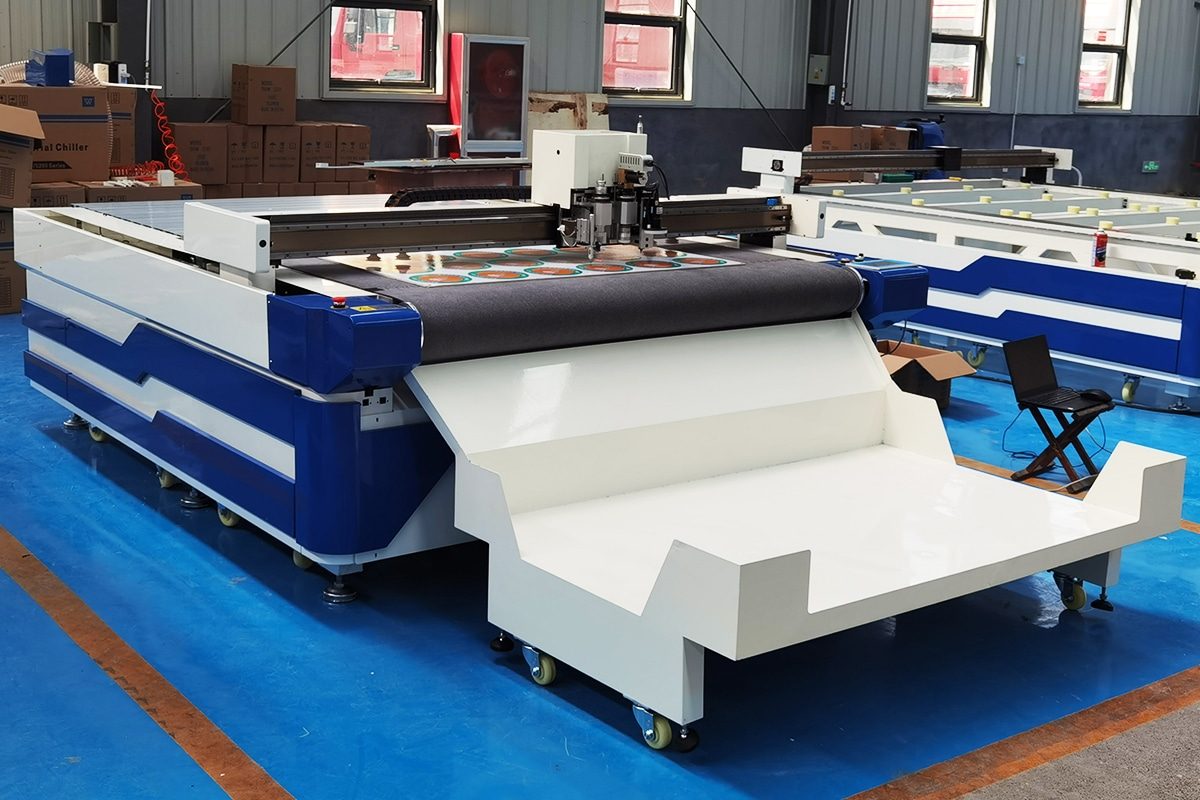
Can Oscillating Knife Cutting Machines Reduce Material Waste
In modern manufacturing, reducing material waste has become a major priority for companies seeking to improve profitability, production efficiency, and environmental sustainability. Industries such as textiles, packaging, composites, automotive interiors, leather processing, foam fabrication, and technical fabrics all face increasing pressure to optimize material utilization while maintaining high cutting precision and production speed. Traditional cutting methods, including manual cutting, rotary blades, laser systems, and die cutting, often generate unnecessary scrap due to inaccurate cuts, thermal deformation, excessive kerf width, or limitations when processing complex shapes and delicate materials. As a result, manufacturers are increasingly exploring advanced cutting technologies that can improve accuracy while minimizing waste.
Among these technologies, oscillating knife cutting machines have attracted significant attention. These machines use rapidly vibrating blades to cut materials with high precision and controlled force, making them suitable for both soft and semi-rigid materials. Unlike laser cutting systems, oscillating knives do not rely on heat, which helps prevent material burning, melting, discoloration, or deformation. At the same time, their computer-controlled cutting paths enable highly accurate nesting and contour cutting, allowing manufacturers to maximize material usage and reduce offcuts.
The potential of oscillating knife technology extends beyond simple cutting efficiency. By improving dimensional accuracy, reducing operator error, and enabling automated production workflows, these machines may contribute to lower overall production waste throughout the manufacturing process. Furthermore, the growing adoption of digital manufacturing and CNC-based automation has made oscillating knife systems increasingly attractive for customized, small-batch, and high-mix production environments where material optimization is especially important.
This article examines whether oscillating knife cutting machines can effectively reduce material waste. It explores the operating principles of the technology, compares it with conventional cutting methods, and analyzes its advantages, limitations, and practical applications across different industries.
Table of Contents
Understanding Material Waste in Manufacturing
Material waste is a critical issue in modern manufacturing because it directly affects production cost, operational efficiency, product quality, and environmental sustainability. In industries such as textiles, leather processing, packaging, foam fabrication, automotive interiors, composites, and advertising materials, manufacturers consume large amounts of raw materials every day. Even a small percentage of wasted material can result in significant financial losses over time. As competition increases and sustainability regulations become stricter, reducing waste has become a major objective for manufacturers worldwide.
Material waste does not originate from a single source. Instead, it occurs throughout the entire production cycle, from material preparation and machine setup to cutting, handling, storage, and final inspection. Some waste is visible in the form of leftover scraps, while other forms are less obvious, such as damaged materials, rejected products, or obsolete inventory. Understanding the different categories of manufacturing waste is essential when evaluating whether advanced technologies like oscillating knife cutting machines can improve material utilization and production efficiency.
Cutting Waste
Cutting waste is the most direct and measurable form of material loss in manufacturing. It refers to the unused material remaining after parts are cut from sheets, rolls, or panels. This waste is commonly generated due to inefficient nesting layouts, excessive spacing between parts, inaccurate cutting paths, or limitations in machine precision.
Traditional cutting methods often struggle to maximize material usage when processing irregular shapes or customized designs. For example, manual cutting may require operators to leave larger gaps between patterns to avoid cutting errors, which increases scrap generation. Similarly, rotary blade systems and die-cutting equipment may have limited flexibility when dealing with complex geometries, leading to inefficient material utilization.
Another important factor is kerf width, which refers to the amount of material removed during the cutting process. Cutting technologies with wider kerf widths naturally generate more waste because more material is consumed along the cut line. Over time, these small losses accumulate into substantial material costs, especially when working with expensive materials such as carbon fiber composites, technical textiles, or genuine leather.
In addition to raw material loss, excessive cutting waste also creates disposal and recycling challenges. Manufacturers may need to invest additional labor and resources to collect, sort, transport, or recycle scrap materials, further increasing operational costs.
Setup Waste
The setup waste occurs before actual production begins. During machine calibration, material alignment, tool adjustment, and test cutting, manufacturers often consume raw materials that cannot be used in final products. This type of waste is especially common in facilities that frequently switch between product types, material thicknesses, or custom orders.
Operators may need to perform multiple trial cuts to verify cutting depth, blade pressure, speed settings, or registration accuracy. If machine settings are inaccurate, additional test materials may be required until the desired cutting quality is achieved. In some industries, setup waste becomes a recurring daily issue due to short production runs and high product variation.
Older or manually operated cutting systems usually generate more setup waste because adjustments depend heavily on operator experience and repeated testing. In contrast, digitally controlled CNC systems can reduce setup waste by storing predefined cutting parameters and automatically adjusting machine settings for different materials.
Setting up waste also contributes to production downtime. The longer machines remain idle during calibration, the lower the overall manufacturing efficiency becomes. As a result, reducing setup waste is important not only for material savings but also for improving productivity and throughput.
Production Errors
Production errors are another major source of material waste in manufacturing environments. These errors occur when finished parts fail to meet design specifications or quality standards, making them unusable for final assembly or customer delivery.
Common production errors include incorrect dimensions, incomplete cuts, rough edges, distorted shapes, inaccurate pattern placement, and material tearing. These problems may result from poor machine calibration, software inaccuracies, unstable material feeding, excessive vibration, or operator mistakes.
Human error remains a significant factor in many traditional cutting operations. Incorrect measurements, misaligned templates, or improper handling during cutting can quickly lead to defective products and wasted materials. In high-volume manufacturing environments, even a small defect rate can translate into large amounts of scrap over time.
Production errors also create indirect waste. Defective components may interrupt downstream assembly operations, increase inspection workloads, and require rework or additional labor. In some cases, manufacturers must restart entire production batches due to a single cutting error, leading to further material consumption and production delays.
To reduce production-related waste, many manufacturers are adopting automated cutting systems with digital controls, vision alignment systems, and precision motion technology to improve repeatability and accuracy.
Thermal Damage Waste
Thermal damage waste is commonly associated with heat-based cutting technologies such as laser cutting, plasma cutting, and hot-wire cutting. These processes rely on high temperatures to separate materials, but the generated heat can negatively affect material quality.
Heat-sensitive materials such as foam, textiles, synthetic fabrics, plastics, rubber, and coated materials are particularly vulnerable to thermal damage. During cutting, excessive heat may cause burning, melting, edge hardening, discoloration, warping, or deformation. In some cases, the heat-affected zone around the cutting edge becomes unusable, effectively increasing the amount of wasted material.
Thermal distortion can also reduce dimensional accuracy, making parts unsuitable for assembly or quality requirements. For example, melted edges on synthetic fabrics may weaken product performance, while burned composite materials may lose structural integrity.
Manufacturers working with decorative, technical, or precision-engineered materials often face additional challenges because thermal damage may affect both appearance and functionality. As a result, avoiding heat-related waste is essential in industries that require clean edges and high material integrity.
Handling Waste
Handling waste refers to material losses caused by improper transportation, loading, unloading, storage, or positioning during production. Many manufacturing materials are sensitive to physical stress and can easily become damaged before cutting even begins.
Flexible materials such as leather, fabric, foam, vinyl, and thin plastics are especially vulnerable to wrinkles, stretching, tearing, contamination, and surface scratches during manual handling. Heavy or oversized materials may also become bent or deformed if moved incorrectly.
Poor material handling practices can lead to inaccurate positioning on the cutting table, which increases cutting errors and material waste. In some cases, operators may accidentally damage materials while lifting, stacking, or transferring them between workstations.
Environmental conditions also contribute to handling waste. Excessive humidity, dust, temperature fluctuations, or improper storage methods may cause materials to deteriorate over time. For example, moisture can affect cardboard strength, while heat exposure may deform plastic sheets.
To minimize handling waste, manufacturers increasingly implement automated feeding systems, conveyor-assisted transport, vacuum positioning systems, and organized storage solutions that reduce direct human contact with materials.
Inventory Waste
Inventory waste occurs when raw materials become obsolete, damaged, expired, or unnecessary before they are used in production. This type of waste is often linked to inaccurate forecasting, inefficient production planning, or excessive purchasing practices.
Manufacturers sometimes purchase surplus materials to compensate for expected cutting waste, production defects, or supply chain uncertainty. However, excess inventory increases storage costs and raises the risk of material deterioration over time. Materials that remain unused for extended periods may lose quality, become outdated, or no longer match changing product specifications.
Industries with rapidly changing consumer trends or seasonal demand patterns are especially vulnerable to inventory waste. For example, outdated fabric colors, discontinued product designs, or obsolete packaging materials may no longer have commercial value.
Inventory waste also ties up financial resources because companies invest capital in materials that may never be used efficiently. Improving cutting accuracy and material utilization can help manufacturers estimate material requirements more precisely, reducing the need for excessive stock and improving inventory control.
Material waste in manufacturing is a complex issue that extends far beyond leftover cutting scraps. Waste can occur during nearly every stage of production, including machine setup, cutting operations, product handling, quality control, and inventory management. Each category of waste contributes to higher operating costs, lower productivity, and increased environmental impact.
Among the different forms of waste, cutting waste and production errors are often the most visible, but hidden losses such as thermal damage, handling problems, and inventory inefficiencies can be equally costly over time. Manufacturers that fail to control these waste sources may experience reduced profitability, inconsistent product quality, and higher material consumption.
As industries continue moving toward automation and sustainable manufacturing practices, advanced cutting technologies are becoming increasingly important. Technologies that improve precision, reduce manual intervention, minimize material damage, and optimize production workflows have the potential to significantly reduce waste across multiple stages of manufacturing. This is one of the key reasons why oscillating knife cutting machines are receiving growing attention as a possible solution for improving material efficiency and reducing overall manufacturing waste.
What Are Oscillating Knife Cutting Machines
Oscillating knife cutting machines are advanced digital cutting systems designed to process a wide range of flexible and semi-rigid materials with high precision and efficiency. These machines are widely used in industries such as textiles, packaging, automotive interiors, leather processing, composites, foam fabrication, signage, and technical fabrics. Unlike traditional cutting systems that rely on static blades, dies, or heat-based technologies, oscillating knife machines use rapidly vibrating blades controlled by a computerized motion system to achieve clean and accurate cuts.
One of the main advantages of oscillating knife cutting technology is its ability to cut materials without generating excessive heat. This makes it especially suitable for heat-sensitive materials that may deform, melt, or burn during laser or plasma cutting processes. In addition, oscillating knife systems are highly adaptable and can process different material types, thicknesses, and shapes with minimal setup changes. Their integration with digital design software and CNC automation also allows manufacturers to improve production consistency, reduce manual labor, and optimize material usage.
As manufacturing increasingly moves toward customized production, short production runs, and automated workflows, oscillating knife cutting machines have become an important solution for companies seeking both flexibility and precision.
Working Principle
The working principle of an oscillating knife cutting machine is based on high-speed blade vibration combined with computer-controlled movement. During operation, the knife blade rapidly moves up and down at high frequencies while the CNC system guides the cutting head along a programmed path. This oscillating motion reduces cutting resistance and allows the blade to penetrate materials more efficiently than a stationary knife.
The machine follows digital cutting patterns generated from CAD/CAM software, ensuring accurate reproduction of shapes and dimensions. Depending on the material and application, operators can adjust parameters such as oscillation frequency, cutting speed, blade depth, and tool pressure to achieve optimal cutting performance.
Unlike laser cutting systems, oscillating knives use mechanical force rather than thermal energy. As a result, the cutting process produces clean edges without burning, melting, or heat distortion. This makes the technology particularly effective for materials such as foam, textiles, leather, corrugated cardboard, rubber, gasket materials, and composite fabrics.
The oscillating motion also improves cutting stability when processing thick or layered materials. Instead of dragging through the material continuously, the vibrating blade performs repeated micro-cutting actions, which help reduce material deformation and improve edge quality.
Main Components
Cutting Table
The cutting table forms the foundation of the machine and provides a stable working surface for material processing. Most oscillating knife cutting machines use flatbed cutting tables designed to support large sheets or rolls of material during operation.
The table surface is typically divided into vacuum zones that help hold materials firmly in place while cutting takes place. A stable and properly aligned cutting table is essential for maintaining dimensional accuracy and preventing material shifting during production.
Some advanced systems also include conveyorized cutting tables that allow continuous material feeding for high-volume production environments. These conveyor systems improve automation and reduce manual handling requirements.
Oscillating Knife Tool
The oscillating knife tool is the core cutting component of the machine. It contains a motor-driven blade that vibrates at high speed during operation. Different blade types are available depending on the material being processed, including straight blades, angled blades, drag knives, and specialized cutting tools.
The oscillating action enables the blade to cut efficiently through soft and semi-rigid materials while minimizing cutting force and material distortion. Blade selection is critical because different materials require different cutting geometries and sharpness levels.
For example, foam materials may require long blades with deeper cutting capability, while delicate fabrics may need finer blades to prevent fraying or tearing. Regular blade maintenance and replacement are also important for maintaining cutting quality and minimizing material waste.
CNC Motion System
The CNC (Computer Numerical Control) motion system controls the movement of the cutting head across the X, Y, and sometimes Z axes. This system ensures that the cutting tool follows the exact digital path defined in the cutting program.
Servo motors, linear guides, and precision drive mechanisms work together to provide smooth and accurate motion control. High-quality CNC systems are capable of producing highly complex shapes with excellent repeatability, even during high-speed operation.
The CNC motion system also enables automated production by reducing dependence on manual operation. Operators can load digital cutting files directly into the machine, allowing consistent production across multiple batches with minimal human intervention.
Advanced motion systems may include automatic material alignment, vision positioning systems, and real-time error correction features to further improve cutting precision.
Vacuum System
The vacuum system plays a critical role in maintaining material stability during the cutting process. Vacuum pumps create suction beneath the cutting table, securely holding materials in place while the knife moves across the surface.
Proper vacuum holding prevents shifting, lifting, wrinkling, or deformation of materials during cutting. This is especially important when processing lightweight, flexible, or thin materials such as fabrics, foam, leather, and vinyl.
A strong and evenly distributed vacuum system improves cutting accuracy and helps reduce errors caused by material movement. Some machines include independently controlled vacuum zones, allowing operators to activate suction only in the areas being used, which improves energy efficiency.
In automated production environments, vacuum systems also help reduce manual repositioning and improve overall workflow efficiency.
CAD/CAM Software
CAD/CAM software is the digital control center of the oscillating knife cutting process. CAD (Computer-Aided Design) software is used to create product designs and cutting patterns, while CAM (Computer-Aided Manufacturing) software converts those designs into machine instructions.
The software allows operators to optimize cutting layouts through nesting functions, which arrange parts as closely as possible to reduce material waste. Advanced nesting algorithms are especially valuable when working with expensive materials because they maximize material utilization.
CAD/CAM software also enables quick design modifications, automated scaling, and efficient handling of customized production orders. Digital workflows reduce the need for physical templates and manual measurements, improving both accuracy and production flexibility.
Many modern systems support integration with ERP systems, barcode tracking, and cloud-based production management platforms for enhanced automation and data control.
Tool Changer (Optional)
Some advanced oscillating knife cutting machines are equipped with automatic tool changers that allow the machine to switch between different tools without manual intervention. This feature increases production flexibility and reduces downtime during multi-process operations.
In addition to oscillating knives, machines may use creasing tools, routing tools, marking pens, perforation tools, or kiss-cutting blades, depending on the application. The automatic tool changer selects the appropriate tool based on the programmed cutting sequence.
This capability is especially useful in industries such as packaging and signage, where multiple operations may need to be completed on the same material sheet. By automating tool changes, manufacturers can improve production efficiency, reduce operator workload, and maintain consistent processing quality.
Oscillating knife cutting machines are highly advanced digital cutting systems designed to provide precise, flexible, and efficient material processing across a wide range of industries. Their working principle combines high-frequency blade oscillation with CNC-controlled motion, allowing them to cut materials accurately without generating the heat associated with laser or plasma cutting technologies.
The performance of these machines depends on several key components, including the cutting table, oscillating knife tool, CNC motion system, vacuum system, CAD/CAM software, and optional automatic tool changers. Each component contributes to cutting precision, production efficiency, workflow automation, and material stability during operation.
Because oscillating knife cutting machines can process complex shapes with minimal thermal damage and high dimensional accuracy, they are increasingly viewed as an effective solution for reducing material waste in modern manufacturing. Their ability to integrate digital design, automated motion control, and optimized nesting functions makes them especially valuable in industries focused on sustainability, customization, and efficient material utilization.
Materials Suitable for Oscillating Knife Cutting
One of the biggest advantages of oscillating knife cutting machines is their ability to process a wide variety of materials with high precision and minimal damage. Unlike heat-based cutting technologies, oscillating knife systems use mechanical blade vibration to separate materials, which allows them to cut sensitive, flexible, and layered materials without burning, melting, or deforming the edges. This versatility makes oscillating knife cutting machines highly valuable across industries such as textiles, packaging, automotive manufacturing, aerospace, advertising, furniture production, and composite fabrication.
The suitability of a material for oscillating knife cutting depends on several factors, including thickness, density, flexibility, surface finish, and internal structure. In general, oscillating knife machines perform best with soft to semi-rigid materials that require clean edges, accurate contours, and low thermal impact. Their ability to switch between different blade types and cutting parameters also allows manufacturers to handle multiple material categories on a single machine, improving production flexibility and reducing setup time.
Textiles and Fabrics
Textiles are among the most common materials processed by oscillating knife cutting machines. These include natural fabrics such as cotton, wool, silk, and linen, as well as synthetic materials like polyester, nylon, spandex, and acrylic fabrics.
Traditional cutting methods may cause fabric fraying, stretching, or distortion, especially when working with delicate or elastic materials. Oscillating knife technology reduces these issues by applying controlled mechanical cutting action with minimal pulling force. This allows manufacturers to achieve clean edges and precise dimensions even on lightweight or flexible fabrics.
The technology is widely used in industries such as garment manufacturing, upholstery production, sportswear, industrial textiles, and automotive interiors. Multi-layer fabric cutting is also possible, allowing manufacturers to improve production efficiency while maintaining accuracy.
For patterned or printed textiles, oscillating knife systems can integrate with camera positioning systems to ensure accurate contour cutting and pattern alignment.
Leather and Synthetic Leather
Leather processing requires extremely accurate cutting because leather is both expensive and naturally inconsistent in texture and thickness. Oscillating knife cutting machines are well-suited for genuine leather, PU leather, PVC leather, suede, and other synthetic leather materials.
The vibrating blade reduces cutting resistance and helps produce smooth edges without burning or discoloration. Unlike laser cutting, which may leave darkened edges or unpleasant odors, oscillating knife cutting preserves the natural appearance and quality of the leather surface.
In industries such as footwear, automotive seating, furniture upholstery, handbags, and fashion accessories, oscillating knife systems help manufacturers optimize nesting layouts to maximize material utilization. Since leather often contains imperfections or irregular shapes, digital nesting software can significantly reduce material waste during production.
Foam Materials
Oscillating knife cutting machines are widely used for cutting soft and semi-rigid foam materials. These include polyurethane foam, EVA foam, PE foam, acoustic foam, sponge materials, insulation foam, and packaging foam.
Foam materials can be difficult to cut accurately using conventional blades because they compress easily during processing. The oscillating motion of the knife reduces pressure on the material and allows smoother penetration through thick foam layers.
The technology is especially useful for producing custom foam inserts, protective packaging, cushioning components, mattresses, automotive insulation, and soundproofing products. Because no heat is generated during cutting, foam edges remain clean without melting or hardening.
For thick foam applications, longer oscillating blades can be used to achieve deep and accurate cuts while maintaining edge quality.
Corrugated Cardboard and Packaging Materials
Packaging manufacturers frequently use oscillating knife cutting machines for processing corrugated cardboard, paperboard, honeycomb board, chipboard, and other packaging materials.
The technology supports both prototyping and mass customization of packaging designs. Manufacturers can quickly create boxes, displays, protective inserts, and custom packaging solutions without the need for expensive physical dies.
Oscillating knife cutting is particularly valuable in short-run and customized packaging production because digital cutting files can be modified easily without changing the tooling equipment. This flexibility helps companies reduce setup costs and minimize inventory waste associated with traditional die-cutting methods.
In addition to cutting, some machines also support creasing, perforating, and marking functions, allowing multiple packaging operations to be completed on a single platform.
Composite Materials
Composite materials are increasingly used in industries such as aerospace, automotive, marine manufacturing, wind energy, and sports equipment. Oscillating knife cutting machines are suitable for many composite materials, including carbon fiber prepreg, fiberglass fabrics, aramid fibers, and other reinforced composite sheets.
These materials often require precise cutting to maintain structural integrity and reduce waste. The oscillating blade minimizes fiber distortion and helps produce accurate contours without generating excessive dust or thermal damage.
For prepreg materials, which contain resin coatings sensitive to heat, non-thermal cutting is especially important. Oscillating knife systems help preserve material properties while maintaining dimensional accuracy.
Because composite materials are expensive, efficient nesting and precise cutting are critical for controlling manufacturing costs. Advanced CAD/CAM software integrated with oscillating knife machines can optimize part placement and significantly improve material utilization.
Rubber and Gasket Materials
Rubber sheets and gasket materials are commonly processed using oscillating knife cutting technology. These materials include silicone rubber, neoprene, nitrile rubber, EPDM, cork-rubber composites, and sealing materials used in industrial applications.
Rubber materials can be difficult to cut cleanly because they are flexible and resistant to deformation. The rapid blade oscillation improves cutting stability and reduces edge tearing or stretching.
Oscillating knife machines are widely used in industries that manufacture seals, gaskets, insulation components, vibration-damping materials, and industrial pads. The high precision of CNC-controlled cutting systems also supports the production of complex gasket geometries with tight tolerances.
Vinyl, PVC, and Advertising Materials
The advertising and signage industries rely heavily on oscillating knife cutting machines for processing vinyl films, PVC sheets, banner materials, adhesive graphics, reflective films, and display boards.
The machines can accurately cut letters, logos, decals, and custom graphic shapes with smooth edges and consistent quality. Since many advertising materials are sensitive to heat, oscillating knife cutting prevents edge melting and discoloration that may occur with laser cutting systems.
In addition to flat cutting, some machines support kiss-cutting applications, where only the top material layer is cut while the backing layer remains intact. This feature is particularly useful for sticker and label production.
Technical and Industrial Fabrics
Technical fabrics used in industrial applications often require highly accurate and repeatable cutting processes. These materials include fiberglass fabrics, filter materials, tarpaulins, ballistic fabrics, conveyor belts, insulation textiles, and coated industrial fabrics.
Oscillating knife cutting machines can process these materials efficiently while maintaining edge quality and dimensional consistency. Their ability to handle thick, layered, or reinforced fabrics makes them suitable for demanding industrial production environments.
Many technical fabrics are difficult to process using conventional cutting methods because they may fray, deform, or generate hazardous fumes under heat. Oscillating knife technology helps avoid these problems while supporting automated production workflows.
Oscillating knife cutting machines are highly versatile systems capable of processing a broad range of flexible and semi-rigid materials. Their non-thermal cutting method makes them particularly suitable for heat-sensitive materials that require clean edges, dimensional accuracy, and minimal deformation during processing.
From textiles and leather to foam, composites, rubber, packaging materials, and technical fabrics, oscillating knife technology offers manufacturers a flexible solution for handling diverse production requirements. The ability to combine precision cutting with digital automation and optimized nesting also helps improve material utilization and reduce manufacturing waste.
As industries continue adopting customized production, lightweight materials, and sustainable manufacturing practices, the demand for versatile cutting systems is increasing. Oscillating knife cutting machines are becoming an important tool for manufacturers seeking to improve production flexibility, maintain product quality, and minimize material loss across different applications.
How Oscillating Knife Cutting Machines Reduce Material Waste
Reducing material waste has become a major priority in modern manufacturing as companies seek to lower production costs, improve operational efficiency, and meet sustainability goals. In industries that process expensive or high-volume materials, even small improvements in material utilization can produce significant financial savings over time. Traditional cutting methods often generate waste due to inaccurate cuts, thermal damage, production errors, inefficient layouts, and inconsistent handling. As manufacturers move toward automated and digitally controlled production systems, oscillating knife cutting machines are increasingly recognized as an effective solution for minimizing these losses.
Oscillating knife cutting technology combines high-speed blade vibration with CNC automation and digital workflow integration to improve cutting precision and production consistency. Unlike conventional cutting systems that may rely heavily on manual operation or heat-based processing, oscillating knife machines provide accurate, repeatable, and non-thermal cutting performance across a wide range of materials. Their ability to optimize material usage, reduce defects, and improve workflow efficiency makes them especially valuable in industries such as textiles, packaging, composites, leather processing, automotive interiors, and industrial fabrics.
The following sections explain the key ways oscillating knife cutting machines help reduce material waste in manufacturing environments.
Precision Cutting Reduces Scrap
One of the most important ways oscillating knife cutting machines reduce waste is through highly precise cutting performance. The CNC-controlled motion system guides the oscillating blade along exact digital cutting paths, ensuring accurate dimensions and clean contours.
Traditional manual cutting methods often produce inconsistencies caused by operator fatigue, inaccurate measurements, or uneven blade control. These mistakes can lead to unusable parts, excessive trimming, and increased scrap rates. In contrast, oscillating knife systems maintain consistent accuracy across repeated production cycles.
The high-frequency oscillating motion also reduces cutting resistance, allowing smoother cutting through soft and semi-rigid materials without excessive deformation. This precision enables manufacturers to position cut parts closer together while maintaining clean separation between components, which directly improves material utilization.
For industries working with expensive materials such as carbon fiber composites, leather, or technical fabrics, reducing scrap through precision cutting can generate substantial cost savings.
Advanced Nesting Software Maximizes Material Utilization
Modern oscillating knife cutting machines are typically integrated with advanced CAD/CAM nesting software that automatically arranges cutting patterns to maximize material usage.
Nesting software analyzes the size, shape, and orientation of parts and places them as closely as possible within the available material area. By minimizing empty spaces between parts, manufacturers can significantly reduce leftover scrap material.
This capability is particularly valuable when processing irregularly shaped products or natural materials such as leather, where efficient layout planning is essential. Some advanced systems can even identify material defects and avoid damaged areas automatically during nesting.
Manual layout planning is often time-consuming and less efficient because operators may not achieve the optimal arrangement of parts. Automated nesting algorithms improve both speed and accuracy while reducing dependence on operator experience.
Over large production volumes, even small improvements in nesting efficiency can lead to major reductions in raw material consumption.
Clean Cutting Eliminates Thermal Damage
Unlike laser cutting or plasma cutting systems, oscillating knife cutting machines use mechanical blade motion instead of heat to process materials. This non-thermal cutting method eliminates many forms of material damage associated with high-temperature cutting technologies.
Heat-based cutting processes can cause burning, melting, discoloration, edge hardening, or deformation, especially when working with sensitive materials such as foam, textiles, vinyl, rubber, or coated fabrics. In many cases, the heat-affected zone surrounding the cut edge becomes unusable, increasing material waste.
Oscillating knife cutting avoids these problems by producing clean and smooth edges without generating excessive heat. This helps preserve the original material properties, appearance, and structural integrity of the product.
For manufacturers working with decorative materials, technical fabrics, or composite materials, eliminating thermal damage is critical for maintaining product quality and reducing rejection rates.
Vacuum Hold-Down Prevents Material Movement
Material movement during cutting is a common cause of dimensional inaccuracies and production errors. Oscillating knife cutting machines address this issue through integrated vacuum hold-down systems that secure materials firmly to the cutting table.
The vacuum system creates suction beneath the material surface, preventing shifting, lifting, wrinkling, or stretching during operation. This is especially important for lightweight and flexible materials such as fabrics, foam, leather, and vinyl.
Without proper material stabilization, even slight movement can result in inaccurate cuts, wasted material, and defective products. Vacuum hold-down systems improve cutting consistency and allow the machine to maintain precise alignment throughout the cutting process.
Stable material positioning also reduces the need for repeated adjustments or recutting, which further minimizes material waste and improves production efficiency.
Reduced Human Error
Human error is one of the leading causes of waste in traditional manufacturing environments. Mistakes such as incorrect measurements, improper alignment, inconsistent cutting pressure, or inaccurate template placement can quickly produce defective parts and unnecessary scrap.
Oscillating knife cutting machines reduce these risks by automating much of the cutting process. Once digital cutting files and machine parameters are programmed into the system, the machine can reproduce identical cutting results with minimal operator intervention.
Automation improves consistency across production batches and reduces variability caused by manual operation. Operators no longer need to guide cutting paths by hand, which lowers the risk of dimensional inaccuracies and cutting defects.
In addition, digital systems simplify production setup and reduce the likelihood of setup-related mistakes, especially in high-mix or customized manufacturing environments.
Multi-Layer Cutting Improves Efficiency
Many oscillating knife cutting machines are capable of cutting multiple material layers simultaneously. This capability improves production efficiency while reducing overall material handling and setup requirements.
Instead of cutting each layer individually, manufacturers can stack several layers together and process them in a single operation. This reduces machine downtime, lowers labor requirements, and improves production throughput.
Multi-layer cutting also helps maintain consistency between parts because all layers are cut using the same programmed path. Uniformity reduces the likelihood of mismatched dimensions and rejected components.
For industries such as textile manufacturing, foam processing, and gasket production, multi-layer cutting significantly improves operational efficiency while minimizing handling-related waste.
Better Edge Quality Reduces Rejection Rates
Edge quality plays a critical role in determining whether finished parts meet production standards. Poor edge quality may lead to fraying, tearing, rough surfaces, deformation, or incomplete cuts, all of which can result in rejected products.
The oscillating motion of the knife allows smoother and cleaner penetration through materials, producing high-quality edges with minimal distortion. Because the cutting force is distributed through rapid vibration, materials experience less stress during processing.
Improved edge quality reduces the need for secondary finishing operations such as trimming or sanding, which can generate additional waste and labor costs. It also increases the likelihood that finished parts will pass quality inspections on the first attempt.
In industries where appearance and precision are critical, such as automotive interiors, upholstery, packaging, and signage, consistent edge quality is essential for reducing production losses.
Digital Workflow Integration Minimizes Mistakes
Oscillating knife cutting machines are often integrated into fully digital manufacturing workflows that connect design, nesting, production planning, and machine operation.
CAD/CAM software allows manufacturers to create digital cutting patterns, modify designs quickly, and transfer production data directly to the cutting machine. This eliminates many manual steps that traditionally introduce errors into the production process.
Digital workflows improve communication between design teams and production operators, reducing the risk of incorrect dimensions, outdated templates, or misinterpreted specifications. Automated file handling also helps ensure that the correct production parameters are used consistently across different jobs.
Some advanced systems integrate with ERP platforms, barcode systems, and production management software, enabling real-time tracking and process optimization. These integrated workflows reduce administrative errors, improve traceability, and minimize unnecessary material consumption caused by production mistakes.
Oscillating knife cutting machines reduce material waste through a combination of precision cutting, digital automation, stable material handling, and advanced software integration. Their CNC-controlled operation improves dimensional accuracy and reduces scrap generated by inconsistent manual cutting processes. At the same time, advanced nesting software helps manufacturers maximize material utilization by arranging parts more efficiently within available material areas.
The non-thermal cutting process also eliminates many forms of heat-related damage commonly associated with laser or plasma cutting technologies. Features such as vacuum hold-down systems, multi-layer cutting capability, and automated digital workflows further reduce production errors, material movement, and handling-related losses.
By improving edge quality, minimizing rejected parts, and reducing dependence on manual operation, oscillating knife cutting machines help manufacturers achieve more efficient and sustainable production processes. As industries continue prioritizing cost control and environmental responsibility, these machines are becoming an increasingly important solution for reducing material waste across a wide range of manufacturing applications.
Industry Examples of Waste Reduction
Material waste affects nearly every manufacturing industry, but the causes and consequences of waste vary depending on the materials, production methods, and product requirements involved. Industries that rely heavily on cutting operations often experience significant losses due to scrap generation, inaccurate cutting, thermal damage, setup inefficiencies, and rejected products. As manufacturers seek to improve sustainability and reduce production costs, many are turning to oscillating knife cutting machines as a practical solution for improving material utilization.
The ability of oscillating knife systems to deliver precise, non-thermal, and digitally controlled cutting makes them suitable for a wide range of industries. Their flexibility allows manufacturers to process complex shapes, optimize nesting layouts, and maintain high production consistency while reducing waste throughout the manufacturing process. In many cases, the adoption of oscillating knife technology not only lowers raw material consumption but also improves workflow efficiency, product quality, and operational reliability.
The following examples demonstrate how different industries use oscillating knife cutting machines to reduce material waste and improve manufacturing efficiency.
Textile Industry
The textile industry is one of the largest users of oscillating knife cutting technology because fabric cutting plays a critical role in garment production, upholstery manufacturing, technical textiles, and automotive fabrics. Textile manufacturers often process large quantities of material daily, making even small reductions in waste highly valuable.
Traditional manual cutting methods can lead to uneven edges, inaccurate dimensions, and excessive spacing between pattern pieces. Human error during marker placement and fabric alignment also increases scrap generation. Oscillating knife cutting machines reduce these issues through CNC-controlled precision cutting and automated nesting software.
Advanced nesting systems arrange garment patterns closely together to maximize fabric usage while minimizing leftover material. Because the oscillating blade produces clean cuts with minimal fabric distortion, manufacturers can maintain tight spacing between components without risking cutting overlap or damage.
Another important advantage is the ability to cut multiple fabric layers simultaneously. Multi-layer cutting improves production efficiency and ensures consistent dimensions across all layers, reducing the likelihood of defective parts and rejected products.
In industries such as sportswear, fashion apparel, furniture upholstery, and industrial textiles, reducing fabric waste directly lowers production costs and supports more sustainable manufacturing practices.
Leather Processing
Leather is one of the most expensive materials used in manufacturing, making waste reduction especially important in leather processing industries. Manufacturers producing footwear, automotive seating, handbags, furniture upholstery, and fashion accessories must carefully optimize material utilization to maintain profitability.
Unlike synthetic materials, natural leather contains irregular shapes, scars, wrinkles, and surface imperfections that complicate the cutting process. Traditional manual cutting methods often result in inconsistent layouts and excessive scrap because operators must work around defective areas by hand.
Oscillating knife cutting machines improve efficiency by combining digital pattern placement with precision cutting. Advanced software can analyze leather surfaces, identify defects, and optimize nesting layouts to maximize usable material area. This significantly reduces unnecessary waste while maintaining product quality standards.
The non-thermal cutting process also preserves the appearance and texture of the leather. Unlike laser cutting, which may cause darkened edges or burn marks, oscillating knife cutting produces clean edges without thermal discoloration.
Because leather materials are expensive and difficult to replace, even small improvements in nesting efficiency and cutting precision can lead to substantial cost savings over time.
Packaging Industry
The packaging industry increasingly relies on oscillating knife cutting machines for producing corrugated boxes, display packaging, protective inserts, folding cartons, and custom packaging prototypes. Waste reduction is especially important in this industry because packaging manufacturers often process large volumes of cardboard, paperboard, foam, and corrugated materials.
Traditional die-cutting systems are effective for mass production but can generate considerable setup waste during tooling preparation and test runs. They also lack flexibility when producing customized or short-run packaging designs.
Oscillating knife cutting machines eliminate the need for physical dies by using digital cutting files instead. This significantly reduces setup material waste and allows manufacturers to switch quickly between different packaging designs without additional tooling costs.
Advanced CAD/CAM nesting software also helps optimize sheet usage by arranging packaging components more efficiently on the material surface. As a result, manufacturers can reduce scrap generation while maintaining fast production turnaround times.
Many packaging manufacturers also use oscillating knife systems for prototyping because design modifications can be implemented immediately without producing new dies. This reduces both material waste and product development costs.
Automotive Interiors
Automotive interior manufacturing requires highly accurate cutting of materials such as leather, textiles, foam, insulation materials, carpets, and composite fabrics. Since automotive production involves strict quality standards and high material consumption, reducing waste is a major priority for manufacturers and suppliers.
Oscillating knife cutting machines are widely used to produce seat covers, headliners, floor mats, door panels, insulation components, and interior trim materials. Their high cutting precision helps ensure consistent part dimensions and proper assembly fit.
Vacuum hold-down systems prevent material movement during cutting, reducing errors caused by shifting or stretching. This is particularly important when processing soft interior materials that are easily deformed.
The non-thermal cutting method also helps preserve the appearance and structural integrity of decorative and functional automotive materials. Heat-sensitive fabrics and foam materials can be cut cleanly without burning, melting, or edge hardening.
Automotive manufacturers often process large production volumes, so reducing scrap rates and rejected components can produce major long-term cost savings. Automated digital workflows further improve production consistency and reduce operator-related mistakes.
Composite Materials
Composite materials are widely used in aerospace, automotive, marine, renewable energy, and sporting goods industries because of their high strength-to-weight ratio. However, composite materials such as carbon fiber, fiberglass, and aramid fabrics are expensive and require precise cutting to avoid unnecessary waste.
Traditional cutting methods may cause fraying, fiber distortion, thermal damage, or inaccurate dimensions, especially when processing layered composite materials. Oscillating knife cutting machines reduce these problems by using controlled mechanical cutting action rather than heat-based processing.
The oscillating blade cuts composite fabrics cleanly while minimizing stress on the material structure. This improves edge quality and reduces the likelihood of rejected components caused by fiber separation or dimensional inaccuracies.
Advanced nesting software is particularly valuable in composite manufacturing because raw materials are costly. Optimized part placement helps manufacturers maximize material utilization while minimizing leftover scraps.
In industries such as aerospace and wind energy, where composite material costs are extremely high, improving cutting efficiency can significantly reduce production expenses and material waste.
Different manufacturing industries face different forms of material waste, but many of the underlying causes are related to cutting precision, inefficient layouts, production errors, and material damage. Oscillating knife cutting machines address these challenges through precise CNC-controlled cutting, advanced nesting software, stable material handling, and non-thermal processing capabilities.
In the textile industry, these machines improve fabric utilization and reduce cutting inconsistencies. In leather processing, they help manufacturers maximize the use of expensive natural materials while maintaining edge quality. Packaging manufacturers benefit from reduced setup waste and flexible digital production, while automotive interior suppliers use oscillating knife systems to improve cutting accuracy and reduce defective components. Composite material manufacturers also benefit from improved edge quality and optimized material utilization when processing high-value materials.
Across all of these industries, oscillating knife cutting machines contribute to lower scrap rates, improved production efficiency, and more sustainable manufacturing practices. Their ability to combine automation, precision, and material flexibility makes them an increasingly valuable solution for manufacturers seeking to reduce waste and improve overall operational performance.
Comparison with Other Cutting Technologies
Manufacturers today can choose from several cutting technologies depending on their production requirements, material types, product complexity, and cost considerations. Each cutting method has its own advantages and limitations in terms of precision, speed, flexibility, automation, and material utilization. Since reducing waste has become an increasingly important goal in modern manufacturing, companies must carefully evaluate which cutting technology offers the best balance between efficiency and material conservation.
Oscillating knife cutting machines are often compared with manual cutting, laser cutting, and die cutting because these are among the most commonly used cutting methods in industries such as textiles, packaging, leather processing, automotive interiors, composites, and industrial fabrication. While traditional methods remain widely used, oscillating knife technology offers several advantages that can help reduce material waste and improve production consistency.
The following sections examine how oscillating knife cutting machines compare with other major cutting technologies in terms of waste reduction, production flexibility, cutting quality, and operational efficiency.
Oscillating Knife VS Manual Cutting
Manual cutting is one of the oldest and most widely used cutting methods, particularly in small workshops, low-volume production environments, and industries that rely heavily on skilled labor. Operators typically use hand tools, scissors, rotary cutters, or manually guided blades to cut materials according to printed templates or drawn patterns.
Although manual cutting offers flexibility and low initial equipment cost, it often generates significant material waste due to inconsistent accuracy and operator-dependent performance. Human error can lead to incorrect measurements, uneven edges, poor alignment, and excessive spacing between parts. As production volume increases, maintaining consistent quality becomes even more difficult because operator fatigue and variations in skill level affect cutting precision.
Oscillating knife cutting machines significantly improve cutting consistency by replacing manual movement with CNC-controlled automation. Digital cutting files guide the blade along exact programmed paths, reducing dimensional inaccuracies and minimizing scrap generation. Since the machine can reproduce identical cuts repeatedly, manufacturers experience fewer rejected parts and lower material loss.
Another major advantage is nesting optimization. In manual cutting processes, operators may not arrange patterns efficiently, leading to unnecessary leftover material. Oscillating knife systems use advanced nesting software to maximize material utilization automatically.
Manual cutting also tends to be slower and more labor-intensive, especially for complex shapes or large production batches. Oscillating knife cutting machines improve productivity through automation and multi-layer cutting capability, allowing manufacturers to process more material with less labor while maintaining consistent quality.
However, manual cutting may remain practical for extremely small production runs, simple cutting tasks, or businesses with limited budgets. For large-scale or precision-oriented manufacturing, oscillating knife systems generally provide far greater efficiency and waste reduction benefits.
Oscillating Knife VS Laser Cutting
Laser cutting is a highly advanced technology that uses concentrated laser beams to cut or engrave materials. It is widely used in industries requiring high precision, intricate shapes, and fast processing speeds. Laser cutting is especially effective for rigid materials such as metals, acrylics, wood, and certain plastics.
Compared with manual cutting, laser cutting offers excellent automation and dimensional accuracy. However, when processing flexible or heat-sensitive materials, oscillating knife cutting machines often provide important advantages in terms of material preservation and waste reduction.
One of the main differences between the two technologies is the cutting method itself. Laser systems rely on thermal energy, while oscillating knife machines use mechanical blade motion. Because laser cutting generates high temperatures, it can cause burning, melting, discoloration, edge hardening, or deformation in materials such as foam, leather, textiles, rubber, and vinyl.
These thermal effects may increase material waste because damaged edges or heat-affected zones can become unusable. In some cases, manufacturers must leave larger cutting margins to avoid quality problems caused by heat distortion.
Oscillating knife cutting eliminates thermal damage because no heat is generated during the process. This allows manufacturers to cut heat-sensitive materials cleanly while preserving edge quality, appearance, and structural integrity.
Another important consideration is ventilation and safety. Laser cutting certain synthetic materials can produce smoke, fumes, or toxic gases that require specialized extraction systems. Oscillating knife cutting generally produces fewer hazardous emissions, making it more suitable for some indoor manufacturing environments.
Laser cutting may still offer advantages in applications requiring extremely intricate engraving, high-speed thin-sheet processing, or metal fabrication. However, for flexible materials and applications where edge quality and material preservation are critical, oscillating knife cutting often provides better waste reduction performance.
Oscillating Knife VS Die Cutting
Die cutting is a traditional industrial cutting process that uses custom-made dies to stamp or press shapes into materials. It is widely used in mass production industries such as packaging, labels, textiles, foam products, and automotive components because of its high production speed and efficiency for repetitive designs.
For long production runs involving identical shapes, die cutting can be highly productive and cost-effective. However, the technology also has several limitations that may contribute to material waste, especially in modern manufacturing environments that demand customization and flexible production.
One major disadvantage of die cutting is tooling dependency. Each product design requires a dedicated physical die, and creating or modifying dies can be expensive and time-consuming. During setup and testing, manufacturers often waste materials while adjusting die alignment and cutting pressure.
Oscillating knife cutting machines eliminate the need for physical dies because all cutting operations are controlled digitally. Design changes can be implemented instantly through CAD/CAM software without additional tooling costs or lengthy setup procedures. This greatly reduces setup waste and improves production flexibility.
Die cutting also becomes less efficient for short production runs or customized products because the cost and time required to produce new dies may outweigh production benefits. Oscillating knife systems are much more adaptable in these situations because they can switch between designs quickly using digital files.
In terms of material utilization, oscillating knife cutting machines often provide superior nesting optimization compared with traditional die layouts. Advanced software can position parts more closely and efficiently, reducing leftover scrap material.
Another important difference is maintenance and wear. Physical dies gradually wear down over time, which can reduce cutting quality and increase rejection rates. Oscillating knife blades also require maintenance, but replacing or adjusting blades is generally simpler and less expensive than manufacturing new dies.
Despite these advantages, die cutting may remain the preferred choice for extremely high-volume production where product designs rarely change, and tooling costs can be distributed over large quantities.
Different cutting technologies offer different advantages depending on the materials being processed, production volume, and manufacturing requirements. Manual cutting provides flexibility and low startup costs but often produces inconsistent quality and higher material waste due to human error. Laser cutting offers excellent precision and automation, but may generate thermal damage when processing heat-sensitive materials. Die cutting remains highly efficient for large-scale repetitive production but lacks flexibility and may generate setup waste associated with tooling.
Oscillating knife cutting machines combine several advantages that make them highly effective for reducing material waste in modern manufacturing environments. Their CNC-controlled precision improves cutting accuracy and reduces scrap generation, while advanced nesting software helps maximize material utilization. Unlike laser cutting, oscillating knife systems avoid thermal damage entirely, preserving material quality and minimizing rejected products.
The digital and flexible nature of oscillating knife technology also allows manufacturers to respond quickly to customized production demands without the setup limitations associated with die cutting. As industries continue moving toward automation, shorter production cycles, and sustainable manufacturing practices, oscillating knife cutting machines are becoming an increasingly valuable alternative to traditional cutting technologies for waste reduction and production efficiency.
The Role of Nesting Optimization in Waste Reduction
Nesting optimization plays a critical role in reducing material waste in modern manufacturing. In industries that process sheet, roll, or panel materials, the arrangement of parts before cutting directly affects how much raw material is consumed and how much scrap is generated. Even highly precise cutting equipment can still produce unnecessary waste if parts are not arranged efficiently. For this reason, nesting software has become one of the most important technologies integrated into oscillating knife cutting systems.
Nesting refers to the process of positioning cutting patterns within a material area to maximize utilization while minimizing unused spaces. Advanced nesting systems use computer algorithms to analyze part geometry, material dimensions, cutting direction requirements, and production constraints to determine the most efficient layout possible. By improving material usage, nesting optimization helps manufacturers lower raw material costs, reduce scrap disposal, improve production efficiency, and support sustainability goals.
For industries that process expensive materials such as leather, carbon fiber composites, technical fabrics, and specialty foams, even small improvements in nesting efficiency can generate significant financial savings over time. In addition, optimized nesting contributes to shorter production cycles and more predictable inventory management by reducing unnecessary material consumption.
Automatic Nesting Algorithms
Automatic nesting algorithms are the core technology behind modern material optimization systems. These algorithms use advanced mathematical calculations and software logic to arrange parts as closely and efficiently as possible within the available material area.
In traditional manual nesting processes, operators often position patterns by hand based on experience and visual judgment. While skilled operators may achieve acceptable results, manual nesting is time-consuming and rarely produces the highest possible material utilization. Human limitations make it difficult to calculate the most efficient arrangement for complex or irregularly shaped parts.
Automatic nesting software eliminates much of this inefficiency by rapidly evaluating thousands of possible layout combinations. The system considers factors such as part geometry, spacing requirements, cutting direction, rotation limitations, and machine constraints to determine the optimal placement of components.
Modern nesting algorithms can also prioritize different production goals depending on manufacturer requirements. Some systems focus primarily on maximizing material utilization, while others prioritize cutting speed, production order sequencing, or tool path efficiency.
Advanced software may include true-shape nesting technology, which arranges parts based on their actual contour geometry rather than simple rectangular boundaries. This allows parts with irregular shapes to fit together more tightly, significantly reducing leftover scrap areas.
Automatic nesting is especially valuable in industries producing customized products or short production runs because layouts can be generated quickly without extensive manual planning. This improves workflow efficiency while reducing setup time and operator workload.
Remnant Management
Remnant management is another important aspect of nesting optimization that helps manufacturers reduce waste and improve material utilization. Remnants are leftover material sections remaining after a cutting operation that are still large enough to be reused in future production.
In many traditional manufacturing environments, remnants are poorly tracked or discarded because managing irregular leftover pieces manually can be difficult and time-consuming. As a result, manufacturers may purchase new raw materials even when usable remnants are available, increasing both material waste and inventory costs.
Modern oscillating knife cutting systems integrated with nesting software can automatically track and manage remnant materials. The software records the dimensions, shapes, and locations of leftover material pieces after each cutting job and stores this information digitally for future use.
When new production orders are created, the nesting system can automatically evaluate whether existing remnants are suitable for the required parts before allocating fresh material. This helps maximize the use of previously unused material and reduces the amount of scrap sent to disposal or recycling.
Remnant management is particularly important when processing expensive materials such as leather, composites, specialty foams, or technical textiles. Since these materials represent a major portion of manufacturing cost, efficient reuse of remnants can significantly improve profitability.
In addition to reducing raw material consumption, remnant management also improves inventory control by providing more accurate visibility into available material resources. Manufacturers can reduce over-purchasing and optimize storage space more effectively.
Grain and Pattern Matching
Grain and pattern matching are critical considerations in many industries where material appearance, texture, or structural direction affects product quality. Materials such as wood veneers, textiles, leather, composites, and decorative laminates often contain visible grain lines, woven patterns, printed graphics, or directional properties that must be aligned correctly during cutting.
Without proper grain and pattern control, manufacturers may produce visually inconsistent products or weaken the structural performance of materials. However, maintaining alignment requirements can make nesting more complicated because parts cannot always be rotated freely to maximize material utilization.
Advanced nesting software integrated with oscillating knife cutting systems addresses this challenge by balancing material efficiency with orientation requirements. The software ensures that parts maintain proper grain direction, pattern continuity, or print alignment while still optimizing the overall layout as efficiently as possible.
In textile and apparel manufacturing, grain direction affects fabric stretch, drape, and garment appearance. Incorrect orientation may cause finished products to deform or appear inconsistent. In leather processing, maintaining grain consistency is essential for aesthetic quality in products such as automotive seats, handbags, and furniture upholstery.
Pattern matching is especially important when processing printed materials or decorative surfaces. Packaging graphics, upholstery patterns, and automotive interior materials often require precise alignment to maintain a professional appearance. Oscillating knife cutting systems equipped with camera positioning and vision recognition systems can automatically detect printed markers and adjust cutting paths accordingly.
Composite materials may also require directional control because fiber orientation influences mechanical strength and performance. Nesting software ensures that structural requirements are maintained while minimizing unnecessary waste.
Although grain and pattern constraints may slightly reduce nesting flexibility compared with unrestricted layouts, advanced optimization algorithms help manufacturers achieve the best possible balance between product quality and material efficiency.
Nesting optimization is one of the most important factors in reducing material waste when using oscillating knife cutting machines. While cutting precision is essential, efficient material layout planning often determines how much raw material is ultimately consumed during production. Advanced nesting software helps manufacturers maximize material utilization by arranging parts more efficiently, reducing scrap generation, and improving production planning.
Automatic nesting algorithms greatly improve upon manual layout methods by rapidly calculating highly efficient cutting arrangements based on complex production requirements. At the same time, remnant management systems help manufacturers reuse leftover material pieces that might otherwise be discarded, further reducing waste and lowering material costs.
Grain and pattern matching functions add another layer of optimization by ensuring proper material orientation and visual consistency while still maintaining efficient layouts. This capability is especially important in industries that process decorative, structural, or patterned materials where both quality and material efficiency are critical.
By combining intelligent nesting algorithms, digital remnant tracking, and advanced material orientation control, oscillating knife cutting systems provide manufacturers with powerful tools for minimizing waste and improving overall production efficiency. As raw material costs continue to rise and sustainability becomes more important across industries, nesting optimization will remain a key technology for achieving more efficient and environmentally responsible manufacturing processes.
Environmental Benefits of Waste Reduction
Reducing material waste is no longer viewed only as a cost-saving strategy in manufacturing. It has also become an important environmental objective as industries face increasing pressure to minimize their ecological impact and operate more sustainably. Manufacturing processes consume large amounts of raw materials, energy, water, and transportation resources, and excessive waste generation contributes directly to pollution, greenhouse gas emissions, and landfill accumulation. As governments, customers, and investors place greater emphasis on sustainable production practices, manufacturers are actively searching for technologies that can improve both efficiency and environmental performance.
Oscillating knife cutting machines contribute to waste reduction by improving cutting precision, maximizing material utilization, reducing defective products, and minimizing unnecessary material consumption. While the direct economic benefits are significant, the environmental advantages are equally important. By lowering scrap generation and improving production efficiency, manufacturers can reduce their overall environmental footprint throughout the product lifecycle.
The environmental impact of waste reduction extends beyond the factory floor. Lower waste levels reduce pressure on raw material extraction, decrease transportation requirements, conserve energy resources, and support broader sustainability initiatives. The following sections examine the major environmental benefits associated with reducing manufacturing waste through advanced cutting technologies such as oscillating knife cutting systems.
Reduced Landfill Waste
One of the most immediate environmental benefits of reducing material waste is the reduction of landfill disposal. Manufacturing industries generate enormous quantities of scrap materials every year, including textiles, leather offcuts, foam scraps, packaging waste, plastics, rubber, and composite materials. In many cases, these materials are difficult to recycle or reuse effectively, leading to large volumes of industrial waste being sent to landfills.
Landfill accumulation creates several environmental problems. As waste materials break down over time, they may release harmful chemicals, microplastics, or greenhouse gases into the environment. Certain synthetic materials can take decades or even centuries to decompose fully, increasing long-term environmental pollution.
By improving cutting accuracy and nesting efficiency, oscillating knife cutting machines help manufacturers generate less scrap during production. More efficient material utilization means fewer offcuts and rejected parts require disposal. This directly reduces the amount of industrial waste entering landfills.
The ability to manage remnants and reuse leftover material sections further contributes to landfill reduction. Instead of discarding partially used materials, manufacturers can reintegrate usable remnants into future production cycles.
In industries such as textiles and packaging, where waste volumes are particularly high, even modest improvements in material efficiency can prevent significant amounts of waste from being discarded annually.
Lower Raw Material Consumption
Reducing material waste also decreases the overall demand for raw materials. Every unit of wasted material represents additional resources that had to be extracted, processed, transported, and manufactured unnecessarily.
Raw material production often involves substantial environmental impacts. Textile manufacturing consumes large amounts of water, chemicals, and agricultural resources. Leather processing requires energy-intensive treatment processes. Composite material production involves complex chemical manufacturing and high energy consumption. Packaging materials such as paperboard and plastics also rely heavily on natural resources and industrial processing.
When manufacturers improve material utilization through precision cutting and optimized nesting, they can produce the same number of finished products using less raw material overall. This lowers the environmental burden associated with resource extraction and material production.
Reduced raw material consumption also helps conserve finite natural resources. For example, minimizing leather waste reduces demand for animal hides, while efficient use of composite materials lowers consumption of petroleum-based resins and reinforcing fibers.
In addition, lower material demand reduces transportation activity throughout the supply chain. Fewer raw material shipments mean lower fuel consumption and reduced carbon emissions associated with logistics and distribution.
Energy Savings
Waste reduction contributes to energy savings throughout the entire manufacturing process. Every stage of material production, transportation, storage, processing, and disposal requires energy. When material waste is reduced, the total amount of energy needed to manufacture finished products also decreases.
Producing raw materials is often one of the most energy-intensive parts of industrial manufacturing. For example, producing synthetic textiles, plastics, rubber, and composite materials requires large amounts of electricity, heat, and chemical processing. If manufacturers waste significant portions of these materials during cutting operations, the energy invested in producing them is effectively lost.
Oscillating knife cutting machines help improve energy efficiency by maximizing material utilization and reducing defective production. Since fewer materials are wasted, less energy is required to replace discarded components or manufacture additional raw material supplies.
The non-thermal cutting process used by oscillating knife systems may also contribute to energy efficiency compared with some heat-based cutting technologies. Laser cutting systems, for example, often require high-power energy sources, cooling systems, and ventilation equipment to manage heat and fumes. Oscillating knife machines rely primarily on mechanical motion, which may reduce energy consumption for certain applications.
Improved workflow automation and digital integration can also lower energy waste associated with repeated setup adjustments, production delays, and inefficient machine operation.
Over time, these cumulative energy savings can significantly reduce the overall environmental impact of manufacturing operations.
Improved ESG Performance
Environmental, Social, and Governance (ESG) performance has become an increasingly important factor for manufacturers, investors, customers, and regulatory agencies. Companies are now expected to demonstrate measurable progress in sustainability, resource efficiency, waste reduction, and responsible production practices.
Reducing material waste through advanced manufacturing technologies directly supports ESG objectives by improving environmental performance and operational sustainability. Manufacturers that reduce scrap generation and optimize resource utilization can strengthen their sustainability reporting and demonstrate commitment to environmental responsibility.
Waste reduction initiatives may also help companies comply with government regulations related to industrial waste management, carbon reduction, and environmental protection. In some regions, stricter environmental policies are increasing pressure on manufacturers to minimize landfill contributions and improve resource efficiency.
From a business perspective, strong ESG performance can improve brand reputation and customer trust. Many consumers and commercial buyers now prefer suppliers that prioritize sustainable manufacturing practices. This is especially important in industries such as fashion, automotive manufacturing, packaging, and consumer products, where sustainability has become a major purchasing consideration.
Investors are also paying closer attention to ESG metrics when evaluating long-term business performance and risk management. Manufacturers that adopt waste-reduction technologies such as oscillating knife cutting systems may improve their competitiveness by aligning with broader sustainability expectations.
In addition, improving ESG performance can support employee engagement and corporate culture by demonstrating a company’s commitment to responsible manufacturing and environmental stewardship.
Reducing material waste provides important environmental benefits that extend far beyond simple cost savings. By improving material utilization and minimizing scrap generation, manufacturers can reduce landfill waste, conserve natural resources, lower energy consumption, and strengthen overall sustainability performance.
Oscillating knife cutting machines contribute to these environmental improvements through precision cutting, optimized nesting, reduced production errors, and non-thermal processing capabilities. Their ability to minimize unnecessary material loss helps reduce the environmental burden associated with raw material extraction, industrial processing, transportation, and waste disposal.
At the same time, waste reduction supports broader ESG goals by helping manufacturers improve regulatory compliance, sustainability reporting, and corporate environmental responsibility. As industries continue facing increasing pressure to adopt greener manufacturing practices, technologies that reduce waste and improve resource efficiency will become even more important.
By combining operational efficiency with environmental benefits, oscillating knife cutting machines offer manufacturers a practical solution for supporting both profitability and long-term sustainability objectives.
Economic Benefits of Waste Reduction
Reducing material waste is not only an environmental priority but also a major economic advantage for manufacturers. In competitive industries where profit margins are often tightly controlled, excessive waste can significantly increase production costs and reduce operational efficiency. Every piece of discarded material represents lost investment in raw materials, labor, energy, machine time, and transportation. As a result, manufacturers are increasingly focused on improving material utilization and minimizing production losses throughout the manufacturing process.
Oscillating knife cutting machines help manufacturers reduce waste through precision cutting, automated nesting, digital workflow integration, and improved production consistency. By lowering scrap generation and reducing production errors, these systems contribute to significant cost savings across multiple areas of operation. In many industries, the financial benefits of waste reduction can quickly offset the initial investment in advanced cutting equipment.
Beyond direct material savings, waste reduction also improves productivity, lowers labor requirements, reduces disposal expenses, and enhances product quality consistency. These combined economic benefits make oscillating knife cutting technology an attractive solution for manufacturers seeking long-term operational efficiency and stronger market competitiveness.
Lower Material Costs
Raw materials often represent one of the largest operating expenses in manufacturing industries such as textiles, leather processing, composites, packaging, and automotive interiors. When materials are wasted during cutting operations, manufacturers must purchase additional raw material to maintain production output, increasing overall production costs.
Oscillating knife cutting machines reduce material waste by improving cutting precision and maximizing material utilization through advanced nesting software. Accurate CNC-controlled cutting allows parts to be positioned closer together while maintaining clean separation lines, reducing unnecessary scrap generation.
Automatic nesting algorithms further improve efficiency by arranging patterns in the most space-efficient layout possible. This is especially important for expensive materials such as carbon fiber composites, genuine leather, technical fabrics, and specialty foams, where even small reductions in waste can produce substantial financial savings.
Improved remnant management also contributes to lower material costs by allowing manufacturers to reuse leftover material sections that might otherwise be discarded. Over time, these material savings can significantly reduce purchasing requirements and improve overall profitability.
Reduced Labor Costs
Traditional cutting processes often rely heavily on manual labor for material positioning, pattern alignment, cutting operations, and quality inspection. Manual cutting not only increases labor expenses but also raises the risk of human error, which can generate additional waste and rework costs.
Oscillating knife cutting machines automate much of the cutting process, reducing dependence on highly skilled manual operators. Once digital cutting files and production parameters are programmed into the system, the machine can perform repetitive cutting tasks with minimal supervision.
Automation reduces the need for manual measuring, tracing, template positioning, and hand-guided cutting. This allows manufacturers to operate more efficiently with fewer workers while maintaining consistent production quality.
Reduced labor involvement also lowers the likelihood of costly production mistakes caused by operator fatigue, inconsistent cutting techniques, or setup errors. In high-volume manufacturing environments, these labor savings can become a major contributor to overall cost reduction.
Additionally, digital workflows simplify production preparation and shorten training requirements for machine operators compared with traditional manual cutting methods.
Faster Production
Production speed has a direct impact on manufacturing profitability. Faster production cycles allow manufacturers to complete more orders in less time, improve equipment utilization, and respond more effectively to changing customer demands.
Oscillating knife cutting machines improve production efficiency through automation, high-speed motion control, and optimized cutting paths. CNC-controlled systems can process complex shapes rapidly while maintaining precise cutting accuracy.
Multi-layer cutting capability further increases productivity by allowing several layers of material to be cut simultaneously. Instead of processing each layer individually, manufacturers can complete larger production batches in a single operation, reducing machine time and labor requirements.
Digital workflow integration also shortens setup times because design files can be transferred directly from CAD/CAM software to the cutting machine without manual pattern preparation. Quick design modifications and automatic parameter adjustments make oscillating knife systems especially valuable in customized or short-run production environments.
Faster production cycles help manufacturers improve throughput, reduce lead times, and increase operational flexibility while lowering the cost per finished product.
Lower Disposal Costs
Material waste not only increases raw material expenses but also creates additional disposal and waste management costs. Scrap materials must often be collected, transported, sorted, recycled, or disposed of according to environmental regulations.
Industries that process large quantities of textiles, leather, foam, plastics, rubber, or composite materials may generate substantial waste volumes during production. In some cases, disposal fees for industrial waste can become a significant operational expense.
By reducing scrap generation, oscillating knife cutting machines help lower the amount of waste requiring disposal. Improved material utilization means fewer offcuts, defective parts, and rejected products are produced during manufacturing.
Better remnant management also allows manufacturers to reuse more leftover material instead of discarding it immediately. This reduces the frequency of waste collection and lowers transportation and landfill-related costs.
In regions with strict environmental regulations or rising landfill fees, reducing disposal volumes can provide important long-term financial benefits for manufacturers.
Better Product Consistency
Consistent product quality is essential for maintaining customer satisfaction, reducing returns, and minimizing production losses. Inconsistent cutting quality can result in defective components, assembly problems, rejected products, and increased rework expenses.
Oscillating knife cutting machines improve product consistency through precise CNC-controlled operation and repeatable cutting performance. Once production parameters are established, the machine can reproduce identical cutting results across multiple batches with minimal variation.
The oscillating blade motion also helps produce cleaner edges and more accurate contours compared with many manual or conventional cutting methods. Improved edge quality reduces the need for secondary finishing operations and lowers rejection rates during quality inspection.
Consistent product dimensions are particularly important in industries such as automotive interiors, aerospace composites, packaging, and industrial textiles, where even small dimensional variations may cause assembly failures or product defects.
By reducing variability and minimizing production errors, manufacturers can lower warranty claims, reduce rework costs, and strengthen customer confidence in product quality.
Reducing material waste provides significant economic advantages across nearly every aspect of manufacturing operations. Lower scrap generation directly reduces raw material purchasing requirements, while improved nesting efficiency and remnant management help manufacturers maximize the value of every material sheet or roll.
Oscillating knife cutting machines also contribute to lower labor costs through automation and reduced dependence on manual cutting processes. Faster production speeds, multi-layer cutting capabilities, and digital workflow integration improve operational efficiency and allow manufacturers to increase productivity while lowering overall production costs.
In addition, reduced waste generation lowers disposal expenses and helps manufacturers comply more efficiently with environmental regulations. Improved cutting precision and consistent product quality further reduce rejection rates, rework costs, and customer complaints.
Together, these economic benefits demonstrate that waste reduction is not simply an environmental initiative but also a powerful strategy for improving manufacturing profitability and competitiveness. By combining precision cutting, automation, and material optimization, oscillating knife cutting machines provide manufacturers with an effective solution for achieving both financial and operational improvements in modern production environments.
Factors That Influence Waste Reduction Performance
Although oscillating knife cutting machines have strong potential to reduce material waste, their actual performance depends on several important factors. Simply installing advanced cutting equipment does not automatically guarantee maximum efficiency or minimal scrap generation. Waste reduction results are influenced by the quality of the machine itself, the effectiveness of the software, operator experience, material properties, and ongoing maintenance practices.
Manufacturers often achieve very different levels of waste reduction even when using similar cutting technologies. In some cases, companies may significantly improve material utilization and production consistency, while others experience only modest improvements due to poor system configuration or operational limitations. Understanding the factors that influence waste reduction performance is therefore essential for maximizing the value of oscillating knife cutting systems.
A well-optimized production environment combines advanced machinery, intelligent software, skilled operators, suitable material handling, and proper maintenance procedures. When these elements work together effectively, manufacturers can achieve higher cutting accuracy, lower rejection rates, improved productivity, and better overall material utilization.
Machine Quality
The quality of the oscillating knife cutting machine itself is one of the most important factors affecting waste reduction performance. High-quality machines are typically built with more precise motion systems, stronger structural stability, better vibration control, and more advanced automation features.
A machine with poor mechanical accuracy may produce dimensional inconsistencies, uneven cuts, or unstable cutting paths, all of which can increase material waste. Precision components such as servo motors, linear guides, drive systems, and cutting head assemblies play a major role in maintaining accurate and repeatable cutting performance.
Machine rigidity is also important. During high-speed operation, weak machine structures may experience vibration or deflection, which can reduce cutting precision and damage materials. High-quality systems are designed to maintain stability even during continuous industrial production.
The performance of the oscillating knife tool itself also influences waste reduction. Machines with adjustable oscillation frequency, cutting pressure, and blade control can better adapt to different material types and thicknesses, improving edge quality and reducing defects.
Advanced machines may also include additional features such as vision positioning systems, automatic material feeding, intelligent vacuum control, and automatic tool changers, all of which contribute to more efficient production and lower material waste.
Although high-quality machines usually require greater initial investment, they often deliver better long-term waste reduction and operational reliability.
Software Capability
Software capability is another critical factor in determining how effectively oscillating knife cutting machines reduce material waste. Modern cutting systems rely heavily on CAD/CAM software, nesting algorithms, and digital workflow integration to optimize production efficiency.
Advanced nesting software can significantly improve material utilization by arranging parts more efficiently within available material areas. More sophisticated algorithms can calculate complex layouts quickly, minimize empty spaces, and adapt to irregular part shapes or material constraints.
Software quality also affects cutting path optimization. Efficient tool paths reduce unnecessary machine movement, improve cutting speed, and lower the risk of production errors. Some systems can automatically adjust cutting parameters based on material properties, improving both accuracy and consistency.
For industries processing patterned, printed, or textured materials, software with grain direction and pattern-matching capabilities is essential for maintaining product quality while minimizing waste.
Remnant management functions are another valuable software feature. Systems that can digitally track and reuse leftover material sections help manufacturers reduce unnecessary scrap and improve inventory efficiency.
Integration with ERP systems, barcode tracking, production scheduling, and cloud-based data management can further improve workflow accuracy and reduce administrative mistakes that contribute to waste.
Manufacturers using outdated or limited software may not fully benefit from the precision and automation capabilities of their cutting equipment.
Operator Skill
Even highly automated cutting systems still depend on skilled operators for setup, programming, material handling, and production monitoring. Operator experience and technical knowledge have a direct impact on machine performance and material utilization.
Operators must understand how to select proper cutting parameters for different materials, including blade type, oscillation frequency, cutting speed, vacuum settings, and tool pressure. Incorrect parameter settings may lead to poor edge quality, incomplete cuts, material deformation, or excessive blade wear.
Proper material loading and positioning are also important for maintaining cutting accuracy. Operators who incorrectly align materials or fail to secure them properly may increase the risk of cutting defects and wasted material.
In addition, operators are responsible for preparing digital cutting files and verifying nesting layouts. Mistakes during file preparation or production setup can result in inaccurate cutting patterns, rejected products, and unnecessary scrap.
Training plays a major role in maximizing waste reduction performance. Manufacturers that invest in operator education and technical support often achieve better production consistency and more efficient machine utilization.
As cutting systems become increasingly digital and software-driven, operators must also develop a strong understanding of CAD/CAM workflows, machine diagnostics, and production optimization techniques.
Material Characteristics
The characteristics of the materials being processed strongly influence waste reduction performance. Different materials behave differently during cutting, and some materials are naturally more challenging to process than others.
Factors such as thickness, density, flexibility, surface texture, elasticity, and internal structure all affect cutting accuracy and material stability. Soft and flexible materials such as textiles, foam, and rubber may stretch or deform during cutting if not handled correctly. Rigid or layered materials may require specialized blades and cutting settings to maintain clean edges.
Natural materials such as leather often contain irregular shapes, scars, wrinkles, or thickness variations that complicate nesting and cutting operations. Patterned or directional materials may also limit nesting flexibility because parts must maintain specific orientations.
Composite materials present additional challenges because fiber orientation, resin content, and layered structures affect cutting resistance and edge quality. Improper cutting parameters may cause fraying, fiber separation, or structural damage.
Material consistency is equally important. Variations in thickness, density, or surface quality can reduce cutting precision and increase rejection rates. Manufacturers processing inconsistent materials may need more frequent adjustments to maintain production quality.
Understanding material behavior and selecting appropriate cutting strategies are essential for minimizing waste and achieving reliable production performance.
Maintenance Quality
Proper machine maintenance is essential for sustaining long-term cutting accuracy and waste reduction performance. Even high-quality machines can gradually lose precision if maintenance procedures are neglected.
Blade condition is one of the most important maintenance factors. Worn or damaged blades may produce rough edges, incomplete cuts, tearing, or material deformation. Regular blade inspection and replacement help maintain clean cutting performance and reduce rejected products.
The CNC motion system also requires ongoing maintenance. Dust accumulation, loose components, worn bearings, or improper lubrication can reduce positioning accuracy and machine stability over time.
Vacuum systems must be maintained properly to ensure consistent material hold-down performance. Weak suction may allow materials to shift during cutting, leading to dimensional inaccuracies and wasted material.
Software updates and calibration procedures are equally important. Outdated software or inaccurate calibration settings can reduce cutting efficiency and increase production errors.
Preventive maintenance programs help manufacturers identify problems before they cause serious production disruptions or material losses. Companies that perform regular inspections, calibration, cleaning, and component replacement generally achieve better machine reliability and lower long-term waste rates.
The ability of oscillating knife cutting machines to reduce material waste depends on a combination of technological, operational, and maintenance-related factors. While advanced cutting systems provide the foundation for efficient material utilization, their actual performance is strongly influenced by machine quality, software capability, operator expertise, material characteristics, and maintenance practices.
High-quality machines with precise motion systems and advanced automation features typically deliver better cutting accuracy and more consistent results. Sophisticated software improves nesting efficiency, cutting optimization, and digital workflow integration, while skilled operators ensure proper machine setup and material handling.
At the same time, material properties and production conditions can affect cutting performance and waste levels, making it important for manufacturers to understand the specific requirements of the materials they process. Regular maintenance is equally essential for preserving machine precision and preventing performance degradation over time.
When all of these factors are properly managed, oscillating knife cutting machines can significantly reduce scrap generation, improve production efficiency, and support more sustainable manufacturing operations. However, achieving the highest level of waste reduction requires not only advanced equipment but also effective operational management and continuous process optimization.
Common Challenges and Limitations
Although oscillating knife cutting machines offer many advantages in terms of precision, automation, and waste reduction, they are not without limitations. Like any manufacturing technology, their performance depends on the application, material type, production requirements, and operational conditions. While these machines are highly effective for processing flexible and semi-rigid materials, certain technical and economic challenges may affect their efficiency and suitability in some manufacturing environments.
Understanding these limitations is important for manufacturers considering the adoption of oscillating knife cutting technology. In some cases, businesses may overestimate the machine’s capabilities or underestimate the importance of operator training, software management, and maintenance requirements. A realistic evaluation of both the strengths and weaknesses of oscillating knife systems helps manufacturers make better investment decisions and optimize production performance.
The following sections examine several common challenges associated with oscillating knife cutting machines, including limitations with rigid materials, blade wear issues, investment costs, software complexity, and vacuum table performance.
Limited for Thick Rigid Materials
One of the primary limitations of oscillating knife cutting machines is their reduced effectiveness when processing very thick or highly rigid materials. Oscillating knife systems are designed mainly for flexible and semi-rigid materials such as textiles, foam, leather, rubber, composites, and corrugated board. While they can handle some dense materials, their cutting capability becomes more limited as material hardness and thickness increase.
Rigid materials such as thick metal sheets, hardwood panels, dense acrylic boards, or heavy industrial plastics often require significantly greater cutting force than oscillating knife systems can provide efficiently. Attempting to process overly rigid materials may result in poor edge quality, incomplete cuts, excessive blade wear, or machine vibration.
In some cases, manufacturers may need to reduce cutting speed substantially when processing dense materials, which lowers productivity and may reduce overall operational efficiency. Multi-pass cutting may also be required for thicker materials, increasing production time and energy consumption.
For applications involving hard industrial materials, alternative technologies such as CNC routers, waterjet cutting, plasma cutting, or laser cutting may be more suitable. As a result, manufacturers must carefully evaluate whether oscillating knife technology matches their primary material requirements before investing in the system.
Blade Wear
Blade wear is another important challenge that can affect both cutting quality and waste reduction performance. Since oscillating knife systems rely on mechanical blade contact rather than non-contact thermal cutting, blades naturally experience wear over time.
Different materials affect blade lifespan differently. Abrasive materials such as fiberglass composites, carbon fiber fabrics, rubber, and dense industrial textiles can dull blades relatively quickly. As blades become worn, cutting precision decreases, and edge quality may deteriorate.
A dull blade can produce rough edges, tearing, incomplete cuts, fraying, or material deformation. These issues may increase rejection rates and generate additional scrap material if not addressed promptly.
Frequent blade replacement also contributes to operating costs and machine downtime. Manufacturers processing high production volumes may need to implement regular blade inspection schedules and maintain sufficient spare blade inventory to ensure uninterrupted production.
Selecting the correct blade type for each material is essential for minimizing wear and maintaining cutting performance. However, this requires operator knowledge and proper production management. Poor blade selection or incorrect cutting parameters may accelerate wear and reduce overall machine efficiency.
Although blade maintenance is a manageable part of normal machine operation, it remains an ongoing operational consideration that manufacturers must plan for carefully.
Initial Investment Cost
The initial investment cost of oscillating knife cutting machines can be relatively high compared with traditional manual cutting systems or basic cutting equipment. Advanced machines equipped with CNC motion systems, vacuum tables, automated feeding systems, vision positioning technology, and CAD/CAM software may require substantial capital investment.
In addition to the machine itself, manufacturers may also need to invest in supporting infrastructure such as compressed air systems, ventilation equipment, digital workflow integration, operator training, and software licensing.
For small businesses or low-volume manufacturers, the upfront cost may appear difficult to justify, especially if existing manual processes are already functional. Companies must evaluate whether the long-term savings from waste reduction, labor efficiency, and improved productivity are sufficient to offset the initial investment.
Return on investment often depends heavily on production volume, material costs, and operational complexity. Industries processing expensive materials or large production quantities typically recover investment costs more quickly because material savings and productivity improvements generate significant financial benefits over time.
However, businesses with low production demand or limited automation needs may require longer payback periods before realizing the full economic value of the equipment.
Software Learning Curve
Modern oscillating knife cutting systems rely heavily on digital software for design processing, nesting optimization, machine control, and workflow management. While advanced software greatly improves automation and material utilization, it also introduces a learning curve for operators and production staff.
CAD/CAM software systems can be complex, particularly for employees with limited experience in digital manufacturing environments. Operators must learn how to prepare cutting files, optimize nesting layouts, adjust cutting parameters, manage production data, and troubleshoot software-related issues.
Improper software usage can reduce machine efficiency and increase material waste rather than improving it. For example, incorrect nesting settings, inaccurate scaling, poor tool path generation, or improper material parameter selection may lead to cutting errors and rejected products.
Training requirements may increase further when manufacturers integrate oscillating knife systems into broader ERP platforms, barcode systems, or automated production workflows.
Software updates and changing production requirements also require continuous learning and adaptation. Manufacturers that fail to provide adequate training may struggle to fully utilize the machine’s capabilities or achieve expected waste reduction benefits.
Although modern software interfaces are becoming increasingly user-friendly, digital workflow management remains an important operational challenge for some companies transitioning from traditional manufacturing methods.
Vacuum Table Limitations
The vacuum table is a critical component of oscillating knife cutting machines because it stabilizes materials during cutting operations. However, vacuum systems also have certain limitations that can affect cutting performance and material handling efficiency.
Vacuum hold-down performance depends heavily on the material type being processed. Porous or highly breathable materials may reduce vacuum effectiveness because air passes through the material too easily, weakening suction strength. Lightweight materials may also shift if the vacuum pressure is insufficient or unevenly distributed.
Large material sheets or irregularly shaped remnants can create additional challenges because maintaining consistent vacuum pressure across the entire surface may become difficult. Poor vacuum performance can lead to material movement, wrinkles, lifting, or inaccurate cuts, increasing the risk of waste generation.
Vacuum pumps also consume energy and require regular maintenance to maintain proper performance. Dust accumulation, filter blockages, and air leakage can reduce suction efficiency over time if maintenance is neglected.
In some production environments, high-powered vacuum systems may generate additional noise and operational costs. Manufacturers processing highly flexible or thin materials may need specialized vacuum zoning systems to improve stability and optimize suction control.
Although vacuum technology significantly improves cutting accuracy overall, its performance limitations must still be managed carefully to maintain consistent production quality.
Oscillating knife cutting machines offer significant advantages for reducing material waste, improving precision, and increasing production efficiency. However, like all manufacturing technologies, they also present certain limitations and operational challenges that manufacturers must consider carefully.
These systems are most effective when processing flexible and semi-rigid materials, but they may struggle with very thick or rigid materials that require higher cutting force. Blade wear remains an ongoing maintenance concern, especially when processing abrasive materials, while advanced software systems may require substantial operator training and technical knowledge.
The initial investment cost can also be significant, particularly for small manufacturers or businesses with lower production volumes. In addition, vacuum table performance may vary depending on material characteristics and maintenance quality.
Despite these challenges, many manufacturers still achieve substantial long-term benefits from oscillating knife cutting technology because the improvements in material utilization, production consistency, and workflow automation often outweigh the limitations. By understanding these common challenges and implementing proper machine selection, operator training, maintenance procedures, and software management strategies, manufacturers can maximize the effectiveness of oscillating knife cutting systems while minimizing operational risks and material waste.
Best Practices for Maximizing Waste Reduction
While oscillating knife cutting machines have strong potential to reduce material waste, achieving the highest level of efficiency requires more than simply installing advanced equipment. Manufacturers must combine proper machine operation, intelligent software usage, maintenance management, and workflow optimization to fully realize the waste reduction benefits of the technology.
In many production environments, waste is influenced not only by the cutting machine itself but also by operational practices, material handling methods, operator skill levels, and production planning strategies. Even highly advanced cutting systems may generate unnecessary scrap if machine settings are poorly optimized or workflows are not managed effectively.
Manufacturers that successfully minimize waste typically adopt a comprehensive approach that combines precision cutting technology with continuous process improvement. By implementing best practices across software management, machine maintenance, operator training, and production analysis, companies can improve material utilization, reduce errors, and increase long-term manufacturing efficiency.
The following strategies represent some of the most effective practices for maximizing waste reduction when using oscillating knife cutting machines.
Use Advanced Nesting Software
Advanced nesting software is one of the most powerful tools for reducing material waste in cutting operations. Efficient nesting allows manufacturers to arrange parts as closely as possible within the available material area, minimizing leftover scrap and improving overall material utilization.
Modern nesting systems use intelligent algorithms to calculate optimized layouts based on part geometry, material dimensions, grain direction requirements, spacing rules, and cutting constraints. These systems can often achieve significantly better material efficiency than manual layout planning.
Manufacturers should fully utilize features such as true-shape nesting, automatic rotation optimization, remnant usage, and defect avoidance to maximize cutting efficiency. In industries such as leather processing and composites manufacturing, where raw material costs are particularly high, even small improvements in nesting performance can generate major cost savings.
It is also important to update nesting strategies regularly based on production requirements and material behavior. Poorly configured nesting settings may leave unnecessary gaps between parts or fail to utilize remnant materials effectively.
Integrating nesting software directly with CAD/CAM systems and production scheduling tools can further improve workflow efficiency and reduce setup-related waste.
Optimize Cutting Parameters
Proper cutting parameter optimization is essential for achieving clean cuts, minimizing defects, and reducing material loss. Different materials require different cutting conditions, and incorrect settings may lead to tearing, incomplete cuts, rough edges, or excessive blade wear.
Important cutting parameters include oscillation frequency, cutting speed, blade depth, tool pressure, acceleration settings, and vacuum strength. These parameters should be adjusted carefully based on material thickness, density, flexibility, and structural characteristics.
For example, soft foam materials may require lower cutting pressure and higher oscillation frequency, while dense rubber or composite fabrics may need slower cutting speeds and stronger blade penetration. Using incorrect settings can increase rejection rates and reduce overall cutting quality.
Manufacturers should conduct material testing and create standardized parameter libraries for commonly used materials. Storing optimized settings digitally helps ensure consistent production performance across different production batches and operators.
Continuous monitoring and fine-tuning of cutting parameters also allow manufacturers to adapt to changing material conditions and maintain stable waste reduction performance over time.
Maintain Sharp Blades
Blade condition has a direct impact on cutting accuracy, edge quality, and material waste. Dull or damaged blades increase cutting resistance and may cause rough edges, fraying, material deformation, incomplete cuts, or tearing.
Regular blade inspection and replacement are therefore essential for maintaining optimal cutting performance. Manufacturers should establish preventive maintenance schedules based on material type, production volume, and blade wear rates.
Different materials affect blade lifespan differently. Abrasive materials such as fiberglass composites, carbon fiber fabrics, and dense rubber can dull blades more quickly than softer materials like textiles or foam. Selecting the correct blade type for each application helps improve cutting efficiency and extend blade life.
Operators should also monitor signs of blade wear during production, including increased cutting force, declining edge quality, or inconsistent cutting depth. Replacing blades before performance deteriorates significantly helps prevent unnecessary scrap generation.
Proper blade storage and handling are equally important because damaged or contaminated blades may reduce cutting precision even before use.
Train Operators Properly
Although oscillating knife cutting systems are highly automated, skilled operators remain essential for maximizing efficiency and minimizing waste. Operators are responsible for machine setup, material loading, parameter selection, software management, troubleshooting, and quality monitoring.
Insufficient training can lead to incorrect cutting settings, poor nesting decisions, material handling mistakes, or software errors that increase scrap generation and reduce productivity. Proper operator education is therefore critical for achieving consistent waste reduction performance.
Training programs should cover machine operation, blade selection, material characteristics, CAD/CAM software usage, nesting optimization, preventive maintenance, and troubleshooting procedures. Operators should also understand how different materials behave during cutting and how to adjust parameters accordingly.
As manufacturing systems become increasingly digital, operators must develop strong technical skills related to software workflows, data management, and machine diagnostics. Continuous training is especially important when new materials, software updates, or production processes are introduced.
Well-trained operators not only improve cutting accuracy but also help identify process improvements and prevent production issues before they result in significant material losses.
Implement Digital Workflow Management
Digital workflow management helps reduce production mistakes, improve communication, and increase overall manufacturing efficiency. By integrating design, nesting, production planning, and machine control into a unified digital system, manufacturers can minimize many of the manual errors that contribute to material waste.
CAD/CAM integration allows cutting files to move directly from product design to machine execution without requiring manual pattern transfer or repeated data entry. This reduces the risk of dimensional inaccuracies, outdated templates, or incorrect cutting instructions.
Digital production systems also improve traceability and version control. Manufacturers can ensure that the correct production files, material specifications, and machine settings are used consistently across different jobs and production shifts.
ERP integration, barcode tracking, and cloud-based production management systems further enhance workflow visibility and inventory control. Real-time production monitoring allows manufacturers to identify inefficiencies quickly and make data-driven adjustments to improve material utilization.
Automated workflow management is especially valuable in customized production environments where frequent design changes and short production cycles increase the risk of human error.
Analyze Production Data
Continuous analysis of production data is one of the most effective ways to improve long-term waste reduction performance. Modern oscillating knife cutting systems generate large amounts of operational data related to material utilization, cutting speed, machine efficiency, rejection rates, and production downtime.
By analyzing this data, manufacturers can identify patterns, inefficiencies, and recurring sources of waste. For example, production reports may reveal that certain materials consistently produce higher scrap rates or that specific cutting parameters lead to increased rejection rates.
Data analysis also helps manufacturers evaluate nesting efficiency, monitor blade wear trends, optimize maintenance schedules, and improve production planning accuracy.
Key performance indicators such as material utilization rate, scrap percentage, machine uptime, and defect frequency should be monitored regularly to support continuous improvement efforts.
Advanced manufacturers may also use artificial intelligence and predictive analytics to optimize production automatically and anticipate maintenance requirements before performance problems occur.
A data-driven approach allows companies to move beyond reactive problem-solving and implement proactive waste reduction strategies that improve efficiency over time.
Maximizing waste reduction with oscillating knife cutting machines requires a combination of advanced technology, effective operational practices, and continuous process optimization. While the machines themselves provide highly precise and automated cutting capabilities, the overall level of waste reduction depends heavily on how well the entire production system is managed.
Using advanced nesting software helps manufacturers maximize material utilization and reduce scrap generation, while optimized cutting parameters improve edge quality and minimize defects. Regular blade maintenance ensures consistent cutting performance, and properly trained operators help maintain production accuracy and workflow efficiency.
Digital workflow management further reduces errors by integrating design, production planning, and machine control into a unified system. At the same time, ongoing analysis of production data allows manufacturers to identify inefficiencies and implement long-term process improvements.
By combining these best practices, manufacturers can significantly improve material efficiency, lower operating costs, and enhance production consistency. As competition and sustainability demands continue to increase across manufacturing industries, companies that actively optimize their cutting operations will be better positioned to achieve both economic and environmental advantages through reduced material waste.
Summary
Oscillating knife cutting machines have become an increasingly important technology in modern manufacturing because of their ability to improve cutting precision, production flexibility, and material utilization. As industries continue facing pressure to reduce costs, improve sustainability, and increase operational efficiency, minimizing material waste has become a major objective across sectors such as textiles, leather processing, packaging, automotive interiors, composites, and industrial fabrication.
Compared with traditional cutting methods, oscillating knife cutting systems offer several important advantages that directly contribute to waste reduction. Their CNC-controlled precision helps reduce scrap caused by inaccurate cutting, while advanced nesting software maximizes material utilization by arranging parts more efficiently within available material areas. The non-thermal cutting process also eliminates many forms of heat-related damage commonly associated with laser cutting technologies, helping preserve material quality and reduce rejected products.
Additional features such as vacuum hold-down systems, multi-layer cutting capability, digital workflow integration, and remnant management further improve production consistency and reduce unnecessary material loss. By automating many aspects of the cutting process, these machines also reduce human error, shorten setup times, and improve overall manufacturing efficiency.
At the same time, the effectiveness of oscillating knife cutting machines depends on several important factors, including machine quality, software capability, operator skill, material characteristics, and maintenance practices. Manufacturers that combine advanced equipment with optimized workflows, proper training, and continuous production analysis are more likely to achieve significant long-term waste reduction benefits.
Although oscillating knife cutting systems do have limitations, particularly when processing very thick or rigid materials, their advantages often outweigh these challenges in industries focused on flexible and semi-rigid material processing. Beyond reducing raw material consumption, these machines also provide important environmental and economic benefits by lowering landfill waste, reducing energy usage, improving ESG performance, and decreasing production costs.
Overall, oscillating knife cutting machines represent a highly effective solution for manufacturers seeking to reduce material waste, improve sustainability, and enhance production efficiency in today’s increasingly competitive manufacturing environment.
Get Oscillating Knife Cutting Solutions
As manufacturers continue searching for ways to reduce material waste, improve production efficiency, and support sustainable manufacturing practices, choosing the right cutting equipment partner becomes increasingly important. AccTek Group, as a professional manufacturer of intelligent laser and CNC cutting equipment, provides advanced oscillating knife cutting solutions designed to meet the evolving needs of modern industries.
AccTek Group’s oscillating knife cutting machines are developed to deliver high cutting precision, stable performance, and flexible material processing capabilities across a wide range of applications. These machines are suitable for processing textiles, leather, foam, packaging materials, composites, rubber, advertising materials, and other flexible or semi-rigid materials. By combining CNC automation, intelligent control systems, and advanced nesting software, AccTek solutions help manufacturers maximize material utilization while minimizing production waste.
One of the key advantages of AccTek oscillating knife cutting systems is their ability to integrate digital workflow management with high-speed cutting performance. Advanced CAD/CAM software allows users to optimize nesting layouts, reduce scrap generation, and improve production consistency. Vacuum hold-down systems ensure stable material positioning during cutting, while intelligent motion control systems maintain precise cutting accuracy even during complex operations.
AccTek Group also offers customized cutting solutions based on different industry requirements. Whether customers need high-speed textile cutting, precision leather processing, foam fabrication, packaging prototyping, or composite material cutting, AccTek can provide suitable machine configurations and tooling options to match specific production demands.
In addition to equipment manufacturing, AccTek Group provides technical support, operator training, software assistance, and after-sales service to help customers achieve maximum production efficiency and long-term operational reliability. With continuous focus on innovation, automation, and intelligent manufacturing technologies, AccTek aims to help manufacturers improve cutting quality, reduce operating costs, and achieve more sustainable production processes.
For companies seeking efficient and reliable waste reduction solutions, oscillating knife cutting technology from AccTek Group offers a practical and future-oriented approach to modern manufacturing.