

How To Choose Laser Welding Machines?
Choosing the right laser welding machine is an important decision for any manufacturer, workshop, or metal fabrication business that wants to improve welding quality, production efficiency, and long-term competitiveness. Compared with traditional welding methods such as TIG, MIG, and resistance welding, laser welding offers a concentrated heat source, faster welding speed, smaller heat-affected zones, cleaner weld seams, and less post-processing. These advantages make laser welding machines widely used in industries such as automotive manufacturing, sheet metal fabrication, stainless steel products, aerospace, electronics, medical devices, kitchenware, hardware processing, and precision machinery.
However, not all laser welding machines are suitable for every application. Different materials, thicknesses, production volumes, weld joint designs, working environments, and operator skill levels require different equipment configurations. A machine that performs well on thin stainless steel may not be the best choice for thick carbon steel, aluminum alloys, or high-reflective metals. Similarly, handheld laser welding machines may be ideal for flexible repair and small-batch production, while an automated laser welding system may be more suitable for high-volume, repeatable industrial manufacturing.
When selecting laser welding machines, buyers should consider more than just laser power. Factors such as laser source quality, welding head design, cooling system, control system, wire feeding function, safety protection, machine stability, after-sales support, and total operating cost all affect the final welding performance. Choosing only based on price or power can lead to poor weld quality, unstable operation, higher maintenance costs, or limited application range.
This article will explain how to choose laser welding machines from a practical purchasing perspective. By understanding the key selection factors, application requirements, and common configuration options, you can make a more informed decision and select laser welding machines that match your production needs, budget, and future business development.
Table of Contents
Understand Your Welding Application First
Before choosing laser welding machines, the first step is not to compare prices, laser power, or machine appearance. The most important step is to clearly understand your actual welding application. Laser welding machines are not one-size-fits-all equipment. A machine that works well for thin stainless steel kitchenware may not be suitable for thick carbon steel structures, aluminum alloy parts, copper components, or precision electronic products. If the application requirements are not clear from the beginning, it is easy to choose a machine with too much power, insufficient penetration, poor stability, or unnecessary functions.
A good purchasing decision starts with a detailed analysis of what you need to weld, how thick the materials are, what kind of joint structure is used, and whether filler wire is required. These factors directly affect the recommended laser power, welding head configuration, wire feeding system, cooling method, fixture design, and automation level. By understanding your welding application first, you can avoid overspending on unnecessary configurations and reduce the risk of buying a machine that cannot meet production requirements.
Identify the Main Materials
The material type is one of the most important factors when choosing laser welding machines. Different metals absorb laser energy differently, conduct heat differently, and react differently during welding. Common materials for laser welding include stainless steel, carbon steel, galvanized steel, aluminum alloy, copper, brass, titanium alloy, and nickel-based alloys. Each material has its own welding characteristics, so the machine configuration should be selected according to the main materials used in production.
Stainless steel is one of the most common materials for laser welding. It usually has good laser absorption, stable weld formation, and relatively low deformation. For stainless steel products such as kitchen equipment, cabinets, doors, handrails, medical devices, and sheet metal parts, handheld laser welding machines are often a practical choice because they provide fast welding speed and clean weld seams.
Carbon steel is also suitable for laser welding, but its thickness, surface condition, and joint design should be considered carefully. For carbon steel parts, laser power and shielding gas settings need to be matched properly to ensure enough penetration and reduce defects such as pores, undercuts, or incomplete fusion. If the surface has oil, rust, paint, or oxide layers, cleaning before welding becomes more important.
Aluminum alloy is more challenging than stainless steel and carbon steel because it has high thermal conductivity and strong reflectivity. It often requires higher laser power, better process control, and sometimes filler wire to improve weld stability and reduce cracking. If aluminum welding is one of your main applications, you should not choose a machine only based on general stainless steel welding performance.
Copper, brass, and other highly reflective metals are even more demanding. These materials reflect more laser energy and conduct heat quickly, which can make welding unstable if the machine is not properly configured. For these applications, it is important to confirm whether the laser source, welding head, and process parameters are suitable for high-reflective materials.
In short, buyers should list their main materials before contacting suppliers. If one material accounts for most of the production, the machine should be optimized around that material. If multiple materials are involved, the selected laser welding machine should have enough flexibility to handle different welding requirements.
Confirm Material Thickness Range
After identifying the material type, the next step is to confirm the thickness range. Material thickness directly affects the required laser power, welding speed, penetration depth, and whether single-side welding or multi-pass welding is needed. Choosing laser power without knowing the thickness range is one of the most common purchasing mistakes.
For thin sheet metal, such as stainless steel or carbon steel, below a few millimeters, laser welding usually provides excellent results. The weld seam can be narrow and smooth, with low heat input and minimal deformation. In these applications, too much laser power may not be necessary and may even increase the risk of burn-through, excessive melting, or poor appearance if not controlled properly.
For medium-thickness materials, higher laser power may be needed to achieve sufficient penetration and stable welding speed. The machine should also have a reliable cooling system and stable laser output, especially if it will be used for continuous production. If the laser power is too low, the operator may need to slow down significantly, which reduces efficiency and may still result in weak welds.
For thicker materials, it is important to understand the limits of laser welding. Laser welding is very efficient for many sheet metal and precision welding applications, but it may not always replace traditional arc welding for very thick structural parts. In some cases, bevel preparation, filler wire, multi-pass welding, or hybrid welding methods may be required. Buyers should ask the supplier for realistic welding capability data instead of relying only on maximum thickness claims.
It is also important to distinguish between “can weld” and “can weld well in production.” A machine may be able to weld a certain thickness under ideal test conditions, but actual production may involve gaps, inconsistent fit-up, surface contamination, different operator skills, and long working hours. Therefore, you should provide the supplier with your normal thickness range, maximum thickness, common material grade, and expected welding speed. This helps the supplier recommend a machine that is practical for daily use, not just impressive in a demonstration.
Analyze the Joint Type
Joint type has a major influence on laser welding performance. Even when the material and thickness are the same, different joint designs may require different welding parameters, fixtures, welding heads, or filler wire options. Common joint types include butt joints, lap joints, corner joints, fillet joints, T-joints, and edge joints.
Butt joints usually require good fit-up accuracy. Since laser welding uses a concentrated heat source and a relatively narrow weld pool, large gaps between the parts can lead to underfill, incomplete fusion, or weak welds. If your products often use butt joints, you should pay attention to cutting accuracy, part preparation, clamping, and whether a wire feeder is needed to fill small gaps.
Lap joints are generally easier for laser welding because the overlapping area provides more material for fusion. They are commonly used in sheet metal fabrication, automotive parts, enclosures, and metal boxes. However, the overlap size, surface cleanliness, and welding path still need to be controlled. If there are coatings, oil, or trapped air between the sheets, defects such as pores or spatter may occur.
Corner joints and fillet joints are widely used in cabinets, frames, kitchenware, doors, windows, and metal structures. For these applications, handheld laser welding machines are often popular because they allow flexible operation and can produce clean seams with less grinding. However, the operator needs to maintain proper welding angle, focus position, and movement speed to ensure consistent fusion.
T-joints and structural joints may require deeper penetration and stronger weld strength. If the product must meet load-bearing or safety requirements, the buyer should not only focus on appearance. Weld strength testing, penetration testing, and sample verification may be necessary before final machine selection.
Joint accuracy is especially important for laser welding. Compared with traditional MIG or TIG welding, laser welding has less tolerance for poor fit-up in some applications. If your workpieces have inconsistent gaps, irregular edges, or manual assembly variation, you may need filler wire, better fixtures, higher operator training, or a machine with an adjustable wobble welding function. A clear understanding of joint type helps ensure that the selected machine can produce stable and repeatable welds.
Determine Whether Filler Wire Is Needed
Many buyers are attracted to laser welding because it can produce smooth welds without filler wire in certain applications. Autogenous welding, which means welding without added filler material, is common for thin stainless steel, well-fitted sheet metal parts, and precision components. It can reduce material consumption, improve welding speed, and minimize post-weld polishing.
However, filler wire is still necessary or beneficial in many situations. If there is a gap between the parts, filler wire can help bridge the gap and improve weld formation. If the joint requires additional reinforcement, filler wire can increase weld volume. If the base material is aluminum alloy or another material prone to cracking, filler wire may help improve metallurgical properties and reduce welding defects.
Filler wire is also useful when the product requires a fuller weld appearance. Some customers may prefer a slightly raised weld bead rather than a very narrow seam. In other cases, filler wire can help compensate for imperfect part preparation, especially in manual welding environments where fit-up accuracy is not always consistent.
When choosing laser welding machines, you should decide whether a wire feeding system is required. Basic handheld laser welding machines may be enough for simple thin-sheet welding without gaps. But if your production involves thicker materials, larger gaps, aluminum welding, corner filling, or stronger weld requirements, a machine with automatic wire feeding may be a better choice. The wire feeder should be stable, adjustable, and compatible with the wire diameters and materials you plan to use.
It is also important to test the actual welding samples with and without filler wire. This allows you to compare weld appearance, strength, speed, spatter, and post-processing requirements. The best choice is not always the simplest configuration, but the configuration that produces stable results under real production conditions.
Understanding your welding application first is the foundation of choosing the right laser welding machine. Before comparing brands, prices, or laser power, buyers should clearly define the main materials, material thickness range, joint types, and whether filler wire is needed. These factors determine the machine’s practical welding capability and directly affect the final weld quality, production efficiency, and operating cost.
Suitable laser welding machines should match real production requirements rather than ideal demonstration conditions. Stainless steel, carbon steel, aluminum, copper, and other materials all have different welding characteristics. Thin sheets, medium-thickness parts, and thicker components require different power levels and process strategies. Joint types such as butt joints, lap joints, corner joints, and T-joints also influence welding stability and fixture requirements.
In addition, filler wire should not be ignored. Although laser welding can often achieve clean welds without filler, wire feeding may be necessary when dealing with gaps, aluminum alloys, thicker parts, or stronger weld requirements. By analyzing these application details in advance, buyers can select laser welding machines that are not only powerful but also practical, stable, and suitable for long-term production.
Choose the Right Type of Laser Welding Machine
After understanding your materials, thickness range, joint types, and filler wire requirements, the next step is to choose the right type of laser welding machine. Different machine structures are designed for different production needs. Some are made for flexible manual operation, some are built for precision welding on small parts, and others are designed for fully automated mass production. Choosing the wrong type may lead to low efficiency, difficult operation, poor repeatability, or unnecessary investment.
Laser welding machines can generally be divided into handheld laser welding machines, desktop or workstation laser welding machines, robotic laser welding systems, CNC laser welding systems, and fully customized laser welding lines. Each type has its own advantages, limitations, and ideal applications. The best choice depends on your production volume, workpiece size, welding accuracy, automation requirements, labor skill level, safety requirements, and budget.
For small workshops or factories that handle many different products, flexibility may be more important than automation. For precision components, stability and positioning accuracy may matter more than speed. For high-volume manufacturing, repeatability, cycle time, fixture design, and integration with other production processes become more important. Therefore, buyers should not simply ask which laser welding machine is “best.” The better question is: which type of laser welding machine best matches the actual production process?
Handheld Laser Welding Machines
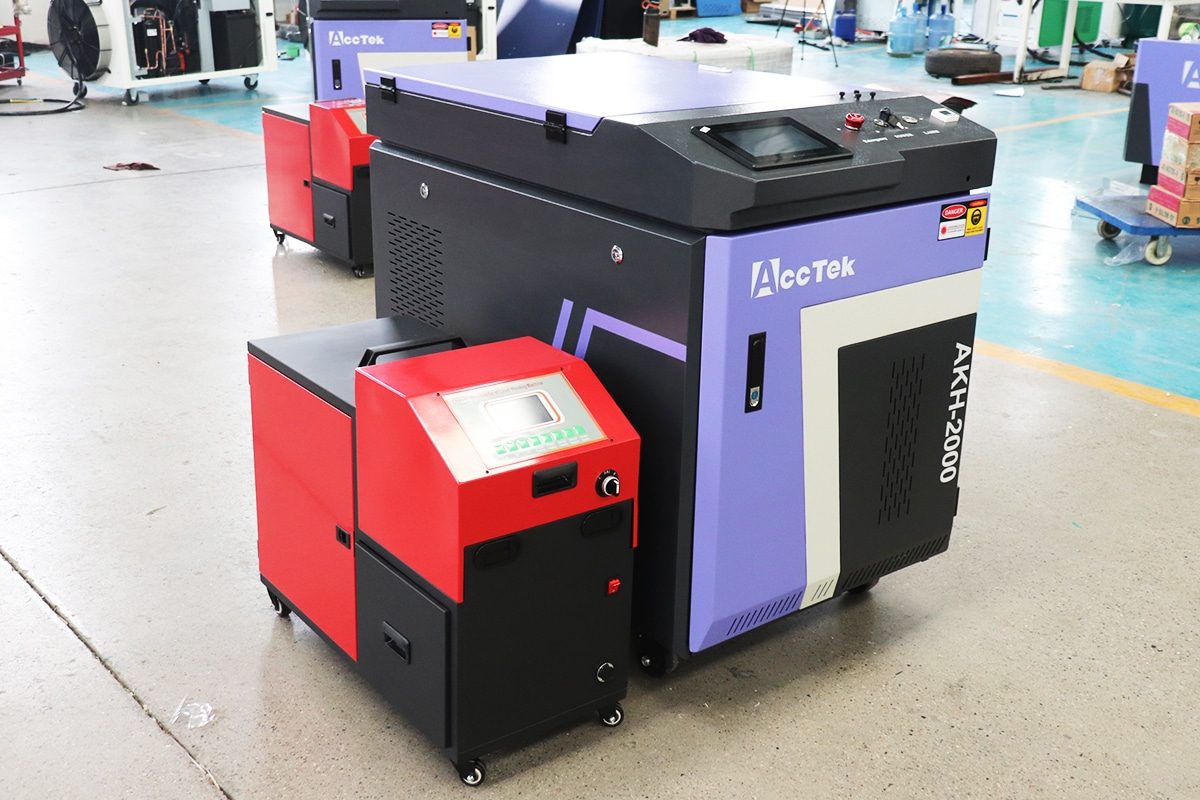
Handheld laser welding machines are one of the most popular choices for metal fabrication, sheet metal processing, stainless steel products, kitchenware, cabinets, doors, windows, hardware, advertising signs, and repair work. The operator holds the laser welding guns and moves them along the welding seam manually. This type of machine is valued for its flexibility, fast welding speed, relatively simple operation, and clean weld appearance.
The biggest advantage of handheld laser welding is flexibility. It can weld workpieces of different shapes, sizes, and positions without requiring complex fixtures or programming. For factories that produce small batches, customized parts, or products with frequent design changes, handheld laser welding machines can be very practical. They can handle straight seams, corner joints, lap joints, fillet welds, and some irregular welding paths more easily than fixed automatic equipment.
Handheld laser welding machines are also attractive because they can reduce post-processing. Compared with traditional TIG or MIG welding, the weld seam is usually narrower, the heat-affected zone is smaller, and the deformation is lower. In many stainless steel and sheet metal applications, the welded surface may require less grinding, polishing, or correction. This can save labor time and improve the final appearance of the product.
Another benefit is easier operator training. Although proper training is still essential, many operators can learn basic handheld laser welding faster than traditional arc welding. The machine can often produce stable welds with less dependence on highly skilled welding techniques. This is especially useful for companies facing labor shortages or high training costs.
However, handheld laser welding also has limitations. Since the welding path is controlled by the operator, consistency depends on hand movement, welding angle, travel speed, focus position, and workpiece fit-up. For products that require extremely high repeatability or strict dimensional control, manual operation may not be enough. Handheld welding is also less suitable for very small precision parts, complex micro-welding, or fully standardized mass production, where automation would be more efficient.
Safety is another major consideration. Handheld laser welding uses a high-energy laser beam, and improper operation can create serious risks to the eyes and skin. Buyers should choose machines with proper safety interlocks, protective eyewear, grounding detection, emergency stop functions, and clear operating procedures. A safe working area, training, and shielding are necessary.
Handheld laser welding machines are best suited for companies that need flexible welding, fast deployment, relatively low investment, and broad application coverage. They are a strong choice for workshops and manufacturers that weld stainless steel, carbon steel, galvanized steel, aluminum, and similar materials in small to medium batches.
Desktop or Workstation Laser Welding Machines
Desktop or workstation laser welding machines are designed for more controlled and precise welding operations. Instead of holding the welding gun freely in the air, the workpiece is usually placed on a fixed platform, inside a workstation, or under a controlled welding head. These machines are commonly used for small parts, precision components, jewelry, molds, electronic parts, sensors, medical devices, battery components, and other applications where accuracy and stability are important.
The main advantage of a desktop or workstation laser welding machine is better control. The operator can position the part more accurately, observe the welding area through a microscope, camera, or viewing system, and adjust welding parameters more carefully. This makes the machine suitable for small weld spots, fine seams, thin materials, and delicate components that may be difficult to weld manually with a handheld laser gun.
Workstation laser welding machines often provide better safety protection than open handheld operation. Many systems have enclosed or semi-enclosed structures that help contain laser radiation and reduce exposure risk. This is especially important for precision welding environments where operators work close to the welding area for long periods.
Another advantage is process stability. Because the welding head and workpiece are better controlled, the welding quality can be more consistent than a fully manual operation. Some workstation systems can be equipped with rotary fixtures, small motion platforms, vision positioning, or programmable welding paths. This allows the machine to handle repetitive precision tasks with better repeatability.
Desktop laser welding machines are especially useful when the workpieces are small, valuable, or require fine control. For example, mold repair welding may require accurate energy control to fill small damaged areas without affecting surrounding surfaces. Jewelry welding requires fine weld spots and minimal heat input. Electronic components may require precise welding without excessive thermal damage.
However, workstation laser welding machines are usually not ideal for large workpieces or long weld seams. Their working area is limited by the platform size, enclosure structure, and fixture design. They may also be slower for large sheet metal products compared with handheld laser welding. In addition, some systems require more careful setup, positioning, and operator attention.
When choosing this type of machine, buyers should pay attention to the working table size, positioning accuracy, observation system, pulse or continuous laser source type, fixture options, cooling system, and safety enclosure. The machine should match the size and precision requirements of the parts being welded.
Desktop or workstation laser welding machines are best for manufacturers that need precision, repeatability, and controlled welding conditions, especially for small parts or high-value components.
Robotic Laser Welding Systems
Robotic laser welding systems combine laser welding technology with industrial robots. The robot moves the laser welding head along a programmed path, allowing automated welding of complex three-dimensional workpieces. This type of system is widely used in automotive manufacturing, battery production, machinery, metal furniture, appliances, aerospace parts, and other industries that require high efficiency and repeatability.
The biggest advantage of robotic laser welding is flexibility within automation. A robot can move in multiple axes and weld complex shapes, curved seams, corners, and hard-to-reach positions. Compared with simple linear motion systems, robots offer greater freedom of movement. This makes them suitable for parts with three-dimensional geometry or multiple weld locations.
Robotic laser welding can greatly improve consistency. Once the welding path, parameters, and fixtures are properly set, the robot can repeat the same welding process with high accuracy. This reduces variation caused by manual operation and improves production stability. For high-volume products, this consistency can improve quality control and reduce rework.
Another benefit is productivity. Robotic systems can work continuously, maintain a stable travel speed, and reduce dependence on manual welding labor. In production lines where cycle time matters, robotic laser welding can significantly increase output. It can also be integrated with automatic loading, unloading, vision systems, rotary positioners, conveyors, and quality inspection systems.
Robotic laser welding is especially suitable for applications where the same or similar parts are produced repeatedly. Examples include automotive body parts, battery trays, metal frames, stainless steel assemblies, appliance parts, and structural components. If the workpiece design is stable and production volume is high, the investment in robotic automation may be justified.
However, robotic laser welding requires more planning than handheld or workstation welding. The system is not only laser welding machines; it is an integrated automation project. Buyers must consider robot reach, payload, motion accuracy, fixture design, welding sequence, safety enclosure, programming, part tolerance, and production line layout. Poor fixture design or inconsistent part dimensions can cause welding defects even if the robot itself is accurate.
The initial investment is also higher. In addition to the laser source and welding head, the system may require a robot arm, controller, safety enclosure, positioner, fixtures, sensors, software, and installation support. Maintenance and programming skills are also needed. Therefore, robotic laser welding is usually more suitable for medium to large factories with stable production requirements.
Robotic laser welding systems are best for manufacturers that need automated welding of complex parts, high repeatability, higher production efficiency, and reduced dependence on manual labor.
CNC Laser Welding Systems
CNC laser welding systems use computer numerical control motion platforms to move the welding head or workpiece along a programmed path. Unlike robotic systems, which use multi-axis robot arms, CNC laser welding systems usually rely on linear axes, gantry structures, rotary axes, or multi-axis motion platforms. They are well-suited for flat parts, regular shapes, long straight seams, circular seams, and products requiring accurate path control.
The main advantage of CNC laser welding is precision and repeatability in controlled motion. Once the welding program is set, the machine can follow the same path repeatedly with stable speed and position. This makes CNC laser welding suitable for standardized parts and batch production where weld consistency is important.
CNC laser welding systems are often used for sheet metal parts, battery modules, metal boxes, tubes, flanges, containers, heat exchangers, sensors, and precision assemblies. For example, a CNC system can weld long straight seams on metal enclosures, circular seams on tubes or cylinders, or repeated weld patterns on plates. With the right fixture, it can produce clean and consistent welds with minimal manual variation.
Compared with robotic laser welding, CNC systems are usually easier to understand and program for simple geometries. If the welding path is mainly straight, circular, or two-dimensional, a CNC structure may be more cost-effective than a robot. It can also provide high positioning accuracy and stable movement, especially for parts that can be clamped firmly on a table or fixture.
CNC laser welding can also be combined with rotary devices, automatic wire feeding, vision positioning, seam tracking, and automatic loading systems. This allows the machine to handle more complex production tasks while maintaining stable motion control.
However, CNC laser welding systems are less flexible than robotic systems for complex three-dimensional workpieces. If the part has many different angles, deep corners, irregular surfaces, or difficult access points, a robot may be more suitable. CNC systems also require proper fixture design. If the workpiece is not positioned consistently, the welding path may not align with the actual seam.
When choosing CNC laser welding machines, buyers should consider the working area, number of axes, positioning accuracy, motion speed, fixture design, welding head type, wire feeding requirements, software control, and whether the machine can be upgraded with automation functions. It is also important to confirm whether the system can handle the actual workpiece size and welding path.
CNC laser welding systems are best for manufacturers that need stable, programmable welding for regular parts, long seams, circular seams, or repeatable batch production.
Fully Customized Laser Welding Lines
Fully customized laser welding lines are designed for specific products, production processes, and factory layouts. These systems may combine laser welding machines, robots, CNC axes, automatic feeding, clamping fixtures, conveyors, vision systems, seam tracking, quality inspection, cooling systems, safety enclosures, and data management software into one complete production solution.
The main advantage of customized laser welding lines is that they can be built around the exact production requirements. Instead of adapting the product to a standard machine, the welding line is designed to match the product, cycle time, quality requirements, labor arrangement, and factory workflow. This can bring major benefits in efficiency, consistency, and production management.
Customized laser welding lines are commonly used in high-volume manufacturing, such as automotive parts, battery packs, power battery trays, home appliances, metal containers, heat exchangers, aerospace components, and specialized industrial products. These applications often require stable welding quality, strict process control, automatic handling, and traceable production data.
A customized line can include many advanced functions. For example, automatic loading and unloading can reduce manual labor. Vision positioning can identify part location and correct welding paths. Seam tracking can compensate for small assembly variations. Automatic inspection can detect defects or confirm weld quality. Data recording can help with quality traceability and process optimization. Multiple welding stations can be arranged to improve production capacity.
However, fully customized laser welding lines require the highest level of planning and investment. The buyer must provide detailed product drawings, material information, production targets, quality standards, factory layout, cycle time requirements, and automation expectations. Sample testing is usually necessary before final design. The supplier must understand not only laser welding, but also mechanical design, automation control, fixtures, safety systems, and production engineering.
The development cycle is also longer than buying a standard machine. Design, testing, manufacturing, installation, commissioning, operator training, and process optimization all take time. Any change in product design may affect the line configuration, so customized systems are best suited for stable products and long-term production plans.
Buyers should also evaluate after-sales support carefully. A customized welding line may require remote diagnostics, spare parts, software support, maintenance training, and on-site service. Choosing a supplier with strong engineering capability is more important than simply choosing the lowest price.
Fully customized laser welding lines are best for manufacturers with mature products, high production volume, strict quality requirements, and a clear need for automation integration.
Choosing the right type of laser welding machine is a key step in building an efficient and reliable welding process. Handheld laser welding machines are flexible and practical for sheet metal fabrication, repair work, small-batch production, and products with varied shapes. Desktop or workstation laser welding machines are better for precision parts, small components, mold repair, jewelry, electronics, and applications that require fine control. Robotic laser welding systems are suitable for automated welding of complex three-dimensional parts, especially when production volume and repeatability are important.
CNC laser welding systems provide stable, programmable motion for regular parts, long seams, circular seams, and batch production. Fully customized laser welding lines are designed for high-volume manufacturing where automation, process control, quality inspection, and production efficiency must be integrated into a complete solution.
The right choice depends on your product structure, welding path, production volume, required accuracy, available labor, safety requirements, and long-term development plan. Small workshops may benefit most from handheld laser welding machines, while a large factory may need robotic automation or a customized welding line. Before purchasing, buyers should compare not only the machine price, but also whether the machine type truly matches the production process. Selecting the correct machine structure helps improve weld quality, reduce labor costs, increase efficiency, and support stable long-term manufacturing.
Select the Proper Laser Source
The laser source is the core component of laser welding machines. It determines how laser energy is generated, how stable the beam output is, how efficiently the machine converts electrical energy into welding energy, and what kind of welding performance the system can achieve. When choosing laser welding machines, many buyers focus first on laser power, but power alone does not tell the whole story. The type of laser source, output mode, beam quality, stability, maintenance requirements, and compatibility with different materials are equally important.
Suitable laser sources should match the welding application, material type, thickness range, required penetration depth, weld appearance, production speed, and automation level. For example, thin precision parts may need controlled pulsed energy to reduce heat input, while sheet metal fabrication and industrial production often benefit from continuous-wave fiber laser sources because of their high speed and stable output. If the laser source is not selected properly, the machine may produce excessive spatter, unstable weld seams, insufficient penetration, burn-through, cracks, or unnecessary operating costs.
In modern laser welding, fiber laser sources are widely used because of their high efficiency, compact structure, stable beam quality, and relatively low maintenance requirements. However, buyers still need to understand the difference between pulsed laser sources and continuous-wave laser sources. These two output modes behave differently during welding and are suitable for different applications. Before purchasing, it is important to confirm not only the laser power but also whether the selected laser source can provide the right energy delivery method for your production needs.
Fiber Laser Source
Fiber laser sources are one of the most common and practical choices for modern laser welding machines. It uses optical fiber as the gain medium and deliver the laser beam through fiber transmission. Compared with older laser technologies, fiber laser sources usually offer higher electro-optical conversion efficiency, better beam quality, smaller size, and more stable operation. This makes them widely used in handheld laser welding machines, robotic welding systems, CNC laser welding equipment, and automated production lines.
One of the biggest advantages of fiber laser sources is high energy efficiency. Fiber lasers can convert electrical energy into laser energy more efficiently than many traditional laser welding systems, which helps reduce operating costs. In long-term industrial production, this can make a meaningful difference, especially when the machine runs for many hours per day. Lower energy consumption also means less heat generation, which can reduce the cooling burden and improve system stability.
Another major advantage is beam quality. Fiber laser sources can produce a concentrated and stable beam, allowing the welding machine to create narrow, deep, and clean welds. This is especially useful for stainless steel, carbon steel, galvanized steel, aluminum alloy, and many precision metal parts. A stable beam helps improve penetration consistency, weld seam appearance, and welding speed.
Fiber laser sources are also known for low maintenance. Since the laser is generated and transmitted through fiber, there are fewer exposed optical components compared with some traditional laser welding systems. This reduces alignment problems and makes the machine more suitable for industrial environments. For buyers who want a machine that is easier to operate and maintain, fiber laser sources are often a strong choice.
In handheld laser welding, fiber laser sources are especially popular because they provide sufficient power for fast welding while keeping the machine compact and practical. Common power levels such as 1000W, 1500W, 2000W, and 3000W can meet many sheet metal welding applications. Lower power machines may be suitable for thinner stainless steel, carbon steel, and galvanized steel, while higher power machines can handle thicker materials or improve welding speed.
However, buyers should not choose fiber laser sources only by power rating. The quality of the laser source brand, beam stability, output control, cooling requirements, and compatibility with the welding head are also important. Low-quality laser sources may have unstable output, shorter service life, poor after-sales support, or difficulty maintaining consistent weld quality during continuous operation.
It is also important to consider high-reflective materials such as aluminum, copper, and brass. Although fiber lasers can weld these materials, they require careful parameter control and laser sources with good protection against back reflection. If your production involves a large amount of aluminum or copper welding, you should confirm with the supplier whether the laser source is suitable for high-reflective materials and whether sample testing has been performed.
In general, fiber laser sources are suitable for most modern industrial laser welding applications. They are efficient, stable, compact, and versatile, making them a preferred choice for many manufacturers. For buyers who need practical performance across sheet metal fabrication, stainless steel products, carbon steel parts, aluminum components, and automated welding, fiber laser sources are usually the first option to consider.
Pulsed Laser Source
Pulsed laser sources output laser energy in short pulses instead of a continuous beam. Each pulse delivers a specific amount of energy to the workpiece, and the welding effect is controlled by parameters such as pulse energy, pulse width, frequency, peak power, and spot size. Pulsed laser welding is often used when precise heat control is more important than maximum welding speed.
The main advantage of pulsed laser sources is controlled heat input. Because the laser energy is delivered in separate pulses, the material has time to cool between pulses. This helps reduce excessive heating, deformation, burn-through, and thermal damage. For thin materials, small parts, precision components, and heat-sensitive products, pulsed laser welding can provide better control than continuous welding.
Pulsed laser sources are widely used in mold repair, jewelry welding, electronic components, sensors, medical devices, battery tabs, small metal parts, and precision assemblies. These applications often require small weld spots, fine control, and minimal impact on surrounding material. In mold repair, for example, the operator may need to fill a small damaged area without overheating the whole mold surface. In jewelry welding, the weld area may be very small and visually sensitive. In electronics, excessive heat can damage nearby components.
Another benefit of pulsed laser welding is its ability to handle delicate or thin materials. When welding very thin sheets, foils, or small parts, continuous laser beams may easily cause burn-through if not carefully controlled. Pulsed energy allows the machine to create small, controlled molten pools, which are useful for fine welds and spot welding.
Pulsed laser welding can also be useful for materials that are prone to cracking or thermal stress. By controlling pulse duration and cooling time, the welding process can reduce heat accumulation and improve weld stability. However, the correct parameters must be selected carefully. Too much pulse energy may still cause spatter, cracks, or deformation, while too little energy may lead to weak bonding or incomplete fusion.
Compared with continuous-wave laser welding, pulsed laser welding is generally slower for long seams and high-volume production. Since the weld is formed by repeated pulses, it may not be the best choice for applications that require fast welding of long, straight seams or thick sheet metal. For this reason, pulsed laser sources are more commonly used for precision welding, repair welding, spot welding, and small-part welding rather than general sheet metal fabrication.
When choosing pulsed laser sources, buyers should pay attention to pulse energy, pulse width adjustment range, repetition frequency, peak power, stability, spot size control, and observation system. For precision applications, the machine should allow fine parameter adjustment and provide good visual control. Workstation-style systems are often paired with pulsed laser sources because they allow accurate positioning and careful operation.
Pulsed laser sources are best for applications that require precision, low heat input, small weld size, and delicate process control. It is not always the fastest option, but it can be the better choice when weld accuracy and thermal control are more important than production speed.
Continuous-Wave Laser Source
Continuous-wave laser sources, often called a CW laser source, output laser energy continuously rather than in separate pulses. This means the laser beam remains active during the welding process and creates a stable molten pool as the welding head moves along the seam. Continuous-wave fiber laser sources are widely used in modern industrial laser welding because they provide high speed, deep penetration, and stable seam formation.
The main advantage of continuous-wave laser sources is welding efficiency. Because the laser output is continuous, the machine can maintain a stable weld pool and move quickly along the welding path. This is especially suitable for long seams, sheet metal fabrication, stainless steel products, carbon steel parts, aluminum alloy components, automotive parts, metal cabinets, kitchenware, doors, windows, and many industrial assemblies.
Continuous-wave laser welding is also effective for achieving deeper penetration. When the laser energy is concentrated on the workpiece continuously, it can form a keyhole welding effect under suitable conditions. This allows the laser to produce narrow and deep welds with relatively small heat-affected zones compared with traditional welding methods. For medium-thickness materials, CW laser welding can provide strong welds while keeping deformation relatively low.
Another advantage is a smooth weld appearance. With proper parameters, continuous-wave laser welding can create uniform, clean, and narrow weld seams. This reduces the need for grinding or polishing in many applications. For products where appearance matters, such as stainless steel furniture, kitchen equipment, elevators, display shelves, and decorative metal parts, this is a major benefit.
CW laser sources are commonly used in handheld laser welding machines because they support fast manual welding. They are also widely used in robotic laser welding systems and CNC laser welding systems because continuous output works well with programmed motion. When combined with stable travel speed, proper focus control, shielding gas, and good fixtures, CW laser welding can deliver highly repeatable results in automated production.
However, continuous-wave laser sources require careful control of heat input. Since the laser energy is delivered continuously, excessive power or slow travel speed can cause burn-through, distortion, wide welds, or excessive melting, especially on thin materials. Operators need to adjust power, speed, focus position, wobble width, shielding gas, and wire feeding parameters according to material type and thickness.
For highly reflective materials such as aluminum, copper, and brass, CW fiber laser welding can be effective, but the process may require higher power, better back-reflection protection, and more stable parameter control. Aluminum may require filler wire in some cases to reduce cracking or improve weld shape. Copper and brass require extra attention because their reflectivity and thermal conductivity can make welding more difficult.
When choosing continuous-wave laser sources, buyers should consider rated power, output stability, beam quality, cooling method, modulation capability, compatibility with the welding head, and protection features. The power level should be selected based on the actual material thickness and production speed rather than simply choosing the highest available power. Higher power can increase capability, but it also increases machine cost, safety requirements, and cooling demand.
Continuous-wave laser sources are best for users who need fast welding, long seams, medium-thickness materials, stable production, and strong overall efficiency. For most sheet metal fabrication and industrial welding applications, CW fiber laser sources are often the most practical and cost-effective choice.
Selecting the proper laser source is one of the most important decisions when choosing laser welding machines. The laser source affects welding speed, penetration depth, heat input, weld appearance, machine stability, operating cost, and long-term reliability. Buyers should not choose only according to power. They should also consider the laser source type, output mode, beam quality, cooling requirements, material compatibility, and the real production environment.
Fiber laser sources are widely used because they are efficient, stable, compact, and suitable for many metal welding applications. They are a strong choice for handheld welding, robotic welding, CNC welding, and automated welding systems. Pulsed laser sources are better for precision welding, mold repair, jewelry, electronic components, thin materials, and heat-sensitive parts because they provide better control over energy input. Continuous-wave laser sources are more suitable for fast welding, long seams, sheet metal fabrication, medium-thickness materials, and high-efficiency industrial production.
The best laser source depends on the application. If you need precision and low heat input, pulsed laser sources may be more suitable. If you need fast and stable welding for sheet metal and industrial production, continuous-wave fiber laser sources are usually the better option. If your production involves multiple materials or special metals such as aluminum, copper, or brass, sample testing and supplier process support are especially important. Properly selected laser sources help ensure stable weld quality, efficient production, lower maintenance costs, and better long-term value.
Choose the Right Laser Power
Laser power is one of the most important specifications when choosing laser welding machines, but it should not be treated as the only deciding factor. The power level affects welding penetration, welding speed, material compatibility, heat input, operating cost, cooling requirements, and safety requirements. If the power is too low, the machine may not achieve enough penetration or may require a very slow welding speed. If the power is too high, it may increase the risk of burn-through, excessive melting, deformation, spatter, and unnecessary investment.
In practical purchasing, the right laser power should be selected according to the material type, thickness range, joint type, welding speed, weld strength requirement, and production environment. Stainless steel, carbon steel, galvanized steel, aluminum alloy, copper, and brass do not respond to laser welding in the same way. Thin sheet metal, medium-thickness plates, and thicker components also require different welding strategies. Therefore, buyers should choose power based on real production needs, not simply on the highest number shown in a catalog.
Common handheld and industrial laser welding machines are often available in 1000W, 1500W, 2000W, 3000W, and higher power levels. Each power range has its own suitable applications. Understanding the difference between them can help buyers avoid both underpowered machines and oversized machines.
1000W Laser Welding Machines
1000W laser welding machines are usually considered an entry-level or light-duty industrial option. It is suitable for thin sheet metal welding, small workshops, repair work, stainless steel products, light carbon steel parts, galvanized sheet, advertising signs, cabinets, kitchenware, hardware products, and decorative metal fabrication. For users whose main materials are relatively thin, a 1000W machine can provide clean weld seams, low heat input, and good control.
The main advantage of 1000W laser welding machines is that it is easier to control on thin materials. When welding thin stainless steel or carbon steel, excessive power can cause burn-through, wide welds, or deformation. 1000W machines can often produce fine welds with less heat input, making it practical for products where appearance and dimensional stability are important.
Another advantage is lower equipment cost. Compared with higher power machines, 1000W laser welding machines usually have a lower purchase price, lower cooling demand, and lower energy consumption. This can make it attractive for small businesses, maintenance shops, and companies that are trying laser welding for the first time.
However, 1000W machines have limitations. They are not ideal for thicker materials or high-speed production. When welding medium-thickness plates, the operator may need to reduce the welding speed significantly to achieve acceptable penetration. In some cases, the weld may still be too shallow for structural strength requirements. If the buyer frequently welds thicker carbon steel, aluminum alloy, or parts that require deep penetration, a 1000W machine may become a bottleneck.
1000W laser welding machines are best for users who mainly work with thin materials, have moderate production volume, and need a cost-effective welding solution with good weld appearance. It is not the best choice for heavy-duty welding or applications where high speed and deep penetration are required.
1500W Laser Welding Machines
1500W laser welding machines are one of the most commonly selected power levels for general sheet metal fabrication. It offers a good balance between welding capability, cost, speed, and control. For many workshops and factories, 1500W is more versatile than 1000W while still being easier to manage than higher power systems.
This power level is widely used for stainless steel, carbon steel, galvanized steel, aluminum alloy, metal cabinets, doors and windows, kitchen equipment, hardware, elevator parts, metal furniture, and general fabrication. It can handle thin materials efficiently and also provide better penetration than 1000W machines on medium-thickness parts.
The advantage of 1500W is flexibility. It can be used for many common welding tasks without requiring the buyer to invest in a much more powerful machine. For small and medium-sized manufacturers, this makes it a practical choice. It provides faster welding speed than 1000W in many applications and can reduce the risk of insufficient penetration when the material thickness increases slightly.
For handheld laser welding, 1500W is often considered a very practical choice because it can cover many everyday production needs. It can weld thin sheets cleanly when the parameters are reduced, and it can provide stronger welding capability when more penetration is needed. When combined with a wire feeder, it can also help bridge small gaps and improve weld formation on corner joints or imperfect fit-ups.
However, buyers should still avoid assuming that 1500W can handle all materials and thicknesses. Aluminum, copper, brass, and highly reflective materials may require more careful process control or higher power depending on the thickness and welding requirements. Thick structural components may also exceed the practical capability of a 1500W machine.
1500W laser welding machines are suitable for users who need a balanced machine for common industrial materials and moderate thicknesses. It is often a good choice for general-purpose production, especially when the buyer wants better capability than 1000W without moving into the higher cost and safety demands of 2000W or 3000W systems.
2000W Laser Welding Machines
2000W laser welding machines provide stronger welding capability and higher production efficiency than 1000W and 1500W models. It is suitable for users who regularly weld medium-thickness materials, need faster welding speed, or require better penetration. This power level is widely used in sheet metal fabrication, machinery manufacturing, stainless steel products, aluminum parts, automotive components, metal frames, cabinets, and industrial assemblies.
The main advantage of 2000W is improved penetration and speed. For the same material and thickness, 2000W machines can often weld faster than a lower power machine while still maintaining good fusion. This is important for factories where production efficiency directly affects cost. If operators are using a lower-power machine and must slow down too much to obtain acceptable weld strength, upgrading to 2000W may improve both productivity and consistency.
2000W laser welding machines are also more flexible for users who process different materials. It provides more power reserve when welding aluminum alloy or thicker carbon steel and stainless steel. With proper parameter adjustment, it can still be used for thinner materials, although operators must control power, speed, focus position, wobble width, and shielding gas carefully to avoid excessive heat input.
For businesses with growing production needs, 2000W can be a safer long-term choice than 1000W or 1500W. If the current workpieces are mostly thin but future orders may involve thicker materials, a 2000W machine can provide more room for expansion. This can prevent the machine from becoming outdated too quickly.
However, higher power also brings higher requirements. 2000W systems usually cost more, require better cooling, and have stricter safety demands. If the machine is used mainly for very thin sheet metal, the extra power may not be fully used. Improper settings can also cause burn-through, wider welds, more spatter, or deformation. Therefore, training and parameter control become more important.
2000W laser welding machines are best for manufacturers that need stronger capability, higher welding speed, and greater application flexibility. It is a good choice for medium-duty industrial welding, especially when production includes a range of material thicknesses and the buyer wants enough power reserve for future work.
3000W and Higher Power Machines
3000W and higher power laser welding machines are designed for more demanding industrial applications. They can provide deeper penetration, faster welding speed, and stronger capability for thicker materials. These machines are often used in heavy sheet metal fabrication, machinery manufacturing, automotive parts, ship-related components, energy equipment, pressure-related structures, large metal frames, and automated welding systems.
The biggest advantage of 3000W and higher power machines is productivity. In high-volume production, higher power can allow faster travel speed while maintaining sufficient penetration. This can reduce cycle time and increase output. For automated welding lines, robotic systems, and CNC welding systems, higher power can be especially useful because the motion system can maintain stable speed and position, allowing the laser power to be used efficiently.
Higher power is also useful when welding materials with higher thermal conductivity or reflectivity, such as aluminum alloys and some copper-based materials. These materials may absorb less laser energy or conduct heat away quickly, so additional power can help stabilize the welding process. However, welding reflective metals still requires suitable laser source protection, process development, and parameter control.
For thicker materials, 3000W and above can provide more practical penetration than lower power machines. This can reduce the need for slow welding speeds or multiple passes in some applications. It can also improve weld consistency when the product requires stronger joints. However, it does not mean that higher power can solve every welding challenge. Joint design, gap control, fixture accuracy, shielding gas, filler wire, and operator skill remain important.
The main disadvantage is cost and complexity. Higher power machines are more expensive to purchase and operate. They require stronger cooling systems, stricter safety protection, better fume control, and more careful process management. The laser beam is more hazardous, so safety enclosures, interlocks, protective eyewear, training, and controlled work areas become even more important.
Another issue is that high power may be unsuitable for thin materials if not controlled properly. Too much power can cause burn-through, excessive melting, undercut, spatter, and distortion. Although power can be adjusted, buying a very high-power machine for mostly thin materials may be unnecessary and inefficient.
3000W and higher power laser welding machines are best for manufacturers with demanding production requirements, thicker materials, higher welding speed needs, or automated industrial processes. They should be selected when the application truly requires the capability, not simply because higher power sounds better.
Avoid Choosing Power by Maximum Thickness Claims Alone
Many buyers make the mistake of choosing laser power based only on maximum thickness claims in brochures or advertisements. For example, a supplier may state that a certain machine can weld a specific maximum thickness, but this number may be based on ideal conditions, a specific material, perfect fit-up, slow welding speed, single test samples, or a weld quality standard that may not match your production needs.
Maximum thickness is not the same as practical production thickness. A machine may be able to melt or join a material once during a demonstration, but that does not mean it can produce strong, consistent, attractive, and repeatable welds in daily production. Real production includes variations in material quality, surface condition, part fit-up, operator skill, welding position, fixture accuracy, and production speed.
Buyers should also consider weld strength, not just whether the material is joined. A shallow weld may look acceptable on the surface but fail under load, vibration, pressure, or long-term use. If the product has structural or safety requirements, sample testing, cross-section inspection, tensile testing, bend testing, or other quality checks may be needed.
Material type also affects the thickness capability. The same laser power may perform differently on stainless steel, carbon steel, galvanized steel, aluminum, copper, or brass. Aluminum and copper-based materials are generally more difficult because of their reflectivity and thermal conductivity. Therefore, a thickness claim for stainless steel should not be directly applied to aluminum or copper.
Joint type matters as well. Butt joints, lap joints, corner joints, fillet joints, and T-joints have different energy requirements and gap tolerance. A machine that performs well on a lap joint may not perform equally well on a butt joint with poor fit-up. If the product has gaps, filler wire may be required even if the power is sufficient.
Instead of asking only, “What is the maximum thickness this machine can weld?” buyers should ask more practical questions: What material and grade was tested? What joint type was used? Was filler wire used? What was the welding speed? Was the weld tested by cross-section or strength testing? Can the supplier test my actual samples? What weld quality can be achieved in continuous production?
Choosing power should be based on the normal thickness range, the maximum thickness used regularly, the required welding speed, and the quality standard of the finished product. A reliable supplier should recommend power based on application details, not simply promote the highest wattage machine.
Choosing the right laser power requires a balance between welding capability, production efficiency, cost, and process control. 1000W laser welding machines are suitable for thin materials, light-duty fabrication, repair work, and users who need a cost-effective entry-level solution. 1500W machines offer better versatility and are often suitable for general sheet metal welding, stainless steel products, carbon steel parts, galvanized steel, and many common workshop applications. 2000W machines provide stronger penetration, faster welding speed, and better flexibility for medium-duty industrial production. 3000W and higher power machines are better suited for demanding applications, thicker materials, high-volume manufacturing, and automated welding systems.
However, higher power is not always better. Excessive power can increase cost, safety risks, cooling requirements, deformation, spatter, and burn-through, especially when most workpieces are thin. At the same time, insufficient power can reduce welding speed and cause weak welds or incomplete penetration. The best choice is the power level that matches your real materials, thickness range, joint type, welding speed, and quality requirements.
Buyers should avoid relying only on maximum thickness claims. Practical welding performance depends on material type, surface condition, joint design, gap control, filler wire, shielding gas, operator skill, and whether the weld can meet actual strength and appearance requirements. Before making a final decision, it is best to provide real samples to the supplier for testing. A machine that performs well on your actual products will always be more valuable than a machine that only looks powerful on paper.
Evaluate Welding Quality Requirements
When choosing laser welding machines, welding quality requirements should be evaluated before deciding on the final configuration. Different products have different standards for weld appearance, strength, sealing performance, and dimensional accuracy. Some parts only need a clean and attractive surface, while others must withstand load, vibration, pressure, liquid, gas, or long-term working stress. If the quality requirements are not clearly defined, it is easy to choose a machine that looks suitable during a simple demonstration but fails to meet real production standards.
Laser welding is known for its narrow weld seam, small heat-affected zone, fast welding speed, and low deformation. However, these advantages do not automatically guarantee good results in every application. Weld quality depends on laser power, beam quality, welding speed, focus position, shielding gas, wire feeding, fixture accuracy, material cleanliness, joint design, and operator skill. Suitable laser welding machines should be selected according to the actual quality standard of the finished product, not only the material thickness.
Before purchasing, buyers should ask what level of weld appearance is required, how much strength the joint must achieve, whether the weld must be leak-tight, and how much distortion is acceptable after welding. These requirements directly affect the choice of laser power, machine type, welding head, wire feeder, fixtures, cooling system, automation level, and testing methods.
Appearance Requirements
Weld appearance is one of the most visible quality factors, especially for products where the welded area remains exposed after production. Stainless steel kitchenware, cabinets, doors, windows, elevators, decorative panels, advertising signs, furniture, hardware products, and consumer-facing metal parts often require smooth, clean, and attractive weld seams. In these applications, the buyer should choose laser welding machines that can provide stable weld formation with minimal spatter, discoloration, undercut, and surface roughness.
One of the main advantages of laser welding is that it can produce a narrow and neat weld seam. Compared with traditional TIG or MIG welding, laser welding usually creates less heat input and a smaller heat-affected zone, which helps reduce surface discoloration and deformation. In many stainless steel applications, the weld may require less grinding and polishing after welding. This can save labor time and improve production efficiency.
However, good appearance depends on more than the laser welding machine itself. The workpiece must be properly prepared. Oil, dust, rust, oxide layers, paint, and coating residues can cause pores, black marks, spatter, or uneven welds. The joint gap must also be controlled. If the parts do not fit well, the laser beam may not create a smooth weld seam, and filler wire may be needed to improve the surface shape.
For products with high appearance standards, buyers should pay attention to the welding head design and parameter adjustability. A wobble welding head can help create a wider and smoother weld seam, improve gap tolerance, and make the weld appearance more uniform. Adjustable laser power, wobble width, frequency, welding speed, shielding gas flow, and focus position all help operators fine-tune the final weld effect.
Shielding gas also has a strong influence on weld appearance. Argon, nitrogen, or other suitable gases may be used depending on the material and desired result. Proper gas protection can reduce oxidation, improve weld color, and produce a cleaner seam. Poor gas flow, wrong nozzle distance, or unstable gas supply may lead to dark welds, oxidation, and inconsistent appearance.
If appearance is a major requirement, buyers should request sample welding using their actual materials and joint types. A supplier’s standard demonstration may look good on clean stainless steel plates, but real production parts may have corners, gaps, coatings, or different surface finishes. The best evaluation is whether the machine can produce an acceptable weld appearance on your real products with reasonable speed and repeatability.
Leak-Tightness Requirements
Some products require welds that are not only strong but also leak-tight. This is common in tanks, containers, pipes, heat exchangers, battery cases, cooling plates, fuel-related parts, hydraulic components, medical devices, stainless steel vessels, and sealed enclosures. For these applications, even a tiny pore, crack, incomplete fusion area, or pinhole may cause product failure.
Leak-tight welding requires excellent process stability. The weld seam must be continuous, fully fused, and free from through-holes or internal defects that connect to the surface. Laser welding can be suitable for sealing applications because it can create narrow, precise, and controlled welds. However, leak-tightness is also one of the more demanding quality requirements, and the machine must be selected carefully.
Material cleanliness is especially important for sealed welding. Oil, moisture, oxide layers, plating, coatings, or dirt can vaporize during welding and create pores or blowholes. In sealed products, these small defects may become leakage paths. Therefore, before welding, the parts often need cleaning, drying, and controlled handling. If the product has a galvanized coating, paint, or surface treatment, the welding process must be tested carefully.
Joint fit-up also affects leak-tightness. Large gaps, uneven edges, or poor contact can lead to incomplete fusion or underfill. For sealing welds, fixtures should hold the parts in a stable and accurate position. In many cases, CNC laser welding or robotic laser welding is better than fully manual operation because it can maintain consistent speed, position, and focus throughout the seam.
Welding parameters must be carefully optimized. Too little energy can cause incomplete fusion, while too much energy can create excessive vaporization, spatter, collapse, or cracks. Shielding gas selection and flow control are also important because oxidation or turbulence can affect weld quality. For circular seams, long seams, or closed paths, the starting and ending points of the weld must be controlled to prevent small leakage defects.
Leak-tight products usually require inspection after welding. Common methods include air pressure testing, water immersion testing, vacuum testing, helium leak testing, dye penetrant testing, or other sealing tests, depending on the product requirements. Buyers should confirm whether the laser welding machine can consistently meet the required leak standard under actual production conditions.
If leak-tightness is a key requirement, buyers should not rely only on appearance samples. A weld seam may look smooth but still contain microscopic pores or incomplete fusion. It is better to send actual samples to the supplier and require leak testing after welding. The machine, fixture, parameters, and inspection process should all be evaluated as one complete solution.
Distortion Control
Distortion control is one of the major reasons many manufacturers choose laser welding. Because laser welding uses a concentrated heat source and often has a smaller heat-affected zone than traditional welding methods, it can reduce thermal deformation. This is especially valuable for thin sheet metal, precision parts, stainless steel products, aluminum components, medical devices, electronics, and products with tight dimensional tolerances.
Distortion occurs when the material expands and contracts unevenly during heating and cooling. The more heat introduced into the workpiece, the higher the risk of warping, bending, shrinkage, or dimensional change. Laser welding can reduce this problem by concentrating energy in a small area and completing the weld quickly. However, distortion is not automatically eliminated. Poor parameter settings, excessive power, slow welding speed, bad clamping, or incorrect welding sequence can still cause deformation.
When distortion control is important, buyers should choose a machine that allows precise control of laser power, welding speed, wobble width, focus position, and shielding gas. Stable laser sources and good welding heads help maintain consistent heat input. For thin materials, lower power settings and faster travel speed may be needed to avoid overheating. For larger parts, welding sequence and fixture design become especially important.
Fixtures play a key role in controlling distortion. A good fixture holds the parts in the correct position, maintains joint gaps, supports the workpiece, and prevents movement during welding. For manual handheld welding, simple clamps or positioning tools may be enough for some products. For high-precision or repeatable production, dedicated fixtures, CNC platforms, or robotic systems may be necessary.
Welding sequence should also be considered. Long continuous welds can accumulate heat and cause warping, especially on thin sheets. In some applications, intermittent welding, segmented welding, symmetrical welding, or controlled cooling time may help reduce distortion. Automated systems can follow a programmed sequence more consistently than manual operation.
Material type also influences distortion. Aluminum conducts heat quickly and may require different parameter control than stainless steel. Thin carbon steel sheets may deform easily if the heat input is too high. Stainless steel has relatively low thermal conductivity, which can concentrate heat near the weld area and cause local distortion if not controlled properly.
Buyers should evaluate acceptable distortion before choosing the machine. For some products, slight deformation may be acceptable and can be corrected later. For precision parts, even small dimensional changes may cause assembly problems. If the product has strict tolerance requirements, sample welding should include dimensional measurement after welding, not just visual inspection.
Laser welding machines with good distortion control should help reduce rework, improve assembly accuracy, and maintain product consistency. However, the final result depends on the full welding process, including machine selection, parameter control, fixture design, welding sequence, and operator training.
Evaluating welding quality requirements is essential when choosing laser welding machines. Different products require different levels of appearance quality, weld strength, leak-tightness, and distortion control. A machine that is suitable for decorative stainless steel parts may not be suitable for pressure containers, structural components, sealed products, or precision assemblies. Therefore, buyers should define quality expectations clearly before selecting the machine configuration.
Appearance requirements focus on clean, smooth, and attractive weld seams with minimal spatter, oxidation, discoloration, and post-processing. Strength requirements focus on penetration, fusion, weld volume, joint design, and mechanical performance. Leak-tightness requirements demand continuous, defect-free welds and usually require careful sample testing and inspection. Distortion control focuses on reducing heat input, maintaining dimensional accuracy, and using proper fixtures and welding sequences.
The best laser welding machine is not simply the one with the highest power or the lowest price. It is the machine that can consistently meet the required weld quality under real production conditions. Buyers should test actual samples, evaluate weld appearance and internal quality, confirm strength or sealing performance when necessary, and consider fixture design, shielding gas, filler wire, and automation level. By matching machine selection to welding quality requirements, manufacturers can achieve more stable production, lower rework rates, better product reliability, and higher long-term value.
Consider Fit-Up Accuracy and Gap Tolerance
Fit-up accuracy is one of the most important but often underestimated factors when choosing laser welding machines. Many buyers focus on laser power, welding speed, and machine price, but they forget that laser welding performance depends heavily on how well the parts are prepared and assembled before welding. Even high-quality laser welding machines may produce poor results if the joint gap is too large, the edges are uneven, or the workpieces are not held in the correct position.
Laser welding uses a highly concentrated heat source. This allows it to produce narrow weld seams, fast welding speeds, small heat-affected zones, and low distortion. However, the same concentrated energy also means that laser welding may have less tolerance for poor fit-up than some traditional welding methods. If the laser beam does not accurately hit the joint, or if there is not enough fusion material, defects such as underfill, incomplete fusion, porosity, burn-through, weak welds, and uneven appearance may occur.
Before purchasing laser welding machines, buyers should evaluate the entire production process, not just the welding equipment. Cutting accuracy, bending accuracy, part preparation, assembly method, fixture design, and operator skill all affect the final weld quality. If the current production process produces inconsistent gaps or irregular edges, the buyer may need laser welding machines with wobble welding, filler wire feeding, better fixtures, or automation support. In some cases, improving upstream cutting and assembly quality may be just as important as choosing more powerful laser welding machines.
Cutting Accuracy Before Welding
Good laser welding starts before welding begins. The cutting process has a direct influence on weld quality because the edge shape, dimensional accuracy, and surface condition of the parts determine how well they can be assembled. If the parts are cut accurately, the joint will fit closely, and the laser beam can create a stable molten pool. If the parts are poorly cut, the welding process becomes more difficult and less predictable.
For sheet metal fabrication, parts may be prepared by fiber laser cutting, plasma cutting, CNC punching, shearing, sawing, milling, or other cutting methods. Each method produces different edge quality and dimensional accuracy. Fiber laser cutting usually provides clean edges and high precision, making it well suited for laser welding preparation. Plasma cutting and flame cutting may leave wider kerfs, rougher edges, oxide layers, or thermal distortion, which may need additional cleaning or machining before welding.
Edge quality is especially important for butt joints. Since the two edges must meet closely, uneven cutting, burrs, bevel errors, or wavy edges can create gaps along the seam. These gaps may lead to underfill or incomplete fusion if no filler wire is used. For thin materials, even a small gap can affect weld appearance and strength. Therefore, if the product mainly uses butt joints, cutting accuracy should be evaluated carefully before selecting the welding machine.
For lap joints, cutting accuracy is still important, but the process may be slightly more forgiving because the sheets overlap. However, poor cutting can still affect positioning, overlap consistency, and final product dimensions. If the overlap is too small or uneven, the weld may not have enough bonding area. If the edge has burrs or contamination, it may cause spatter, pores, or poor surface appearance.
Surface condition after cutting also matters. Oil, dust, rust, oxide, paint, zinc coating residue, and cutting slag can all affect laser welding stability. Contaminants may vaporize during welding and create pores, black marks, or spatter. Before purchasing laser welding machines, buyers should consider whether their parts require cleaning, deburring, grinding, or surface preparation before welding.
If the existing cutting process cannot consistently produce accurate parts, the buyer should not expect the laser welding machine to solve every problem. Instead, the complete workflow should be improved. Better cutting accuracy, cleaner edges, and more consistent part dimensions can greatly improve laser welding quality and reduce the need for rework.
Gap Sensitivity
Gap sensitivity refers to how much joint gap the welding process can tolerate while still producing an acceptable weld. Laser welding is often more sensitive to gaps than traditional MIG or TIG welding because the laser beam is narrow and the molten pool is relatively small. This is one reason laser welding can produce clean, precise seams, but it also means that poor fit-up can quickly affect weld quality.
When the joint gap is too large, there may not be enough molten material to bridge the space between the parts. This can cause underfill, holes, incomplete fusion, weak welds, or an uneven seam. In butt welding, a large gap can make the laser beam pass through the joint instead of melting both edges properly. In corner welding, gaps can cause the weld to sink or leave visible defects. In lap welding, gaps between layers may trap air, coating residue, or vapor, causing pores and spatter.
The acceptable gap depends on material thickness, joint type, laser power, spot size, wobble width, welding speed, and whether filler wire is used. Thin materials usually have less gap tolerance because there is less base metal available to melt and fill the joint. Thicker materials may allow slightly more tolerance, but large gaps still reduce weld strength and appearance. High-power welding can increase penetration, but it does not automatically solve gap problems.
Wobble welding can improve gap tolerance in many handheld and automated laser welding applications. A wobble welding head moves the laser beam in a small oscillating pattern, creating a wider molten pool than a fixed spot. This can help bridge small gaps, improve seam width, and make the weld appearance smoother. For products with slight assembly variation, wobble welding can be very useful.
Filler wire is another important solution for gap tolerance. When the joint gap cannot be controlled tightly, wire feeding can add material to the weld pool and help fill the space. This is especially useful for corner joints, butt joints with small gaps, aluminum welding, and applications that require a fuller weld bead. However, adding filler wire also requires proper wire feeding speed, wire diameter, material compatibility, and operator control.
Buyers should be realistic about their production conditions. A supplier may show a perfect weld on tightly fitted sample plates, but actual production parts may have inconsistent gaps. Therefore, sample testing should include real workpieces with normal production tolerances. If the machine can only perform well on ideal samples, it may not be reliable in daily use.
When choosing laser welding machines, buyers should ask the supplier about practical gap tolerance for the specific material, thickness, joint type, and welding method. They should also confirm whether the machine supports wobble welding, wire feeding, parameter adjustment, and fixture assistance. Good gap tolerance is not just a machine feature; it is the result of proper part preparation, suitable welding technology, and stable process control.
Clamping and Fixtures
Clamping and fixtures play a major role in laser welding quality. Even if the parts are cut accurately, they must still be held in the correct position during welding. If the workpieces move, lift, warp, or separate during the process, the weld seam may become inconsistent. Poor clamping can cause gaps, misalignment, distortion, incomplete fusion, and poor appearance.
For simple handheld laser welding, operators may use basic clamps, magnetic holders, positioning blocks, or worktables to hold the parts. This may be enough for small-batch production, repair work, or products with lower precision requirements. However, as production volume, quality requirements, or repeatability demands increase, more dedicated fixtures become necessary.
A good fixture should position the parts accurately, maintain the correct joint gap, support the workpiece, and allow the welding head to access the seam smoothly. It should also be easy to load and unload, especially in batch production. If the fixture is too slow or difficult to use, it may reduce the efficiency advantage of laser welding.
For thin sheet metal, fixtures are especially important because the material can easily deform during welding. Proper clamping helps keep the sheets flat and reduces movement caused by thermal expansion and contraction. For long seams, fixtures may need to support the entire length of the joint to prevent lifting or uneven gaps. For circular parts, rotary fixtures or chucks may be required to maintain concentricity and stable welding speed.
In robotic and CNC laser welding systems, fixtures are even more important because the machine follows a programmed path. If the part is not positioned consistently, the laser beam may not align with the joint. Unlike a human operator, an automatic system will not naturally adjust to every variation unless it is equipped with vision positioning, seam tracking, or other compensation systems. Therefore, fixture accuracy directly affects automation success.
Fixtures should also consider heat dissipation and accessibility. Some fixtures may absorb heat and help reduce distortion, while others may block shielding gas or prevent the welding head from reaching the correct angle. A poorly designed fixture can create new welding problems even if it holds the part firmly. Therefore, fixture design should be part of the machine selection process.
For high-quality or high-volume production, buyers should discuss fixture design with the supplier before purchasing the machine. They should provide product drawings, sample parts, welding positions, tolerance requirements, and production targets. The supplier can then recommend whether simple manual fixtures, adjustable fixtures, rotary fixtures, CNC platforms, robotic fixtures, or customized tooling are needed.
Clamping and fixtures may not look as impressive as laser power or machine appearance, but they often determine whether the welding process can be stable and repeatable. A well-designed fixture can improve weld quality, reduce operator difficulty, increase production efficiency, and lower rework rates.
Fit-up accuracy and gap tolerance are critical factors when choosing laser welding machines. Laser welding can produce narrow, clean, fast, and low-distortion welds, but it also requires proper part preparation and assembly. If the parts are poorly cut, unevenly positioned, or loosely clamped, the final weld may suffer from underfill, porosity, incomplete fusion, weak strength, poor appearance, or excessive rework.
Cutting accuracy before welding determines whether the joint can be assembled correctly. Clean edges, accurate dimensions, minimal burrs, and proper surface preparation all help improve weld stability. Gap sensitivity must also be considered because laser welding has limited tolerance for large or inconsistent gaps. Wobble welding and filler wire can improve gap tolerance, but they cannot fully replace good fit-up and proper joint design.
Clamping and fixtures are equally important. They keep the parts aligned, control gaps, reduce movement, support thin materials, and improve repeatability. For manual welding, simple clamps may be enough in some cases. For CNC, robotic, or high-volume production, dedicated fixtures and accurate positioning systems are often essential.
Good laser welding machines should be selected together with the complete welding process. Buyers should evaluate their cutting method, assembly accuracy, joint gap, fixture requirements, and real production tolerances before making a purchase. When fit-up accuracy is properly controlled, laser welding can deliver better weld quality, higher efficiency, less distortion, and more stable long-term production.
Evaluate the Welding Head
The welding head is one of the most important parts of laser welding machines because it directly affects how laser energy is delivered to the workpiece. Even if the machine has high-quality laser sources and suitable power, poor welding head design can lead to unstable welding, uncomfortable operation, inconsistent focus, poor shielding gas protection, and reduced weld quality. For this reason, buyers should evaluate the welding head carefully before choosing laser welding machines.
The welding head connects the laser source, optical system, focusing lens, protective lens, shielding gas nozzle, and sometimes the wire feeding system. It determines how easily the operator can control the weld, how stable the laser beam remains during work, how well the weld pool is protected from oxidation, and how flexible the machine is for different joint types. Good welding heads should be stable, safe, ergonomic, easy to maintain, and suitable for the actual welding application.
For handheld laser welding machines, the welding gun design is especially important because the operator must hold and move the gun for long periods. For automated systems, the welding head must provide stable beam delivery, accurate focus, reliable cooling, and compatibility with fixtures or motion systems. Functions such as wobble welding, adjustable focus, and suitable shielding gas nozzles can significantly improve weld quality and gap tolerance.
Handheld Welding Gun Design
For handheld laser welding machines, the welding gun is the part the operator interacts with most directly. Its design affects comfort, stability, safety, and welding quality. A well-designed handheld welding gun should be lightweight enough for long-term use, balanced in the hand, easy to grip, and simple to control. If the gun is too heavy, awkward, or poorly balanced, operator fatigue will increase, and welding consistency will decline.
Ergonomics should not be ignored. Handheld laser welding often requires the operator to weld in different positions, such as flat seams, vertical seams, corners, inner angles, and irregular workpieces. The gun should allow flexible movement without making the operator struggle to maintain the correct angle. A comfortable handle, reasonable cable layout, and smooth trigger operation all help improve practical usability.
The welding gun should also be durable. In real workshops, the gun may be used for long hours and moved frequently around metal parts, fixtures, and worktables. The body should be strong enough to resist normal industrial use, while the cable and fiber connection should be well protected. Poor cable design can cause bending stress, unstable operation, or premature damage.
Safety features are also essential. A handheld welding gun should include reliable trigger control, grounding detection, emergency stop compatibility, and, in many cases, contact safety protection. Some systems require the welding head to contact the workpiece or detect proper grounding before laser emission is allowed. This helps reduce accidental laser exposure and improves operator safety.
Maintenance convenience is another important factor. Protective lenses can become contaminated by dust, spatter, fumes, or improper gas flow. If the protective lens is difficult to replace, downtime and maintenance costs will increase. Buyers should check whether the lens drawer or lens holder is easy to access, whether replacement lenses are available, and whether the supplier provides clear maintenance instructions.
The welding gun should also support the joint types used in production. For example, corner welding, lap welding, butt welding, and fillet welding may require different nozzle shapes, guide wheels, or auxiliary accessories. If the gun design is too limited, it may perform well in demonstrations but become inconvenient in real production.
Good handheld laser welding guns should make welding easier, safer, and more consistent. It should not only look modern, but also feel practical after hours of real use.
Wobble Welding Function
Wobble welding is an important function in many modern laser welding heads. Instead of keeping the laser beam fixed in one small spot, the wobble function moves the beam in a controlled pattern, such as circular, linear, or spiral oscillation. This creates a wider weld pool and gives the operator more flexibility when welding different joints or handling small gaps.
One of the main advantages of wobble welding is improved gap tolerance. Traditional fixed-spot laser welding produces a very narrow molten pool. If the joint gap is too large or the beam is slightly off-center, defects such as underfill, incomplete fusion, or poor appearance may occur. Wobble welding expands the effective welding width, making it easier to bridge small gaps and create a smoother seam.
Wobble welding can also improve weld appearance. By controlling wobble width, wobble frequency, and travel speed, the operator can create a more uniform weld bead. This is especially useful for stainless steel products, cabinets, doors, windows, kitchen equipment, decorative metal parts, and other applications where surface appearance matters. A suitable wobble pattern can reduce the need for grinding and polishing after welding.
Another benefit is better adaptability to different joint types. Butt joints, corner joints, lap joints, and fillet joints may all benefit from wobble welding, especially when the fit-up is not perfect. For handheld welding, wobble can make the process more forgiving and easier for operators to control. For automated welding, wobble can help stabilize weld width and improve fusion consistency.
However, wobble welding is not a magic solution for poor part preparation. Large gaps, severe misalignment, dirty surfaces, or unstable clamping can still cause defects. Wobble welding should be seen as a process improvement tool, not a replacement for good cutting accuracy and proper fixtures.
Buyers should check whether the welding head allows adjustment of wobble width, frequency, and pattern. The control interface should be easy to use, and the settings should be stable during operation. Different materials and thicknesses may require different wobble parameters, so parameter flexibility is important.
It is also important to confirm whether wobble welding works well with wire feeding. In many applications, wobble plus filler wire can greatly improve gap filling, weld bead shape, and joint strength. But the wire feeding position and laser oscillation must be properly coordinated. If the wire does not enter the molten pool correctly, spatter, uneven welds, or unstable fusion may occur.
Laser welding machines with a reliable wobble welding function can provide better flexibility, improved weld appearance, and greater tolerance for real production conditions.
Focusing System
The focusing system controls where the laser beam is concentrated on the workpiece. Proper focus position is essential for stable welding because it affects energy density, penetration depth, weld width, spatter, and overall weld quality. If the focus is incorrect, the weld may become too shallow, too wide, unstable, or visually poor.
In laser welding, the beam is focused through optical lenses inside the welding head. The focused spot delivers high energy to a small area, creating the molten pool. The relationship between the focus position and the workpiece surface determines how the energy enters the material. A focus position that works well for thin stainless steel may not be suitable for thicker carbon steel or aluminum alloy.
A good welding head should allow accurate and convenient focus adjustment. Some welding heads use manual focus adjustment, while more advanced systems may have digital or motorized focus control. For general handheld welding, manual adjustment may be sufficient if it is stable and easy to operate. For automated or precision welding, more accurate focus control may be required.
Focus stability is also important. If the welding head vibrates, the lens system is poorly assembled, or the operator cannot maintain a consistent distance from the workpiece, the welding result may vary. This can lead to inconsistent penetration, uneven seams, or increased spatter. Guide wheels, positioning tips, or distance-control accessories can help maintain a stable working distance in some applications.
Protective lenses are part of the optical path and help protect the focusing lens from spatter, smoke, dust, and contamination. If the protective lens becomes dirty or damaged, laser transmission decreases, and welding quality may decline. Symptoms may include weaker penetration, unstable welds, excessive heat in the welding head, or lens burn marks. Buyers should ask how often the protective lens needs to be inspected and how easy it is to replace.
Different welding applications may require different focal lengths or spot sizes. A smaller spot provides higher energy density and deeper penetration, but may be less tolerant of gaps. A larger spot or wobble pattern may improve seam width and appearance but may reduce penetration if parameters are not adjusted properly. The supplier should recommend the correct optical configuration based on material, thickness, joint type, and welding method.
For automated laser welding systems, the focusing system may also need to work with vision positioning, seam tracking, or height control. This ensures that the laser remains properly focused even when part height or surface position changes slightly. Without stable focus control, automation cannot deliver consistent welding quality.
A reliable focusing system helps ensure that the laser power is used effectively. It improves weld consistency, reduces defects, and allows the machine to adapt to different materials and welding requirements.
Shielding Gas Nozzle
The shielding gas nozzle is a small component, but it has a major influence on weld quality. During laser welding, the molten metal is exposed to high temperatures and can react with oxygen, nitrogen, moisture, or contaminants in the air. Shielding gas protects the weld pool and helps reduce oxidation, discoloration, pores, and spatter. The nozzle controls how the gas reaches the welding area.
A good shielding gas nozzle should deliver stable, smooth, and properly directed gas flow to the weld pool. If the gas coverage is insufficient, the weld may become dark, oxidized, porous, or rough. If the gas flow is too strong or turbulent, it may disturb the molten pool and cause unstable welding. Therefore, nozzle design and gas flow adjustment are both important.
Different materials may require different shielding gases. Stainless steel is often welded with argon or nitrogen, depending on the application and desired appearance. Aluminum usually requires good gas protection to reduce oxidation and improve weld stability. Some high-quality or special applications may require specific gas types or back shielding. Buyers should confirm the recommended shielding gas for their materials before choosing the machine.
Nozzle shape also matters. Straight nozzles, angled nozzles, extended nozzles, and special corner nozzles may be used for different joint types and welding positions. A nozzle that works well for flat sheet welding may not provide good coverage in inner corners, narrow spaces, or complex structures. If the product includes many corners or hard-to-reach seams, nozzle options should be evaluated carefully.
For handheld laser welding, the nozzle should also help the operator maintain the correct distance and angle. Some nozzles work with guide wheels or support tips to improve movement stability. This can help beginners produce more consistent welds and reduce hand fatigue. For automated systems, the nozzle must be compatible with the welding path, fixture design, and part clearance.
Gas consumption should also be considered. A well-designed nozzle can provide effective protection without wasting excessive gas. Poor nozzle design or incorrect flow settings may increase operating cost while still failing to protect the weld properly. Buyers should ask the supplier for recommended gas flow ranges and nozzle maintenance instructions.
The nozzle is also exposed to heat, spatter, dust, and contact with the workpiece. It should be easy to clean and replace. If the nozzle becomes blocked, damaged, or misaligned, gas protection will decline. Regular inspection is necessary to maintain weld quality.
A suitable shielding gas nozzle helps produce cleaner, brighter, and more stable welds. It should be selected according to material type, joint design, welding position, and production quality requirements.
Evaluating the welding head is essential when choosing laser welding machines because it directly affects operation comfort, welding stability, weld appearance, gap tolerance, focus accuracy, and shielding gas protection. Powerful laser sources cannot deliver good results if the welding head is poorly designed, difficult to control, or unsuitable for the application.
For handheld laser welding machines, the welding gun should be ergonomic, durable, safe, and easy to maintain. A good gun design reduces operator fatigue and helps improve welding consistency. The wobble welding function can improve seam width, appearance, and gap tolerance, making the welding process more adaptable to real production conditions. The focusing system determines whether laser energy is delivered accurately to the workpiece, while focus stability and protective lens maintenance directly influence penetration and weld quality.
The shielding gas nozzle should not be overlooked. Proper gas flow and nozzle design help protect the molten pool, reduce oxidation, improve weld color, and prevent defects. Different materials, joint types, and welding positions may require different nozzle designs or gas settings.
When choosing laser welding machines, buyers should not evaluate only the laser power and machine price. They should also test the welding head on actual products, check its comfort, adjustability, maintenance convenience, safety features, and compatibility with wire feeding and shielding gas. A well-designed welding head can make the machine easier to use, more reliable in production, and more capable of producing stable, high-quality welds.
Check Wire Feeding Capability
Wire feeding capability is an important factor when choosing laser welding machines, especially if your production involves gaps, thicker materials, corner joints, aluminum alloys, or welds that require additional reinforcement. Many buyers are attracted to laser welding because it can often create clean weld seams without filler wire. However, in real production, parts are not always perfectly fitted, joint gaps are not always consistent, and some materials require added filler metal to improve weld quality. In these cases, a stable wire feeding system can make the laser welding machine much more practical and versatile.
A wire feeder adds filler wire into the molten pool during welding. This can help bridge gaps, increase weld volume, improve joint strength, reduce underfill, and create a fuller weld bead. It is especially useful for butt joints with small gaps, corner joints, fillet joints, aluminum welding, and applications where appearance or strength requirements cannot be met by autogenous welding alone.
However, wire feeding also increases the complexity of the welding process. The wire must enter the molten pool at the correct speed, diameter, angle, and position. If the wire feeding is unstable, too slow, too fast, misaligned, or poorly matched to the laser parameters, it may cause spatter, uneven welds, wire sticking, lack of fusion, or poor surface appearance. Therefore, when choosing laser welding machines, buyers should evaluate not only whether the machine has a wire feeder, but also how stable, adjustable, and compatible the wire feeding system is with their actual welding application.
Wire Feeder Stability
Wire feeder stability is the foundation of good filler-wire laser welding. A stable wire feeder should deliver the wire smoothly and continuously into the weld pool without shaking, slipping, stopping, or feeding unevenly. If the wire feeding is not stable, the welding result will also be unstable, even if the laser source and welding head are high quality.
In laser welding, the molten pool is usually smaller and more concentrated than in traditional MIG welding. This means the wire must be delivered more accurately. If the wire arrives too late, misses the molten pool, or enters inconsistently, it may not melt properly. This can cause spatter, wire buildup, rough weld beads, or incomplete fusion. If the wire feeding speed fluctuates, the weld bead may become uneven, with alternating high and low sections.
A good wire feeder should have precise speed control. The operator should be able to adjust the wire feeding speed according to laser power, welding speed, material thickness, joint gap, wire diameter, and desired weld shape. Thin materials may require slower wire feeding to avoid excessive buildup, while larger gaps or thicker joints may require more filler material. Fine adjustment makes it easier to optimize the process.
The wire feeding motor and drive rollers should also be reliable. The rollers should grip the wire firmly without crushing or deforming it. If the pressure is too low, the wire may slip; if the pressure is too high, the wire may be damaged and feed poorly. For soft wires such as aluminum, this is especially important because aluminum wire is easier to deform than steel wire.
Wire feeding stability is also affected by the wire path. The feeding tube should be smooth, properly aligned, and not excessively bent. A long or sharply curved feeding path can create resistance and cause unstable feeding. The wire spool should rotate smoothly and should not create sudden tension changes. Poor spool quality, tangled wire, rusted wire, or contaminated wire can also affect feeding performance.
For industrial production, the wire feeder should be durable and easy to maintain. Operators should be able to replace rollers, feeding tubes, tips, and other consumable parts conveniently. The system should also be compatible with the wire materials commonly used in production, such as stainless steel wire, carbon steel wire, aluminum wire, or other alloy wires.
Before purchasing laser welding machines, buyers should test the wire feeder under real welding conditions. A wire feeder may seem acceptable during a short demonstration, but long-term stability is what matters in production. The test should include the actual wire material, wire diameter, welding position, joint type, and welding speed. A stable wire feeder can greatly improve weld consistency and reduce operator frustration.
Wire Diameter Selection
Wire diameter selection directly affects weld formation, filler metal deposition, gap filling ability, and welding stability. If the wire diameter is too small, it may not provide enough filler material to fill the joint or strengthen the weld. If the wire diameter is too large, it may be difficult to melt completely, especially at lower laser power or faster welding speed. Choosing the correct wire diameter helps balance weld appearance, strength, and process stability.
The proper wire diameter depends on material thickness, joint gap, laser power, welding speed, joint type, and required weld bead size. Thin sheet metal usually requires smaller wire diameters because too much filler material can create a bulky weld bead, excessive heat buildup, or poor appearance. Thicker materials or larger gaps may require larger wire diameters to provide enough filler volume.
For butt joints with small gaps, a moderate wire diameter can help fill the space and prevent underfill. For corner joints and fillet joints, the wire diameter should be selected according to the required bead size and joint strength. If the weld needs a fuller appearance or additional reinforcement, a larger wire may be useful, but only if the laser power is sufficient to melt it properly.
Material type also matters. Stainless steel wire, carbon steel wire, and aluminum wire behave differently during feeding and melting. Aluminum wire is softer and may require special feeding rollers, suitable liner materials, and careful tension control. If the machine will be used for aluminum welding, buyers should confirm that the wire feeder is compatible with aluminum wire and not only designed for steel wire.
The filler wire material should also match the base material and welding requirements. Using the wrong wire can lead to cracking, poor corrosion resistance, weak welds, color mismatch, or metallurgical problems. For example, aluminum alloy welding may require a specific filler wire grade to improve crack resistance. Stainless steel products may require matching stainless filler wire to maintain corrosion resistance and appearance. Buyers should confirm filler wire compatibility with the material grade being welded.
Wire diameter should also be matched with the welding head and nozzle. The wire guide, feeding tube, contact tip, and wire feeding outlet must be suitable for the selected diameter. If the wire guide is too large, the wire may shake and lose accuracy. If it is too small, feeding resistance may increase and cause jams. A good machine should support the wire diameter range needed for the buyer’s applications.
In practical production, it is often useful to test more than one wire diameter. The best choice may not be obvious from theory alone. Sample welding can show how different wire diameters affect bead shape, surface smoothness, penetration, spatter, welding speed, and gap filling. Buyers should choose a machine that allows reasonable wire diameter flexibility rather than limiting them to only one option.
Wire Feeding Angle
Wire feeding angle is another key factor in filler-wire laser welding. Even if the wire feeder is stable and the wire diameter is correct, the weld quality may still be poor if the wire does not enter the molten pool at the right angle and position. The wire must be delivered into the area where the laser has already created enough heat to melt it properly. If the wire misses the molten pool or enters from the wrong direction, welding defects can occur.
The wire feeding angle affects how smoothly the wire melts, how well it mixes with the base material, and how the weld bead forms. If the angle is too steep, the wire may push into the workpiece, bounce, or disturb the molten pool. If the angle is too shallow, the wire may not enter the melt zone effectively and may melt unevenly. If the wire is too far from the laser spot, it may remain unmelted or form lumps. If it is too close or directly blocks the laser beam, it may cause spatter or unstable energy absorption.
For handheld laser welding, the operator often controls the welding gun and wire feeding direction at the same time. This requires practice and good machine design. The wire feeding bracket should hold the wire outlet firmly and allow adjustment of angle, height, and position. If the bracket is loose or difficult to adjust, the wire may shift during welding, causing inconsistent welds.
For automated laser welding, the wire feeding angle should be designed into the welding head, fixture, or robotic path. The wire position must remain stable throughout the welding process. If the part geometry changes or the welding path includes corners and curves, the wire feeding direction must still allow the wire to enter the weld pool correctly. This may require special nozzles, adjustable wire guides, or coordinated robot motion.
Different joint types may require different wire feeding angles. Butt joints often need the wire to enter the center of the joint gap. Corner joints may require the wire to feed into the root of the corner. Fillet joints may need the wire positioned to fill the angle evenly. Lap joints may require careful control to avoid excessive buildup on the upper sheet. The correct setup depends on the weld target and desired bead shape.
The wire feeding angle should also work together with wobble welding. When the laser beam oscillates, the molten pool becomes wider, and the wire must be positioned so it melts consistently during the wobble motion. If the wire is not aligned with the wobble path, one side of the bead may become higher, rougher, or less fused. This is especially important when welding visible parts or joints with strength requirements.
Buyers should ask the supplier whether the wire feeding angle is adjustable and whether different guide accessories are available for different welding tasks. During sample testing, operators should observe whether the wire enters the molten pool smoothly, melts completely, and produces a stable weld bead. A well-adjusted wire feeding angle can improve weld appearance, gap filling, and joint strength.
Wire feeding capability can greatly expand the practical use of laser welding machines. Although many laser welding applications can be completed without filler wire, real production often involves gaps, corner joints, thicker materials, aluminum alloys, and welds that require better reinforcement or a fuller bead appearance. In these situations, a stable and adjustable wire feeding system becomes an important part of machine selection.
Wire feeder stability determines whether filler metal can be delivered smoothly and consistently into the weld pool. Wire diameter selection affects gap filling, bead shape, melting behavior, and weld strength. Wire feeding angle controls whether the wire enters the molten pool correctly and melts evenly. If any of these factors are poorly controlled, the welding process may produce spatter, rough beads, incomplete fusion, wire sticking, or inconsistent weld quality.
When choosing laser welding machines, buyers should not simply ask whether the machine includes a wire feeder. They should evaluate feeding stability, speed adjustment, wire material compatibility, supported wire diameters, feeding tube quality, guide accuracy, and angle adjustability. The best approach is to test actual workpieces with the real filler wire and joint conditions used in production. A reliable wire feeding system can improve weld quality, increase gap tolerance, reduce rework, and make the laser welding machine more flexible for long-term manufacturing.
Evaluate Cooling System Performance
The cooling system is an essential part of laser welding machines because it protects the laser source, welding head, optical components, and electrical system from overheating. During laser welding, the machine converts electrical energy into laser energy, but part of that energy becomes heat. If the heat is not removed effectively, the machine may suffer from unstable laser output, reduced welding quality, frequent alarms, shorter component life, or even serious equipment failure.
Many buyers pay close attention to laser power, welding speed, and price, but they often overlook cooling performance. In reality, cooling stability directly affects long-term reliability. A machine may perform well during a short demonstration, but if the cooling system is weak, it may become unstable during continuous production. This is especially important for factories that run the machine for many hours per day, weld thick materials, use high power, or work in hot environments.
Laser welding machines generally use either water cooling or air cooling. Water cooling is more common for medium- and high-power systems because it provides stronger and more stable heat control. Air cooling is simpler and more compact, but it is usually more suitable for lower-power or lighter-duty applications. In addition, the working environment, ambient temperature, ventilation, dust level, and maintenance habits all influence cooling performance. Before choosing a machine, buyers should evaluate not only the cooling method but also whether the cooling system can support real production conditions.
Water Cooling
Water cooling is widely used in industrial laser welding machines, especially for 1000W, 1500W, 2000W, 3000W, and higher power systems. A water-cooled machine uses a chiller to circulate cooling water through the laser source, welding head, and sometimes other key components. The chiller removes heat from the system and keeps the machine operating within a safe temperature range.
The biggest advantage of water cooling is strong heat dissipation. Compared with air cooling, water cooling can remove heat more efficiently and maintain more stable temperature control during continuous operation. This is important for high-power laser welding because the laser source and optical components generate significant heat during work. If the temperature rises too much, laser output may become unstable, and weld quality may decline.
Water cooling also helps protect the laser source. Laser sources are one of the most expensive components of laser welding machines, and overheating can shorten their service life. Stable cooling helps maintain output power, beam quality, and long-term reliability. For factories that use the machine every day, a good water chiller is not an optional accessory; it is a key part of the welding system.
Another benefit is better suitability for long working hours. If your production requires continuous welding, high duty cycles, thick material processing, or automated welding, water cooling is usually the safer choice. A properly matched chiller can support stable operation and reduce the risk of overheating alarms that interrupt production.
However, water cooling also requires proper maintenance. The cooling water must be clean and suitable for the system. Dirty water, mineral deposits, algae, rust, or blocked filters can reduce cooling efficiency and damage internal channels. Buyers should follow the supplier’s recommendations for water type, replacement cycle, filter cleaning, and antifreeze use when necessary.
The chiller capacity should match the laser power. A low-quality or undersized chiller may not remove enough heat, especially in hot workshops or during long production shifts. Buyers should check whether the chiller is from a reliable brand, whether it has temperature control, flow monitoring, alarm protection, and enough cooling capacity for the selected laser source.
Water cooling also increases machine size and complexity. The user must consider space, water maintenance, chiller noise, hose connections, and possible leakage risks. Even so, for most industrial laser welding applications, the stability and protection provided by water cooling usually outweigh these disadvantages.
Water-cooled laser welding machines are best for users who need stable performance, higher power, continuous production, and long-term reliability.
Air Cooling
Air cooling is a simpler cooling method that uses fans, heat sinks, and air circulation to remove heat from the laser welding machine. Compared with water cooling, air cooling does not require a separate water chiller, water pipes, cooling liquid, or regular water replacement. This makes the system more compact, easier to move, and simpler to maintain.
The main advantage of air cooling is convenience. Air-cooled laser welding machines are usually lighter and more portable than water-cooled systems. They can be attractive for small workshops, repair work, on-site welding, maintenance tasks, and users who need flexible movement. Without a water chiller, the machine setup is simpler, and there is less risk of water leakage or cooling water contamination.
Air cooling can also reduce maintenance workload. Users do not need to monitor water quality, replace cooling water, clean water filters, or worry about freezing in cold environments. This can be helpful for users who want a simple machine and do not have dedicated maintenance personnel.
However, air cooling has limitations. Its cooling capacity is usually lower than water cooling, which means it is generally more suitable for lower-power machines or lighter-duty welding. If the machine is used continuously at high power, the temperature may rise more quickly and affect performance. In demanding industrial production, air cooling may not provide the same stability as a properly matched water chiller.
Air-cooled systems are also more affected by the surrounding environment. If the workshop temperature is high, ventilation is poor, or the machine is surrounded by dust and metal particles, cooling efficiency may decrease. The fans and heat sinks need clean airflow to work properly. If dust accumulates inside the machine, heat dissipation can become weaker, and component life may be reduced.
Noise can also be a consideration. Air-cooled machines rely on fans, and fan noise may become noticeable during operation, especially in compact machines. While this may not be a major issue in many workshops, it should still be considered in enclosed or noise-sensitive environments.
When choosing air-cooled laser welding machines, buyers should confirm the actual power rating, duty cycle, recommended working time, temperature alarm protection, airflow design, and maintenance requirements. It is also important to understand whether the machine is suitable for the intended production load. A machine that works well for short welding tasks may not be suitable for continuous heavy-duty production.
Air cooling is best for users who need portability, simple maintenance, lower power operation, and flexible welding. It can be a practical option for light-duty applications, but buyers should be careful when using air-cooled machines for long-term high-power industrial welding.
Ambient Temperature and Working Environment
The cooling system does not work alone. Its performance is strongly affected by the working environment. Ambient temperature, ventilation, dust, humidity, workshop layout, and operating habits all influence how well the machine can control heat. Even a good cooling system may perform poorly if the machine is used in an unsuitable environment.
Ambient temperature is one of the most important factors. In a hot workshop, the cooling system must work harder to remove heat. Water chillers may need more capacity to maintain a stable temperature, while an air-cooled machine may become less effective because the surrounding air is already warm. If the machine is used in a high-temperature environment for long periods, overheating alarms, unstable output, or reduced component life may occur.
Ventilation is also important. Laser welding machines should not be placed in closed, crowded, or poorly ventilated areas where heat cannot escape. Air-cooled machines especially need enough space around the vents and fans. If the air inlet or outlet is blocked, the cooling effect will decline quickly. Water-cooled machines also need proper ventilation around the chiller so that it can release heat effectively.
Dust and metal particles can create another problem. Welding workshops often contain grinding dust, cutting residue, fumes, and airborne particles. If dust enters the machine or accumulates on fans, filters, heat sinks, or electrical components, cooling performance may decline. For water-cooled systems, dust can also affect the chiller radiator and reduce heat exchange efficiency. Regular cleaning and proper placement can help reduce these risks.
Humidity should also be considered. In humid environments, condensation may form when the cooling water temperature is set too low. Condensation near optical or electrical components can cause damage, corrosion, or safety problems. Buyers should follow the supplier’s recommended temperature settings and avoid setting the chiller temperature far below the ambient dew point.
Cold environments may require antifreeze or special attention to water circulation. If the cooling water freezes, it can damage the laser source, chiller, pipes, or internal channels. For users in cold regions, the supplier should provide clear guidance on antifreeze selection, storage, and shutdown procedures.
The working environment also includes power supply stability and machine placement. A stable power supply helps the chiller and laser source operate normally. The machine should be placed on a flat surface, away from excessive vibration, direct sunlight, rain, corrosive gases, and extreme temperature changes. Good placement can improve both cooling performance and overall machine life.
Before choosing laser welding machines, buyers should tell the supplier about the actual working environment, including average workshop temperature, maximum summer temperature, daily working hours, dust level, ventilation conditions, and whether the machine needs to move frequently. This helps the supplier recommend the right cooling method and chiller capacity.
Suitable cooling systems should match not only the laser power but also the real operating environment. Proper environmental control can reduce downtime, improve welding stability, and extend the service life of the machine.
Cooling system performance is a key factor in choosing laser welding machines. Stable cooling systems protect the laser source, welding head, optical components, and electrical system from overheating. It also helps maintain stable laser output, consistent weld quality, and long-term machine reliability. If the cooling system is weak or poorly matched, the machine may work during short tests but fail to perform reliably in continuous production.
Water cooling is usually the better choice for medium- and high-power laser welding machines, long working hours, automated welding, and demanding industrial applications. It provides stronger heat dissipation and more stable temperature control, but it requires proper water quality management, chiller maintenance, and sufficient installation space. Air cooling is simpler, more compact, and easier to maintain, making it suitable for lower-power, portable, or light-duty applications. However, it is more limited in cooling capacity and more sensitive to workshop temperature and airflow.
The working environment should also be evaluated carefully. High ambient temperature, poor ventilation, dust, humidity, blocked air vents, unstable power supply, or cold-weather freezing risks can all affect cooling performance. Buyers should choose a cooling system based on laser power, duty cycle, daily working hours, workshop conditions, and maintenance capability. A properly selected and well-maintained cooling system helps improve machine stability, reduce downtime, protect expensive components, and support efficient long-term welding production.
Safety Must Be a Core Selection Factor
Safety should never be treated as an optional feature when choosing laser welding machines. Laser welding equipment uses a high-energy beam that can produce serious risks if the machine is not designed, installed, and operated correctly. The hazards are not limited to the visible welding area. Reflected laser radiation, intense light, hot metal, welding fumes, electrical systems, shielding gas, and fire risks all need to be considered before purchase.
Many buyers focus mainly on welding speed, power, and machine price, but laser welding machines that lack proper safety protection can create long-term risks for operators, nearby workers, equipment, and the factory environment. This is especially important for handheld laser welding machines because the laser beam is manually directed and the working area may be more open than a fully enclosed automated system. Without proper protection, accidental exposure can occur quickly.
Safe laser welding solutions should include machine-level safety features, workplace protection, operator training, protective equipment, fume control, and fire prevention measures. Buyers should evaluate whether the supplier provides clear safety guidance, protective accessories, warning labels, interlocks, emergency stop functions, and after-sales support for safe operation. The goal is not only to buy a machine that can weld well, but also to build a welding process that protects people and supports stable production.
Laser Radiation Protection
Laser radiation protection is the most important safety consideration when selecting laser welding machines. The laser beam used for welding is powerful enough to damage eyes and skin, and in many cases, the wavelength may be invisible or only partly visible to the human eye. This makes the hazard more dangerous because operators may not realize they are being exposed until damage has already occurred.
Direct laser exposure is extremely dangerous, but reflected radiation must also be taken seriously. Metal surfaces such as stainless steel, aluminum, copper, brass, and polished parts can reflect laser energy. Even a scattered or reflected beam can be harmful, especially when welding highly reflective materials or working at unusual angles. Therefore, the safety design should protect not only the operator holding the welding gun, but also anyone nearby.
Good laser welding machines should include safety control functions that reduce the chance of accidental emission. Common features may include key switch control, emergency stop buttons, trigger protection, grounding detection, workpiece contact detection, laser emission indicators, and system alarms. For handheld laser welding, grounding or contact safety is especially important because it helps ensure the laser is emitted only when the welding gun is properly positioned on the workpiece.
The working area should also be controlled. Laser welding should not be performed in an open area where unprotected people can walk through. Warning signs, restricted access, protective screens, and clear operating procedures are necessary. Operators should understand the laser hazard zone and keep unnecessary personnel away from the welding area.
When choosing laser welding machines, buyers should ask the supplier what laser safety measures are included as standard and what additional protection is recommended. A responsible supplier should explain how to set up a safe working area, how to protect against reflected radiation, and how to train operators. If a supplier only talks about welding speed and ignores safety, buyers should be cautious.
Protective Eyewear
Protective eyewear is essential for laser welding. Ordinary sunglasses, welding helmets, or traditional arc welding goggles are not enough unless they are specifically rated for the wavelength and power level of the laser being used. Laser protective glasses must match the laser wavelength and provide the required optical density for the application.
The purpose of laser protective eyewear is to reduce harmful laser radiation before it reaches the eyes. Eye injury from laser exposure can happen very quickly and may be permanent. Because many fiber laser welding machines operate at wavelengths that are not clearly visible, the natural blink reflex may not protect the operator. This makes proper eyewear even more important.
When choosing laser welding machines, buyers should confirm whether protective eyewear is included and whether it is suitable for the machine’s laser wavelength and power. The eyewear should come from a reliable source and should be clearly marked with its protection rating. It should also fit comfortably because uncomfortable glasses may tempt operators to remove them during work, which defeats the purpose of protection.
Protective eyewear should be used not only by the main operator, but also by anyone who may enter the laser welding area. Supervisors, assistants, maintenance personnel, and nearby workers may also be at risk from reflected or scattered laser radiation. A safe workplace should have enough protective eyewear available for all relevant personnel.
However, eyewear should not be the only safety measure. Laser safety should be based on multiple layers of protection. Protective glasses reduce risk, but they do not replace enclosures, curtains, access control, proper training, and safe operating procedures. Relying only on eyewear while welding in an open environment is not a good safety strategy.
Buyers should also consider eyewear maintenance. Scratched, cracked, dirty, or damaged protective glasses may not provide reliable protection. Operators should inspect eyewear regularly and replace it when necessary. Clear storage and cleaning procedures help maintain protective performance.
Laser welding machine suppliers should provide guidance on correct eyewear selection, use, and replacement. If the supplier cannot explain what protective eyewear is required, that is a warning sign that their safety support may be insufficient.
Enclosures and Curtains
Enclosures and laser safety curtains are important for controlling the laser welding area. They help prevent direct, reflected, or scattered laser radiation from reaching nearby workers. For many laser welding applications, especially high-power welding, open operation without proper barriers can be unsafe.
Full enclosures provide the highest level of protection because the laser welding process is contained inside a controlled space. Enclosed laser welding systems are commonly used for workstation welding, robotic welding, CNC welding, and automated production lines. These systems can include safety doors, interlocks, viewing windows, warning lights, extraction ports, and access control. When the door is opened, the interlock can stop laser emission, reducing the risk of accidental exposure.
For handheld laser welding, a full enclosure may not always be practical, especially when welding large or irregular workpieces. In these cases, laser safety curtains or protective screens can be used to create a controlled welding zone. The curtains must be designed for laser protection, not ordinary fabric or standard welding screens. They should be suitable for the laser wavelength and power level used by the machine.
The layout of enclosures or curtains should be planned carefully. The protection should cover possible beam directions and reflection paths. Open gaps, low curtain height, or poorly placed screens can allow radiation to escape. The welding area should also allow enough space for the operator to move safely without accidentally directing the beam toward an unprotected area.
Viewing windows should also be laser-safe. Ordinary glass or plastic may not provide proper protection. If the machine includes a window, it should be rated for the laser wavelength and should be maintained in good condition. Damaged or unsuitable viewing panels should be replaced immediately.
Enclosures and curtains also support better workplace organization. They define the laser welding area, reduce unauthorized access, and remind workers that special precautions are required. Combined with warning lights and signs, they help create a safer production environment.
When choosing laser welding machines, buyers should ask whether the supplier can provide suitable enclosures, curtains, or workstation solutions. The safest choice depends on the machine type, laser power, workpiece size, factory layout, and production process. For automated systems, an enclosure with interlocks should be strongly considered. For handheld systems, properly rated curtains and controlled access are usually necessary.
Fume Extraction
Fume extraction is another important safety factor in laser welding. During welding, high temperatures can vaporize or decompose metal, coatings, oils, plating layers, paints, and surface contaminants. This can produce fumes, smoke, fine particles, and gases that may be harmful to operators if not properly controlled.
The type and amount of fume depend on the material being welded. Stainless steel may generate fumes containing metal oxides. Galvanized steel can release zinc oxide fumes. Painted, oily, or coated materials may produce more complex and potentially harmful emissions. Aluminum, copper, brass, and other alloys also require proper ventilation. The cleaner the workpiece surface, the easier it is to reduce fume generation, but extraction is still important.
Good laser welding setups should include local fume extraction close to the welding area. General workshop ventilation may not be enough because fumes are generated directly at the weld pool and can rise into the operator’s breathing zone. A local extraction arm, downdraft table, enclosed extraction system, or integrated fume collector can help capture contaminants before they spread through the workshop.
The fume extraction system should match the welding process. Handheld welding may require a flexible extraction arm that can be positioned near the weld seam. Workstation and robotic systems may use enclosed extraction ports. Automated production lines may require larger centralized extraction systems. The filter type and airflow capacity should be selected according to materials, production volume, and fume characteristics.
Buyers should also consider maintenance. Filters must be inspected and replaced regularly. If filters become clogged, extraction efficiency decreases, and fumes may return to the workplace. The system should have clear maintenance instructions, accessible filters, and, ideally, airflow monitoring or filter replacement indicators.
Fume extraction also helps protect the machine. Smoke and particles can contaminate protective lenses, optical components, sensors, and electrical cabinets. Poor fume control may increase lens replacement frequency and reduce welding stability. Therefore, fume extraction is not only a health requirement but also a machine reliability factor.
Before purchasing laser welding machines, buyers should ask the supplier what fume extraction solution is recommended for their materials and production volume. A safe and professional welding setup should include both operator protection and environmental control.
Fire Safety
Fire safety must be considered whenever laser welding is used. The laser beam creates intense heat, and welding can produce hot metal, sparks, spatter, and high-temperature workpieces. If flammable materials are nearby, a fire can start quickly. Even though laser welding often produces less spatter than some traditional welding methods, the fire risk still exists.
The welding area should be kept clean and free of flammable materials such as paper, cardboard, wood, plastic, cloth, oil, solvents, packaging materials, and dust. Workbenches, floors, and nearby storage areas should be inspected before welding begins. If the machine is used in a shared workshop, clear rules should prevent unrelated materials from being placed near the welding zone.
Fire extinguishers should be available near the welding area, and operators should know how to use them. The correct type of extinguisher depends on the materials and fire risks in the facility. Staff should also know emergency shutdown procedures, evacuation routes, and how to respond if a fire starts.
Hot workpieces should be handled carefully after welding. A part may remain hot even if the weld seam looks finished. Operators should use proper gloves, tools, and cooling time to avoid burns or accidental ignition of nearby materials. Finished parts should not be placed directly on flammable surfaces.
Shielding gases and gas cylinders should also be managed safely. Cylinders must be secured, stored properly, and kept away from heat sources or impact. Gas hoses should be checked for leaks, damage, or poor connections. Although many shielding gases are not flammable, improper gas handling can still create safety risks.
Electrical safety is also connected to fire prevention. Laser welding machines use significant electrical power, and poor wiring, unstable power supply, damaged cables, overloaded circuits, or poor grounding can increase fire risk. Buyers should make sure the machine is installed according to the supplier’s requirements and local electrical safety practices.
For automated or enclosed laser welding systems, fire detection and automatic shutdown features may be useful, especially when the machine operates continuously or with limited operator supervision. In high-volume production, fire safety planning should be included in the overall line design.
When choosing laser welding machines, buyers should evaluate whether the supplier provides fire safety guidance, emergency stop functions, reliable electrical design, and suitable operating instructions. A safe welding process should prevent fires before they happen, not only respond after they start.
Safety must be a core selection factor when choosing laser welding machines. Laser welding offers high speed, clean welds, and low distortion, but it also introduces serious hazards if the machine and workplace are not properly protected. Buyers should evaluate safety features with the same seriousness as laser power, welding speed, and machine price.
Laser radiation protection is the priority because direct or reflected laser exposure can cause serious eye and skin injuries. Proper protective eyewear must match the laser wavelength and power level, and it should be used by all people who may enter the welding area. Enclosures, curtains, warning signs, access control, interlocks, and emergency stop systems help prevent accidental exposure and create a controlled working environment.
Fume extraction is also essential because welding fumes can affect operator health and contaminate machine components. A suitable extraction system should capture fumes near the weld source and be maintained regularly. Fire safety must also be planned carefully. The welding area should be free of flammable materials, equipped with fire extinguishers, and supported by clear emergency procedures.
Safe laser welding machines are not only machines with protective accessories. It is part of a complete safety system that includes equipment design, workplace layout, operator training, protective equipment, fume control, fire prevention, and maintenance. Choosing a machine with strong safety features helps protect workers, reduce production risks, improve compliance, and support stable long-term operation.
Consider Control System and Software
The control system and software are the “brain” of laser welding machines. They determine how easily the operator can set welding parameters, adjust the process, store commonly used settings, diagnose problems, and maintain stable production. Even if the machine has good laser sources, suitable power, and well-designed welding heads, poor control software can make operation difficult and increase the risk of inconsistent weld quality.
Good control systems should be simple enough for daily operators to use, but powerful enough to support different materials, thicknesses, joint types, and welding processes. In real production, operators may need to switch between stainless steel, carbon steel, galvanized steel, aluminum alloy, different wire diameters, different wobble settings, and different welding speeds. If every adjustment is complicated, production efficiency will decrease, and operator mistakes will increase.
When choosing laser welding machines, buyers should evaluate not only the hardware but also the software interface, parameter adjustment range, preset functions, alarm system, language support, and maintenance tools. The best control system helps operators work faster, reduces trial-and-error, improves repeatability, and makes troubleshooting easier.
Parameter Control
Parameter control is one of the most important functions of laser welding machine software. Welding quality depends heavily on the correct combination of laser power, welding speed, wobble width, wobble frequency, focus position, shielding gas flow, wire feeding speed, and other process settings. If the control system does not allow accurate adjustment, it will be difficult to optimize weld quality for different applications.
Good control systems should allow operators to adjust the main welding parameters clearly and precisely. For handheld laser welding machines, common adjustable parameters include laser power, peak power, start and end power, ramp-up time, ramp-down time, wobble width, wobble frequency, and wire feeding speed. These settings help control penetration, weld width, heat input, spatter, bead appearance, and gap filling ability.
Parameter flexibility is especially important when welding different materials. Stainless steel may require different settings from carbon steel. Aluminum may need higher energy input, better shielding gas control, and suitable wire feeding. Thin materials require careful power reduction to prevent burn-through, while thicker materials may require more power and slower speed to achieve adequate penetration. A machine with limited parameter control may perform well on one material but poorly on another.
The control system should also support stable output. It is not enough to display parameter values; the machine must maintain them consistently during welding. If the actual laser output, wire feeding speed, or wobble motion fluctuates, weld quality will become inconsistent. Buyers should test whether the machine can maintain stable performance during continuous operation, not only during short demonstrations.
For automated systems, parameter control becomes even more important. Robotic and CNC laser welding may require synchronization between motion speed, laser output, wire feeding, shielding gas, and seam tracking. The control system should allow these functions to work together smoothly. Poor synchronization can cause weak starts, crater defects, uneven bead shape, or inconsistent penetration along the welding path.
Well-designed parameter control systems helps operators quickly adjust the process, reduce defects, and improve production stability. Buyers should choose a machine with clear parameter settings, enough adjustment range, and reliable process control for their actual welding applications.
Recipe Storage
Recipe storage is a useful software function that allows operators to save commonly used welding parameter sets. A “recipe” is a saved group of settings for a specific material, thickness, joint type, wire diameter, and welding requirement. Instead of manually entering parameters every time, the operator can select the correct recipe and start welding more quickly.
This function is especially valuable when a factory handles multiple products. For example, one recipe may be used for thin stainless steel cabinets, another for carbon steel frames, another for aluminum parts, and another for corner joints with filler wire. Without recipe storage, operators must write down parameters manually or rely on memory, which increases the risk of mistakes.
Recipe storage improves repeatability. Once a good parameter set has been tested and approved, it can be saved and reused. This helps different operators produce more consistent results. It also reduces dependence on one experienced worker. If a skilled operator leaves or is absent, the factory can still use the saved welding recipes to maintain production quality.
Good recipe systems should be easy to organize. Operators should be able to name recipes clearly according to material, thickness, product type, or customer order. The control system should allow recipes to be edited, copied, deleted, and protected if necessary. For factories with strict quality requirements, password protection or administrator control may be useful to prevent unauthorized parameter changes.
Recipe storage can also reduce setup time. In production environments where product changeover happens frequently, fast recipe selection helps improve efficiency. Instead of spending time adjusting power, wobble width, wire speed, and other settings from zero, the operator can load the closest recipe and make only small adjustments.
For automated laser welding systems, recipe storage can be even more advanced. A recipe may include not only welding parameters but also motion paths, fixture settings, robot programs, part numbers, inspection requirements, and production data. This helps support standardized production and quality traceability.
When evaluating laser welding machines, buyers should ask whether the control system supports recipe storage, how many recipes can be saved, how easy they are to manage, and whether parameters can be backed up or restored. A strong recipe function makes the machine easier to use, especially for factories that weld many different products.
Error Diagnosis
Error diagnosis is an important part of machine reliability and maintenance. During laser welding, problems may occur in the laser source, cooling system, welding head, wire feeder, control board, power supply, gas system, optical path, or safety circuit. A good control system should help operators identify problems quickly instead of leaving them guessing.
Common alarms may include laser source faults, water chiller temperature alarms, low water flow, protective lens overheating, abnormal wire feeding, communication errors, emergency stop activation, grounding failure, door interlock faults, gas pressure problems, or power supply issues. If the software clearly displays the error type and possible cause, the operator can respond faster and reduce downtime.
Poor error diagnosis can make maintenance difficult. If the machine only shows a vague fault code without explanation, operators may need to contact the supplier for every small problem. This can delay production and increase frustration. A better system should provide clear alarm messages, troubleshooting guidance, and status indicators for key components.
Error history is also useful. If the control system records past alarms, maintenance staff can identify repeated problems. For example, frequent cooling alarms may indicate poor ventilation, dirty filters, low water level, or an undersized chiller. Repeated wire-feeding alarms may suggest roller wear, poor wire quality, or an incorrect feeding tube setup. Alarm records can help identify root causes rather than just resetting the machine.
Remote diagnosis can be valuable for industrial users. Some suppliers provide remote support through software, network connection, or video guidance. This allows technicians to check settings, read alarm information, and guide operators through troubleshooting. For buyers located far from the supplier, remote diagnostic support can reduce service delays.
The control system should also protect the machine. When serious faults occur, the software should stop laser emission or shut down the relevant system to prevent damage. For example, if the cooling water flow is too low, the machine should not continue welding until the problem is solved. Safety-related alarms should not be easy to ignore or bypass.
Before purchasing, buyers should ask the supplier to demonstrate common alarms and troubleshooting procedures. They should check whether error messages are understandable, whether manuals explain fault codes clearly, and whether after-sales support can help diagnose problems quickly. Good error diagnosis systems reduce downtime, protect expensive components, and improve long-term production reliability.
Language and User Interface
The user interface affects daily operation more than many buyers expect. Laser welding machines may have advanced functions, but if the interface is confusing, poorly translated, or difficult to navigate, operators may make mistakes or avoid using important features. A clear and user-friendly interface helps improve training speed, parameter accuracy, and production efficiency.
Language support is especially important for international buyers. The control system should support a language that operators can understand clearly. If the menu, alarm messages, parameter names, and instructions are poorly translated, operators may misunderstand settings or fail to respond correctly to faults. This can affect both weld quality and safety.
The interface should be logically organized. Common functions such as power adjustment, wobble settings, wire feeding speed, gas control, recipe selection, alarm information, and system status should be easy to find. Operators should not need to search through many confusing menus during production. A clean interface reduces the chance of selecting the wrong setting.
Parameter names should be clear and consistent. For example, operators should understand the difference between average power, peak power, start power, end power, frequency, wobble width, and wire speed. If the software uses unclear abbreviations, the supplier should provide training and documentation. Clear labeling is especially important for new operators.
The display should also be practical for the workshop environment. Touchscreens should respond reliably, buttons should be easy to operate, and the screen should be visible under normal lighting conditions. If the machine is used in dusty or harsh environments, the control panel should be durable and protected from contamination.
For more advanced systems, the interface may include visual welding paths, parameter curves, production records, user permissions, maintenance reminders, and data export functions. These features can be useful for factories that need quality control, production management, or process traceability. However, advanced features should not make basic operations more difficult.
Training support also matters. Good suppliers should provide user manuals, parameter guides, videos, and operator training in a language the buyer can understand. Even the best interface requires proper training, especially when safety and process quality are involved.
When choosing laser welding machines, buyers should spend time testing the control interface themselves. They should ask actual operators to try changing parameters, saving recipes, checking alarms, and switching welding modes. If the interface is easy for real operators to use, the machine will be easier to integrate into daily production.
The control system and software should be carefully evaluated when choosing laser welding machines. They affect how easily operators can adjust parameters, save welding recipes, diagnose errors, and use the machine safely and efficiently. Good control systems help turn machine hardware into a stable and repeatable production process.
Parameter control determines whether the machine can adapt to different materials, thicknesses, joint types, wire feeding conditions, and quality requirements. Recipe storage helps factories save proven settings, reduce operator mistakes, shorten setup time, and improve consistency across different products. Error diagnosis helps operators identify faults quickly, reduce downtime, protect important components, and support easier maintenance. Language and user interface quality affect training speed, daily operation, safety, and the ability of operators to use the machine correctly.
Buyers should not treat software as a minor detail. Laser welding machines with powerful hardware but poor control software may be difficult to use and maintain. Before purchasing, buyers should test the interface, check parameter adjustment functions, confirm recipe storage capacity, review alarm messages, and evaluate supplier training support. A clear, stable, and practical control system can improve weld quality, reduce downtime, and make the laser welding machine more valuable in long-term production.
Compare Manual, Semi-Automatic, and Automatic Operation
When choosing laser welding machines, buyers should consider not only what the machine can weld, but also how the welding process will be operated. Different production environments require different levels of human involvement. Some factories need flexible manual welding for many types of products, while others need semi-automatic fixtures to improve consistency. Large manufacturers may require fully automatic systems for high-volume, repeatable production.
The operation mode directly affects welding efficiency, labor requirements, weld consistency, training difficulty, investment cost, safety design, and production flexibility. Manual laser welding machines may be affordable and easy to introduce, but their results still depend on operator skill. A semi-automatic system can improve repeatability while keeping some flexibility. Fully automatic laser welding systems can provide high consistency and high productivity, but it requires more planning, fixtures, programming, and investment.
There is no single best operation mode for all users. The right choice depends on product variety, batch size, weld path complexity, quality requirements, labor availability, factory layout, and long-term production goals. Before purchasing, buyers should compare manual, semi-automatic, and fully automatic operation based on real production needs rather than simply choosing the most advanced-looking machine.
Manual Operation
Manual operation usually refers to handheld laser welding, where the operator holds the welding gun and moves it along the weld seam by hand. This is one of the most common and accessible forms of laser welding, especially for sheet metal fabrication, stainless steel products, metal cabinets, doors, windows, kitchen equipment, hardware, repair work, and small-batch production.
The biggest advantage of manual laser welding is flexibility. The operator can weld different workpiece shapes, sizes, and joint positions without complex programming or dedicated automation equipment. This is useful for workshops that handle customized orders, irregular parts, or products that change frequently. If the workpiece is large, heavy, or difficult to place inside a fixed machine, handheld welding may also be more practical.
Manual operation also has a lower initial investment compared with automated systems. Handheld laser welding machines generally require less floor space, fewer fixtures, and simpler setup. For small and medium-sized businesses, it can be a practical way to improve welding speed and weld appearance without building a complete automated line.
Another benefit is fast deployment. Operators can often begin using the machine after training and parameter setup. Compared with robotic or CNC systems, there is no need to write complex programs for every weld path. This helps reduce preparation time, especially when production orders are varied.
However, manual operation has limitations. Weld consistency depends heavily on the operator’s hand movement, travel speed, welding angle, focus distance, and ability to follow the seam. If different operators use different techniques, weld quality may vary. For products with strict strength, leak-tightness, or dimensional requirements, manual operation may not provide enough repeatability unless strong fixtures, training, and inspection procedures are used.
Manual laser welding also requires careful safety management. Since the welding beam is directed by hand and the work area may be relatively open, laser radiation protection, protective eyewear, safety curtains, grounding detection, and restricted access are essential. Operator fatigue should also be considered, especially during long shifts.
Manual operation is best for users who need flexibility, lower investment, quick setup, and the ability to weld different products. It is suitable for small-batch production and general fabrication, but it may not be ideal for high-volume production where every weld must be exactly the same.
Semi-Automatic Operation
Semi-automatic laser welding combines human operation with mechanical assistance. In this mode, the operator may load and position the workpiece manually, while part of the welding process is controlled by a fixture, rotary device, linear guide, small CNC platform, or automatic wire feeding system. Semi-automatic operation is a good middle ground between fully manual welding and fully automated production.
The main advantage of semi-automatic operation is improved consistency. By using fixtures, guides, positioners, or controlled motion devices, the welding path can become more stable than freehand welding. For example, a rotary fixture can help weld circular seams at a constant speed. A linear guide can help produce straight welds more evenly. A clamping fixture can hold parts accurately and reduce gap variation during welding.
Semi-automatic systems are especially useful when the same or similar parts are produced repeatedly, but the production volume is not high enough to justify fully automatic robotics or CNC systems. They can improve weld quality while keeping investment relatively moderate. This makes them suitable for medium-batch production, metal enclosures, tubes, tanks, flanges, small containers, hardware parts, and products with repeated weld shapes.
Another benefit is reduced operator difficulty. Instead of controlling every movement by hand, the operator can rely on mechanical assistance for positioning or motion. This can reduce fatigue and make it easier to maintain a stable welding speed and angle. It can also help less experienced operators produce more consistent welds after proper training.
Semi-automatic operation can also improve safety and process control. Since the welding path is more controlled, it may be easier to design protective screens, local fume extraction, and fixed working areas. Some semi-automatic systems can include start-stop controls, parameter presets, safety interlocks, and simple production monitoring functions.
However, semi-automatic systems are less flexible than purely manual welding. Fixtures and motion devices are usually designed for specific workpiece sizes or joint types. If the product design changes frequently, the user may need to adjust or replace fixtures. Poor fixture design can reduce efficiency or cause alignment problems. Therefore, buyers should evaluate whether the expected production volume and repeatability justify the additional setup.
Semi-automatic laser welding is best for users who want better consistency than manual welding but do not need a fully automatic production line. It is a practical choice for factories that process repeated parts, require improved weld quality, and want to balance flexibility, cost, and productivity.
Fully Automatic Operation
Fully automatic operation uses CNC motion systems, robotic arms, automatic loading and unloading, vision positioning, seam tracking, conveyors, or integrated production lines to complete the welding process with minimal manual intervention. In this mode, operators mainly handle machine setup, monitoring, material supply, quality inspection, and maintenance rather than directly controlling the welding path.
The biggest advantage of fully automatic laser welding is repeatability. Once the process is properly designed and programmed, the machine can follow the same welding path with stable speed, focus position, laser power, wire feeding, and shielding gas control. This makes it suitable for high-volume production where consistent weld quality is essential.
Fully automatic operation can also greatly improve productivity. Robots and CNC systems can work continuously, reduce cycle time, and maintain stable output over long production runs. For manufacturers producing automotive parts, battery components, metal frames, appliances, containers, heat exchangers, or precision industrial assemblies, automation can reduce labor dependence and increase production capacity.
Another important advantage is quality control. Automatic systems can be integrated with vision positioning, seam tracking, sensors, inspection devices, data recording, and production management software. These functions help improve process stability and traceability. For products with strict quality requirements, automated control can reduce variation caused by manual operation.
Fully automatic laser welding is also useful for complex or repetitive weld paths. Robotic systems can weld three-dimensional parts, curved seams, and hard-to-reach positions. CNC systems are effective for flat parts, straight seams, circular seams, and regular welding patterns. Customized automatic lines can combine multiple stations to handle loading, clamping, welding, inspection, and unloading.
However, fully automatic operation requires the highest level of planning and investment. The buyer must consider product design, part tolerance, fixture accuracy, welding sequence, cycle time, programming, safety enclosure, factory layout, and maintenance capability. If the workpieces are inconsistent or the product design changes often, automation may become difficult or expensive to adapt.
Fixtures are especially important in fully automatic welding. The machine follows a programmed path, so the part must be positioned accurately every time. If the part location changes, the weld may miss the seam unless the system includes vision correction or seam tracking. This means upstream cutting, bending, forming, and assembly quality must also be stable.
Fully automatic systems also require skilled technical support. Operators and maintenance staff may need training in programming, troubleshooting, fixture adjustment, sensor calibration, and process optimization. Buyers should choose a supplier that can provide strong engineering support, installation guidance, operator training, and after-sales service.
Fully automatic operation is best for manufacturers with stable products, high production volume, strict quality standards, and a clear need to reduce labor dependence. It provides strong long-term value when the production process is mature and the automation design matches the actual workflow.
Comparing manual, semi-automatic, and fully automatic operation helps buyers choose laser welding machines that match their production reality. Manual operation provides the highest flexibility and the lowest initial investment. It is suitable for small-batch production, repair work, customized products, and workshops that weld many different workpieces. However, weld consistency depends strongly on operator skill, and safety management must be strict.
Semi-automatic operation improves repeatability by using fixtures, positioners, guides, rotary devices, or controlled motion systems. It is suitable for repeated parts and medium-batch production where users want better consistency without investing in a complete automated line. It offers a practical balance between flexibility, cost, and quality control.
Fully automatic operation provides the highest consistency and productivity. It is suitable for high-volume manufacturing, stable product designs, strict quality requirements, and production lines that need repeatable welding with minimal manual variation. However, it requires higher investment, better fixtures, programming support, and more complete process planning.
The best operation mode depends on product variety, batch size, weld quality requirements, labor skill level, budget, and future production goals. Buyers should not choose automation only because it looks advanced, nor should they choose manual welding only because it is cheaper. The right choice is the operation mode that delivers stable weld quality, efficient production, safe operation, and long-term value for the actual manufacturing process.
Evaluate Welding Speed and Productivity
Welding speed and productivity are major reasons why many manufacturers choose laser welding machines. Compared with many traditional welding methods, laser welding can often complete welds faster, reduce heat input, improve weld appearance, and lower the amount of post-weld processing. However, productivity is not determined by welding speed alone. A machine that welds quickly during a short demonstration may not always deliver higher output in real production if setup time is long, fixtures are inefficient, operators are not trained, or the weld still requires heavy grinding and rework.
When choosing laser welding machines, buyers should evaluate the full production cycle. This includes how fast the machine can weld the actual material, how long it takes to prepare and position the workpiece, how much cleaning or polishing is needed after welding, and how efficiently operators can use the machine during daily work. A productive welding process should not only be fast at the weld seam, but also efficient from material preparation to finished product.
Different users may define productivity differently. Small workshops may care more about flexibility and quick changeover between different jobs. A factory producing repeated parts may care more about stable cycle time and lower labor cost. Fully automated production lines may focus on output per hour, fixture loading time, inspection speed, and integration with upstream and downstream processes. Therefore, welding speed and productivity should be evaluated according to the actual production environment, not only by machine specifications.
Welding Speed
Welding speed refers to how fast the welding head moves along the seam while still producing acceptable weld quality. It directly affects production efficiency, heat input, penetration depth, weld appearance, and distortion. In many sheet metal applications, laser welding can be much faster than traditional TIG welding and may reduce the need for repeated passes or heavy post-processing.
However, faster is not always better. If the welding speed is too high, the laser may not provide enough energy to fully melt the material. This can cause incomplete fusion, shallow penetration, weak welds, or discontinuous seams. If the speed is too slow, too much heat may enter the workpiece, leading to burn-through, deformation, excessive melting, wider welds, or discoloration. The correct speed is the speed that achieves the required weld strength, appearance, and consistency.
Welding speed depends on several factors, including laser power, material type, material thickness, joint type, focus position, shielding gas, wire feeding, and wobble settings. Thin stainless steel can often be welded quickly with a clean appearance, while thicker carbon steel may require a slower travel speed to ensure penetration. Aluminum may need different parameter control because of its high thermal conductivity and reflectivity. Copper and brass may require even more careful process testing.
The joint type also affects speed. Lap joints may allow faster welding in some cases because the overlap provides more material for fusion. Butt joints may require slower and more accurate welding if the fit-up is tight and penetration must be controlled. Corner joints and fillet joints may require wobble welding or filler wire, which can influence travel speed. For leak-tight or strength-critical welds, the speed should be chosen based on tested quality, not just visual appearance.
Buyers should be cautious when suppliers advertise very high welding speeds. These numbers may come from ideal test conditions, thin materials, simple straight seams, perfect fit-up, or welds that do not represent the buyer’s actual quality requirements. A more useful question is: what speed can the machine achieve on your actual material, thickness, joint type, and required weld standard?
Before purchasing, buyers should send real samples for welding tests whenever possible. The test should record welding speed, laser power, shielding gas, wire feeding condition, weld appearance, penetration, and post-weld processing needs. Practical welding speed should be judged by repeatable production results, not only by the fastest possible demonstration.
Setup Time
Setup time is the time required before actual welding begins. It includes preparing the workpiece, selecting welding parameters, installing fixtures, adjusting focus, setting wire feeding, connecting shielding gas, loading programs, positioning parts, and confirming safety protection. In many factories, setup time can have as much impact on productivity as welding speed itself.
For manual handheld laser welding, setup time may be relatively short. The operator can often adjust parameters, clamp the workpiece, and begin welding quickly. This is useful for repair work, small-batch production, and customized jobs. However, if each product requires different settings, different nozzles, different wire diameters, or frequent repositioning, setup time can still become significant.
Semi-automatic and automatic systems may require more setup at the beginning, especially when fixtures, rotary devices, CNC programs, or robotic paths are involved. However, once the setup is complete, they can produce repeated parts more efficiently. This means the value of automation depends heavily on batch size. For a one-off job, manual welding may be faster overall. For repeated production, a longer setup time may be acceptable because it is spread across many parts.
Fixture design has a strong influence on setup time. A good fixture should make part loading, positioning, clamping, welding, and unloading fast and repeatable. If the fixture is difficult to adjust, slow to clamp, or easy to misalign, it can reduce productivity even if the welding speed is high. For automated welding, fixture accuracy and loading efficiency are critical to achieving stable cycle times.
Recipe storage in the control system can also reduce setup time. If commonly used welding parameters are saved as recipes, operators can quickly switch between different materials, thicknesses, and joint types without manually entering settings every time. This reduces mistakes and helps less experienced operators work more efficiently.
Buyers should evaluate how often product changeovers occur. If the factory produces many different parts in small batches, a flexible machine with quick parameter adjustment and simple fixtures may be better than a highly specialized automated system. If the factory produces the same part repeatedly, a more structured setup with dedicated fixtures and saved programs may greatly improve productivity.
Setup time should be measured as part of the total production process. A machine that welds very quickly but takes too long to prepare may not improve overall output. The best laser welding solution should balance welding speed with fast, reliable, and repeatable setup.
Post-Weld Processing
Post-weld processing includes grinding, polishing, cleaning, straightening, removing discoloration, correcting deformation, inspecting defects, and repairing poor welds. One of the major advantages of laser welding is that it can often reduce these steps compared with traditional welding methods. A narrow weld seam, small heat-affected zone, and clean appearance can help save significant labor time after welding.
For products with visible welds, post-weld processing can be one of the most expensive parts of production. Stainless steel cabinets, kitchen equipment, doors, windows, decorative panels, furniture, and consumer-facing metal products often require smooth and attractive surfaces. If the weld seam is rough, oxidized, uneven, or too large, workers may spend a long time grinding and polishing. Laser welding can reduce this workload when the process is properly controlled.
However, not all laser welds automatically require no finishing. Poor parameter settings, dirty materials, unstable shielding gas, incorrect focus, excessive gaps, or bad wire feeding can still create defects that require rework. If the machine produces spatter, underfill, pores, discoloration, or inconsistent seams, the time saved during welding may be lost during finishing.
Distortion correction is another part of post-weld productivity. If the welding process introduces too much heat, parts may warp or shrink. Workers may then need to straighten or adjust the parts before assembly. Since laser welding usually has lower heat input than many traditional methods, it can help reduce distortion, but proper parameters, fixtures, and welding sequence are still necessary.
Post-weld inspection should also be considered. For appearance-focused products, visual inspection may be enough. For strength-critical or leak-tight products, additional testing may be required. If welding quality is unstable, inspection and rework time will increase. A more stable machine and process can improve productivity by reducing rejected parts and repeated repairs.
Buyers should compare productivity based on total labor time, not only welding time. For example, a welding method that is slightly slower at the seam but produces a cleaner weld with almost no grinding may be more productive overall than a faster process that requires heavy finishing. The real question is how quickly the product can move from raw parts to acceptable finished parts.
When testing laser welding machines, buyers should evaluate the weld after cooling, cleaning, and inspection. They should estimate how much grinding, polishing, or correction is still needed. A machine that reduces post-weld processing can provide major long-term savings, especially in labor-intensive fabrication.
Operator Efficiency
Operator efficiency refers to how easily and consistently workers can use the laser welding machine during real production. A machine may have strong technical specifications, but if it is difficult to operate, uncomfortable to hold, confusing to adjust, or hard to maintain, actual productivity will suffer. The human factor is especially important for handheld and semi-automatic laser welding.
For handheld laser welding, operator comfort directly affects efficiency. A lightweight and ergonomic welding gun helps reduce fatigue during long shifts. A flexible cable, a balanced handle, clear trigger control, and a stable wire-feeding system make the welding process smoother. If the operator must constantly fight with a heavy gun, stiff cable, unstable wire feeder, or awkward nozzle, welding speed and quality will decline.
Training also affects productivity. Laser welding is often easier to learn than some traditional welding methods, but operators still need proper instruction. They must understand laser safety, parameter selection, focus distance, welding angle, travel speed, shielding gas, wire feeding, and basic troubleshooting. Well-trained operators can weld faster, make fewer mistakes, and respond quickly when problems occur.
The control system can improve operator efficiency if it is clear and practical. Recipe storage, simple parameter adjustment, understandable alarm messages, and a user-friendly interface help operators work faster and with fewer errors. If the software is confusing or poorly translated, operators may waste time searching for settings or correcting mistakes.
Maintenance convenience also affects productivity. Protective lenses, nozzles, wire feeding tubes, rollers, filters, and cooling systems require regular inspection. If consumables are difficult to replace or spare parts are not available, downtime can increase. A machine designed for easy maintenance will keep operators productive and reduce interruptions.
For semi-automatic and automatic systems, operator efficiency depends on loading and unloading speed, fixture convenience, program selection, monitoring functions, and error recovery. Fully automatic systems are not productive if operators spend too much time adjusting parts, clearing alarms, or fixing alignment problems. Automation should reduce labor burden, not create new bottlenecks.
Operator efficiency should be evaluated with real workers, not only technical managers. Before purchasing, buyers can ask operators to try the welding gun, interface, fixture, and wire feeder. Their feedback can reveal practical issues that may not appear in a sales demonstration. A machine that operators can use comfortably and confidently will usually deliver better long-term productivity.
Welding speed and productivity should be evaluated as a complete production process, not as a single machine specification. Welding speed is important, but it must be matched with material type, thickness, joint design, penetration requirements, appearance standards, and process stability. The fastest weld is not useful if it causes weak joints, poor appearance, distortion, or rework.
Setup time also has a major influence on productivity. Manual welding may offer faster preparation for varied jobs, while semi-automatic and automatic systems may require more setup but provide better efficiency for repeated production. Fixtures, recipe storage, parameter control, and product changeover frequency all affect the actual production cycle.
Post-weld processing can determine whether laser welding truly saves time. A clean and stable laser weld can reduce grinding, polishing, cleaning, straightening, and repair work. However, poor machine settings or weak process control can still create defects that increase finishing labor. Operator efficiency is equally important because comfort, training, software usability, maintenance access, and fixture design all affect daily output.
The best laser welding machine is not simply the one with the highest advertised welding speed. It is the machine that helps produce acceptable finished parts faster, with less rework, lower labor demand, and more stable quality. Buyers should evaluate welding speed, setup time, post-weld processing, and operator efficiency together before making a final decision.
Check Power Supply and Gas Requirements
Before choosing laser welding machines, buyers should confirm whether their workshop can support the machine’s power supply and gas requirements. Laser welding machines are not only a welding tool; it is a complete system that may include laser sources, cooling system, welding head, control system, wire feeder, fume extraction equipment, gas supply, and sometimes automation components. If the workshop does not have the correct electrical capacity, gas supply, or compressed air conditions, the machine may not operate safely or reliably.
Many purchasing problems happen after the machine arrives. The buyer may discover that the voltage is not suitable, the circuit capacity is too low, the grounding is poor, the shielding gas supply is unstable, or the compressed air quality is not good enough. These issues can cause unstable welding, machine alarms, poor weld appearance, higher operating costs, or even safety risks. Therefore, power and gas requirements should be checked before purchase, not after installation.
Different laser welding machines have different utility requirements. A small air-cooled machine may have relatively simple power needs, while a high-power water-cooled machine, robotic system, or fully automatic welding line may require stronger electrical infrastructure, stable gas supply, and additional compressed air. Buyers should ask the supplier for detailed installation requirements and compare them with the actual conditions in their factory.
Electrical Supply
Electrical supply is the first requirement to confirm when selecting laser welding machines. The machine must match the available voltage, phase, frequency, and circuit capacity in the workshop. If the power supply is unstable or insufficient, the machine may fail to start, shut down unexpectedly, trigger alarms, or produce inconsistent welding performance.
Common laser welding machines may require single-phase or three-phase power, depending on laser power and machine configuration. Lower-power machines may be able to use a simpler electrical connection, while 1500W, 2000W, 3000W, and higher power systems often require stronger electrical capacity. Machines with water chillers, wire feeders, fume extractors, CNC systems, robots, or automatic loading devices may require additional electrical power beyond the laser source itself.
Buyers should not look only at laser output power. 2000W laser welding machines do not mean the machine consumes only 2000W of electricity. The total power consumption includes the laser source, cooling system, control system, motors, fans, wire feeder, and auxiliary equipment. The supplier should provide the rated input power, voltage requirement, current requirement, breaker recommendation, cable specification, and grounding requirements.
Stable voltage is important for machine reliability. Large voltage fluctuations can affect the laser source, control board, chiller, and electrical components. In some factories, other heavy equipment such as compressors, cutting machines, press brakes, or large motors may cause voltage drops when starting. If the workshop power supply is unstable, buyers may need a voltage stabilizer, dedicated circuit, or electrical upgrade before installing the laser welding machine.
Grounding is another key safety and performance factor. Poor grounding can cause electrical safety risks, machine alarms, unstable laser emission, or interference with control systems. Handheld laser welding machines may also use grounding detection as part of their safety logic. If grounding is not reliable, the machine may not allow laser emission or may behave unpredictably.
The installation location should also be considered. The machine should be placed where the power cable can be routed safely and where the electrical cabinet is protected from dust, moisture, heat, and mechanical damage. Cables should not be placed where forklifts, workers, or metal parts can damage them. Emergency stop access and safe machine shutdown procedures should also be planned.
Before purchasing, buyers should send their local power conditions to the supplier, including voltage, phase, frequency, available breaker capacity, and working environment. If necessary, an electrician should confirm whether the workshop can support the machine. A properly prepared electrical supply helps ensure safe installation, stable welding, and longer machine life.
Shielding Gas
Shielding gas is essential in most laser welding applications because it protects the molten pool from oxygen, moisture, and other gases in the air. Without proper shielding gas, the weld may become oxidized, dark, porous, rough, or unstable. Shielding gas also affects weld appearance, penetration, spatter, cooling behavior, and overall weld quality.
Common shielding gases used in laser welding include argon and nitrogen. The best choice depends on the material, weld quality requirement, cost, and supplier recommendation. Stainless steel may use argon or nitrogen depending on the desired appearance and application. Aluminum usually requires good gas protection to reduce oxidation and improve weld stability. Some special materials or high-quality applications may require more carefully selected gas types or gas purity levels.
Gas purity should not be ignored. Low-purity gas or contaminated gas can introduce moisture, oxygen, or other impurities into the welding area. This may cause pores, discoloration, unstable weld seams, or reduced corrosion resistance. For products with high appearance, strength, or leak-tightness requirements, buyers should use gas that meets the process requirement rather than choosing only the cheapest option.
Gas flow must also be stable and properly adjusted. Too little gas may fail to protect the weld pool, resulting in oxidation and pores. Too much gas may create turbulence, disturb the molten pool, waste gas, and even worsen weld quality. The correct gas flow depends on nozzle design, welding speed, joint type, material, and welding position. The machine should allow convenient flow adjustment, and the operator should be trained to set it correctly.
The gas delivery system should be checked as part of machine selection. Gas cylinders, regulators, flow meters, hoses, connectors, and nozzles all affect shielding performance. Poor-quality regulators may cause pressure fluctuations. Leaking hoses waste gas and reduce protection. Dirty or damaged nozzles can disturb gas flow. For automated systems, gas control may need to be integrated with the machine program so that gas starts and stops at the correct time.
Buyers should also estimate gas consumption and operating costs. Laser welding machines that produce excellent welds but consume shielding gas inefficiently may increase long-term cost. Good nozzle design, correct flow settings, and proper operator training can reduce waste while maintaining weld quality.
For production planning, gas supply continuity is important. If the factory relies on small gas cylinders, frequent cylinder replacement may interrupt welding. Larger cylinders, gas manifolds, or centralized gas supply systems may be better for continuous production. The buyer should choose a gas supply method that matches production volume and daily working hours.
Before purchasing, buyers should ask the supplier which shielding gas is recommended for each material, what flow range is typical, what gas purity is required, and whether any special nozzle or back shielding is needed. Proper shielding gas setup helps produce cleaner, stronger, and more stable laser welds.
Compressed Air
Compressed air may be required for certain laser welding machines or auxiliary systems. While shielding gas protects the weld pool, compressed air is usually used for machine control, pneumatic fixtures, protective lens cleaning, automation components, air knives, dust removal, or supporting equipment such as fume extraction and workpiece handling. Not every laser welding machine has the same compressed air requirement, so buyers should confirm this before installation.
For simple handheld laser welding machines, compressed air may not always be necessary for the welding process itself. However, some systems may use air for auxiliary cleaning, cooling assistance, pneumatic control, or fixture operation. Semi-automatic and fully automatic systems are more likely to require compressed air because they may use pneumatic clamps, cylinders, automatic doors, loading devices, or positioning mechanisms.
Air pressure and air flow must meet the machine’s requirements. If the pressure is too low, pneumatic fixtures may not clamp parts securely, automatic mechanisms may move slowly, or sensors may fail to operate properly. If the air supply is unstable, the welding process may be interrupted, or the workpiece may not be positioned consistently. In automated welding, unstable compressed air can directly affect repeatability and cycle time.
Air quality is also important. Compressed air often contains moisture, oil, dust, or particles if it is not properly filtered and dried. Moisture and oil can damage pneumatic components, contaminate optics, affect sensors, or reduce the reliability of automatic systems. For equipment that uses air near optical parts or welding areas, clean and dry air is especially important. Buyers may need air filters, oil-water separators, dryers, or pressure regulators.
If compressed air is used for protective lens cleaning or air blowing, dirty air can create serious problems. Oil or moisture from the air line may contaminate the protective lens, reduce laser transmission, cause lens heating, and affect weld quality. Therefore, air used near the optical path must be clean and properly filtered.
Compressed air capacity should be evaluated based on the entire workshop, not only the laser welding machine. If the same compressor also supplies cutting machines, pneumatic tools, packaging equipment, or other machines, pressure may drop during peak use. Buyers should check whether the compressor has enough capacity to support the laser welding system continuously.
Noise, maintenance, and placement should also be considered. Air compressors and dryers need regular maintenance and may produce heat and noise. If the compressor is placed too far from the welding machine, pressure loss may occur through long pipes or small-diameter hoses. Proper pipe sizing and regulator placement help maintain a stable air supply.
Before purchase, buyers should ask whether the laser welding machine requires compressed air, what pressure and flow are needed, what air quality level is recommended, and whether the system needs additional filters or dryers. For automated systems, compressed air requirements should be included in the complete installation plan.
Power supply and gas requirements should be checked before buying laser welding machines because they directly affect installation, welding quality, safety, and long-term reliability. The machine with the right laser power and configuration may still fail to perform well if the workshop cannot provide stable electricity, proper shielding gas, or suitable compressed air.
Electrical supply should be evaluated based on voltage, phase, frequency, total input power, breaker capacity, cable size, grounding, and power stability. Buyers should consider the full system, including the laser source, chiller, wire feeder, control system, fume extractor, and automation equipment. A stable and properly grounded electrical supply helps prevent alarms, downtime, and safety problems.
Shielding gas is essential for protecting the weld pool and improving weld appearance, strength, and stability. Buyers should confirm the recommended gas type, purity, flow range, regulator quality, nozzle design, and gas supply method. Compressed air may also be required for pneumatic fixtures, automation, cleaning, or auxiliary machine functions. Its pressure, flow, cleanliness, and dryness should match the machine’s requirements.
Before making a final decision, buyers should ask the supplier for a complete utility requirement list and compare it with their actual workshop conditions. Preparing the correct electrical supply, gas supply, and compressed air system in advance can make installation smoother, reduce production interruptions, improve weld quality, and support safe long-term operation.
Consider Material Surface Condition
Material surface condition has a direct influence on laser welding quality. Even if the laser welding machine has suitable power, a stable laser source, a good welding head, and proper shielding gas, poor surface condition can still cause welding defects. Oil, rust, dirt, coating, zinc layers, oxide films, and highly reflective surfaces can affect laser absorption, molten pool stability, weld appearance, fume generation, and final joint strength.
Laser welding uses concentrated energy and often produces a small, fast-moving molten pool. This makes the process efficient, but it also means the welding area must be reasonably clean and predictable. Contaminants on the surface may vaporize during welding, creating pores, spatter, black marks, smoke, or unstable fusion. Coatings may release fumes or gases that interfere with the weld. Reflective materials may reduce laser absorption and increase the risk of unstable welding or back reflection into the laser welding system.
Before choosing laser welding machines, buyers should evaluate the real surface condition of their production materials, not only clean test samples. In actual workshops, materials may arrive with oil, fingerprints, dust, rust, oxide layers, protective films, galvanized coatings, plating, or surface treatments. If these conditions are common, the selected machine should have enough process flexibility, suitable laser power, good shielding gas control, reliable fume extraction, and strong supplier support for sample testing.
Oil, Rust, and Dirt
Oil, rust, and dirt are common surface problems in metal fabrication. Materials may become contaminated during storage, cutting, bending, handling, transportation, or previous processing steps. Operators may also leave fingerprints, cutting fluid, grease, dust, or grinding residue on the welding area. Although these problems may look minor, they can seriously affect laser welding quality.
Oil and grease are especially harmful because they can vaporize quickly under laser heat. When oil burns or evaporates inside the molten pool, it may create pores, bubbles, black smoke, spatter, and unstable weld seams. Even if the weld looks acceptable on the surface, internal porosity may reduce strength or leak-tightness. For products that require a clean appearance, oil contamination may also cause discoloration and black deposits around the weld.
Rust and oxide layers can also reduce weld quality. Rust changes how the material absorbs laser energy and may prevent clean fusion between the base metals. It can introduce oxygen and other contaminants into the weld pool, increasing the risk of pores, slag-like defects, weak bonding, and poor surface appearance. On carbon steel, rusted edges may make the weld rough and inconsistent. On stainless steel, contamination can affect corrosion resistance and final appearance.
Dust, dirt, and grinding residue may also create problems. Fine particles can enter the weld pool and form inclusions or surface defects. Cutting slag, burrs, and metal chips can interfere with joint fit-up and cause uneven welding. If dirt is trapped between overlapping sheets, it may vaporize during welding and create pores or spatter.
For these reasons, buyers should consider whether their production process includes cleaning before welding. Depending on the material and quality requirements, this may include wiping, degreasing, brushing, sanding, grinding, ultrasonic cleaning, or laser cleaning. For high-quality welding, especially leak-tight or strength-critical parts, cleaning should be treated as part of the welding process rather than an optional step.
When choosing laser welding machines, buyers should ask suppliers to test real production samples with normal surface conditions. If the supplier only tests perfectly polished plates, the result may not represent daily production. A suitable machine and process should be able to handle realistic material conditions, or the supplier should clearly explain what surface preparation is required before welding.
Coated and Galvanized Materials
Coated and galvanized materials require special attention in laser welding. These materials are widely used because coatings can improve corrosion resistance, appearance, or product performance. However, coatings can also create welding challenges because they may melt, vaporize, burn, or release gases during laser welding.
Galvanized steel is a common example. The zinc coating protects the steel from corrosion, but zinc has a lower boiling point than steel. During welding, zinc can vaporize rapidly and create gas pressure inside the molten pool. This may cause pores, spatter, blowholes, underfill, or unstable weld formation. If zinc vapor cannot escape properly, it can weaken the weld or create visible surface defects.
Welding galvanized materials may require process adjustments. Joint design, gap control, welding speed, laser power, shielding gas, and fume extraction all become important. In some cases, a small gap may help zinc vapor escape. In other cases, the coating near the weld area may need to be removed before welding. The correct solution depends on the product structure, coating thickness, weld requirements, and production method.
Painted, plated, powder-coated, or film-covered materials can create additional problems. Paint, plastic films, adhesives, and coatings may burn or produce fumes when exposed to the laser. This can contaminate the weld, damage the surface, and create health risks for operators. Welding through unknown coatings is especially risky because the coating composition may not be suitable for high-temperature processing.
Some coated metals may also require post-weld corrosion protection. If the coating is burned away near the weld, the exposed metal may need cleaning, passivation, repainting, sealing, or other surface treatment. Buyers should consider not only whether the machine can weld the material, but also whether the final product will still meet corrosion resistance and appearance requirements.
Fume extraction is particularly important when welding coated or galvanized materials. Coatings can release smoke, fine particles, and potentially harmful fumes. A proper extraction system should capture fumes close to the weld area and protect both operators and machine components. Poor fume control can also contaminate protective lenses and reduce welding stability.
Before purchasing laser welding machines, buyers should provide coated or galvanized samples to the supplier for testing. The test should evaluate weld appearance, porosity, spatter, strength, fume generation, coating damage, and post-weld treatment needs. Coated materials should never be judged only by simple surface appearance after welding; internal defects and long-term corrosion resistance may also matter.
Reflective Materials
Reflective materials such as aluminum, copper, brass, silver-colored alloys, and polished metals can be more difficult to weld with laser equipment. These materials may reflect a significant portion of the laser energy, especially at the beginning of welding before the surface melts. They may also conduct heat away quickly, making it harder to maintain a stable molten pool.
Aluminum is commonly welded with laser welding machines, but it requires proper parameter control. It has high thermal conductivity and a naturally forming oxide layer on the surface. This oxide layer has a much higher melting point than the aluminum base metal, which can affect weld formation if not managed properly. Aluminum welding may also be prone to porosity or cracking depending on alloy grade, joint design, and filler wire selection.
Copper and brass are even more challenging in many cases because they are highly reflective and conduct heat very efficiently. If the laser energy is not absorbed well, welding may be unstable at the start of the seam. Once melting begins, absorption can change quickly, which may cause sudden changes in the molten pool. This requires stable laser sources, suitable power, proper focus, and careful control of welding speed.
Reflective materials can also create a risk of back reflection. Reflected laser energy may travel back toward the welding head or laser source and potentially damage optical components if the system is not properly protected. This is why buyers who need to weld aluminum, copper, brass, or polished metals should confirm that the laser source and welding head are suitable for high-reflective materials.
Surface preparation can help improve welding stability. Removing oxide layers, oil, polishing residue, or protective films can improve absorption and reduce defects. For aluminum, proper cleaning before welding is often important. For copper or brass, sample testing is especially necessary because welding behavior can vary according to material grade, thickness, surface finish, and joint type.
Higher laser power may help with reflective materials, but power alone is not enough. Beam quality, focus position, wobble settings, shielding gas, wire feeding, and welding speed all influence the result. In some aluminum applications, filler wire may be needed to improve bead formation, reduce cracking, or compensate for gaps. For copper and brass, specialized process development may be required.
Buyers should be cautious if a supplier claims that one machine can easily weld all reflective metals without testing. The practical weldability of reflective materials depends on the actual material grade, thickness, surface condition, and quality requirement. The safest approach is to send real samples and require welding tests before purchase.
Material surface condition should be considered carefully when choosing laser welding machines. Clean, consistent surfaces help produce stable welds, while oil, rust, dirt, coatings, zinc layers, oxide films, and reflective surfaces can create defects, reduce strength, increase fumes, and make the welding process less predictable.
Oil, grease, rust, dust, and dirt can cause pores, spatter, black marks, weak fusion, and poor weld appearance. Coated and galvanized materials may release vapor or fumes during welding, especially when zinc coatings or paint layers are involved. These materials often require process testing, proper ventilation, and sometimes coating removal or special joint design. Reflective materials such as aluminum, copper, and brass require careful evaluation because they can reflect laser energy, conduct heat quickly, and increase the risk of unstable welding or back reflection.
Good laser welding machines should be selected based on real production materials, not ideal clean samples only. Buyers should provide actual workpieces for testing, confirm surface preparation requirements, evaluate fume extraction needs, and check whether the laser source and welding head are suitable for difficult materials. By considering surface condition before purchase, manufacturers can reduce welding defects, improve process stability, protect equipment, and achieve better long-term production quality.
Evaluate Machine Structure and Build Quality
Machine structure and build quality have a major influence on the long-term reliability, usability, and safety of laser welding machines. Many buyers focus mainly on laser power, welding thickness, and price, but the physical design of the machine determines how well it performs in real workshop conditions. Laser welding machines may look similar from the outside, but differences in cabinet design, cable routing, fiber protection, mobility, dust resistance, and environmental protection can strongly affect daily operation and maintenance.
Well-built laser welding machines should protect key components such as the laser source, control system, water chiller, electrical parts, optical fiber, gas lines, and cooling channels. It should also be easy to move, easy to maintain, safe to operate, and suitable for the working environment. If the structure is weak, poorly arranged, or difficult to service, the machine may suffer from cable damage, overheating, unstable operation, dust contamination, frequent downtime, and higher maintenance costs.
Before purchasing, buyers should evaluate the machine as a complete industrial system rather than only laser sources with a welding gun. The cabinet should be strong and practical, the internal layout should be clean and serviceable, the cables and fiber should be well protected, and the machine should match the workshop’s movement and environmental conditions. Good build quality may not always be obvious in a short demonstration, but it becomes very important after months or years of daily production.
Cabinet Design
The cabinet is the main body of the laser welding machine. It houses and protects the laser source, control system, electrical components, cooling system, wire feeder, gas connections, and other internal parts. Good cabinet design should provide strength, stability, heat dissipation, maintenance convenience, and safe access to key components.
The first thing to consider is structural strength. The cabinet should be made from durable materials and should not easily deform during transportation, movement, or daily use. A weak cabinet may vibrate, bend, or fail to protect internal components properly. In busy workshops, machines may be moved, bumped, or operated near other equipment, so the cabinet should be strong enough for industrial conditions.
Internal layout is also important. Well-designed machines should have organized wiring, clear separation between electrical parts and cooling parts, proper airflow, and enough space for maintenance. If the internal layout is crowded or messy, troubleshooting becomes more difficult. Poor cable arrangement may also increase the risk of loose connections, overheating, signal interference, or accidental damage during maintenance.
Heat dissipation should be considered in cabinet design. Even if the machine uses a water chiller, electrical components and control systems still need proper ventilation. Air inlets and outlets should be positioned to allow smooth airflow without easily drawing in excessive dust. If the cabinet traps heat, electronic components may age faster, and the machine may become less reliable during long working hours.
Maintenance access is another key factor. Operators should be able to inspect and replace consumables, filters, water lines, electrical parts, and connectors without unnecessary difficulty. A cabinet with convenient doors, removable panels, clear labels, and organized internal space can reduce downtime. If maintenance requires excessive disassembly, small problems may be ignored until they become serious failures.
The cabinet should also support safe operation. Emergency stop buttons, power switches, grounding points, warning labels, and control panels should be placed in accessible and logical positions. The operator should not need to reach into unsafe areas during normal use. If the machine includes a built-in chiller or wire feeder, these parts should be arranged so that operation and maintenance are convenient.
Appearance is not the only sign of quality. A cabinet may look modern from the outside, but still have a poor internal layout or weak protection. Buyers should ask suppliers for internal photos, maintenance videos, and clear explanations of cabinet structure. If possible, they should inspect the machine in person or request a video showing the inside of the cabinet.
Good cabinet designs improve machine reliability, operator convenience, serviceability, and overall production stability. It is one of the basic signs of whether the machine is built for real industrial use.
Cable and Fiber Protection
Cable and fiber protection is critical for laser welding machines. The optical fiber delivers laser energy from the laser source to the welding head, while electrical cables, signal cables, gas hoses, water hoses, and wire feeding lines support machine operation. If these connections are poorly protected, the machine may suffer from unstable welding, safety risks, communication errors, gas leakage, water leakage, or expensive component damage.
The optical fiber is especially important because it is one of the most sensitive and costly parts of the system. It should not be sharply bent, crushed, pulled, stepped on, or exposed to repeated mechanical stress. If the fiber is damaged, laser transmission may become unstable or fail. In some cases, fiber damage can also create serious safety and repair issues.
Good machines should provide proper fiber routing and strain relief. The fiber cable should have enough length for practical operation, but it should not be so long that it becomes difficult to manage. It should be protected by a strong outer covering and arranged to avoid sharp edges, hot surfaces, moving parts, forklifts, and foot traffic. For handheld laser welding, the fiber and welding gun cable should remain flexible enough for comfortable operation while still being protected from excessive bending.
Electrical cables should also be organized and protected. Poor cable routing can lead to loose connectors, signal interference, overheating, or accidental damage. In industrial environments, cables may be exposed to dust, metal edges, welding spatter, oil, and machine movement. Cable sleeves, drag chains, protective conduits, and secure connectors can help improve reliability.
Water hoses and gas hoses should be routed safely as well. If a water hose leaks inside the machine, it can damage electrical components. If a gas hose leaks or becomes loose, shielding gas protection may fail, and weld quality may decline. Hose connectors should be secure, easy to inspect, and positioned away from high-temperature areas or sharp metal parts.
For machines with wire feeders, the wire feeding cable and liner should also be protected from bending and twisting. A poor wire path can cause unstable feeding, wire jams, or inconsistent weld beads. The wire feeder, welding gun, and cable assembly should work together smoothly, especially when the operator needs to move around large workpieces.
Buyers should check whether the machine provides cable management features such as hanging arms, cable holders, protective sleeves, strain relief fittings, and organized connection ports. These details may seem small, but they make a big difference in daily operation. A messy cable layout can slow down operators, increase fatigue, and create safety hazards.
Cable and fiber protection should be evaluated before purchase because repairs can be costly and downtime can be disruptive. Well-protected cable and fiber systems help maintain stable laser transmission, safe operation, and longer machine life.
Mobility
Mobility is an important consideration, especially for handheld laser welding machines and workshops that need to weld different workpieces in different locations. Some users keep the machine in one fixed position, while others need to move it between workstations, production areas, repair zones, or large assemblies. The right level of mobility depends on the machine size, workshop layout, workpiece type, and production process.
Mobile laser welding machines should be easy to move without compromising stability. Good caster wheels, locking brakes, balanced weight distribution, and a strong cabinet base are important. If the wheels are weak or too small, the machine may be difficult to move on rough workshop floors. If the brakes are unreliable, the machine may shift during operation, creating safety and quality problems.
Weight distribution should also be considered. A machine with a built-in chiller, laser source, wire feeder, and electrical cabinet may be heavy. If the center of gravity is poorly designed, the machine may feel unstable when moved. This is especially risky when crossing floor joints, slopes, ramps, or uneven surfaces. A well-designed mobile machine should move smoothly while remaining stable.
Cable length affects mobility as well. If the welding gun cable, fiber cable, gas hose, and ground cable are too short, the operator may need to move the entire machine frequently. If they are too long and poorly managed, they may become tangled, damaged, or unsafe. The best design provides enough working range while keeping cables organized and protected.
For large workpieces, mobility can improve productivity. Instead of moving heavy metal parts to the welding machine, operators can move the machine closer to the workpiece. This is useful for metal frames, large cabinets, machinery parts, repair work, and on-site welding tasks. However, the working area must still include proper safety curtains, fume extraction, grounding, and gas supply.
For automated laser welding systems, mobility is usually less important because the machine is installed in a fixed production cell. In these cases, stability, alignment, and integration are more important than movement. However, smaller semi-automatic systems may still benefit from moderate mobility if they need to serve different production areas.
Buyers should also consider how the machine will be transported, installed, and maintained. Machines that are too large for doorways, elevators, or workshop aisles may create installation problems. If the machine needs to be moved regularly, the floor condition, turning space, cable routing, and gas cylinder placement should all be planned.
Mobility should not be confused with portability alone. Good mobile laser welding machines should be easy to move, stable during use, safe to operate, and practical for the real workshop layout. If mobility is important, buyers should evaluate the machine’s wheels, brakes, cable management, weight, size, and working range before purchase.
Dust and Environmental Protection
Laser welding machines often operate in workshops where dust, metal particles, welding fumes, oil mist, humidity, heat, and vibration may be present. These environmental factors can affect machine performance and service life. A machine with poor environmental protection may work well in a clean showroom but become unreliable in a real production environment.
Dust protection is especially important. Metal dust, grinding particles, cutting residue, and airborne contaminants can enter the cabinet through vents, gaps, or open panels. Once inside, dust can accumulate on electrical components, fans, filters, circuit boards, and cooling surfaces. This may reduce heat dissipation, cause electrical faults, increase fire risk, or shorten component life.
Optical components are also sensitive to contamination. Smoke, dust, and spatter can contaminate protective lenses, reduce laser transmission, and cause lens heating or damage. Although the welding head uses protective lenses, the overall working environment still affects maintenance frequency. Good fume extraction and clean air management help protect both the machine and the operator.
Humidity can create additional problems. Moisture can cause corrosion, electrical leakage, condensation, or damage to optical and electronic components. In water-cooled machines, temperature settings should also be managed carefully to avoid condensation near the laser source or optical path. If the workshop is humid, buyers should consider ventilation, dehumidification, and proper machine storage.
High ambient temperature can affect cooling performance and electrical reliability. If the machine is used in a hot workshop, the cooling system must be strong enough to maintain stable operation. Air inlets, fans, filters, and chillers should be kept clean and unobstructed. Poor ventilation around the cabinet can cause heat buildup and frequent alarms.
Oil, chemical vapors, and corrosive gases should also be avoided. Some workshops use cutting fluids, cleaning chemicals, paints, solvents, or surface treatment processes. These substances may damage machine surfaces, electrical parts, seals, hoses, or optical components over time. The laser welding machine should be placed away from corrosive or highly contaminated areas whenever possible.
Environmental protection also includes vibration and mechanical impact. Machines placed near heavy presses, stamping equipment, forklifts, or vibrating production lines may experience loose connections or alignment issues over time. The machine should be installed on a stable surface and protected from frequent impact.
Buyers should ask the supplier about the recommended working environment, temperature range, humidity range, dust control requirements, ventilation needs, and maintenance schedule. They should also confirm whether filters, sealed cabinet sections, dust covers, or protective designs are included. For harsh workshops, stronger environmental protection may be more valuable than a lower purchase price.
Laser welding machines with good dust and environmental protection can operate more reliably, require less maintenance, and maintain better welding stability over time.
Machine structure and build quality should be evaluated carefully when choosing laser welding machines. A reliable machine is not only defined by laser power or welding speed, but also by how well its physical structure protects key components and supports daily operation. Cabinet design, cable and fiber protection, mobility, and environmental protection all influence long-term performance.
good cabinet should be strong, well-organized, easy to maintain, properly ventilated, and safe to operate. Cable and fiber protection should prevent bending, pulling, crushing, leakage, and accidental damage. Mobility should match the workshop layout and production needs, especially for handheld laser welding machines that may need to move between workstations. Dust and environmental protection should be suitable for real factory conditions, including metal dust, fumes, humidity, heat, vibration, and contamination.
Buyers should not judge build quality only by appearance. They should inspect the internal layout, cable routing, cabinet strength, wheel design, maintenance access, cooling airflow, and environmental protection features. Well-built laser welding machines may cost more at the beginning, but they can reduce downtime, protect expensive components, improve operator convenience, and provide better long-term value in daily production.
Ask for a Real Sample Welding
Real sample welding is one of the most reliable ways to judge whether a laser welding machine is suitable for your production needs. Specifications, brochures, videos, and supplier claims can provide useful information, but they cannot fully prove how the machine will perform on your actual materials, thicknesses, joint types, surface conditions, and quality requirements. A machine may look impressive in a demonstration using clean stainless steel plates, but the result may be very different when welding your real parts with normal gaps, coatings, surface contamination, or production tolerances.
Before purchasing laser welding machines, buyers should ask the supplier to weld actual samples instead of relying only on standard test pieces. Real sample testing helps confirm practical welding speed, weld appearance, penetration, gap tolerance, wire feeding performance, distortion, spatter, fume generation, and post-weld processing requirements. It also helps the buyer understand whether the recommended power level, welding head, wire feeder, shielding gas, and control settings are truly suitable.
Sample welding should not be treated as a simple marketing show. It should be used as a technical evaluation process. Buyers should prepare representative materials, define quality standards, request clear test records, and inspect the final welds carefully. The goal is not only to see whether the machine can weld, but whether it can weld consistently, efficiently, and reliably under conditions close to real production.
Use Your Own Materials
The first rule of sample welding is to use your own materials whenever possible. Many suppliers use clean, flat, standard stainless steel or carbon steel plates for demonstrations because these materials are easier to weld and often produce attractive weld seams. While this may show the general capability of the machine, it does not prove that the machine can handle your actual production materials.
Your own materials may have different grades, thicknesses, surface finishes, coatings, tolerances, and cleanliness levels. For example, stainless steel sheet used in decorative products may require a bright and smooth weld appearance. Galvanized steel may produce zinc vapor and porosity if not handled properly. Aluminum alloy may require more careful parameter control and sometimes filler wire. Copper and brass may reflect more laser energy and require stronger process testing.
Using your own materials also helps reveal surface condition problems. Real workpieces may have oil, dust, oxide layers, fingerprints, burrs, rust, cutting residue, or protective film. These factors can affect weld quality, even if the base material itself is suitable for laser welding. If the supplier only tests perfectly cleaned samples, the result may be too ideal and may not match daily production.
Buyers should send several representative samples, not only the easiest part. It is better to include the most common material, the thickest material, the thinnest material, the most difficult surface condition, and any material that has caused welding problems in the past. If the product includes different material combinations, those combinations should also be tested.
The supplier should record the welding parameters used for each material, including laser power, welding speed, wobble width, wobble frequency, focus position, shielding gas, wire feeding speed, and wire type if filler wire is used. These records help the buyer understand whether the process is practical and repeatable. If the supplier can weld the sample only with extremely slow speed or difficult settings, the result may not be suitable for real production.
Using your own materials makes the test more meaningful. It reduces purchasing risk and gives buyers a clearer understanding of what the machine can actually do.
Test Different Joint Types
Different joint types can produce very different welding results, even when the material and thickness are the same. A machine that performs well on a simple lap joint may not perform equally well on a butt joint, corner joint, fillet joint, T-joint, circular seam, or irregular assembly. Therefore, sample welding should include the joint types used in actual production.
Butt joints are often more demanding because the two edges must fit closely. If the gap is too large or the edges are uneven, the weld may show underfill, incomplete fusion, or poor appearance. Testing butt joints helps confirm the machine’s gap tolerance, penetration capability, and whether filler wire is needed.
Lap joints are common in sheet metal fabrication, automotive parts, enclosures, and metal boxes. They may be easier in some applications, but trapped air, coatings, oil, or zinc layers between sheets can still cause pores or spatter. Testing lap joints helps confirm whether the machine can produce stable fusion between layers and whether the weld meets strength or sealing requirements.
Corner joints and fillet joints are widely used in cabinets, kitchenware, frames, doors, windows, furniture, and hardware products. These joints often require good operator control, a suitable welding angle, proper wobble settings, and sometimes wire feeding. If the finished product requires a smooth visible seam, corner joint testing is especially important.
T-joints and structural joints should be tested when strength matters. These joints may require deeper penetration, more weld volume, or filler wire reinforcement. A surface weld that looks neat may not provide enough strength if fusion at the root is insufficient. Testing these joints helps determine whether the selected machine power and process are suitable for load-bearing applications.
If the production includes circular seams, tubes, flanges, tanks, or containers, the supplier should test those shapes as well. Circular welding may require a rotary fixture, stable speed control, and accurate starting and ending overlap. For leak-tight products, this type of test is very important.
Buyers should not allow the supplier to choose only the easiest joint type. The test should represent the real product structure. If different joints require different accessories, such as special nozzles, guide wheels, fixtures, wire feeders, or rotary devices, the supplier should explain these requirements clearly before purchase.
Testing different joint types helps buyers understand the machine’s true application range and prevents surprises after installation.
Inspect Weld Cross-Sections
Visual appearance alone is not enough to evaluate laser welding quality. A weld may look clean and smooth on the surface but still have insufficient penetration, incomplete fusion, internal pores, cracks, underfill, or weak bonding. This is why weld cross-section inspection is important, especially for products that require strength, leak-tightness, or consistent quality.
A weld cross-section is created by cutting through the welded sample, polishing the cut surface, and sometimes etching it to reveal the weld profile. This allows buyers to see penetration depth, weld width, fusion shape, porosity, cracks, and whether the joint is fully bonded. It provides much more useful information than surface appearance alone.
For butt joints, cross-section inspection can show whether the weld fully penetrates the joint or whether there is a lack of fusion at the root. For lap joints, it can show whether the upper and lower sheets are properly fused. For fillet and T-joints, it can reveal whether the weld has enough throat size and root fusion. For leak-tight products, cross-sections can help identify pores or weak areas that may become leakage paths.
Cross-section inspection is also useful when comparing different laser powers or welding parameters. A lower power machine may produce a clean-looking surface but shallow penetration. A higher power machine may provide better penetration but may also create excessive melting or undercut if not controlled properly. By comparing cross-sections, buyers can make a more practical decision.
If filler wire is used, cross-section inspection can show whether the filler metal has melted and mixed properly with the base metal. Poor wire feeding may create surface buildup without proper fusion. This can look acceptable from the outside but provide weak strength. Cross-sections help reveal this problem.
For critical applications, cross-section inspection may be combined with bend testing, tensile testing, hardness testing, pressure testing, leak testing, or other quality checks. The required level of inspection depends on the product. Decorative products may need mainly visual inspection, while structural, pressure-related, or safety-related parts need deeper evaluation.
Buyers should ask suppliers to provide cross-section photos or videos from the sample welding test. If possible, the buyer should also inspect the samples independently after receiving them. A supplier that is confident in its process should be willing to show not only the surface weld, but also the internal weld quality.
Inspecting weld cross-sections helps buyers avoid choosing a machine based only on beautiful surface results. It provides evidence of real welding performance.
Test Welding Speed and Consistency
Good sample welding tests should evaluate not only whether the machine can make one good weld, but whether it can weld consistently at a practical production speed. Many machines can produce one attractive weld under careful demonstration conditions. The real question is whether the machine can repeat that result again and again during normal production.
Welding speed should be recorded during the test. If the supplier claims high productivity, the test should show the actual travel speed used on the buyer’s material and joint type. A machine that must weld very slowly to achieve acceptable penetration may not meet production goals. At the same time, a very fast weld is not useful if it produces weak fusion, pores, excessive spatter, or poor appearance.
Consistency should be tested by welding several samples, not just one. Repeated samples can reveal whether the laser output, wire feeding, shielding gas, wobble function, focus stability, and cooling system remain stable. If the first sample looks good but later samples become inconsistent, there may be problems with heat buildup, operator control, wire feeding, gas flow, or machine stability.
For handheld laser welding, consistency also depends on operator skill. The supplier should explain whether the sample was welded by an experienced technician and how easy it would be for a normal operator to reproduce the result. If the weld requires very difficult hand movement or perfect angle control, the process may be hard to apply in daily production.
For semi-automatic or automatic systems, consistency should be evaluated through repeated cycles. The test should check whether the fixture positions the workpiece accurately, whether the welding path aligns with the joint, whether the start and end points are stable, and whether the same quality can be achieved over multiple parts. This is especially important for mass production.
The test should also include practical factors such as setup time, post-weld processing, distortion, fume level, gas consumption, and consumable wear. If the weld looks good but requires heavy polishing or frequent lens replacement, the process may be less productive than expected.
Buyers should ask for a clear testing report when possible. The report should include material information, thickness, joint type, machine power, welding parameters, wire feeding conditions, shielding gas type, welding speed, photos of weld appearance, cross-section images, and any inspection results. This gives the buyer a more objective basis for comparing suppliers.
Testing speed and consistency helps confirm whether the machine is suitable for real production, not just a short demonstration.
Asking for a real sample of welding is one of the most important steps before choosing laser welding machines. It allows buyers to verify actual welding performance on their own materials, joint types, thicknesses, surface conditions, and quality requirements. This reduces the risk of relying only on catalog specifications, promotional videos, or ideal demonstration samples.
Buyers should use their own materials whenever possible because real production materials may have different grades, coatings, surface finishes, and contamination levels. They should test different joint types, including butt joints, lap joints, corner joints, fillet joints, T-joints, circular seams, and any product-specific structures. Weld cross-sections should be inspected when strength, penetration, or leak-tightness matters, because surface appearance alone cannot prove internal weld quality.
Welding speed and consistency should also be tested carefully. A machine should not only produce one good weld; it should produce repeatable welds at a practical production speed. Buyers should ask for welding parameters, sample photos, cross-section images, and test results so they can compare machines more objectively.
Real sample welding turns machine selection from guesswork into evidence-based decision-making. It helps buyers confirm the right laser power, welding head, wire feeder, shielding gas, machine type, and automation level before purchase. A supplier that can successfully weld real samples and explain the process clearly is usually a safer choice for long-term production.
Evaluate Supplier Experience
Choosing laser welding machines is not only about choosing equipment. It is also about choosing a supplier who can understand your application, recommend the right configuration, test your samples, provide process guidance, and support the machine after installation. Laser welding machines include many technical elements, such as laser source selection, welding head design, wire feeding, shielding gas, cooling, safety protection, fixtures, automation, and parameter optimization. If the supplier lacks real application experience, the buyer may receive a machine that looks correct on paper but performs poorly in production.
Supplier experience becomes especially important when the application involves different materials, varying thicknesses, reflective metals, coated sheets, tight quality standards, or automated welding. In these cases, a simple price quotation is not enough. The supplier should be able to ask the right technical questions, explain the limits of the machine honestly, recommend suitable accessories, and provide realistic welding solutions.
A professional supplier should act as a technical partner rather than only a machine seller. Buyers should evaluate the supplier’s application knowledge, industry experience, sample cases, and technical communication before making a final decision. A supplier with strong experience can help reduce selection mistakes, shorten process development time, improve welding quality, and provide better long-term value.
Application Knowledge
Application knowledge is one of the most important signs of qualified laser welding machine suppliers. A good supplier should understand how different materials, thicknesses, joint types, surface conditions, and quality requirements affect machine selection. Instead of simply asking what power the buyer wants, the supplier should ask what the buyer needs to weld, how the parts are assembled, what quality standard is required, and what production problems need to be solved.
For example, welding thin stainless steel cabinets is very different from welding aluminum parts, galvanized sheets, copper components, battery cases, or structural steel frames. Each application may require different laser power, welding head settings, shielding gas, wire feeding method, fixture design, or safety protection. A supplier with real application knowledge can explain these differences clearly and recommend a practical configuration.
Application knowledge also helps prevent overbuying or underbuying. Some suppliers may push higher-power machines because they look more impressive or cost more. However, excessive power may not be necessary for thin sheet metal and may increase cost, safety requirements, and the risk of burn-through. On the other hand, choosing a machine with too little power may lead to slow welding, shallow penetration, and poor productivity. A knowledgeable supplier should recommend power based on real application needs, not only sales value.
A good supplier should also understand process limits. Laser welding is powerful, but it cannot solve every welding problem automatically. Poor fit-up, large gaps, dirty surfaces, unstable fixtures, or unsuitable materials can still cause defects. A responsible supplier should explain what preparation is needed and what results are realistic. Buyers should be cautious if a supplier claims that a single machine can easily weld every material and thickness without testing.
Application knowledge is also reflected in parameter support. The supplier should be able to suggest starting parameters for different materials and explain how power, speed, focus, wobble width, gas flow, and wire feeding affect weld quality. This helps the buyer start production sooner and reduce trial and error after installation.
When evaluating suppliers, buyers should ask technical questions about their actual welding application. The quality of the supplier’s answers often reveals whether they truly understand laser welding or are only repeating product specifications.
Industry Experience
Industry experience shows whether the supplier has served similar customers and understands the practical needs of different production environments. Laser welding machines are used in many industries, including sheet metal fabrication, kitchenware, automotive parts, battery manufacturing, electronics, medical devices, hardware, metal furniture, machinery, aerospace, and precision components. Each industry has different expectations for weld appearance, strength, productivity, safety, and inspection.
A supplier with experience in the buyer’s industry can provide more accurate recommendations. For example, a manufacturer of stainless steel kitchen equipment may care about bright weld appearance, low discoloration, reduced polishing, and flexible handheld operation. A battery manufacturer may care more about precision, repeatability, low spatter, leak-tightness, and automation. A metal frame manufacturer may focus on penetration, strength, fixture design, and production speed. These differences matter when choosing the machine type and configuration.
Industry experience also helps with workflow planning. A supplier who understands fabrication shops may know that operators need flexible movement, quick setup, and easy maintenance. A supplier experienced in automated production may understand fixture accuracy, cycle time, loading and unloading, safety enclosures, and integration with conveyors or robots. This experience can help buyers avoid hidden bottlenecks.
Buyers should ask whether the supplier has sold machines to similar industries or solved similar welding problems. The supplier should be able to explain what machine configuration was used, what materials were welded, what challenges appeared, and how they were solved. This does not always require confidential customer details, but it should include enough practical information to show real experience.
Industry experience is especially important for customized or automated laser welding systems. A standard handheld machine may be easier to purchase, but robotic welding, CNC welding, and fully customized lines require deeper engineering ability. The supplier must understand not only laser welding but also fixtures, motion control, safety design, process testing, and production integration.
A supplier with strong industry experience can help buyers choose a machine that matches not only the welding seam but also the entire manufacturing process.
Sample Cases
Sample cases are useful evidence of supplier capability. They show whether the supplier has completed real projects, welded similar materials, built similar systems, or helped customers solve practical production problems. When choosing laser welding machines, buyers should ask for relevant sample cases instead of relying only on product catalogs or promotional claims.
A useful sample case should include information about the material, thickness, joint type, machine power, machine type, welding method, and final result. For example, a case may show handheld welding of stainless steel cabinets, robotic welding of automotive parts, CNC welding of circular seams, or workstation welding of precision components. These details help buyers judge whether the supplier’s experience matches their own application.
Photos and videos can be helpful, but they should be interpreted carefully. A beautiful weld photo does not prove long-term production stability. Buyers should ask whether the sample was produced in real production or only for demonstration. They should also ask whether the weld was inspected by cross-section, strength testing, leak testing, or customer acceptance standards if those factors matter.
Sample cases can also reveal the supplier’s ability to solve problems. Good cases often include challenges such as poor gap tolerance, reflective materials, coated surfaces, high appearance requirements, or automation integration. A supplier who can explain how these problems were handled is more valuable than one who only shows perfect sample plates.
For buyers considering automatic systems, sample cases are even more important. The supplier should be able to show examples of fixtures, robots, CNC platforms, rotary devices, loading systems, safety enclosures, or production lines. This helps prove that the supplier has engineering capability beyond selling standard machines.
Buyers should look for cases that are close to their own products. A supplier experienced only in thin stainless steel handheld welding may not be the best choice for aluminum battery trays or robotic welding of structural parts. The more similar the sample case is to the buyer’s real application, the more meaningful it becomes.
Sample cases do not replace actual sample welding, but they help buyers judge supplier reliability before sending materials or placing an order.
Technical Communication
Technical communication is a strong indicator of supplier professionalism. A good supplier should communicate clearly, ask detailed questions, explain technical choices, and respond honestly to concerns. Poor communication before purchase often becomes a bigger problem after purchase, especially when installation, training, troubleshooting, or process optimization is needed.
A professional supplier should not only send a price list. They should ask about material type, thickness range, joint type, gap condition, surface condition, production volume, quality requirements, available power supply, gas supply, working environment, and operator skill level. These questions show that the supplier is trying to understand the real application before recommending a machine.
Clear explanations are also important. The supplier should be able to explain why a certain power level is recommended, whether wire feeding is needed, what shielding gas should be used, what cooling method is suitable, and what safety protection is required. If the buyer asks about limitations, the supplier should answer realistically rather than making exaggerated promises.
Technical communication should include documentation. A reliable supplier should provide machine specifications, installation requirements, operation manuals, maintenance instructions, safety guidance, spare parts information, and sample welding records when needed. For international buyers, language support is also important. Poorly translated manuals or unclear training materials can lead to operational mistakes and safety risks.
Response speed matters, but accuracy matters more. A supplier who replies quickly but gives vague answers may not be helpful when real problems occur. Buyers should evaluate whether the supplier can provide detailed and practical responses. During the inquiry stage, buyers can ask several technical questions to test the supplier’s knowledge and communication quality.
After-sales communication should also be considered. Laser welding machines may require parameter adjustment, consumable replacement, software guidance, alarm diagnosis, and maintenance support. If the supplier cannot provide clear technical support after delivery, downtime may increase. Buyers should ask whether the supplier offers remote support, video training, spare parts supply, on-site service, or engineer assistance.
Good technical communication reduces misunderstanding, improves machine selection accuracy, and makes future support easier. A supplier who communicates well before purchase is more likely to support the buyer effectively after installation.
Supplier experience is a key factor when choosing laser welding machines. A good supplier does more than sell equipment; they help buyers understand the application, select the right configuration, test samples, optimize parameters, and solve production problems. The supplier’s knowledge and support can strongly affect welding quality, productivity, safety, and long-term machine value.
Application knowledge shows whether the supplier understands materials, thicknesses, joint types, surface conditions, filler wire, shielding gas, and process limits. Industry experience shows whether the supplier has served similar production environments and can recommend practical solutions. Sample cases provide evidence of real project capability and help buyers judge whether the supplier has experience with similar products. Technical communication shows whether the supplier can explain clearly, respond accurately, and support the buyer after installation.
Buyers should not choose laser welding machine suppliers based only on the lowest price. A cheaper machine may become expensive if the supplier cannot provide proper guidance, training, spare parts, or troubleshooting support. Before purchasing, buyers should evaluate the supplier’s technical ability, sample welding support, project experience, documentation, and after-sales communication. Choosing an experienced supplier can reduce risk, improve production stability, and help the buyer get better long-term results from the laser welding machine.
Consider Training and Operator Skill
Training and operator skill should be considered before choosing laser welding machines. Although laser welding is often easier to learn than traditional TIG or MIG welding in many sheet metal applications, it is still an industrial process that requires proper knowledge, safe operation, and process control. A machine with advanced functions will not automatically produce good welds if operators do not understand how to use it correctly.
Operator skill affects weld appearance, penetration, strength, distortion, gap tolerance, wire feeding stability, and production efficiency. In handheld laser welding, the operator controls the welding angle, travel speed, focus distance, movement stability, and wire position. In semi-automatic and automatic systems, operators must understand fixtures, programs, parameters, alarms, loading procedures, and inspection requirements. Therefore, the required training level depends on the machine type and production complexity.
Buyers should evaluate whether the supplier provides training, manuals, videos, parameter guidance, safety instructions, and after-sales support. Training should not only cover how to turn on the machine and start welding. It should also explain how to select parameters, identify weld defects, protect operators, maintain consumables, and respond to common problems. A well-trained team can use the laser welding machine more safely, efficiently, and consistently.
Basic Operator Training
Basic operator training teaches workers how to use the laser welding machine correctly in daily production. This includes machine startup, shutdown, parameter adjustment, welding gun handling, focus control, shielding gas setup, wire feeder operation, and basic troubleshooting. Without proper training, operators may use incorrect settings, damage consumables, create poor welds, or reduce production efficiency.
For handheld laser welding machines, basic training should focus on welding technique. Operators need to learn how to hold the welding gun at the correct angle, maintain a stable distance from the workpiece, move at a consistent speed, and follow the weld seam accurately. Small changes in movement can affect weld width, penetration, surface appearance, and spatter. Even though handheld laser welding can be easier than traditional welding in many cases, good hand control is still important.
Operators should also learn how different parameters affect the weld. Laser power, welding speed, wobble width, wobble frequency, focus position, shielding gas flow, and wire feeding speed all influence the final result. If the power is too high, the weld may burn through or deform the material. If the speed is too fast, penetration may be insufficient. If the shielding gas is incorrect, the weld may oxidize or become porous. Basic parameter knowledge helps operators adjust the process instead of relying only on trial and error.
Material knowledge is also useful. Stainless steel, carbon steel, galvanized steel, aluminum, copper, and brass behave differently during laser welding. Operators should understand that different materials and thicknesses require different settings. They should also know that surface contamination, rust, oil, coatings, and gaps can create welding defects.
For machines with wire feeding, operators need specific training on wire selection, wire feeding speed, wire angle, and wire alignment. If the wire does not enter the molten pool correctly, the weld may become rough, uneven, or weak. Operators should know how to adjust the wire feeder and recognize signs of unstable feeding.
For semi-automatic and automatic systems, basic operator training should include fixture loading, program selection, part positioning, cycle start, cycle stop, and quality inspection. Operators must understand how to place parts consistently because even a good program cannot compensate for poor loading or incorrect clamping unless advanced vision or seam tracking is used.
Good basic training helps operators produce stable welds, reduce rework, and use the machine with confidence. Buyers should ask the supplier how training is provided, how long it takes, what topics are covered, and whether training materials are available for future employees.
Safety Training
Safety training is essential for every laser welding application. Laser welding machines use high-energy beams that can cause serious eye or skin injury if operated incorrectly. In addition to laser radiation, operators must also understand risks related to reflected beams, fumes, hot metal, electricity, shielding gas, fire, and machine movement. Safety training should be treated as a core part of machine selection, not as a simple formality.
Laser radiation safety is the priority. Operators must understand that direct and reflected laser beams can be dangerous, especially when welding reflective metals such as stainless steel, aluminum, copper, or brass. They should know where the laser hazard area is, how to control access, and why unprotected people should not enter the welding zone.
Protective eyewear training is also necessary. Operators should know that ordinary sunglasses or standard welding goggles are not enough unless they are rated for the laser wavelength and protection level required by the machine. They should learn when to wear protective glasses, how to inspect them for scratches or damage, and how to store them properly.
Training should also cover enclosures, curtains, warning signs, grounding detection, emergency stop buttons, interlocks, and safe work area setup. For handheld laser welding, safety management is especially important because the welding beam is manually directed and the working area may be more open than a fully enclosed workstation. Operators should understand how to position safety curtains, avoid unsafe beam directions, and prevent bystanders from exposure.
Fume safety should not be ignored. Welding fumes may come from metal vapor, coatings, galvanized layers, oil, paint, or surface contaminants. Operators should know how to use local fume extraction, position extraction arms correctly, and avoid welding contaminated materials without proper ventilation. This protects both workers and machine components.
Fire safety should also be included. Operators should keep flammable materials away from the welding area, understand how to handle hot workpieces, check gas hoses and cables, and know where fire extinguishers are located. They should also know what to do in an emergency, including how to stop the machine and report unsafe conditions.
Electrical safety and gas safety are also important. Operators should not open electrical cabinets without authorization, bypass alarms, use damaged cables, or operate the machine with poor grounding. Gas cylinders should be secured, regulators used correctly, and hoses checked for leaks.
A supplier should provide clear safety instructions and help buyers understand what protective equipment and workplace controls are required. Laser welding machines should only be operated by trained personnel who understand both welding techniques and safety responsibilities.
Maintenance Training
Maintenance training helps operators and maintenance staff keep the laser welding machine stable, safe, and productive. Many welding problems are caused not by major machine failure, but by poor daily maintenance. Dirty protective lenses, blocked nozzles, unstable wire feeding, contaminated cooling water, clogged filters, loose cables, and poor gas flow can all reduce weld quality and increase downtime.
One of the most important maintenance tasks is checking and replacing protective lenses. The protective lens prevents smoke, spatter, and dust from damaging the focusing lens and optical system. If the protective lens becomes dirty or damaged, laser transmission may decrease, weld penetration may become weaker, and the lens may overheat. Operators should know how to inspect the lens, clean it properly, replace it safely, and recognize signs of lens contamination.
The welding head and nozzle also require regular attention. Shielding gas nozzles can become blocked, damaged, or contaminated by spatter. If gas flow is disturbed, the weld may become oxidized, porous, or dark. Operators should know how to clean and replace nozzles, check gas flow, and ensure the welding head remains in good condition.
For machines with wire feeders, maintenance training should include roller adjustment, feeding tube inspection, wire spool installation, wire path cleaning, and troubleshooting wire jams. Incorrect roller pressure, dirty liners, poor wire quality, or excessive bending can cause unstable wire feeding. Stable wire feeding is essential for smooth weld formation when filler wire is used.
Cooling system maintenance is also important. Water-cooled machines require proper water quality, correct water level, clean filters, and regular inspection of hoses and connections. Operators should understand chiller alarms, temperature settings, water replacement schedules, and antifreeze requirements if the machine is used in cold environments. Air-cooled machines require clean airflow, unobstructed vents, and regular dust removal.
Electrical and cable inspection should be included in maintenance training. Operators should check for damaged cables, loose connectors, worn hoses, poor grounding, and unsafe cable routing. The optical fiber should be protected from sharp bending, crushing, pulling, and impact. Damage to the fiber can be costly and may halt production entirely.
Maintenance training should also teach operators how to respond to alarms. Instead of simply resetting the machine, they should understand common fault messages and basic troubleshooting steps. For example, cooling alarms, gas pressure alarms, wire feeding alarms, grounding alarms, and protective lens warnings may each require different actions.
A good supplier should provide maintenance manuals, spare parts lists, video guidance, recommended inspection schedules, and remote support when needed. Proper maintenance training helps extend machine life, reduce downtime, protect expensive components, and keep weld quality consistent.
Training and operator skill are important factors when choosing laser welding machines. Even a high-quality machine cannot deliver stable results if operators do not understand how to use it safely and correctly. Buyers should evaluate not only the machine itself, but also the training support provided by the supplier and the skill level required for daily production.
Basic operator training helps workers understand machine operation, welding technique, parameter control, material differences, wire feeding, fixture use, and quality inspection. Safety training protects operators from laser radiation, reflected beams, fumes, fire hazards, electrical risks, and gas-related dangers. Maintenance training helps operators keep the machine stable by caring for protective lenses, nozzles, wire feeders, cooling systems, cables, and other important components.
Good training improves weld quality, reduces rework, prevents accidents, extends machine life, and makes production more efficient. Before purchasing, buyers should ask whether the supplier provides on-site training, remote training, manuals, videos, parameter guides, safety instructions, and after-sales technical support. Laser welding machines are most valuable when the operators are trained well enough to use them confidently, safely, and consistently.
Understand Common Welding Defects
Understanding common welding defects is important when choosing laser welding machines because defects reveal whether the machine, process, material preparation, and operator control are suitable for real production. Laser welding can produce clean, narrow, and strong welds, but it is not defect-free by default. Problems such as porosity, cracking, undercut, lack of fusion, and burn-through can still occur if the parameters, joint fit-up, shielding gas, surface condition, or machine configuration are not properly controlled.
Buyers should not only ask whether laser welding machines can weld a certain material or thickness. They should also ask what defects may appear, why they happen, and how the supplier helps prevent them. A good supplier should be able to explain the relationship between laser power, welding speed, focus position, wobble settings, shielding gas, wire feeding, material cleanliness, and weld defects. This kind of technical support is especially important when welding aluminum, galvanized steel, coated materials, reflective metals, thin sheets, or strength-critical parts.
Before purchasing, buyers should inspect sample welds carefully and understand the most common defect types. Some defects are visible on the surface, while others can only be found through cross-section inspection, leak testing, bend testing, or other quality checks. Knowing these defects helps buyers evaluate machine performance more realistically and avoid choosing a machine based only on attractive surface welds.
Porosity
Porosity refers to small holes or gas pockets inside or on the surface of the weld. It is one of the most common welding defects and can reduce weld strength, affect appearance, and cause leakage in sealed parts. In laser welding, porosity may appear as tiny surface pinholes, internal voids, or scattered pores along the weld seam.
Porosity is often caused by gas trapped in the molten pool. This gas may come from oil, moisture, rust, paint, coating, zinc vapor, oxide layers, or contamination on the material surface. It may also result from poor shielding gas protection, incorrect gas flow, excessive welding speed, unstable keyhole behavior, or unsuitable welding parameters.
Galvanized steel is especially prone to porosity because zinc vapor can form during welding. If the vapor cannot escape from the joint, it may remain trapped and form pores. Aluminum can also be sensitive to porosity because moisture, oxide films, and hydrogen contamination can affect weld quality. For stainless steel and carbon steel, oil, rust, cutting residue, and poor gas coverage are common causes.
To reduce porosity, buyers should pay attention to surface preparation, shielding gas quality, nozzle design, gas flow stability, and joint structure. Materials should be cleaned before welding when quality requirements are high. Shielding gas should be suitable for the material and delivered smoothly to the weld pool. For coated or galvanized materials, sample testing is especially important because the correct process may require a suitable gap, adjusted parameters, or coating removal near the weld.
Laser welding machines with stable power output, adjustable parameters, good shielding gas control, and reliable welding head design can help reduce porosity. However, machine quality alone cannot solve porosity if the material surface is dirty or the joint design traps gas. Buyers should evaluate porosity during sample welding, especially for leak-tight products, pressure-related parts, and structural components.
Cracking
Cracking is a serious welding defect because it can weaken the joint and lead to product failure. Cracks may appear on the weld surface, inside the weld metal, at the weld edge, or in the heat-affected zone. Some cracks are visible immediately after welding, while others may appear later due to stress, cooling, vibration, or service conditions.
In laser welding, cracking can be caused by material composition, rapid cooling, excessive heat input, high internal stress, poor filler wire selection, unsuitable joint design, or incorrect parameters. Some materials are more crack-sensitive than others. Aluminum alloys, high-carbon steels, certain stainless steels, and dissimilar metal combinations may require special attention.
Aluminum welding is a common example. Some aluminum alloys are prone to hot cracking if the weld chemistry and cooling behavior are not controlled properly. In these cases, filler wire may be needed to improve weld composition and reduce cracking risk. For carbon steel, higher carbon content or hardened structures may increase cracking sensitivity. For stainless steel, incorrect heat input or contamination may affect weld quality and corrosion resistance.
Cracking can also be related to restraint and distortion. If the workpiece is clamped too rigidly or the weld sequence creates high stress, cracks may form as the metal cools and contracts. Thin materials may deform, while thicker materials may hold more residual stress. Proper fixture design, welding sequence, parameter control, and filler wire selection can help reduce these risks.
Buyers should ask suppliers whether the intended material is prone to cracking and whether sample welds should be tested by cross-section, bend testing, or other methods. A smooth surface weld does not always mean the joint is free of internal cracks. For strength-critical parts, visual inspection alone is not enough.
Suitable laser welding machines should provide stable energy control, adjustable welding speed, suitable wire feeding capability, and process flexibility. More importantly, the supplier should understand the material and recommend the correct welding method. Cracking is not just a machine problem; it is a material, design, and process problem that must be controlled together.
Undercut
Undercut is a defect where the base metal near the edge of the weld is melted away but not properly filled. It usually appears as a groove along one or both sides of the weld seam. Undercut can weaken the joint, reduce fatigue resistance, create stress concentration, and affect weld appearance.
In laser welding, undercut may be caused by excessive laser power, too fast welding speed, incorrect focus position, poor wobble settings, insufficient filler material, or improper welding angle. If the laser energy melts the edge of the joint but the molten metal does not refill the groove, an undercut occurs. This is especially important in visible products, thin materials, corner joints, and strength-critical welds.
For handheld laser welding, operator technique can strongly affect the undercut. If the welding gun angle is incorrect, movement is unstable, or travel speed changes suddenly, the molten pool may become uneven. In corner or fillet welds, poor torch positioning may concentrate heat on one side of the joint and create an uneven bead.
Wobble welding can help reduce undercut in some applications by widening the molten pool and distributing energy more evenly. Filler wire can also help fill the weld edge and create a fuller bead. However, too much wobble or incorrect wire feeding can create other problems, such as excessive weld width, spatter, or poor fusion.
To prevent undercutting, buyers should evaluate whether the machine allows precise adjustment of laser power, speed, wobble width, wobble frequency, focus position, and wire feeding speed. The welding head should be comfortable and stable, especially for handheld use. For automated systems, motion control and fixture accuracy should keep the laser path aligned with the joint.
During sample welding, the undercut should be inspected both visually and through cross-section when strength matters. A slight groove may look acceptable on the surface but still reduce effective joint thickness. Buyers should define acceptable weld appearance and strength standards before approving a machine.
Lack of Fusion
Lack of fusion occurs when the weld metal does not properly bond with the base metal or when different parts of the joint are not fully fused together. This is one of the most serious weld defects because it can make the joint weak even if the surface looks smooth. In laser welding, lack of fusion may occur at the root of a butt joint, between overlapping sheets, along the sidewall of a joint, or beneath filler wire.
Common causes include insufficient laser power, excessive welding speed, incorrect focus position, poor joint fit-up, large gaps, dirty surfaces, wrong welding angle, or poor wire feeding. If the laser energy does not reach the correct area, the metal may not melt deeply enough. If the welding speed is too fast, the molten pool may not have enough time to form a strong bond.
Lack of fusion can be difficult to detect from surface appearance alone. A weld may look clean, but the internal bonding may be incomplete. This is why cross-section inspection is very important during sample testing. For load-bearing parts, pressure-related components, or safety-critical products, buyers should not approve a machine based only on surface weld photos.
Joint type has a strong influence on the lack of fusion. Butt joints require accurate edge alignment and enough penetration. Lap joints require proper fusion between the upper and lower sheets. Fillet and T-joints need enough energy at the root. If the joint gap is too large or the welding path is misaligned, fusion may be incomplete.
Wire feeding can also cause a lack of fusion if it is not set correctly. In some cases, filler wire may melt on the surface but not fully bond with the base material. This can create a weld bead that looks full but has poor strength. The wire must enter the molten pool at the correct angle and speed, and the laser energy must be sufficient to melt both the wire and base metal.
To reduce lack of fusion, buyers should choose a machine with suitable laser power, stable output, precise focus control, adjustable wobble function, and reliable wire feeding if filler is required. They should also improve cutting accuracy, clamping, surface cleaning, and fixture design. Lack of fusion is often a sign that the complete welding process needs improvement, not only the machine itself.
Burn-Through
Burn-through occurs when the laser melts through the material excessively, creating holes or collapsed areas in the weld. This defect is especially common in thin sheets, edges, corners, and materials with poor heat control. Burn-through can ruin appearance, weaken the part, cause leakage, and increase rework or scrap.
In laser welding, burn-through is usually caused by too much laser power, too slow a welding speed, incorrect focus position, excessive heat accumulation, large gaps, poor fit-up, or unsuitable wobble settings. Thin stainless steel, thin carbon steel, aluminum sheets, and small precision parts are more sensitive to burn-through because they have less material to absorb and distribute heat.
Burn-through can also happen at the start or end of a weld if the laser power is not controlled properly. If the machine does not have good ramp-up and ramp-down control, the beginning or ending point may receive too much energy. This can create holes, craters, or uneven weld ends. A good control system should allow start power, end power, and timing settings to reduce these problems.
Joint gaps increase the risk of burn-through. If the parts are not closely fitted, the laser may pass through the gap or concentrate heat on a small edge. In butt joints, poor fit-up can make burn-through more likely. In corner joints, thin edges may melt away if power and movement are not controlled carefully.
To prevent burn-through, buyers should choose laser power based on the normal material thickness range, not only maximum thickness claims. A high-power machine may be useful for thicker materials, but it must also allow stable low-power control for thin sheets. Parameter adjustability, focus control, wobble settings, and operator training are all important.
For thin materials, sample welding should test the thinnest real production parts, not only the thickest ones. Buyers often focus on whether a machine can weld thick material, but thin material performance is just as important if the factory handles a wide thickness range. The supplier should show that the machine can weld thin parts without holes, excessive distortion, or poor appearance.
Burn-through is a reminder that higher power is not always better. The best laser welding machine should provide enough power for penetration while still allowing fine control for delicate materials.
Understanding common welding defects helps buyers evaluate laser welding machines more realistically. Porosity, cracking, undercut, lack of fusion, and burn-through can all affect weld appearance, strength, leak-tightness, and long-term product reliability. These defects may come from machine limitations, incorrect parameters, poor material preparation, bad fit-up, unstable shielding gas, unsuitable filler wire, or insufficient operator training.
Porosity is often related to trapped gas, contamination, coatings, or poor shielding gas protection. Cracking may result from material sensitivity, rapid cooling, stress, or wrong filler selection. Undercut usually appears when the weld edge melts but is not properly filled. Lack of fusion occurs when the joint is not fully bonded, even if the surface looks acceptable. Burn-through happens when excessive heat melts through the material, especially on thin sheets or poorly fitted joints.
Buyers should ask suppliers to explain how these defects are prevented and what process adjustments are available. Real sample welding, cross-section inspection, parameter records, and repeated consistency tests are important before purchasing. Good laser welding machines should provide stable power, precise parameter control, suitable shielding gas delivery, reliable wire feeding, and enough flexibility to correct common defects. More importantly, the supplier should have the technical knowledge to help buyers identify causes and optimize the process. Understanding welding defects before purchase helps reduce rework, improve product quality, and choose a machine that is truly suitable for long-term production.
Consider Maintenance and Consumables
Maintenance and consumables are important factors when choosing laser welding machines because they affect long-term cost, welding stability, downtime, and machine life. Many buyers focus mainly on purchase price, laser power, and welding thickness, but daily maintenance can have an even greater impact on real production performance. A machine that is inexpensive to buy may become costly if consumables wear quickly, spare parts are difficult to obtain, or maintenance is complicated.
Laser welding machines comprise optical, electrical, cooling, gas, wire-feeding, and software systems. These systems must work together to maintain stable laser output and consistent weld quality. Protective lenses, nozzles, cooling water, filters, wire feeder parts, software settings, and firmware versions all require attention. If these items are ignored, the machine may produce weaker penetration, more spatter, unstable wire feeding, frequent alarms, overheating, or unexpected downtime.
Before purchasing, buyers should ask the supplier what consumables are required, how often they need replacement, how much they cost, and whether they are easy to obtain. They should also understand the recommended maintenance schedule and the level of skill required for routine service. Good laser welding machines should not only weld well during demonstration, but also be easy to maintain in daily production.
Protective Lenses
Protective lenses are among the most important consumables in laser welding machines. They are installed inside the welding head to protect the focusing lens and other optical components from smoke, spatter, dust, and metal vapor. Because the laser beam passes through the protective lens before reaching the workpiece, its condition directly affects welding performance.
If the protective lens is clean and undamaged, laser transmission remains stable. If the lens becomes dirty, scratched, burned, cracked, or coated with contaminants, the laser energy reaching the workpiece may decrease. This can cause shallow penetration, unstable weld seams, increased spatter, poor appearance, or inconsistent welding results. In severe cases, a damaged lens may overheat and damage more expensive optical components inside the welding head.
Protective lens life depends on several factors, including material type, welding parameters, shielding gas quality, spatter level, fume extraction, surface cleanliness, and operator habits. Welding dirty, oily, coated, galvanized, or highly spattering materials may more quickly contaminate lenses. Incorrect focus position, poor nozzle design, or unstable gas flow can also increase lens contamination.
Buyers should ask how easy it is to inspect and replace the protective lens. A good welding head should allow convenient lens replacement without complicated disassembly. Operators should be able to check the lens regularly and replace it before it affects weld quality. If lens replacement is difficult, operators may delay maintenance, leading to greater machine problems.
The cost and availability of protective lenses should also be considered. Some machines use standard lenses that are easy to purchase, while others may require special sizes or supplier-specific parts. Buyers should confirm the lens model, price, expected replacement frequency, and recommended spare parts quantity before purchasing the machine.
Protective lens maintenance is a small task, but it has a large influence on welding quality and machine reliability. A buyer should choose laser welding machines with good lens protection, convenient replacement, and reliable spare part support.
Nozzles
Nozzles are another important consumable in laser welding. The nozzle guides shielding gas to the welding area and helps protect the molten pool from oxidation and contamination. In some welding heads, different nozzle shapes are used for different joint types, such as flat welds, corner welds, fillet welds, narrow spaces, or wire-fed welding.
A good nozzle helps deliver shielding gas smoothly and evenly. If the nozzle is damaged, blocked, worn, contaminated, or incorrectly installed, gas flow may become unstable. This can lead to oxidation, pores, discoloration, rough welds, spatter, or poor weld appearance. For stainless steel and aluminum welding, nozzle condition is especially important because clean gas protection strongly affects final weld quality.
Nozzles may become contaminated by spatter, dust, smoke, metal particles, and contact with the workpiece. In handheld laser welding, operators may accidentally touch the nozzle against the material, especially when welding corners or irregular parts. This can deform the nozzle opening or change the gas flow direction. Even a small change in nozzle geometry can affect shielding performance.
Different applications may require different nozzle types. A standard nozzle may be suitable for simple flat seams, but corner joints, internal angles, deep grooves, and wire feeding applications may require special nozzles. Buyers should ask whether the supplier provides suitable nozzle options for their common joint types and whether these nozzles are included or sold separately.
Nozzle replacement should be simple and fast. Operators should be trained to inspect nozzles, remove spatter, check the gas outlet, and replace damaged parts. If the nozzle is not maintained, the operator may incorrectly blame the laser source or parameters for weld problems that are actually caused by poor gas protection.
The buyer should also consider nozzle cost and availability. Low-cost, easy-to-replace nozzles can reduce long-term maintenance costs. However, nozzle quality should not be ignored. Poorly made nozzles may have inaccurate dimensions, unstable gas flow, or short service life. A reliable supplier should provide consistent nozzle quality and clear recommendations for different welding tasks.
Chiller Maintenance
For many medium- and high-power laser welding machines, the water chiller is essential for stable operation. The chiller removes heat from the laser source, welding head, and other components. If the cooling system does not work properly, the machine may trigger temperature alarms, reduce output stability, or suffer damage to expensive parts.
Chiller maintenance includes checking water level, water quality, temperature settings, filters, hoses, connectors, pumps, and heat exchange components. Clean and suitable cooling water is important. Dirty water, mineral deposits, algae, or impurities can block water channels, reduce cooling efficiency, and damage the laser source or welding head. Buyers should follow the supplier’s recommended water type and replacement schedule.
Temperature control is also important. If the water temperature is too high, the laser source may overheat. If the temperature is too low in a humid environment, condensation may form on optical or electrical components. Condensation can cause serious damage, especially near the laser source or optical path. Operators should understand how to set the chiller temperature according to the working environment.
Filters and air inlets should be cleaned regularly. Chillers often work in dusty workshops, where metal particles and dust can block filters or reduce airflow. Poor airflow makes the chiller less effective and may cause frequent alarms during continuous welding. If the workshop temperature is high, chiller maintenance becomes even more important.
Hoses and connectors should be inspected for leaks, cracks, bending, or loose fittings. Water leakage inside or near the laser welding machine can damage electrical parts and create safety risks. Operators should respond immediately to water flow alarms or leakage signs rather than continuing to weld.
In cold climates, antifreeze protection may be necessary. If water freezes inside the chiller, laser source, or water lines, it can cause serious damage. Buyers should ask the supplier whether antifreeze is required, what type is recommended, and how the system should be stored during shutdown periods.
A well-maintained chiller helps keep laser output stable, reduces downtime, and extends the life of expensive components. Buyers should evaluate whether the chiller is properly sized for the laser power and duty cycle, and whether maintenance instructions are clear and practical.
Wire Feeder Maintenance
If the laser welding machine uses filler wire, wire feeder maintenance is necessary for stable welding. The wire feeder delivers filler wire into the molten pool at a controlled speed. If wire feeding is unstable, the weld may become uneven, rough, weak, or inconsistent. Poor wire feeding can also cause spatter, wire sticking, underfill, excessive buildup, or lack of fusion.
Wire feeder maintenance includes checking rollers, feeding tubes, liners, guide tips, wire spool installation, wire path alignment, and feeding pressure. Rollers must match the wire diameter and material. If the roller pressure is too low, the wire may slip. If the pressure is too high, the wire may deform, especially soft aluminum wire. Damaged or dirty rollers can cause irregular feeding.
The wire path should be smooth and properly aligned. Excessive bending, twisting, or resistance can cause wire feeding problems. Feeding tubes and liners may collect dust, metal particles, or wire residue over time. If they are not cleaned or replaced, feeding resistance increases and wire motion becomes unstable.
Wire quality also affects feeder performance. Rusty, dirty, bent, or poor-quality wire can clog the feeding system and contaminate the weld. Aluminum wire requires special care because it is softer and easier to deform. Buyers who plan to weld aluminum should confirm that the wire feeder is suitable for aluminum wire and that the supplier provides correct setup guidance.
Wire feeding angle and position should be checked regularly. The wire must enter the molten pool correctly. If it is too far from the laser spot, too close, too steep, or misaligned, it may melt irregularly or fail to bond properly with the base metal. Maintenance and setup training should include how to adjust the wire feeding bracket and guide position.
For production users, spare feeder parts should be available. Rollers, liners, guide tubes, tips, and wire feeding accessories may wear over time. If these parts are difficult to obtain, a small feeding problem can stop production. Buyers should ask for a spare parts list and keep common consumables in stock.
A stable wire feeder improves gap filling, bead shape, and weld consistency. When choosing laser welding machines, buyers should evaluate not only whether a wire feeder is included, but also whether it is durable, adjustable, easy to maintain, and suitable for the materials they plan to weld.
Software and Firmware
Software and firmware maintenance is becoming increasingly important in modern laser welding machines. The control system manages laser power, wobble function, wire feeding, safety logic, alarms, recipe storage, motion control, and sometimes automation integration. If the software is unstable, outdated, or poorly supported, machine operation may become difficult.
Software maintenance includes backing up parameter settings, saving welding recipes, updating control programs when needed, and ensuring that operators understand the interface. Recipe backup is especially important. If parameters are lost after a system reset or control board replacement, production may be delayed while operators try to recreate previous settings.
Firmware updates may improve machine stability, add functions, correct bugs, or improve compatibility with components such as laser sources, wire feeders, chillers, or robotic systems. However, updates should be handled carefully. An incorrect update may cause communication problems or change machine behavior. Buyers should confirm whether updates are provided by the supplier and whether technical support is available during the update process.
Alarm records and diagnostic software can also support maintenance. A good control system may store fault history, operating hours, temperature data, laser status, or communication errors. This information helps maintenance staff identify repeated problems and prevent unexpected downtime. Buyers should ask whether the machine provides error logs or remote diagnosis functions.
User permissions are useful in production environments. Operators may only need access to basic welding recipes, while supervisors or engineers may need permission to modify advanced parameters. Proper software control can prevent accidental parameter changes and improve process consistency.
For automated systems, software support becomes even more important. Robot programs, CNC paths, vision systems, seam tracking, safety interlocks, and production data may all depend on software stability. Buyers should ask whether the supplier can provide program backup, remote support, training, and troubleshooting for the complete system.
Software and firmware may not look like traditional consumables, but they affect the machine’s long-term usability. Laser welding machines with good software support, clear update procedures, and reliable technical assistance are easier to maintain and more stable in production.
Maintenance and consumables should be considered before purchasing laser welding machines because they directly affect long-term cost, weld quality, downtime, and machine reliability. A machine is not only judged by its first welding test, but also by how easily it can maintain stable performance during daily production.
Protective lenses must be inspected and replaced regularly because they directly affect laser transmission and protect expensive optical components. Nozzles must remain clean and undamaged to ensure proper shielding gas flow and stable weld quality. Chiller maintenance is essential for water-cooled machines because cooling water quality, temperature control, filters, and hoses all affect laser source protection and output stability.
Wire feeder maintenance is important when filler wire is used. Rollers, liners, feeding tubes, guide tips, wire path alignment, and wire quality all influence feeding stability and weld consistency. Software and firmware maintenance should also be included because parameter backup, recipe storage, alarm diagnosis, updates, and technical support affect long-term usability.
Before buying, buyers should ask the supplier for a complete consumables list, maintenance schedule, spare parts prices, replacement procedures, and training support. Good laser welding machines should be easy to inspect, easy to maintain, and supported by readily available consumables and spare parts. Considering maintenance from the beginning helps reduce production interruptions, protect key components, and improve the total value of the machine over its service life.
Calculate Total Cost, Not Only Purchase Price
When choosing laser welding machines, buyers should calculate the total cost of ownership rather than focusing only on the initial purchase price. The cheapest machine is not always the most economical choice, and the most expensive machine is not always the best investment. Laser welding machines should be evaluated based on the costs to purchase, operation, maintenance, repair, and integration into production, as well as the value it delivers through faster welding, reduced labor demand, reduced rework, and improved product quality.
Total cost includes direct expenses such as machine price, shipping, installation, training, consumables, electricity, shielding gas, cooling, spare parts, and maintenance. It also includes indirect costs such as downtime, rejected parts, poor weld quality, operator inefficiency, slow production, and lack of technical support. These hidden costs can become significant over time, especially in factories with continuous production or strict quality requirements.
A practical purchasing decision should compare the machine value over months and years, not only the quotation price on the first day. Buyers should ask whether the machine can reduce polishing, shorten production time, lower scrap rate, improve consistency, and reduce dependence on highly skilled welders. In many cases, a better-supported and more stable machine may cost more initially but save more money in the long term during production.
Initial Purchase Cost
Initial purchase cost is the most visible part of the investment. It includes the price of the laser welding machine itself, but buyers should check exactly what is included in the quotation. Two machines with similar advertised power may have very different configurations, accessories, safety features, cooling systems, wire feeders, software functions, and after-sales support.
Basic handheld laser welding machines may include the laser source, welding head, control system, chiller or air-cooling system, and standard accessories. However, some important items may be optional, such as wire feeder, extra nozzles, protective lenses, safety glasses, laser safety curtains, fume extraction, voltage stabilizer, spare parts kit, or customized fixtures. If these items are not included, the buyer may need to pay additional costs after purchase.
Machine configuration has a major effect on price. A 1000W machine usually costs less than a 2000W or 3000W machine, but lower power may not meet productivity or penetration requirements. A machine with high-quality laser sources, reliable welding heads, stable wire feeders, stronger chillers, and better control software may cost more, but it may provide better performance and lower failure risk. Buyers should compare configuration details, not only machine power.
For semi-automatic and automatic systems, initial cost may include fixtures, rotary devices, CNC platforms, robots, safety enclosures, vision systems, seam tracking, loading and unloading devices, and programming. These systems require more investment, but they may be justified when production volume is high, and repeatability is important.
Installation and training costs should also be considered. Some suppliers include basic training, while others charge extra for on-site installation, engineer travel, remote support, or extended training. International buyers should also consider shipping, customs duties, taxes, insurance, packaging, and local electrical preparation.
Warranty terms are part of the initial value. A lower-priced machine with weak warranty support may become expensive if key components fail. Buyers should ask what parts are covered, how long the warranty lasts, whether consumables are excluded, and how quickly spare parts can be supplied.
Initial purchase cost matters, but it should be judged together with configuration, reliability, support, and production value. A cheaper machine is only a good choice if it can meet the required welding quality and production needs reliably.
Operating Cost
Operating cost refers to the expenses required to use the laser welding machine every day. These costs may seem small individually, but they can become significant over long-term production. Common operating costs include electricity, shielding gas, compressed air, cooling water, consumables, filler wire, fume extraction filters, and routine maintenance parts.
Electricity cost depends on machine power, duty cycle, cooling system, and auxiliary equipment. Buyers should not confuse laser output power with total power consumption. Laser welding systems may also include a chiller, wire feeder, control cabinet, fume extractor, motors, fans, or automation components. A high-power machine may increase electricity consumption, but if it welds faster and reduces labor time, the overall cost per part may still be lower.
Shielding gas is another important operating cost. Argon, nitrogen, or other gases may be required depending on the material and weld quality requirement. Gas consumption depends on flow rate, welding time, nozzle design, operator habits, and production volume. Poor gas control can waste gas and increase cost without improving weld quality. Buyers should ask about typical gas flow ranges and estimate daily gas consumption based on working hours.
Consumables include protective lenses, nozzles, wire feeding parts, filters, and sometimes cooling system components. A machine that consumes protective lenses quickly may be more expensive to operate than expected. Lens life depends on spatter, fumes, surface condition, shielding gas, and welding head design. Buyers should ask how often consumables are normally replaced and how much they cost.
Filler wire cost should be included if wire feeding is required. Different materials require different wire types and diameters. Stainless steel wire, carbon steel wire, aluminum wire, and special alloy wires have different prices. If the application has poor gaps or requires reinforcement, wire consumption may be a regular cost.
Cooling and maintenance costs should also be considered. Water-cooled machines require proper water quality, filter cleaning, possible antifreeze, and chiller maintenance. Air-cooled machines may have lower cooling maintenance needs but may be limited by power or duty cycle. Fume extraction systems require filter replacement, especially when welding coated, oily, or galvanized materials.
The most useful way to evaluate operating cost is to calculate cost per finished part, not only cost per hour. A machine with slightly higher electricity or gas consumption may still be more economical if it produces good parts faster and reduces grinding, rework, and scrap.
Downtime Cost
Downtime cost is often underestimated when buying laser welding machines. Downtime means the machine cannot produce because of faults, missing spare parts, poor maintenance, software problems, cooling alarms, damaged optics, unstable wire feeding, or lack of technical support. In production, downtime can cost much more than the price difference between two machines.
When laser welding machines stop unexpectedly, the factory may lose production output, delay orders, increase labor idle time, and disrupt downstream processes. If the machine is part of a production line, one failure may affect cutting, bending, assembly, polishing, inspection, and delivery schedules. For high-volume manufacturers, even a few hours of downtime can be expensive.
Machine reliability strongly affects downtime cost. A machine with poor cabinet design, weak cooling, unstable control software, low-quality cables, poor fiber protection, or an unreliable wire feeder may require frequent troubleshooting. Even if the purchase price is low, repeated failures can make the machine costly over time.
Spare parts availability is also critical. Protective lenses, nozzles, wire feeder rollers, liners, sensors, water filters, pumps, control boards, and welding head components should be available quickly. If the supplier cannot provide parts promptly, a small issue may stop production for days or weeks. Buyers should ask which spare parts should be kept in stock and how quickly the supplier can ship replacements.
Technical support affects downtime as well. A supplier with strong remote diagnosis, clear manuals, video support, and experienced engineers can help solve problems faster. A supplier that gives vague answers or slow responses may leave the buyer unable to restart production. Before purchase, buyers should evaluate after-sales service, not only sales communication.
Preventive maintenance can reduce downtime. Regular lens inspection, nozzle cleaning, chiller maintenance, wire feeder cleaning, cable inspection, and software backup can prevent many problems. A machine that is easy to maintain will usually have lower downtime risk.
Downtime cost should be part of the total cost calculation because production stability is often more valuable than a small saving on purchase price. A reliable machine with good support may be the more economical choice in real manufacturing.
Labor Savings
Labor savings are one of the main reasons many factories invest in laser welding machines. Laser welding can often increase welding speed, reduce grinding and polishing, lower rework, and make it easier for operators to produce clean welds. These advantages can reduce total labor demand and improve production efficiency.
In many sheet metal applications, traditional welding requires experienced welders and significant post-weld finishing. Skilled TIG or MIG welders may be difficult to find, expensive to hire, or limited in availability. Laser welding may reduce dependence on highly skilled manual welding, especially for thin sheet metal, stainless steel products, cabinets, kitchen equipment, doors, windows, and hardware products.
Handheld laser welding can allow operators to learn faster in some applications, but training is still necessary. If the machine is easy to operate and has stable parameters, one operator may complete more work in less time. Faster welding and cleaner seams can also reduce the number of workers needed for polishing and rework.
Semi-automatic and automatic systems can create even greater labor savings when products are repeated. Fixtures, rotary devices, CNC platforms, and robots can reduce manual movement and improve consistency. Operators may mainly load parts, start cycles, monitor production, and inspect quality. This can reduce the need for multiple skilled welders on repetitive tasks.
However, labor savings should be calculated realistically. A fully automatic system may reduce welding labor, but it may require technical staff for programming, fixture adjustment, maintenance, and troubleshooting. If production volume is low or product designs change frequently, the labor savings may not justify the automation cost. For customized work, a flexible handheld or semi-automatic solution may provide better value.
Buyers should compare the full labor process before and after laser welding. This includes welding time, clamping time, cleaning time, grinding time, polishing time, inspection time, repair time, and training time. In many cases, the largest labor saving comes not only from faster welding, but from reduced post-weld processing.
Labor savings are a key part of return on investment. A machine that costs more initially may pay for itself if it reduces labor hours, improves throughput, and allows workers to produce more acceptable parts each day.
Quality Savings
Quality savings come from reducing defects, rework, scrap, customer complaints, and product inconsistency. Laser welding machines can create value not only by welding faster but also by producing cleaner, more stable, and more repeatable welds. In many industries, quality improvement can save as much money as labor reduction.
Poor weld quality creates hidden costs. If welds have porosity, cracking, undercut, lack of fusion, burn-through, distortion, or poor appearance, workers may need to repair them. Some parts may be scrapped completely. Defective products may delay assembly, fail inspection, leak during testing, or be returned by customers. These costs can be difficult to see in a machine quotation, but they are very real in production.
Laser welding can reduce quality-related costs when the machine and process are properly selected. A concentrated heat source can reduce distortion. A clean weld seam can reduce grinding and polishing. Stable parameters and fixtures can improve repeatability. Good wire feeding and shielding gas control can improve bead quality. Automation can reduce variation caused by manual movement.
Quality savings are especially important for visible products, leak-tight products, pressure-related parts, structural components, battery parts, medical devices, electronics, and precision assemblies. In these applications, weld defects may create serious functional or appearance problems. A machine that provides better weld consistency may be worth a higher purchase price.
Buyers should also consider inspection savings. If the welding process is stable, fewer parts may require repair or repeated inspection. If the machine supports recipe storage, parameter control, and production records, quality management becomes easier. For automated systems, data recording and process monitoring may help with traceability.
Sample welding helps estimate quality savings before purchase. Buyers should compare weld appearance, cross-sections, distortion, post-weld finishing requirements, and consistency between machines. A lower-priced machine that produces more rework may not be cheaper in the long run.
Quality savings are part of total cost because every rejected or repaired part consumes material, labor, time, and production capacity. laser welding machines should be judged by their ability to produce acceptable finished parts consistently, not only by their ability to make a weld.
The total cost of laser welding machines is much more than the purchase price. Buyers should calculate initial purchase cost, operating cost, downtime cost, labor savings, and quality savings before making a decision. A machine with a lower quotation may become expensive if it consumes more consumables, requires frequent repairs, lacks spare parts, produces unstable welds, or causes production delays.
Initial purchase cost should include machine configuration, accessories, safety equipment, shipping, installation, training, warranty, and optional systems such as wire feeders, fume extraction, fixtures, or automation. Operating cost should include electricity, shielding gas, compressed air, cooling, consumables, filler wire, filters, and maintenance. Downtime cost should include lost production, idle labor, delayed orders, and slow technical support.
Labor savings and quality savings are also important parts of machine value. Suitable laser welding machines can reduce welding time, polishing time, rework, scrap, inspection problems, and dependence on highly skilled welders. These savings can make a higher-quality machine more economical over its service life.
Buyers should choose laser welding machines based on long-term value, not the lowest price alone. The best investment is the machine that produces acceptable finished parts consistently, reduces total production cost, and supports stable operation over time. Calculating total cost helps buyers make a more realistic and profitable purchasing decision.
Check Warranty and After-Sales Support
Warranty and after-sales support are critical factors when choosing a laser welding machine. Laser welding machines are not a simple tool that can be judged only by power, welding speed, or price. It is a technical system that includes laser sources, welding heads, control systems, cooling systems, optical fiber, wire feeders, gas systems, software, and sometimes automation components. If problems occur after delivery, strong support can make the difference between quick recovery and long production downtime.
Many buyers pay close attention to the machine quotation but do not carefully check the warranty terms, spare parts policy, installation support, or technical service capability. This can create problems later. A machine may be cheaper at first, but if warranty coverage is unclear, spare parts are unavailable, or technical support is slow, the total cost can become much higher. For production users, after-sales service is part of the machine value.
Before purchasing, buyers should ask clear questions about warranty scope, remote support, spare parts availability, installation guidance, training, and response time. A professional supplier should provide written warranty terms, clear service procedures, and practical technical support. The goal is not only to buy a machine, but to ensure that the machine can be installed correctly, operated safely, maintained properly, and supported throughout its working life.
Warranty Scope
Warranty scope defines what parts and services are covered if the machine has a problem within the warranty period. Buyers should not assume that every component is covered in the same way. Different suppliers may offer different warranty periods for the laser source, welding head, control system, chiller, wire feeder, electrical parts, optical fiber, and other components.
The laser source is usually one of the most expensive parts of the machine, so its warranty should be checked carefully. Buyers should ask how long the warranty lasts, what types of failure are covered, and whether damage caused by improper operation, poor cooling, unstable electricity, or back reflection is excluded. The same should be done for the welding head, optical fiber, chiller, control board, and wire feeder.
Consumables are usually not covered by warranty. Protective lenses, nozzles, guide tubes, wire feeder rollers, filters, and similar wear parts normally require regular replacement. Buyers should confirm which items are considered consumables and which items are considered warranty parts. This avoids misunderstanding after the machine is delivered.
Warranty terms should also explain service procedures. If a part fails, buyers should know whether the supplier will send a replacement part, repair the component, provide remote diagnosis first, or require the part to be returned. For international buyers, shipping time, customs procedures, and freight costs should also be clarified.
Buyers should also ask whether the warranty covers labor, technical support, software problems, and installation-related issues. Some warranties cover only parts, while others may include online troubleshooting or limited engineer support. If the machine is an automatic system, the warranty scope should include not only the laser equipment but also fixtures, motion systems, safety devices, and integration components when applicable.
A good warranty should be specific, written, and easy to understand. Vague promises such as “we will support you” are not enough. Buyers should request written warranty documents before payment and keep all warranty details for future reference.
Remote Support
Remote support is very important for laser welding machines, especially when the supplier is located in another city or country. Many machine problems can be solved through online communication if the supplier has experienced engineers and clear troubleshooting procedures. Good remote support can reduce downtime, avoid unnecessary part replacement, and help operators resume production quickly.
Remote support may include video calls, screen sharing, software diagnostics, alarm code interpretation, parameter adjustments, operational guidance, maintenance instructions, and troubleshooting videos. For many common issues, such as cooling alarms, gas flow problems, wire feeding instability, parameter errors, protective lens contamination, or software settings, remote support can be very effective.
Buyers should ask how remote support is provided. The supplier should explain whether support is available by email, phone, video call, messaging apps, or remote software connection. Response time should also be discussed. In production, waiting several days for a simple answer can be costly. A good supplier should provide a practical response process and assign technical staff who understand laser welding, not only sales representatives.
Remote support is also useful for parameter optimization. After installation, operators may need help adjusting laser power, welding speed, wobble width, wire feeding speed, focus position, and shielding gas settings. If the supplier can review weld photos, videos, and sample results remotely, they can help improve welding quality and reduce trial-and-error.
For machines with advanced control systems, remote diagnosis may allow engineers to check software settings, alarm records, communication status, or machine parameters. This can speed up troubleshooting. However, buyers should confirm whether the machine supports remote connection and whether any network or software setup is required.
Language support also matters. If operators cannot understand the supplier’s instructions clearly, remote support becomes less effective. Buyers should confirm whether the supplier can provide support in a language their team can understand, along with manuals, videos, and troubleshooting guides.
Strong remote support is especially valuable for overseas buyers, small workshops without in-house engineers, and production users who cannot afford long downtime. Before purchasing, buyers should test the supplier’s technical communication quality during the inquiry stage.
Spare Parts Availability
Spare parts availability directly affects machine uptime. Even reliable laser welding machines will need consumables and replacement parts over time. If spare parts are not available quickly, a small problem can stop production for days or weeks. Therefore, buyers should check the spare parts supply before choosing a supplier.
Common spare and wear parts may include protective lenses, nozzles, ceramic rings, wire feeder rollers, liners, guide tubes, filters, water hoses, gas hoses, sensors, switches, connectors, lenses, control boards, pumps, fans, and welding head components. For machines with automation, spare parts may also include servo parts, belts, motors, cylinders, sensors, fixture parts, and safety interlock components.
Buyers should ask the supplier for a recommended spare parts list. This list should identify which parts are consumables, which parts are common maintenance items, and which parts are critical emergency spares. For production users, keeping common consumables in stock is usually necessary. For remote locations or international buyers, keeping additional spare parts may be even more important.
The cost of spare parts should also be checked. Some machines may have a low purchase price but expensive replacement parts. Buyers should ask for spare part prices before purchase, especially for protective lenses, nozzles, wire feeder parts, welding head parts, and chiller components. Long-term spare parts cost should be included in the total cost of ownership.
Compatibility is another important issue. Some machines use standard parts that are easy to source, while others use special supplier-specific components. Supplier-specific parts are not always bad, but buyers should know whether they can be obtained quickly and reliably. If a key part is difficult to replace, the downtime risk increases.
Spare parts shipping time should be discussed clearly. Buyers should ask whether the supplier has local inventory, overseas warehouses, distributor support, or fast international shipping. For important production lines, spare parts availability may be more important than a small price difference between machines.
A responsible supplier should provide spare parts support throughout the machine’s service life, not only during the warranty period. Buyers should choose a supplier that can supply parts consistently and provide clear replacement instructions.
Installation Support
Installation support helps ensure that the laser welding machine is set up correctly from the beginning. Poor installation can cause unstable welding, safety risks, machine alarms, cooling problems, gas problems, electrical faults, or operator confusion. Even a good machine may perform poorly if it is installed in the wrong environment or connected incorrectly.
Installation support should begin before delivery. The supplier should provide installation requirements, including power supply, voltage, phase, grounding, breaker capacity, gas supply, compressed air, cooling requirements, workshop temperature, humidity, dust control, fume extraction, and safety area layout. Buyers should prepare these conditions before the machine arrives.
After delivery, installation support may include unpacking guidance, machine positioning, power connection checks, chiller setup, gas connection, wire feeder setup, software setup, safety device inspection, and test welding. For handheld laser welding machines, installation may be relatively simple, but safety and grounding should still be checked carefully. For automatic systems, installation is more complex and may require alignment, fixture adjustment, programming, and trial production.
Buyers should ask whether installation support is provided remotely or on-site. Remote installation support may be enough for standard machines if the buyer has basic technical staff and clear instructions. For robotic, CNC, or customized laser welding systems, on-site installation or professional commissioning may be necessary.
Training should be included as part of installation support. Operators should learn how to start and stop the machine, set parameters, use the welding gun, adjust wire feeding, inspect protective lenses, respond to alarms, and follow safety procedures. Maintenance staff should learn routine inspection, chiller care, consumable replacement, and troubleshooting.
Installation support should also include sample welding and parameter confirmation. The supplier should help test the buyer’s actual materials and adjust settings according to weld appearance, penetration, speed, and quality requirements. This helps the buyer move from machine delivery to real production more smoothly.
A good installation process reduces mistakes, protects the machine, improves safety, and shortens the time needed to begin production. Buyers should clarify installation responsibility before purchase so there are no gaps between delivery and operation.
Warranty and after-sales support should be checked carefully before buying laser welding machines. A machine is a long-term production investment, and its value depends not only on hardware quality but also on the support behind it. Clear warranty terms, fast technical communication, available spare parts, and proper installation support can reduce downtime and protect the buyer’s investment.
Warranty scope should explain which components are covered, how long coverage lasts, what is excluded, and how service claims are handled. Remote support helps solve problems quickly through video guidance, alarm diagnosis, parameter adjustment, software support, and troubleshooting. Spare parts availability ensures that consumables and replacement parts can be supplied quickly when needed. Installation support helps the buyer prepare the workshop, connect the machine correctly, train operators, and start production safely.
Buyers should not rely only on verbal promises. They should request written warranty terms, spare parts lists, installation requirements, and service procedures before purchasing. A supplier with strong after-sales support may provide better long-term value than a cheaper supplier with limited service. Choosing a machine with reliable support helps ensure stable production, lower downtime risk, safer operation, and better return on investment.
Match the Machine to Your Industry
Different industries use laser welding machines for different reasons. Some users care most about weld appearance, some need high strength, some require leak-tight seams, and others need fast, repeatable production. A machine that works well for stainless steel kitchen equipment may not be the best choice for battery components, automotive parts, decorative products, or heavy machinery assemblies. Therefore, buyers should match the machine configuration to their industry instead of choosing only by laser power or price.
Industry requirements affect many purchasing decisions, including machine type, laser power, welding head, wire feeder, cooling system, fixture design, safety protection, automation level, and inspection method. Handheld laser welding may be ideal for flexible sheet metal fabrication and stainless steel products, while robotic or CNC laser welding may be better for high-volume automotive parts or battery applications. Some industries need smooth cosmetic welds, while others need deep penetration, strength testing, leak testing, or traceability.
Before purchasing, buyers should explain their industry, product type, material range, batch size, quality requirements, and production process to the supplier. A good supplier should recommend a machine based on the real application, not just offer a standard model. Matching the machine to the industry helps improve welding quality, reduce rework, increase productivity, and achieve better long-term value.
Sheet Metal Fabrication
Sheet metal fabrication is one of the most common application areas for laser welding machines. This industry often involves stainless steel, carbon steel, galvanized steel, aluminum sheet, cabinets, enclosures, electrical boxes, frames, brackets, panels, doors, covers, and custom metal parts. The workpieces may vary in size, shape, thickness, and batch quantity, so flexibility is often very important.
For many sheet metal workshops, handheld laser welding is a practical choice because it can handle different parts without complex programming. Operators can move around large workpieces, weld corners, repair seams, and switch between different jobs quickly. This is useful for factories that process customized orders or small to medium batches.
Power selection should match the normal thickness range. A 1000W or 1500W machine may be suitable for thinner sheet metal, while 2000W or higher power may be needed for thicker sheets or faster production. However, buyers should not choose power based only on the thickest material. If the factory also welds thin sheets, the machine must provide stable low-power control to avoid burn-through and distortion.
Wobble welding and wire feeding are often useful in sheet metal fabrication. Wobble welding can improve bead appearance and gap tolerance, while wire feeding can help fill larger gaps or reinforce joints. Since sheet metal parts may have gaps caused by cutting, bending, or assembly tolerance, the machine should have enough process flexibility.
Fixtures should also be considered. Although handheld welding is flexible, simple clamps and positioning tools can greatly improve consistency. For repeated parts, semi-automatic fixtures, rotary devices, or small CNC platforms may improve efficiency and reduce operator variation.
For sheet metal fabrication, the best laser welding machine is usually one that balances flexibility, speed, appearance, gap tolerance, and ease of use. Buyers should test real sheet metal parts before purchase, especially common corner joints, butt joints, lap joints, and visible seams.
Kitchen Equipment and Stainless Steel Products
Kitchen equipment and stainless steel products often require clean, smooth, and attractive welds. Common products include stainless steel sinks, cabinets, countertops, shelves, food processing equipment, restaurant equipment, cookware parts, water tanks, and decorative stainless steel assemblies. In this industry, weld appearance and corrosion resistance are often as important as strength.
Laser welding is attractive for stainless steel products because it can produce narrow weld seams, lower heat input, reduced distortion, and less post-weld polishing compared with many traditional welding methods. This can save labor and improve the final appearance. However, good results require proper shielding gas, clean material surfaces, correct parameters, and skilled operation.
For stainless steel kitchen equipment, handheld laser welding is often useful because products may have many corners, edges, irregular shapes, and visible seams. A lightweight welding gun, a stable wobble function, suitable nozzles, and easy parameter adjustment are important. Operators should be able to weld internal corners, external corners, thin sheets, and polished surfaces without excessive discoloration or spatter.
Shielding gas control is especially important. Poor gas coverage can cause oxidation, black marks, discoloration, and a rough weld appearance. Buyers should check nozzle design, gas flow control, and whether special nozzles are available for corners or narrow positions. If the finished product needs a bright surface, sample welding should include actual visible parts.
Thin stainless steel is sensitive to burn-through and distortion. The machine should have stable low-power control, adjustable wobble settings, and good start-end power control. Excessive power may create deformation or require more polishing. For products that need leak-tight seams, such as sinks or tanks, cross-section inspection and water or pressure testing may be necessary.
For kitchen equipment and stainless steel products, buyers should choose a machine that produces clean seams consistently and reduces finishing labor. The best choice is not simply the strongest machine, but the one that delivers stable appearance, low distortion, and efficient post-weld processing.
Automotive Parts
Automotive parts often require high consistency, repeatability, and process control. Laser welding may be used for brackets, frames, exhaust components, seat parts, body components, transmission parts, battery housings, sensors, precision assemblies, and other metal components. Depending on the part, the main requirement may be strength, dimensional accuracy, leak-tightness, productivity, or automation compatibility.
For automotive production, semi-automatic or fully automatic laser welding systems are often more suitable than purely manual welding. Repeated parts require stable positioning, consistent welding paths, controlled parameters, and reliable inspection. Robotic laser welding, CNC laser welding, rotary fixtures, and customized welding cells may be used to improve repeatability and cycle time.
Fixtures are critical in automotive applications. If the part position changes from one cycle to another, weld location and quality may become inconsistent. The machine should work with accurate clamping, locating pins, sensors, and sometimes vision correction or seam tracking. Upstream cutting, stamping, bending, and assembly tolerances must also be stable.
Automotive parts may include carbon steel, stainless steel, aluminum, galvanized steel, and coated materials. Each material requires different parameter control and sometimes different shielding gas or filler wire. Galvanized or coated components may create porosity or spatter if the process is not optimized. Aluminum parts may require careful control of power, speed, wire feeding, and cleanliness.
Quality inspection is also important. Some automotive welds may require cross-section inspection, tensile testing, fatigue testing, leak testing, or production traceability. The control system should support recipe storage, parameter consistency, alarm records, and sometimes data export. For automated systems, integration with production management may also be valuable.
For automotive parts, buyers should focus on process stability, automation capability, fixture design, repeatability, and supplier engineering support. A machine that can produce one good sample is not enough; it must produce consistent welds over many production cycles.
Battery and New Energy Applications
Battery and new energy applications have strict requirements for precision, cleanliness, repeatability, and safety. Laser welding may be used for battery tabs, busbars, battery cases, module connections, cooling plates, energy storage components, aluminum housings, copper parts, and new energy vehicle components. These applications often involve thin materials, reflective metals, dissimilar metals, and tight quality standards.
Battery welding is different from general fabrication because small defects can affect electrical performance, sealing, safety, or product life. The weld may need to be strong, conductive, low-spatter, low-distortion, and highly repeatable. In some cases, the weld must also be leak-tight or suitable for later assembly processes.
Many battery and new energy applications require automated laser welding rather than handheld welding. CNC systems, robotic systems, precision workstations, galvanometer welding systems, vision positioning, seam tracking, and production data recording may be needed. Manual variation is usually not acceptable for high-volume battery production.
Material challenges are also important. Aluminum and copper are common in battery and new energy components, and both can be more difficult to weld because of reflectivity and thermal conductivity. The laser source should be suitable for reflective materials, and the welding head should provide stable focus and protection against back reflection. Sample testing is essential before purchase.
Cleanliness and surface preparation matter greatly. Oil, oxide layers, coating residues, and particles may cause porosity, spatter, weak bonding, or unstable electrical performance. For battery components, buyers should confirm whether cleaning, clamping, shielding gas, or special process control is required.
Inspection and traceability are often needed. Buyers may require weld appearance inspection, pull testing, electrical resistance testing, cross-section analysis, leak testing, or production data storage. A suitable machine should support stable process control and, when needed, integration with inspection systems.
For battery and new energy applications, buyers should choose a supplier with strong application experience. This industry requires more than basic welding ability; it requires precision process development, automation design, material knowledge, and quality control support.
Metal Furniture and Decorative Products
Metal furniture and decorative products often focus on weld appearance, surface finish, low distortion, and efficient post-processing. Common applications include stainless steel furniture, metal tables, chairs, frames, shelves, display stands, railings, doors, windows, lighting fixtures, architectural decoration, and customized metal products. Many of these products have visible welds, so the final appearance is very important.
Laser welding can be a strong choice for decorative products because it can produce narrow and clean seams with less heat input. This helps reduce grinding, polishing, deformation, and surface damage. For stainless steel, aluminum, and painted or polished metal parts, a clean weld can save significant finishing labor.
Handheld laser welding is often suitable for metal furniture and decorative products because the parts may vary in shape and size. Operators may need to weld long frames, corners, tubes, sheet panels, and irregular structures. A comfortable welding gun, flexible cable, wobble function, and suitable nozzles can improve operator efficiency and weld appearance.
Gap tolerance should be considered. Decorative products may use thin tubes or sheets that are cut, bent, and assembled manually. If gaps are common, the machine may need wire feeding or wobble welding to create a fuller and smoother seam. Without proper gap control, the weld may show underfill, burn-through, or an uneven appearance.
Distortion control is also important. Thin decorative parts can deform easily if heat input is too high. The machine should allow fine parameter adjustment and stable low-power welding. Operators should be trained to control speed, angle, sequence, and heat accumulation.
For decorative products, buyers should test actual visible parts, not only flat plates. The test should evaluate weld smoothness, discoloration, polishing time, distortion, and final appearance after finishing. The best machine is one that helps produce attractive finished products with less labor and rework.
Machinery Manufacturing
Machinery manufacturing covers a wide range of products, including machine frames, equipment housings, brackets, covers, guards, structural parts, containers, mechanical assemblies, agricultural machinery, industrial equipment, and custom fabricated components. The welding requirements can vary widely depending on part size, material thickness, strength needs, and production volume.
In machinery manufacturing, strength and reliability are often more important than cosmetic appearance alone. Welds may need sufficient penetration, stable fusion, and good resistance to vibration or load. Buyers should consider whether the laser welding machine can meet the structural requirements of the parts, especially for thicker materials or load-bearing components.
Laser welding can improve productivity for machinery manufacturers by reducing welding time, distortion, and post-weld processing. It is useful for sheet metal covers, enclosures, guards, cabinets, and medium-thickness components. However, for very thick structural parts, traditional welding or hybrid processes may still be needed. Buyers should evaluate which parts are suitable for laser welding and which are not.
Handheld laser welding may be useful for repair, small batches, equipment covers, custom assemblies, and large workpieces that are difficult to move. Semi-automatic systems may be better for repeated parts such as flanges, tubes, brackets, and containers. For high-volume machinery components, robotic or CNC laser welding may improve consistency and reduce labor.
Material variety is common in machinery manufacturing. Carbon steel, stainless steel, aluminum, galvanized steel, and alloy steels may all appear in one factory. The machine should provide enough parameter flexibility and, when needed, wire feeding capability. Surface condition should also be considered because machinery parts may have rust, oil, cutting residue, or scale.
Fixtures and handling equipment are important for larger machinery parts. Heavy or bulky components require safe positioning, stable clamping, and sometimes lifting equipment. The welding machine should be integrated into the workflow so that operators can weld efficiently without unsafe movement or excessive setup time.
For machinery manufacturing, buyers should choose a machine based on real part categories. The goal is not to replace every welding process, but to use laser welding where it improves speed, consistency, distortion control, and finishing efficiency.
Matching the laser welding machine to the industry helps buyers choose equipment that fits real production needs. Different industries have different priorities. Sheet metal fabrication usually needs flexibility, speed, gap tolerance, and easy operation. Kitchen equipment and stainless steel products need a clean appearance, low discoloration, low distortion, and reduced polishing. Automotive parts require repeatability, fixtures, automation, and stable quality control.
Battery and new energy applications require precision, cleanliness, reflective material capability, automation, inspection, and traceability. Metal furniture and decorative products focus on visible weld appearance, smooth seams, low heat input, and efficient finishing. Machinery manufacturing may require strength, penetration, material flexibility, and practical handling of large or varied parts.
Buyers should not choose laser welding machines only by advertised power or general welding thickness. They should define their industry requirements, common materials, part sizes, joint types, batch volume, quality standards, and finishing needs. A suitable machine should match not only the weld seam but also the complete production process. Choosing based on industry fit helps improve weld quality, reduce rework, increase productivity, and achieve better long-term value.
Compare Laser Welding With Traditional Welding
Before choosing laser welding machines, buyers should understand how laser welding compares with traditional welding methods such as TIG welding, MIG welding, and resistance welding. Laser welding is not simply a newer version of these processes. It uses a highly concentrated laser beam to melt and join materials, which gives it different advantages, limitations, cost factors, and application requirements.
Traditional welding methods are still widely used because they are mature, flexible, affordable, and suitable for many materials and thicknesses. However, they may require more heat input, more skilled labor, more filler material, more post-weld processing, or slower production speed in some applications. Laser welding can often provide faster welding, narrower seams, lower distortion, cleaner appearance, and easier automation, but it also requires good fit-up, proper safety protection, suitable machine selection, and operator training.
The purpose of comparison is not to say that laser welding is always better. The right choice depends on product type, material thickness, joint design, appearance requirements, strength requirements, batch size, labor cost, and production goals. Buyers should compare laser welding with traditional welding based on real production needs rather than choosing a process only because it is newer or more advanced.
Compared With TIG Welding
TIG welding is known for high-quality welds, good control, and clean results. It is widely used for stainless steel, aluminum, thin metals, precision parts, pipes, tanks, food-grade equipment, and decorative products. Skilled TIG welders can produce attractive and strong welds, especially when appearance and control are important.
Compared with TIG welding, laser welding is usually faster in many sheet metal applications. Laser welding machines use concentrated energy to create a narrow molten pool, which can complete many welds at higher travel speeds. This can improve productivity, especially for stainless steel cabinets, kitchen equipment, sheet metal enclosures, metal furniture, doors, windows, and hardware products.
Laser welding also usually produces less heat input than TIG welding. Lower heat input can reduce distortion, shrinkage, discoloration, and the size of the heat-affected zone. This is very valuable for thin stainless steel, decorative panels, precision sheet metal, and products that require good appearance after welding. In many cases, laser welding can reduce grinding and polishing work after welding.
Another advantage is operator learning time. TIG welding requires strong hand coordination, arc control, filler rod control, and long-term skill development. Laser welding still requires training, especially for safety and parameter control, but many operators can learn basic handheld laser welding faster than high-quality TIG welding in suitable applications.
However, TIG welding still has advantages. It is very flexible, relatively affordable, and can handle many repair tasks, complex positions, and small jobs without expensive equipment. TIG welders can manually adjust the arc, filler, and heat input in real time. For some special materials, difficult joint positions, or low-volume repair work, TIG welding may remain more practical.
Laser welding is also more sensitive to joint fit-up than TIG welding in many cases. If the gap is too large, laser welding may require filler wire, a wobble function, or better clamping. TIG welding can sometimes tolerate wider gaps more easily because the operator can manually add filler material and control the weld pool.
For buyers, the comparison should focus on productivity, finishing labor, distortion, operator skill, and part consistency. If the factory mainly welds thin sheet metal and wants faster speed, cleaner seams, and less polishing, laser welding may offer major benefits over TIG welding. If the work is highly varied, low-volume, repair-focused, or requires very manual control, TIG welding may still be useful.
Compared With MIG Welding
MIG welding is widely used in metal fabrication because it is fast, productive, and suitable for many medium- and thick-material applications. It uses a continuously fed wire electrode and shielding gas to create the weld. MIG welding is common in structural fabrication, machinery manufacturing, automotive repair, metal frames, carbon steel parts, aluminum fabrication, and general industrial production.
Compared with MIG welding, laser welding can produce a narrower weld seam and a smaller heat-affected zone. This can reduce distortion and improve appearance, especially on thin sheet metal and visible products. MIG welding often produces a wider bead and more heat input, which may require more grinding, polishing, or distortion correction after welding.
Laser welding can also reduce spatter in many suitable applications. MIG welding may create spatter depending on wire type, shielding gas, transfer mode, machine settings, and operator technique. Spatter removal can add labor time, especially for products that need a clean surface. Laser welding, when properly set, can produce cleaner welds with less post-weld cleanup.
Another difference is filler material use. MIG welding always uses wire as part of the process, while laser welding may weld with or without filler wire. For thin sheet metal with good fit-up, laser welding can often join parts without filler material. This may reduce material consumption and create a flatter seam. However, when gaps are large or reinforcement is needed, laser welding may also require wire feeding.
MIG welding can be more tolerant of poor fit-up and thicker joints in many general fabrication applications. Since filler wire is continuously added, MIG welding can fill larger gaps and build up more weld metal. This is useful for heavy structures, rough fabrication, and parts where cosmetic appearance is less important. Laser welding needs better part preparation, tighter gaps, and more accurate positioning to achieve stable results.
For thick structural parts, MIG welding may still be more practical or economical. Laser welding can handle some medium-thickness materials, especially with sufficient power, but very thick welds may require special preparation, multiple passes, hybrid welding, or traditional welding methods. Buyers should not assume that laser welding will replace MIG welding in every application.
Automation is possible with both methods. MIG welding robots are common in many industries, while laser welding robots can offer high speed, low distortion, and precise weld paths. However, robotic laser welding usually requires more attention to fixture accuracy, seam positioning, safety enclosures, and process control.
For buyers, laser welding may be a strong alternative to MIG welding when the goal is cleaner seams, less distortion, reduced finishing, and higher speed on thin or medium sheet metal. MIG welding may be better for rough fabrication, thick sections, large gaps, and applications that need heavy weld buildup.
Compared With Resistance Welding
Resistance welding joins materials by applying pressure and electrical current through electrodes. Spot welding and seam welding are common forms of resistance welding. This process is widely used in automotive manufacturing, sheet metal assemblies, appliances, metal cabinets, battery components, and mass production of overlapping sheet materials.
Compared with resistance welding, laser welding offers more flexibility in weld shape and joint design. Resistance welding usually requires electrode access from both sides of the workpiece, especially in spot welding. If the structure does not allow electrode contact or if the weld position is difficult to reach, resistance welding may not be suitable. Laser welding can often access the joint from one side, depending on part design and welding requirements.
Laser welding can also create continuous seams, precise lines, small weld spots, circular seams, and complex paths. Resistance spot welding usually creates individual weld nuggets at specific points. This is effective for many overlapping sheet applications, but it may not provide a sealed continuous weld unless seam welding is used. For tanks, containers, battery cases, cooling plates, or leak-tight parts, laser welding may provide better seam flexibility.
Another advantage of laser welding is lower mechanical contact. Resistance welding depends on electrode pressure and electrode condition. Electrodes can wear, deform, contaminate, or leave marks on the workpiece surface. This may be a concern for visible products, coated materials, or delicate parts. Laser welding is a non-contact process at the energy delivery point, which can reduce surface indentation and electrode maintenance issues.
However, resistance welding is very efficient for certain high-volume applications. It is mature, fast, and cost-effective for repeated spot welds on overlapping sheet metal. Automotive body manufacturing and appliance production often use resistance spot welding because it is reliable and productive when part design is suitable. In these cases, laser welding is not automatically a replacement.
Resistance welding can also be simpler in some production lines. Once electrodes, pressure, current, and timing are set correctly, the process can be highly repeatable. Equipment cost may be lower than that of high-end automated laser welding systems for certain spot welding tasks. If the product only needs repeated spot welds and electrode access is easy, resistance welding may remain a practical choice.
Laser welding may have advantages when the product needs continuous welds, lower surface marking, one-side access, smaller heat input, flexible weld paths, or integration with precision automation. It may also be useful when resistance welding electrodes cannot reach the joint or when electrode wear causes quality problems.
For buyers, the decision should be based on joint design, access conditions, appearance requirements, sealing requirements, production volume, and inspection standards. Resistance welding is excellent for repeated overlapping sheet joints, while laser welding provides more flexibility and precision for complex or continuous welds.
Comparing laser welding with traditional welding helps buyers understand where laser welding provides real value and where traditional methods may still be suitable. Laser welding often offers faster speed, lower heat input, narrower seams, reduced distortion, cleaner appearance, and easier integration with automation. These advantages are especially useful for sheet metal fabrication, stainless steel products, decorative parts, precision assemblies, and applications that require less post-weld finishing.
Compared with TIG welding, laser welding can be faster and may require less finishing, while TIG welding remains highly flexible and suitable for skilled manual control. Compared with MIG welding, laser welding can produce cleaner and narrower welds with less distortion, while MIG welding remains strong for thick materials, larger gaps, and heavy weld buildup. Compared with resistance welding, laser welding provides more flexible weld paths, one-side access in many cases, continuous seam capability, and less electrode-related surface marking, while resistance welding remains efficient for high-volume spot welding.
Laser welding should not be selected only because it is modern. It should be selected when its advantages match the production problem the buyer wants to solve. Buyers should compare welding speed, weld appearance, material thickness, fit-up requirements, labor cost, automation needs, post-weld processing, and total cost before making a decision. In many factories, laser welding does not completely replace traditional welding, but it becomes a valuable process that improves efficiency, quality, and competitiveness in the right applications.
Questions To Ask Before Buying
Asking the right questions before buying laser welding machines can prevent costly mistakes. Many buyers begin by asking only about laser power, maximum welding thickness, and price, but these questions are not enough. Laser welding machines must match the buyer’s materials, joint types, production volume, quality standards, safety requirements, workshop conditions, and after-sales expectations. Without a clear discussion before purchase, the machine may not perform as expected after delivery.
A good purchasing process should be based on technical communication, sample testing, and realistic production needs. Buyers should prepare questions for the supplier before requesting a final quotation. These questions should cover the application, machine configuration, sample testing, safety protection, installation, warranty, spare parts, and service support. The answers will help buyers judge whether the supplier truly understands laser welding or is only selling a standard machine.
The purpose of asking questions is not only to collect information, but also to test supplier professionalism. A reliable supplier should be able to answer clearly, explain limitations honestly, and recommend a configuration based on the actual application. If the supplier avoids technical questions, gives vague promises, or claims that one machine can weld everything easily, buyers should be cautious.
Application Questions
Application questions should come first because the welding application determines the machine configuration. Before discussing price or power, buyers should clearly define what they need to weld. The supplier should understand the material type, thickness range, joint design, part size, production volume, quality requirements, and current welding problems.
Buyers should ask whether the machine is suitable for their main materials, such as stainless steel, carbon steel, galvanized steel, aluminum, copper, brass, titanium, or special alloys. Different materials respond differently to laser welding. Aluminum and copper may require more careful process control because of reflectivity and thermal conductivity. Galvanized steel may create porosity because of zinc vapor. Stainless steel may need good shielding gas control to maintain a clean appearance.
Material thickness should also be discussed in detail. Buyers should not ask only about maximum thickness. They should ask what thickness range the machine can weld consistently in real production. A machine that can weld thick material may not automatically perform well on very thin sheets. If the factory handles both thin and thick materials, the machine must provide both penetration capability and fine, low-power control.
Joint type is another important question. Buyers should ask whether the machine can weld their actual butt joints, lap joints, corner joints, fillet joints, T-joints, circular seams, or irregular assemblies. Some joints require tighter fit-up, special nozzles, wobble welding, filler wire, fixtures, or automation. A supplier should be able to explain how the machine handles each joint type.
Buyers should also ask about gap tolerance. Laser welding usually requires better fit-up than many traditional welding methods. If the production process creates gaps after cutting, bending, or assembly, the supplier should explain whether wobble welding or wire feeding is needed. Buyers should not assume that laser welding can automatically solve poor assembly accuracy.
Quality requirements should be included in the discussion. Buyers should ask whether the machine can meet appearance requirements, strength requirements, leak-tightness requirements, or dimensional accuracy standards. Products such as stainless steel cabinets may mainly need a clean appearance, while tanks, battery cases, or pressure-related parts may require cross-section inspection or leak testing.
Application questions help the buyer and supplier define the real problem before selecting the machine. Without this step, the final recommendation may be based on guesswork instead of production reality.
Machine Configuration Questions
After clarifying the application, buyers should ask detailed machine configuration questions. Laser welding machines are a complete system, not only laser sources. The final performance depends on laser power, laser source quality, welding head, cooling system, wire feeder, control software, safety functions, cabinet design, cables, gas system, and optional automation.
Buyers should ask why a certain laser power is recommended. The supplier should explain how the selected power matches material type, thickness, welding speed, penetration, and production needs. If the supplier recommends a higher-power machine, buyers should ask whether it can also weld thin materials without burn-through. If the supplier recommends a lower-power machine, buyers should ask whether it can achieve the required speed and penetration.
The laser source should be discussed clearly. Buyers should ask what brand and type of laser source is used, whether it is suitable for reflective materials, whether it has back-reflection protection, and what warranty is provided. Since the laser source is one of the most expensive components, its reliability and support are very important.
The welding head should also be evaluated. Buyers should ask whether the welding head supports wobble welding, what wobble patterns are available, how focus is adjusted, what nozzles are included, and how easy it is to replace protective lenses. For handheld machines, welding gun weight, cable flexibility, ergonomics, and safety functions should also be checked.
If filler wire is needed, buyers should ask about the wire feeder. Important questions include supported wire diameters, compatible wire materials, feeding speed range, roller type, wire feeding stability, wire angle adjustment, and maintenance requirements. A poor wire feeder can reduce weld quality even if the laser source is powerful.
Cooling system questions are also necessary. Buyers should ask whether the machine is air-cooled or water-cooled, what chiller capacity is provided, what water quality is required, and how the cooling system is maintained. For high-power or continuous production, cooling performance affects machine stability and service life.
Software and control questions should include parameter adjustment, recipe storage, alarm diagnosis, language support, user permissions, remote diagnosis, and software update support. A good control system makes production easier and reduces operator mistakes.
Buyers should also ask what accessories are included in the quotation. Safety glasses, spare protective lenses, nozzles, wire feeder, fume extraction, safety curtains, fixtures, voltage stabilizers, and spare parts kits may not always be included. A complete configuration comparison helps avoid unexpected costs after purchase.
Testing Questions
Testing questions are essential because real sample welding provides evidence of machine performance. Buyers should not rely only on brochures, demonstration videos, or supplier claims. A good supplier should be willing to test the buyer’s materials and provide clear welding results before the buyer makes a final decision.
Buyers should ask whether the supplier can weld their actual samples. The samples should represent real production conditions, including actual material grade, thickness, surface finish, joint type, gap condition, coating, and part shape. Testing only clean flat plates may not prove that the machine can handle real workpieces.
The buyer should ask what parameters will be recorded during the test. Useful information includes laser power, welding speed, focus position, wobble width, wobble frequency, shielding gas type, gas flow, wire feeding speed, wire material, and wire diameter. Without parameter records, it is difficult to judge whether the test result can be repeated in production.
Buyers should also ask whether different joint types can be tested. If the factory uses butt joints, lap joints, corner joints, fillet joints, or circular seams, each important joint type should be tested. A machine that performs well on one joint may not perform equally well on another.
Inspection methods should be discussed before testing. Buyers should ask whether the supplier can provide weld appearance photos, cross-section images, penetration analysis, bend testing, tensile testing, leak testing, or other inspection results if required. For strength-critical or leak-tight products, surface appearance alone is not enough.
Welding speed and consistency should also be tested. Buyers should ask not only whether the supplier can produce one good weld, but whether the machine can repeat the same result at a practical production speed. Several repeated samples can reveal whether the process is stable.
Post-weld processing should be evaluated during testing. Buyers should ask how much grinding, polishing, cleaning, straightening, or rework is needed after welding. A weld that looks acceptable only after heavy finishing may not provide the expected labor savings.
Testing questions help buyers make an evidence-based decision. If a supplier refuses real sample testing or cannot explain the testing process clearly, the buyer should be careful.
Safety Questions
Safety questions are extremely important because laser welding uses high-energy laser radiation. Improper operation can cause serious eye injury, skin injury, fire hazards, fume exposure, electrical risks, or accidental beam reflection. Buyers should confirm safety requirements before installing the machine, not after production begins.
Buyers should ask what laser safety protection is required for the machine. This includes protective eyewear, safety curtains, warning signs, access control, beam direction control, grounding detection, emergency stop buttons, interlocks, and safe work area layout. For handheld laser welding, the working area is often more open, so safety management must be strict.
Protective eyewear should be discussed carefully. Buyers should ask what wavelength and protection level the glasses must match. Ordinary sunglasses or standard welding goggles are not suitable unless they are rated for the laser wavelength and required optical density. The supplier should provide proper safety eyewear recommendations and usage instructions.
Buyers should ask how the machine prevents accidental laser emission. Safety features may include contact detection, grounding protection, trigger control, emergency stop buttons, key switches, interlocks, and alarm systems. These features help reduce risk, but operators still need proper training and safe work procedures.
Fume extraction should also be included in safety questions. Laser welding may generate fumes from metal vapor, coatings, galvanized layers, oil, paint, or surface contamination. Buyers should ask whether local exhaust ventilation or a fume extraction system is needed for their materials. This is especially important when welding coated, painted, oily, or galvanized parts.
Fire safety should be discussed as well. Buyers should ask what materials must be removed from the welding area, what fire protection measures are needed, and how hot workpieces should be handled. Reflective materials may also require additional caution because reflected beams can create hazards.
Training is part of safety. Buyers should ask whether the supplier provides safety training for operators and maintenance staff. The training should cover laser hazards, PPE, work area setup, emergency stop procedures, fume control, electrical safety, gas safety, and daily inspection.
A safe laser welding process requires both machine safety features and workplace safety management. Buyers should never treat safety as an optional accessory.
Service Questions
Service questions help buyers evaluate long-term supplier support. Even well-built laser welding machines may need installation guidance, parameter support, spare parts, troubleshooting, maintenance advice, software updates, and operator training. Good service reduces downtime and protects the buyer’s investment.
Buyers should ask what warranty is provided and what parts are covered. The warranty should clearly state the coverage period for the laser source, welding head, control system, chiller, wire feeder, optical fiber, electrical parts, and other important components. Buyers should also ask which items are considered consumables and excluded from warranty.
Remote support should be discussed before purchase. Buyers should ask whether the supplier provides support by video call, phone, email, messaging apps, or remote software connection. They should also ask about response time, available languages, and whether support is provided by technical engineers or only sales staff.
Spare parts availability is another important service question. Buyers should ask for a recommended spare parts list, spare parts prices, shipping time, and whether the supplier keeps common parts in stock. Protective lenses, nozzles, wire feeder parts, filters, sensors, hoses, and welding head parts should be easy to obtain.
Installation support should also be clarified. Buyers should ask whether the supplier provides installation instructions, remote installation guidance, or on-site commissioning. For robotic, CNC, or customized systems, installation support may need to include fixture alignment, software setup, safety checks, test welding, and operator training.
Training support should be included in service questions. Buyers should ask whether the supplier provides operation manuals, maintenance manuals, safety instructions, training videos, parameter guides, and troubleshooting documents. Training materials are useful not only for the first operators, but also for future employees.
Software and firmware support should not be ignored. Buyers should ask whether software updates are available, whether recipe backups are supported, and whether the supplier can help solve control system problems. For automated systems, program backup and remote diagnosis may be very important.
Service questions help buyers understand what will happen after payment and delivery. A supplier with strong service support may be more valuable than a cheaper supplier with limited technical ability.
Asking the right questions before buying laser welding machines helps buyers avoid unsuitable equipment, hidden costs, safety problems, and weak after-sales support. The purchasing process should begin with application questions, including material type, thickness range, joint design, gap tolerance, quality requirements, and production volume. These questions help define what the machine must actually do.
Machine configuration questions help buyers compare laser power, laser source quality, welding head design, wire feeder capability, cooling system, control software, accessories, and automation options. Testing questions help verify real welding performance through sample welding, parameter records, cross-section inspection, speed testing, and consistency evaluation. Safety questions ensure that operators, bystanders, and the workshop are properly protected from laser radiation, fumes, fire, electricity, and gas-related risks.
Service questions are equally important because installation, warranty, spare parts, training, remote support, and software assistance all affect long-term machine value. Buyers should request clear written answers instead of relying only on verbal promises. A reliable supplier should be able to answer these questions directly, explain technical choices, and recommend a machine based on real production requirements.
The best laser welding machine is not chosen by price or power alone. It is chosen through careful questioning, real sample testing, safety planning, and service evaluation. Asking detailed questions before purchase helps buyers make a safer, more practical, and more profitable decision.
Common Mistakes To Avoid
Choosing laser welding machines can bring major benefits, including faster welding, cleaner seams, lower distortion, reduced polishing, and improved production efficiency. However, these benefits are not guaranteed simply because a factory buys laser welding machines. Many purchasing problems happen because buyers focus on one factor, such as price or power, while ignoring the complete welding process, safety requirements, sample testing, fixtures, and after-sales support.
Laser welding machines should be selected based on real production needs. Materials, thicknesses, joint types, gap conditions, surface quality, operator skill, safety protection, utility requirements, maintenance, and supplier support all affect the final result. If these factors are not considered carefully, the machine may fail to meet expectations after installation.
Understanding common mistakes helps buyers make better decisions before purchase. It also helps them ask more practical questions, compare suppliers more accurately, and avoid hidden costs. The goal is not only to buy a machine that can weld, but to choose a machine that can weld safely, consistently, efficiently, and profitably in real production.
Buying Only Based on Price
One of the most common mistakes is buying laser welding machines only because it has the lowest price. Price is important, especially for small workshops and first-time buyers, but it should not be the only decision factor. A low-priced machine may save money at the beginning, but it can become expensive if it has poor welding stability, weak cooling, low-quality components, limited safety protection, poor software, or unreliable after-sales support.
Two laser welding machines with the same advertised power may have very different configurations. One machine may use better laser sources, more stable welding heads, stronger chillers, safer control systems, better wire feeders, and more complete accessories. Another machine may look similar from the outside but use cheaper components that affect long-term reliability. Buyers should compare machine configuration, not only the final quotation.
A very cheap machine may also exclude important items such as wire feeder, safety glasses, safety curtains, extra protective lenses, nozzles, fume extraction, spare parts, installation support, or training. These costs may appear later and increase the real purchase cost. Buyers should always ask what is included and what is optional.
Low price can also mean weak technical support. If the supplier cannot help with parameter adjustment, sample welding, troubleshooting, spare parts, or operator training, the buyer may spend more time solving problems after delivery. Downtime, rework, rejected parts, and delayed production can cost more than the original price difference.
A better approach is to calculate the total value. Buyers should consider purchase price, operating cost, consumables, warranty, spare parts, maintenance, downtime risk, labor savings, and quality improvement. The best machine is not always the cheapest one, but the one that provides reliable performance and lower total cost over its service life.
Choosing Excessive Power
Another common mistake is choosing excessive laser power. Many buyers believe that higher power is always better because it can weld thicker materials and appears more powerful. However, excessive power may increase cost, safety requirements, cooling demand, electricity consumption, and the risk of burn-through or distortion, especially when welding thin materials.
Power should match the actual material thickness range, not only the maximum thickness claim. If most production involves thin stainless steel, light sheet metal, decorative products, or precision parts, a very high-power machine may be unnecessary. It may be more difficult to control heat input, and operators may need to reduce power significantly to avoid damaging the workpiece.
Excessive power can also increase the initial investment. A higher-power machine usually requires a stronger laser source, a larger cooling system, more careful safety protection, and sometimes higher operating costs. If the extra power is rarely used, the buyer may not receive a good return on investment.
On the other hand, choosing too little power is also a problem. A machine with insufficient power may weld too slowly, fail to achieve enough penetration, or struggle with thicker materials. The correct decision should be based on normal production needs, not fear of missing the highest specification.
Buyers should discuss their most common materials and thicknesses with the supplier. They should test the thinnest, thickest, and most difficult parts before purchase. The machine should have enough power for penetration and speed, but also stable control for thin materials and delicate joints.
The right power is not the highest number. It is the power level that provides the best balance of welding quality, speed, cost, safety, and process control for the buyer’s real application.
Ignoring Safety
Ignoring safety is one of the most serious mistakes when buying laser welding machines. Laser welding uses high-energy laser radiation that can cause serious eye and skin injuries. Reflected beams, fumes, fire hazards, hot workpieces, electrical systems, shielding gas, and moving automation components can also create risks. Safety should be planned before installation, not after an accident or near miss.
Some buyers focus only on welding speed and appearance while treating safety equipment as optional. This is dangerous. Protective eyewear, safety curtains, warning signs, emergency stop buttons, access control, grounding protection, interlocks, and fume extraction should be considered part of the complete laser welding system.
Handheld laser welding requires special attention because the welding gun is manually directed and the working area may be more open than an enclosed workstation. Operators must understand safe beam direction, reflected light risk, bystander protection, and proper work area setup. People without protective equipment should not enter the welding area.
Protective glasses must match the laser wavelength and required protection level. Ordinary sunglasses or standard welding goggles are not suitable unless they are specifically rated for the laser welding system. Buyers should ask the supplier for correct eye protection recommendations and safety documentation.
Fume extraction should also be considered. Welding galvanized steel, coated materials, oily parts, painted surfaces, or certain alloys can generate harmful fumes. Good ventilation and local extraction protect both operators and machine components.
Safety training is just as important as safety hardware. Operators should know how to start and stop the machine safely, respond to alarms, inspect protective lenses, handle hot parts, control fumes, use gas cylinders, and react in emergencies. A machine should not be operated by untrained workers.
Ignoring safety may lead to injuries, production shutdowns, legal problems, equipment damage, and reputational loss. Buyers should choose a machine and supplier that take safety seriously.
Not Testing Real Parts
Many buyers make the mistake of accepting standard demonstration samples instead of testing their own real parts. A supplier may show clean welds on flat stainless steel plates, but real production parts may have different materials, thicknesses, coatings, gaps, bends, surface contamination, or difficult joint positions. A beautiful demonstration weld does not prove that the machine is suitable for the buyer’s actual application.
Real sample welding is one of the best ways to reduce purchasing risk. Buyers should send their own materials and representative parts for testing. The samples should include common materials, difficult materials, thin parts, thick parts, visible seams, coated surfaces, and real joint types. If the production has gap problems, the test should include those gap conditions as well.
Testing should include more than weld appearance. Buyers should ask for welding parameters, such as laser power, welding speed, wobble width, focus position, shielding gas, wire feeding speed, and wire type. These records help determine whether the result can be repeated in the buyer’s factory.
For strength-critical or leak-tight parts, buyers should request cross-section inspection, bend testing, tensile testing, pressure testing, or leak testing when appropriate. Surface appearance alone may hide defects such as lack of fusion, porosity, cracks, or insufficient penetration.
Testing should also consider productivity. A weld may look good, but if the welding speed is too slow or requires heavy post-weld polishing, the machine may not meet production goals. Repeated samples should be welded to check consistency.
Not testing real parts can lead to wrong machine selection, unexpected defects, low productivity, and extra rework after delivery. Buyers should never rely only on catalog claims or ideal demonstration videos when real production quality matters.
Underestimating Fixtures
Fixtures are often underestimated when choosing laser welding machines. Many buyers focus on the laser source and welding head but forget that the workpiece must be held accurately during welding. Laser welding usually requires better fit-up and more stable positioning than many traditional welding methods. If the parts are not aligned correctly, even a high-quality machine may produce poor welds.
Fixtures help control gaps, alignment, joint position, distortion, and repeatability. For handheld welding, simple clamps, positioning blocks, magnetic tools, or custom supports can improve weld quality. For repeated parts, dedicated fixtures may reduce setup time and make weld results more consistent.
In semi-automatic and automatic laser welding, fixtures become even more important. CNC and robotic systems follow programmed paths. If the workpiece is not positioned correctly, the laser beam may miss the joint or weld in the wrong location. Accurate clamping, locating pins, sensors, and part support are necessary for stable production.
Poor fixtures can cause many welding defects. Large gaps may lead to underfill, burn-through, or lack of fusion. Loose parts may move during welding and create inconsistent seams. Uneven clamping may increase distortion. Bad fixture design can also slow down loading and unloading, reducing productivity.
Buyers should consider fixture design before purchasing the machine. They should ask whether the supplier can provide fixture suggestions, rotary devices, worktables, guide tools, or customized clamping systems. For automated welding, fixture design should be part of the complete project plan.
Fixtures may seem like a small accessory, but they often determine whether laser welding works well in real production. A machine with good power and features may still fail if the workpieces are poorly positioned.
Forgetting After-Sales Support
Forgetting after-sales support is another major mistake. Laser welding machines may work well during a demonstration, but buyers will still need support after delivery. Installation, parameter adjustment, operator training, maintenance, consumable replacement, troubleshooting, software updates, spare parts, and warranty service all affect long-term performance.
Some buyers choose a supplier only by price and later discover that technical support is slow or unclear. When problems occur, they may not know how to adjust parameters, solve alarms, replace parts, or improve weld quality. This can lead to downtime, rework, and frustration.
Good after-sales support should include clear installation guidance, operation manuals, maintenance instructions, safety training, remote support, spare parts supply, and warranty procedures. For international buyers, language support, video guidance, and fast response time are especially important.
Spare parts availability should be confirmed before purchase. Protective lenses, nozzles, wire feeder parts, filters, hoses, sensors, and welding head components should be easy to obtain. If a small consumable or spare part is unavailable, production may stop for an unnecessary length of time.
For automated systems, after-sales support is even more important. Robots, CNC systems, fixtures, vision systems, software, safety interlocks, and production programs may require professional troubleshooting. Buyers should confirm whether the supplier has enough engineering capability to support the complete system.
Warranty terms should also be written clearly. Buyers should know which parts are covered, how long the warranty lasts, what is excluded, and how service claims are handled. Verbal promises are not enough for an important production investment.
After-sales support is part of the machine’s real value. A slightly more expensive machine from a reliable supplier may be more economical than a cheaper machine with weak service.
Avoiding common mistakes helps buyers choose laser welding machines that perform well in real production. Buying only based on price can lead to weak components, missing accessories, poor support, and higher long-term costs. Choosing excessive power may increase cost and make thin-material welding more difficult. Ignoring safety can create serious risks for operators, bystanders, and the workshop.
Not testing real parts is another common mistake because standard demonstrations may not reflect actual production conditions. Buyers should test their own materials, joint types, gaps, surface conditions, and quality requirements before purchasing. Underestimating fixtures can also cause poor alignment, large gaps, unstable welds, and low repeatability. Fixtures are especially important for semi-automatic and automatic laser welding systems.
After-sales support should never be forgotten. Installation guidance, training, spare parts, remote support, warranty, and troubleshooting all affect long-term machine value. A good purchasing decision should consider the complete welding process, not only the machine body.
The best way to avoid mistakes is to define the real application, ask detailed questions, request sample welding, review safety requirements, evaluate fixtures, and choose a supplier with strong technical support. This approach helps buyers reduce risk, improve welding quality, and get better long-term value from the laser welding machine.
Step-By-Step Selection Process
Choosing laser welding machines becomes much easier when buyers follow a clear selection process. Instead of starting with price, power, or supplier promotion, the decision should begin with real production needs. The machine should match the parts, materials, thicknesses, joint types, quality standards, safety requirements, production volume, and long-term service expectations of the buyer.
A step-by-step process helps prevent common mistakes such as choosing excessive power, ignoring fixtures, skipping sample welding, or underestimating after-sales support. It also helps buyers compare suppliers more objectively. When every supplier is asked the same technical questions and tested against the same application requirements, it becomes easier to identify which machine offers the best long-term value.
The right laser welding machine is not necessarily the most powerful or the cheapest. It is the machine that can produce acceptable finished parts safely, consistently, and efficiently in the buyer’s actual production environment. By defining the application first, selecting the right machine type, confirming the welding configuration, reviewing safety, testing real samples, comparing total cost, and choosing a reliable supplier, buyers can reduce risk and make a more confident purchasing decision.
Define Your Parts and Materials
The first step is to clearly define the parts and materials that need to be welded. Buyers should list the main materials, material grades, thickness range, surface condition, joint types, product size, and production volume. This information is the foundation for all later decisions.
Material type is especially important. Stainless steel, carbon steel, galvanized steel, aluminum, copper, brass, titanium, and special alloys behave differently during laser welding. Some materials are easy to weld, while others require stronger process control, better surface preparation, special shielding gas, filler wire, or back-reflection protection.
The thickness range should be realistic. Buyers should identify the thinnest, thickest, and most common material thicknesses in daily production. The machine should not be selected only for the maximum thickness. If the factory handles both thin and thick materials, the machine must provide enough power for penetration and enough control for thin-sheet welding.
Joint type should also be defined. Butt joints, lap joints, corner joints, fillet joints, T-joints, circular seams, and irregular assemblies all have different welding requirements. Some joints require tight fit-up, while others may need filler wire or special nozzles. If the workpieces have assembly gaps, poor edge quality, coatings, rust, oil, or oxide layers, these conditions should be included in the application analysis.
Buyers should also define quality requirements. Some products mainly need a clean appearance, while others require strength, leak-tightness, low distortion, corrosion resistance, or repeatability. A decorative stainless steel product and a battery housing may both use laser welding, but their quality standards are very different.
Defining parts and materials helps the buyer avoid vague machine selection. It gives the supplier enough information to recommend a practical configuration and helps the buyer judge whether the recommendation is based on real application needs.
Decide the Machine Type
After defining the application, buyers should decide which type of laser welding machine is most suitable. Common options include handheld laser welding machines, desktop or workstation systems, semi-automatic systems, CNC laser welding systems, robotic laser welding systems, and fully customized production lines.
Handheld laser welding machines are often suitable for flexible production, sheet metal fabrication, stainless steel products, repair work, metal furniture, machinery parts, and small to medium batches. They are easy to move, quick to set up, and useful when workpieces vary in size and shape. However, weld consistency depends more on operator skill.
Desktop or workstation laser welding machines are better for smaller parts, precision components, electronics, molds, jewelry, medical devices, and products that need controlled welding in a compact area. These systems usually provide better protection, repeatability, and process control than open handheld operation.
Semi-automatic systems are useful when the product has some repeatability but does not require a fully automated line. Fixtures, rotary devices, linear guides, small CNC platforms, or controlled wire feeding can improve consistency while keeping investment moderate. This is often a good solution for medium-batch production.
CNC and robotic laser welding systems are more suitable for repeated parts, high-volume production, complex paths, strict quality requirements, or applications where manual variation is unacceptable. These systems require better fixtures, programming, safety enclosures, and engineering support, but they can deliver strong repeatability and productivity.
The machine type should match the production method. If the buyer produces many different parts in small batches, flexibility may be more important than full automation. If the buyer produces the same part every day, automation may provide better long-term value.
Select Laser Power
Laser power should be selected after the material, thickness range, joint type, and production speed requirements are clear. Power affects penetration, welding speed, heat input, cost, safety requirements, cooling demand, and operating flexibility. Choosing the right power is one of the most important steps in the selection process.
Lower-power machines may be suitable for thin sheets, light-duty welding, repair work, and products where heat control is important. Medium-power machines are often used for general sheet metal, stainless steel products, cabinets, enclosures, and fabrication work. Higher-power machines may be needed for thicker materials, faster production, deeper penetration, or demanding industrial applications.
Buyers should avoid selecting power only by the advertised maximum thickness. Maximum thickness claims are often based on ideal conditions, clean samples, slow speed, or simple joint types. Real production may involve gaps, coatings, surface contamination, variable operators, or stricter quality requirements. Practical welding capability is more important than brochure numbers.
Excessive power can also create problems. If most production involves thin materials, too much power may increase burn-through risk, distortion, safety requirements, and cost. The machine should have stable low-power control if thin materials are part of daily production.
Sample welding is the best way to confirm power selection. Buyers should test the thinnest, thickest, most common, and most difficult materials. The goal is to confirm that the selected power can achieve the required penetration, speed, appearance, and consistency.
The right laser power should provide a balance between capability and control. It should meet production needs without creating unnecessary cost or process difficulty.
Confirm Welding Head and Wire Feeder
The welding head and wire feeder strongly affect real welding performance. Even if the laser source is powerful, poor welding head design or unstable wire feeding can cause poor weld appearance, spatter, underfill, lack of fusion, or operator fatigue. Buyers should evaluate these components carefully before making a final decision.
For handheld laser welding, the welding gun should be comfortable, lightweight, balanced, and easy to control. Operators may use it for long periods, so ergonomics matter. Cable flexibility, trigger design, nozzle access, focus adjustment, and lens replacement convenience should all be checked.
Wobble welding is an important function for many applications. It can widen the molten pool, improve appearance, and increase gap tolerance. Buyers should ask what wobble patterns are available, how wobble width and frequency are adjusted, and whether the function is suitable for their joint types.
Focus control should also be confirmed. Focus position affects penetration, weld width, spatter, and stability. The machine should allow operators to adjust focus accurately and maintain stable performance during production. Protective lens design and replacement convenience are also important because lens contamination directly affects laser transmission.
If the application requires filler wire, the wire feeder should be tested carefully. Buyers should confirm supported wire diameters, wire materials, feeding speed range, roller type, liner design, wire angle adjustment, and feeding stability. Aluminum wire may require special attention because it is softer and easier to deform.
Wire feeding should be tested on real joints. The wire must enter the molten pool at the correct position and speed. Poor wire feeding can create surface buildup without proper fusion, rough beads, spatter, or inconsistent welds.
The welding head and wire feeder should match the actual welding application. They are not small accessories; they are key parts of weld quality and operator efficiency.
Review Safety Configuration
Safety configuration should be reviewed before purchase and before installation. Laser welding machines use high-energy laser radiation that can cause serious injury if not controlled properly. Safety should be treated as part of the machine system, not as an optional add-on.
Buyers should confirm the required protective eyewear, safety curtains, warning signs, emergency stop buttons, interlocks, key switches, grounding protection, access control, and safe work area layout. Protective glasses must match the laser wavelength and required protection level. Standard welding goggles or ordinary sunglasses are not suitable unless they are properly rated for the laser welding system.
Handheld laser welding requires special safety planning because the beam is manually directed and the work area may be more open. Operators must control beam direction, prevent bystander exposure, avoid unsafe reflections, and use proper safety barriers. Reflective materials such as stainless steel, aluminum, copper, and brass may require extra caution.
Fume extraction should also be reviewed. Welding metal, galvanized sheets, coated materials, oily surfaces, painted parts, or certain alloys can generate fumes. A proper fume extraction system protects operators and reduces contamination of the welding head and protective lenses.
Fire safety should be included in the review. Flammable materials should be removed from the welding area, hot workpieces should be handled properly, and fire extinguishers should be available. Electrical safety, gas cylinder safety, cable routing, and machine grounding should also be checked.
A good supplier should provide safety guidance and training. Buyers should ask what safety equipment is included and what additional workplace protection is required. A machine that welds well but lacks proper safety planning is not a complete solution.
Request Sample Welding
Sample welding is one of the most important steps before the final purchase. It verifies whether the machine can actually weld the buyer’s materials, thicknesses, joint types, and surface conditions. Buyers should not rely only on catalogs, videos, or standard demonstration plates.
The sample should represent real production. Buyers should send actual materials, actual thicknesses, real joint types, and typical surface conditions. If the factory commonly deals with coatings, galvanized layers, oil, oxide, burrs, gaps, or formed parts, these factors should be included in the test.
The supplier should record welding parameters during sample testing. Important records include laser power, welding speed, focus position, wobble width, wobble frequency, shielding gas type, gas flow, wire feeding speed, wire diameter, and wire material. These records help the buyer understand whether the result can be repeated after delivery.
Weld quality should be inspected carefully. Appearance, penetration, distortion, spatter, porosity, cracking, undercut, lack of fusion, and burn-through should all be considered. If strength or leak-tightness matters, cross-section inspection, bend testing, tensile testing, pressure testing, or leak testing may be necessary.
Sample welding should also evaluate productivity. A machine that produces a good weld very slowly may not meet production requirements. Buyers should ask whether the welding speed is practical and whether the result can be repeated across multiple samples.
Requesting a sample welding changes the selection process from guesswork to evidence. It helps buyers confirm machine suitability before spending money.
Compare Total Cost
After confirming technical suitability, buyers should compare the total cost rather than only the purchase price. A lower-priced machine may not be the best choice if it has weak components, high consumable costs, poor support, frequent downtime, or limited welding capability. Total cost should include both direct and indirect expenses.
Direct costs include machine price, shipping, taxes, installation, training, safety equipment, wire feeder, chiller, fume extraction, fixtures, spare parts, consumables, electricity, shielding gas, cooling water, and maintenance. Buyers should ask what is included in the quotation and what must be purchased separately.
Indirect costs include downtime, rework, rejected parts, slow welding speed, excessive polishing, poor weld quality, operator inefficiency, and delayed orders. These costs are often higher than expected. A machine that produces cleaner welds and reduces finishing labor may save more money over time than a cheaper machine.
Labor savings should also be calculated. Laser welding may reduce welding time, grinding time, polishing time, and rework. In some factories, it may reduce dependence on highly skilled traditional welders. However, buyers should calculate savings realistically based on actual production volume and operator training.
Quality savings are also important. Fewer defects, less distortion, better repeatability, and fewer customer complaints can create long-term value. For leak-tight, structural, decorative, or precision parts, stable weld quality may justify higher machine investment.
Total cost comparison helps buyers make a more practical decision. The best machine is the one that provides the best value over its service life, not necessarily the one with the lowest initial price.
Choose a Reliable Supplier
The final step is to choose a reliable supplier. Laser welding machines are a long-term production tool, so supplier support is as important as machine configuration. Buyers should evaluate the supplier’s technical knowledge, application experience, sample welding ability, communication quality, spare parts supply, warranty policy, and after-sales service.
A reliable supplier should understand the buyer’s application and recommend a machine based on real needs. They should be able to explain why a certain power, welding head, wire feeder, cooling system, or machine type is suitable. They should also be honest about process limits instead of claiming that one machine can weld every material and thickness perfectly.
Sample cases are useful for evaluating supplier experience. Buyers should ask whether the supplier has served similar industries or solved similar welding problems. Relevant experience in sheet metal fabrication, stainless steel products, automotive parts, batteries, machinery, or decorative products can make the selection process safer.
After-sales support should be checked before payment. Buyers should ask about warranty scope, remote support, installation guidance, training, spare parts availability, response time, software support, and maintenance guidance. Written service terms are better than verbal promises.
Technical communication during the inquiry stage is also important. If the supplier gives vague answers before purchase, support after purchase may be weak as well. A good supplier should ask detailed questions, explain technical options clearly, and provide practical recommendations.
Choosing a reliable supplier reduces risk and improves long-term machine value. The best supplier is not only a seller, but a technical partner who can support the buyer before and after installation.
A step-by-step selection process helps buyers choose laser welding machines more safely and accurately. The process should begin by defining parts and materials, including material type, thickness range, joint design, surface condition, production volume, and quality requirements. This information determines the machine type, power level, welding head, wire feeder, fixtures, and testing requirements.
After defining the application, buyers should decide the machine type, select suitable laser power, confirm the welding head and wire feeder, and review the safety configuration. These steps ensure that the machine is not only powerful enough but also practical, controllable, safe, and suitable for daily production.
Real sample welding should be requested before purchase to verify weld quality, speed, penetration, consistency, and post-weld processing requirements. Buyers should then compare total cost, including purchase price, operating cost, downtime risk, labor savings, quality savings, consumables, and service support. Finally, they should choose a reliable supplier with strong technical knowledge, clear communication, spare parts availability, warranty support, and after-sales service.
The best laser welding machine is selected through a complete process, not a single specification. By following these steps, buyers can reduce purchasing risk, improve welding results, and choose a machine that delivers better long-term value in real production.
Summary
Choosing laser welding machines is not only about selecting the highest power or the lowest price. It is a complete decision that should be based on materials, thickness range, joint types, production volume, quality requirements, safety needs, operator skill, maintenance ability, and long-term supplier support. A suitable machine should match the buyer’s actual parts and production process, not just look impressive in a catalog or demonstration video.
The first step is to understand the welding application clearly. Buyers should define the main materials, thicknesses, surface conditions, joint designs, gap tolerance, appearance standards, strength requirements, and whether filler wire is needed. These details help determine the right machine type, laser source, laser power, welding head, wire feeder, cooling system, and control software. Handheld laser welding may be ideal for flexible fabrication and stainless steel products, while CNC, robotic, or customized systems may be better for repeated parts, automotive components, battery applications, or high-volume production.
Sample welding is one of the most important steps before purchase. Buyers should test real materials and real joint types, inspect weld appearance and cross-sections, evaluate welding speed and consistency, and confirm whether the machine can meet production standards. Safety should also be treated as a core requirement. Proper protective eyewear, safety curtains, fume extraction, grounding, emergency stops, operator training, and safe work area design are essential.
Total cost should be calculated beyond the purchase price. Buyers should consider consumables, electricity, shielding gas, maintenance, downtime, labor savings, quality savings, spare parts, warranty, and after-sales support. A cheaper machine may become more expensive if it creates rework, unstable welding, long downtime, or poor service.
The best laser welding machine is the one that produces acceptable finished parts safely, consistently, and efficiently in real production. By defining the application, testing real samples, reviewing safety, comparing total cost, and choosing an experienced supplier, buyers can reduce risk and gain better long-term value from their investment.
Get Laser Welding Solutions
Choosing the right laser welding machine requires more than comparing power, price, or appearance. It requires a complete understanding of your materials, thickness range, joint types, production volume, quality standards, safety requirements, and long-term operating goals. AccTek Group provides intelligent laser welding solutions designed to help manufacturers improve welding efficiency, reduce distortion, lower post-weld processing, and achieve more consistent weld quality.
As a professional manufacturer of intelligent laser equipment, AccTek Group can help users evaluate the most suitable laser welding machine according to real application needs. Whether you need handheld laser welding machines for flexible sheet metal fabrication, a workstation for precision parts, or an automated welding system for repeated production, AccTek Group can provide practical configuration guidance. Key factors such as laser power, welding head, wobble function, wire feeder, cooling system, shielding gas, safety protection, and control software can be matched to your production requirements.
AccTek Group also supports sample welding and process evaluation. By testing actual materials and real joint types, users can better understand weld appearance, penetration, speed, gap tolerance, distortion, and post-weld finishing requirements before making a purchasing decision. This helps reduce the risk of selecting an unsuitable machine and gives buyers more confidence in future production performance.
In addition to equipment selection, AccTek Group provides technical support for installation, operation training, parameter adjustment, maintenance, consumables, spare parts, and after-sales service. Laser welding machines are a long-term production investment, and reliable support is essential for stable operation.
If you are planning to upgrade from traditional welding, reduce polishing labor, improve weld consistency, or build a more efficient metal fabrication process, AccTek Group can help you develop laser welding solutions that fit your materials, products, and production goals. Contact AccTek Group to discuss your application and find the right laser welding machine for your business.