

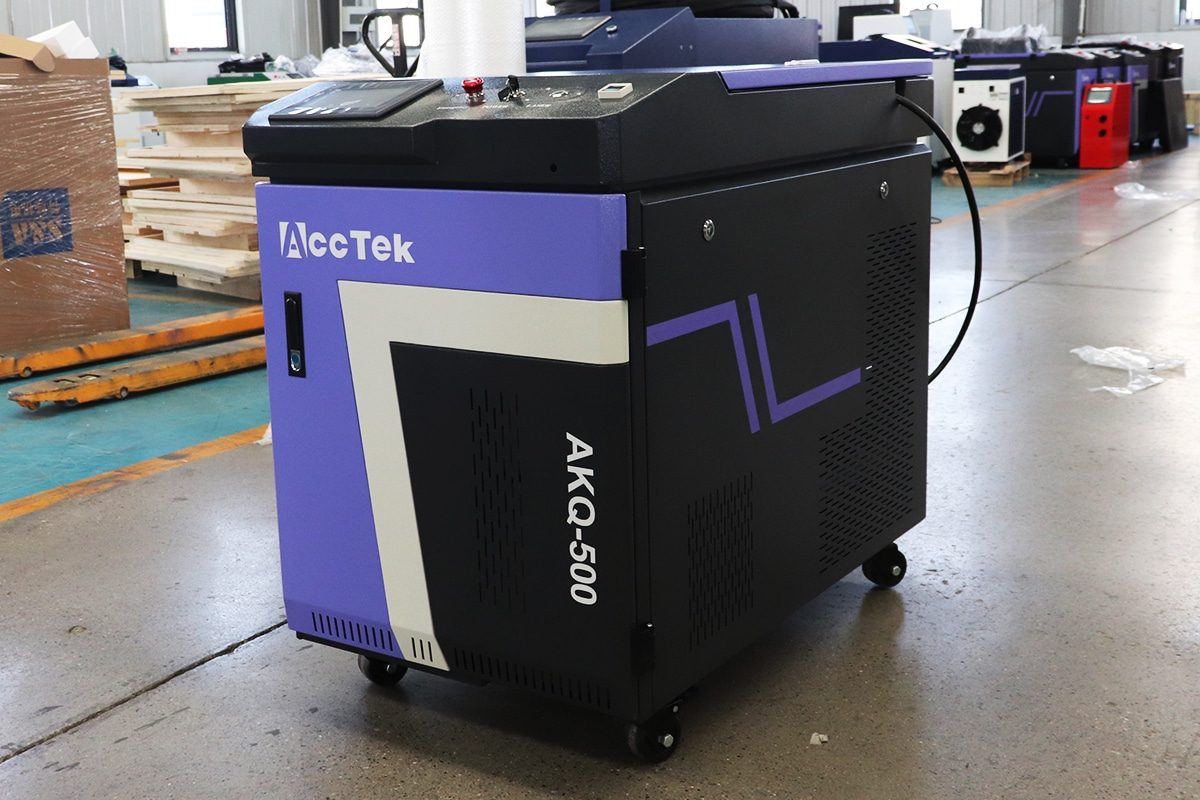
Applications of Pulsed Laser Cleaning
Surface cleanliness directly affects manufacturing quality, equipment reliability, and the performance of protective coatings and bonded joints. Rust, oxides, paint, oil, and production residues can interfere with processing, weaken adhesion, and complicate maintenance. Pulsed laser cleaning provides a precise, non-contact method for removing these unwanted layers, making it a valuable tool for applications ranging from industrial surface preparation to specialized restoration.
Unlike continuous-wave systems, pulsed lasers deliver energy in short bursts with high peak power. When the beam interacts with a surface, absorbed energy can cause contaminants or coatings to vaporize, break apart, or detach through rapid thermal expansion. By adjusting pulse duration, pulse energy, repetition rate, and scanning conditions, operators can control the cleaning action. Appropriate settings help remove the targeted layer while limiting heat buildup and unwanted changes to the underlying material. This selectivity is particularly useful when cleaning thin coatings, intricate components, or surfaces requiring dimensional accuracy.
Applications extend across automotive manufacturing, aerospace, energy production, tooling, and general industrial maintenance. Common tasks include rust and oxide removal, selective paint stripping, mold cleaning, and preparation before welding, adhesive bonding, or coating. In battery manufacturing, laser cleaning can prepare selected joining areas for more consistent welding. Beyond manufacturing, pulsed lasers also support cultural heritage conservation, where carefully developed processes remove deposits from suitable historic surfaces. Each application requires a cleaning approach matched to the substrate, unwanted layer, and desired surface condition.
Pulsed laser cleaning can reduce reliance on abrasive media and chemical cleaning agents while supporting localized treatment and automated production. However, its effectiveness depends on material compatibility, contaminant thickness, surface geometry, and process settings. Understanding these factors helps identify where the technology offers practical advantages. This article explores the principal applications of pulsed laser cleaning, explaining how its controlled material removal capabilities address different cleaning and surface preparation requirements.
Table of Contents
Understanding Pulsed Laser Cleaning
Pulsed laser cleaning uses short bursts of laser energy to remove unwanted material from a surface. Depending on the application, this material may include rust, oxide films, paint, oil, carbon deposits, or manufacturing residues. By controlling how energy reaches the workpiece, the process can treat selected areas without physical contact between a cleaning tool and the surface. This makes it useful for surface preparation, equipment maintenance, component refurbishment, and specialized restoration.
The cleaning action depends on the interaction between the laser, the unwanted layer, and the underlying substrate. Material removal can involve heating, decomposition, mechanical separation, and pressure effects, often acting together. Understanding these mechanisms—and the conditions under which they occur—is essential for selecting a suitable cleaning method and achieving the required surface condition.
How Pulsed Laser Cleaning Works
A pulsed laser releases energy in discrete bursts. Optical components direct the beam toward the workpiece, while a scanning system or controlled movement distributes successive pulses across the treatment area. Each location receives a defined pattern of exposure determined by the pulse frequency, scanning speed, beam size, and overlap between adjacent scan paths. Material is removed progressively, with additional passes used when necessary to reach the required cleaning depth.
When the surface layer absorbs laser energy, its temperature and internal stresses can rise rapidly. Depending on the material and processing conditions, the layer may vaporize, decompose, fracture, or detach. Removal does not always require complete vaporization: a coating can also separate as fragments. The resulting gases, aerosols, and particles must be collected through suitable extraction near the cleaning area.
Several parameters describe the energy delivery. Pulse energy is the energy contained in an individual burst, pulse duration is its length, and repetition rate is the number of pulses emitted per second. Fluence describes pulse energy per unit area at the surface. Together with beam shape and scanning conditions, these parameters determine removal intensity and heat accumulation. Average power alone therefore provides an incomplete basis for comparing cleaning systems.
Principal Removal Mechanisms
Pulsed laser cleaning can involve several mechanisms simultaneously. Their relative contributions depend on the coating’s composition, thickness, and adhesion, as well as the substrate properties and laser parameters. Experiments on multilayer paint removal demonstrate that ablation, thermal stress, and plasma action can interact throughout the process.
Thermal Ablation and Decomposition
Thermal ablation occurs when absorbed laser energy heats material sufficiently to remove it through processes such as vaporization and rapid material ejection. Short pulses concentrate energy into a brief interval, allowing intense localized heating while limiting the time available for heat to spread during each pulse.
Organic coatings and contaminants may also undergo thermal decomposition, in which their compounds break down into gases, particles, and other products. Paint removal can consequently involve both chemical breakdown and physical ejection. Insufficient treatment may leave altered residues, while excessive exposure can heat the underlying substrate. Research on aircraft paint removal identifies thermal ablation as an important mechanism and demonstrates the influence of processing conditions on cleaning quality.
Thermal Stress and Spallation
Rapid heating causes materials to expand. When a coating and substrate expand differently, stresses develop within the coating and along their interface. If these stresses exceed the layer’s strength or its adhesion to the substrate, cracking, lifting, and detachment can occur.
Spallation refers to material separation associated with stress waves and tensile stresses. It can eject fragments without requiring the entire layer to vaporize. Its effectiveness depends on the mechanical properties of the materials, the strength of their interface, and the rate of energy deposition. Experimental studies of oxide removal show that changing laser energy density can shift the balance between ablation and stress-driven separation.
Plasma and Pressure Effects
At sufficiently high intensity, the laser interaction can generate an ionized plume, or plasma, above the surface. Rapid expansion of vapor and plasma creates pressure that can assist material ejection and dislodge nearby fragments. Vaporization also produces recoil pressure, adding a mechanical contribution to removal.
These effects can help cleaning, but their influence is not always beneficial. A dense plume may absorb or scatter incoming laser energy, reducing the amount reaching the surface. This plasma shielding can affect removal depth and uniformity. Research on composite paint layers demonstrates that pulse overlap influences the interaction between ablation, plasma pressure, and shielding, making their combined behavior important to process optimization.
Selective Cleaning and Processing Windows
Selective cleaning means removing the unwanted layer while preserving the substrate properties required for its intended use. Differences in optical absorption, thermal response, adhesion, and resistance to material removal can make this possible. However, selectivity must be established for the particular coating–substrate combination; it is not an automatic property of pulsed laser exposure.
The processing window is the range of parameter combinations that produces adequate cleaning without unacceptable surface changes. Below this window, contamination may remain, or removal may be uneven. Above it, treatment may cause melting, pitting, discoloration, excessive roughening, or other modifications. Experimental investigations identify distinct regimes of incomplete cleaning, effective removal, and substrate damage, illustrating why a validated operating range is necessary.
This window depends on more than single-pulse fluence. Pulse duration, repetition rate, scanning speed, line spacing, and repeated passes determine the cumulative exposure. As a coating becomes thinner, later pulses increasingly interact with the exposed substrate. Excessive overlap can also produce thermal accumulation, even when individual pulses are short.
Representative trials should therefore assess both removal completeness and substrate condition. Depending on the application, useful checks may include microscopy, residual contamination measurements, surface roughness, composition, and mechanical properties. A clean-looking surface alone may not demonstrate that the required processing window has been maintained.
Types of Pulsed Laser Cleaning
Pulsed laser cleaning can be classified according to how laser energy is coupled into the cleaning process. Direct dry cleaning, liquid-assisted cleaning, and laser-induced shock-wave cleaning use different routes to detach or remove unwanted material.
Dry pulsed laser cleaning directs laser pulses onto a surface without deliberately applying a liquid film. Energy absorbed by the contamination, coating, or substrate produces ablation, decomposition, thermal expansion, or mechanical detachment. This approach is used in industrial systems for tasks such as rust removal, coating removal, and surface preparation. Although it avoids liquid cleaning media, the removed material still requires collection.
Liquid-assisted or steam laser cleaning introduces a thin liquid layer before irradiation. Rapid laser heating causes the liquid to evaporate explosively, generating pressure and acoustic forces that help detach particles. Research has demonstrated this approach for removing small particles from solid surfaces. Its suitability depends on controlling the liquid layer and confirming compatibility with the substrate and subsequent processing.
Laser-induced shock-wave laser cleaning uses a laser-generated pressure wave to remove contamination. In some configurations, laser-induced breakdown occurs near the surface, and the expanding shock wave pushes particles away. This differs from relying primarily on direct irradiation to ablate a coating. Experimental work has investigated the technique for removing fine particles from silicon wafers and other surfaces, making it relevant to specialized precision-cleaning applications.
These process types can also be delivered through different equipment configurations. Handheld systems allow an operator to guide the cleaning head across accessible surfaces, while automated workstations and robotic systems control beam position and movement for repeatable treatment. Automation can move the scanner around a fixed component or move the component beneath a stationary scanner. The delivery arrangement affects access, consistency, and production integration rather than defining a separate removal mechanism.
Pulsed and Continuous-Wave Cleaning
Pulsed and continuous-wave lasers differ in how they deliver energy. A continuous-wave laser supplies a sustained beam during operation, while a pulsed laser concentrates energy into separate bursts. Pulsed operation can provide high instantaneous power at a lower average power, offering useful control over material removal and substrate heating. However, closely spaced or overlapping pulses can still cause substantial heat accumulation.
Pulsed laser cleaning systems are often suitable for applications where controlled layer removal and preservation of surface condition are priorities. Adjustable pulse characteristics can help balance cleaning effectiveness against thermal and mechanical effects. Comparative paint-removal experiments have demonstrated that pulse duration, repetition rate, and scanning speed influence both substrate condition and removal efficiency.
Continuous-wave laser cleaning systems can also clean effectively, including the removal of corrosion from substantial steel structures. Their sustained energy delivery makes scanning speed and heat management especially important. Neither operating mode is universally faster or more suitable: performance depends on the unwanted layer, substrate, available power, beam characteristics, and acceptable surface changes. Selection should follow application trials that compare cleaning quality, throughput, and the condition of the treated component.
Pulsed laser cleaning removes unwanted surface material through interacting thermal, mechanical, and pressure-driven effects. Its effectiveness depends on matching the cleaning method and energy delivery to the coating, contaminant, and substrate. Dry, liquid-assisted, and shock-wave approaches offer different ways to achieve removal, while handheld and automated systems provide different delivery options. A validated processing window is essential for balancing cleanliness, productivity, and surface preservation. These fundamentals provide the basis for understanding where pulsed laser cleaning offers practical advantages across manufacturing, maintenance, refurbishment, and restoration applications.
Surface Preparation for Welding, Bonding, and Coating
Surface preparation is one of the most important applications of pulsed laser cleaning. Oils, oxides, corrosion products, processing residues, and unwanted coatings can interfere with joining, reduce adhesive strength, and weaken protective coating adhesion. Pulsed lasers provide a controlled method for removing these materials from selected areas, helping manufacturers establish more consistent conditions before subsequent processing. Applications range from cleaning weld seams and adhesive tracks to preparing components for painting and removing contamination from electrical connection areas.
The objective is to produce the surface condition required by the next operation. A welding process may need reduced organic contamination, an adhesive joint may require suitable chemistry and texture, and a protective coating may need a specified surface profile. Effective laser preparation therefore combines selective removal, control of substrate changes, and verification against the final application’s requirements.
Welding and Brazing Applications
Pulsed laser cleaning can be integrated before joining or used afterward to remove selected process residues. Its localized action allows treatment along a weld path or joining interface while limiting exposure of surrounding areas. Automated scanning also makes it possible to coordinate cleaning with component positioning and subsequent joining operations.
Cleaning Before Joining
Before welding, pulsed laser cleaning can remove oils, oxidation, phosphate layers, and other residues from the intended joint area. These materials may introduce gases, inclusions, or inconsistent surface conditions during welding. Removing them can reduce contamination-related variability and support more stable joining. Typical applications include cleaning automotive components, gears, fabricated metal assemblies, and battery joining areas. The treatment must match the material and welding process because acceptable surface conditions differ between applications.
For battery connections, surface preparation can also improve consistency in weld monitoring. Residues of varying thickness can influence the optical signals used to evaluate a weld, complicating the distinction between acceptable joints and suspected defects. Cleaning selected joining areas before welding can reduce this source of variation, although weld quality still depends on fit-up, joining parameters, and component condition.
In brazing, surface preparation is particularly important for filler-metal wetting and spreading. Pulsed laser treatment can remove oxide barriers before joining, but the benefit depends on preserving the prepared condition. Aluminum, for example, readily reoxidizes after oxide removal. Research on laser-assisted brazing demonstrates that oxide removal and control of the joining atmosphere can work together to enable wetting under specifically developed conditions. Laser cleaning should therefore be evaluated as part of the complete brazing process, including flux and atmosphere requirements.
Cleaning After Welding
After welding, pulsed lasers can remove heat tint, oxide layers, and certain welding by-products from the weld bead and surrounding surface. This can improve appearance and prepare the area for inspection, painting, or further surface treatment. Removal efficiency varies between deposits: a thin oxide film and a thicker slag residue may respond differently and require different settings or complementary treatment.
For stainless steel, post-weld treatment also requires attention to corrosion performance. Removing visible discoloration alone does not establish that the required surface properties have been restored. Laser parameters influence oxide removal, surface morphology, and the condition of the resulting oxide film. Studies on welded stainless steel demonstrate that appropriately developed laser treatments can improve corrosion resistance, emphasizing the importance of validating the final surface rather than relying solely on appearance.
Adhesive Bonding Applications
Adhesive bonding depends on the condition of the interface between the adhesive and the substrate. Pulsed laser treatment can prepare that interface by removing contamination and, where appropriate, modifying surface texture and chemistry. Its ability to follow a defined bonding track makes it useful for localized preparation of components and assemblies.
Removing Adhesion-Inhibiting Contamination
Lubricants, silicone films, handling residues, and other contaminants can prevent effective adhesive contact or create weak interfacial regions. Some contamination is too thin to identify reliably through visual inspection. Pulsed laser cleaning can remove these layers from selected bonding areas, provided the exposure is sufficient to achieve removal without leaving degraded residues or damaging the substrate.
Cleaning conditions must account for the contaminant’s composition and distribution. A process developed for machining lubricant may perform differently on silicone contamination or residual adhesive. Investigations of contaminated aluminum surfaces show that bond quality depends on the interaction between cleaning, surface morphology, and surface energy, supporting the need to validate each material–contaminant–adhesive combination.
Combining Cleaning With Surface Modification
Pulsed lasers can combine contaminant removal with controlled surface modification. Suitable parameters can produce microstructures that improve adhesive wetting and provide additional opportunities for mechanical interlocking. This allows cleaning and texturing to occur within the same localized treatment sequence, which can simplify integration into an automated production line.
The target is a texture suited to the adhesive and joint design, rather than maximum roughness. Laser processing can produce different surface structures, and their effects depend on how the adhesive interacts with them. Excessive treatment may also create undesirable surface changes. Research on aluminum bonding surfaces demonstrates that varying laser conditions produce distinct microstructures, making parameter selection an important part of developing the bonding process.
Verifying Bonding Performance
Verification should connect surface preparation to the performance of the completed joint. Surface measurements, including contact angle, roughness, and chemical analysis, can help characterize treatment consistency. However, these measurements should be correlated with mechanical testing using the intended adhesive, substrates, curing conditions, and joint geometry. Lap-shear testing is one useful approach, while other joint designs may require peel or fracture testing.
Durability is equally important. A joint that performs well immediately after curing may respond differently after moisture exposure, elevated temperature, or repeated loading. Qualification should therefore include relevant environmental conditioning and examination of failure behavior. Studies of laser-pretreated aluminum joints have evaluated strength after hydrothermal aging and resistance to fatigue crack growth, demonstrating why long-term performance belongs in the assessment. The interval and handling conditions between preparation and bonding should also be controlled to maintain repeatability.
Preparation Before Painting and Protective Coating
Before painting or protective coating, pulsed laser cleaning can remove rust, unwanted paint, oxides, and other surface deposits. It is useful for localized refurbishment, where only selected areas require stripping or preparation. The process can also be applied to components before other coating operations, including certain thermal-spray and deposited-coating applications.
Successful preparation requires attention to both cleanliness and surface profile. A surface may be visibly free of rust yet retain dust, salts, oil, or an unsuitable texture. Protective coating performance depends on these conditions as well as the coating system itself. Preparation requirements should therefore follow the intended coating specification, including the required profile and acceptable contamination levels.
Soluble salts deserve particular attention in marine and other corrosive environments. Their presence should be assessed separately rather than inferred from the removal of visible corrosion or paint. Where necessary, additional cleaning should address remaining contamination before coating application. Coating manufacturers identify salt contamination as a contributor to blistering and corrosion, reinforcing the need to verify the prepared surface.
Laser parameters must also avoid creating an unfavorable surface condition. Excessive thermal exposure can generate new oxides that affect subsequent deposition or adhesion. Research combining laser cleaning with zinc cold spraying illustrates this balance: corrosion removal supported coating performance, while laser-induced oxidation could reduce deposition efficiency. Representative coated samples should therefore be assessed for adhesion and relevant exposure performance. After preparation, handling and coating schedules should protect the surface from renewed contamination and corrosion.
Preparation of Electrical Contact Areas
Pulsed laser cleaning can prepare selected areas of battery terminals, busbars, and other electrical connection components by removing organic residues and unwanted surface films. Applications include preparation before welding and ultrasonic ribbon bonding, as well as treatment of certain mechanically assembled contact surfaces. Controlled cleaning or structuring can improve the condition of the interface through which current passes.
Preserving functional surface layers is essential. Nickel or other metallization may be part of the component’s electrical, corrosion, or joining design and should remain intact where required. Research on cylindrical battery terminals demonstrates that a validated pulsed laser process can reduce organic contamination while preserving nickel metallization and supporting improved ribbon bondability. The cleaning objective is therefore selective contaminant removal, with explicit limits on acceptable changes to the component.
Oxide removal also requires careful control because laser heating can cause melting or reoxidation under some conditions. Consequently, a brighter surface does not automatically indicate a better electrical interface. Verification should include the completed connection: contact resistance measurements, such as the four-wire method, can assess electrical performance, while welded or bonded connections also require appropriate mechanical evaluation. Assembly conditions, including contact pressure and temperature, should be considered because they influence measured resistance and service behavior.
Pulsed laser cleaning supports welding, brazing, adhesive bonding, coating, and electrical assembly by preparing selected surfaces for their next operation. Its value comes from controlled removal of unwanted layers and, where appropriate, carefully developed surface modification. Reliable results require application-specific parameters and protection of the prepared surface during handling and assembly. Verification should address the finished product’s needs: sound joints, durable adhesive bonds, adherent protective coatings, and dependable electrical connections. Treating laser cleaning as an integrated manufacturing step helps translate surface preparation into consistent component performance.
Rust, Oxide, Scale, and Residue Removal
Removing rust, oxides, scale, and process residues is a major application of pulsed laser cleaning. These unwanted layers can interfere with manufacturing, obscure surface defects, reduce coating adhesion, and complicate component maintenance. Pulsed lasers deliver concentrated energy to selected areas, allowing deposits to be removed through a combination of ablation, decomposition, and mechanical detachment. Applications range from cleaning corroded steel parts to removing oxide films from nonferrous metals and eliminating residues from production surfaces.
Each deposit presents a different cleaning challenge. Loose rust behaves differently from dense mill scale, while a thin lubricant film responds differently from baked-on carbon. Effective treatment therefore begins with identifying the unwanted material, understanding the underlying surface, and defining the required endpoint. The aim is to achieve suitable cleanliness while preserving the component’s dimensions, finish, and functional properties.
Rust Removal From Steel Components
Pulsed laser cleaning can remove corrosion products from steel components during maintenance, refurbishment, and preparation for further processing. Typical applications include fabricated assemblies, machinery components, structural connections, and areas requiring localized repair. Controlled scanning allows treatment to follow the affected region, making the process useful where access and selective removal are important.
Rust removal depends on the corrosion layer’s thickness, composition, adhesion, and distribution. Rapid energy absorption can cause material to ablate or separate through thermal stresses. Multiple passes may be necessary where corrosion is uneven or tightly attached. Experimental work on mild steel shows that removal depth changes with laser power, scanning speed, and the number of passes, illustrating the importance of coordinating these parameters.
Pitted and irregular surfaces require particular attention because deposits can remain in recesses after surrounding areas have been exposed. Cleaning should provide sufficient coverage of these locations while controlling repeated irradiation of already-cleaned steel. Excessive energy input can produce remelting, secondary oxidation, or other surface changes. The exposed surface can also reveal existing pits and discontinuities that need separate assessment during refurbishment.
Verification should consider residual corrosion, surface profile, and the requirements of the next operation. Where salt contamination is relevant, its removal should be assessed separately from visible rust removal. Studies of corroded structural steel treat rust, roughness, and soluble salts as distinct preparation criteria. After cleaning, appropriate handling and subsequent protection help maintain the prepared surface condition.
Oxide Removal From Nonferrous Metals
Pulsed lasers can remove unwanted oxide films from nonferrous metals, including aluminum, copper, and titanium alloys. Such treatment is useful before selected joining, coating, and electrical assembly operations. However, the optical and thermal behavior of each metal–oxide combination differs, so parameters developed for one alloy or surface condition require verification before being transferred to another.
On aluminum alloys, oxide removal can prepare selected joining areas, but exposure must be controlled carefully. Research on aluminum oxide cleaning identifies changes in the removal mechanism as laser energy density increases, demonstrating that effective treatment depends on a suitable operating range. Reoxidation also matters: an aluminum surface prepared for joining must be managed as part of the complete manufacturing sequence.
Copper oxide removal is relevant to solderability and electrical applications. Pulsed laser treatment can remove oxide layers, but pulse duration and fluence influence substrate heating and the resulting surface condition. Comparative research using femtosecond and nanosecond pulses shows that oxide removal can be accompanied by different levels of melting and reoxidation. A brighter appearance alone therefore provides insufficient evidence of the required electrical or joining performance.
Titanium alloys also require control of energy input and atmospheric interaction. Experiments on titanium oxide removal demonstrate that excessive laser fluence can generate new oxides after the original film has been removed. Process development should consequently evaluate residual oxide, roughness, and the intended surface function. Where oxide removal is required, the endpoint should be defined for the application rather than assumed to mean a permanently oxide-free surface.
Mill Scale and Manufacturing Oxides
Mill scale forms on steel during hot rolling, while related oxide layers develop during other high-temperature manufacturing operations. These deposits can be compact, layered, and strongly attached. Their response to laser cleaning can therefore differ substantially from that of loose atmospheric rust. Investigations of oxidized steel components show that removal conditions must account for the deposit and its adhesion to the substrate.
Pulsed laser treatment can remove manufacturing oxides through interacting ablation and stress-driven separation. Pulse energy, repetition rate, scanning pattern, and repeated passes affect both removal completeness and heat accumulation. Research on hot-rolled steel scale demonstrates that some parameter combinations leave substantial oxide residues, emphasizing the need to establish conditions for the actual scale thickness and composition.
The endpoint should be assessed across the entire treatment area, including transitions between heavily oxidized and already-exposed metal. Microscopy, surface composition measurements, and roughness checks can help establish whether the required condition has been reached. For automated production, techniques such as laser-induced breakdown spectroscopy have been investigated to monitor oxide removal during processing. These approaches support more consistent treatment of variable manufacturing surfaces.
Oil Films, Carbon, and Process Residues
Pulsed laser cleaning can remove thin lubricant films and organic residues remaining after rolling, forming, machining, or handling. Their removal involves a combination of heating, evaporation, decomposition, and material ejection. Performance depends on the lubricant’s absorption characteristics, film thickness, and behavior during rapid heating. Research on metal surfaces demonstrates that liquid lubricant films introduce additional thermal and fluid effects that must be considered during process development.
Successful oil removal requires sufficient exposure without excessive thermal accumulation. Under unsuitable conditions, organic material can burn or carbonize, leaving an altered residue. A study of press-oil removal from aluminum demonstrated effective cleaning within an optimized parameter range, while excessive overlap or power promoted localized burning and carbonization. Surface analysis was used to verify the disappearance of lubricant-related chemical features.
Carbonaceous deposits present a different challenge because they may be thick, uneven, and strongly attached after prolonged service. Pulsed laser cleaning has been investigated for removing deposits from diesel engine pistons and nickel-based alloy surfaces. Treatment must account for variations in deposit thickness and the properties of the underlying component, particularly where preserving surface finish is important. Residual contamination and substrate condition should be evaluated together when establishing the cleaning endpoint.
Other applications include removing molding residues, release-agent deposits, and residual adhesive. Cleaning can help restore tooling surfaces or prepare components for reuse and subsequent processing. These tasks require material-specific trials because residues differ in composition and removal behavior. For example, ultrashort pulsed laser treatment has been investigated for removing residual epoxy adhesive from aluminum substrates before rebonding. Collection of the generated fumes and particles remains part of the cleaning process.
Protecting Functional Surface Layers
Many components contain surface layers that provide useful properties and must remain after cleaning. Examples include metallic plating, anodized finishes, protective coatings, and deliberately engineered surface textures. Defining which layer should be removed—and which must be retained—is therefore essential before selecting laser parameters.
Preserving a functional layer requires a validated separation between effective contaminant removal and unacceptable modification of that layer. Thin coatings may leave little margin for excessive exposure. Research on cylindrical battery terminals demonstrates that a suitably developed pulsed laser process can reduce organic contamination while preserving nickel metallization. Such results support selective cleaning for a defined material system rather than a universal assumption of coating compatibility.
The substrate’s finish and material properties also matter. A polished tool, fitted surface, or wear component may require limits on roughness, dimensional change, and thermal effects. Studies of steel cleaning show that unsuitable exposure can alter surface profile, hardness, and corrosion behavior. Representative trials should therefore assess the properties that determine whether the component remains fit for its intended use.
Verification should match the function being preserved. Relevant checks may include coating continuity and thickness, surface roughness, microscopy, chemical composition, or application-specific performance testing. The required endpoint is a sufficiently clean surface that retains its intended protective, electrical, mechanical, or tribological behavior.
Pulsed laser cleaning offers a controlled method for removing rust, oxide films, mill scale, oil, carbon, and other process residues. Each application requires settings matched to the deposit, substrate, geometry, and required surface condition. Reliable results depend on balancing removal completeness with limits on heating and material modification. Verification should assess remaining contamination and the properties needed for subsequent processing or continued service. Identifying and preserving functional surface layers is especially important when cleaning coated, plated, polished, or otherwise engineered components.
Paint, Coating, and Selective Layer Removal
Pulsed laser cleaning provides a controlled method for removing paint and other coatings during manufacturing, maintenance, and component refurbishment. Short pulses deliver concentrated energy to the treatment area, causing unwanted material to ablate, decompose, or detach. Applications include stripping deteriorated finishes, exposing metal before joining, and removing coatings from selected connection areas. Because treatment can follow a defined pattern, manufacturers can prepare specific regions while retaining useful coating elsewhere on the component.
Successful coating removal requires a clear definition of the intended endpoint. Some applications require complete stripping to the substrate, while others involve removing only a topcoat or exposing a narrow assembly area. The process must therefore balance removal completeness, treatment speed, and preservation of the underlying material or retained layers.
Removing Industrial Paint and Coatings
Pulsed lasers can remove industrial paint, powder coatings, electrodeposited coatings, and selected insulating or conversion coatings from metal components. Applications include automotive parts, machinery assemblies, electrical components, and equipment undergoing refurbishment. Each coating requires appropriate process development because its composition, thickness, and interaction with the substrate influence removal behavior.
Removal usually involves several interacting mechanisms. Absorbed energy can break down organic binders, generate vapor and particles, and create stresses that separate coating fragments. Research on polyacrylate paint demonstrates contributions from chemical bond breakdown, thermal expansion, and plasma-related mechanical effects. Consequently, effective stripping does not necessarily require the entire coating to vaporize.
Coating appearance alone does not reliably predict its response. Pigments and binders influence absorption at the operating wavelength, while some coatings transmit enough energy for the substrate to participate in detachment. Experiments on a relatively transparent polymeric paint over aluminum illustrate this challenge. Parameters must therefore be established for the actual coating–substrate combination, with checks for remaining paint, altered residues, and unacceptable substrate changes.
Selective Removal From Defined Areas
Selective area removal exposes only the regions needed for subsequent manufacturing or assembly. Examples include stripping paint along weld seams, removing insulating coatings from copper hairpins, and exposing grounding areas on battery enclosures. The surrounding coating can continue to provide corrosion protection, insulation, or the required appearance. This makes localized stripping useful when a component benefits from broad coating coverage but needs selected bare surfaces.
In suitable production workflows, laser removal can replace some masking operations. A manufacturer can coat the complete component and then remove the coating from specified locations. This approach can simplify preparation where applying, positioning, and removing masks would otherwise require substantial labor. Its suitability depends on the coating thickness, required cycle time, and acceptable condition of the exposed area.
Accurate treatment also depends on beam positioning and access. Scanner optics, fixtures, and robotic movement can guide the beam across repeatable patterns and three-dimensional components. Process qualification should check the treatment boundary as well as the center of the stripped region, confirming adequate removal without unacceptable modification of adjacent coating. The required accuracy must be established for the actual component geometry and delivery system.
Removing Individual Layers
Removing an individual layer requires control of depth as well as the treatment area. A multilayer paint system may contain a topcoat, primer, and underlying pretreatment, each serving a different purpose. During maintenance, the objective may be to remove the deteriorated outer coating while retaining a serviceable primer. Alternatively, the specification may require complete paint removal while preserving the surface beneath it.
Layer-by-layer removal is possible when the process can distinguish between the responses of successive materials. However, the laser does not automatically stop at a coating boundary. Variations in thickness and accumulated exposure can cause some locations to reach the underlying layer before others. A validated process therefore needs an endpoint appropriate to the particular coating system.
Monitoring can help identify these transitions. Research on aircraft coatings has demonstrated laser-induced breakdown spectroscopy, or LIBS, for tracking characteristic elemental signals as topcoat and primer are removed. Such measurements can support decisions about continuing, adjusting, or stopping treatment. The signals and stopping criteria require calibration for the relevant materials; a monitoring method developed for one paint system cannot be assumed to identify every layer in another.
Repair, Recoating, and Component Recovery
Pulsed laser stripping can support repair by removing damaged coatings from selected areas and preparing components for inspection or refinishing. Applications include exposing weld regions for examination, cleaning deteriorated protective finishes, and preparing valuable parts for refurbishment. Localized treatment can be particularly useful where access is practical and only a limited area requires removal. NASA field evaluations investigated these uses on structures, ground equipment, and aerospace components.
Before recoating, the exposed surface must satisfy the requirements of the replacement coating system. Evaluation should consider residual material, surface condition, and adhesion of the newly applied coating. Research on coated bridge steel found acceptable subsequent coating adhesion under the conditions investigated, even though microscopy revealed small residual particles. This illustrates why acceptance should follow demonstrated coating performance and the applicable preparation specification.
Component recovery also depends on preserving the substrate. Thin sections and composite structures require particular care because excessive exposure can compromise the material beneath the paint. Research using femtosecond pulses on coated carbon-fiber composites demonstrated successful removal under specifically developed conditions, supported by examination of surface and subsurface integrity. Such results reinforce the need to qualify the laser source and treatment parameters for the component being recovered.
Thick and Hazardous Coatings
Thick coatings present a greater removal burden because more material must be detached or ablated. Multilayer marine and protective coating systems may require substantial cumulative exposure, making pulse overlap, scanning strategy, and heat accumulation important. Research on approximately one-millimeter-thick marine coatings demonstrates that nanosecond pulsed cleaning can achieve complete removal under developed conditions, while emphasizing the balance between adequate energy input and substrate thermal effects.
Practical suitability also depends on the treatment area and available equipment. A process that works effectively on a small repair region may provide insufficient throughput for a large structure. NASA evaluations found thick structural coatings challenging for the portable systems tested. Representative trials should therefore establish both removal quality and achievable productivity before selecting laser stripping for an extensive project.
Hazardous coatings require assessment of their composition and removal products. Older paints and primers may contain lead or hexavalent chromium compounds. Laser stripping can reduce the need for added blasting media or chemical strippers, but hazardous constituents still require controlled collection and handling. Evaluations of lead-coated bridge steel found that collected laser-removal waste required hazardous-waste management.
Suitable extraction and treatment of emissions are therefore integral to the application. Controls should address the particles, fumes, and vapors produced by the actual coating, with exposure assessment used to verify their effectiveness. Collected debris and contaminated filters also require appropriate handling. These measures allow the benefits of localized stripping to be evaluated alongside the complete requirements for operating and maintaining the process.
Pulsed laser cleaning supports complete paint stripping, localized coating removal, and controlled removal of individual layers. Its applications include manufacturing preparation, repair, recoating, and component recovery. Reliable results depend on matching the laser and scanning conditions to the coating system, defining the removal endpoint, and verifying the properties of exposed or retained surfaces. Thick coatings require particular attention to productivity and accumulated heating, while hazardous coatings require effective emission collection and waste handling throughout the operation.
Mold, Die, and Precision Tool Cleaning
Molds, dies, and precision tools accumulate residues during repeated production cycles. Release agents, polymer deposits, rubber compounds, resin residues, lubricants, and other contaminants can obscure surface details, interfere with material release, and affect finished-part quality. Pulsed laser cleaning provides a localized, noncontact method for removing these deposits from suitable tooling surfaces. Applications include maintaining molding cavities, cleaning composite manufacturing tools, restoring printing-roll cleanliness, and removing buildup from production fixtures.
The objective is to restore the tool’s required working condition while preserving its geometry, finish, and functional surface treatments. Cleaning parameters must account for the deposit, tool material, surface coating, and accessibility of the affected area. A successful process therefore combines effective residue removal with verification that the tool remains suitable for continued production.
Tire and Rubber Mold Cleaning
Tire molds require regular cleaning to remove release agents and residues generated during vulcanization. Deposits can accumulate around tread features, sidewall engravings, and venting structures, affecting the appearance and consistency of molded tires. Pulsed laser cleaning can follow these detailed surfaces, removing contamination through controlled exposure. Its localized action is particularly useful for molds containing fine textures and delicate features that require careful maintenance.
Similar applications include cleaning molds used to manufacture seals, O-rings, and other rubber components. Release-agent films and product residues can be removed from accessible working surfaces, helping restore cavity cleanliness between production runs. However, deep undercuts, narrow holes, and strongly adhered deposits can limit treatment effectiveness. Tool positioning and beam access must therefore be assessed rather than assuming that every internal feature receives adequate cleaning.
Preserving protective coatings is especially important on plated molds. Research on chromium-plated steel tire molds demonstrated that excessive energy density or repeated pulse exposure could crack and thin the chromium layer. Qualification should consequently examine both residue removal and coating integrity, including the effects of repeated cleaning cycles. A visibly clean cavity alone does not establish that its protective surface remains intact.
Injection Molds and Forming Tools
Injection molds can develop deposits from molding materials and release agents, particularly after repeated processing. Pulsed laser cleaning can treat accessible cavity surfaces and inserts to remove unwanted buildup. This supports maintenance of the surface condition responsible for reproducing part details and finishes. Handheld systems suit selected maintenance tasks, while automated arrangements can provide repeatable treatment across frequently cleaned regions.
Polished cavities and deliberately textured surfaces require particular care. Their finish contributes directly to the appearance and function of the molded product, so cleaning should preserve the required microstructure and surface profile. Trials should establish sufficient exposure to remove deposits while limiting roughening, melting, discoloration, or changes to retained coatings. Inspection of representative molded parts can help confirm that cleaning has preserved the intended production result.
For forming tools and dies, relevant cleaning tasks include removing drawing oils, grease, oxides, and selected production residues. Localized treatment can concentrate on contaminated working areas while respecting the tool’s designed contact geometry. The required endpoint should account for surface finish and subsequent lubrication requirements. Cleaning results should also be distinguished from existing wear or damage, which may require separate tool repair. Industrial mold-cleaning systems are offered for these residue-removal applications, with settings developed for the individual task.
Composite Manufacturing Molds
Molds used to manufacture composite parts can accumulate cured resin and release-agent residues over successive cycles. These deposits can affect the tool surface and the quality of subsequent components. Pulsed laser cleaning has been investigated for removing crosslinked epoxy residues from resin-transfer-molding tools, including nickel tooling, before applying a fresh external release agent and returning the mold to service.
Composite manufacturing tools may themselves be metallic or made from fiber-reinforced materials. Industrial applications include cleaning steel, aluminum, and nickel molds used to produce composite components. Large tools can be treated using coordinated scanner and robotic movement, allowing cleaning to follow the required surface area. The tool’s construction and finish determine the acceptable processing conditions; manufacturing composite parts does not imply that every mold has the same cleaning response.
Tools made from composite materials require additional attention to their resin matrix and reinforcing fibers. Research on release-agent removal from glass-fiber-reinforced polymer shows that laser parameters influence fiber integrity and surface roughness. Conditions established for metallic tooling should therefore be requalified before use on composite tooling, with checks appropriate to the material and any retained surface coating.
Release-agent removal must also fit the manufacturing procedure. A maintenance operation may require stripping accumulated deposits and rebuilding the release system, whereas another may require retaining a functional layer. Research on release-agent-coated steel demonstrates that laser treatment can change wettability, roughness, and near-surface properties. Acceptance should therefore consider the condition needed for release-agent application, demolding, and finished-part quality.
Printing Rolls and Production Fixtures
Pulsed laser cleaning is used to remove dried ink, adhesive, primer, and coating residues from suitable anilox rolls and sleeves. These rolls contain engraved cells that meter material during printing or coating. Deposits occupy usable cell volume and can interfere with consistent transfer. Removing the buildup helps restore the roll’s working capacity and supports more stable ink densities or coating weights.
Dedicated systems coordinate roll movement and laser scanning to distribute exposure across the engraved surface. Parameters must suit the residue and roll construction, with particular attention to preserving cell walls and surface coatings. Qualification can include microscopic examination, cell-volume measurements, and production checks after cleaning. These assessments help determine whether usable volume has been recovered while maintaining the geometry needed for consistent transfer.
Production fixtures present related maintenance opportunities. Paint-shop jigs, racks, hangers, and masking frames accumulate coatings that can interfere with electrical contact or reliable component support. Selective laser treatment can remove buildup from critical contact and locating areas. Cleaning should restore the fixture’s required function while preserving dimensions and any retained protective layers. Applications also include removing deposits from workpiece carriers used in coating equipment.
In-Situ and Automated Tool Cleaning
In-situ cleaning allows suitable molds to be treated while installed in the production equipment. This can reduce the handling and disassembly associated with maintenance. Industrial applications include cleaning rubber molds in vulcanization presses and integrating cleaning systems with injection molding machines. Some systems can also treat hot molds, provided the equipment and cleaning process are qualified for the relevant operating temperature and access conditions.
Automation makes it possible to repeat cleaning paths across successive maintenance cycles. Robots, gantries, or dedicated mechanisms can position the cleaning head around the tool, while controlled scanning distributes pulses over selected areas. Repeatability depends on maintaining appropriate positioning, focus, and exposure as the surface geometry changes. Automated tire-mold cleaning and large-area composite-tool cleaning illustrate established uses of this approach.
Integration must also provide effective collection of removed material and control of laser exposure. Extraction should capture generated particles and fumes near the treatment area, while suitable beam containment and interlocks protect the surrounding workspace. Cleaning schedules and acceptance checks should follow actual deposit buildup and tool-performance requirements. Monitoring the tool over repeated cycles helps confirm that the process remains effective as contamination and surface condition change.
Pulsed laser cleaning supports the maintenance of tire molds, injection molds, forming dies, composite manufacturing tools, printing rolls, and production fixtures. Its localized action and compatibility with automation make it useful for removing selected deposits and maintaining consistent working surfaces. Reliable results depend on matching exposure to the residue and tool construction, ensuring adequate access, and preserving functional coatings and fine geometry. Verification should connect surface cleanliness with practical outcomes, including consistent molded finishes, dependable release, stable material transfer, and accurate component positioning.
Automotive and Electric Vehicle Applications
Pulsed laser cleaning supports automotive manufacturing by preparing selected surfaces for welding, bonding, sealing, electrical connection, and assembly. Applications extend from conventional body and powertrain components to battery systems, electric motors, and specialized tire production. Its localized action allows manufacturers to remove unwanted contamination or coatings from defined areas while retaining useful surface layers elsewhere on the component. Automated systems can integrate these operations into production lines and repeat the required treatment across successive parts.
The cleaning objective varies considerably between components. A structural joint may require removal of lubricant or paint, a battery terminal may need contaminant removal while preserving metallization, and a tire inner liner may require preparation for adhesive bonding. Reliable implementation therefore depends on matching the process to the material, surface function, and subsequent manufacturing operation.
Body, Chassis, and Powertrain Manufacturing
In body and chassis manufacturing, pulsed laser cleaning can prepare localized welding and assembly areas by removing unwanted coatings and surface contamination. Examples include stripping electrodeposited paint from joining regions and removing aluminum–silicon coatings from selected weld areas on coated steel sheets. This selective approach allows protective coatings to remain on surrounding surfaces while exposing the regions needed for manufacturing.
Powertrain applications include cleaning joining surfaces on gears, shafts, flanges, and related assemblies. Oils, rust, and phosphate layers can interfere with the required joining conditions, making their localized removal useful before welding. TRUMPF identifies flange-tripod cleaning as one application in which laser treatment removes these unwanted layers before the joining operation.
Selective stripping can also simplify some coating workflows. Components may be coated completely and then laser-cleaned at designated assembly locations, reducing the need for masking those areas beforehand. Applications include driveshafts, pinions, and ring gears. Qualification should confirm that the exposed surface meets assembly requirements while retaining the geometry, finish, and surrounding protection needed by the component.
Battery Terminals, Tabs, and Busbars
Battery terminals, tabs, and busbars provide the electrical connections between cells, modules, and associated conductors. Oils, handling residues, and unwanted surface films can introduce variability into welding or ultrasonic bonding. Pulsed laser cleaning can prepare the small, defined regions where these connections are formed, making it useful for densely arranged battery assemblies. Research on nickel-plated steel tabs demonstrates that different contaminants require different cleaning conditions, even on the same underlying material.
Preserving functional metallization is essential. Nickel plating and other terminal surface layers may contribute to corrosion protection and joining performance. Research on commercially available cylindrical cells demonstrated reduced organic contamination while retaining terminal metallization under the tested pulsed-laser conditions. These findings support selective preparation, provided the process is qualified for the actual cell construction and surface condition.
Cleaning can also improve consistency in weld monitoring. Variable residues can influence the reflected and emitted optical signals used to assess laser welds, potentially producing misleading indications. Preparing cell tabs before welding can reduce this source of variation. Verification should nevertheless address the completed connection through suitable mechanical testing, electrical-resistance measurements, and examination of joint quality. Surface appearance alone is insufficient to establish connection performance.
Battery Trays, Housings, and Cooling Assemblies
Battery trays, housings, and lids contain bonding tracks, sealing flanges, and other interfaces that require controlled surface preparation. Pulsed laser cleaning can remove unwanted films and residues from these defined regions before applying adhesives, sealants, or gaskets. Selective treatment is particularly useful where the surrounding coating must remain for corrosion protection or electrical insulation.
Cooling plates and tubes present related applications. Their surfaces may require preparation before assembly with structural adhesives or thermal-interface materials. Cleaning removes contamination that could interfere with contact and adhesion, while a separately developed texturing process can modify surface topography. These operations may be combined, but the required texture should be matched to the adhesive and assembly design.
Verification should connect preparation to the function of the completed assembly. Relevant checks include adhesive strength and durability, sealing performance, and thermal behavior where heat transfer is involved. A lower contact angle or visibly cleaner surface can indicate a change in surface condition, but it does not independently demonstrate an acceptable seal or thermal interface. Trials should use the intended materials, application conditions, and curing process.
Electric Motor Manufacturing
One established electric-motor application is removing insulating enamel from copper hairpin ends before welding. Pulsed lasers can expose the required joining regions while preserving insulation elsewhere along the conductor. The stripping process must provide sufficient removal without unacceptable copper loss, residual coating, or damage at the transition to retained insulation. TRUMPF identifies short-pulse laser stripping as a production application for preparing hairpin connections.
Other applications include removing epoxy from stator connector tabs and cleaning rotor shafts before press fitting. Localized coating removal can expose copper connection surfaces after a broader coating operation, potentially reducing masking requirements. Rotor-shaft cleaning addresses oil, dust, and manufacturing contamination before assembly. These tasks require different process settings because coating removal and preparation of a precision mechanical interface have different acceptance criteria.
Motor housings also require preparation at sealing and bonding interfaces. Pulsed laser treatment can clean selected stator-housing surfaces before subsequent assembly. Qualification should assess the properties needed at each interface, including seal adhesion, connection quality, or dimensional suitability. Extraction and debris control are particularly important when cleaning near surfaces and components that must remain free of redistributed contamination.
Tire Manufacturing and Inner-Liner Preparation
Tire manufacturing uses pulsed laser cleaning both for tooling maintenance and for preparing the tire itself. Mold cleaning removes production residues and release-agent deposits from tread features, sidewall details, and other accessible surfaces. This helps maintain the surface condition needed to reproduce tire designs consistently. Treatment must account for delicate textures and venting structures within the mold.
Inner-liner preparation addresses a different requirement. Release agents, oils, and other contamination remaining after curing can interfere with materials subsequently bonded inside the tire. Laser cleaning can prepare selected inner-liner regions for noise-reducing foam, self-sealing materials, or sensors. Automated systems can follow defined cleaning zones and use recipes developed for different tire sizes and compound combinations.
The process should preserve the rubber surface and the inner liner’s required function while producing a suitable bonding interface. Qualification should therefore include the intended adhesive or applied material and appropriate durability testing. Effective extraction also supports consistent treatment by collecting the sticky by-products generated during removal. Process settings should be reassessed when the liner compound, release agent, or bonded material changes.
Repair and Remanufacturing
Pulsed laser cleaning can support repair by removing localized corrosion, deteriorated coatings, and selected service deposits before inspection or further processing. Its defined treatment area is useful where surrounding surfaces or retained finishes require protection. Potential tasks include preparing metal components for recoating, exposing repair regions, and cleaning parts being assessed for reuse.
Carbon-deposit removal from engine components is one researched remanufacturing application. Experiments on diesel-engine piston crowns demonstrated removal of carbonaceous constituents using nanosecond pulses. The deposits were unevenly distributed, and treatment also produced oxidation and localized melting. These findings illustrate why removal completeness and substrate condition must be evaluated together when developing a refurbishment process.
Recovered components require assessment beyond cleanliness. Dimensional tolerances, surface finish, retained coatings, and service-related damage determine whether a part remains suitable for reuse. Cleaning may expose existing pits, cracks, or wear that need separate repair or rejection decisions. For precision or electrically functional components, qualification should also establish that the cleaned surface can meet the requirements of subsequent assembly and continued service.
Pulsed laser cleaning serves automotive and electric vehicle production through localized surface preparation, selective coating removal, tooling maintenance, and component refurbishment. Applications include structural joining areas, battery connections, enclosure seals, cooling assemblies, motor conductors, and tire inner liners. Its value depends on producing the surface condition required by the next operation while preserving useful coatings, geometry, and material properties. Reliable implementation combines representative trials, controlled handling after cleaning, effective debris collection, and verification of the completed joint, seal, electrical connection, or recovered component.
Aerospace and Aircraft Maintenance Applications
Pulsed laser cleaning offers a controlled method for removing unwanted surface material during aerospace manufacturing, inspection, and maintenance. Applications include localized paint stripping, preparation for adhesive bonding, cleaning selected high-value components, and maintaining composite production tooling. Its ability to treat defined regions makes it useful where surrounding coatings, precision features, or sensitive hardware require protection. NASA evaluations have investigated laser coating removal on flight-related hardware, support equipment, and weld regions requiring nondestructive examination.
Aerospace applications place particular emphasis on preserving material properties and demonstrating process repeatability. Removing contamination is only one acceptance criterion: the treated component must also retain the surface condition, dimensions, protective layers, and structural performance required for its intended use. Implementation therefore depends on application-specific qualification and appropriate maintenance documentation.
Localized Paint Removal
Localized paint removal can expose an inspection area, prepare a defined repair region, or remove deteriorated coating before refinishing. Controlled scanning confines treatment to the required footprint, allowing surrounding finishes to remain where specified. Research on painted aircraft-skin materials demonstrates that pulse energy, focus, incidence angle, coating characteristics, and repeated exposure influence both removal effectiveness and the resulting surface condition.
The required removal depth must be defined before treatment. Some tasks require complete stripping to the substrate, while others require retaining primer or an underlying pretreatment. Layer transitions can be monitored using techniques such as laser-induced breakdown spectroscopy, which identifies characteristic elemental signals during removal. Research on aircraft coatings has demonstrated this approach for distinguishing topcoat and primer removal. The monitoring method and stopping criteria must be calibrated for the actual coating system.
Composite aircraft structures require additional attention to the resin matrix, reinforcing fibers, and subsurface integrity. Femtosecond-laser research has demonstrated removal of multilayer aerospace paint from carbon-fiber-reinforced polymer under specifically developed conditions, with no detectable subsurface damage in the tested samples. Such results establish technical possibilities for a defined material system; operational use still requires qualification for the relevant structure and maintenance task.
Preparation for Bonding and Assembly
Pulsed laser treatment can prepare selected bonding surfaces by removing contamination and deliberately modifying surface topography and chemistry. This is relevant to aerospace assemblies where a durable adhesive interface depends on consistent surface preparation. Research involving Ti-6Al-4V has investigated laser ablation as an alternative to selected chemical and abrasive preparation steps, assessing surface characteristics, adhesive performance, environmental durability, and fatigue behavior.
For composite bonding, controlled laser ablation can remove a shallow surface-resin layer and create a reproducible bonding surface while limiting exposure or damage to reinforcing fibers. NASA studies have examined laser-prepared composite laminates through mechanical testing and evaluation after extended hot, wet aging. These investigations show why qualification must connect the preparation method to bond durability and failure behavior, rather than relying only on initial strength or apparent cleanliness.
Other joining applications have also been investigated. Research on titanium diffusion bonding identified laser-cleaning conditions that produced suitable surfaces and satisfactory bondability for the tested materials. It also found that a low water contact angle did not necessarily establish complete removal of carbon contamination. Assembly procedures should therefore define appropriate cleanliness checks, handling conditions, and the permitted interval between preparation and joining.
High-Value Component Maintenance
High-value aerospace components can benefit from localized cleaning before inspection, repair, or further surface treatment. Potential tasks include removing selected coatings and service deposits from accessible regions while preserving nearby precision features. NASA demonstrations included coating removal from specialized hardware and weld lines, illustrating the value of treating limited areas within a broader maintenance operation. Access, deposit thickness, and the underlying material affected practical effectiveness.
Carbon-deposit removal from nickel-based alloys is an active research area relevant to aero-engine maintenance. Experiments on IN625 surfaces have investigated nanosecond pulsed laser cleaning, examining how laser power and pulse overlap influence removal depth and heat accumulation. Excessive overlap produced additional ablation under the tested conditions. These findings support development of controlled cleaning processes while emphasizing the need to evaluate the specific deposit and component surface.
Protective coatings, thin sections, and precision interfaces require explicit preservation criteria. Qualification should assess acceptable material loss, roughness, oxidation, and changes to retained layers. Research on another nickel-based superalloy demonstrated that increasing fluence could shift treatment from effective contaminant removal toward substrate remelting and secondary oxidation. A process developed on uncoated alloy samples therefore requires further assessment before application to coated or otherwise engineered hardware.
Composite Production Tooling
Aerospace composite production relies on molds with carefully controlled surfaces. Resin residues and accumulated release agents can affect tool cleanliness and subsequent part quality. Pulsed laser cleaning can remove these deposits from suitable tooling before the next manufacturing cycle or a planned release-system renewal. Research has investigated removal of crosslinked epoxy residues from nickel resin-transfer-molding tools before reapplication of an external release agent.
Metallic tools used to manufacture composite components may be made from nickel, steel, or aluminum. Industrial laser-cleaning systems can treat large mold surfaces using manual or automated delivery, with scanning paths adapted to the tool geometry. The cleaning objective should identify the residues to remove and any functional coating or release layer that must remain. Tool material and finish determine the acceptable exposure conditions.
Verification should consider surface condition and manufacturing performance after cleaning. Relevant checks may include residual contamination, surface profile, release-agent application behavior, demolding consistency, and finished-part appearance. Research on release-agent-coated steel demonstrates that laser treatment can change wettability and near-surface properties as well as remove deposits. Repeated cleaning should therefore be evaluated over representative maintenance cycles, particularly for tools with demanding finish requirements.
Qualification and Documentation
Qualification should define the process scope, including substrate alloy or composite construction, material thickness, coating system, contamination, geometry, and required endpoint. Aircraft maintenance use must follow the applicable maintenance instructions and engineering requirements. FAA corrosion-control guidance, for example, directs users to the original equipment manufacturer’s maintenance manuals for specific paint-removal guidance. A successful laboratory demonstration alone does not establish authorization for every aircraft application.
Testing should establish both removal effectiveness and acceptable effects on the underlying material. Depending on component function, assessment may include microscopy, surface chemistry, roughness, coating integrity, corrosion behavior, mechanical properties, or fatigue testing. Research on aviation aluminum alloys reports surface roughening, localized melting, and changes in fatigue performance after pulsed laser stripping under the investigated conditions. This demonstrates the importance of evaluating properties beyond visible cleanliness.
Process documentation should capture the qualified equipment configuration and operating limits. Useful information includes laser wavelength, pulse duration, pulse energy, repetition rate, beam size, scanning speed, overlap, focus position, and number of passes. Records should also identify the component, treated area, initial surface condition, procedure revision, operator, inspection results, and disposition of any deviations. Equipment checks and calibration records support confidence that the specified exposure was delivered.
Changes to the laser source, optics, coating formulation, scan program, or component construction should receive appropriate engineering review before extending an existing qualification. Production records should also make repeated treatment traceable, allowing cumulative exposure and component history to be considered. This documentation connects the cleaning operation with the evidence used to accept the component for its next manufacturing or maintenance stage.
Pulsed laser cleaning supports aerospace applications through localized paint removal, bonding preparation, selected component maintenance, and composite-tool cleaning. Its usefulness comes from controlled treatment of defined surfaces while preserving the properties needed for continued manufacturing or service. Reliable adoption requires qualification for the actual material, coating, geometry, and maintenance objective. Surface examination, relevant performance testing, and traceable process records provide the evidence needed to translate effective cleaning into a repeatable aerospace operation.
Marine, Railway, and Infrastructure Applications
Pulsed laser cleaning provides a controlled method for removing corrosion products, unwanted coatings, and surface contamination from selected areas of ships, railway assets, and steel infrastructure. Applications include preparation for welding, inspection, localized coating repair, and component refurbishment. Mobile equipment allows treatment of fixed structures, while dedicated automated systems can address repetitive cleaning tasks. Fraunhofer ILT identifies ships, bridges, large steel structures, and railheads among the applications investigated for mobile laser cleaning.
These environments present demanding combinations of thick coatings, irregular corrosion, restricted access, and exposure to moisture or salts. Successful treatment therefore requires more than visible deposit removal. The prepared surface must meet the requirements of the subsequent coating, joining, inspection, or service operation, and the cleaning method must remain practical under actual site conditions.
Shipbuilding and Marine Maintenance
In shipbuilding, relevant applications include preparing selected joining areas by removing unwanted oxides, coatings, and manufacturing residues. During maintenance, pulsed laser cleaning can treat localized corrosion and deteriorated paint before repair or recoating. Its defined treatment area is useful where surrounding coatings remain serviceable or where only a particular connection, weld region, or inspection location needs exposure. Mobile laser cleaning systems have been developed for preparing ships and other large steel structures before applying corrosion-protection coatings.
Marine coatings can be thick and multilayered, with antifouling and anticorrosive layers responding differently to irradiation. Research on approximately one-millimeter-thick coatings over shipbuilding steel demonstrated complete removal under specifically developed nanosecond-pulse conditions. Pulse energy, overlap, and scan spacing influenced removal depth and uniformity. Such results demonstrate technical feasibility, while productivity and substrate effects still require evaluation for each coating system.
Salt contamination requires separate attention. Removing visible rust or paint does not independently establish an acceptable chloride level. Research on corroded structural steel has examined rust removal, surface roughness, and residual salts as distinct preparation criteria. Marine maintenance procedures should therefore include appropriate contamination checks and any additional washing or cleaning needed to satisfy the coating specification.
Localized recoating also requires preparation of the transition between exposed steel and retained paint. Remaining coatings must have adequate adhesion, and repair boundaries may require feathering or roughening before overcoating. The complete preparation sequence should address cleanliness, surface profile, dust removal, and protection against renewed contamination before paint application.
Railway Equipment Maintenance
During railway overhaul, pulsed laser cleaning can be evaluated for localized rust and coating removal from bogie frames, underframes, brackets, and associated steel components. Exposing selected regions can support inspection, repair assessment, and repainting while allowing sound coating elsewhere to remain. These workshop applications require trials that account for the actual contamination, component geometry, and required maintenance endpoint.
Preserving component properties is particularly important on railway equipment. Fatigue-sensitive regions, fitted surfaces, threads, and friction interfaces may have strict limits on roughness, material removal, and thermal modification. Cleaning should therefore follow a qualified procedure for the relevant component. Inspection must also distinguish remaining contamination from existing corrosion pits, cracks, or wear that require separate maintenance decisions.
Railhead cleaning is a specialized application with a different objective: removing contamination that reduces wheel–rail adhesion. Pulsed-laser cleaning systems have been investigated for this purpose, and railway operators have trialed dedicated laser-equipped vehicles to remove leaf debris and other railhead deposits. MTA documentation describes rail-mounted cleaning modules intended to reduce contamination-related slip and slide events. Such systems require integrated positioning, monitoring, and railway operating controls tailored to moving-track treatment.
Bridges and Steel Structures
Bridges and exposed steel structures develop coating failures and corrosion at locations where moisture, salts, and debris accumulate. Pulsed laser cleaning is particularly relevant to targeted maintenance, including selected girder ends, connections, weld regions, and accessible steel surfaces requiring coating repair. Research on actual bridge components has examined laser coating removal in laboratory and field conditions, including treatment of older lead-containing paint systems.
The required endpoint depends on the repair specification. A stripped region may need further assessment of residual coating, mill scale, soluble contamination, and surface profile before recoating. Virginia Transportation Research Council studies found acceptable subsequent coating adhesion under the conditions investigated. However, laser-prepared surfaces differed from grit-blasted surfaces, reinforcing the need to evaluate the resulting surface against the intended coating system.
Preservation of structural properties must also be demonstrated within the qualified scope. Testing of the ASTM A36 steel examined in one bridge study found no detrimental effects on the mechanical properties assessed. That finding applies to the tested materials and processing conditions; other steel grades, thin sections, fasteners, and previously damaged regions require appropriate assessment. Cleaning can expose section loss or defects, which must then be addressed through the structural inspection and repair process.
Limits of Large-Area Field Cleaning
Treatment area and deposit volume strongly influence practical suitability. Thick coatings and heavy corrosion can require substantial cumulative exposure, increasing processing time and energy consumption. Research on thick marine coatings specifically identifies productivity, operating cost, and large-area performance as matters requiring further investigation. A successful demonstration on a small sample therefore needs to be followed by representative production trials before estimating a full-hull or whole-structure project.
Access can be as important as laser output. Field planning should account for working height, confined geometry, head positioning, extraction placement, equipment movement, and the ability to maintain consistent treatment distance and coverage. Project estimates should include setup, repositioning, inspection, and preparation for recoating, rather than relying solely on the rate achieved while the beam is actively removing material.
Weather and site conditions add further constraints. A field assessment should consider rain, condensation, humidity, salt spray, and airborne contamination, together with the available coating window. Newly exposed steel must remain in an acceptable condition until protection is applied. Coating guidance emphasizes controlling flash rust and following the specified limits for the intended paint system.
Emission capture remains essential outdoors. Removed paint and corrosion products can generate airborne contamination, and older coatings may produce hazardous debris. Bridge research found that laser units without effective integrated extraction could expose workers to unacceptable contaminant levels. Barriers, extraction, collection, and waste handling must therefore suit the actual site and coating. Combined approaches may also be practical: bridge studies have investigated removing bulk coating by induction before laser treatment of the remaining primer.
Pulsed laser cleaning supports marine, railway, and infrastructure maintenance through localized corrosion removal, selective coating stripping, inspection preparation, and surface preparation for repair. Dedicated systems also extend its use to specialized tasks such as railhead cleaning. Reliable results require verification of cleanliness, salts, surface profile, and retained material properties. Large-area suitability depends on achievable productivity, access, weather, emission capture, and the complete maintenance workflow. Representative field trials provide the basis for selecting laser cleaning alone or as part of a combined preparation process.
Energy, Power Generation, and Petrochemical Applications
Pulsed laser cleaning supports energy-sector manufacturing and maintenance by removing selected coatings, corrosion products, and process residues from accessible surfaces. Applications include preparing equipment for inspection, cleaning precision components during refurbishment, maintaining renewable-energy production tooling, and preparing surfaces for bonding or recoating. Its localized action is useful where treatment must follow a defined area while preserving surrounding finishes or sensitive features. Mobile laser cleaning systems have been developed for fixed equipment and large structures, with extraction arranged near the processing point.
The required result depends on the component’s function. A surface prepared for inspection must reveal relevant defects, a sealing interface must retain its specified finish, and a coated component must preserve any functional layers designated to remain. Process selection therefore requires an assessment of the deposit, substrate, geometry, operating environment, and subsequent maintenance or manufacturing step.
Power-Generation Equipment
Power-generation equipment presents opportunities for localized coating removal and surface preparation during planned maintenance. Pulsed laser cleaning can expose selected regions for inspection or repair while limiting treatment of surrounding surfaces. A reported hydropower project used pulsed lasers to remove paint from accessible regions inside a turbine spiral casing during a scheduled outage, preparing the surface for nondestructive testing and subsequent repair work.
Turbine-component research also demonstrates the potential for carefully controlled coating and contaminant removal. Studies have investigated pulsed laser paint stripping from low-pressure turbine blades, with particular attention to suppressing substrate remelting. Related research on nickel-based superalloys shows that cleaning effectiveness and substrate response change with exposure conditions. These findings support application development while emphasizing the need to qualify treatment for the actual alloy, coating, and component design.
Maintenance procedures must distinguish unwanted deposits from protective coatings and engineered surface layers. Excessive exposure can alter roughness, create new oxides, or modify the substrate. Acceptance should therefore address both removal completeness and the properties required for continued operation. Where components remain installed, debris collection and protection of nearby seals, clearances, and precision interfaces become important parts of the cleaning arrangement.
Renewable-Energy Manufacturing
In wind-energy manufacturing, pulsed laser cleaning can maintain suitable molds used to produce fiber-reinforced composite components. Accumulated release agents and manufacturing residues can affect tool cleanliness and subsequent part quality. Industrial mold-cleaning systems use controlled laser exposure to remove these deposits, with manual or automated delivery selected according to tool size and geometry. The process must preserve the mold finish and any functional layer required by the production procedure.
Photovoltaic manufacturing includes specialized selective-ablation applications such as edge deletion on thin-film solar modules. Removing the layer system around the module perimeter creates a region suitable for subsequent sealing and helps address unwanted conductive paths near the edge. This operation requires control of removal completeness and glass integrity. Its relevance lies in precise manufacturing preparation, with conditions developed for the particular film stack and substrate.
Fuel-cell manufacturing provides another application connected with renewable-energy systems. Metallic bipolar plates can undergo laser cleaning to remove oils, oxides, and other contaminants before coating or assembly. Controlled texturing may be incorporated where a defined surface structure is needed for coating or adhesive adhesion. Qualification should preserve plate geometry and evaluate the properties required by the finished stack, rather than assuming that increased roughness is always beneficial.
Across these applications, automation can provide repeatable treatment paths and exposure settings. Manufacturing changes—including different release agents, coatings, alloys, or surface finishes—should receive appropriate process review because they can change the separation between effective cleaning and unacceptable material modification.
Oil, Gas, and Petrochemical Maintenance
Oil, gas, and petrochemical facilities contain extensive steel equipment and structures requiring corrosion control and periodic inspection. Relevant laser-cleaning tasks include localized removal of rust and deteriorated coatings from accessible surfaces, along with preparation of selected joining or repair regions. The ability to concentrate treatment on defined areas can be useful where sound surrounding coatings should remain. Suitability depends on access, coating thickness, required preparation quality, and the complete maintenance workflow.
Component refurbishment is another practical area. A supplier demonstration using a pulsed laser on oil-and-gas valve assemblies reported removal of mixed contamination, including surface oxidation, oily residues, and carbon deposits. Cleaning also exposed previously obscured identification markings. Such demonstrations illustrate potential maintenance uses, while the acceptable process must still be established for the component’s material, finish, and inspection requirements.
Organic residues require particular care because their response varies with composition and thickness. Insufficient treatment may leave contamination, while excessive exposure can produce burning or carbonized residue. Research on pulsed laser removal of press oil from aluminum demonstrates this balance. Heavy or mixed deposits may therefore require a staged cleaning sequence, with laser treatment evaluated against the condition remaining after any preliminary preparation.
Facility conditions also determine whether the work can proceed. Maintenance planning must address equipment isolation, hazardous residues, potential explosive atmospheres, ignition sources, and the applicable permit arrangements. Portable laser equipment should not be assumed suitable for a classified area. Cleaning belongs within the facility’s established assessment and work-control procedures, including appropriate emission capture and waste handling.
Valves, Heat Exchangers, and Complex Parts
Valves contain precision features that require controlled cleaning, including sealing surfaces, fitted regions, threads, and identification markings. Pulsed laser treatment can remove selected contamination from accessible areas during refurbishment and inspection preparation. The objective is to expose the surface while retaining the geometry and finish required by the component. Subsequent acceptance should include the specified dimensional, surface-condition, and functional checks, including leakage testing where applicable.
Heat-exchanger applications depend strongly on construction and accessibility. Exposed plates, selected external surfaces, and accessible assembly regions can be evaluated for laser treatment. Manufacturing applications also include removing residual forming oils from aluminum components before later processing. Research on aluminum heat-exchanger materials demonstrates effective oil removal within a developed parameter range, together with the risk of carbonization under excessive exposure.
Internal fouling presents a more demanding problem. Deposits may extend along tubes, narrow channels, and concealed surfaces that a conventional cleaning head cannot reach. Cleaning an exposed region does not establish that the complete flow path is clear. The selected method must therefore provide adequate access and verification throughout the required area, potentially involving disassembly, specialized tooling, or complementary cleaning processes.
For complex parts generally, robotic positioning, rotary fixtures, and suitable optics can improve coverage of accessible contours. Deep holes, undercuts, and narrow passages remain important limitations. Trials should identify untreated or repeatedly exposed regions and confirm that contamination has been removed without unacceptable changes to thin sections, coatings, or precision surfaces.
Pulsed laser cleaning serves energy, power-generation, and petrochemical applications through localized surface preparation, selective coating removal, tooling maintenance, and component refurbishment. Its usefulness depends on matching treatment to the deposit and preserving the component’s required surface properties. Renewable-energy manufacturing benefits from precise preparation of molds, thin-film module edges, and selected electrical-system components. Maintenance applications require particular attention to access, hazardous residues, facility controls, and functional verification. Representative trials establish where laser cleaning can operate effectively alone or within a combined cleaning process.
Electronics, Semiconductors, and Precision Optics
Pulsed laser cleaning can remove selected surface films, particles, and manufacturing residues from electrical interfaces, semiconductor materials, and optical components. These applications use carefully controlled interactions between the laser, contamination, and underlying surface. Depending on the task, removal may involve direct irradiation, rapid expansion of a thin liquid film, or a laser-generated pressure wave. Research has demonstrated these approaches on semiconductor, metallic, ceramic, and optical surfaces.
Precision applications require particularly close control of material modification and contamination redistribution. Thin metallization, patterned wafer structures, and optical coatings may tolerate very little surface change. The objective is therefore to achieve the required cleanliness while preserving electrical, mechanical, or optical performance. Each application needs equipment and parameters qualified for its specific materials and geometry.
Electrical Interfaces and Precision Assemblies
Electrical interfaces can carry organic films, handling residues, and unwanted oxides that interfere with bonding or joining. Pulsed laser cleaning can prepare selected connection regions immediately before subsequent assembly. Examples include terminal preparation for ultrasonic wire or ribbon bonding. Research on cylindrical-cell terminals demonstrated reduced organic contamination while preserving the tested nickel and aluminum metallization, supporting the use of controlled laser preparation at these interfaces.
Similar concepts have been proposed for cleaning semiconductor bond pads and substrate connection areas before wire attachment. Integrating preparation with the bonding sequence can limit the interval during which the exposed surface may become contaminated or oxidized again. Such applications require precise targeting because the cleaning region may lie close to thin conductors, dielectric layers, and other sensitive features. Patent literature describes systems that coordinate localized laser cleaning with wire-bonding operations, although individual implementations still require validation.
The intended surface layers must remain clearly defined. Electrical contacts may rely on multilayer coatings, such as nickel and gold over a copper alloy, to provide diffusion and corrosion barriers. Cleaning should preserve the layers needed for the component’s function. Qualification must therefore assess coating continuity, material loss, surface morphology, and the performance of the completed connection.
Semiconductor Particle Removal
Semiconductor particle removal is a specialized application in which pulsed lasers have been investigated as a means of detaching small contaminants from wafer surfaces. Research approaches include dry laser cleaning, liquid-assisted cleaning, and laser-induced shock-wave cleaning. Their effectiveness depends on particle size, composition, adhesion, substrate properties, and the distribution of energy or mechanical forces across the surface. Results obtained on bare silicon require further evaluation before transfer to patterned wafers or complex device structures.
In dry laser cleaning, pulses irradiate the contaminated surface directly. Rapid thermal expansion, particle heating, and localized ablation can contribute to detachment. However, particles can concentrate the optical field or transfer heat into the substrate beneath them. Experimental studies have identified these effects as potential causes of localized surface damage, making particle removal and substrate preservation separate qualification objectives.
Liquid-assisted or steam laser cleaning introduces a controlled thin liquid film before irradiation. Rapid vaporization produces forces that help detach particles. IBM research demonstrated removal of several particle materials from silicon and other surfaces using this approach. Practical development must also consider liquid purity, film uniformity, compatibility with the wafer structure, and the subsequent drying and handling sequence.
Laser-induced shock-wave cleaning generates plasma near the surface, using the resulting pressure wave to detach contamination. Research has demonstrated particle removal from silicon wafers, while subsequent studies have examined regions where removal is less effective. Work on double-beam configurations illustrates how plasma position and shock-wave geometry influence coverage. These techniques should therefore be evaluated across the complete treatment area rather than through a single average removal value.
Optical Surface and Manufacturing-Residue Cleaning
Contamination on optical surfaces can increase scattering, reduce transmission or reflectivity, and contribute to laser-induced damage. Pulsed laser cleaning has been investigated for removing particles from glass and coated mirrors. Experiments on aluminum-coated optical samples demonstrated dust removal and recovery of reflectivity within a suitable irradiation range, with the coating’s damage threshold limiting the permissible exposure.
Optical cleaning must account for the complete component construction. Glass composition, metallic or dielectric coatings, surface defects, and contamination all influence the response to irradiation. A cleaning condition suitable for one uncoated substrate cannot be assumed compatible with an antireflection coating or multilayer reflector. Contamination can also promote localized absorption and damage, so the behavior of the contaminated optic matters when establishing the processing window.
Manufacturing residues present additional challenges because polishing can leave impurities and defects within a shallow surface layer. Research on fused silica has investigated microsecond-pulsed CO₂ treatment that removes material to nanometer-scale depths while reducing contamination and defects. The tested samples showed improved laser-damage resistance. Because this process intentionally modifies the near-surface material, qualification must address removal depth, roughness, residual stress, and the optical properties required by the finished component.
Cleanliness and Functional Verification
Verification should establish what remains on the surface and whether treatment has introduced unacceptable changes. For semiconductor particle-removal applications, useful measurements include particle counts, size distributions, and spatial maps before and after cleaning. Microscopy can identify residual particles, redeposition, pits, or localized damage. Coverage should include boundaries and difficult regions where average measurements could conceal incomplete cleaning.
Chemical analysis complements particle inspection. Surface-sensitive methods can assess organic films, oxides, and trace residues that may be invisible under ordinary illumination. Research on electrical terminals combined compositional analysis, microscopy, and chemical identification of organic contamination with bonding tests. This illustrates the value of using complementary measurements rather than treating visual brightness as proof of cleanliness.
Functional testing must follow the intended application. Electrical assemblies may require contact-resistance measurements, bond-strength testing, or checks of insulation and device behavior. Optical components may require transmission, reflectivity, scatter, or wavefront measurements. Where resistance to high-power laser exposure is important, an appropriate damage-threshold qualification should be performed on representative samples. Improved appearance alone does not establish improved optical performance.
The surrounding process also affects the result. Removed material must be transported away without depositing on neighboring surfaces, and cleaned parts need controlled handling and storage. Qualification should consider the complete sequence from contamination removal through inspection and final assembly, including repeated exposure where relevant.
Pulsed laser cleaning offers specialized methods for preparing electrical interfaces, removing semiconductor particles, and treating selected optical surfaces and manufacturing residues. Direct irradiation, liquid-assisted removal, and laser-generated shock waves provide different routes to cleaning. Their suitability depends on the contamination, substrate, surface layers, and acceptable material changes. Reliable implementation combines application-specific processing windows with measurements of residual contamination, surface integrity, and functional performance. Careful control of handling and redeposition helps preserve the benefits achieved during treatment.
Cultural Heritage and Architectural Conservation
Pulsed laser cleaning is used in cultural heritage conservation to remove selected deposits from monuments, sculptures, historic objects, and decorated surfaces. Applications include reducing pollution crusts on stone, removing unwanted material from historic metals, and investigating controlled cleaning of paintings and organic artifacts. Its localized, noncontact action allows conservators to work on defined regions and adjust treatment as the surface becomes exposed. Established projects include cleaning architectural sculptures at the Acropolis Museum using specially developed laser equipment.
The objective is to preserve an object’s material, significance, and historical evidence while addressing harmful or obscuring deposits. Cleaning may permanently remove material, making the choice of endpoint particularly important. Treatment must therefore follow careful examination, testing, and documentation, with decisions guided by qualified conservation professionals.
Stone Monuments and Sculptures
Stone conservation is one of the established applications of pulsed laser cleaning. Soot and pollution crusts can obscure carved details and alter the appearance of architectural ornament, reliefs, and sculptures. Where an appropriate processing window exists, laser treatment can reduce these deposits while preserving the underlying stone surface. The Acropolis Museum’s program demonstrates this approach on ancient architectural sculptures through collaboration between conservators and laser researchers.
Stone composition, weathering, previous treatments, and deposit thickness influence the result. A process developed for one marble surface cannot automatically be transferred to limestone, sandstone, or a differently weathered sculpture. Yellowing and other color changes are recognized concerns. Research at IESL-FORTH has developed combined-wavelength cleaning methods to address such effects, illustrating how the laser configuration can be adapted to a particular conservation problem.
Cleaning also requires attention to fragile surfaces and traces of decoration. Exposed grains, weakened crusts, original tool marks, and surviving pigments may need different treatment limits within the same object. Conservation can therefore involve surface stabilization, carefully staged cleaning, and repeated inspection. The Karyatids conservation program, for example, combined documentation, removal of previous treatment materials, stabilization, and laser cleaning within a coordinated intervention.
Historic Metal Objects
Pulsed laser cleaning can reduce selected corrosion layers and unwanted deposits on historic metal objects. Applications include archaeological bronzes, iron artifacts, armor, and other objects whose details have become obscured. The treatment must distinguish material suitable for removal from patinas, finishes, and corrosion layers that retain historical or aesthetic significance. Exposing bright metal is not necessarily the conservation objective.
Research on a nineteenth-century European scale-armor object combined laser cleaning with traditional mechanical methods. Different wavelengths produced different corrosion-removal and substrate effects, demonstrating the importance of matching the laser to the particular corrosion structure. The study also highlights the usefulness of combining techniques rather than expecting one cleaning method to address every region equally well.
Historic bronzes present similar questions about selectivity. A study of an ancient Chinese bronze vessel identified an unwanted surface material before developing a treatment combining pulsed laser exposure and solvent cleaning. Analysis supported removal of the deposit while preserving the original patina. Such work illustrates why material identification and an agreed preservation target should precede cleaning. Subsequent stabilization and environmental care remain part of the object’s conservation plan.
Painted and Polychrome Surfaces
Painted and polychrome objects contain several materials with different responses to laser exposure. Pigments, binders, varnishes, grounds, and supporting substrates can absorb energy differently, creating a narrow margin between deposit removal and alteration of original decoration. Research applications include reducing soiling and removing selected polymeric overlayers, but the treatment must be developed for the actual layer structure. IESL-FORTH identifies pigment discoloration and controlled removal of painting overlayers among its conservation research priorities.
Pigment color alone does not establish compatibility. A study of tempera mock-ups containing pigments such as cinnabar, azurite, malachite, orpiment, and lead white found blackening whose intensity depended on pigment, binder, and irradiation conditions. Physical changes included mineral melting and binder loss, which did not necessarily correspond directly to the visible color change. These findings demonstrate the need for chemical and microscopic assessment alongside visual observation.
Suitable testing should therefore examine the complete paint system, including any underlying decoration exposed as cleaning progresses. Different regions may require different settings or another cleaning method. A treatment that works on unpainted stone may be unsuitable for an adjacent painted area, while a successful result on a replica provides supporting evidence rather than complete assurance for an aged original.
Paper and Other Organic Artifacts
Pulsed laser cleaning has been investigated for removing selected contamination from paper, parchment, papyrus, textiles, and other organic materials. These substrates can be sensitive to heating and chemical alteration, while inks, pigments, sizing, and previous repairs introduce additional variables. Their suitability must consequently be assessed individually, with particular attention to changes that may be difficult to recognize immediately.
Research on artificially aged and soiled paper mock-ups has explored femtosecond cleaning with chemical monitoring. One study demonstrated removal of graphite and partial reduction of kaolinite while retaining identifiable cellulose and sizing features under the tested conditions. Differences between burnished and unburnished samples affected cleaning efficiency, showing how surface preparation and embedded contamination influence the result. These findings apply to the investigated sample systems and exposure range.
Organic artifacts can also lack a clearly defined damage threshold. Research on papyrus evaluated color, morphology, chemistry, and cellulose condition before and after accelerated degradation, finding that treatment decisions required balancing cleaning benefits against substrate effects. A lighter appearance therefore does not independently demonstrate successful preservation. Assessment should consider both immediate changes and the evidence available for longer-term material stability.
Conservation Assessment and Documentation
Assessment begins with identifying the object’s materials, condition, significance, and treatment history. Conservators must determine which deposits are unwanted and which surface features should remain. Examination may reveal fragile original finishes, earlier repairs, or decoration beneath apparent dirt. The American Institute for Conservation’s guidance emphasizes careful examination and selecting treatment appropriate to the cultural property, including nonintervention where that best supports preservation.
Testing should establish the cleaning response and acceptable endpoint before broader treatment. Representative mock-ups can help investigate material interactions, followed where appropriate by small, agreed test areas. Evaluation may combine photography, microscopy, color measurements, and suitable chemical analysis. Research on painted and paper surfaces demonstrates how these complementary methods can reveal changes that appearance alone would miss.
Documentation should record the object or architectural location, initial condition, examination findings, treatment rationale, and test results. Laser records should identify the equipment, wavelength, pulse characteristics, exposure settings, delivery arrangement, and treated regions. Photographs and treatment maps should make it possible to relate observed changes to specific interventions. Written and pictorial records also need to capture retained deposits, unresolved questions, and any departure from the planned procedure.
Post-treatment examination should confirm that the agreed objective has been reached and provide a basis for subsequent care. Storage, display, environmental conditions, and future monitoring may influence whether deterioration continues. Permanent conservation records preserve the reasoning behind the intervention and help future professionals interpret the object’s condition and treatment history.
Pulsed laser cleaning offers valuable applications in stone conservation and selected treatments of historic metals, painted surfaces, and organic artifacts. Its effectiveness depends on understanding the relationship between the unwanted deposit and the historically significant surface beneath it. Preserving patinas, pigments, finishes, and fragile substrates requires material-specific testing and a clearly defined endpoint. Careful examination, complementary analytical methods, and permanent documentation allow cleaning decisions to support the object’s long-term preservation while retaining its cultural and historical evidence.
Other Specialized Applications
Pulsed laser cleaning also serves specialized applications in medical device manufacturing, food-production tooling, nuclear decontamination, and component recovery. These activities benefit from controlled treatment of selected surfaces, particularly where deposits must be removed while preserving precision features, functional coatings, or valuable underlying material.
Each application has its own acceptance requirements. Removing a manufacturing residue does not independently establish medical-device sterility, hygienic suitability, radiological clearance, or fitness for component reuse. Successful implementation therefore combines a qualified cleaning process with the measurements and functional checks required by the finished product or maintenance task.
Medical Device Manufacturing
Medical device manufacturing includes opportunities for removing residues from earlier production stages and preparing selected surfaces for bonding or other assembly operations. Pulsed laser processing can concentrate treatment on defined regions of small or complex components. TRUMPF identifies removal of preproduction residues and surface preparation for adhesive bonding among its medical-manufacturing applications. The selected laser and delivery system must suit the component’s material, geometry, and required surface condition.
Preserving the intended surface is particularly important. Medical components may contain thin coatings, passivated metal surfaces, engineered textures, or delicate features that contribute to performance. Process development should establish acceptable limits for material removal, roughness, oxidation, and residual contamination. Surface modification intended to improve bonding must also remain consistent with the requirements of the completed device.
Additive manufacturing presents an additional research opportunity: targeted removal of remnant powder particles. Experimental work has investigated nanosecond-pulse removal of stainless-steel particles from model substrates as a basis for cleaning high-value additive-manufactured parts. Such research demonstrates potential, while actual devices with porous structures, internal passages, or loosely attached particles require validation using representative geometries and contamination conditions.
Manufacturing cleanliness, biological safety, and sterilization require appropriate evidence within the complete production process. FDA guidance emphasizes evaluating a device in its final finished form, including manufacturing methods, processing residuals, and sterilization where applicable. Laser cleaning should therefore be assessed as one controlled manufacturing step, with suitable residue measurements and verification that the final device retains its required properties.
Food-Production Tooling
Food-production tooling can accumulate baked-on residues that affect release behavior and production consistency. Pulsed laser cleaning is used on suitable baking molds and plates, particularly in wafer and ice-cream-cone production. Localized treatment can follow textured working surfaces, helping remove buildup while preserving the tooling features responsible for forming and releasing the product.
Dedicated systems can integrate cleaning into the production cycle. In reported baking applications, adapted optics treat circulating molds between product removal and the next dough application. Heat-resistant equipment allows treatment at operating temperature, reducing the interruption associated with removing molds for separate cleaning. These capabilities depend on a purpose-designed installation rather than the general suitability of any portable laser cleaning system.
The installation must collect removed material effectively and protect food, adjacent equipment, and retained surface coatings. Cleaning trials should examine residue removal, tooling condition, and product-release performance over repeated cycles. Hygienic acceptance must also follow the producer’s sanitation program, including allergen or microbiological verification where relevant. FDA research demonstrates that allergen-removal effectiveness depends on the contamination, surface material, and cleaning procedure, reinforcing the need for application-specific evidence.
Nuclear Decontamination
Pulsed laser ablation has been investigated for removing radioactively contaminated surface layers from metallic equipment and other nuclear-facility materials. Depending on the contamination, treatment may remove a deposited film, an oxide layer, or a shallow portion of the substrate containing embedded material. Research reported by the US Department of Energy describes laser removal of contaminated metal surfaces combined with collection of the ejected material to prevent redeposition.
The process transfers radioactive material from the treated surface into a collected waste stream. It does not eliminate the radioactivity of the removed material. Its usefulness depends on the location and depth of contamination, the substrate, access, and the intended future management of the component. Radioactivity distributed through the bulk material requires assessment beyond surface cleaning.
Containment, extraction, monitoring, and waste management are integral to the application. Remote delivery and automation can help reduce the need for personnel to work close to contaminated surfaces. IAEA guidance discusses these advantages while identifying the need for closed systems to control airborne contamination. Equipment selection and operation must remain within the facility’s authorized radiation-protection and decontamination arrangements.
Verification requires radiological measurements appropriate to the radionuclides and contamination involved. A visually clean surface does not establish clearance for unrestricted reuse or release. IAEA guidance distinguishes surface contamination from activity within the material and explains that applicable clearance criteria depend on the relevant regulatory framework and exposure assumptions. Treatment records must therefore connect the cleaning operation with the measurements and disposition decision for the item.
Remanufacturing and Component Recovery
Remanufacturing uses cleaning to expose the condition of returned components and prepare them for further repair or assembly. Pulsed laser treatment can remove selected corrosion products, old coatings, carbon deposits, and adhesive residues from suitable surfaces. Its localized action is useful where valuable features or serviceable surface layers must remain during refurbishment.
Carbon-deposit removal from engine components illustrates both the opportunity and the need for control. Research on diesel-engine pistons demonstrated nanosecond-pulse removal of carbonaceous constituents from uneven deposits. Treatment also produced oxidation and localized melting under the investigated conditions. Cleaning development must therefore evaluate substrate changes alongside the amount of contamination removed.
Recovery of previously bonded components is another investigated application. Research on aluminum single-lap joints used an ultrashort pulsed laser to remove residual epoxy after debonding. The treatment changed surface morphology and chemistry, and mechanical testing demonstrated improved lap-shear performance for the tested rebonded joints. These results support developing cleaning and controlled texturing sequences for component reuse, with qualification tied to the actual substrate, adhesive, and joint design.
Final acceptance must address the component’s intended service. Dimensional checks, surface inspection, coating assessment, and appropriate functional testing determine whether the recovered part can proceed to repair or reassembly. Cleaning can reveal existing wear, cracks, or corrosion damage that require separate action. Records of the component’s condition and treatment history help support a consistent reuse decision.
Specialized pulsed laser cleaning applications extend from medical manufacturing and baking-tool maintenance to radioactive-surface treatment and component recovery. Their practical value comes from controlled removal matched to a clearly defined surface requirement. Reliable results require preservation of functional materials, collection of removed contamination, and verification appropriate to the application. Treating cleaning as part of a complete manufacturing or maintenance process helps translate surface improvement into acceptable product performance, controlled waste management, and dependable component reuse.
Benefits Compared With Conventional Cleaning Methods
Pulsed laser cleaning offers benefits where manufacturers need precise treatment, selective layer removal, and repeatable surface preparation. Dry laser processes can remove contamination without introducing abrasive grit or a chemical cleaning bath, reducing the handling of added cleaning materials. Controlled scanning also allows treatment to follow defined weld paths, bonding tracks, contact areas, or repair regions. These characteristics make the technology useful for selected manufacturing and maintenance tasks.
The value of these benefits depends on the application. Deposit thickness, substrate sensitivity, geometry, required surface profile, and production volume influence which method performs best. A useful comparison therefore considers the complete workflow, including preparation, cleaning, inspection, waste collection, and readiness for the next operation. Pulsed laser cleaning can also work alongside conventional methods when different stages require different capabilities.
Precision and Localized Treatment
A principal benefit of pulsed laser cleaning is its ability to treat geometrically defined areas. A scanner or controlled positioning system can direct the beam along a narrow joining region, expose selected electrical contacts, or remove coating from an assembly interface. Surrounding surfaces can retain their required coating or finish, provided the process boundaries and exposure are properly controlled. TRUMPF identifies localized preparation for welding, bonding, fastening, and electrical contacting among its coating-removal applications.
This selectivity can simplify some production sequences. A component may be coated completely and then stripped only where bare material is needed, reducing masking operations. Automated positioning can also repeat the treatment pattern across successive parts. The practical benefit comes from directing processing effort toward the functional area and producing a consistent starting condition for subsequent assembly.
Depth control provides another potential advantage. Pulse characteristics, scanning conditions, and repeated passes can be coordinated to remove a coating progressively. With suitable monitoring, treatment may distinguish successive layers. However, precise beam positioning and selective depth removal are separate capabilities: retaining an underlying primer or thin functional coating requires a validated processing window and appropriate endpoint detection.
Comparison With Abrasive Cleaning
Abrasive blasting removes material through the impact of particles carried toward the surface. Pulsed laser cleaning delivers energy optically, avoiding the introduction of blasting grit. This can reduce the volume of contaminated cleaning media requiring collection and disposal. It also avoids grit becoming trapped in component features, although removed coating and corrosion products still require effective capture.
Surface preservation can be particularly valuable on precision components. Laser exposure can be developed to remove an unwanted layer while limiting changes to dimensions, textures, and retained coatings. Abrasive processes, depending on the media and settings, may intentionally roughen the substrate or remove some base material. The comparison should therefore focus on the finish required by the application rather than assuming that either a smoother or rougher surface is inherently preferable.
Abrasive blasting remains useful when preparation requires rapid bulk removal and a particular anchor profile. Laser treatment can preserve or modify surface topography, but the resulting profile differs with the material and exposure. Bridge-coating research found that laser-prepared surfaces had a smaller profile than grit-blasted surfaces while still providing acceptable adhesion for the tested coating systems. This demonstrates why surface measurements and coating performance should guide acceptance.
For extensive areas with thick coatings, productivity also matters. Pulsed laser trials should establish the actual removal rate and number of passes required. Research on thick marine coatings identifies processing time, energy consumption, and large-area performance as important considerations when comparing laser treatment with conventional mechanical preparation.
Comparison With Chemical Cleaning
Dry pulsed laser cleaning can reduce reliance on solvents, acids, alkaline solutions, and associated rinsing stages. Because it does not immerse the component in a cleaning bath, it can prepare a selected region without wetting the entire part. This can simplify handling where a component must proceed directly to joining or assembly after cleaning.
Reducing chemical use can also reduce bath maintenance, liquid-waste treatment, and drying requirements. These benefits are especially relevant when cleaning is localized or integrated into an automated production line. Research on titanium bonding surfaces has investigated laser preparation as an alternative to selected chemical-immersion and abrasive steps, assessing bond durability and substrate properties rather than judging the process solely by appearance.
Chemical and aqueous processes nevertheless provide important capabilities. Immersion, circulation, and appropriately designed washing systems can reach internal cavities and channels that a conventional laser head cannot directly illuminate. Washing may also be needed to address soluble contamination or heavy deposits before a final laser-preparation step. Combined sequences can therefore use bulk cleaning for the whole component and localized laser treatment for critical functional areas.
The environmental comparison should include the complete waste stream. Laser cleaning reduces the need for added cleaning chemicals in suitable applications, but ablated deposits can generate particles, fumes, and contaminated filters. Effective extraction and appropriate waste handling remain necessary, particularly when removing hazardous coatings.
Comparison With Dry Ice and Mechanical Methods
Dry ice blasting uses solid carbon dioxide particles accelerated by compressed air. The particles sublime during cleaning, leaving the dislodged contamination rather than persistent blasting grit. Consequently, both dry ice blasting and dry laser cleaning can avoid adding a solid abrasive waste stream. Both still require management of the material removed from the workpiece.
Pulsed laser cleaning offers particular value when treatment must follow a small, defined region or selectively remove a layer. It also avoids the purchase, delivery, and storage of dry ice. Dry ice blasting has its own operating advantages for suitable deposits and surfaces, and can support cleaning installed equipment. Selection should compare achieved cleanliness, surface condition, access, and total downtime using representative parts. Laser cleaning systems also incur costs for energy, extraction, maintenance, and replacement items such as filters.
The operating controls differ. Dry ice blasting requires adequate compressed-air capacity and attention to carbon dioxide accumulation, particularly in poorly ventilated spaces. Laser cleaning requires controls for direct and reflected radiation, together with suitable emission extraction. These requirements belong in the practical comparison because they affect installation, work-area arrangements, and operating cost.
Compared with brushing, scraping, sanding, or grinding, pulsed laser cleaning can reduce repeated contact with the workpiece and support more consistent automated exposure. This can be useful where preserving fine features is important. Contact tools remain practical for many occasional repairs and operations that deliberately require material removal. Research on historic iron treatment illustrates the value of combining laser cleaning with mechanical techniques to address different corrosion regions efficiently.
Pulsed laser cleaning provides benefits through localized treatment, controlled exposure, reduced use of added cleaning media, and compatibility with automation. These advantages can simplify selected joining, coating, maintenance, and refurbishment operations. Abrasive, chemical, dry ice, and contact-tool methods retain useful roles according to the deposit, geometry, required finish, and production scale. The strongest comparison measures the complete process against a shared acceptance requirement, including surface preservation, productivity, waste management, and subsequent component performance.
Benefits Compared With Conventional Cleaning Methods
Pulsed laser cleaning offers benefits where manufacturers need precise treatment, selective layer removal, and repeatable surface preparation. Dry laser processes can remove contamination without introducing abrasive grit or a chemical cleaning bath, reducing the handling of added cleaning materials. Controlled scanning also allows treatment to follow defined weld paths, bonding tracks, contact areas, or repair regions. These characteristics make the technology useful for selected manufacturing and maintenance tasks.
The value of these benefits depends on the application. Deposit thickness, substrate sensitivity, geometry, required surface profile, and production volume influence which method performs best. A useful comparison therefore considers the complete workflow, including preparation, cleaning, inspection, waste collection, and readiness for the next operation. Pulsed laser cleaning can also work alongside conventional methods when different stages require different capabilities.
Precision and Localized Treatment
A principal benefit of pulsed laser cleaning is its ability to treat geometrically defined areas. A scanner or controlled positioning system can direct the beam along a narrow joining region, expose selected electrical contacts, or remove coating from an assembly interface. Surrounding surfaces can retain their required coating or finish, provided the process boundaries and exposure are properly controlled. TRUMPF identifies localized preparation for welding, bonding, fastening, and electrical contacting among its coating-removal applications.
This selectivity can simplify some production sequences. A component may be coated completely and then stripped only where bare material is needed, reducing masking operations. Automated positioning can also repeat the treatment pattern across successive parts. The practical benefit comes from directing processing effort toward the functional area and producing a consistent starting condition for subsequent assembly.
Depth control provides another potential advantage. Pulse characteristics, scanning conditions, and repeated passes can be coordinated to remove a coating progressively. With suitable monitoring, treatment may distinguish successive layers. However, precise beam positioning and selective depth removal are separate capabilities: retaining an underlying primer or thin functional coating requires a validated processing window and appropriate endpoint detection.
Comparison With Abrasive Cleaning
Abrasive blasting removes material through the impact of particles carried toward the surface. Pulsed laser cleaning delivers energy optically, avoiding the introduction of blasting grit. This can reduce the volume of contaminated cleaning media requiring collection and disposal. It also avoids grit becoming trapped in component features, although removed coating and corrosion products still require effective capture.
Surface preservation can be particularly valuable on precision components. Laser exposure can be developed to remove an unwanted layer while limiting changes to dimensions, textures, and retained coatings. Abrasive processes, depending on the media and settings, may intentionally roughen the substrate or remove some base material. The comparison should therefore focus on the finish required by the application rather than assuming that either a smoother or rougher surface is inherently preferable.
Abrasive blasting remains useful when preparation requires rapid bulk removal and a particular anchor profile. Laser treatment can preserve or modify surface topography, but the resulting profile differs with the material and exposure. Bridge-coating research found that laser-prepared surfaces had a smaller profile than grit-blasted surfaces while still providing acceptable adhesion for the tested coating systems. This demonstrates why surface measurements and coating performance should guide acceptance.
For extensive areas with thick coatings, productivity also matters. Pulsed laser trials should establish the actual removal rate and number of passes required. Research on thick marine coatings identifies processing time, energy consumption, and large-area performance as important considerations when comparing laser treatment with conventional mechanical preparation.
Comparison With Chemical Cleaning
Dry pulsed laser cleaning can reduce reliance on solvents, acids, alkaline solutions, and associated rinsing stages. Because it does not immerse the component in a cleaning bath, it can prepare a selected region without wetting the entire part. This can simplify handling where a component must proceed directly to joining or assembly after cleaning.
Reducing chemical use can also reduce bath maintenance, liquid-waste treatment, and drying requirements. These benefits are especially relevant when cleaning is localized or integrated into an automated production line. Research on titanium bonding surfaces has investigated laser preparation as an alternative to selected chemical-immersion and abrasive steps, assessing bond durability and substrate properties rather than judging the process solely by appearance.
Chemical and aqueous processes nevertheless provide important capabilities. Immersion, circulation, and appropriately designed washing systems can reach internal cavities and channels that a conventional laser head cannot directly illuminate. Washing may also be needed to address soluble contamination or heavy deposits before a final laser-preparation step. Combined sequences can therefore use bulk cleaning for the whole component and localized laser treatment for critical functional areas.
The environmental comparison should include the complete waste stream. Laser cleaning reduces the need for added cleaning chemicals in suitable applications, but ablated deposits can generate particles, fumes, and contaminated filters. Effective extraction and appropriate waste handling remain necessary, particularly when removing hazardous coatings.
Comparison With Dry Ice and Mechanical Methods
Dry ice blasting uses solid carbon dioxide particles accelerated by compressed air. The particles sublime during cleaning, leaving the dislodged contamination rather than persistent blasting grit. Consequently, both dry ice blasting and dry laser cleaning can avoid adding a solid abrasive waste stream. Both still require management of the material removed from the workpiece.
Pulsed laser cleaning offers particular value when treatment must follow a small, defined region or selectively remove a layer. It also avoids the purchase, delivery, and storage of dry ice. Dry ice blasting has its own operating advantages for suitable deposits and surfaces, and can support cleaning installed equipment. Selection should compare achieved cleanliness, surface condition, access, and total downtime using representative parts. Laser cleaning systems also incur costs for energy, extraction, maintenance, and replacement items such as filters.
The operating controls differ. Dry ice blasting requires adequate compressed-air capacity and attention to carbon dioxide accumulation, particularly in poorly ventilated spaces. Laser cleaning requires controls for direct and reflected radiation, together with suitable emission extraction. These requirements belong in the practical comparison because they affect installation, work-area arrangements, and operating cost.
Compared with brushing, scraping, sanding, or grinding, pulsed laser cleaning can reduce repeated contact with the workpiece and support more consistent automated exposure. This can be useful where preserving fine features is important. Contact tools remain practical for many occasional repairs and operations that deliberately require material removal. Research on historic iron treatment illustrates the value of combining laser cleaning with mechanical techniques to address different corrosion regions efficiently.
Pulsed laser cleaning provides benefits through localized treatment, controlled exposure, reduced use of added cleaning media, and compatibility with automation. These advantages can simplify selected joining, coating, maintenance, and refurbishment operations. Abrasive, chemical, dry ice, and contact-tool methods retain useful roles according to the deposit, geometry, required finish, and production scale. The strongest comparison measures the complete process against a shared acceptance requirement, including surface preservation, productivity, waste management, and subsequent component performance.
Material Compatibility and Application Limitations
Pulsed laser cleaning can treat many metallic and nonmetallic surfaces, but compatibility depends on the complete combination of substrate, contamination, laser parameters, and required surface condition. A material that tolerates one cleaning process may respond differently to another wavelength, pulse duration, or exposure pattern. Successful treatment therefore requires a process window that removes the unwanted material while keeping changes to the underlying surface within acceptable limits.
This window is not always wide enough for practical use. Contaminants may remain after the substrate begins to change, especially when layers are strongly bonded or respond similarly to the laser. Compatibility should consequently be established through representative trials and appropriate surface measurements. Research on fluoropolymer coating removal from aluminum illustrates this limitation: residual contamination and substrate oxidation or damage occurred together under the investigated conditions.
Ferrous and Nonferrous Metals
Ferrous metals are common candidates for removing rust, scale, paint, and manufacturing residues. However, successful cleaning does not mean that steel is unaffected by further exposure. Once an absorbing contamination layer has been removed, additional pulses can interact directly with the metal, producing remelting, surface texturing, or renewed oxidation. Experiments on steel have shown that excessive fluence can worsen surface quality after an effective cleaning condition has already been reached.
Nonferrous metals also require material-specific settings. Aluminum, copper, and titanium differ in optical response, thermal behavior, and oxide characteristics, so parameters cannot be transferred reliably between them. Studies of aluminum and titanium have identified conditions that remove oxide layers, alongside higher exposures that cause melting or other substrate damage. Copper investigations likewise demonstrate the importance of wavelength when removing surface oxides. For plated, anodized, or otherwise treated components, compatibility must also include preserving any functional layer that is intended to remain.
Polymers, Rubber, and Composites
Polymers and rubber require careful distinction between removing them as contamination and cleaning them as the underlying material. Removing rubber residue from a metal mold presents a different challenge from removing a release agent from a rubber product. Commercial tire inner-liner cleaning systems demonstrate that targeted treatment of rubber surfaces is feasible, but their use of recipes for specific tire designs and compound mixtures emphasizes the importance of matching the process to the material.
Fiber-reinforced composites introduce additional complexity because the resin matrix and reinforcing fibers can respond differently to irradiation. Removing paint or release residue may also remove surface resin, expose fibers, or damage reinforcement if treatment continues too far. Research using ultraviolet nanosecond pulses has demonstrated paint removal from carbon-fiber-reinforced polymer while retaining fiber integrity under selected conditions, but also identified thermomechanical forces as a cause of fiber damage. A visually clean composite surface therefore needs assessment against its intended structural or bonding function.
Glass, Ceramics, and Stone
Glass and ceramics can be suitable for pulsed laser cleaning, but their resistance to conventional wear does not guarantee resistance to localized laser exposure. Rapid heating and stress generation must remain compatible with the substrate, its coatings, and any decorative layers. Experiments on contaminated glass insulators have demonstrated effective cleaning within a defined combination of power and scanning speed, while ceramic-tile investigations show that additional exposure can progressively increase substrate damage. These results support application-specific qualification rather than a universal setting for brittle materials.
Stone presents further variability through mineral composition, surface condition, and the character of the unwanted crust. A dark deposit on a light stone may provide useful absorption contrast, allowing selective removal. Nevertheless, discoloration and changes to historically significant surface layers remain possible. Research on stone conservation has shown that combining appropriate wavelengths can address limitations associated with infrared cleaning, including yellowing. Stone compatibility must therefore include color and preservation requirements as well as the absence of visible erosion.
Difficult Contamination and Geometry
Thick, strongly adhered, or uneven contamination can limit both cleaning quality and productivity. Thin regions may expose the substrate while thicker deposits still require treatment, making a single uniform exposure unsuitable. Increasing the dose until every deposit disappears can damage already-clean areas. Some applications consequently benefit from staged removal, localized additional treatment, or a combination of laser cleaning and another method. Equipment manufacturers themselves identify thick, strongly adhered residues as a practical limitation.
Geometry also determines whether an otherwise compatible material can be cleaned effectively. The beam must reach the target with suitable focus and incidence angle, while removed material needs a route away from the surface. Deep undercuts, narrow holes, and angled internal passages can prevent complete coverage. Specialized optics and repositioning can improve access, but they do not eliminate these restrictions. A successful trial on an exposed flat coupon therefore does not establish feasibility for an entire component with recessed features.
Thermal and Mechanical Surface Changes
Short pulses can limit heat transfer, yet the surface can still experience intense localized heating and rapid stress development. Depending on the material and exposure, cleaning may change roughness, hardness, oxide chemistry, or near-surface microstructure. Some changes may support subsequent bonding or coating, while others may compromise dimensional accuracy, corrosion behavior, or fatigue performance. Research on aviation aluminum has documented surface roughening, localized melting, and changes in mechanical and fatigue properties after particular cleaning treatments.
Acceptance should therefore reflect the component’s function. Precision surfaces may require roughness and dimensional measurements; structural parts may need appropriate mechanical evaluation; and bonding surfaces may require adhesion testing. Repeated cleaning cycles should also be considered where tools or components undergo regular maintenance. The relevant question is whether the cleaned part retains its required properties throughout the intended service or production cycle.
Material compatibility in pulsed laser cleaning depends on controlled interaction with both contamination and substrate. Metals, polymers, rubber, composites, glass, ceramics, and stone can all offer useful applications, but each introduces distinct limitations. Representative testing, realistic access conditions, and verification of functional surface properties are essential for determining where the process provides reliable cleaning.
Factors Affecting Cleaning Performance
Pulsed laser cleaning performance depends on how energy reaches the surface, how successive pulses interact, and how the contamination and substrate respond. Average laser power alone cannot predict removal quality or productivity. Two processes with the same rated power may deliver different pulse energies, spot sizes, peak intensities, and exposure histories, producing substantially different results.
Effective process development therefore considers the parameters together. The objective is to achieve the required cleanliness and surface condition at a practical processing rate while controlling unnecessary irradiation. This requires balancing individual-pulse effects with the accumulated exposure created by scanning, overlap, and repeated passes.
Pulse Energy and Fluence
Pulse energy is the energy delivered in one laser pulse, while fluence expresses that energy per unit area at the workpiece, commonly in joules per square centimeter. Increasing pulse energy at a constant spot size increases fluence; enlarging the spot distributes the same energy across a greater area. Fluence is therefore more informative than pulse energy alone when comparing how strongly different settings expose the surface. Paint-removal studies use this relationship to investigate the transition from insufficient removal to effective cleaning and substrate modification.
Below a useful removal threshold, contamination may remain largely intact or undergo only partial change. Increasing fluence can improve removal, but further increases may expose or damage the substrate before all residues disappear. Moreover, thresholds measured using isolated pulses do not automatically apply to repeated scanning. Coating-removal experiments demonstrate that fluence and cleaning cycles jointly affect residue levels, substrate condition, and wettability. Settings should therefore be qualified using the actual exposure sequence intended for production.
Pulse Duration and Repetition Rate
Pulse duration controls how quickly the pulse energy is delivered. At the same pulse energy, shortening the duration generally increases peak power and changes the balance between heating, ablation, and mechanical effects. Shorter pulses can reduce heat diffusion during an individual interaction, but they do not guarantee an unchanged substrate. Research on ultraviolet femtosecond cleaning of coated composites, for example, achieved successful removal within a selected process window while identifying fiber fracture under excessive cleaning conditions.
Repetition rate determines the number of pulses delivered each second and the interval available between them. Its effect depends on what remains constant. At constant average power, a higher repetition rate means less energy per pulse; at constant pulse energy, it means greater average power. During scanning, repetition rate also changes pulse spacing and the opportunity for heat accumulation. Consequently, increasing frequency may improve coverage, reduce individual-pulse effectiveness, or increase cumulative heating, depending on the other settings. Experimental laser-ablation research confirms that repetition rate and pulse duration can change both removal efficiency and surface morphology.
Scan Speed, Overlap, and Passes
Scan speed determines how quickly the beam moves across the surface. At a fixed repetition rate, faster scanning increases the distance between successive pulses and reduces the number reaching a given location. Slower scanning increases exposure and may improve removal, but it can also introduce unnecessary heat or substrate interaction. Coverage depends on overlap in both the scanning direction and between neighboring scan tracks. Insufficient overlap can leave stripes or isolated residues, especially when the beam’s edges deliver less energy than its center.
Additional passes can remove remaining contamination progressively, but each pass encounters a different surface as the layer becomes thinner or disappears. Repeating an unchanged recipe may therefore become increasingly aggressive toward the substrate. Pass count should be linked to the required endpoint and remaining contamination. The beam’s scanning motion and the movement of a robot or handheld head must also be coordinated, since either can change local dwell time and accumulated exposure. A high scanning speed is useful only when the resulting surface meets the cleaning requirement.
Wavelength, Focus, and Beam Profile
Wavelength influences how strongly the contamination and substrate absorb the laser energy. Favorable absorption contrast can support selective removal, whereas similar responses may narrow the available process window. Wavelength selection must therefore consider both materials and any intermediate coatings. Experiments removing copper oxides with different harmonics of a pulsed Nd laser illustrate why results obtained at one wavelength should not be transferred directly to another.
Focus determines the spot size and resulting fluence at the surface. Variations in working distance, part curvature, or positioning can change the interaction even when the programmed pulse energy remains constant. Beam profile adds another influence: a Gaussian beam concentrates energy near its center, whereas a flat-top profile distributes energy more uniformly across its useful area. Comparative paint-removal research on marine steel found differences in cleaning efficiency and substrate properties between these profiles. Focus and beam shape should therefore be selected alongside overlap and surface-quality requirements.
Incoming Surface and Process Stability
Incoming contamination can vary in thickness, composition, adhesion, and distribution. These variations affect removal behavior and can make a fixed recipe inconsistent between components. The process also changes as cleaning proceeds: later pulses may encounter exposed substrate, altered residue, or material deposited by earlier pulses. Research on ferrite-containing paint has shown that ejected droplets and particles can form deposits on the cleaned surface, demonstrating that effective removal includes controlling where the released material goes.
Stable production consequently requires repeatable positioning, beam delivery, motion, and debris extraction, together with clear limits for incoming surface condition. Monitoring can help identify changes during treatment, but its signals must be related to verified cleaning outcomes. Research using fast infrared diagnostics has distinguished thermal responses during the cleaning of paint, scale, and corrosion from steel, demonstrating the potential for process feedback. Such monitoring should complement appropriate cleanliness and surface-integrity checks, rather than rely solely on appearance.
Reliable pulsed laser cleaning comes from coordinating pulse energy, fluence, duration, repetition rate, scanning strategy, and beam delivery with the actual incoming surface. Increasing power, overlap, or pass count does not necessarily improve the final result. The most effective settings achieve the required removal and surface condition consistently, with sufficient tolerance for normal variations in components and contamination.
Equipment Selection and Automation
Selecting pulsed laser cleaning equipment begins with understanding the cleaning task, the required surface condition, and the production environment. Laser power is only one consideration. Pulse characteristics, processing optics, component accessibility, material handling, extraction, and process controls all influence whether a system can deliver consistent results. The appropriate solution may be a mobile handheld unit, an enclosed workstation, or a fully integrated automated cell.
Equipment selection should therefore connect demonstrated cleaning performance with practical operating requirements. Representative sample testing helps establish a suitable configuration before investment, while automation planning determines how the validated process will operate reliably at the required production rate.
Define the Application Requirements
The first step is to identify the substrate, contamination, treatment area, and intended next operation. Removing rust before repainting requires different acceptance criteria from preparing battery terminals for welding or cleaning a precision mold. Application information should describe the material grade, existing surface treatments, contamination composition and thickness, component geometry, and any layers that must remain. Variations between incoming parts should also be documented because they can affect the available cleaning process window.
The required outcome should be expressed through measurable criteria. Depending on the application, these may include residual contamination, coating removal boundaries, surface roughness, dimensional preservation, electrical resistance, or subsequent bonding and welding performance. A visually bright surface may satisfy an appearance requirement while providing insufficient evidence for a demanding joining process. Equipment trials should consequently assess the properties that determine whether the cleaned component is suitable for its intended use.
Production requirements are equally important. Define the number of components per shift, available cleaning time, product variety, changeover frequency, and expected operating hours. Supplier trials should use representative parts and provide documented settings, measured results, and processing times. Commercial process-development services already use this approach, comparing laser configurations against customer specifications and returning treated samples for further validation.
Handheld and Automated Systems
Handheld systems offer flexibility for maintenance, repair, varied components, and work on large installed equipment. Their suitability depends on practical access as well as laser performance. Head weight, cable reach, working distance, visibility, and extraction-hose routing can influence how consistently an operator treats the surface. Trials should therefore include realistic working positions and sustained operation, allowing the user to assess both cleaning quality and handling requirements. Mobile and stationary equipment with application-specific optics are available within industrial laser-cleaning product ranges.
Automated systems are useful when components require repeatable treatment paths, precise cleaning boundaries, or regular production volumes. Robots can orient the cleaning head around complex parts, while linear axes and gantries can provide controlled movement across simpler geometries. Fixtures remain important because automation must maintain a suitable relationship between the beam and the target surface. Available robotic cleaning cells combine multi-axis motion, controlled laser orientation, and extraction positioned near the treatment zone.
A manually loaded enclosed workstation provides another practical option. An operator loads and locates the component, and the machine executes a programmed cleaning cycle. This arrangement can provide controlled treatment without requiring fully automated part handling. Commercial workstations include configurations with interlocked enclosures, adjustable focus, and driven axes, making them suitable candidates for smaller components, batch production, and process development.
Evaluate the Complete System
The laser source and processing head should be evaluated as a working combination. Relevant specifications include wavelength, available pulse energies and durations, repetition-rate range, spot size, beam profile, scan field, and working-distance tolerance. The supplier should confirm which combinations are achievable at the settings demonstrated during testing. A broader scan field or higher rated power is useful only when the complete configuration delivers the required surface quality and processing rate.
Extraction and debris management are integral to that configuration. Their design should account for the material being removed, the cleaning-head position, and the movement of the component. Poor capture can allow removed material to settle on the workpiece or nearby equipment. Automated conveyor-cleaning systems illustrate the importance of coordinated design through customized extraction nozzles, source capture, and monitoring of extraction conditions. Filter access and replacement requirements should also be included in the equipment assessment.
Laser safety must be assessed for the complete installed arrangement, including loading openings, reflected radiation, access doors, and maintenance activities. Enclosed systems can restrict access to hazardous radiation during normal operation, while handheld applications require controls appropriate to their operating environment. Protective housings, interlocks, operating procedures, and control of process emissions should be addressed during system design and commissioning.
Commercial evaluation should cover installation, fixtures, programming, utilities, cooling where required, extraction filters, protective optics, training, and service support. Maintenance access and spare-parts availability also affect production availability. Comparing the expected cost per accepted component gives a more useful purchasing basis than comparing the laser-source price alone.
Production-Line Integration
Production-line integration requires the cleaning operation to fit the complete manufacturing cycle. Loading, locating, repositioning, cleaning, inspection, and unloading all consume time. The equipment layout should therefore be assessed using the total station cycle and the required production rhythm. Rotary arrangements can allow loading and cleaning to occur simultaneously, while conveyor systems can treat stationary or moving parts when the application supports the selected approach.
Reliable integration also requires suitable communication with the machine or line controller. Part identification, recipe selection, start permissions, cycle completion, and fault reporting should be defined before commissioning. Industrial robotic cleaning systems offer digital inputs and outputs or fieldbus interfaces for this purpose. Where positioning varies, fixtures, profiling sensors, vision, or automatic focus adjustment may help maintain the validated beam-to-surface relationship. Their required accuracy should be established through testing on actual production parts.
Quality control should connect the executed cleaning cycle with appropriate inspection evidence. Useful production records may include component identification, recipe revision, processing status, and relevant alarms. Any monitoring signal used to accept or reject a part should be validated against the required cleanliness or functional outcome. Commissioning should also examine changeovers, interrupted cycles, recovery procedures, and the protection of cleaned surfaces before the next operation. Acceptance testing at the supplier and after installation helps confirm that laboratory results translate into dependable production.
Effective equipment selection combines application testing with a realistic assessment of handling, extraction, safety, maintenance, and production requirements. Handheld equipment offers operational flexibility, while enclosed workstations and automated cells provide different levels of process control and throughput. The strongest solution is one that repeatedly achieves the required surface condition, accommodates normal production variation, and integrates reliably with the surrounding manufacturing process.
Safety and Environmental Controls
Pulsed laser cleaning requires coordinated control of laser radiation, airborne emissions, fire risks, and collected waste. Its ability to reduce the use of abrasive media and chemical cleaning agents can simplify some environmental management tasks, but safe operation still depends on the materials being removed, the equipment configuration, and the surrounding workplace.
Controls should address normal cleaning, component loading, setup, maintenance, and foreseeable faults. A suitable assessment considers operators, maintenance personnel, nearby workers, and anyone who could enter the treatment area. Effective protection combines engineered containment, verified extraction, trained personnel, and procedures appropriate to the application.
Laser Beam Hazards
Industrial laser cleaning commonly involves high-power sources capable of causing serious eye and skin injuries. Class 4 laser radiation presents hazards from the direct beam and reflected radiation, with diffuse reflections also potentially hazardous under relevant exposure conditions. The classification of the complete machine matters: an enclosed system may limit accessible radiation during normal operation even though it contains a high-power laser source.
Many cleaning lasers operate at invisible near-infrared wavelengths, so visible brightness cannot indicate the exposure risk. Reflections must be assessed throughout cleaning, including when removal exposes a different underlying surface. A competent laser-safety assessment should establish the controlled area and appropriate exposure boundaries for the actual equipment and workpiece arrangement. These boundaries should account for beam direction, reflections, access points, and changing operating positions.
Engineering Controls
Engineering controls should restrict access to hazardous radiation wherever practicable. Enclosed workstations and automated cells can contain the treatment zone using suitable protective housings, interlocked access doors, and appropriately rated viewing windows. The enclosure must be evaluated as an installed system, including seams, loading openings, and the range of possible workpiece positions. Warning indicators, controlled activation, beam termination, and accessible emergency stops support this protective arrangement.
Handheld work requires an arrangement suited to the changing beam position and workpiece geometry. Protective barriers should be selected for the laser wavelength and anticipated exposure; ordinary partitions or curtains should not be assumed adequate. Access controls must protect nearby workers as well as the operator. Inspection and maintenance procedures should also address situations in which opening a housing exposes radiation normally contained during production. Safety devices should remain functional, with defects corrected before operation resumes.
Fume and Particle Extraction
Removing contamination can release particles, aerosols, and other airborne products whose hazards depend on the original material and its response to irradiation. Paint composition is particularly important because older or specialized coatings may contain hazardous constituents. The assessment should use available coating records, safety information, and material analysis where necessary. Bridge-coating research has demonstrated that effective engineering controls can limit airborne exposure during laser removal of lead-containing paint, while the collected material still requires hazardous-waste management.
Local exhaust ventilation should capture emissions near their point of generation. Hood position, extraction flow, cleaning-head movement, workpiece geometry, and surrounding air currents all affect capture. An extraction system should be commissioned under representative operating conditions, establishing performance benchmarks that can be checked during use. Airflow indicators, inspection, maintenance, and appropriate exposure measurements help confirm continued effectiveness. A fan operating or smoke disappearing does not, by itself, establish adequate exposure control.
Filtration must match the contaminants. Particle filters, including HEPA filters, address particulate matter; gases and vapors require suitable additional treatment where present. Activated carbon and other adsorbents have substance-specific capabilities and finite service lives. Returning filtered air indoors therefore requires careful evaluation of the complete emission mixture, filter performance, and possible failure conditions. Outdoor discharge must also be arranged to prevent harmful emissions from re-entering buildings or exposing others.
Training and Personal Protection
Training should cover the machine, approved cleaning procedures, reflected-beam hazards, extraction use, access restrictions, and emergency response. Operators need to recognize conditions requiring work to stop, such as damaged barriers, failed extraction, unexpected contamination, or changes outside the approved process. Maintenance personnel require training appropriate to the additional hazards encountered when protective housings are opened.
Laser protective eyewear must be selected for the actual emission wavelengths and exposure characteristics, including pulse energy, duration, and repetition behavior. Its protective rating, condition, fit, and compatibility with other equipment matter. Ordinary safety glasses or welding filters should not be assumed suitable. Protective clothing and gloves should address the identified radiation, heat, and contamination hazards, while keeping hands and other body parts outside possible beam paths.
Respiratory protection may be necessary where the assessment identifies residual airborne exposure. Selection should address the contaminants and concentrations involved, supported by training, maintenance, and fit testing for tight-fitting equipment. Particulate-filtering respirators do not protect against gases or vapors. Respiratory protection should form part of a managed program alongside effective engineering controls.
Fire, Waste, and Site Conditions
Laser radiation, heated surfaces, and hot removed material can present ignition hazards. Combustible items near the treatment zone and material accumulating in extraction equipment should be considered during planning. Suitable housekeeping, fire-response arrangements, and equipment-specific precautions are important. Where flammable gases, vapors, mists, or combustible dust could create an explosive atmosphere, the task requires specialist assessment of ignition prevention and equipment suitability before cleaning proceeds.
Collected dust, coating fragments, and used filters should be handled according to their composition and applicable disposal requirements. Lower waste volume does not remove the hazardous properties of the original contamination. Waste handling and filter replacement should prevent unnecessary exposure and dispersal. Research on lead-paint removal from bridge steel found that the laser-generated waste remained classified as hazardous, illustrating why collection and disposal belong within the cleaning process.
Field conditions can change the effectiveness of controls. Wind may interfere with extraction, while nearby work and public access can complicate the controlled area. Confined-space applications require additional planning for atmospheric hazards, ventilation, access, communication, and rescue. Where entry is necessary, these provisions should be established through a competent assessment before work begins and maintained throughout the task.
Safe pulsed laser cleaning depends on controlling the complete process, from beam delivery to waste disposal. Appropriate containment, effective source extraction, suitable filtration, and trained personnel support both worker protection and environmental performance. These measures should be verified under actual operating conditions and reviewed whenever equipment, contamination, workpiece geometry, or site conditions change.
Economic Feasibility and Sustainability
The economic feasibility of pulsed laser cleaning depends on the value it creates across the complete cleaning workflow. Equipment purchase price, operating expenses, production volume, surface-quality requirements, and opportunities to simplify other process steps all influence the result. A system that performs well in a demonstration must also deliver consistent, acceptable components at a practical cost under normal operating conditions.
Sustainability requires a similarly complete assessment. Pulsed laser cleaning can reduce consumption of cleaning chemicals, abrasive media, and water in suitable applications, while supporting component reuse. These benefits should be evaluated alongside electricity consumption, extraction requirements, collected waste, and the consequences of incomplete cleaning or substrate damage.
Initial Investment
Initial investment includes the equipment needed to perform the validated cleaning process reliably. Depending on the application, this may comprise the pulsed laser source, processing optics, motion equipment, fixtures, protective enclosure, extraction system, cooling equipment, and control software. Installation, utility connections, commissioning, and operator training also contribute to the installed cost. Commercial systems range from manually loaded workstations to complete robotic and conveyor-based machines, making the required level of integration a major purchasing consideration.
Process development and qualification should be included in the investment assessment. Representative testing establishes whether the proposed configuration can meet the required cleanliness, surface integrity, and cycle time. Trials should cover meaningful variations in contamination thickness, component geometry, and incoming condition. A documented test program provides a stronger purchasing basis than a demonstration on an easily cleaned sample. Supplier process-development services can provide measured results, processing speeds, configuration recommendations, and treated samples for independent evaluation.
The investment should also reflect expected utilization. Occasional maintenance work, regular batch production, and continuous manufacturing justify different equipment arrangements. A staged introduction can help establish actual demand and performance before committing to extensive automation. Quotations should be compared against the same application requirements and installation scope so that essential supporting equipment and services are included consistently.
Ongoing Operating Costs
Operating costs include electricity, labor, inspection, maintenance, extraction filters, protective optical components, and waste handling. Cooling systems, compressed air, robots, and other auxiliary equipment add costs where they are required. The electrical consumption of the complete installation should be measured because the laser’s optical output rating does not represent the total power drawn by the cleaning cell.
Energy consumption should be related to accepted output, such as kilowatt-hours per successfully cleaned component or per unit area meeting the specified condition. This captures the effects of repeated passes, loading delays, standby operation, and rejected parts. Research using a picosecond pulsed fiber laser for tooling-coating removal found that scanning speed and pulse frequency strongly influenced cleaning rate and specific energy consumption, demonstrating that parameter selection affects both productivity and energy demand.
Maintenance planning should account for the complete system. Extraction equipment, motion components, cooling equipment, fixtures, and optical protection require attention appropriate to their duty. Labor requirements also extend beyond holding or loading the cleaning head to include setup, changeovers, inspection, and filter replacement. A realistic operating-cost model uses production measurements and documented maintenance requirements, with allowances for expected downtime and replacement items.
Measuring Operational Value
Operational value can extend beyond the cleaning station itself. Localized treatment may reduce masking, handling, or unnecessary processing of surrounding surfaces. Preparing components close to the next manufacturing operation may also reduce transport and waiting time. These advantages should be measured against the current workflow, including its washing, rinsing, drying, inspection, and waste-management activities where applicable.
Quality-related value is particularly important for high-value components. Consistent surface preparation may reduce rework, improve downstream process stability, or enable repair and recoating. However, these benefits must be demonstrated through relevant acceptance tests and production records. The assessment should track the cost per accepted component, first-pass acceptance rate, total cycle time, and the frequency of cleaning-related defects.
Annual financial benefits should reflect savings or productive capacity that the business can actually use. Released operator time may support other work without reducing payroll, while additional machine capacity creates value when it addresses a production constraint or supports demand. A simple payback estimate divides the additional installed investment by expected annual net cash savings. Longer-term evaluations can also account for financing, equipment life, and the timing of future costs and benefits.
Combined processes may provide the strongest operational result. Bridge-coating research found that induction removal of bulk coating followed by laser removal of the remaining primer achieved substantially higher removal rates than laser treatment alone under the tested conditions. This illustrates why feasibility studies should evaluate the complete removal strategy, including combinations that assign each method to the work it performs effectively.
Environmental Performance
Dry pulsed laser cleaning can reduce the demand for abrasive media, solvents, and washing water when it replaces processes that consume these materials. Selective treatment can further reduce resource use by cleaning only the areas required for welding, bonding, contacting, or repair. The resulting environmental benefit depends on which existing steps are actually eliminated and which supporting operations remain necessary.
Electricity consumption remains an important part of the environmental assessment. Laser operation, extraction, cooling, and motion equipment should be included within a clearly defined process boundary. Associated emissions depend on the electricity supply as well as energy consumed. Research on selective diamond-like carbon coating removal has demonstrated that process optimization can reduce energy demand while maintaining the required removal and surface quality, supporting the use of measured, application-specific energy data.
Removed contamination still requires collection and management. Reduced secondary waste can be valuable, particularly when avoiding mixtures of spent abrasive and hazardous coating material. Nevertheless, laser-generated particles, residues, and used filters retain hazards associated with their composition. Bridge-coating investigations reported lower hazardous-waste quantities than conventional blasting while also identifying the need for effective fume extraction. Waste reduction and airborne-emission control should therefore be assessed together.
Component recovery offers another potential sustainability benefit. Removing worn coatings can support regrinding, recoating, and reuse of valuable tooling, provided the recovered substrate meets its acceptance criteria. Environmental comparisons should use an equivalent cleaning outcome and account for rejected parts, repeat treatments, and verified service-life extension. Broader lifecycle claims should also state whether equipment manufacture, replacement components, transport, and end-of-life treatment are included.
Pulsed laser cleaning becomes economically attractive when its installed cost and ongoing expenses are justified by measurable improvements in accepted output, workflow efficiency, quality, or component recovery. Its sustainability benefits depend on actual reductions in resource consumption, waste, and lifecycle impacts. Representative trials and production data provide the strongest basis for demonstrating both financial value and environmental improvement.
Frequently Asked Questions
Pulsed laser cleaning offers useful capabilities for surface preparation, coating removal, tool maintenance, and component recovery. Its suitability depends on the relationship between the contamination, underlying material, laser parameters, and required cleaning result. Understanding these factors helps manufacturers and maintenance teams set realistic expectations for quality, productivity, and cost.
The following questions address common application decisions, including where pulsed laser cleaning provides the greatest value, what can limit its performance, and how suitability should be demonstrated before routine use.
Which Applications Are Best Suited to Pulsed Laser Cleaning?
Pulsed laser cleaning is particularly well suited to applications requiring controlled, localized removal from accessible surfaces. Common examples include removing oxides before welding, preparing selected areas for adhesive bonding, stripping coatings from electrical contact zones, and removing production residues from molds and tools. These applications benefit from directing treatment toward defined areas and adjusting the exposure to the required removal depth and surface condition. Industrial applications already include battery joining preparation, gear-component treatment, and tire-mold cleaning.
The strongest candidates usually combine a valuable cleaning outcome with a workable separation between contaminant removal and unacceptable substrate change. Precision components, expensive tooling, and repeated production tasks can therefore offer attractive opportunities. Large components may also be suitable when treatment is concentrated on weld seams, repair zones, or other functional areas. Actual compatibility must still be demonstrated for the specific material, contamination, and geometry.
Can Pulsed Laser Cleaning Damage the Substrate?
Yes. Excessive or poorly controlled exposure can change the underlying material. Possible effects include localized melting, increased roughness, oxidation, changes in hardness, or removal of an intended surface layer. Research on coated aviation aluminum has documented localized melting and changes in surface and mechanical properties under particular cleaning conditions. Short pulses and noncontact operation therefore do not guarantee that the substrate remains unchanged.
Damage prevention requires settings matched to the complete material system and actual exposure sequence. Pulse energy, duration, focus, overlap, and repeated passes all matter. Treatment should stop at an appropriate endpoint, particularly when the contamination becomes thin, or the substrate is exposed. Inspection should address the properties important to the application, such as retained plating, roughness, dimensional accuracy, fiber integrity, or downstream bonding performance.
Can It Remove Every Type of Contamination?
No. Pulsed laser cleaning is effective for many coatings, oxides, corrosion products, and manufacturing residues, but complete removal is not achievable under acceptable conditions for every combination. Some deposits require enough exposure to alter the substrate before the required cleanliness is reached. In one investigation of fluoropolymer coating removal from aluminum, residual contamination remained alongside substrate damage and oxidation within the tested parameter range.
Accessibility creates another limitation. Deep undercuts, narrow holes, and angled internal passages may prevent adequate beam coverage. Thick or strongly adhered deposits can also make removal slow or difficult. These applications may benefit from another cleaning method or a combined workflow, such as bulk washing followed by localized laser preparation. Suitability should be judged against the required cleanliness specification, including residues that cannot be assessed reliably by appearance alone.
How Fast Is the Process?
There is no universal cleaning speed. Removal rate depends on contamination thickness, composition, adhesion, substrate response, treatment area, and access. Thin surface layers can often be removed more quickly than thick paint or accumulated deposits. Recessed features and complex shapes may require repositioning, additional passes, or different beam orientations, increasing the time needed for complete treatment.
Useful productivity measurements describe accepted output, such as successfully cleaned components per hour or treated area meeting a defined specification. The assessment should include loading, positioning, cleaning, inspection, and unloading. Beam-scanning speed alone does not represent the production rate. Trials should establish the complete cycle time using representative components, realistic contamination, and the intended handling arrangement.
Is a Higher-Power System Always Better?
No. Higher average power can support greater throughput when the application can use the additional energy effectively, but power alone does not establish cleaning quality or suitability. Pulse energy, pulse duration, repetition rate, spot size, beam profile, and scanning strategy determine how energy reaches the surface. Systems with similar average-power ratings can therefore produce different removal behavior and substrate effects.
A higher-power system may provide useful capacity for demanding applications, while a suitably configured lower-power system may meet the requirements of a small or sensitive treatment area. Selection should be based on demonstrated surface quality, cycle time, and operating stability. Research on pulsed-laser coating removal shows that cleaning rate, energy consumption, and surface integrity depend on the interaction of several process parameters.
How Should Suitability Be Confirmed?
Suitability should be confirmed through documented trials on representative materials and components. Testing should include relevant variations in coating thickness, contamination distribution, surface finish, and geometry. The required outcome should be agreed beforehand so that results can be judged against measurable criteria. Depending on the application, these may include residual contamination, surface roughness, retained functional layers, electrical resistance, coating adhesion, or weld and bond performance. Supplier testing can provide processing settings, measurements, speeds, and treated samples for further evaluation.
Confirmation should also cover repeatability and practical operation. Trials need to establish whether normal positioning variations, production changes, and repeated cleaning cycles remain within acceptable limits. Extraction, beam containment, operator access, maintenance, and waste handling should be evaluated alongside cleaning performance. A suitable process consistently delivers accepted parts within the available production time and operating budget.
Pulsed laser cleaning is most valuable when controlled treatment solves a clearly defined surface-cleaning problem. Its performance depends on material compatibility, contamination characteristics, access, and coordinated laser settings. Representative trials, measurable acceptance criteria, and realistic production assessments provide the strongest basis for confirming suitability and selecting appropriate equipment.
Summary
Pulsed laser cleaning provides a controlled, noncontact approach to removing rust, oxides, paint, coatings, and manufacturing residues. Short bursts of laser energy remove unwanted material through mechanisms such as ablation, rapid thermal expansion, and mechanical separation. With appropriately qualified settings, the process can target defined areas while keeping changes to the underlying surface within acceptable limits.
Applications extend across automotive and electric vehicle manufacturing, aerospace maintenance, marine and railway equipment, infrastructure, power generation, and petrochemical facilities. Common tasks include preparing surfaces for welding and bonding, cleaning molds and precision tooling, selectively removing coatings, and recovering components for repair or recoating. Electronics, precision optics, cultural heritage, medical manufacturing, food-production tooling, and nuclear decontamination introduce specialized requirements for material compatibility, cleanliness, and verification.
The principal benefits include localized treatment, repeatability, automation potential, and reduced consumption of abrasive media or chemical cleaning agents. These advantages can simplify manufacturing workflows, reduce secondary waste, and support component reuse. Economic value depends on the complete operation, including equipment investment, labor, maintenance, extraction, inspection, production volume, and accepted output.
Performance depends on coordinated selection of pulse energy, fluence, duration, repetition rate, wavelength, focus, scanning speed, overlap, and pass count. Contamination thickness, adhesion, component geometry, and incoming surface variation also influence results. Excessive exposure can alter surface chemistry, roughness, or mechanical properties, making representative trials and functional acceptance tests essential.
Safe implementation requires effective beam containment, controlled access, suitable fume extraction, trained personnel, and appropriate personal protection. Removed contamination and used filters still require responsible handling and disposal. Pulsed laser cleaning delivers its greatest value when a validated process consistently meets application requirements and demonstrates measurable improvements in quality, productivity, resource use, and lifecycle cost.
Get Laser Cleaning Solutions
AccTek Group provides intelligent laser equipment to help manufacturers and maintenance teams address demanding surface-cleaning tasks. Whether you need to remove rust and oxides, strip paint from defined areas, clean production tooling, or prepare components for welding, bonding, or recoating, we can help you evaluate equipment suited to your application. Our pulsed laser cleaning machines support controlled, noncontact treatment for a range of industrial requirements.
Finding the right solution starts with understanding your workpiece and cleaning objectives. Share your substrate material, contamination type, coating thickness, treatment area, and required surface condition. Photographs, drawings, representative samples, and production targets help clarify accessibility, precision, and cycle-time requirements. Tell us whether the equipment will support workshop maintenance, mobile cleaning, batch processing, or a planned production-line installation.
Application testing provides a practical foundation for equipment selection. Ask our team about evaluating representative samples to assess cleaning quality, processing speed, surface preservation, and suitable operating parameters. Testing should establish a repeatable result across realistic conditions, including normal variations in contamination and component geometry. Documented settings and inspection results can then support further evaluation within your own production process.
Complete cleaning solutions also consider handling, extraction, cooling, laser safety, and maintenance access. For automation projects, discuss positioning, fixtures, cleaning paths, and communication requirements so the integration scope can be defined early. Available setup guidance, training, and technical support can help your team prepare for operation and ongoing equipment care.
Contact AccTek Group with your application details and preferred implementation schedule. We will help you explore suitable configurations, identify the next evaluation steps, and develop an equipment proposal aligned with your cleaning goals, production needs, and budget. Start the conversation today and move toward verified laser cleaning processes for your business.