

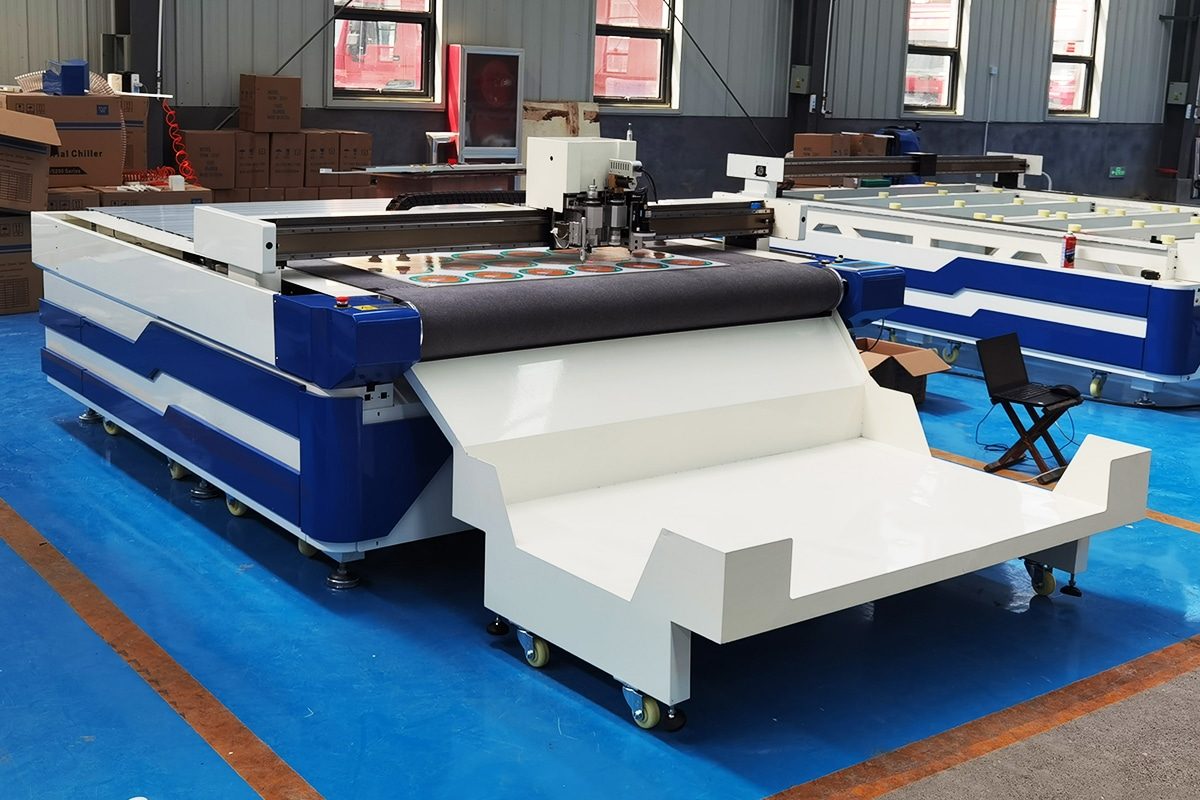
Can Oscillating Knife Cutting Machines Handle Multi-Layered Materials?
Oscillating knife cutting machines are widely used in modern digital cutting because they can process flexible and semi-rigid materials with high precision, clean edges, and minimal heat impact. Unlike laser cutting or thermal cutting methods, an oscillating knife uses a rapidly vibrating blade to separate materials mechanically. This makes it especially suitable for materials that may melt, burn, deform, or release fumes when exposed to heat, such as fabric, leather, foam, rubber, gasket materials, composite textiles, corrugated board, and many packaging or insulation materials.
As manufacturers look for higher productivity and lower labor costs, one important question often arises: can oscillating knife cutting machines handle multi-layered materials? In many industries, cutting materials one sheet at a time is too slow for batch production. Stacking several layers together can greatly improve efficiency, reduce repeated positioning, and help maintain consistency across multiple identical parts. This is especially valuable in sectors such as automotive interiors, upholstery, apparel, packaging, advertising, footwear, luggage, and technical textiles.
However, multi-layer cutting is not as simple as placing several sheets on the table and starting the machine. The cutting result depends on many factors, including material thickness, density, hardness, elasticity, surface friction, blade type, cutting speed, vacuum adsorption, tool pressure, and machine rigidity. Some materials can be stacked and cut smoothly, while others may shift, compress, stretch, or produce uneven edges if the cutting parameters are not properly controlled.
Therefore, the ability of oscillating knife cutting machines to handle multi-layered materials depends on both the machine configuration and the characteristics of the material itself. A properly selected machine, combined with the right blade, vacuum system, cutting parameters, and nesting strategy, can make multi-layer cutting practical and efficient for many applications. This article will explain how oscillating knife cutting machines work with multi-layered materials, what materials are suitable, what limitations should be considered, and how to achieve better cutting quality in real production.
Table of Contents
Understanding Oscillating Knife Cutting
Before discussing whether oscillating knife cutting machines can handle multi-layered materials, it is important to understand how this cutting technology works. Oscillating knife cutting is a mechanical cutting process that uses a rapidly moving blade to slice through materials without burning, melting, or producing thermal deformation. This makes it very different from laser cutting, plasma cutting, hot knife cutting, and other heat-based cutting methods.
In many production environments, oscillating knife cutting machines are used for flexible, soft, semi-rigid, and layered materials. These may include fabric, leather, foam, rubber, cardboard, gasket materials, insulation materials, composites, non-woven fabrics, carpet, automotive interior materials, and packaging materials. Because many of these materials are difficult to cut cleanly with traditional saws or thermal tools, the oscillating knife offers a practical solution for precision cutting, small-batch customization, and automated production.
For multi-layer cutting, the working principle of the oscillating knife becomes especially important. Cutting several layers at one time means the blade must penetrate deeper, maintain a stable path, reduce drag, and prevent material movement. The oscillating motion helps the blade enter and separate the layers more easily, reducing resistance compared with a fixed-blade knife. However, the final cutting result still depends on the material type, total stack thickness, blade geometry, cutting speed, vacuum holding force, tool pressure, and machine rigidity.
What Are Oscillating Knife Cutting Machines?
Oscillating knife cutting machines are digital cutting systems equipped with a blade that moves up and down at high frequency while following a programmed cutting path. The machine is usually controlled by CNC software, which converts design files into cutting instructions. Operators can import patterns, adjust cutting parameters, arrange layouts, and let the machine complete the cutting process automatically.
Typical oscillating knife cutting machines include a cutting table, CNC control system, tool head, oscillating knife module, servo or stepper drive system, vacuum adsorption system, and cutting software. Depending on the application, the machine may also be equipped with additional tools such as a drag knife, creasing wheel, V-cut tool, punching tool, pen marker, routing spindle, or camera recognition system.
The main advantage of this type of machine is its versatility. It can cut many materials without needing a physical die or mold. This is useful for industries that require frequent design changes, personalized products, short production runs, or rapid prototyping. Instead of making a cutting die for every shape, users can simply modify the digital file and start a new cutting job.
Oscillating knife cutting machines are commonly used in industries such as packaging, advertising, automotive interiors, apparel, footwear, luggage, furniture, upholstery, sports equipment, and composite material processing. In these industries, materials often have different textures, thicknesses, densities, and surface properties. The oscillating knife cutting machine can adapt to these differences by changing the blade type, oscillation frequency, cutting speed, and downward pressure.
For multi-layer cutting, the machine must be strong and stable enough to maintain accuracy through the full stack. A light-duty machine may cut a single layer well but struggle when the material is stacked. A machine designed for multi-layer production usually requires a powerful tool head, strong vacuum suction, a stable gantry structure, accurate motion control, and suitable software for nesting and path optimization.
How the Oscillating Blade Works
The core feature of oscillating knife cutting machines is the blade’s high-frequency up-and-down movement. Unlike a drag knife, which is pulled through the material mainly by the motion of the machine, oscillating blades actively move during cutting. This motion helps the blade penetrate the material and reduce resistance as it travels along the cutting path.
The oscillating blade works by rapidly moving vertically while the tool head follows the programmed shape. As the blade vibrates, it creates a repeated slicing action. Instead of forcing the entire blade through the material in one continuous push, the machine makes many small cutting actions at high speed. This reduces friction, lowers the cutting force, and helps the blade move through thicker or denser materials more smoothly.
Blade selection is very important. Different materials require different blade shapes, lengths, thicknesses, and edge angles. For example, soft foam may require a longer blade with a sharper cutting edge, while rubber or gasket material may need a stronger blade with better rigidity. Thin fabrics may need a fine blade to reduce fraying, while corrugated board may need a blade that can pass through the structure cleanly without crushing the edges.
The cutting depth must also be controlled carefully. In single-layer cutting, the blade only needs to pass through one sheet of material and slightly into the cutting mat. In multi-layer cutting, the blade must pass through the entire stack. If the blade is too short, it cannot cut the bottom layers completely. If the blade is too long or too flexible, it may bend during cutting, causing inaccurate edges or dimensional errors.
The oscillation frequency and cutting speed must be balanced. If the blade moves too slowly through the material, production efficiency decreases. If the machine moves too fast, the blade may not have enough time to separate each layer cleanly, especially in thick or dense stacks. Proper parameter settings allow the blade to cut smoothly while maintaining accuracy from the top layer to the bottom layer.
Why Oscillation Helps Multi-Layer Cutting
Oscillation is one of the main reasons these machines can handle multi-layered materials better than simple fixed-blade cutting systems. When multiple layers are stacked together, the resistance against the blade increases. Each additional layer adds friction, compression, and the possibility of movement between sheets. Non-oscillating blades may drag the upper layers, push the stack out of position, or create rough edges. The oscillating action helps reduce these problems.
First, oscillation reduces cutting resistance. Because the blade moves up and down rapidly, it slices the material in small repeated motions. This makes it easier for the blade to enter the stack and continue cutting through the lower layers. The machine does not need to rely only on horizontal pulling force, so the material is less likely to shift during cutting.
Second, oscillation helps maintain cleaner edges. Multi-layer materials can be difficult to cut because the top layer, middle layers, and bottom layer may react differently. Some materials compress, some stretch, and some separate slightly between layers. The repeated slicing motion helps the blade cut more directly through the stack instead of tearing or dragging the material.
Third, oscillation improves cutting performance on soft and elastic materials. Foam, rubber, felt, leather, fabric, and non-woven materials may deform under pressure. If the blade simply pushes against them, the material may bend or compress before it is cut. The oscillating blade reduces the amount of continuous pressure needed, which helps preserve the original shape of the material and improves dimensional accuracy.
Fourth, oscillation makes thicker cutting possible. When the total stack height increases, blade friction becomes a major challenge. The oscillating motion helps the blade overcome this friction more efficiently. This does not mean there is no limit to stack height, but it does make multi-layer cutting more practical for many materials.
However, oscillation alone does not guarantee successful multi-layer cutting. The layers must be held firmly in place, usually by a vacuum table. The stack must be flat and stable. The blade must be suitable for the material and thick enough to resist bending. The cutting speed must be adjusted according to the stack height. For materials with low friction between layers, additional fixing methods may be needed to prevent shifting.
In other words, oscillation helps multi-layer cutting by reducing resistance, improving penetration, and lowering the risk of dragging. But it works best when combined with a rigid machine structure, reliable vacuum adsorption, proper blade selection, and optimized cutting parameters.
The Difference Between Oscillating Knife and Other Cutting Methods
Oscillating knife cutting is only one of many material cutting methods. To understand its advantages and limitations, it is useful to compare it with other common cutting technologies.
Compared with manual cutting, oscillating knife cutting is much more consistent and efficient. Manual cutting depends heavily on operator skill, physical strength, and attention. It may be suitable for simple shapes or small quantities, but it becomes difficult to maintain accuracy during batch production. Oscillating knife cutting uses digital control, so each piece can be cut according to the same programmed path. This improves repeatability and reduces labor intensity.
Compared with die cutting, oscillating knife cutting offers more flexibility. Die cutting is fast and efficient for mass production, but it requires a physical cutting die. If the product design changes, a new die may be needed. This increases cost and lead time. Oscillating knife cutting does not require dies, making it more suitable for customized products, sample making, short runs, and production environments with frequent design changes. However, for very high-volume production of the same simple shape, die cutting may still be faster.
Compared with laser cutting, oscillating knife cutting does not use heat. This is one of its biggest advantages for materials that are sensitive to temperature. Laser cutting may cause burning, melting, yellowing, hard edges, smoke, odor, or toxic fumes, depending on the material. Oscillating knife cutting avoids thermal damage because it separates the material mechanically. This makes it more suitable for many textiles, foams, leathers, rubbers, and composite materials that may not respond well to laser processing. However, laser cutting may be better for very fine details, sealed edges on synthetic fabrics, and certain rigid materials.
Compared with waterjet cutting, oscillating knife cutting is cleaner and easier to integrate into many dry production environments. Waterjet cutting can cut thick and hard materials, but it uses water and abrasive media, which may not be suitable for absorbent materials such as fabric, cardboard, foam, or paper-based products. Oscillating knife cutting keeps the material dry and usually requires less post-processing. However, waterjet cutting has advantages for metals, stone, glass, ceramics, and other hard materials that an oscillating knife cannot process.
Compared with CNC routing, oscillating knife cutting produces less dust and is better suited for flexible materials. Routing removes material using a rotating tool, which is effective for wood, plastics, acrylic, aluminum, and other rigid boards. But for soft materials, the rotating bit may pull, twist, or damage the workpiece. Oscillating knives slice instead of milling, so it is better for flexible sheets and stacked soft materials. On the other hand, routing is better for thick, rigid materials and applications that require engraving, grooving, or pocketing.
Compared with hot knife cutting, oscillating knife cutting avoids melted edges. Hot knives can be useful for sealing synthetic fibers, but they may leave hardened edges, discoloration, or unpleasant smells. For applications requiring natural edges, clean mechanical cuts, or heat-free processing, the oscillating knife is often a better choice.
These differences show why oscillating knife cutting is widely used for multi-layer flexible material processing. It offers a strong balance between precision, flexibility, cleanliness, and material compatibility. It is not the best method for every material, but for many non-metallic sheets and layered materials, it provides an efficient and reliable cutting solution.
Oscillating knife cutting is a mechanical cutting process that uses a rapidly vibrating blade to slice through materials without heat. This makes it especially suitable for flexible, soft, semi-rigid, and heat-sensitive materials. Because the machine follows digital cutting paths, it can process complex shapes without physical dies, making it useful for both customized production and batch manufacturing.
For multi-layered materials, the oscillating motion provides important advantages. It reduces cutting resistance, improves blade penetration, helps maintain cleaner edges, and lowers the risk of material dragging. These benefits make it possible to cut multiple layers of fabric, leather, foam, rubber, felt, gasket material, cardboard, and other suitable materials more efficiently than cutting each sheet separately.
However, the success of multi-layer cutting depends on more than the oscillating blade alone. The machine must have enough rigidity, the vacuum table must hold the stack firmly, the blade must match the material, and the cutting speed and depth must be properly adjusted. If the material is too thick, too slippery, too elastic, or poorly fixed, cutting quality may decline.
Compared with laser cutting, die cutting, waterjet cutting, CNC routing, manual cutting, and hot knife cutting, oscillating knife cutting stands out for its heat-free operation, flexibility, and suitability for many non-metallic materials. Understanding these principles helps users evaluate whether oscillating knife cutting machines are suitable for their specific multi-layer cutting needs.
What “Multi-Layered Materials” Really Means
When discussing whether oscillating knife cutting machines can handle multi-layered materials, it is important to first define what “multi-layered” actually means. In real production, this term does not refer to only one type of material structure. It may describe several individual sheets stacked together, layers permanently bonded into one composite sheet, soft materials with internal padding, or different materials placed together for batch cutting.
This distinction matters because each type of multi-layered material behaves differently during cutting. A stack of separate fabric sheets may shift between layers. A bonded laminate may resist cutting because of adhesive layers. A sandwich material may have a hard surface and a soft core. A padded material may compress under blade pressure. A mixed-material stack may create uneven cutting resistance from top to bottom. Although all of these can be called “multi-layered,” they require different cutting strategies.
For oscillating knife cutting machines, the main challenge is not only the number of layers. The real challenge is how those layers interact with the blade, the vacuum table, and each other. Some materials remain stable during cutting, while others slide, stretch, compress, delaminate, or deform. Therefore, understanding the structure of the material is the first step toward deciding whether multi-layer cutting is practical.
In most cases, oscillating knife cutting machines can process many types of multi-layered materials, but the machine settings, blade selection, cutting depth, vacuum strength, and stack preparation must match the material structure. A material that performs well as a single sheet may behave very differently when stacked or laminated. That is why “multi-layered materials” should be evaluated by structure, thickness, density, surface friction, compressibility, and bonding condition rather than by layer count alone.
Stacked Sheets
Stacked sheets are the most common and easiest-to-understand form of multi-layered materials. In this case, several separate sheets of the same material are placed one on top of another and cut at the same time. The layers are not bonded together. They are only held in position by gravity, vacuum adsorption, clamps, pins, film covering, or other fixing methods.
This method is often used when manufacturers need to produce multiple identical parts efficiently. Instead of cutting one sheet, removing the finished parts, loading another sheet, and repeating the same process, operators can place several layers on the cutting table and complete several pieces in one cutting cycle. This can improve productivity, reduce repeated setup time, and keep parts more consistent across a batch.
Stacked sheet cutting is common in fabric, leather, non-woven materials, felt, rubber sheets, foam sheets, paperboard, cardboard, gasket materials, and some flexible plastics. For example, a furniture manufacturer may stack upholstery fabric to cut multiple seat covers. A packaging company may stack cardboard sheets for sample production. A gasket manufacturer may stack rubber sheets to increase output.
However, stacked sheets also create some typical cutting challenges. Because the layers are separate, they may move relative to each other during cutting. The top layer may be held firmly, while the middle or bottom layers may shift slightly if the vacuum force is not strong enough. Smooth materials may slide easily. Stretchable materials may deform before being cut. Thick stacks may create higher blade friction, which can affect cutting accuracy.
The bottom layer is often the most difficult to cut cleanly. If the blade depth is not sufficient, the lower layers may remain partially connected. If the blade is too long or too flexible, it may bend under resistance, causing the bottom layer to have a slightly different size than the top layer. This is especially important when cutting narrow curves, small holes, sharp corners, or detailed patterns.
To cut stacked sheets successfully, the stack must be flat, stable, and evenly compressed. The blade must be long enough to pass through all layers but rigid enough to stay straight. The cutting speed may need to be reduced compared with single-layer cutting. The vacuum table must provide enough holding force to prevent shifting. In some cases, operators may use plastic film, masking paper, or temporary fixation to improve stability.
Stacked sheets are usually the best starting point for multi-layer cutting because they allow manufacturers to increase efficiency without changing the material structure. But the maximum number of layers depends heavily on the material. Thin, stable, high-friction sheets may stack well, while slippery, stretchy, or thick materials may need fewer layers to maintain quality.
Bonded Laminates
Bonded laminates are multi-layered materials in which two or more layers are permanently joined together using adhesive, heat, pressure, coating, or other bonding methods. Unlike stacked sheets, bonded laminates behave more like a single material because the layers do not freely separate during cutting. However, the internal structure may still affect cutting performance.
Examples of bonded laminates include laminated fabric, coated textiles, adhesive-backed foam, PVC-coated materials, composite leather, reinforced rubber sheets, insulation laminates, laminated cardboard, flexible packaging materials, and technical textiles with backing layers. These materials are widely used in automotive interiors, signage, packaging, insulation, luggage, furniture, protective products, and industrial components.
For oscillating knife cutting, bonded laminates often have one advantage: the layers do not easily shift. Since the layers are attached, the machine does not need to control each layer separately. This can improve dimensional consistency and reduce the risk of misalignment between layers. The cutting path is usually more stable than cutting loose stacked sheets.
However, bonded laminates may introduce other difficulties. Adhesive layers can increase blade resistance. Some adhesives may be soft and sticky, causing material buildup on the blade. Others may be tough and elastic, making the material harder to penetrate. If the bond strength is weak, the cutting action may cause delamination near the edge, especially when the blade is dull, the speed is too high, or the material is poorly supported.
The surface and core layers of a laminate may also have different properties. For example, a fabric surface may be soft, while the backing layer may be rubbery or plastic-based. A coated material may have a smooth surface but a fibrous inner layer. These differences can affect how the blade enters, cuts, and exits the material. The machine must cut through all layers cleanly without pulling one layer away from another.
Blade choice is especially important for bonded laminates. A sharp blade can reduce edge lifting and tearing. A stronger blade may be needed for dense or reinforced laminates. For sticky materials, operators may need to clean the blade more frequently or choose a blade shape that reduces adhesive contact. The cutting speed should be adjusted to avoid heat from friction, excessive drag, or edge distortion.
Bonded laminates can often be processed very well by oscillating knife cutting machines, especially when they are non-metallic and not too hard. The key is to understand the internal bonding structure. A laminate that looks simple from the outside may contain adhesive films, woven reinforcement, foam backing, plastic coating, or other hidden layers that change the cutting behavior.
Sandwich Materials
Sandwich materials are multi-layered structures that usually consist of two outer skins and a middle core. The outer layers may provide strength, surface protection, or appearance, while the core may provide thickness, cushioning, insulation, stiffness, or lightweight performance. This structure is very common in packaging, automotive interiors, insulation, advertising panels, protective inserts, and composite products.
Typical sandwich materials include foam-core boards, honeycomb cardboard, corrugated board, fabric-foam-fabric structures, leather-foam backing materials, insulation boards with surface films, and lightweight composite panels. Some sandwich materials are soft and flexible, while others are semi-rigid. Some have dense skins with a soft core, while others have a hollow or cellular structure inside.
The main challenge when cutting sandwich materials is that each layer may respond differently to the blade. The top layer may be dense and smooth, the core may be soft or hollow, and the bottom layer may need firm support to cut cleanly. If the blade pressure is too high, the core may compress before it is cut. If the blade is too dull, the outer skin may tear. If the blade speed is too fast, the edge may become crushed or uneven.
Oscillating knife cutting is often suitable for sandwich materials because the blade’s up-and-down motion helps reduce horizontal drag. This is useful when the material has a soft core that could be pulled or distorted by a fixed blade. The oscillating action allows the blade to slice through the outer surface, pass through the core, and exit the bottom layer with less tearing than many traditional mechanical methods.
For corrugated board and honeycomb materials, the blade must cut across internal voids and support walls. The cutting quality depends on the direction of the flute or honeycomb structure, the blade angle, and the support from the cutting table. If the material is not well supported, the internal structure may collapse near the cut edge. For foam-core materials, the blade must be long enough to reach through the full thickness while staying rigid enough to avoid deflection.
Sandwich materials may also require different cutting strategies for straight lines, curves, bevels, and small details. Large simple shapes are usually easier to cut because the blade can move smoothly. Small holes, tight curves, and sharp corners are more difficult because the blade must change direction while still passing through layers with different densities. In these cases, slower cutting speeds and optimized blade compensation can improve accuracy.
Although oscillating knife cutting machines can handle many sandwich materials, not all sandwich structures are suitable. Materials with hard metal skins, glass fiber reinforcement, extremely dense cores, or abrasive fillers may exceed the capability of standard oscillating knives. For these materials, routing, waterjet cutting, or other specialized methods may be more appropriate.
Quilted, Padded, and High-Loft Materials
Quilted, padded, and high-loft materials are another important category of multi-layered materials. These materials usually contain soft filling, foam, fiber padding, batting, or air-filled structures between surface layers. They are common in upholstery, mattresses, cushions, automotive interiors, thermal insulation, protective packaging, bags, apparel, sports products, and soft home goods.
These materials are different from ordinary stacked sheets or bonded laminates because they are highly compressible. When the blade presses down, the material may flatten before it is cut. After cutting, it may rebound to its original thickness. This compression and rebound can affect edge shape, part size, and cutting accuracy.
For example, padded fabric may shift slightly as the blade enters. A quilted material may contain stitched areas and raised areas, creating uneven thickness across the cutting path. High-loft insulation may compress under vacuum suction, making its actual cutting thickness different from its relaxed thickness. Foam padding may deform around the blade, especially if it is soft or thick.
Oscillating knife cutting can be useful for these materials because the blade slices with less continuous pushing force than a static blade. This helps reduce dragging and deformation. However, cutting high-loft materials still requires careful control. Too much pressure can crush the material. Too little pressure may fail to cut through the bottom layer. Too high a speed may cause the blade to push the material instead of slicing it cleanly.
The choice of blade length and stiffness is critical. A long blade may be necessary for thick, padded materials, but long blades can bend more easily. If the blade deflects, the cut edge may become angled or uneven. A sharper blade can reduce compression because it enters the material more easily. For very soft foam or batting, special blade types may be needed to achieve a clean edge.
Vacuum holding must also be managed carefully. Strong vacuum adsorption helps hold the material in place, but it may also compress high-loft materials unevenly. In some cases, light pre-compression is helpful because it stabilizes the material before cutting. In other cases, excessive compression can distort the part size. Operators may need to test different vacuum levels, cutting speeds, and tool pressures to find a balance.
Quilted and padded materials may also include seams, stitching, or bonded areas. These areas can be denser than the surrounding material and may cause changes in cutting resistance. The machine should be set to handle the densest part of the material, not only the softest part. Otherwise, some sections may cut cleanly while others remain partially connected.
Oscillating knife cutting machines can process many quilted, padded, and high-loft materials, but these materials often require more testing than flat sheets. Their softness is both an advantage and a challenge: they are easy to cut in principle, but difficult to hold, measure, and control accurately during cutting.
Mixed-Material Stacks
Mixed-material stacks refer to situations where different materials are placed together and cut at the same time. This may involve different sheet types, different thicknesses, different densities, or different surface textures in one stack. For example, a manufacturer may want to cut fabric and foam together, leather and lining together, rubber and adhesive backing together, or several packaging materials in one batch.
Mixed-material stacks can be useful when the layers will later be assembled into the same product. Cutting them together can help ensure that all parts share the same shape and alignment. It can also reduce production time by combining several cutting steps into one operation. This is attractive in industries such as footwear, luggage, upholstery, automotive interiors, protective cases, and composite product manufacturing.
However, mixed-material cutting is usually more difficult than cutting identical stacked sheets. Different materials create different levels of friction and resistance. One layer may be soft and compressible, while another may be dense and tough. One layer may be slippery, while another may grip the blade. One layer may stretch, while another remains dimensionally stable. These differences can cause the stack to move unevenly during cutting.
The biggest risk is that the cutting parameters may be suitable for one material but not for another. A speed that works well for fabric may be too fast for rubber. A blade that cuts foam smoothly may not be strong enough for dense gasket material. A vacuum level that holds cardboard well may not hold a slick plastic film securely. If the machine settings are based only on the top layer, the lower layers may not be cut accurately.
Mixed-material stacks also increase the risk of edge mismatch. Even if all layers are cut in the same pass, different materials may deform differently under blade pressure. After the cutting force is released, elastic materials may rebound, while rigid layers remain unchanged. This can create slight dimensional differences between layers.
For this reason, mixed-material stacks should be tested carefully before full production. The operator should evaluate whether the materials can be held together firmly, whether the blade can pass through all layers without excessive bending, and whether the finished parts meet tolerance requirements. In some cases, temporary bonding, film covering, adhesive spray, registration pins, or layered nesting methods may improve stability.
Not all mixed-material stacks should be cut together. If the materials have very different hardness, thickness, or cutting requirements, it may be better to cut them separately and assemble them afterward. The goal is not simply to cut as many layers as possible, but to achieve reliable quality, accurate dimensions, and stable production efficiency.
“Multi-layered materials” is a broad term that includes several different structures. It may refer to loose stacked sheets, bonded laminates, sandwich materials, quilted or padded materials, high-loft materials, and mixed-material stacks. Each structure behaves differently during oscillating knife cutting, so the cutting strategy must be based on how the layers are arranged, bonded, compressed, and supported.
Stacked sheets are often used to improve productivity, but they may shift between layers if not held firmly. Bonded laminates are more stable because the layers are joined together, but adhesives, coatings, and reinforcement layers can increase cutting resistance. Sandwich materials may combine hard skins and soft cores, requiring careful control to avoid crushing or uneven edges. Quilted, padded, and high-loft materials are usually easy to penetrate but difficult to hold accurately because they compress and rebound. Mixed-material stacks can improve alignment and efficiency, but they are the most difficult to control because each layer may react differently to the blade.
For oscillating knife cutting machines, successful multi-layer processing depends on more than the total number of layers. Material thickness, density, elasticity, surface friction, bonding strength, internal structure, blade length, machine rigidity, vacuum adsorption, and cutting parameters all influence the final result. Understanding what type of multi-layered material is being processed helps manufacturers choose the right machine configuration and avoid unrealistic expectations.
In practical terms, many multi-layered materials can be cut effectively with oscillating knife cutting machines, but they should not all be treated the same way. The more stable, uniform, and well-supported the layers are, the easier they are to cut. The more slippery, compressible, elastic, or mixed the layers are, the more testing and parameter optimization are required.
Can Oscillating Knife Cutting Machines Handle Multi-Layered Materials
Yes, oscillating knife cutting machines can handle many multi-layered materials, but the answer is not a simple “yes” for every material, every thickness, and every production requirement. Multi-layer cutting is possible when the machine configuration, material structure, stack height, blade selection, vacuum holding system, and cutting parameters are properly matched. If these conditions are ignored, the machine may still cut the upper layers, but the lower layers may shift, remain partially connected, or show poor edge quality.
Oscillating knife cutting machines are especially suitable for flexible and non-metallic materials because it cuts mechanically without heat. This means it can process materials such as fabric, leather, foam, felt, rubber, cardboard, gasket material, non-woven fabric, carpet, and many composite textiles without burning, melting, or producing thermal deformation. When these materials are stacked correctly, the machine can improve production efficiency by cutting several identical pieces in one operation.
However, multi-layer cutting adds more difficulty than single-layer cutting. The blade must travel through a greater total thickness. The cutting resistance increases. The material stack must stay stable during the entire cutting process. The blade must remain straight from the top layer to the bottom layer. The vacuum table or fixing system must prevent movement between layers. The cutting path must also be suitable for the stack, especially when the design includes small holes, narrow curves, sharp corners, or fine details.
Therefore, oscillating knife cutting machines can handle multi-layered materials, but only within realistic limits. A well-configured machine can cut multiple layers efficiently and accurately, while an underpowered or poorly adjusted machine may struggle even with relatively simple materials. The key is to evaluate both the machine and the material before deciding how many layers can be cut at one time.
Yes, But Not Without Conditions
The most accurate answer is: yes, oscillating knife cutting machines can cut multi-layered materials, but not without conditions. Multi-layer cutting is a practical and widely used method in many industries, but it requires more control than single-layer cutting. The number of layers alone does not determine whether cutting will be successful. A stack of five thin, stable fabric sheets may be easier to cut than two layers of thick, elastic rubber. A bonded laminate may remain stable during cutting, while loose, slippery sheets may shift even if the total thickness is small.
The first condition is material suitability. Oscillating knife cutting works best on materials that can be separated by a sharp blade without excessive hardness, brittleness, or abrasiveness. Many flexible non-metallic materials are suitable, but hard metals, glass, stone, ceramics, and very abrasive composites are generally not appropriate for standard oscillating knife cutting. Some reinforced materials may also be difficult if they contain hard fibers, wire mesh, or dense fillers that dull or deflect the blade.
The second condition is stack height. Every machine and tool head has a maximum cutting thickness. This does not mean that the machine can always cut every material up to that thickness. The rated cutting thickness is usually affected by material density, blade length, blade rigidity, and cutting resistance. A machine may be able to cut thick foam, but that does not mean it can cut the same thickness of dense rubber or compact gasket sheet.
The third condition is material stability. Loose layers must not slide against each other during cutting. If the top layer moves differently from the bottom layer, the finished parts will not match. This is one of the most common problems in multi-layer cutting. The stack must be held firmly by vacuum suction, clamps, cover film, temporary adhesive, pins, or other positioning methods.
The fourth condition is correct tooling. The blade must be long enough to pass through the entire stack, but it must also be strong enough to resist bending. A thin blade may create a clean edge in single-layer cutting, but it may flex when cutting a thick stack. A dull blade may increase drag and cause the layers to shift. Choosing the right blade type, edge angle, and blade length is essential.
The fifth condition is proper cutting parameters. Multi-layer cutting usually requires a slower cutting speed, suitable oscillation frequency, correct cutting depth, and appropriate tool pressure. If the machine moves too quickly, the blade may not complete the cut through all layers. If the downward pressure is too high, soft materials may compress or distort. If the cutting depth is too shallow, the bottom layer may remain connected.
In short, multi-layer cutting is possible, but it must be treated as a controlled process rather than a simple stacking operation. The machine can only perform well when the material, blade, vacuum system, and cutting program work together.
Multi-Layer Cutting Is Easier With Flexible Non-Metallic Materials
Oscillating knife cutting machines are most effective when processing flexible non-metallic materials. This is why they are widely used in industries such as packaging, apparel, upholstery, automotive interiors, footwear, luggage, insulation, gasket production, signage, and soft material manufacturing. These industries often work with materials that are difficult to cut with heat or rotary tools but respond well to sharp oscillating blades.
Flexible non-metallic materials are generally easier for oscillating knife multi-layer cutting because they can be sliced cleanly without melting, burning, or creating hard thermal edges. Fabrics, felt, leather, foam, non-woven materials, rubber sheets, cork, cardboard, corrugated board, and many soft composites can often be stacked and cut efficiently when the correct settings are used.
For fabric and textile materials, multi-layer cutting can significantly improve productivity. Instead of cutting one garment piece, upholstery panel, or lining component at a time, the operator can stack several sheets and cut multiple pieces in one cycle. This reduces repeated loading, unloading, and positioning. It also helps keep the parts consistent because the same digital path is used for all layers.
For leather and synthetic leather, multi-layer cutting is possible in some cases, but it requires more caution. Leather thickness, surface friction, natural variation, and material value make cutting control especially important. Thin artificial leather or bonded leather may be stacked more easily than thick natural leather. If the layers are slippery or expensive, it may be better to reduce the number of layers to protect quality.
For foam and padded materials, oscillating knife cutting is often effective because the blade’s vibrating motion reduces drag. However, foam compressibility must be considered. A thick stack of soft foam may compress under vacuum or blade pressure, which can change the final size of the cut parts. Lower cutting speeds, proper blade length, and careful vacuum control are often needed.
For rubber and gasket materials, multi-layer cutting depends strongly on hardness and thickness. Soft rubber may deform if the blade pressure is too high. Dense rubber may create high cutting resistance and require slower cutting. The machine must have enough power and rigidity to keep the blade moving accurately through the stack. In many cases, cutting fewer layers with higher accuracy is better than cutting too many layers with poor edge quality.
For cardboard, corrugated board, and packaging materials, oscillating knife cutting machines can cut multiple layers well when the stack is flat, and the vacuum table holds the sheets evenly. However, corrugated structures can crush if the blade pressure is excessive or if the material is poorly supported. The direction of the corrugation may also affect edge quality.
The reason flexible non-metallic materials are more suitable is that they are within the mechanical cutting range of the oscillating blade. They do not usually require melting, grinding, or abrasive cutting. The blade can physically separate the material fibers, cells, or layers. But even within this category, each material has its own limit. The more elastic, slippery, dense, or compressible the material is, the more careful the cutting setup must be.
The Machine Must Have Enough Cutting Depth
Cutting depth is one of the most important requirements for multi-layer cutting. In single-layer cutting, the blade only needs to pass through one sheet of material and slightly enter the cutting mat. In multi-layer cutting, the blade must pass through the entire stack from top to bottom. If the machine does not have enough cutting depth, the lower layers will not be fully separated.
However, cutting depth is not only about blade length. It also depends on the tool head stroke, machine clearance, blade rigidity, material compression, and cutting mat condition. A blade may appear long enough, but if the material compresses or rebounds during cutting, the actual cutting result may still be inconsistent. The blade must reach the bottom layer reliably throughout the full cutting path.
The total stack height should always be measured under realistic cutting conditions. Soft materials may have a relaxed thickness and a compressed thickness. For example, a stack of foam, padding, or high-loft textile may look thick when placed on the table but become thinner under vacuum suction. This can help stabilize the material, but it can also create uneven compression if the vacuum is not balanced. The cutting depth should be set according to the compressed cutting condition, not only the relaxed height.
Blade length must be selected carefully. A blade that is too short cannot cut through all layers. A blade that is too long may bend, especially when cutting dense materials or tight curves. Blade deflection can cause angled edges, inaccurate bottom layers, and uneven part sizes. This is one of the main reasons why maximum cutting thickness is not always the same as practical cutting thickness.
Machine rigidity also affects cutting depth performance. When the blade enters a thick stack, cutting resistance increases. If the machine frame, gantry, tool holder, or blade clamp is not stable enough, the blade may vibrate, tilt, or deviate from the programmed path. A strong machine structure helps maintain accuracy throughout the full material thickness.
Tool pressure must be matched to the material. Too little pressure may leave the bottom layer uncut. Too much pressure may compress the stack, damage the cutting mat, increase blade wear, or distort soft materials. For multi-layer cutting, the goal is not simply to push harder. The goal is to let the blade pass cleanly through the stack with enough pressure to complete the cut but not so much that it deforms the material.
It is also important to consider blade wear. A new blade may cut through a multi-layer stack cleanly, while a worn blade may struggle with the same material after several hours of production. As the blade becomes dull, resistance increases, and the risk of shifting, tearing, or incomplete cutting rises. Regular blade inspection and replacement are necessary for consistent multi-layer cutting.
In practical production, users should test the actual material stack before mass cutting. The test should check whether the bottom layer is fully cut, whether the edge is vertical, whether the part size is consistent from top to bottom, and whether the blade leaves excessive marks on the cutting mat. Only after confirming these points should the operator increase the number of layers or production speed.
The Stack Must Be Held Firmly
A stable material stack is essential for successful multi-layer cutting. Even if the machine has enough cutting depth and a sharp blade, poor material holding can ruin the result. When the blade moves through the stack, it creates cutting force, friction, and vibration. If the layers are not fixed properly, they may slide, stretch, lift, wrinkle, or rotate slightly. This causes inaccurate parts and uneven edges.
Most oscillating knife cutting machines use a vacuum adsorption table to hold materials in place. The vacuum pulls the material downward against the cutting surface, reducing movement during cutting. For multi-layer cutting, vacuum strength becomes even more important because the machine must hold not only the top sheet but the entire stack. If air leaks between layers or around the material edges, holding force may be reduced.
The effectiveness of vacuum holding depends on the material. Porous materials such as fabric, felt, foam, and some textiles may allow air to pass through, reducing suction efficiency. Smooth and dense materials such as rubber or plastic sheets may seal better against the table, but they may slide against each other if their surfaces are slick. Corrugated board may hold well in some directions but may deform if suction is too strong.
For loose stacked sheets, the relationship between layers is critical. The vacuum table mainly holds the bottom layer directly, while the upper layers rely on friction, pressure, and airflow through the stack. If the layers have low surface friction, the top sheets may shift even though the bottom sheet remains fixed. In such cases, operators may need additional fixing methods.
Cover film is one common solution. A thin plastic film can be placed over the stack to improve vacuum sealing and hold the layers together. This is often useful for porous or lightweight materials. Temporary adhesive, masking paper, clamps, pins, or registration marks may also be used depending on the material and production requirement. The purpose is to make the stack behave as one stable unit during cutting.
The stack must also be prepared properly before cutting. Sheets should be aligned, flattened, and free from wrinkles. Edges should be positioned to reduce air leakage. Thick stacks should be checked for uneven height. If one side of the stack is higher than the other, the blade may cut differently across the table. For soft materials, light pre-compression may help create a more stable cutting condition.
Material size also matters. Very small pieces may be harder to hold because they have less surface area under vacuum. When cutting small parts from a multi-layer stack, the pieces may loosen after the cut is completed. This can interfere with later cutting paths. In such cases, operators may use bridges, tabs, modified cutting order, or stronger vacuum zones to keep parts stable until the job is finished.
Cutting direction and path order can also affect stack stability. If the machine cuts internal holes first and outer contours later, the material may remain more stable. If the outer contour is cut too early, the part may separate from the surrounding material and shift before the inner details are finished. Proper path planning is especially important for multi-layer cutting.
A firm stack is the foundation of accurate multi-layer cutting. Without stable holding, the machine may still follow the correct digital path, but the material will not stay where it should. Good vacuum control and proper stack preparation are just as important as blade performance.
The Cutting Path Must Be Suitable
The cutting path plays a major role in whether multi-layer cutting succeeds. A material stack may be easy to cut in straight lines but difficult to cut in tight curves, small holes, sharp corners, or fine details. The more complex the cutting path, the more stress is placed on the blade, the machine, and the material stack.
Straight lines and large curves are generally easier for multi-layer cutting because the blade can move smoothly and maintain a stable direction. The cutting force remains more consistent, and the blade is less likely to twist or deflect. This is why large panels, upholstery pieces, packaging shapes, insulation pads, and simple gasket profiles are often suitable for multi-layer cutting.
Small holes are more challenging. When the blade cuts a small circular or narrow internal shape, it must constantly change direction. In a thick stack, the blade may not rotate or follow the path as cleanly through the bottom layers as it does on the top layer. This can lead to tapered holes, rough edges, or incomplete cutting. For very small holes, punching tools or separate processing may be more suitable than oscillating knife cutting.
Sharp corners also require careful handling. The blade has physical thickness and length, so it cannot instantly change direction without creating stress. In multi-layer cutting, sharp corners may cause blade drag, material lifting, or slight overcutting. Software compensation, corner slowdown, and optimized blade turning control can improve results, but there are still practical limits.
Narrow strips and thin details are another issue. When cutting thin shapes from multiple layers, the material may lose support quickly. The cut pieces may shift, curl, or lift before the cutting job is complete. This is especially common with flexible materials, lightweight foam, thin fabric, or slippery plastic films. In these cases, reducing the number of layers or adjusting the cutting sequence may improve quality.
The cutting path should also consider material grain, texture, or internal structure. Fabric may stretch differently in different directions. Corrugated board cuts differently along and across the flute direction. Foam may compress differently depending on density and cell structure. Leather may have natural variation. The same shape may cut better when oriented in a certain direction on the material.
For multi-layer cutting, the nesting strategy is also important. Nesting refers to arranging parts on the material to reduce waste and improve efficiency. In single-layer cutting, the focus may be on material utilization. In multi-layer cutting, the nesting layout must also preserve stack stability. If parts are placed too close together, the material between cuts may become weak and move. If the cutting path crosses too many small areas too early, the stack may lose support.
The machine software should allow proper path optimization, cutting order control, blade compensation, and speed adjustment for corners and curves. These functions help the machine adapt to the demands of multi-layer cutting. Without proper path control, even a strong machine may produce inconsistent results on complex designs.
In practical terms, multi-layer cutting is most reliable when the design has moderate detail, enough spacing between parts, smooth curves, and stable outer contours. Highly detailed patterns, very small parts, deep internal cuts, and fragile narrow shapes should be tested carefully. If the design is too complex, cutting fewer layers at a time may produce better overall efficiency because it reduces waste and rework.
Oscillating knife cutting machines can handle many multi-layered materials, but successful results depend on several important conditions. The process works best when the material is flexible, non-metallic, stable, and suitable for mechanical blade cutting. Materials such as fabric, leather, foam, felt, rubber, gasket sheets, cardboard, corrugated board, non-woven fabric, and many soft composites can often be cut in multiple layers when the machine is properly configured.
The machine must have enough cutting depth to pass through the full stack, but cutting depth alone is not enough. The blade must be long enough, rigid enough, and sharp enough to cut the bottom layers accurately. The tool head, machine frame, and motion system must also remain stable under increased cutting resistance. A machine that performs well on a single layer may not automatically perform well on a thick multi-layer stack.
The material stack must also be held firmly. Vacuum adsorption, cover film, clamps, temporary fixation, and careful material preparation help prevent shifting between layers. If the stack moves during cutting, the digital accuracy of the machine cannot be transferred to the finished parts. Stable holding is especially important for slippery, porous, elastic, or lightweight materials.
Finally, the cutting path must be suitable for multi-layer processing. Simple shapes, straight lines, large curves, and moderate-size parts are usually easier to cut in stacks. Small holes, sharp corners, narrow strips, and complex details require more careful testing and parameter adjustment. In some cases, reducing the number of layers may be the best way to maintain accuracy and edge quality.
Oscillating knife cutting machines can handle multi-layered materials effectively, but multi-layer cutting should be planned and tested carefully. The best results come from matching the material, machine configuration, blade, vacuum system, cutting parameters, and cutting path to the actual production requirement.
Materials That Are Commonly Suitable for Multi-Layer Oscillating Knife Cutting
Oscillating knife cutting machines are widely used for multi-layer cutting because they are especially effective on flexible, soft, semi-rigid, and non-metallic materials. Unlike thermal cutting methods, the oscillating knife does not rely on heat to separate the material. Instead, it uses a high-frequency blade movement to slice through the stack mechanically. This makes it suitable for materials that may burn, melt, discolor, harden, or release fumes when exposed to laser or hot knife cutting.
However, not every material can be stacked and cut successfully in the same way. The suitability of a material depends on its thickness, density, hardness, elasticity, surface friction, porosity, compressibility, internal structure, and whether the layers are loose, bonded, padded, or reinforced. Some materials are very friendly to multi-layer cutting because they remain stable under the blade. Others require careful testing because they may shift, stretch, compress, or resist the blade as the stack becomes thicker.
In general, commonly suitable materials include textiles, fabrics, leather, synthetic leather, foam, sponge, rubber, gasket sheets, corrugated cardboard, packaging board, felt, insulation materials, acoustic materials, composite fabrics, and certain prepreg materials. These materials are frequently used in industries such as apparel, furniture, upholstery, automotive interiors, packaging, advertising, footwear, luggage, sports equipment, insulation, sealing products, and composite manufacturing.
For multi-layer cutting, the goal is not simply to cut as many layers as possible. The goal is to maintain clean edges, accurate dimensions, consistent part shape, and stable production efficiency. A material may be suitable for single-layer cutting but still require a reduced stack height for multi-layer processing. Therefore, each material category should be evaluated according to its real cutting behavior rather than by material name alone.
Textiles and Fabrics
Textiles and fabrics are among the most common materials used in multi-layer oscillating knife cutting. These materials are widely used in clothing, upholstery, curtains, carpets, automotive interiors, soft furnishings, bags, tents, sports goods, protective covers, and industrial textile products. Because many fabric products require repeated shapes in large quantities, multi-layer cutting can greatly improve production efficiency.
Common textile materials include cotton, polyester, nylon, canvas, denim, woven fabric, knitted fabric, non-woven fabric, microfiber, felt-like fabric, coated fabric, mesh fabric, technical textiles, and blended fabrics. Many of these materials can be stacked and cut with oscillating knives if the layers are aligned and firmly held in place.
One major advantage of oscillating knife cutting for fabrics is that it avoids heat damage. Laser cutting can seal the edges of some synthetic fabrics, but it may also cause burning, yellowing, odor, smoke, or hardened edges. For natural fabrics such as cotton, wool, or linen, laser cutting may leave scorched edges. Oscillating knife cutting produces a mechanical cut, so it is better suited for applications where the original texture and softness of the fabric edge must be preserved.
Multi-layer fabric cutting is often easier when the fabric has moderate friction between layers. Materials such as canvas, cotton fabric, felt fabric, and certain upholstery textiles tend to stay more stable because the layers grip each other slightly. Smooth or slippery fabrics, such as satin, nylon, coated textiles, or thin synthetic fabrics, may shift more easily during cutting. In these cases, vacuum suction, cover film, temporary fixation, or fewer layers may be needed.
Stretchy fabrics require extra attention. Knitted fabrics, elastic textiles, and spandex-containing materials may deform under vacuum pressure or blade movement. If the fabric stretches during cutting and then rebounds afterward, the final part may become smaller or distorted. For these materials, operators should reduce cutting speed, control vacuum strength, avoid excessive tool pressure, and test the nesting direction according to the fabric’s stretch direction.
Another important factor is fabric thickness and density. Thin fabrics can often be stacked in more layers, but they may be difficult to hold if they are lightweight and porous. Heavy fabrics may require fewer layers because the total stack resistance increases. Dense woven fabrics may create more blade friction, while loose fabrics may fray if the blade is dull or the cutting speed is too high.
For multi-layer textile cutting, cutting path design also matters. Large garment panels, upholstery pieces, and cover shapes are usually suitable. Very small holes, narrow strips, fine decorative patterns, or sharp internal corners may be harder to cut accurately through a thick fabric stack. The more detailed the design, the fewer layers should be used to maintain accuracy.
Textiles and fabrics are highly suitable for multi-layer oscillating knife cutting, especially when the material is stable, flat, and not excessively slippery or elastic. Proper blade selection, vacuum control, and stack preparation are essential for achieving clean, repeatable results.
Leather and Synthetic Leather
Leather and synthetic leather are also commonly processed with oscillating knife cutting machines. These materials are used in footwear, bags, belts, furniture, automotive seats, steering wheel covers, fashion accessories, protective equipment, and decorative products. Oscillating knife cutting is suitable because it can produce accurate shapes without molds and without thermal damage.
Natural leather is a valuable material with irregular thickness, grain direction, scars, stretch variation, and natural texture differences. Because of this, leather cutting requires careful planning. Single-layer cutting is very common, especially for high-value leather products where defect avoidance and grain matching are important. However, multi-layer cutting may still be used for certain leather types, especially thinner leather, split leather, bonded leather, or less expensive leather components.
Synthetic leather, PU leather, PVC leather, microfiber leather, and coated artificial leather are often more uniform than natural leather. This makes them more suitable for controlled multi-layer cutting. Because synthetic leather is manufactured in rolls or sheets with more consistent thickness and surface properties, it is easier to stack and cut several layers at one time.
One of the key advantages of oscillating knife cutting for leather and synthetic leather is the clean mechanical edge. Laser cutting may burn leather, create odor, darken the edge, or damage surface coatings. Hot knife cutting may melt or harden synthetic leather edges. Oscillating knives avoid these problems and help preserve the appearance and texture of the material.
However, leather materials can create challenges in multi-layer cutting. Natural leather may stretch or shift if stacked too high. Some leather surfaces are smooth and slippery, which increases the risk of layer movement. Thick leather can create high cutting resistance, and a blade that is too thin may deflect. If the blade bends, the top and bottom layers may not match perfectly.
Synthetic leather may have textile backing, foam backing, adhesive layers, or coated surfaces. These internal layers can affect cutting performance. A soft backing may compress, while a plastic coating may resist the blade differently from the base layer. Some synthetic leather materials may also stick slightly to the blade if the coating or adhesive is soft.
For best results, leather and synthetic leather stacks should be kept moderate in height. The blade should be sharp and strong enough to pass through the stack without bending. The cutting speed should be controlled to prevent drag and edge distortion. Vacuum suction should hold the material firmly, but excessive suction should not deform soft-backed synthetic leather.
When cutting expensive natural leather, manufacturers often prioritize material utilization and surface quality over maximum cutting speed. In such cases, single-layer or low-layer cutting may be more practical. For synthetic leather, especially in high-volume production, multi-layer cutting can be more efficient if the material is stable and the finished parts meet tolerance requirements.
Leather and synthetic leather can be suitable for multi-layer oscillating knife cutting, but the number of layers should be determined by material value, thickness, surface friction, backing structure, and quality requirements.
Foam and Sponge Materials
Foam and sponge materials are widely used in packaging, furniture, mattresses, automotive interiors, protective cases, sports equipment, insulation, filters, cushions, toys, and medical products. These materials are often suitable for oscillating knife cutting because they are soft, non-metallic, and easy to separate with a blade. Multi-layer cutting can be effective, but foam behavior depends strongly on density, thickness, elasticity, and compression.
Common foam materials include PU foam, PE foam, EVA foam, sponge foam, rubber foam, memory foam, acoustic foam, insulation foam, filter foam, and packaging foam. Some foams are soft and highly compressible, while others are dense and firm. Some recover quickly after compression, while others deform more slowly. These differences directly affect multi-layer cutting performance.
The oscillating knife is useful for foam because its up-and-down slicing action reduces horizontal drag. A fixed blade may push soft foam before cutting it, causing distortion. The oscillating blade enters the foam more easily and helps produce a cleaner cut. This is especially helpful when cutting thick foam sheets or stacked foam layers.
However, foam and sponge materials are highly compressible. When several foam sheets are stacked, the total height may change under vacuum suction or blade pressure. If the foam compresses unevenly, the cut shape may become inaccurate. After cutting, the foam may rebound, and the final edge may look different from the compressed cutting condition.
For soft foam, excessive tool pressure can crush the material. For dense foam, the blade may encounter greater resistance. For elastic foam, the material may bend around the blade before it is fully cut. For porous foam, vacuum holding may be less effective because air can pass through the material. These factors make parameter testing very important.
Blade length is another key issue. Foam stacks may be thick, so a longer blade may be required. However, long blades are more likely to bend, especially when cutting curves or dense foam. Blade deflection can produce angled edges or uneven dimensions between the top and bottom layers. For this reason, the blade should be long enough to cut through the stack but rigid enough to maintain a straight cutting line.
Foam cutting paths should be planned carefully. Large shapes, inserts, protective pads, packaging liners, and cushion components are often suitable for multi-layer cutting. Very small holes, narrow slots, or detailed internal contours may be more difficult, especially in thick foam. In some cases, cutting fewer layers or using special tools may produce better results.
EVA foam and rubber foam may require slower cutting speeds because they are denser than ordinary sponge foam. Memory foam may need careful vacuum and pressure control because it reacts slowly to compression. Acoustic foam may have uneven surface geometry, which can affect cutting depth if not flattened properly.
Overall, foam and sponge materials are commonly suitable for multi-layer oscillating knife cutting, but they require careful control of compression, blade length, cutting speed, and vacuum suction. The best results are achieved when the stack is stable, and the blade can cut through the foam without excessive deformation.
Rubber and Gasket Materials
Rubber and gasket materials are important applications for oscillating knife cutting machines. These materials are used for seals, gaskets, pads, vibration-damping parts, insulation components, protective liners, industrial washers, and custom sealing products. Oscillating knife cutting is useful because it can process many rubber-like materials without the need for expensive dies, especially for small batches, prototypes, and customized shapes.
Common materials in this category include natural rubber, silicone rubber, neoprene, EPDM, nitrile rubber, SBR rubber, foam rubber, cork rubber, gasket sheet, non-asbestos gasket material, graphite composite gasket sheet, PTFE-based soft sheet, and other flexible sealing materials. Some of these materials can be stacked and cut effectively, while others require careful limitation of stack height.
Rubber and gasket materials are generally denser and more resistant than fabrics or foams. This means the blade must work harder to penetrate and move through the stack. As the number of layers increases, blade friction and cutting force increase significantly. A machine that cuts a single rubber sheet easily may need a slower speed, stronger tooling, and fewer layers for multi-layer cutting.
The hardness of rubber is a major factor. Soft rubber may deform or stretch under the blade, while hard rubber may resist cutting and increase blade wear. Elastic rubber can close around the blade during cutting, creating additional friction. Sticky rubber surfaces may also drag against the blade or stick between layers. These behaviors can make multi-layer cutting more difficult than it appears from thickness alone.
Gasket materials may be easier or harder depending on their composition. Some gasket sheets are fiber-reinforced, some contain rubber binders, some are cork-based, and some include graphite or other fillers. Reinforced materials may be tougher and more abrasive, which can dull the blade faster. If the material contains hard particles or strong fibers, the cutting result should be tested carefully before full production.
One advantage of oscillating knife cutting for gasket materials is flexibility in shape production. Gaskets often include holes, internal cutouts, curves, and custom profiles. Digital cutting allows quick changes without die-making. This is valuable for maintenance, replacement parts, small production runs, and customized industrial sealing solutions.
However, multi-layer gasket cutting becomes more challenging when the design includes small holes or narrow rings. The blade must rotate and change direction frequently while passing through a dense stack. If the stack is too thick, internal shapes may become less accurate on the bottom layers. For small holes, a punching tool may be more suitable than using only oscillating blades.
Vacuum holding is usually effective for dense rubber sheets because they can seal against the table, but smooth rubber layers may slide against each other. Cover film, temporary adhesive, or reduced layer count may be needed. The stack should be flat, and the cutting speed should be adjusted to prevent pulling or distortion.
Rubber and gasket materials are suitable for multi-layer oscillating knife cutting when the stack height is controlled, and the machine has enough rigidity and cutting force. For dense or reinforced materials, quality should be prioritized over maximum layer count. Cutting fewer layers accurately is often better than cutting too many layers and producing unusable parts.
Corrugated Cardboard and Packaging Materials
Corrugated cardboard and packaging materials are among the most common applications for oscillating knife cutting machines. These materials are used in cartons, display stands, protective packaging, folding boxes, sample packaging, advertising displays, point-of-sale materials, honeycomb panels, and custom inserts. Multi-layer cutting can improve efficiency, especially for sample making, short runs, and batch production of repeated packaging shapes.
Common materials include corrugated cardboard, single-wall board, double-wall board, honeycomb cardboard, kraft board, gray board, paperboard, foam board, coated board, plastic corrugated sheet, and laminated packaging materials. Many of these materials are suitable for oscillating knife cutting because they are non-metallic and can be mechanically sliced without burning or melting.
Oscillating knife cutting is especially useful in packaging because it can combine cutting, creasing, marking, and sometimes V-cutting in one digital workflow. The machine can cut outer contours, internal windows, slots, folding lines, and sample structures without making a physical die. This is valuable for packaging prototypes and customized packaging production.
For multi-layer corrugated cardboard cutting, stack stability is important. The sheets must be flat and aligned. If the board is warped, curled, or uneven, the blade may cut inconsistently. Vacuum suction can help hold the stack, but excessive suction or pressure may crush the corrugated structure. The cutting depth and tool pressure should be controlled to cut through the layers without damaging the flute structure more than necessary.
Corrugated materials have internal air gaps and directional structures. Cutting along the flute direction may behave differently from cutting across the flute direction. Across-flute cuts may require more force because the blade passes through more internal walls. Along-flute cuts may be easier but may also create a different edge appearance. The operator should consider material orientation when nesting parts.
Honeycomb cardboard and thick packaging board can also be cut with oscillating knives if the blade is long and rigid enough. However, internal voids can cause the blade to encounter alternating resistance as it passes through the surface skins and core structure. If the material is too thick or the honeycomb core collapses, edge quality may decline.
Paperboard and folding carton materials are usually thinner and can often be stacked more easily. However, coated paperboard may be slippery, and small packaging details may loosen during cutting. The machine’s path order is important: internal cuts and creasing lines should usually be completed before the outer contour is fully cut so the sheet remains stable.
Plastic corrugated sheet and foam board may also be suitable, but the blade and speed must match the material. Some plastic sheets may be tougher than paper-based board. Foam board may have paper surfaces and a soft foam core, making it a sandwich material that requires careful pressure control.
Corrugated cardboard and packaging materials are highly suitable for oscillating knife cutting, including multi-layer processing in many cases. The best results depend on flat material, proper vacuum control, suitable blade depth, careful pressure adjustment, and good cutting sequence planning.
Felt, Insulation, and Acoustic Materials
Felt, insulation, and acoustic materials are commonly cut with oscillating knife cutting machines because they are often soft, fibrous, porous, and heat-sensitive. These materials are used in automotive interiors, wall panels, HVAC systems, soundproofing products, machinery insulation, thermal insulation, vibration damping, appliance components, building materials, and decorative acoustic panels.
Common examples include wool felt, polyester felt, industrial felt, needle-punched felt, acoustic felt, sound-absorbing cotton, fiberglass-free insulation materials, thermal insulation pads, non-woven insulation, rubber insulation foam, mineral-free soft insulation, and layered acoustic composites. Many of these materials are suitable for mechanical knife cutting because they can be separated cleanly without thermal damage.
Oscillating knife cutting is useful for felt because it can cut thick fibrous materials with less pulling than a drag knife. Felt can be dense or loose depending on its manufacturing process. Dense felt may require slower cutting and a stronger blade. Loose felt may fray or pull if the blade is dull. Sharp oscillating blades help reduce edge fuzzing and improve contour accuracy.
Insulation materials can vary widely. Some are soft and compressible, while others are semi-rigid. Some have foil surfaces, adhesive backing, foam layers, or fabric reinforcement. These layered structures can still be suitable for oscillating knife cutting, but the blade must cut through each layer consistently. If the top film is tough and the core is soft, the machine must be set to avoid tearing the film or crushing the core.
Acoustic materials often have porous structures designed to absorb sound. This porosity can make vacuum holding less effective because air may pass through the material. To improve holding force, operators may use cover film or adjust vacuum zones. For lightweight acoustic panels, the stack must be prevented from lifting or shifting during cutting.
High-loft insulation and sound-absorbing cotton are more difficult because they compress easily. The material may flatten under vacuum or blade pressure, then rebound after cutting. This can affect final dimensions. For these materials, the operator may need to test different vacuum levels, reduce cutting speed, and use a blade that minimizes compression.
Felt and insulation materials may also produce fibers or dust during cutting, although oscillating knife cutting usually produces less dust than routing or sawing. Still, production environments may need dust collection, regular table cleaning, and blade maintenance, especially when cutting fibrous materials in large volumes.
For multi-layer cutting, felt and acoustic sheets can often be stacked if they are stable and not too thick. Dense felt stacks may increase cutting resistance, while soft acoustic stacks may compress. The practical number of layers depends on whether the finished parts remain accurate and whether the edge quality meets requirements.
In general, felt, insulation, and acoustic materials are good candidates for oscillating knife cutting, especially when thermal cutting is not suitable. The main challenges are porosity, compression, fiber pulling, and stack stability. With the right blade and holding method, these materials can often be processed efficiently in multiple layers.
Composite Fabrics and Prepreg Materials
Composite fabrics and prepreg materials are more specialized but increasingly important applications for oscillating knife cutting machines. These materials are used in aerospace, automotive, marine, wind energy, sports equipment, protective equipment, electronics, and advanced manufacturing. They may include carbon fiber fabric, glass fiber fabric, aramid fabric, woven reinforcement, technical textiles, resin-impregnated fabrics, and prepreg sheets.
Oscillating knife cutting can be suitable for composite fabrics because it provides precise digital cutting without heat. This is important for materials where thermal damage, fiber burning, resin change, or contamination must be avoided. Unlike laser cutting, which may affect fibers or resin systems, oscillating knives mechanically separate the material.
Dry composite fabrics, such as carbon fiber cloth, fiberglass cloth, and aramid fabric, can often be cut with oscillating knife cutting machines. However, they require careful blade selection because the fibers may be strong, slippery, or abrasive. Aramid fibers, for example, are known for toughness and may be difficult to cut cleanly with ordinary blades. Carbon fiber and glass fiber fabrics may accelerate blade wear because of their abrasive nature.
Prepreg materials contain resin that has been partially cured or prepared for later molding. These materials may be sticky, sensitive to contamination, and affected by temperature and handling. Oscillating knife cutting is useful because it avoids heat and can cut complex ply shapes accurately. However, the cutting environment and handling process must be controlled to prevent distortion, contamination, or resin buildup on the blade.
Multi-layer cutting of composite fabrics and prepregs can improve productivity, but it is more demanding than cutting ordinary textiles. The layers must remain aligned because composite layup accuracy affects final part performance. If the layers shift during cutting, the ply geometry may be incorrect. For high-performance composite parts, even small errors may not be acceptable.
The stack height for composite materials is usually more conservative than for ordinary fabric. This is because fiber direction, resin tack, blade wear, and dimensional tolerance are critical. Cutting too many layers at once may increase drag, cause fiber distortion, or reduce accuracy in the lower layers. It is often better to cut fewer layers with high precision than to maximize stack height.
Composite fabrics may also have directional properties. The fiber orientation affects how the material behaves during cutting. Cutting along the fiber direction may differ from cutting across it. The nesting layout should consider fiber direction requirements, especially for structural composite parts where strength depends on layup orientation.
For prepreg materials, blade cleanliness is especially important. Resin may stick to the blade and increase drag over time. Regular blade cleaning and replacement may be necessary. The cutting table surface should also be clean to prevent contamination. In some cases, a protective backing film or carrier paper is used to help support the material during cutting.
Composite fabrics and prepreg materials can be suitable for oscillating knife cutting, including multi-layer cutting under controlled conditions. However, they require stricter process control than common fabrics, foams, or packaging materials. Machine accuracy, blade sharpness, material handling, nesting direction, and environmental control all influence the final result.
Many flexible, soft, semi-rigid, and non-metallic materials are suitable for multi-layer oscillating knife cutting. Textiles and fabrics are among the most common materials because they can often be stacked to improve production efficiency in apparel, upholstery, automotive interiors, and industrial textile applications. Leather and synthetic leather can also be processed effectively, although natural leather usually requires more careful layer control because of thickness variation, surface value, and material stretch.
Foam and sponge materials are good candidates because the oscillating blade reduces drag and can slice through soft structures cleanly, but compression must be controlled. Rubber and gasket materials can be cut in multiple layers when the stack height is reasonable and the machine has enough rigidity and cutting force. Corrugated cardboard and packaging materials are especially suitable for digital cutting because cutting, creasing, and sample production can be completed without physical dies.
Felt, insulation, and acoustic materials are also commonly processed with oscillating knife cutting machines because they are often fibrous, porous, and heat-sensitive. Their main challenges are compression, fiber pulling, and vacuum holding. Composite fabrics and prepreg materials can be cut with high precision, but they require stricter handling, sharper blades, and more conservative stack heights because fiber orientation, resin tack, and dimensional accuracy are critical.
Material suitability depends not only on the material category but also on the actual thickness, density, surface friction, compressibility, reinforcement, bonding structure, and required tolerance. A material that cuts well in one layer may need testing before being cut in multiple layers. The most reliable approach is to match the blade, cutting speed, vacuum holding method, and stack height to the specific material and production requirement.
Materials That Are Difficult or Unsuitable for Multi-Layer Cutting
Although oscillating knife cutting machines can handle many flexible, soft, semi-rigid, and non-metallic materials, they are not suitable for every material or every multi-layer cutting requirement. Multi-layer cutting increases the difficulty of the process because the blade must pass through a greater total thickness while maintaining a stable cutting path from the top layer to the bottom layer. If the material is too hard, too abrasive, too sticky, too slippery, too uneven, or too compressible, cutting quality may decline quickly.
In single-layer cutting, some difficult materials may still be processed with slower speed, sharper blades, stronger tool pressure, or special fixturing. However, when these same materials are stacked, the problems become more obvious. Cutting resistance increases, blade wear accelerates, layers may shift, adhesive may build up on the blade, and the bottom layers may not match the top layers accurately. In some cases, attempting to cut too many layers may lead to rough edges, incomplete cuts, blade breakage, damaged materials, or poor dimensional accuracy.
This does not mean these materials can never be cut with oscillating knives. Some may be suitable in single-layer form or in very low stack heights. Others may require special blades, stronger machine configurations, protective films, vacuum adjustment, slower cutting speeds, or alternative cutting tools. The key is to understand the limitations before production rather than assuming that every material can be stacked and cut efficiently.
The following material categories are commonly more difficult or sometimes unsuitable for multi-layer oscillating knife cutting: very hard materials, highly abrasive materials, sticky or adhesive-backed materials, slippery films and coated materials, and high-loft or uneven materials. Each category creates a different cutting challenge and should be evaluated carefully through testing.
Very Hard Materials
Very hard materials are generally difficult or unsuitable for multi-layer oscillating knife cutting because the blade is designed to slice flexible and semi-rigid materials, not to grind, mill, melt, or fracture hard solids. Oscillating knife cutting works best when the material can be separated by a sharp edge with controlled mechanical force. When the material is too hard, the blade may not penetrate properly, or it may wear, bend, chip, or break.
Examples of very hard materials include metals, glass, stone, ceramic sheets, dense engineering plastics, hard phenolic boards, thick rigid PVC, hard acrylic, compact laminate, and some high-density composite panels. These materials usually require cutting methods such as CNC routing, milling, sawing, waterjet cutting, laser cutting, or abrasive cutting rather than oscillating knife cutting.
The problem becomes even more serious in multi-layer cutting. A single thin hard sheet may already create high resistance. When several hard sheets are stacked together, the blade must overcome much greater force. Since oscillating knife blades is relatively thin and sharp, it is not designed to withstand the side loads and impact forces generated by hard materials. This can result in poor edge quality, blade deflection, inaccurate dimensions, and tool damage.
Hard materials also reduce the ability of the blade to follow curves and corners. During multi-layer cutting, the blade must maintain alignment through the entire stack. If the material resists the blade, the upper layer may be scored while the lower layers remain uncut or partially cut. On tight curves, the blade may drift, leaving tapered or uneven edges.
Another issue is heat from friction. Although oscillating knife cutting is considered a heat-free cutting method compared with laser or hot knife cutting, friction can still build up when cutting hard, dense materials. This may soften some plastics, increase blade wear, or create rough edges. If the material is too hard, forcing the machine to cut it slowly does not always solve the problem; it may simply increase tool stress and reduce productivity.
For borderline materials, such as thin plastic sheets, soft PVC, cork-rubber composites, or semi-rigid boards, testing is essential. Some may be cut in one layer or a very limited stack with the right blade. However, if the material requires high force, causes frequent blade breakage, or produces inconsistent bottom-layer cuts, it is not a good candidate for multi-layer oscillating knife cutting.
In general, very hard materials should not be selected for multi-layer oscillating knife cutting unless the machine manufacturer has confirmed compatibility and provided a suitable tool configuration. For hard boards and rigid sheets, CNC routing or other cutting methods are usually more reliable.
Highly Abrasive Materials
Highly abrasive materials are another difficult category for multi-layer oscillating knife cutting. These materials may not always be extremely hard, but they contain fibers, particles, fillers, or surface textures that rapidly wear the blade. The blade may cut well at the beginning, but as it becomes dull, edge quality declines, cutting resistance increases, and the risk of incomplete cutting rises.
Common abrasive materials include fiberglass fabrics, carbon fiber fabrics, glass-filled composites, mineral-filled gasket sheets, sanded or textured materials, some reinforced rubber sheets, certain insulation materials, cementitious boards, ceramic fiber materials, and composite sheets containing hard fillers. Some technical textiles can also be abrasive because of strong synthetic fibers or surface treatments.
Blade wear is the main challenge. Sharp oscillating blades create clean edges with relatively low resistance. Once the blade edge becomes dull, it no longer slices smoothly. Instead, it drags, presses, and tears the material. In multi-layer cutting, this effect is amplified because the blade must pass through more material in each cut. A dull blade may still cut the top layer but fail to cut the bottom layer cleanly.
Abrasive materials also increase heat and friction around the blade. This can cause faster tool degradation and may affect edge quality. If the material contains hard fibers, the blade may snag or pull the fibers instead of cutting them cleanly. This is especially important for composite fabrics where fiber alignment and edge quality may matter for later layup, bonding, or molding.
In gasket and insulation applications, abrasive fillers may be hidden inside the material. A sheet may look soft or rubber-like from the outside but contain mineral fibers, graphite, glass fiber, or other reinforcing components. These internal structures can quickly reduce blade life. For this reason, material composition should be checked before deciding on multi-layer cutting.
Multi-layer cutting of abrasive materials may still be possible, but it usually requires stricter control. The stack height should be conservative. Blades should be replaced more frequently. Cutting speed may need to be reduced. The machine must be rigid enough to maintain the path as resistance increases. Operators should inspect both the top and bottom layers because blade wear often shows up first as poor bottom-layer cutting.
For some abrasive materials, special blades may improve performance, but they do not eliminate the problem. The cost of blade consumption should be considered. If the machine cuts the material but consumes blades too quickly, the process may become uneconomical. In some cases, waterjet cutting, routing, shearing, or specialized composite cutting tools may be better choices.
Highly abrasive materials are not always completely unsuitable for oscillating knife cutting, but they are often unsuitable for high-layer, high-speed, or long-cycle production without careful testing. The question is not only whether the blade can cut the material once, but whether it can cut it consistently, accurately, and economically throughout production.
Sticky or Adhesive-Backed Materials
Sticky or adhesive-backed materials can be difficult for multi-layer oscillating knife cutting because adhesive may attach to the blade, cutting mat, backing liner, or neighboring layers. This can increase drag, contaminate the cut edge, reduce cutting accuracy, and cause materials to lift or shift during cutting. The thicker the stack, the more serious these problems may become.
Examples include adhesive-backed foam, double-sided adhesive sheets, pressure-sensitive adhesive materials, self-adhesive rubber, adhesive-backed felt, tape materials, labels, sticky gasket sheets, laminated materials with soft glue layers, and protective films with tacky surfaces. These materials are common in packaging, sealing, insulation, signage, automotive interiors, electronics, and cushioning products.
The main issue is adhesive buildup on the blade. During cutting, the blade repeatedly passes through adhesive layers. Over time, glue can collect on the blade surface and cutting edge. This increases friction, makes the blade less sharp, and may cause the material to drag instead of being sliced cleanly. A contaminated blade may also pull adhesive from one layer to another, leaving dirty edges or causing layers to separate.
Adhesive-backed materials may also stick to each other in unintended ways. In multi-layer cutting, loose stacked sheets should move as a stable stack, but adhesive can create uneven bonding between layers. Some areas may stick firmly while others remain loose. This can create uneven cutting resistance and cause the stack to distort. If the backing liner is slippery, the adhesive sheet may also slide during cutting.
Another challenge is liner cutting. Many adhesive-backed materials include a release liner or backing paper. Sometimes the goal is to cut only the top material without cutting through the liner. Other times, the goal is to cut through all layers. In multi-layer cutting, controlling this depth becomes more difficult. A small depth error may cut too deeply into lower liners or leave some adhesive layers uncut.
Sticky materials can also pull small parts out of position. When the blade lifts, adhesive may cling to the blade and lift small cut pieces. This is especially problematic for small labels, narrow strips, holes, and detailed shapes. Once a small part moves, it can interfere with later cutting paths.
To improve results, operators may use sharp blades, anti-stick blades where available, lower cutting speeds, frequent blade cleaning, protective liner support, and reduced stack height. In many cases, cutting adhesive-backed materials in fewer layers is more reliable than attempting thick stacks. The machine settings should be tested according to whether the material requires full cutting, kiss cutting, half cutting, or liner-preserving cutting.
Sticky or adhesive-backed materials are not always unsuitable for oscillating knife cutting, but they are often difficult for multi-layer processing. The more exposed, soft, or aggressive the adhesive is, the more likely it is to cause blade contamination and unstable cutting. For high-precision adhesive products, single-layer or low-layer cutting is usually safer.
Slippery Films and Coated Materials
Slippery films and coated materials are difficult for multi-layer cutting because the layers may slide against each other during cutting. Even if the machine follows the correct digital path, the material stack may not remain aligned. This can cause the top, middle, and bottom layers to have slightly different shapes. In precision production, even a small layer shift can make the parts unusable.
Examples include plastic films, PE film, PP film, PET film, PVC film, release film, coated textiles, laminated films, smooth synthetic leather, coated paper, glossy packaging materials, protective films, thin flexible sheets, and materials with silicone, waxed, or polished surfaces. These materials often have low surface friction, which means they do not grip each other well when stacked.
The main challenge is layer movement. In a multi-layer stack, the vacuum table mainly holds the bottom layer. The upper layers rely on friction, pressure, airflow, or cover film to stay aligned. If the material surfaces are slick, the upper layers may shift when the blade enters, turns, or exits the cut. This is especially common during curves, corners, small holes, and narrow details.
Thin films can also wrinkle, lift, or stretch. When the blade moves through a stack of thin film, the material may deform before it is fully cut. If the film has elasticity, it may stretch during cutting and rebound afterward, changing the final part size. If the film is very lightweight, vacuum airflow may disturb it before cutting even begins.
Coated materials can add another layer of difficulty. The coating may be slippery, tough, brittle, or soft depending on the material. A coated textile may have a fabric base that cuts easily but a smooth surface that slides between layers. A laminated film may have multiple internal layers with different cutting behavior. A glossy paperboard may be easy to cut structurally but hard to hold in a neat stack.
The cutting path is especially important for slippery materials. Straight lines and large, simple shapes may be manageable, but small details increase the risk of shifting. If the outer contour is cut too early, the part may become free and move before internal features are finished. Path order should usually keep the material supported for as long as possible.
Possible solutions include reducing the number of layers, using stronger vacuum zones, applying cover film, using temporary fixation, aligning with pins or registration marks, adding tabs or bridges, and adjusting the cutting sequence. The blade should be sharp to minimize drag. Cutting speed should be reduced if the material shifts during blade direction changes.
However, there are practical limits. If a material stack is too slippery to remain aligned, forcing more vacuum or pressure may not solve the problem. Excessive vacuum may wrinkle thin films, while excessive pressure may scratch coated surfaces or distort soft films. In such cases, single-layer cutting or very low-layer cutting may produce better results.
Slippery films and coated materials can sometimes be cut with oscillating knives, but they are often challenging for multi-layer production. The key question is whether the layers can be held together firmly enough to maintain accuracy throughout the entire cutting path.
High-Loft and Uneven Materials
High-loft and uneven materials are difficult for multi-layer cutting because they do not provide a flat, stable, consistent surface for the blade. These materials may compress, rebound, wrinkle, shift, or vary in thickness across the cutting area. As a result, the blade may cut some areas cleanly while leaving other areas partially connected or distorted.
Examples include thick batting, fluffy insulation, sound-absorbing cotton, quilted padding, bulky non-woven materials, uneven foam, textured acoustic foam, layered cushion materials, stuffed materials, thick pile fabrics, raised-surface textiles, and materials with seams, stitches, or uneven laminated zones. These materials are common in upholstery, bedding, automotive interiors, soundproofing, thermal insulation, protective packaging, apparel, and soft product manufacturing.
The biggest issue is compression. When the blade presses down, the material may flatten before it is cut. After the blade passes, the material may rebound. This means the cutting condition is not the same as the final relaxed condition. If the material compresses unevenly, the finished shape may become inaccurate or the edge may appear angled, wavy, or irregular.
Vacuum suction can also create problems. On one hand, a vacuum is needed to hold the stack in place. On the other hand, a strong vacuum may compress soft high-loft materials too much or unevenly. Porous materials may also allow air to pass through, reducing vacuum efficiency. Operators may need cover film to improve suction, but the film may also change the compression behavior of the material.
Uneven surface height affects cutting depth. If one area of the material is thicker than another, a single cutting depth setting may not work perfectly across the entire sheet. The blade may cut too deeply in thinner areas and not deeply enough in thicker areas. This is especially challenging for quilted materials where stitched zones are thinner and padded zones are thicker.
High-loft materials can also create blade deflection. A long blade may be needed to cut through the full thickness, but long blades are more likely to bend. If the blade bends while cutting a thick, soft stack, the top layer and bottom layer may not match. This problem becomes more obvious in curves, corners, and narrow shapes.
Stitched or quilted materials add density variation. A seam or stitched line may be much harder than the surrounding padding. If the cutting path crosses these areas, the blade resistance changes suddenly. The machine must be set to handle the densest area, not only the softest area. Otherwise, some sections may cut cleanly while others show tearing or incomplete cutting.
For these materials, multi-layer cutting should be approached cautiously. The stack height should be limited. The material should be flattened as evenly as possible. Cutting speed should be reduced. Blade length and rigidity should be selected carefully. Operators should test both dimensional accuracy and edge appearance after the material rebounds.
High-loft and uneven materials are not always impossible to cut, but they are often difficult to cut in multiple layers with high precision. If the product requires loose tolerances, large shapes, or simple contours, multi-layer cutting may be acceptable. If the product requires tight tolerances, small details, or clean vertical edges, fewer layers or single-layer cutting may be more reliable.
Oscillating knife cutting machines are highly useful for many flexible and non-metallic materials, but some materials are difficult or unsuitable for multi-layer cutting. Very hard materials are generally poor candidates because the blade is not designed to cut metals, glass, ceramics, stone, or dense rigid boards. These materials usually require routing, sawing, waterjet cutting, laser cutting, or other specialized methods.
Highly abrasive materials can wear blades quickly, especially when several layers are stacked. Even if the material can be cut at first, blade wear may reduce edge quality and cause incomplete cutting over time. Sticky or adhesive-backed materials create different problems because adhesive can build up on the blade, increase friction, contaminate edges, or pull small parts out of position.
Slippery films and coated materials are difficult because the layers may slide against each other during cutting. The machine may follow the programmed path accurately, but the stack may not remain aligned. High-loft and uneven materials create challenges because they compress, rebound, and vary in thickness, making it harder to maintain consistent cutting depth and dimensional accuracy.
In practical production, these materials should not be judged only by name or thickness. Their hardness, abrasiveness, stickiness, surface friction, compressibility, flatness, and internal structure all affect multi-layer cutting performance. Some difficult materials may still be cut in single layers or limited stacks with special blades and careful settings. However, when the material cannot be held firmly, cut cleanly, or processed economically, reducing the layer count or choosing another cutting method is the better solution.
Key Machine Features Needed for Multi-Layer Cutting
Multi-layer cutting places higher demands on oscillating knife cutting machines than single-layer cutting. When only one sheet is being processed, the blade needs to penetrate a limited thickness, the vacuum table only needs to stabilize one layer, and the cutting resistance is relatively low. When several layers are stacked together, every part of the system must work harder. The blade must cut deeper, the tool head must remain stable, the vacuum table must prevent layer movement, and the machine structure must maintain accuracy under greater cutting force.
For this reason, not every oscillating knife cutting machine is equally suitable for multi-layer production. A light-duty digital cutter may work well for samples, thin materials, or single-layer cutting, but it may not provide enough suction, rigidity, cutting depth, or tool control for stacked materials. A machine intended for multi-layer cutting should be equipped with a strong vacuum hold-down system, zoned vacuum control, a suitable oscillating tool, correct blade geometry, accurate Z-axis movement, a rigid frame, and reliable feeding or registration systems when continuous production is required.
The goal of these features is not simply to make the blade cut through more material. The real goal is to maintain clean edges, consistent dimensions, accurate alignment, and stable production efficiency from the first layer to the last layer. If the stack shifts, compresses unevenly, or is not fully cut at the bottom, the advantage of multi-layer cutting may be lost through waste, rework, or poor product quality.
Therefore, before purchasing or configuring oscillating knife cutting machines for multi-layered materials, users should evaluate the complete machine system rather than focusing only on maximum cutting thickness. Cutting quality depends on how the vacuum system, tool head, blade, motion control, machine frame, feeding system, and recognition system work together.
Strong Vacuum Hold-Down
A strong vacuum hold-down system is one of the most important features for multi-layer oscillating knife cutting. During cutting, the blade creates downward force, horizontal resistance, vibration, and friction. If the material stack is not held firmly, the layers may slide, wrinkle, stretch, lift, or rotate slightly. Once the stack moves, even the most accurate CNC motion system cannot guarantee accurate finished parts.
The vacuum hold-down system pulls the material stack against the cutting table surface. This helps keep the material flat and stable while the blade follows the programmed path. For single-layer cutting, moderate vacuum may be enough. For multi-layer cutting, stronger and more stable suction is usually required because the system must control not only the bottom layer but also the upper layers.
The effectiveness of vacuum hold-down depends on material type. Dense materials such as rubber sheets, synthetic leather, and some plastic boards may seal well against the table, allowing strong suction. Porous materials such as fabric, felt, foam, and acoustic materials may allow air to pass through, reducing the holding effect. Lightweight materials may flutter or shift if airflow is not controlled. Slippery materials may still slide between layers even when the bottom layer is firmly held.
A powerful vacuum pump can improve holding strength, but power alone is not enough. The table surface, air channels, sealing design, cutting mat, and vacuum distribution all affect performance. If the cutting table leaks too much air, the suction may be weak. If the cutting mat is worn or clogged with dust, vacuum flow may become uneven. If the material does not cover enough of the vacuum area, suction may be wasted through uncovered zones.
For multi-layer cutting, operators may also use cover film to improve vacuum efficiency. A thin film placed over porous or lightweight materials can reduce air leakage and help hold the stack as one unit. This is especially useful for fabrics, foam, felt, and insulation materials. However, cover film must be used carefully because it may affect material compression, cutting depth, and cutting waste.
Strong vacuum hold-down helps reduce layer shifting, improves edge consistency, and allows the blade to cut through the stack more cleanly. It is especially important when cutting flexible materials, large sheets, porous materials, or designs with many internal cuts. Without reliable vacuum holding, multi-layer cutting becomes unstable and difficult to repeat.
Zoned Vacuum Control
Zoned vacuum control is another important feature for multi-layer cutting. A large cutting table usually has multiple vacuum zones that can be turned on or off independently. Instead of applying suction across the entire table, the operator can activate only the zones covered by the material. This improves vacuum efficiency, reduces air leakage, and provides stronger hold-down where it is actually needed.
This feature is especially useful when cutting materials of different sizes. If a small sheet is placed on a large table and the entire vacuum table is open, much of the suction will escape through uncovered areas. As a result, the material may not be held firmly enough. By activating only the zones under the sheet, the vacuum system can concentrate suction and improve stability.
For multi-layer cutting, zoned vacuum control becomes even more valuable because stacked materials often require greater holding force. When the total stack height increases, blade resistance increases. Stronger localized suction helps prevent the stack from moving during cutting. It also helps keep the bottom layer in full contact with the cutting surface, reducing the risk of incomplete cuts or uneven edges.
Zoned vacuum control is also useful for production efficiency. In a continuous workflow, one zone may be used for cutting while another zone is being loaded or unloaded. On some machines, front and rear vacuum zones can support conveyor feeding, allowing material to move forward while maintaining stable hold-down during cutting. This is helpful for roll materials, long sheets, or batch production.
Different materials may require different zone strategies. Porous fabrics may need more active zones and possibly a cover film to maintain suction. Dense rubber sheets may need fewer zones because they seal well. Lightweight films may need gentle but stable suction to avoid wrinkling. Thick foam may need balanced suction to prevent uneven compression.
Good zoned vacuum control also reduces energy waste. Instead of running maximum suction across the whole table all the time, the machine can focus vacuum power on the cutting area. This can improve holding performance, reduce pump load, and make the system easier to manage during different jobs.
For multi-layer cutting, zoned vacuum control gives operators more flexibility. It allows them to adapt the machine to different material sizes, stack heights, porosity levels, and cutting layouts. A strong vacuum system is important, but a strong vacuum system with good zone control is far more practical for real production.
Suitable Oscillating Tool
The oscillating tool is the core cutting unit of the machine. For multi-layer cutting, the tool must provide enough oscillation power, stroke, frequency, and stability to cut through the full stack without excessive drag or blade deflection. A tool that works well for thin single-layer materials may not be strong enough for thicker or denser multi-layer stacks.
Suitable oscillating tools should match the material category and stack thickness. For thin fabrics, lightweight cardboard, or soft films, standard oscillating knives may be sufficient. For thick foam, dense rubber, gasket materials, leather, or composite fabrics, a more powerful oscillating tool may be required. The denser the material, the more important tool strength becomes.
Oscillation frequency affects how quickly the blade moves up and down. Higher frequency can help the blade slice through material more efficiently, especially when cutting soft or fibrous materials. However, frequency alone does not determine cutting quality. The tool must also have enough stroke length and mechanical strength. Stroke length refers to the vertical movement range of the blade during oscillation. A longer or stronger stroke may help with thicker materials, while a shorter stroke may be better for thinner materials requiring fine control.
The tool holder and blade clamp must also be stable. In multi-layer cutting, the blade experiences more resistance than in single-layer cutting. If the tool holder is not rigid, the blade may vibrate, loosen, or deviate from the cutting path. This can cause rough edges, inaccurate shapes, and inconsistent bottom-layer dimensions.
Good oscillating tools should also allow quick blade changes. Multi-layer cutting can wear blades faster, especially when cutting dense, abrasive, or reinforced materials. If blade replacement is complicated, downtime increases. Quick and accurate blade replacement helps maintain production efficiency and cutting consistency.
Some machines offer different tool modules for different applications. For example, high-frequency oscillating knives may be used for textiles and foam, while heavy-duty oscillating knives may be used for rubber and gasket materials. Some applications may require a combination of tools, such as oscillating knives for cutting, a creasing wheel for packaging folds, and a punching tool for small holes.
The suitable oscillating tool should not be chosen only according to the maximum advertised cutting thickness. It should be selected based on the actual material, stack height, cutting detail, production speed, and tolerance requirements. In multi-layer cutting, the right tool can make the difference between stable production and constant adjustment.
Correct Blade Geometry
Blade geometry has a major influence on multi-layer cutting quality. The blade is not just a consumable part; it is one of the most important elements in the cutting process. Its length, thickness, edge angle, tip shape, width, and stiffness all affect how the machine cuts through stacked materials.
Blade length must be sufficient to pass through the full stack. If the blade is too short, the bottom layers may remain uncut or partially connected. However, a longer blade is not always better. Long blades are more likely to bend, especially when cutting dense materials, tight curves, or small internal details. Blade bending can create angled edges and dimensional differences between the top and bottom layers.
Blade thickness affects strength and cutting resistance. A thin blade may produce fine details and reduce kerf width, but it may lack stiffness for thick stacks. A thicker blade is stronger and less likely to deflect, but it may create more resistance and require wider turning compensation. The blade thickness should match the stack height and material density.
The blade edge angle also matters. A sharper angle can enter soft materials more easily and reduce cutting force. This is useful for fabrics, foam, felt, and other flexible materials. However, a very sharp edge may wear faster or become damaged when cutting dense rubber, gasket sheets, or abrasive composites. A stronger edge angle may last longer but may require more force to cut.
The blade tip shape affects penetration and corner quality. Some blades are designed for general straight cutting, while others are better for curves, thick materials, or soft materials. A pointed blade can enter the material more easily, while a more robust blade tip may resist breakage in dense stacks. For multi-layer cutting, the blade must maintain a stable path through all layers, not only cut the surface cleanly.
Blade width influences turning performance. Wider blades may be stronger but harder to turn in small radii. Narrower blades can follow tighter curves but may bend more easily in thick or dense materials. If the cutting path includes many curves, holes, or sharp corners, blade geometry becomes especially important.
For adhesive-backed materials, blade surface and shape can affect glue buildup. For fibrous materials, blade sharpness affects fraying and edge cleanliness. For foam, blade rigidity affects vertical edge quality. For rubber, blade strength affects resistance to bending. For corrugated cardboard, blade shape affects whether the edge is sliced cleanly or crushed.
Correct blade geometry should be selected through testing. The best blade is the one that produces clean top and bottom edges, maintains dimensional accuracy, avoids excessive material drag, and provides acceptable blade life. In multi-layer cutting, blade selection should always be based on the full stack, not only on one layer of material.
Accurate Z-Axis Control
Accurate Z-axis control is essential for multi-layer cutting because the blade must move to the correct depth and maintain consistent contact through the material stack. The Z-axis controls vertical movement, including tool lowering, cutting depth, lifting height, and sometimes pressure control. If the Z-axis is inaccurate, the machine may cut too shallow, too deep, or inconsistently across the table.
In multi-layer cutting, the blade must pass through every layer and slightly enter the cutting mat. If the blade does not reach deep enough, the bottom layer may remain connected. If it cuts too deeply, it may damage the cutting mat, increase blade wear, or create excessive drag. The correct cutting depth must be precise and repeatable.
Material thickness variation makes Z-axis control more challenging. A stack may not have the same height everywhere. Foam, felt, fabric, insulation, and quilted materials can compress unevenly. Corrugated board may have slight warping. Leather may vary in thickness. If the machine cannot manage these differences, cutting quality may vary across the sheet.
A precise Z-axis also helps control blade lifting between cuts. When moving from one cut to another, the blade must lift high enough to avoid scratching or dragging the material, but not so high that cycle time becomes unnecessarily long. In production, efficient Z-axis movement improves both quality and speed.
Some machines allow adjustable cutting depth settings for different tools and materials. This is useful when processing materials with liners, backing films, or partial-cut requirements. For example, adhesive materials may require kiss cutting, where the blade cuts the top layer but not the backing liner. Multi-layer kiss cutting is more difficult than full-depth cutting, so accurate Z-axis control becomes even more important.
For thick stacks, Z-axis stability also affects blade angle. If the tool head has play or vibration in the vertical direction, the blade may not remain perpendicular to the material. This can cause angled edges, especially in foam, rubber, and thick gasket materials. A stable Z-axis helps maintain vertical cutting quality from the top layer to the bottom layer.
Accurate Z-axis calibration should be part of regular machine operation. Operators should check blade depth, tool height, cutting mat condition, and material compression before production. A small depth error that is acceptable in single-layer cutting may become a serious problem in multi-layer cutting because the lower layers are more sensitive to incomplete penetration.
In short, Z-axis control determines whether the blade cuts exactly where it should in the vertical direction. For multi-layer cutting, that accuracy is just as important as X-Y movement accuracy.
Rigid Machine Structure
A rigid machine structure is necessary for stable multi-layer cutting. When the blade cuts through a stack of material, resistance increases. If the machine frame, gantry, tool carriage, or cutting head is not strong enough, the cutting force can cause vibration, deflection, or positional error. This reduces cutting accuracy and edge quality.
Machine rigidity affects how well the blade follows the programmed path. In light-duty machines, the tool head may slightly shake or flex when cutting thick or dense materials. This may not be obvious in single-layer cutting, but it becomes more visible when cutting multiple layers. The result can be rough edges, uneven corners, inconsistent dimensions, and a mismatch between top and bottom layers.
The gantry system must move smoothly while resisting cutting forces. A stable gantry helps maintain straight lines and accurate curves. The guide rails, drive system, bearings, belts, racks, or screws must all be properly designed and maintained. Any looseness in the motion system can become a cutting error.
The cutting table must also be flat and stable. If the table surface is uneven, the blade depth will vary across the cutting area. In multi-layer cutting, this can cause some areas to cut completely while others remain partially connected. A flat table and well-maintained cutting mat are essential for consistent depth control.
Tool head rigidity is especially important. The oscillating tool produces rapid vertical motion, and the blade experiences resistance from the material. If the tool mount is weak, the blade may vibrate or tilt. This affects both edge smoothness and dimensional accuracy. A strong tool holder keeps the blade aligned throughout the cutting cycle.
Machine weight and frame design also matter. A heavier, well-built frame usually absorbs vibration better than a light frame. For industrial multi-layer cutting, welded steel frames, reinforced beams, and high-quality motion components often provide better long-term stability than lightweight structures.
Rigidity is also linked to cutting speed. A rigid machine can maintain accuracy at practical production speeds. A weak machine may need to run very slowly to avoid vibration or deviation. This reduces productivity and may still not solve quality problems for thicker stacks.
Regular maintenance helps preserve rigidity. Loose screws, worn bearings, damaged belts, poor rail lubrication, and worn cutting mats can all reduce machine stability. Multi-layer cutting places more stress on the system, so maintenance becomes more important than in light-duty cutting.
A rigid machine structure not only improves accuracy; it also improves repeatability. In batch production, the machine must produce the same result again and again. Rigidity helps ensure that the first cut and the hundredth cut remain consistent.
Conveyor and Automatic Feeding System
A conveyor and automatic feeding system are useful when multi-layer cutting is part of continuous or batch production. Instead of manually loading and unloading each sheet, the machine can feed roll materials, long sheets, or repeated batches through the cutting area. This improves efficiency, reduces labor, and supports longer production runs.
Conveyor cutting tables are especially common for textiles, fabrics, leather rolls, foam rolls, packaging materials, insulation materials, and other flexible sheet materials. The conveyor belt moves the material forward after each cutting section is completed. The machine then continues cutting the next section according to the digital layout.
For multi-layer cutting, feeding accuracy is very important. If the material shifts during feeding, the next cutting section may not align correctly. The feeding system must move the material smoothly and consistently. The vacuum system should hold the material during cutting and release or reduce suction during feeding. Poor coordination between feeding and vacuum can cause wrinkles, stretching, or misalignment.
Automatic feeding can also help with long materials that exceed the table length. Instead of using an extremely large cutting table, the machine can cut the material in sections. This is useful for roll-to-roll or roll-to-sheet production. However, section cutting requires accurate material advancement and software control to avoid gaps or overlaps between cutting areas.
For stacked sheets, automatic feeding is more challenging than for single-roll materials. The layers must remain aligned while being moved. If the stack is slippery, stretchy, or thick, feeding may cause a layer shift. In such cases, operators may need pre-aligned stacks, film covering, edge guides, clamps, or reduced stack height.
Automatic feeding systems can also include material racks, roll holders, tension control devices, edge alignment systems, and collection tables. These accessories improve workflow and reduce manual handling. For soft materials, tension control is important because excessive tension can stretch the material before cutting. For heavy rolls, stable feeding prevents sudden movement and improves safety.
A conveyor system should be matched to the material type. A belt suitable for fabric may not be ideal for heavy rubber sheets. A system designed for thin packaging materials may not handle thick foam stacks well. Belt grip, surface durability, vacuum permeability, and cleaning requirements should all be considered.
For manufacturers with frequent small-batch jobs, a conveyor system can reduce setup time and improve flexibility. For high-volume production, it can greatly increase throughput. However, automatic feeding does not replace the need for stable hold-down and accurate cutting. It must work together with the vacuum table, software, and material handling process.
Camera Recognition and Registration
Camera recognition and registration systems help improve cutting accuracy when materials have printed patterns, pre-marked positions, irregular shapes, or alignment requirements. For multi-layer cutting, these systems can be especially useful when the machine needs to match the cutting path to the actual position of the material rather than assuming perfect placement.
A camera recognition system can detect registration marks, printed graphics, material edges, patterns, or reference points. The software then adjusts the cutting path according to the detected position. This helps compensate for slight placement errors, material distortion, printing deviation, or feeding variation.
In packaging, signage, advertising, printed textiles, labels, and graphics production, camera registration is often used to cut printed materials accurately. Without recognition, even a small misalignment between the printed image and cutting path can create visible defects. With camera registration, the machine can correct the cutting path so the finished part matches the print.
For multi-layer cutting, camera systems can help when the top layer has visible marks or printed patterns. However, it is important to remember that the camera can only see the top surface. If the lower layers are not aligned with the top layer, camera recognition cannot correct the hidden layer shift. Therefore, registration systems must be combined with good stack preparation and firm hold-down.
Camera recognition is also useful for irregular materials such as natural leather. Leather may have defects, scars, or usable areas that need to be selected manually or automatically. A camera system can help identify material outlines or marks so the cutting software can place patterns more effectively. This is particularly valuable when material utilization is important.
For composite fabrics and prepreg materials, registration may be used to maintain fiber direction, ply position, or printed reference marks. Accurate registration helps ensure that cut pieces match design requirements. However, these materials often require careful handling because they may shift or distort if not supported properly.
Camera systems can also improve repeatability in automated feeding. If the material advances slightly differently from the expected distance, the camera can locate marks and correct the next cut. This reduces accumulated error in long production runs.
The performance of a camera recognition system depends on lighting, mark contrast, software accuracy, camera resolution, and calibration. Poor lighting or low-contrast materials may reduce recognition accuracy. Reflective, transparent, or dark materials may require special lighting or mark preparation. Regular calibration is important to ensure that the camera position matches the cutting head position.
Camera recognition and registration do not directly increase cutting power, but they improve alignment accuracy. For multi-layer cutting, they are most valuable when printed graphics, reference marks, material outlines, or repeated feeding accuracy are important. They should be seen as part of the overall quality-control system rather than as a substitute for proper vacuum holding and stack stability.
Multi-layer oscillating knife cutting requires more than a sharp blade. The machine must be designed and configured to control the entire cutting process from material holding to blade movement, depth control, feeding, and registration. A strong vacuum hold-down system keeps the stack stable during cutting, while zoned vacuum control improves suction efficiency by concentrating holding force where the material is placed.
The oscillating tool must be suitable for the material and stack thickness. It should provide enough power, frequency, stroke, and stability to cut through multiple layers without excessive drag. Correct blade geometry is equally important because blade length, thickness, edge angle, tip shape, and stiffness determine whether the blade can cut cleanly from the top layer to the bottom layer.
Accurate Z-axis control ensures that the blade reaches the correct depth without cutting too shallow or damaging the cutting mat. A rigid machine structure helps maintain accuracy under higher cutting resistance, reducing vibration, blade deflection, and dimensional error. For continuous production, conveyor and automatic feeding systems improve efficiency, but they must feed materials smoothly without causing layer shift.
Camera recognition and registration systems add another level of accuracy, especially for printed materials, irregular sheets, leather, composite fabrics, or jobs that require precise alignment. However, camera systems can only correct what they can detect, so they must be supported by proper stack preparation and reliable material holding.
In practical terms, the best multi-layer cutting results come from a complete machine system. Vacuum strength, zone control, tool performance, blade selection, Z-axis precision, machine rigidity, feeding accuracy, and registration capability all work together. When these features are properly matched to the material and production requirements, oscillating knife cutting machines can process multi-layered materials with higher efficiency, better consistency, and more reliable cutting quality.
Process Factors That Determine Cutting Success
Successful multi-layer oscillating knife cutting depends not only on the machine itself, but also on how the cutting process is prepared and controlled. Even a high-quality machine with a strong vacuum system and suitable oscillating tools may produce poor results if the stack height is too large, the material compresses unevenly, the layers slide, the blade is dull, or the cutting path is not arranged correctly. Multi-layer cutting is a process of balance: the goal is to improve efficiency by cutting several layers at once while still maintaining accuracy, clean edges, and stable production quality.
Compared with single-layer cutting, multi-layer cutting increases cutting resistance and introduces more variables. The blade must pass through a thicker stack, and each layer may react slightly differently. Soft materials may compress. Slippery materials may shift. Fibrous materials may pull. Dense materials may increase blade wear. Complex cutting paths may cause the blade to twist or deflect. These issues are not always obvious when cutting one sheet, but they become much more important when several layers are processed together.
For this reason, operators should not decide the cutting setup based only on the material name or the machine’s maximum cutting thickness. They should evaluate the actual stack structure, total height, layer stability, blade condition, cutting speed, oscillation settings, and path order. Small adjustments can have a major impact on final quality. A slightly lower cutting speed, sharper blade, better vacuum sealing, or improved cutting sequence may greatly reduce defects.
The following process factors are especially important: stack height, material compression, layer friction, cutting speed, oscillation frequency and stroke, blade sharpness, and cutting direction and path order.
Stack Height
Stack height is one of the first factors that determines whether multi-layer cutting will succeed. Stack height refers to the total thickness of all layers placed on the cutting table. It may include separate sheets, bonded layers, padding, backing materials, liners, films, or protective layers. The higher the stack, the more difficult it becomes for the blade to cut accurately through every layer.
A common mistake is assuming that if a machine can cut a certain maximum thickness, it can cut any material up to that thickness. In reality, maximum cutting thickness depends heavily on material type. A machine may be able to cut a thick stack of soft foam, but it may not be able to cut the same thickness of dense rubber, gasket material, or layered composite fabric with the same quality. Thickness alone does not describe cutting difficulty. Density, hardness, elasticity, friction, and internal structure all matter.
As stack height increases, blade resistance increases. The blade must stay straight while passing through all layers. If the blade is too flexible, it may bend slightly, especially during curves and corners. This can cause the top layer and bottom layer to have different dimensions. The cut edge may become angled instead of vertical. Small holes may become tapered. Narrow details may lose accuracy.
A higher stack also increases the risk of incomplete cutting on the bottom layers. The blade may cut the top layers cleanly but fail to fully separate the lower layers if the cutting depth is not set correctly or if the blade becomes dull. This problem is especially common when the stack includes compressible materials. The operator may think the blade is reaching the bottom, but the material may rebound or shift during cutting.
The best stack height is not always the highest stack the machine can physically cut. The best stack height is the one that produces acceptable edge quality, dimensional accuracy, and repeatability. In production, cutting fewer layers accurately may be more efficient than cutting too many layers and creating waste or rework.
For each material, the practical stack height should be determined through testing. The test should check the top layer, middle layers, and bottom layer. Operators should compare part size, edge smoothness, corner accuracy, hole quality, and whether any fibers or connections remain uncut. Once a stable stack height is found, it should be recorded as part of the cutting process standard.
Material Compression
Material compression is a major factor in multi-layer cutting, especially for foam, sponge, felt, insulation, quilted fabric, padding, acoustic material, and high-loft textiles. These materials do not maintain a fixed thickness under pressure. They may flatten under vacuum suction, tool pressure, or blade movement, and then rebound after cutting. This behavior can affect both cutting depth and final part dimensions.
Compression can be helpful in some cases. Light compression can make a soft material more stable, reduce movement, and allow the blade to cut more cleanly. For example, a slightly compressed foam sheet may stay flatter on the table and resist shifting better than a loose, raised sheet. A compressed stack of fabric or felt may also be easier to hold with a vacuum.
However, excessive or uneven compression creates problems. If the material is compressed too much, the blade may cut the material in a deformed state. After cutting, the material rebounds, and the final shape may not match the intended dimensions. Edges may appear wavy, angled, or uneven. Holes may become distorted. Padded materials may show different edge thicknesses after recovery.
Uneven compression is even more difficult. If one area of the stack is pressed more than another, the blade depth and cutting resistance vary across the job. A quilted material may have thin stitched areas and thick raised areas. Acoustic foam may have an uneven surface profile. A stack of soft insulation may be higher on one side than the other. In these cases, one cutting depth setting may not produce consistent results everywhere.
Vacuum suction must be controlled carefully for compressible materials. A strong vacuum can improve hold-down, but it may also flatten the material too much. A weak vacuum may preserve thickness but allow the stack to move. The operator must find a balance between stability and deformation. Cover film may improve vacuum efficiency, but it may also increase compression, so it should be tested rather than used automatically.
Tool pressure also affects compression. Pressing harder does not always improve cutting. Too much downward force may crush the material before the blade slices it. A sharp blade, suitable oscillation setting, and moderate cutting speed usually produce better results than excessive pressure.
For compressible materials, operators should measure both relaxed thickness and compressed cutting thickness. The cutting depth should be based on the condition during actual cutting. Finished parts should be inspected after they rebound to their normal state, not only while they are still compressed on the table.
Layer Friction
Layer friction refers to how strongly the layers grip or slide against each other. It is one of the most important factors in loose-stacked sheet cutting. Even if the bottom layer is held by the vacuum table, the upper layers may still move if there is not enough friction between sheets. When this happens, the machine may cut accurately according to the program, but the layers will not remain aligned.
Materials with higher surface friction are generally easier to stack and cut. Cotton fabric, canvas, felt, some upholstery textiles, rough cardboard, and certain non-woven materials tend to grip each other better. These materials are less likely to slide during cutting, especially when combined with good vacuum hold-down.
Materials with low surface friction are more difficult. Smooth synthetic leather, glossy coated paper, plastic film, release liner, satin fabric, thin nylon, laminated film, and some coated textiles may slide easily. In multi-layer cutting, the top layer may shift slightly when the blade enters or changes direction. This creates dimensional differences between layers.
Layer friction becomes especially important during curves, corners, small holes, and narrow details. When the blade changes direction, it applies sideways force to the material. If the layers do not grip each other, they may move at different rates. This can cause misaligned edges, distorted holes, or parts that do not match after separation.
Friction is also affected by stack height and material weight. A heavier stack may create more pressure between layers, improving grip in some cases. However, a thicker stack also creates more blade resistance, which can increase the force that tries to move the layers. Therefore, more layers do not always mean better stability.
Several methods can improve layer stability. A strong vacuum helps hold the stack down. Cover film can improve suction and press the layers together. Temporary adhesive, masking paper, pins, clamps, or edge fixation can reduce sliding. Reducing the number of layers is often the simplest and most reliable solution for very slippery materials.
The operator should check layer alignment after test cutting. It is not enough to inspect only the top layer. The bottom layer and middle layers must also be measured. If the parts gradually become offset from top to bottom, layer friction or hold-down is probably insufficient.
Good layer friction allows the material stack to behave more like one solid sheet during cutting. Poor layer friction makes every layer behave independently, which makes accurate multi-layer cutting much harder.
Cutting Speed
Cutting speed has a direct effect on edge quality, accuracy, blade resistance, and production efficiency. In multi-layer cutting, speed must be chosen more carefully than in single-layer cutting because the blade has to separate more material with each movement. A speed that works well for one sheet may be too fast for a thicker stack.
If the cutting speed is too high, the blade may not have enough time to slice through each layer completely. It may drag the material instead of cutting it cleanly. This can cause rough edges, skipped sections, incomplete bottom-layer cuts, layer shifting, or blade deflection. In soft materials, high speed may push the stack forward before the blade fully penetrates. In dense materials, high speed may increase resistance and cause the blade to bend.
If the cutting speed is too low, quality may improve in some cases, but production efficiency decreases. Very slow cutting can also create other problems, such as excessive blade wear in abrasive materials or unnecessary compression in soft materials. The goal is not always to use the slowest speed. The goal is to use the fastest speed that still produces clean, accurate, and repeatable cuts.
Different materials require different speed strategies. Fabrics may allow moderate to high speeds when the stack is stable. Dense rubber, gasket sheets, and reinforced materials often require slower speeds. Foam may require a controlled speed that prevents pushing or compression. Corrugated cardboard may need speed adjustment depending on board thickness, flute direction, and cutting detail.
Cutting speed should also vary according to the cutting path. Straight lines can often be cut faster because the blade moves in a stable direction. Tight curves, sharp corners, small holes, and fine details should usually be cut more slowly. Many cutting software systems allow corner slowdown or speed adjustment by path type. This is very helpful for multi-layer cutting.
The relationship between cutting speed and oscillation is also important. If the blade oscillates quickly but the machine moves too fast horizontally, the blade may not make enough effective cutting actions per unit of distance. If the machine moves too slowly, productivity may suffer. The correct speed should match the blade’s oscillation frequency, material resistance, and desired edge quality.
In production, cutting speed should be tested step by step. Operators can begin with conservative settings, inspect the result, and gradually increase speed until quality begins to decline. The selected production speed should include a safety margin so that small changes in blade wear, material thickness, or vacuum strength do not immediately cause defects.
Oscillation Frequency and Stroke
Oscillation frequency and stroke are key settings that affect how the blade interacts with the material. Frequency refers to how many times the blade moves up and down per unit of time. Stroke refers to the vertical distance of each oscillating movement. Together, these settings determine the cutting action of the blade.
A higher oscillation frequency generally creates more slicing actions while the blade moves along the path. This can reduce cutting resistance and help the blade pass through soft, fibrous, or layered materials more smoothly. For textiles, foam, felt, and insulation, higher-frequency oscillation can improve cutting efficiency and reduce dragging.
However, higher frequency is not always better. If the material is dense, sticky, or abrasive, high frequency may increase friction, blade heating, or adhesive buildup. If the blade is not suitable, high-frequency movement may accelerate wear. The correct frequency depends on the material and the blade.
Stroke length is equally important. A longer stroke can help the blade penetrate thicker or softer materials because the cutting motion is more aggressive. This can be useful for foam, sponge, thick felt, and some padded materials. A shorter stroke may provide better control for thin materials, fine details, or materials that do not require deep slicing action.
For multi-layer cutting, frequency and stroke must be matched to stack height. A thick stack may require stronger oscillation to reduce resistance, but too aggressive a setting may disturb the layers or increase edge roughness. A thin stack may not need high stroke, and excessive movement may reduce precision.
The relationship between oscillation and cutting speed is critical. If the machine moves too quickly relative to the oscillation rate, the blade may drag instead of slice. If the oscillation is too aggressive for the speed and material, it may cause vibration or rough edges. The best setting creates a smooth slicing action with minimal material movement.
Different materials respond differently. Soft foam often benefits from a blade motion that reduces pushing. Dense rubber may require slower cutting with stable oscillation rather than simply increasing frequency. Fibrous materials need enough oscillation to separate fibers cleanly. Sticky materials may need settings that reduce adhesive contact and allow easier chip-free movement.
Operators should also consider machine and tool limitations. Not every oscillating tool offers the same frequency range or stroke strength. Heavy-duty tools may be better for dense stacks, while high-frequency tools may be better for textiles and lighter materials. Tool selection and parameter settings should work together.
In practical testing, frequency and stroke should be adjusted along with speed, blade type, and cutting depth. These settings should not be treated separately. A successful cutting process is the result of all parameters working together to create stable blade movement and clean material separation.
Blade Sharpness
Blade sharpness is one of the simplest but most critical factors in multi-layer oscillating knife cutting. A sharp blade reduces cutting resistance, improves edge quality, lowers the risk of layer shifting, and helps the blade cut through the bottom layers cleanly. A dull blade creates the opposite effect: more drag, more compression, more tearing, more heat from friction, and more incomplete cuts.
In single-layer cutting, a slightly worn blade may still produce acceptable results. In multi-layer cutting, blade wear becomes more obvious because the blade must cut through more material in every pass. The resistance is higher, and the lower layers are more sensitive to blade condition. A blade that looks acceptable on the top layer may produce poor results on the bottom layer.
Different materials dull blades at different rates. Soft fabric may allow long blade life. Dense rubber, gasket sheets, fiberglass fabric, carbon fiber fabric, reinforced composites, and abrasive insulation materials can wear blades much faster. Adhesive-backed materials may not only dull the blade but also contaminate it with glue buildup. This makes the blade less effective even before the edge is physically worn out.
A dull blade can cause several visible defects. Fabric edges may fray. Foam edges may tear or compress. Rubber edges may look rough or stretched. Cardboard may crush instead of cutting cleanly. Composite fabrics may show pulled fibers. Bottom layers may remain connected by fibers or small uncut sections. Corners and holes may become less accurate.
Blade sharpness also affects machine stress. When the blade is sharp, the machine needs less force to cut. When the blade is dull, cutting force increases. This can cause more vibration, more tool wear, and a greater risk of blade deflection. In thick stacks, a dull blade may bend slightly, producing angled cuts.
Regular blade inspection and replacement should be part of the process standard. Operators should not wait until defects become severe. For repeat production, blade life can be estimated based on material type, total cutting length, stack height, and observed edge quality. Some manufacturers may replace blades at fixed intervals to maintain consistent quality.
Blade cleaning is also important, especially for sticky, coated, or resin-containing materials. A blade with adhesive or resin buildup may behave like a dull blade even if the cutting edge is still sharp. Cleaning or replacing the blade can restore cutting performance.
For multi-layer cutting, the blade should be selected and maintained as a precision tool, not treated as a minor accessory. A low-cost dull blade can ruin expensive material and waste machine time. Keeping the blade sharp is one of the easiest ways to improve cutting success.
Cutting Direction and Path Order
Cutting direction and path order have a major influence on multi-layer cutting stability. The machine does not simply cut shapes randomly. The order in which it cuts internal holes, outer contours, narrow areas, corners, and large parts can determine whether the stack stays stable or shifts during the job.
In general, internal features should often be cut before outer contours. If the outer contour is cut first, the part may separate from the surrounding material and lose support. Then, when the machine cuts internal holes or details, the part may move, lift, or rotate slightly. This is especially risky in multi-layer cutting because several loose layers may shift differently.
By cutting internal holes, slots, marks, and details first, the material remains connected to the larger sheet for as long as possible. The surrounding material helps hold the part in place. After the internal features are complete, the machine can cut the outer contour. This usually improves accuracy and reduces movement.
Cutting direction also matters for materials with grain, stretch, fiber orientation, or internal structure. Fabric may stretch more in one direction than another. Corrugated cardboard cuts differently along and across the flute direction. Composite fabrics may have required fiber orientations. Leather may have grain direction and stretch variation. Foam may compress differently depending on cell structure. The operator should consider these characteristics when placing and cutting parts.
For multi-layer cutting, the blade may behave differently depending on whether it is moving with or against the material structure. In corrugated board, cutting across the flute may require more force than cutting along it. In woven fabric, cutting at certain angles may cause more fraying. In composite fabric, cutting along fibers may produce a different edge quality than cutting across fibers.
Path order also affects small parts and narrow strips. If many close cuts are made too early, the remaining material may become weak and unstable. Thin bridges of material between parts may shift or lift. The cutting program should maintain support as long as possible. In some cases, tabs, bridges, or temporary connections may be used to keep small pieces in place until the job is finished.
Sharp corners and tight curves should be handled carefully. The software may slow down at corners, lift and rotate the blade, or use blade compensation to maintain accuracy. If corner handling is poor, the blade may drag the stack, overcut the corner, or leave a rough edge. This becomes more noticeable as stack height increases.
Nesting layout is related to path order. Parts should not only be arranged to save material; they should also be arranged to preserve stack stability. Leaving enough space between parts, avoiding excessively narrow waste strips, and planning a logical cutting sequence can improve both quality and efficiency.
A good cutting path reduces stress on the blade and material. It allows the machine to cut complex jobs in a controlled sequence rather than causing the stack to lose stability early. For multi-layer cutting, path planning is not a small detail. It is a key part of process control.
Multi-layer oscillating knife cutting succeeds when the process is controlled carefully. Stack height must be realistic for the material, blade, and machine. A higher stack can improve productivity, but it also increases cutting resistance, blade deflection, bottom-layer errors, and incomplete cuts. The best stack height is the one that produces stable quality, not simply the highest possible number of layers.
Material compression must also be considered. Foam, felt, padding, insulation, and high-loft textiles may flatten under vacuum or blade pressure and rebound after cutting. If compression is uneven, the final shape may become inaccurate. Layer friction is equally important because loose sheets must stay aligned during cutting. High-friction materials are easier to stack, while slippery films and coated materials may require fewer layers or additional fixation.
Cutting speed, oscillation frequency, and stroke must be matched to the material and stack height. Too much speed can cause dragging, shifting, incomplete cuts, and rough edges. Too little speed may reduce productivity. The blade’s oscillation settings should create a smooth slicing action without excessive vibration or material disturbance.
Blade sharpness is critical for clean multi-layer cutting. A dull or contaminated blade increases drag, causes edge defects, and may fail to cut the bottom layers completely. Regular blade inspection, cleaning, and replacement are necessary for repeatable production. Cutting direction and path order also influence results. Internal features should often be cut before outer contours, and the cutting sequence should preserve material support as long as possible.
In practical terms, multi-layer cutting is not only a machine capability but also a process discipline. The material stack, vacuum holding, blade condition, speed, oscillation settings, and cutting path must all work together. When these factors are tested and controlled properly, oscillating knife cutting machines can process multi-layered materials with higher efficiency and reliable quality.
Common Quality Problems in Multi-Layer Cutting
Multi-layer oscillating knife cutting can greatly improve production efficiency, but it also increases the risk of quality problems. When several layers are cut at the same time, the blade must pass through a thicker stack, the cutting resistance becomes higher, and the material must remain stable from the top layer to the bottom layer. Even small problems in blade selection, vacuum holding, stack preparation, cutting depth, or cutting speed can become more obvious in multi-layer cutting than in single-layer cutting.
The most common problems include layer shifting, tapered edges, incomplete bottom cuts, frayed or fuzzy edges, compressed or deformed edges, and adhesive contamination. These issues may appear separately, but they often occur together. For example, a dull blade may increase drag, which can cause layer shifting, rough edges, and incomplete cuts at the same time. A stack that is too high may cause blade deflection, leading to tapered edges and inaccurate bottom layers. A material that compresses too much may produce deformed edges and inconsistent dimensions.
Quality problems in multi-layer cutting should not be seen only as machine failures. In many cases, they are process problems. The machine may be capable of cutting the material, but the stack height, blade type, cutting speed, vacuum strength, or cutting path may not be properly matched to the job. This means many defects can be reduced or solved through testing and adjustment.
For manufacturers, understanding these common quality problems is important because multi-layer cutting is only valuable when it produces usable parts. Cutting more layers at once does not improve efficiency if the result creates waste, rework, or assembly problems. The goal is to find a stable cutting process that balances productivity with edge quality, dimensional accuracy, and repeatability.
Layer Shifting
Layer shifting is one of the most common problems in multi-layer oscillating knife cutting. It happens when the layers in the stack move relative to each other during cutting. The top layer, middle layers, and bottom layer may no longer match exactly, even though the machine itself follows the correct digital cutting path. As a result, parts from different layers may have slightly different sizes, shapes, hole positions, or edge alignment.
This problem is especially common with loose, stacked sheets. Since the layers are not bonded together, they rely on vacuum suction, friction, pressure, clamps, cover film, or temporary fixation to stay aligned. If the holding force is not enough, the blade may push or pull the upper layers as it cuts. The bottom layer may remain fixed on the table while the upper layers shift, creating a mismatch from top to bottom.
Materials with low surface friction are more likely to shift. Smooth synthetic leather, coated textiles, plastic films, glossy paperboard, release liners, and thin slippery fabrics can slide easily between layers. Stretchable materials may also shift because they deform under blade force and then rebound after cutting. Porous materials may be difficult to hold because vacuum suction can pass through the stack instead of firmly locking it in place.
Layer shifting often becomes worse as stack height increases. A taller stack creates more blade resistance, which increases the force acting on the layers. At the same time, the vacuum table has less direct control over the upper layers. Even if the bottom layer is firmly held, the upper layers may still move during curves, corners, small holes, or narrow cuts.
The cutting path can also contribute to shifting. If the outer contour is cut too early, the part may separate from the surrounding material and move before internal features are completed. If many small details are cut close together, the remaining material may lose support and become unstable. Fast cutting speeds and dull blades can also increase drag, pulling the layers out of position.
To reduce layer shifting, the stack should be aligned carefully before cutting. Vacuum suction should be strong and evenly distributed. Zoned vacuum should be used properly so that suction is concentrated under the material. Cover film can help hold porous or lightweight materials. For slippery stacks, temporary adhesive, pins, clamps, edge fixation, or fewer layers may be necessary. Cutting speed should be reduced if the blade is dragging the material.
Layer shifting should be checked by comparing parts from the top, middle, and bottom of the stack. Inspecting only the top layer can hide the problem. In multi-layer cutting, true quality means all layers match the required shape, not just the visible surface.
Tapered Edges
Tapered edges occur when the cut edge is not vertical from the top layer to the bottom layer. Instead of producing a straight edge, the blade creates a slight angle. The top layer may have the correct size, while the bottom layer may be slightly smaller or larger. This problem is especially important for thick stacks, dense materials, foam, rubber, gasket materials, and parts that require tight dimensional accuracy.
The most common cause of tapered edges is blade deflection. When the blade cuts through a thick or resistant stack, it may bend slightly under the cutting force. This bending may not be obvious during cutting, but it becomes visible when the parts are separated and inspected. The thicker the stack, the longer the blade usually needs to be, and long blades are more likely to flex.
Blade geometry plays a major role. A blade that is too thin, too long, or not rigid enough may produce clean results on a single layer but create angled edges in multi-layer cutting. A thicker or stronger blade may reduce deflection, but it may also increase cutting resistance or limit the ability to cut tight curves. Therefore, blade selection must balance sharpness, rigidity, length, and turning ability.
Cutting speed can also cause tapered edges. If the machine moves too fast, the blade may be pulled sideways as it tries to keep up with the cutting path. This is more likely during curves, corners, and small holes. Slowing down the cutting speed, especially at direction changes, can help the blade remain more vertical through the stack.
Material density and elasticity also matter. Dense rubber or gasket sheets may push against the blade strongly, causing deflection. Soft foam may allow the blade to wander if it compresses unevenly. Layered materials with different densities can also cause the blade to move differently as it passes through the stack. For example, a material with a tough top skin and soft core may not cut perfectly vertical unless the blade and parameters are well matched.
Machine rigidity is another factor. If the tool head, blade holder, gantry, or frame is not stable enough, the entire cutting system may flex slightly under load. This can create tapered cuts even when the blade itself is suitable. Multi-layer cutting places more stress on the machine than single-layer cutting, so the machine structure becomes more important.
To reduce tapered edges, the stack height should be kept within a practical range. A shorter stack often improves edge verticality. The blade should be long enough to cut through all layers but not unnecessarily long. A stronger blade may be needed for dense materials. Cutting speed should be reduced for thick stacks, tight curves, and small internal details. The machine should also be well maintained, with a stable tool holder, flat table, and properly calibrated Z-axis.
Tapered edges may be acceptable for some soft products, packaging inserts, or rough-cut components, but they are not acceptable for precision gaskets, fitted upholstery parts, composite plies, or parts that must align accurately during assembly. The acceptable level depends on the final application.
Incomplete Bottom Cuts
Incomplete bottom cuts happen when the blade does not fully cut through the lowest layer of the stack. The top layers may appear cleanly cut, but the bottom layer remains connected by fibers, film, adhesive, rubber bridges, or uncut sections. This is one of the most frustrating problems in multi-layer cutting because it may not be noticed until the operator tries to remove the parts from the table.
There are several common causes. The first is insufficient cutting depth. If the blade does not reach slightly beyond the bottom layer and into the cutting mat, the lowest layer may not separate. This can happen because the depth setting is too shallow, the blade is too short, the Z-axis is not calibrated correctly, or the cutting mat is uneven.
The second cause is stack compression. Soft materials such as foam, felt, insulation, padding, and thick textiles may compress during cutting. The operator may set the blade depth based on the relaxed thickness of the stack, but the material may behave differently under vacuum and tool pressure. If compression changes across the table, some areas may cut through while others remain partially connected.
The third cause is blade dullness. A sharp blade can pass through the full stack cleanly. A dull blade may still mark or cut the upper layers but fail to fully separate the lower layers. This is especially common with dense, fibrous, abrasive, or adhesive-backed materials. As blade wear increases, incomplete bottom cuts may appear more frequently.
The fourth cause is cutting speed. If the machine moves too fast, the blade may not have enough time to complete the cut through the entire thickness. The bottom layers may be dragged or stretched instead of fully sliced. Slower cutting speed can improve penetration, especially in thick or dense stacks.
The fifth cause is uneven table support. A worn cutting mat, uneven table surface, poor vacuum distribution, or debris under the material can create areas where the blade does not reach consistently. Multi-layer cutting requires stable support because even a small vertical difference may affect the bottom layer.
Incomplete bottom cuts can create serious production problems. Parts may tear when removed. Operators may need manual trimming, which reduces efficiency and consistency. The bottom layer may have rough edges or inaccurate dimensions. In packaging, gasket, textile, and composite applications, this can lead to waste or assembly errors.
To solve incomplete bottom cuts, operators should first verify blade depth and Z-axis calibration. The blade should be checked for length, sharpness, and correct installation. The cutting mat should be inspected for wear and flatness. Cutting speed should be reduced if the material is dense or thick. Stack height should be reduced if the blade cannot reliably cut through all layers. For compressible materials, depth should be tested under real vacuum and pressure conditions.
A good test is to inspect the bottom layer after cutting, not only the top layer. The bottom layer reveals whether the process is truly cutting through the full stack.
Frayed or Fuzzy Edges
Frayed or fuzzy edges occur when fibers, threads, or material particles are pulled instead of being cut cleanly. This problem is common with textiles, felt, non-woven fabrics, insulation materials, acoustic materials, composite fabrics, and some fibrous gasket sheets. In multi-layer cutting, fraying may become more noticeable because the blade must pass through more material and may lose sharpness faster.
The most common cause is a dull or unsuitable blade. A sharp blade slices fibers cleanly. A dull blade drags across them, pulling fibers out of the material structure. This creates fuzzy edges, loose threads, uneven contours, and poor appearance. In fabrics, fraying may affect sewing quality. In felt and insulation, fuzzy edges may affect fit and cleanliness. In composite fabrics, pulled fibers may affect layup accuracy and later processing.
Blade type also matters. Some materials require a fine, sharp blade with a suitable edge angle. Others require a stronger blade to prevent bending. If the blade is too thick, too blunt, or not designed for fibrous materials, it may push fibers aside rather than cutting them. For woven fabrics, the blade must cut through crossing yarns cleanly. For non-woven materials, it must separate random fiber structures without pulling clumps from the edge.
Cutting speed can also contribute to frayed edges. If the speed is too high, the blade may not fully slice through the fibers before moving forward. This creates tearing or pulling. Slowing down the cutting speed can improve edge quality, especially on thick fabric stacks, dense felt, and composite textiles.
Oscillation settings are important as well. The blade must have enough oscillating action to separate fibers cleanly. If the oscillation frequency or stroke is not appropriate, the blade may drag through the material. However, overly aggressive oscillation may disturb loose fibers or create rough edges in some materials. The best setting depends on the material structure and stack height.
Layer stability also affects fraying. If the layers shift or vibrate during cutting, fibers may be pulled at the edge. Strong vacuum holding, cover film, and proper stack compression can help stabilize fibrous materials. For very loose or porous materials, additional fixation may be needed.
Some materials naturally fray more than others. Woven fabrics with loose yarns, open mesh, certain non-woven materials, and dry composite fabrics may require special care. In some cases, edge fraying may not be fully eliminated by mechanical cutting. The process can reduce it, but material structure sets a practical limit.
To reduce frayed or fuzzy edges, operators should use a sharp blade suitable for the material, reduce speed if necessary, optimize oscillation settings, improve vacuum holding, and limit stack height if lower layers show worse fraying. Frequent blade replacement is especially important when cutting abrasive or fibrous materials.
Frayed edges should be evaluated according to the final product requirement. A small amount of fiber fuzz may be acceptable for hidden insulation parts, but not for visible upholstery, apparel pieces, precision composite plies, or clean packaging components.
Compressed or Deformed Edges
Compressed or deformed edges occur when the material is pressed, crushed, stretched, or distorted during cutting. Instead of a clean natural edge, the cut area may appear flattened, wavy, squeezed, curled, or dimensionally inaccurate. This problem is especially common with foam, sponge, padding, quilted materials, high-loft textiles, acoustic materials, corrugated cardboard, and soft rubber.
The main cause is excessive pressure or resistance before the blade completes the cut. If the blade is not sharp enough, it may push the material downward or sideways before slicing it. Soft materials may compress under the blade. Elastic materials may stretch. Corrugated board may crush along the edge. Foam may bend away from the blade, producing an uneven surface after it rebounds.
Material compression can be useful for stabilization, but too much compression changes the cutting condition. The machine may cut the material while it is flattened, but after cutting, the material returns to its relaxed state. This can cause the final part shape to differ from the programmed design. Edges may also look rounded or uneven instead of straight.
Vacuum suction can contribute to deformation. A strong vacuum helps hold the stack, but it may also compress soft or porous materials unevenly. Cover film can improve hold-down but may increase compression. For high-loft materials, the operator must balance stability with shape preservation.
Cutting speed and blade condition also affect edge deformation. A fast-moving or dull blade may drag the material rather than slicing it. This causes the edge to stretch or buckle. A sharp blade with suitable oscillation settings reduces the force required and helps preserve the material shape.
Blade length and rigidity matter as well. Thick foam and padded materials may require long blades, but long blades can deflect. If the blade bends, the cut edge may become angled or uneven. For dense soft materials, the blade must be rigid enough to maintain a straight path without crushing the material.
Corrugated cardboard and honeycomb board may show compressed edges if the tool pressure is too high or the blade is not suitable. The internal flutes or honeycomb cells may collapse near the cut line. This can weaken the packaging structure and affect appearance. Proper blade selection, pressure control, and support from the cutting table can reduce crushing.
To reduce compressed or deformed edges, operators should use the sharpest suitable blade, avoid excessive tool pressure, adjust vacuum strength, reduce cutting speed where needed, and limit stack height. For soft materials, test cuts should be inspected after the material has rebounded, not only while it is still held on the table. For corrugated materials, both edge appearance and structural integrity should be checked.
Compressed edges are not always unacceptable. In some cushioning or hidden insulation applications, slight compression may not affect function. But for visible foam products, upholstery, packaging displays, acoustic panels, and precision soft components, edge deformation should be carefully controlled.
Adhesive Contamination
Adhesive contamination occurs when glue, resin, pressure-sensitive adhesive, or sticky coating builds up on the blade, cutting mat, or cut edge. This problem is common when cutting adhesive-backed foam, self-adhesive rubber, double-sided adhesive sheets, labels, tapes, laminated materials, prepreg materials, and coated products with soft bonding layers.
In multi-layer cutting, adhesive contamination can become more serious because the blade passes through more adhesive layers in each cut. As the blade moves up and down, adhesive may stick to the blade surface and cutting edge. This increases friction and makes the blade less effective. Even if the blade is still physically sharp, adhesive buildup can make it behave like a dull blade.
Contaminated blades create several quality problems. They may drag the material, causing layer shifting. They may pull adhesive away from the backing layer, creating messy edges. They may lift small parts when the blade rises. They may leave adhesive residue on the cut edge, affecting appearance, bonding quality, or later assembly. They may also cause incomplete cutting because the blade no longer slices cleanly.
Adhesive-backed materials often include release liners or carrier films. Depending on the application, the machine may need to cut through all layers or only cut the top layer while preserving the liner. In multi-layer cutting, depth control becomes more difficult. If the blade cuts too deep, it may damage lower liners or stick to underlying adhesive. If it cuts too shallow, some layers may remain connected.
Sticky materials can also affect the cutting mat. Adhesive residue may remain on the table surface, attracting dust and fibers. Over time, this can reduce vacuum performance, contaminate other materials, and create uneven support. Regular cleaning becomes important when cutting adhesive products.
Prepreg and resin-containing composite materials can create a similar issue. Resin may build up on the blade, especially during longer cutting cycles. This can increase drag and affect ply edge quality. Since prepreg materials often require clean handling, contamination control is especially important.
To reduce adhesive contamination, operators should use blades suitable for sticky materials, reduce stack height, control cutting speed, and clean or replace blades regularly. In some cases, anti-stick blade coatings, protective liners, carrier papers, or modified cutting paths may help. The material should be stored and handled properly because temperature can affect adhesive tack. Warmer adhesive may become softer and stickier, while cooler conditions may improve cutting stability for some materials.
For adhesive-backed materials, test cutting should evaluate not only whether the material is separated, but also whether the edge is clean, whether adhesive transfers to the blade, and whether small parts remain in position. If adhesive buildup occurs too quickly, multi-layer cutting may not be economical even if it is technically possible.
Multi-layer oscillating knife cutting can improve productivity, but it also introduces quality risks that must be controlled. Layer shifting occurs when the sheets move relative to each other, often because of weak vacuum holding, low layer friction, high cutting speed, or poor cutting sequence. Tapered edges are usually caused by blade deflection, excessive stack height, unsuitable blade geometry, or insufficient machine rigidity.
Incomplete bottom cuts happen when the blade does not fully separate the lowest layer. This may result from shallow cutting depth, dull blades, uneven material compression, high cutting speed, or table surface problems. Frayed or fuzzy edges are common in fibrous materials and are usually linked to blade sharpness, blade type, cutting speed, oscillation settings, and material stability.
Compressed or deformed edges occur when soft, padded, elastic, or corrugated materials are crushed or distorted during cutting. Proper blade selection, moderate tool pressure, controlled vacuum suction, and realistic stack height can reduce this problem. Adhesive contamination appears when glue, resin, or sticky coatings build up on the blade or cut edge, increasing drag and causing unstable cutting.
These problems are not always signs that the material is impossible to cut. In many cases, they indicate that the process needs adjustment. Reducing stack height, improving vacuum hold-down, changing the blade, slowing the cutting speed, cleaning the blade, adjusting cutting depth, or optimizing the cutting path can greatly improve results. The best multi-layer cutting process is one that produces consistent parts across all layers, not only a clean-looking top surface.
How to Evaluate Whether a Machine Can Cut Your Multi-Layered Material
Before deciding whether oscillating knife cutting machines can handle your multi-layered material, it is important to evaluate the machine under real production conditions. Catalog specifications, sales descriptions, and maximum thickness claims can provide a general reference, but they cannot fully predict actual cutting performance. Multi-layer cutting depends on the complete relationship between the machine, material, blade, vacuum system, cutting path, and production requirement.
A machine may be able to cut a certain thickness of soft foam but struggle with the same thickness of dense rubber. It may cut one layer of leather beautifully, but produce layer shifting when several sheets are stacked. It may cut straight lines through a multi-layer stack but fail to produce clean small holes or sharp corners. Therefore, the real question is not simply “Can the machine cut this thickness?” but “Can the machine cut this material, in this layer count, with this shape, at this quality level, and at an acceptable production speed?”
A proper evaluation should include sample testing, top-to-bottom accuracy inspection, edge quality assessment, and production efficiency measurement. The test should use the actual material, actual stack height, actual cutting pattern, and actual quality standards expected in production. Only then can the user determine whether the machine is suitable for long-term use.
For manufacturers, this evaluation process is especially important before purchasing a new machine or introducing a new material into production. It helps avoid unrealistic expectations, reduces the risk of poor cutting quality, and allows operators to establish practical cutting parameters before mass production begins.
Do Not Rely Only on Maximum Thickness Claims
Maximum cutting thickness is one of the most commonly advertised specifications for oscillating knife cutting machines. While it is useful as a basic reference, it should not be treated as a guarantee that the machine can cut every material up to that thickness. Maximum thickness is usually measured under specific test conditions, often using a material that is relatively easy to cut. Real production materials may behave very differently.
For example, a machine may be rated to cut thick foam, but that does not mean it can cut the same thickness of dense rubber, gasket sheet, leather, or composite fabric. Soft foam may compress and separate easily, while dense rubber creates much higher resistance. A thick felt sheet may be easy to penetrate, while an adhesive-backed laminated sheet may cause glue buildup on the blade. Two materials with the same thickness may require completely different cutting forces and blade types.
The structure of the material also matters. A single-layer material, a loose multi-layer stack, a bonded laminate, and a sandwich material may all have the same total thickness, but they do not cut the same way. Loose layers may shift. Bonded layers may contain adhesive. Sandwich materials may have hard skins and soft cores. Quilted materials may have uneven thickness. These factors cannot be explained by thickness alone.
Maximum thickness claims also do not always reflect cutting quality. A machine may physically cut through a thick stack, but the edge may be rough, tapered, compressed, or inaccurate. The bottom layer may not match the top layer. Small holes may be distorted. Parts may require manual trimming after cutting. In that case, the machine may technically “cut” the material, but it may not meet production requirements.
Another point is productivity. A machine may cut a difficult stack only at a very slow speed. If the cutting speed is too low, the process may not be efficient enough for commercial production. The machine’s practical cutting capacity should include both quality and speed, not only physical penetration.
When evaluating a machine, users should ask for more than the maximum thickness. They should ask what material was used for the thickness test, what blade was used, what cutting speed was achieved, what edge quality was obtained, and whether the result was measured on both the top and bottom layers. These details give a more realistic understanding of machine capability.
In short, maximum thickness is only a starting point. The true test is whether the machine can cut your actual material stack accurately, cleanly, and efficiently.
Send Real Material Samples for Testing
Sending real material samples for cutting tests is one of the most reliable ways to evaluate whether oscillating knife cutting machines can handle your multi-layered material. A sample test allows the machine supplier or your own technical team to verify cutting quality under practical conditions instead of relying on assumptions.
The sample should be as close as possible to the real production material. If the material has a specific thickness, coating, backing, adhesive layer, texture, density, or surface finish, the test sample should include those features. If production uses stacked sheets, send enough material to test the intended number of layers. If the material is supplied in rolls, the test should consider roll tension, curling, and flatness. If the material has printed marks, grain direction, fiber orientation, or defects that affect cutting, those should also be included.
It is also important to send the actual cutting design or a representative pattern. A simple straight-line test is not enough if the real product includes holes, curves, corners, notches, slots, narrow strips, or detailed contours. The test pattern should include the most difficult features of the production job. If the machine can only cut simple shapes well but fails on detailed areas, the user needs to know that before purchase or mass production.
For multi-layer testing, the exact stack height should be defined. The test should not only cut one layer unless single-layer cutting is the intended process. If the goal is to cut five layers, ten layers, or a specific total thickness, the test should use that stack. It is also useful to test several layer counts to find the practical limit. For example, the machine may cut ten layers with poor accuracy but cut six layers reliably. In that case, six layers may be the better production setting.
The test should also use realistic holding methods. If production relies on vacuum adsorption, the test should use vacuum holding. If the material needs cover film, temporary adhesive, clamps, or registration marks, those should be tested too. A cutting result obtained by special manual fixing may not represent normal production unless that fixing method can be repeated efficiently.
During sample testing, the supplier should record the blade type, cutting speed, oscillation setting, cutting depth, vacuum setup, and any special process adjustments. These records are valuable because they can become the starting parameters for future production. Without process records, even a successful test may be hard to repeat.
Real sample testing reduces uncertainty. It helps determine whether the material is suitable, how many layers can be cut, what blade should be used, what speed is practical, and what quality problems may appear. For multi-layer cutting, this step is not optional; it is the safest way to confirm real machine performance.
Check Top and Bottom Layer Accuracy
When evaluating multi-layer cutting performance, it is not enough to inspect only the top layer. The top layer is usually the easiest to see and may appear accurate even when the bottom layer has problems. True multi-layer cutting quality must be checked across the entire stack, especially by comparing the top layer and the bottom layer.
Top and bottom layer accuracy refers to whether the parts cut from different layers have the same size, shape, hole position, corner quality, and contour alignment. If the top layer matches the design but the bottom layer is smaller, larger, shifted, angled, or incomplete, the cutting process is not stable enough for reliable multi-layer production.
One common problem is blade deflection. As the blade passes through a thick stack, it may bend slightly under resistance. This can cause the bottom layer to deviate from the top layer. The result may be tapered edges, distorted holes, or mismatched part outlines. This problem is more likely when the blade is too long, too thin, dull, or used on a dense material.
Layer shifting is another common cause of accuracy problems. If the layers slide against each other during cutting, the top and bottom parts may not align. This may happen even when the machine’s motion accuracy is excellent. The machine can only cut accurately if the material stays in the correct position. Slippery films, smooth synthetic leather, coated materials, and stretchable fabrics are especially prone to this issue.
To check accuracy, operators should separate the cut layers and compare them directly. The top, middle, and bottom layers should be stacked together after cutting to see whether their edges match. Critical dimensions should be measured with suitable tools. Hole positions, corner shapes, and narrow features should be inspected carefully because these areas often reveal problems first.
The inspection should also consider the application. For packaging inserts, a small deviation may be acceptable. For gaskets, composite plies, automotive interior parts, or precision assembly components, small dimensional errors may cause functional problems. The acceptable tolerance should be defined before testing.
If the top and bottom layer accuracy is poor, several adjustments may help. Stack height can be reduced. A stronger or shorter blade can be used. Cutting speed can be lowered. Vacuum holding can be improved. Cover film or temporary fixation can be added. The cutting path can be optimized to reduce material movement. In some cases, the machine itself may need a more rigid frame, stronger tool head, or better Z-axis control.
The purpose of checking top and bottom accuracy is to confirm whether the machine can produce consistent parts from all layers, not just cut through the material. Multi-layer cutting is only valuable when every layer meets the required specification.
Evaluate Edge Quality
Edge quality is one of the most important indicators of whether a machine is suitable for multi-layer cutting. A material stack may be fully separated, but the result may still be unacceptable if the edges are rough, frayed, crushed, tapered, dirty, or deformed. Good edge quality means the cut edge meets the functional and visual requirements of the final product.
Different materials have different edge quality standards. For fabric, the edge should be clean with minimal fraying or fiber pulling. For leather, the edge should be smooth and free from drag marks or surface damage. For foam, the edge should be even and not excessively compressed or torn. For rubber and gasket materials, the edge should be accurate and free from ragged bridges. For cardboard, the edge should be clean without severe crushing. For adhesive-backed materials, the edge should not have glue smearing or contamination.
Multi-layer cutting can make edge quality more difficult to control because the blade passes through more material. The top edge may look clean, while the bottom edge may show tearing, fuzzing, or incomplete separation. This is why every layer should be inspected, not only the visible top surface.
Several factors affect edge quality. Blade sharpness is one of the most important. A sharp blade reduces drag and produces cleaner cuts. A dull blade may cause fraying, roughness, compression, or incomplete cuts. Blade geometry also matters. A blade that is suitable for foam may not be ideal for dense rubber. A blade that cuts fabric cleanly may bend in a thick stack.
Cutting speed affects the edge as well. If the speed is too fast, the blade may pull or tear the material. If the speed is too slow, efficiency may suffer, and some materials may show more friction marks. Oscillation frequency and stroke must also be suitable for the material. Proper oscillation helps the blade slice rather than drag.
Material holding is another key factor. If the stack shifts or vibrates during cutting, the edge may become rough or uneven. Strong vacuum hold-down, zoned suction, cover film, and correct path order can help stabilize the stack. For compressible materials, vacuum and tool pressure should be balanced to avoid crushed edges.
Adhesive contamination should also be evaluated during edge inspection. Sticky materials may leave residue on the blade or edge. Resin-containing materials may build up on the blade during longer cutting cycles. If the first few parts look good but edge quality declines quickly, blade contamination or wear may be the cause.
During evaluation, edge quality should be judged after the material returns to its normal condition. Foam, padding, and high-loft materials may look different after rebound. Adhesive materials may need to be checked for liner damage or glue transfer. Composite fabrics may need inspection for pulled fibers or distorted weave.
A machine should only be considered suitable if it can produce the required edge quality consistently, not just once during a short demonstration. Edge quality should remain acceptable after repeated cuts, blade wear, and normal production handling.
Measure Production Efficiency
Production efficiency is an essential part of evaluating whether a machine can truly handle multi-layered materials. A successful cutting process must not only produce acceptable quality; it must also do so at a reasonable speed, with manageable labor, acceptable blade consumption, and stable repeatability. If the process is too slow, too difficult to set up, or requires too much manual correction, it may not be practical for real production.
Multi-layer cutting is usually used to improve efficiency. By cutting several layers at once, manufacturers hope to reduce loading time, cutting cycles, material handling, and repeated positioning. However, this advantage only exists if the finished parts are accurate and usable. If cutting too many layers causes defects, the time saved during cutting may be lost through sorting, trimming, rework, or scrap.
When measuring efficiency, cutting speed is only one factor. Total cycle time should include material loading, layer alignment, vacuum setup, cover film application, cutting time, unloading, part separation, inspection, blade cleaning, and blade replacement. A machine that cuts quickly but requires long preparation time may not be as efficient as expected.
The practical layer count should also be evaluated. For example, cutting ten layers may seem more efficient than cutting five layers. But if ten-layer cutting requires very slow speed, frequent blade changes, and more inspection, five-layer cutting may actually produce more usable parts per hour. The best process is the one that provides the highest stable output, not necessarily the highest stack height.
Blade consumption should be included in the efficiency calculation. Abrasive, dense, or adhesive materials may wear or contaminate blades quickly. If blades must be replaced very frequently, operating costs and downtime increase. A cutting process that looks successful during a short sample test may become expensive during continuous production if blade life is poor.
Labor requirements should also be considered. Some materials need careful alignment, temporary fixation, cover film, or manual unloading. These steps may be acceptable for small batches but inefficient for large-scale production. Conveyor feeding, automatic nesting, camera registration, and zoned vacuum control can improve workflow, but they must be tested with the actual material.
Repeatability is another important efficiency factor. The machine should produce stable quality throughout the job, not only during the first cut. If the operator must constantly adjust settings, stop the machine, clean the blade, or correct material movement, production efficiency will be lower than expected.
A proper efficiency evaluation should answer several practical questions: How many usable parts can the machine produce per hour? How many layers can be cut without quality loss? How often must the blade be changed or cleaned? How long does setup take? How much waste is produced? How much operator attention is required? These answers help determine whether the cutting process is commercially practical.
In the end, production efficiency should be measured by usable output, not theoretical cutting speed. A slightly slower but stable process is often better than a faster process that produces inconsistent parts.
Evaluating whether oscillating knife cutting machines can cut your multi-layered material requires real testing and careful inspection. Maximum thickness claims are only a basic reference and should not be treated as proof of actual cutting performance. Materials with the same thickness may behave very differently depending on density, hardness, elasticity, surface friction, adhesiveness, compressibility, and internal structure.
The most reliable method is to send real material samples for testing. The test should use the actual stack height, actual cutting design, actual holding method, and actual quality requirements. Simple straight-line demonstrations are not enough if the real product includes curves, holes, corners, narrow strips, printed registration, or strict tolerances.
After cutting, the top, middle, and bottom layers should be inspected. Good multi-layer cutting means all layers match the required dimensions, not just the top layer. Edge quality should also be evaluated carefully, including fraying, fuzzing, compression, tapering, incomplete cuts, adhesive contamination, and surface damage. The result should be judged according to the final product’s functional and visual requirements.
Finally, production efficiency must be measured in practical terms. The best process is not always the one with the highest layer count or fastest cutting speed. It is the process that produces the most usable parts with stable quality, reasonable setup time, acceptable blade life, and manageable labor. By evaluating both quality and efficiency, manufacturers can determine whether a machine is truly suitable for their multi-layer cutting needs.
Advantages of Using Oscillating Knife Cutting for Multi-Layered Materials
Using oscillating knife cutting machines for multi-layered materials offers several important advantages for manufacturers that process flexible, soft, semi-rigid, and non-metallic materials. Compared with manual cutting, die cutting, laser cutting, hot knife cutting, or routing, oscillating knife cutting provides a practical balance of flexibility, precision, cleanliness, and production efficiency. These advantages become especially valuable when several layers need to be cut at the same time.
Multi-layer cutting is often used to improve productivity. Instead of cutting one sheet at a time, manufacturers can stack suitable materials and produce multiple identical parts in a single cutting cycle. This reduces repeated loading, positioning, and machine operation time. For industries such as apparel, upholstery, automotive interiors, footwear, luggage, packaging, insulation, gasket production, and soft material manufacturing, this can greatly improve workflow efficiency.
The oscillating knife is also a cold-cutting method. It does not burn, melt, or thermally deform the material. This makes it suitable for materials that may be damaged by heat, such as fabric, leather, foam, rubber, felt, cardboard, insulation materials, and certain composite textiles. Clean mechanical cutting helps preserve the original material properties and reduces the need for secondary finishing.
Another major advantage is flexibility. Because the machine follows digital cutting files, it does not require physical cutting dies. Designs can be changed quickly through software, making it suitable for custom orders, small batches, prototypes, and products with frequent design updates. At the same time, automation reduces manual labor and improves consistency across repeated parts.
However, these advantages are only fully realized when the material, stack height, blade, vacuum system, and cutting parameters are properly matched. When used correctly, oscillating knife cutting can make multi-layer processing faster, cleaner, more flexible, and more consistent than many traditional cutting methods.
No Need for Cutting Dies
One of the biggest advantages of oscillating knife cutting is that it does not require cutting dies. Traditional die cutting uses a physical mold or die to press a shape into the material. This method can be very fast for mass production, but it also has clear limitations. Every new shape requires a new die, and every design change may require die modification or replacement. This increases cost, preparation time, storage requirements, and production inflexibility.
Oscillating knife cutting works differently. The cutting path is controlled by digital software. Operators can import design files, adjust the layout, set cutting parameters, and start production without making a physical die. This is especially useful for manufacturers that handle many product types, custom shapes, short production runs, or frequent design changes.
For multi-layered materials, the no-die advantage becomes even more valuable. If a manufacturer needs to cut several layers of fabric, foam, leather, gasket material, or packaging board into the same shape, the machine can cut the entire stack directly from the digital file. There is no need to manufacture a die for each pattern. This reduces the time between design and production.
This is especially helpful during sample development and prototyping. In packaging, for example, a company may need to test different box structures, insert designs, or display layouts. With die cutting, each design may require a sample die, which slows down development. With oscillating knife cutting, the designer can revise the digital file and cut a new sample quickly. The same advantage applies to automotive interior parts, upholstery templates, footwear components, luggage panels, gasket prototypes, and insulation pads.
Not using dies also reduces upfront cost. For small-batch production, die cost can be a major burden. If only a few hundred pieces are needed, the cost of making a die may be too high compared with the value of the order. Oscillating knife cutting allows manufacturers to produce short runs without die investment, making small orders more practical.
Another benefit is storage and management. Physical dies take up space, require maintenance, and must be stored carefully to prevent damage. When many shapes are used, die management becomes complicated. Digital cutting replaces many physical dies with digital files, making production organization easier.
For multi-layer cutting, digital control also allows fast nesting changes. If the material size, stack height, or order quantity changes, the operator can adjust the layout in software. This helps improve material utilization and reduce waste. Instead of being limited by fixed die layouts, the machine can arrange parts according to actual production needs.
However, it is important to understand that oscillating knife cutting is not always faster than die cutting for very high-volume production of the same simple shape. Die cutting may still be more efficient when millions of identical parts are required. But for flexible production, customized orders, prototypes, and medium or small batches, the ability to cut without dies is a major advantage.
Clean Cold Cutting
Oscillating knife cutting is a cold mechanical cutting process. The blade separates the material through high-frequency movement rather than heat, burning, melting, or vaporization. This is one of the main reasons oscillating knife cutting is suitable for many multi-layered materials.
Heat-based cutting methods, such as laser cutting and hot knife cutting, can be effective for certain materials, but they may also create unwanted side effects. Materials may burn, discolor, melt, shrink, harden, release odor, or produce smoke and fumes. For some materials, heat can damage the surface, change the edge texture, weaken the structure, or affect later bonding and assembly.
Oscillating knife cutting avoids these thermal problems. Because the cutting is done by a blade, the material edge remains closer to its original condition. This is important for fabric, leather, foam, rubber, felt, insulation, cardboard, and many laminated materials. The edge is not sealed by heat, burned by a laser, or hardened by melting. For applications where material feel, appearance, flexibility, or bonding performance matters, cold cutting can be a strong advantage.
For textiles and fabrics, cold cutting helps preserve softness and avoids burnt edges. Natural fabrics such as cotton, wool, linen, and canvas may scorch under laser cutting. Synthetic fabrics may melt or form hard edges. Oscillating knife cutting provides a clean mechanical edge without thermal discoloration. This is useful for apparel, upholstery, curtains, bags, covers, and automotive interior fabrics.
For leather and synthetic leather, cold cutting helps avoid burning, darkening, odor, and surface coating damage. Leather is often valued for its appearance and texture, so edge quality matters. Laser cutting can sometimes leave a burnt smell or a darkened edge. Oscillating knives can cut the material cleanly without exposing it to heat.
For foam, sponge, and padding, cold cutting avoids melting or hardening. Some foam materials may release unpleasant fumes or deform when heated. A blade cut helps maintain the material’s cushioning properties and original structure. This is important for protective packaging, furniture cushions, mattress components, sports padding, and automotive interior foam.
For rubber and gasket materials, heat can change edge properties or create fumes depending on the material composition. Oscillating knife cutting provides a dry, mechanical process that is suitable for many sealing materials. It also avoids water contamination, which may be a concern with waterjet cutting for certain soft or absorbent materials.
For cardboard and packaging materials, cold cutting avoids burnt edges and smoke. It also allows the same machine to perform cutting, creasing, and marking in one workflow. This is useful for sample making and short-run packaging production.
Clean cold cutting also improves workplace conditions. Since the process does not burn or melt the material, it generally produces less smoke, odor, and heat-related contamination than thermal cutting. Dust and fibers may still be produced depending on the material, so extraction and cleaning may still be needed, but thermal fumes are greatly reduced for many applications.
In multi-layer cutting, clean cold cutting is especially useful because heat-based methods may struggle to cut stacked materials evenly without affecting the upper or lower layers. A laser, for example, may burn the top layers before fully cutting through the bottom layers, depending on the material and stack thickness. Oscillating knives physically cut through the stack, making it more suitable for many layered soft materials.
Flexible Production
Flexible production is another major advantage of oscillating knife cutting. Modern manufacturing often requires more than high-volume production of one fixed design. Many companies need to produce different shapes, sizes, materials, and order quantities on the same machine. Oscillating knife cutting supports this type of flexible workflow because it is controlled by software rather than fixed tooling.
With digital cutting, operators can switch from one design to another quickly. A new cutting file can be imported, modified, nested, and processed without changing a physical die. This is useful for manufacturers that handle custom orders, seasonal products, product updates, prototype development, or mixed production batches.
For multi-layered materials, flexible production allows manufacturers to adjust the cutting process according to the material and order requirements. If one job uses three layers of fabric and another uses six layers of felt, the operator can change the stack height, blade type, speed, vacuum setting, and cutting path in software and machine settings. This makes the machine adaptable to a wide range of production needs.
Flexible production is especially valuable in industries where product styles change often. In apparel and upholstery, patterns may vary by size, model, and customer preference. In packaging, every product may require a different insert, box, or display structure. In automotive interiors, parts may vary by vehicle model and trim level. In gasket production, replacement parts may be customized according to different machines or equipment. Oscillating knife cutting helps support these changing demands.
Another advantage is faster response time. When a customer requests a design change, the manufacturer can update the digital file and cut the revised version without waiting for new tooling. This reduces lead time and improves responsiveness. For companies competing in customized or small-batch markets, this speed can be a strong advantage.
Flexible production also supports better material utilization. Cutting software can nest parts efficiently according to material size, shape, and available area. When cutting multiple layers, nesting can help reduce waste across the entire stack. If the order quantity changes, the layout can be adjusted without changing tools.
In addition, oscillating knife cutting machines can often carry multiple tools. A machine may use oscillating knives for cutting, a creasing wheel for folding lines, a punching tool for holes, a pen tool for marking, or a V-cut tool for special packaging structures. This tool’s flexibility allows one machine to complete different processes without moving the material to multiple machines.
Flexible production also reduces dependence on specialized labor. Once cutting parameters are established, the machine can repeat the process according to the digital file. Operators still need training, but they do not need to manually cut every shape or prepare dies for every design. This makes production more scalable and easier to manage.
For multi-layered materials, flexible production must still be controlled carefully. Not every material can use the same layer count or cutting speed. But the ability to adjust parameters and switch jobs quickly makes oscillating knife cutting a powerful option for manufacturers that need both efficiency and adaptability.
Good for Customization
Oscillating knife cutting is particularly well suited for customization. Many industries now face growing demand for personalized products, small-batch orders, rapid samples, and customer-specific designs. Traditional cutting methods that depend on fixed molds or manual templates are often too slow or expensive for this type of production. Digital oscillating knife cutting offers a more flexible solution.
Customization often means that each order may have different dimensions, shapes, materials, or design details. For example, a packaging company may need custom foam inserts for different products. A furniture manufacturer may need upholstery pieces for different sofa models. A gasket supplier may need special shapes for repair or maintenance applications. A luggage manufacturer may need panels in different sizes and materials. An automotive interior supplier may need customized mats, liners, or insulation pads.
With oscillating knife cutting, these customized shapes can be created directly from digital files. The operator does not need to make a new die for each order. This greatly reduces the cost and time of customization. The machine can cut one piece, ten pieces, or hundreds of pieces according to demand.
Multi-layer cutting adds another benefit to customization. If several identical customized parts are needed, suitable materials can be stacked and cut together. This improves efficiency even when the order quantity is not large enough to justify die cutting. For example, a manufacturer may cut several layers of foam inserts, fabric panels, or gasket sheets for a custom order in one machine cycle.
Customization also benefits from fast design iteration. A customer may approve a prototype, request changes, and ask for a revised version. With digital cutting, the design can be modified and recut quickly. This is much faster than making or modifying a physical die. It allows manufacturers to move from concept to sample to production more smoothly.
For products with many sizes, digital cutting is especially useful. Apparel, upholstery, protective covers, mats, and soft goods often require size variations. Instead of storing separate dies for every size, the machine can cut different sizes from digital patterns. If the material is suitable, multiple layers can be cut for each size group.
Oscillating knife cutting also supports personalized branding and printed materials when combined with camera recognition. For printed packaging, signage, labels, or decorative materials, the machine can align the cutting path with printed graphics. This makes customized printed products easier to process accurately.
Another advantage is that customization can be done with less waste. Cutting software can arrange custom shapes efficiently on the material. For irregular shapes or mixed-size orders, nesting can reduce offcuts and improve material usage. This is especially important when cutting expensive materials such as leather, technical textiles, composite fabrics, or specialty foam.
However, customized production still requires process control. Different customer designs may include small holes, sharp corners, narrow strips, or complex contours. These features may affect whether multi-layer cutting is practical. The operator should test difficult designs and adjust layer count when needed. Still, compared with many traditional methods, oscillating knife cutting provides a much more practical path for customized multi-layer material processing.
Reduced Manual Labor
Another important advantage of oscillating knife cutting for multi-layered materials is reduced manual labor. Manual cutting can be slow, physically demanding, and inconsistent, especially when working with large sheets, thick stacks, complex shapes, or repeated production. By using CNC-controlled oscillating knife cutting machines, many manual cutting tasks can be automated.
In manual cutting, workers must measure, mark, align, cut, trim, and inspect the material by hand. The final result depends heavily on operator skill, concentration, tool condition, and physical control. Fatigue can lead to mistakes. Complex curves, repeated parts, and thick materials are especially difficult to cut consistently by hand. Multi-layer manual cutting can be even harder because the stack may shift and the cutting force is greater.
Oscillating knife cutting reduces these problems by following programmed digital paths. Once the design and parameters are set, the machine can cut the same shape repeatedly with consistent motion. This improves repeatability and reduces the variation caused by manual operation. Workers still need to load materials, set parameters, monitor the process, and remove finished parts, but they do not need to guide the blade by hand through every cut.
For multi-layer cutting, labor reduction can be significant. Cutting several layers in one cycle means fewer repeated operations. Instead of manually cutting the same pattern many times, the operator can stack suitable materials and let the machine produce multiple parts at once. This reduces handling time and improves batch efficiency.
Automation also reduces the need for manual templates and marking. Traditional cutting often requires printed patterns, chalk lines, rulers, or physical guides. Digital cutting eliminates much of this preparation. The design file becomes the cutting guide. This reduces setup errors and makes it easier to repeat previous jobs.
Reduced manual labor also improves safety. Hand cutting with knives, saws, or rotary tools can create risks of cuts, strain, and repetitive motion injuries. Oscillating knife cutting machines still require safe operation, guarding, training, and proper handling, but they reduce direct manual contact with the cutting blade during production.
Another benefit is better use of skilled workers. Instead of spending time on repetitive cutting, operators can focus on setup, quality inspection, material planning, nesting optimization, and process improvement. This can make production more efficient and easier to scale.
In industries with labor shortages or high labor costs, automation can be especially valuable. Oscillating knife cutting does not completely remove the need for operators, but it reduces dependence on highly skilled manual cutting labor. Once standard cutting parameters are established, production becomes easier to train, repeat, and manage.
Manual rework can also be reduced when the process is properly controlled. Clean, accurate cuts mean less trimming, correction, and sorting after cutting. However, this depends on the correct machine setup. If the stack height is too high or the blade is dull, multi-layer cutting may create defects that require manual correction. Therefore, labor savings are best achieved when quality is stable.
Oscillating knife cutting helps manufacturers reduce repetitive manual work, improve consistency, increase throughput, and make multi-layer material processing more manageable.
Oscillating knife cutting offers several strong advantages for multi-layered materials. Because it does not require physical cutting dies, it reduces tooling cost, shortens preparation time, and makes design changes much easier. This is especially useful for prototypes, custom orders, short production runs, and products with frequent shape changes.
The process also provides clean, cold cutting. Since the blade cuts mechanically without heat, it avoids burning, melting, hardening, discoloration, and thermal deformation. This makes it suitable for many textiles, leathers, foams, rubbers, felts, packaging boards, insulation materials, and composite fabrics that may be damaged by laser or hot knife cutting.
Flexible production is another major benefit. Manufacturers can switch between different materials, shapes, and order quantities through software and parameter changes. This makes oscillating knife cutting useful for companies that need both batch efficiency and quick response to changing production needs. It is also highly suitable for customization because digital files can be modified quickly without new dies or molds.
Finally, oscillating knife cutting reduces manual labor by automating repeated cutting tasks. Multi-layer cutting can produce several identical parts in one cycle, reducing repeated handling and improving consistency. Workers can spend less time on manual cutting and more time on setup, inspection, and production control.
These advantages make oscillating knife cutting a practical and efficient solution for many multi-layered material applications. However, the benefits depend on proper machine configuration, stack preparation, blade selection, vacuum holding, and cutting parameter control. When these factors are well managed, oscillating knife cutting can help manufacturers achieve cleaner cuts, faster production, greater flexibility, and more reliable quality.
Limitations of Oscillating Knife Cutting for Multi-Layered Materials
Oscillating knife cutting machines can process many multi-layered flexible and non-metallic materials efficiently, but they are not unlimited. Multi-layer cutting introduces more resistance, more material movement, more blade stress, and more quality-control challenges than single-layer cutting. A machine that cuts one sheet cleanly may not always produce the same result when several layers are stacked together.
The main limitations come from the relationship between the blade, the material, and the holding system. The blade must pass through the entire stack while staying straight. The material layers must remain aligned and stable. The vacuum table must hold the stack firmly enough to prevent shifting. The cutting path must be suitable for the stack height. If any of these conditions are not met, defects such as layer shifting, tapered edges, incomplete bottom cuts, compressed edges, or rough contours may appear.
These limitations do not mean oscillating knife cutting is unsuitable for multi-layered materials. Instead, they show why users must evaluate the actual material and production requirements before deciding how many layers to cut. The practical cutting limit is not always the maximum thickness listed in the machine specifications. It is the thickness and layer count that can be cut with acceptable accuracy, edge quality, speed, and repeatability.
Understanding these limitations helps manufacturers set realistic expectations. In many cases, reducing the number of layers, using a better blade, improving vacuum hold-down, slowing the cutting speed, or adjusting the cutting path can solve the problem. In other cases, single-layer cutting or another cutting method may be more suitable.
Not Every Material Can Be Stacked
One of the most important limitations is that not every material is suitable for stacking. Some materials behave well when cut in one layer but become unstable or inaccurate when several sheets are placed together. This is especially true for materials that are slippery, elastic, sticky, uneven, very dense, highly compressible, or difficult to hold with vacuum.
Loose stacked sheets must stay aligned during the entire cutting process. If the layers slide against each other, the machine may still follow the correct cutting path, but the finished parts will not match from top to bottom. Smooth plastic films, coated fabrics, glossy paperboard, release liners, and some synthetic leathers are common examples of materials that may shift during multi-layer cutting.
Elastic materials can also be difficult to stack. Stretch fabrics, soft rubber, sponge, and flexible foams may deform under vacuum suction or blade pressure. If the material stretches during cutting and then rebounds afterward, the final shape may become inaccurate. The more layers are stacked, the harder it becomes to control this movement.
Sticky or adhesive-backed materials create another challenge. Adhesive layers may stick to the blade, to the cutting mat, or to neighboring layers. This can increase drag, contaminate edges, and pull small parts out of position. These materials may still be cut successfully in single-layer or low-layer production, but thick stacks often become difficult to control.
Very porous materials, such as loose felt, insulation, acoustic cotton, and some non-woven materials, may reduce vacuum efficiency because air passes through the stack. Without enough hold-down force, the material may lift or move during cutting. Cover film can help, but it may also compress the material and change the cutting condition.
Some materials are simply too hard or too resistant for multi-layer oscillating knife cutting. Dense rubber, reinforced composites, hard plastic boards, or materials containing abrasive fillers may exceed the practical capability of the blade when stacked. In these cases, reducing the layer count or using another cutting method may be more realistic.
Therefore, stackability should always be tested. A material should not be judged only by thickness or name. Its surface friction, elasticity, porosity, adhesive behavior, density, and internal structure all determine whether it can be stacked successfully.
Blade Deflection Limits Accuracy
Blade deflection is one of the most common accuracy limitations in multi-layer oscillating knife cutting. Deflection happens when the blade bends slightly while moving through the material stack. Even a small amount of bending can cause dimensional differences between the top layer and the bottom layer.
This problem becomes more likely as stack height increases. A thicker stack requires a longer blade, and longer blades are generally more flexible. When the blade cuts through dense or resistant materials, side force can push the blade away from the programmed path. The result may be tapered edges, distorted holes, inaccurate corners, or bottom layers that do not match the top layers.
Blade deflection is especially noticeable in tight curves and small internal features. On straight lines, the blade can often remain stable. But when the cutting path changes direction quickly, the blade must turn while still passing through several layers. If the material resists the blade, the lower part of the blade may lag behind the upper part. This creates angled cuts or shape distortion.
Material type strongly affects blade deflection. Soft foam may allow the blade to wander if it compresses unevenly. Dense rubber or a gasket sheet may push hard against the blade. Composite fabrics may contain strong fibers that resist cutting. Thick cardboard or sandwich materials may have different resistance between surface layers and core layers. Each of these conditions can make it harder for the blade to stay vertical.
Blade geometry also matters. A thin blade may cut fine details well in a single layer, but it may not be stiff enough for thick stacks. A thicker blade may resist bending better, but it may not follow small radii as easily. A long blade may reach the bottom of the stack, but it may create more risk of angled edges. The correct blade must balance length, thickness, sharpness, and stiffness.
Machine rigidity can reduce but not eliminate blade deflection. A strong tool head, stable blade holder, rigid gantry, and accurate motion system help keep the blade aligned. However, the blade itself still has physical limits. If the stack is too thick or the material is too resistant, accuracy will decline.
To control blade deflection, manufacturers may need to reduce stack height, use a stiffer blade, slow down the cutting speed, simplify the cutting path, or cut difficult details separately. The key point is that multi-layer accuracy is limited not only by the machine’s X-Y positioning accuracy but also by how straight the blade remains inside the material.
Vacuum Hold-Down Has Limits
Vacuum hold-down is essential for multi-layer cutting, but it also has practical limits. A vacuum table can help keep the material flat and stable, but it cannot solve every layer movement problem. If the material is too porous, too slippery, too thick, too small, or too uneven, vacuum suction may not be enough to hold the stack firmly.
The vacuum table mainly acts on the bottom layer of the material. The upper layers are held indirectly by friction, pressure, airflow, cover film, or temporary fixation. If the layers have low surface friction, the upper layers may still slide even when the bottom layer is firmly held. This is a common problem with smooth films, coated fabrics, glossy paper, and synthetic leather.
Porous materials create a different limitation. Fabrics, felt, foam, insulation, and acoustic materials may allow air to pass through the stack. When too much air leaks through the material, vacuum pressure drops and the holding force becomes weaker. A stronger pump may help, but it may not fully solve the problem if the material is extremely porous or if the stack is not sealed well.
A vacuum can also compress soft materials. For foam, sponge, quilted fabric, padding, and high-loft insulation, a strong vacuum may flatten the material unevenly. This may improve holding, but it can also distort the final part dimensions. After cutting, the material may rebound, and the finished shape may differ from the compressed cutting condition.
Small parts are also difficult to hold with a vacuum. Once the outer contour is cut, the part may lose connection with the surrounding sheet and become loose. If the part is small or lightweight, it may shift, lift, or interfere with later cutting paths. This problem becomes more serious when cutting multiple layers because several small pieces may move at once.
Vacuum hold-down also depends on table design and maintenance. A worn cutting mat, clogged air channels, poor sealing, open unused zones, or debris under the material can reduce suction. Even a powerful vacuum system may perform poorly if the table surface is not maintained properly.
To improve vacuum performance, operators may use zoned vacuum control, cover film, masking paper, clamps, pins, temporary adhesive, or bridges in the cutting path. However, these methods also add setup time and may not be practical for every production job.
The limitation is clear: vacuum hold-down is powerful, but it is not magic. Multi-layer cutting still depends on material friction, stack preparation, cutting sequence, and realistic layer count. If the stack cannot be held reliably, reducing the number of layers is often the safest solution.
Small Details Are Harder in Thick Stacks
Small details are much harder to cut accurately in thick multi-layer stacks than in single-layer materials. Features such as small holes, narrow slots, sharp corners, thin strips, tight curves, and intricate patterns require the blade to change direction frequently. When the stack is thick, the blade must make these movements while passing through more material resistance.
The main difficulty is blade turning. Oscillating knife blades have physical thickness and length. It cannot change direction instantly inside a thick stack. When cutting a small radius, the upper part of the blade may follow the programmed path, but the lower part may bend or lag slightly. This can make holes tapered, corners rounded, or narrow features inaccurate.
Small internal cuts also reduce material stability. When many small holes or slots are cut close together, the surrounding material loses support. In a multi-layer stack, this can cause layers to shift, lift, or loosen before the job is finished. If the outer contour is cut too early, the part may move before the internal details are completed.
Thin strips and narrow shapes are especially vulnerable. The blade may pull or distort the material as it cuts, and the finished strip may curl, stretch, or shift. This is common with fabric, foam, rubber, films, and other flexible materials. When several layers are cut together, the problem becomes harder to control because each layer may react differently.
Material type affects how well small details can be cut. Dense materials may resist blade turning. Soft materials may compress or deform. Slippery materials may shift. Fibrous materials may fray. Adhesive-backed materials may lift or stick to the blade. These behaviors make fine details less reliable in thick stacks.
Software compensation can help but has limits. Corner slowdown, blade compensation, optimized path order, overcut settings, and tool-lift control can improve detail quality. However, software cannot fully overcome the physical limits of blade length, material resistance, and stack movement.
For products with many small details, it may be better to reduce the number of layers. In some cases, internal holes may be processed with a punching tool instead of oscillating blades. Some detailed shapes may need to be cut in single layers to maintain precision.
The practical rule is simple: the thicker the stack, the simpler the cutting path should be. Large contours, smooth curves, and moderate-sized parts are more suitable for multi-layer cutting. Very small or intricate designs require testing and often need lower stack heights.
Blade Wear Can Increase
Blade wear is another important limitation of multi-layer cutting. Since the blade cuts through more material in each pass, it experiences more friction, more resistance, and more contact length than in single-layer cutting. As a result, blades may wear faster, especially when cutting dense, fibrous, abrasive, or adhesive materials.
A worn blade reduces cutting quality. It may drag rather than slice, causing frayed edges, rough contours, compressed edges, layer shifting, or incomplete bottom cuts. In multi-layer cutting, the lower layers are often the first to show signs of blade wear because the blade has already passed through the upper layers before reaching them.
Different materials affect blade life differently. Soft fabrics and ordinary foam may allow relatively long blade life. Rubber, gasket materials, leather, reinforced textiles, fiberglass fabrics, carbon fiber fabrics, mineral-filled sheets, and abrasive insulation materials can wear blades much faster. Adhesive-backed materials may contaminate the blade with glue even before the cutting edge becomes dull.
Blade wear also increases machine load. A dull blade requires more force to cut, which can increase vibration, blade deflection, and material movement. This creates a chain reaction: as the blade becomes dull, cutting resistance increases; as resistance increases, quality problems become more likely.
In multi-layer production, blade replacement should be treated as part of the process plan, not as an occasional maintenance task. Operators should monitor cut quality, blade condition, cutting length, material type, and stack height. For repeat jobs, it is useful to estimate blade life and replace blades at regular intervals before defects appear.
Blade cleaning is also important. Sticky materials, resin-containing composites, and coated materials can leave residue on the blade. A contaminated blade may perform poorly even if the edge is still sharp. Regular cleaning or using blades designed for sticky materials can help maintain quality.
Blade cost should be included when evaluating multi-layer cutting efficiency. Cutting more layers at once may save machine time, but if it causes rapid blade wear, frequent stoppages, or high scrap rates, the overall benefit may be reduced. Sometimes a lower layer count gives better total productivity because the blade lasts longer and quality remains stable.
Blade wear cannot be avoided completely, but it can be managed. Proper blade selection, realistic stack height, correct cutting speed, suitable oscillation settings, and regular replacement all help keep the process stable.
Oscillating knife cutting is a practical and efficient method for many multi-layered materials, but it has clear limitations. Not every material can be stacked successfully. Slippery, elastic, sticky, porous, uneven, very hard, or highly resistant materials may create problems such as layer shifting, compression, adhesive buildup, or unstable cutting quality. A material that cuts well in one layer may still be difficult in a multi-layer stack.
Blade deflection is another major limitation. As stack height increases, the blade must become longer and work against greater resistance. This can cause tapered edges, inaccurate bottom layers, distorted holes, and poor corner quality. Vacuum hold-down is essential, but it also has limits. It may not fully control upper layers, porous materials, small parts, or soft materials that compress under suction.
Small details are harder to cut in thick stacks because the blade must turn and change direction while passing through multiple layers. Intricate shapes, small holes, narrow slots, and sharp corners often require lower stack heights or special tooling. Blade wear also increases during multi-layer cutting because the blade experiences more friction and resistance. Dull or contaminated blades can quickly lead to rough edges, incomplete cuts, and unstable production.
These limitations do not remove the value of oscillating knife cutting. They simply show that multi-layer cutting must be planned realistically. The best results come from selecting suitable materials, using the right blade, controlling stack height, improving hold-down, optimizing cutting paths, and replacing blades before quality declines. When these limits are understood and managed, oscillating knife cutting remains a highly useful solution for many multi-layer material applications.
Best Practices for Cutting Multi-Layered Materials
Cutting multi-layered materials with oscillating knife cutting machines can greatly improve production efficiency, but good results do not happen automatically. Multi-layer cutting requires a controlled process. The machine, blade, vacuum system, material stack, cutting speed, and cutting path must all work together. If one factor is ignored, problems such as layer shifting, incomplete bottom cuts, tapered edges, frayed edges, compression, or material waste may appear.
The best approach is to treat multi-layer cutting as a process that must be tested, optimized, and recorded. Instead of starting with the maximum possible stack height, operators should begin with conservative layer counts and gradually increase only when quality remains stable. Instead of using a general-purpose blade for every material, they should select the blade according to the material structure, thickness, density, and cutting detail. Instead of focusing only on speed, they should prioritize usable output, edge quality, and repeatability.
Successful multi-layer cutting also depends heavily on material preparation. Sheets must be spread flat, aligned correctly, and held firmly. Vacuum settings should be adjusted according to porosity, weight, slipperiness, and compression. Cutting paths should be arranged so the material remains supported as long as possible. Internal features should usually be cut before outer contours to reduce part movement.
In real production, the most reliable results come from standardization. Once a successful combination of blade type, layer count, vacuum setting, speed, cutting depth, and path order is found, it should be recorded. This allows operators to repeat the same quality in future jobs and reduces unnecessary trial and error.
Start With Conservative Layer Counts
One of the most important best practices is to start with a conservative number of layers. Although multi-layer cutting is often used to increase productivity, cutting too many layers too soon can create quality problems and waste material. A machine may physically cut through a tall stack, but that does not mean the result will meet production requirements.
A conservative layer count gives the operator a safer starting point. It allows the machine to cut with less resistance, reduces the risk of blade deflection, improves bottom-layer accuracy, and makes it easier to identify material behavior. Once the process is stable, the number of layers can be increased gradually.
For example, if the final goal is to cut ten layers of fabric, it may be better to test three layers first, then five layers, then eight layers, and finally ten layers. At each stage, the operator should inspect the top, middle, and bottom layers. If the bottom layer begins to show rough edges, dimensional error, incomplete cuts, or shifting, the layer count may already be too high for stable production.
The correct layer count depends on many factors. Thin, stable, high-friction materials may allow more layers. Thick, dense, slippery, stretchy, or compressible materials may require fewer layers. A stack of thin woven fabric may cut well in several layers, while a stack of thick rubber or soft foam may need a much lower layer count to maintain accuracy.
The cutting design also affects layer count. Simple shapes with long straight lines and large curves are easier to cut in thicker stacks. Designs with small holes, sharp corners, narrow strips, and detailed contours usually require fewer layers. The more complex the cutting path, the more conservative the stack height should be.
Starting conservatively also protects the blade and machine. Excessive stack height increases cutting resistance, blade wear, and tool stress. It may also increase the chance of damaging the cutting mat if operators compensate by setting excessive depth or pressure.
The goal is not to find the highest possible layer count. The goal is to find the highest stable layer count that produces clean, accurate, repeatable parts. In production, a slightly lower layer count with consistent results is often more efficient than a higher layer count that causes rework, inspection problems, or scrap.
Use the Right Blade From the Beginning
Blade selection should be made before production begins, not after problems appear. The blade is the part of the machine that directly contacts the material, so its geometry has a major effect on cutting accuracy, edge quality, and process stability. Using the wrong blade can cause dragging, tearing, compression, tapered edges, incomplete cuts, or excessive blade wear.
The right blade depends on the material type and stack structure. Fabrics may require a sharp blade that can cut fibers cleanly without pulling threads. Foam may require a longer blade that can reach through the full thickness while staying rigid. Rubber and gasket materials may require a stronger blade that resists bending. Corrugated cardboard may need a blade that slices the board without crushing the internal structure. Composite fabrics may require a blade that can handle tough or abrasive fibers.
Blade length is one of the first considerations. The blade must be long enough to pass through the full stack and slightly into the cutting mat. However, a blade should not be longer than necessary. A longer blade is more likely to deflect, especially in dense materials or tight curves. This can create angled edges and inaccurate bottom layers.
Blade thickness also matters. A thinner blade may be better for fine details and narrow cuts, but it may lack stiffness in thick stacks. A thicker blade may be more stable, but it may not turn as easily in small radii. The blade must match both the stack height and the cutting path.
The blade edge angle affects cutting force and durability. A sharper edge can reduce resistance and improve clean cutting in soft materials, but it may wear faster in dense or abrasive materials. A stronger edge may last longer but may require more force. The best choice should be based on test results, not only general recommendations.
For adhesive-backed materials, blade choice is even more important. Sticky materials can build up on the blade and increase drag. A suitable blade shape, frequent cleaning, and reduced stack height may be necessary. For prepreg or resin-containing materials, blade cleanliness and edge quality are critical.
Using the right blade from the beginning saves time and material. It reduces the need for repeated adjustments and prevents the operator from blaming the machine when the real issue is tool mismatch. Before multi-layer production, blade testing should be part of the setup process.
Keep Blades Sharp
A sharp blade is essential for successful multi-layer oscillating knife cutting. In multi-layer cutting, the blade must pass through more material in every cutting pass. If the blade becomes dull, resistance increases quickly. The result may be rough edges, fraying, compression, layer shifting, incomplete bottom cuts, and poor dimensional accuracy.
A dull blade does not slice efficiently. Instead, it pushes, drags, or tears the material. In fabric, this may cause fuzzy or frayed edges. In foam, it may cause compression or tearing. In rubber, it may create rough edges and stretching. In cardboard, it may crush the edge. In composite fabrics, it may pull fibers instead of cutting them cleanly.
Blade wear is often more visible on the bottom layers than on the top layers. The top layer may still look acceptable, while the lower layers show incomplete cuts or rough edges. This is why operators should inspect the entire stack, not only the surface.
Different materials wear blades at different speeds. Soft textiles may allow long blade life. Dense rubber, gasket sheets, abrasive insulation, fiberglass fabric, carbon fiber fabric, and reinforced composites may wear blades much faster. Adhesive-backed materials may contaminate the blade with glue even before the edge becomes physically dull.
Keeping blades sharp means more than replacing them after failure. Operators should develop a blade maintenance routine. This may include checking edge quality after a certain cutting length, inspecting the bottom layer regularly, cleaning adhesive or resin buildup, and replacing blades before serious defects appear.
For repeat production, blade life should be recorded. If a certain material usually requires blade replacement after a specific number of sheets, cutting meters, or working hours, this information should become part of the process standard. This prevents sudden quality decline and reduces scrap.
Blade cost should be viewed as part of quality control. Trying to save money by using a dull blade often creates higher costs through wasted material, slower production, manual trimming, and rejected parts. In multi-layer cutting, a fresh blade is often the simplest way to improve quality.
Optimize Vacuum Settings
Vacuum hold-down is one of the most important factors in multi-layer cutting. The vacuum system keeps the material stack flat and stable while the blade cuts. If the vacuum is too weak, the layers may shift, lift, wrinkle, or move during cutting. If the vacuum is too strong, soft materials may compress or deform. The best setting depends on the material.
For dense materials such as rubber sheets, synthetic leather, or coated board, vacuum may hold the stack effectively because the material seals well against the table. For porous materials such as fabric, felt, foam, insulation, and acoustic materials, air can pass through the material, reducing suction efficiency. In these cases, a stronger vacuum, zoned vacuum control, or cover film may be needed.
Zoned vacuum control should be used whenever possible. Activating only the zones covered by the material concentrates suction and reduces air leakage. If unused zones remain open, vacuum force may be wasted, and the material may not be held firmly enough.
Cover film can be helpful for porous or lightweight materials. By placing a thin film over the stack, air leakage can be reduced, and the upper layers can be held more securely. However, cover film should be tested carefully because it may compress soft materials or affect cutting depth. It may also add material handling time.
For slippery materials, vacuum alone may not be enough. Smooth films, coated textiles, release liners, and glossy materials may slide between layers even when the bottom layer is held. Additional methods such as clamps, pins, temporary adhesive, edge fixation, or reduced layer count may be required.
For high-loft materials, the vacuum must be balanced carefully. Strong suction may flatten the stack unevenly. Weak suction may allow movement. Operators should test different vacuum levels and inspect the finished parts after the material rebounds.
The cutting mat and vacuum table should also be maintained. A worn mat, clogged air channels, dust buildup, or poor sealing can reduce vacuum performance. Regular cleaning helps maintain consistent suction and improves repeatability.
Optimizing vacuum settings means finding the best balance between holding force and material protection. The stack should be stable enough to cut accurately, but not so compressed or distorted that the final part shape changes.
Control Material Spreading
Material spreading is the process of placing and aligning materials on the cutting table before cutting. Good spreading is essential for multi-layer cutting because the machine can only cut accurately if the stack is prepared correctly. Poor spreading can cause wrinkles, misalignment, tension, uneven height, air gaps, and layer shifting.
Each sheet should be laid flat and aligned carefully. The edges should be straight, and the layers should not be twisted or skewed. If the layers are misaligned before cutting, the finished parts will also be misaligned. The machine cannot correct a poorly prepared stack unless registration systems and material handling procedures are used properly.
Wrinkles must be removed before cutting. A wrinkle in the top layer may cause the blade to cut extra material or create a distorted edge. A wrinkle in the middle of the stack may not be visible but can still cause local shifting or uneven cutting resistance. For fabrics and thin films, spreading should be done slowly enough to avoid trapped folds.
Material tension should also be controlled. Stretch fabrics, elastic materials, and thin films should not be pulled too tightly during spreading. If a material is stretched before cutting, it may shrink back after cutting, causing inaccurate dimensions. The material should be placed in a natural, relaxed condition unless the production process specifically requires controlled tension.
For roll materials, curling can be a problem. Materials stored in rolls may not lie flat immediately after being unrolled. Curling edges can reduce vacuum efficiency and interfere with cutting. Allowing the material to relax, using edge holding methods, or applying cover film may help.
For multi-layer stacks, air trapped between layers can reduce stability. Operators should spread the layers evenly and press them lightly if needed to improve contact. However, excessive manual pressure should be avoided for soft or high-loft materials because it may create uneven compression.
Material direction should also be considered. Fabrics may have grain, stretch direction, nap, or pattern orientation. Corrugated board has a flute direction. Composite fabrics have fiber orientation. Leather may have a grain direction and natural stretch. The spreading and nesting process should respect these directional properties.
Good spreading reduces many later problems. It improves vacuum holding, reduces layer shifting, supports cleaner edges, and helps maintain top-to-bottom accuracy. In multi-layer cutting, preparation quality is just as important as machine accuracy.
Adjust Speed for Quality
Cutting speed should be adjusted according to material behavior, stack height, blade type, and cutting path. In multi-layer cutting, speed has a direct impact on edge quality and accuracy. Running too fast may increase output in theory, but it can also cause dragging, shifting, incomplete cuts, blade deflection, and rough edges.
A practical approach is to begin with a moderate or conservative speed during testing. After checking the results, the speed can be increased gradually until quality starts to decline. The final production speed should be below the failure point, leaving enough margin for small changes in material thickness, blade wear, or vacuum performance.
Different materials require different speeds. Fabrics may allow relatively fast cutting if the stack is stable. Foam may require a slower speed to prevent pushing or compression. Rubber and gasket materials usually need a slower speed because they create higher resistance. Corrugated cardboard may need speed adjustment according to board thickness, flute direction, and detail level. Composite fabrics may require controlled speed to prevent fiber pulling or blade wear.
The same job may also need different speeds for different path sections. Straight lines can often be cut faster. Tight curves, small holes, sharp corners, and narrow details should usually be cut more slowly. Many cutting software systems allow speed reduction at corners or for specific path types. This is especially useful in multi-layer cutting because complex features are where defects often appear first.
Speed must also match oscillation settings. If the machine moves too quickly compared with the blade’s oscillation frequency, the blade may not have enough cutting actions per distance to slice the material cleanly. If the speed is too slow, productivity drops, and some materials may experience unnecessary friction. The best setting creates a smooth cutting action without dragging or vibration.
Operators should evaluate speed based on usable output, not only machine movement. A faster speed is not truly efficient if it produces parts that require manual trimming or rejection. A slightly slower speed that produces consistent quality may be better for total production efficiency.
Adjusting speed for quality is one of the easiest ways to improve multi-layer cutting. When edge quality declines, bottom cuts become incomplete, or layers begin to shift, reducing speed should be one of the first adjustments to test.
Cut Internal Features First
Cutting order has a strong influence on multi-layer cutting quality. In most cases, internal features should be cut before outer contours. Internal features include holes, slots, notches, windows, marks, and other details inside the part shape. Cutting these features first helps keep the material supported and stable during the job.
If the outer contour is cut first, the part may separate from the surrounding material. Once separated, it may move, lift, rotate, or shift slightly when the machine tries to cut internal details. This problem becomes more serious in multi-layer cutting because several layers may move differently. The top layer may shift while the lower layers remain in place, or small cut pieces may loosen and interfere with the blade.
By cutting internal features first, the part remains attached to the larger sheet or stack. The surrounding material helps hold it in position. After all internal cuts are completed, the machine can cut the outer contour as the final step. This usually improves accuracy and reduces movement.
This practice is especially important for packaging, gaskets, foam inserts, leather panels, textile parts, and composite plies with holes or slots. Small holes and narrow internal shapes are often the most sensitive areas in multi-layer cutting. If the material moves during these cuts, the defect may be difficult to fix.
Path order should also protect small parts. When many small parts are nested closely together, cutting too many adjacent contours early can weaken the remaining material. The stack may lose support and begin to shift. A good cutting sequence keeps the material stable for as long as possible.
For very small internal holes, oscillating knives may not always be the best tool. A punching tool may produce cleaner, more consistent holes, especially in rubber, gasket materials, leather, and dense fabrics. If the machine supports multiple tools, the process can combine punching and oscillating knife cutting in one workflow.
Corner control is also part of the cutting order. The machine may need to slow down at sharp corners, lift and rotate the blade, or use compensation settings to improve accuracy. These controls become more important as stack height increases.
Cutting internal features first is a simple rule, but it can prevent many common multi-layer cutting problems. It helps preserve material support, improves alignment, and reduces the risk of loose parts moving before the job is complete.
Record Successful Parameters
Recording successful parameters is one of the most valuable best practices for multi-layer cutting. Once a stable process has been found, it should not depend only on operator memory. The cutting parameters should be documented so the same job can be repeated with consistent results in the future.
The record should include material name, thickness, supplier, layer count, relaxed stack height, compressed stack height if relevant, blade type, blade length, cutting depth, cutting speed, oscillation frequency, stroke setting, vacuum zones, vacuum level, use of cover film, cutting mat condition, path order, and any special handling instructions. If the material has direction, grain, stretch, or fiber orientation, that should also be noted.
Recording parameters saves setup time. Without records, operators may need to repeat trial cutting every time the same material is used. This wastes material and reduces efficiency. With records, the operator can start from proven settings and make only small adjustments if needed.
Parameter records also improve quality consistency. Different operators may set up the machine differently if no standard exists. One operator may cut more layers, another may use a different speed, and another may choose a different blade. This can lead to inconsistent results. Written process standards help ensure that the same material is cut the same way every time.
Records are especially useful when troubleshooting. If edge quality suddenly declines, the operator can compare the current settings with the successful standard. The issue may be a dull blade, the wrong blade type, a changed vacuum zone, a different layer count, a worn cutting mat, or a material batch variation. Without records, it is much harder to identify the cause.
For production improvement, records also help evaluate efficiency. A company can compare different layer counts, speeds, blade types, and vacuum methods to find the best balance between quality and output. Over time, these records become a practical database for material processing.
Material batch differences should also be documented. The same material name from a different supplier or batch may behave differently. Thickness, coating, density, adhesive tack, or fiber structure may change. When this happens, previous parameters may need adjustment. Good records help operators notice these differences quickly.
In multi-layer cutting, successful parameters are part of the production knowledge of the company. Recording them turns trial-and-error experience into a repeatable process control.
Best practices for cutting multi-layered materials focus on stability, control, and repeatability. Operators should begin with conservative layer counts instead of immediately testing the machine’s maximum thickness. The practical layer count should be based on real cutting quality, including top-to-bottom accuracy, edge condition, and production repeatability.
Choosing the right blade from the beginning is essential. Blade length, thickness, stiffness, edge angle, and tip shape should match the material and stack height. Keeping the blade sharp is equally important because dull or contaminated blades increase drag, cause rough edges, and may leave the bottom layers incompletely cut.
Vacuum settings should be optimized according to the material. Strong hold-down is necessary, but excessive suction can compress soft materials. Zoned vacuum control, cover film, clamps, temporary fixation, or reduced layer count may be needed depending on material porosity, slipperiness, and compressibility. Material spreading should also be controlled carefully so the stack is flat, aligned, relaxed, and free from wrinkles.
Cutting speed should be adjusted for quality rather than maximum motion speed. Internal features should usually be cut before outer contours so the material remains supported as long as possible. Finally, successful cutting parameters should be recorded, including blade type, layer count, speed, vacuum setup, cutting depth, and path order.
By following these practices, manufacturers can reduce common defects such as shifting, tapered edges, incomplete cuts, fraying, compression, and adhesive contamination. More importantly, they can turn multi-layer oscillating knife cutting from a trial-and-error process into a stable, repeatable production method.
Industry Applications
Oscillating knife cutting machines are widely used in industries that process flexible, soft, semi-rigid, and non-metallic materials. When these materials can be stacked and held firmly, multi-layer cutting can help manufacturers improve efficiency, reduce labor, shorten production cycles, and maintain consistent part shapes. This is especially valuable in industries where the same pattern needs to be repeated many times, but the product design may still change frequently.
Unlike die cutting, oscillating knife cutting does not require physical cutting molds. This makes it suitable for both batch production and customized orders. Unlike laser cutting, it does not burn, melt, or thermally damage the material. This makes it suitable for fabrics, leather, foam, rubber, cardboard, felt, insulation materials, and many laminated or composite soft materials.
In real production, multi-layer oscillating knife cutting is commonly used in apparel, textile products, luggage, bags, automotive interiors, packaging, display products, gaskets, sealing products, foam inserts, and protective packaging. These industries often need accurate cutting, flexible design changes, and efficient material use. Multi-layer cutting allows several identical parts to be produced in one cycle, but the number of layers must be matched to the material and quality requirements.
The following applications show how oscillating knife cutting machines can be used for different multi-layered material scenarios.
Apparel and Textile Products
Apparel and textile production is one of the most common areas for multi-layer oscillating knife cutting. Garment manufacturers often need to cut repeated fabric pieces for shirts, jackets, pants, uniforms, sportswear, protective clothing, home textiles, curtains, and upholstery-related textile products. Cutting one layer at a time can be slow, especially when production requires many identical shapes in different sizes.
Oscillating knife cutting machines can cut many woven fabrics, knitted fabrics, non-woven fabrics, felt fabrics, coated textiles, canvas, denim, polyester, cotton, nylon, and blended fabrics. When suitable fabrics are stacked properly, the machine can cut multiple layers in one operation. This reduces repeated spreading, marking, and manual cutting work.
For apparel production, digital cutting is especially useful because patterns change frequently. Different sizes, styles, and product versions can be cut from digital files without making physical dies. This helps manufacturers respond faster to small-batch orders, sample development, and customized production.
However, textile materials vary greatly. Stable woven fabrics are usually easier to cut in layers, while elastic fabrics, slippery fabrics, mesh fabrics, and lightweight synthetic fabrics require more careful control. Stretchy materials may deform during cutting and rebound afterward. Smooth fabrics may shift between layers. For this reason, vacuum hold-down, cover film, correct blade selection, and proper spreading are very important.
In textile applications, the cutting result should be judged by edge cleanliness, layer alignment, pattern accuracy, and whether the fabric is stretched or distorted. If the fabric stack is too high, the bottom layers may become inaccurate. If the blade is dull, fraying, or fuzzy edges may appear. For high-quality garment and textile products, a moderate layer count with stable quality is usually better than maximum stack height.
Luggage and Bags
Luggage and bag manufacturing often involves many flexible and layered materials, including natural leather, synthetic leather, PU leather, PVC leather, Oxford fabric, canvas, lining fabric, foam padding, EVA sheets, reinforcement materials, and decorative panels. These materials need to be cut into accurate shapes before sewing, bonding, pressing, or assembly.
Oscillating knife cutting is well suited for this industry because bag designs often include many different panel shapes. Front panels, side panels, handle parts, inner linings, zipper supports, reinforcement patches, shoulder straps, and decorative elements may all require different cutting patterns. With digital cutting, manufacturers can quickly switch between styles and sizes without making separate dies for every part.
Multi-layer cutting can improve efficiency when processing suitable materials such as lining fabric, canvas, Oxford cloth, thin synthetic leather, and some foam or reinforcement sheets. Cutting several layers at once helps maintain shape consistency across repeated parts and reduces manual cutting time.
For luggage and bags, edge accuracy is important because cut parts must align during stitching or assembly. If layers shift during cutting, sewing lines may not match. If the blade deflects in a thick stack, panel sizes may vary from top to bottom. If synthetic leather has a slippery coating, the upper layers may move during cutting. Therefore, the stack height should be selected carefully.
Leather and synthetic leather require special attention. Natural leather may have uneven thickness, grain direction, scars, and stretch differences, so it is often cut in single layers or low stacks when material quality is important. Synthetic leather is usually more uniform and may be more suitable for controlled multi-layer cutting, but backing layers and surface coatings still affect cutting behavior.
Oscillating knife cutting also supports customized bag production. Small brands, sample rooms, and manufacturers producing many styles can benefit from fast pattern changes. Instead of making dies for every new bag design, the cutting file can be modified directly. This makes oscillating knife cutting especially useful for product development, short runs, and custom orders.
Automotive Interiors
Automotive interior production uses many materials that are suitable for oscillating knife cutting, including carpets, leather, synthetic leather, non-woven fabrics, headliner materials, insulation pads, acoustic felt, foam-backed textiles, trunk mats, floor mats, seat fabrics, and composite interior materials. Many of these materials are layered, padded, or laminated, making cutting quality and dimensional accuracy very important.
Oscillating knife cutting is useful in automotive interiors because it provides clean mechanical cutting without heat damage. Interior materials often need to maintain their surface appearance, softness, acoustic performance, or bonding properties. Thermal cutting may burn, discolor, harden, or deform some of these materials, while oscillating knife cutting can preserve their original characteristics.
Multi-layer cutting can be used for materials such as fabric panels, carpet pieces, felt insulation, acoustic pads, foam-backed textiles, and some synthetic leather parts. This can improve efficiency when producing repeated components for seats, door panels, trunk liners, floor mats, dashboards, roof liners, and sound insulation systems.
Automotive parts often have strict shape requirements because they must fit into specific vehicle structures. Even small errors can affect installation, appearance, or assembly. Therefore, multi-layer cutting must be controlled carefully. Top and bottom layer accuracy should be checked, especially for thick stacks, foam-backed materials, and parts with holes or notches.
Another benefit is design flexibility. Automotive interior parts vary by vehicle model, trim level, market version, and customer requirement. Digital cutting makes it easier to switch between different part designs without changing physical dies. This is useful for prototyping, small-batch production, model updates, and customized interior products.
For automotive interior applications, the machine should have strong vacuum hold-down, accurate Z-axis control, suitable blades, and possibly camera recognition if printed, marked, or shaped materials need alignment. When the process is properly optimized, oscillating knife cutting can help manufacturers produce clean, accurate, and repeatable interior parts.
Packaging and Display Products
Packaging and display production is another major application area for oscillating knife cutting machines. Materials commonly used in this industry include corrugated cardboard, paperboard, honeycomb board, gray board, foam board, plastic corrugated sheet, coated board, laminated board, and display materials. Many packaging products require cutting, creasing, marking, and sometimes V-cutting, which can often be completed on one digital cutting platform.
Oscillating knife cutting is especially valuable for packaging samples and short-run production because it does not require cutting dies. Packaging designs often need to be tested, adjusted, and approved before mass production. With digital cutting, designers can quickly modify box structures, inserts, display stands, slots, windows, and folding lines.
Multi-layer cutting can be used for suitable paperboard, corrugated board, and packaging sheets when the stack is flat and stable. This improves efficiency for repeated packaging parts, display panels, protective layers, and sample batches. However, the machine must control cutting pressure carefully to avoid crushing corrugated structures or damaging coated surfaces.
For display products, edge appearance is often important. Retail displays, point-of-sale boards, signs, and promotional structures must look clean and professional. If the edge is crushed, fuzzy, uneven, or misaligned, the final product may look low quality. A sharp blade, correct depth, good vacuum control, and suitable cutting sequence are essential.
Packaging materials may also include printed graphics. In this case, camera recognition and registration can help align the cutting path with printed marks. This is important for printed boxes, labels, display panels, and branded packaging. However, in multi-layer cutting, the camera can only recognize the top layer, so the stack must be aligned accurately before cutting.
For packaging and display manufacturers, oscillating knife cutting offers strong advantages in flexibility, fast sampling, low tooling cost, and short-run production. Multi-layer cutting adds efficiency when the material and design are suitable.
Gaskets and Sealing Products
Gasket and sealing product manufacturing often requires accurate cutting of rubber sheets, silicone sheets, EPDM, neoprene, nitrile rubber, cork rubber, foam rubber, non-asbestos gasket sheets, graphite composite sheets, PTFE-based soft materials, and other sealing materials. These products are used in machinery, vehicles, pumps, pipes, electrical cabinets, HVAC systems, industrial equipment, and maintenance applications.
Oscillating knife cutting is useful for gasket production because many gasket shapes are customized or produced in small and medium batches. Traditional die cutting is efficient for large quantities, but making a die for every custom gasket can be expensive and slow. With digital cutting, gasket drawings can be converted into cutting paths quickly, making it easier to produce replacement parts, prototypes, and custom sealing components.
Multi-layer cutting can improve efficiency when the gasket material is thin, stable, and not too dense. Several sheets can be stacked and cut into the same shape, reducing repeated setup time. However, gasket materials are often denser and more resistant than fabrics or foam, so stack height should be controlled carefully.
Small holes and internal cutouts are common in gaskets. These features can be difficult in thick stacks because the blade must turn tightly while passing through dense material. For small holes, a punching tool may provide better accuracy than oscillating knives. In many cases, the best process combines knife cutting for outer contours and punching for holes.
Blade sharpness and rigidity are critical for gasket materials. A dull blade may stretch rubber, leave rough edges, or fail to cut the bottom layer completely. A flexible blade may deflect, causing inaccurate dimensions. Dense or reinforced gasket sheets may also increase blade wear, so blade replacement should be included in the production plan.
For sealing products, edge quality is more than appearance. Poor edges may affect sealing performance, assembly fit, or product life. Therefore, multi-layer gasket cutting should prioritize accuracy and clean edges over maximum layer count. When properly tested and controlled, oscillating knife cutting can be an efficient and flexible solution for many gasket and sealing applications.
Foam Inserts and Protective Packaging
Foam inserts and protective packaging are highly suitable applications for oscillating knife cutting. These products are used to protect tools, electronics, instruments, medical devices, machinery parts, gifts, consumer products, and fragile goods during storage and transportation. Common materials include EVA foam, PE foam, PU foam, sponge, rubber foam, acoustic foam, packaging foam, and layered foam boards.
Oscillating knife cutting works well for many foam materials because the vibrating blade reduces drag and can cut clean shapes without heat. Foam may melt, deform, or release odor when cut by thermal methods, while mechanical knife cutting helps preserve its cushioning structure.
Multi-layer cutting can be used when foam sheets are thin enough and stable enough to stack. This is useful for producing repeated protective pads, box inserts, separators, cushion layers, and packaging liners. Cutting multiple layers at once can improve productivity, especially for large orders of the same insert shape.
However, foam is compressible, so process control is important. Strong vacuum suction or excessive tool pressure may flatten the foam during cutting. After the foam rebounds, the final size or edge shape may change. Thick foam stacks also require longer blades, which may increase the risk of blade deflection. Therefore, stack height should be tested carefully.
Foam inserts often include internal cavities, slots, and custom-shaped openings. These features must fit the product they are designed to protect. If the cut is inaccurate, the product may be too loose or too tight inside the insert. For thick foam or complex shapes, cutting fewer layers may provide better accuracy.
Protective packaging often involves customized production. Different products need different insert shapes, and orders may vary in size. Oscillating knife cutting allows manufacturers to create custom foam inserts directly from digital files without making dies. This is especially useful for sample packaging, small batches, tool case inserts, electronics packaging, and high-value product protection.
When the correct blade, speed, vacuum setting, and stack height are used, oscillating knife cutting can produce clean, accurate, and repeatable foam packaging components while reducing manual cutting labor.
Oscillating knife cutting machines are used in many industries that process flexible, soft, semi-rigid, and non-metallic materials. In apparel and textile production, they help cut repeated fabric patterns efficiently while supporting fast design changes. In luggage and bag manufacturing, they are useful for cutting fabric, leather, synthetic leather, foam, lining, and reinforcement materials for many different product styles.
Automotive interior production benefits from oscillating knife cutting because many interior materials are layered, padded, acoustic, or heat-sensitive. Digital cutting supports accurate production of seat materials, mats, liners, insulation pads, and trim components. Packaging and display manufacturers use oscillating knife cutting machines for cardboard, paperboard, foam board, honeycomb board, and printed display materials, especially when fast sampling and short-run production are needed.
Gasket and sealing product manufacturers benefit from the flexibility of digital cutting, especially for custom shapes and small batches. Foam insert and protective packaging manufacturers use oscillating knife cutting to create accurate cushioning parts, custom cavities, and repeated protective components without thermal damage.
Across these industries, multi-layer cutting can improve efficiency, reduce repeated handling, and increase consistency. However, each application has its own limits. Fabric may stretch, leather may vary in thickness, automotive materials may require tight tolerances, cardboard may crush, rubber may resist the blade, and foam may compress. The best results come from matching the machine configuration, blade, vacuum system, stack height, and cutting parameters to the specific industry material and production requirement.
How to Choose a Machine for Multi-Layered Materials
Choosing oscillating knife cutting machines for multi-layered materials requires more than comparing table size, cutting speed, or maximum cutting thickness. Multi-layer cutting is more demanding than single-layer cutting because the machine must cut through a thicker stack while keeping all layers stable, aligned, and accurately shaped. A machine that performs well on one material may not be suitable for another if the material is denser, more elastic, more slippery, more abrasive, or more compressible.
The right machine should be selected according to the actual materials you plan to cut, the required layer count, the size and complexity of the patterns, the expected edge quality, and the production volume. For example, cutting several layers of fabric is very different from cutting dense rubber gaskets, foam inserts, synthetic leather panels, or laminated packaging materials. Each application may require different tooling, vacuum strength, blade geometry, cutting depth, software functions, and operator support.
A good selection process should begin with a clear understanding of your material range. Then, the machine’s tooling, cutting depth, vacuum system, software, feeding method, and service support should be evaluated under realistic cutting conditions. It is also important to test real samples before purchase whenever possible. Demonstration cuts using easy materials may not prove that the machine can handle your actual multi-layer production needs.
In practical terms, the best machine is not always the one with the highest advertised specifications. It is the one that can repeatedly cut your materials with acceptable accuracy, clean edges, stable output, and manageable operating cost.
Define Your Material Range
The first step in choosing a machine is to define your material range clearly. Many buyers only say they need to cut “fabric,” “foam,” “rubber,” or “leather,” but these names are too general. Materials within the same category can behave very differently during cutting. Before selecting a machine, you should list the exact materials you plan to process and describe their real production conditions.
For each material, consider its thickness, density, hardness, flexibility, elasticity, surface texture, coating, backing, porosity, and compressibility. A thin woven fabric may be easy to stack and cut, while a slippery coated fabric may shift between layers. Soft foam may compress under vacuum, while dense EVA foam may require more cutting force. Thin synthetic leather may be suitable for multi-layer cutting, while thick natural leather may need single-layer processing for better quality control.
You should also define whether the materials are loose sheets, roll materials, bonded laminates, sandwich structures, adhesive-backed materials, padded materials, or mixed-material stacks. A machine may handle a simple stack of fabric well but struggle with adhesive-backed foam or a laminate containing different internal layers. The structure of the material affects blade choice, vacuum performance, cutting depth, and edge quality.
The intended layer count should also be defined. Do you need to cut two layers, five layers, ten layers, or a specific total stack thickness? The practical cutting capability depends on both the number of layers and the material behavior. A high layer count may be possible for thin fabric but unrealistic for dense rubber or thick padded materials.
Pattern complexity is another part of material range evaluation. If your products mainly include large panels and smooth curves, multi-layer cutting will be easier. If they include small holes, narrow slots, sharp corners, or detailed contours, the machine must provide better blade control, stronger rigidity, and more accurate software compensation.
By defining your material range in detail, you can avoid choosing a machine based on vague assumptions. The more clearly you understand your materials, the easier it is to match the machine configuration to real production needs.
Match Tooling to Materials
Tooling is one of the most important factors when choosing oscillating knife cutting machines. The tool head and blade must match the materials you plan to cut. Standard oscillating knives may be suitable for many fabrics, paperboard, and soft materials, but thicker, denser, or more resistant materials may require a stronger oscillating tool or specialized blade.
For textiles and fabrics, the machine should support sharp blades that can cut fibers cleanly without pulling, fraying, or stretching the material. For foam and sponge materials, the tool should allow longer blades while maintaining enough rigidity to avoid angled cuts. For rubber and gasket materials, a stronger blade and a more powerful oscillating tool may be necessary because these materials create higher cutting resistance. For corrugated cardboard and packaging materials, the machine may need both cutting and creasing tools. For composite fabrics and prepreg materials, blade sharpness, cleanliness, and wear resistance become especially important.
The machine should allow blade changes that are quick, accurate, and repeatable. Multi-layer cutting often wears blades faster than single-layer cutting, especially when processing abrasive, dense, or adhesive materials. If blade replacement is difficult or time-consuming, production efficiency will suffer. A good machine should make tooling changes practical for daily operation.
It is also useful to choose a machine that supports multiple tool modules. Many production environments do not need only one cutting function. Packaging manufacturers may need cutting, creasing, V-cutting, and marking. Gasket manufacturers may need cutting and punching. Textile manufacturers may need cutting and drawing marks. Foam packaging manufacturers may need different blades for different foam densities. A machine with flexible tooling can handle more applications and reduce the need for separate equipment.
Blade geometry should also be considered. The machine supplier should be able to recommend blade length, thickness, edge angle, and blade type for your materials. A blade that is too short will not cut the bottom layers completely. A blade that is too long may deflect. A thin blade may cut fine details but lacks stiffness. A thick blade may be stronger but may not handle tight curves well.
When choosing a machine, ask whether the supplier has experience cutting materials similar to yours. Tooling recommendations should be based on actual tests, not only general claims. The best machine configuration is one where the tool head, blade type, material, stack height, and cutting pattern are all matched together.
Check Cutting Thickness Under Real Conditions
Maximum cutting thickness is an important specification, but it should be checked under real conditions. Many machines advertise a maximum cutting thickness, but this number does not always represent practical multi-layer cutting capability for every material. The machine may cut a thick piece of soft foam but fail to cut the same thickness of dense rubber, bonded laminate, or layered composite material with acceptable accuracy.
When evaluating cutting thickness, focus on your actual material stack. Measure the real stack height, including all layers, backing materials, liners, films, padding, or adhesive layers. For compressible materials, check both relaxed thickness and compressed thickness under vacuum. Foam, felt, padding, insulation, and high-loft materials may change thickness during cutting, so the machine must be tested under real hold-down conditions.
The blade must be able to reach through the full stack, but blade reach alone is not enough. The blade must also remain stable while cutting. If the blade is too long and flexible, it may bend in the material, causing tapered edges or inaccurate bottom layers. This is especially important when cutting curves, small holes, or dense stacks.
The test should include real cutting patterns, not only straight lines. A straight-line cut may look good even when the machine struggles with detailed shapes. If your product includes internal holes, slots, notches, curves, or sharp corners, those features should be included in the test. The cutting result should be inspected on the top layer, middle layers, and bottom layer.
Cutting thickness should also be evaluated together with speed. A machine may cut a thick stack only at a very slow speed. If production becomes too slow, the process may not be practical. The useful cutting thickness is the thickness that can be cut with acceptable quality and reasonable productivity.
Before purchasing, it is wise to send real material samples to the machine supplier. Ask them to test the exact layer count and pattern you plan to use. The test report should include blade type, cutting speed, cutting depth, vacuum method, edge quality, and any problems observed. This gives a much more realistic understanding than a specification sheet alone.
Evaluate Vacuum Power and Zoning
Vacuum hold-down is critical for multi-layer cutting. Without stable material holding, the blade may push, drag, or shift the layers during cutting. Even if the machine has accurate motion control, the final parts will be inaccurate if the material stack moves. Therefore, vacuum power and zoning should be carefully evaluated before choosing a machine.
A strong vacuum system helps keep the material flat and stable. However, different materials require different vacuum behavior. Dense materials such as rubber, synthetic leather, and coated boards may seal well against the table. Porous materials such as fabric, felt, foam, insulation, and acoustic materials may allow air to pass through, reducing suction. Slippery materials may still slide between layers even when the bottom layer is held.
Vacuum zoning is especially important. A large table should have multiple vacuum zones that can be activated according to material size and cutting area. If the whole table is open while only a small piece of material is being cut, suction will be wasted through uncovered areas. Zoned vacuum control concentrates suction where it is needed and improves hold-down efficiency.
For multi-layer cutting, zoning can make the difference between stable cutting and layer shifting. It is particularly useful for small sheets, narrow materials, irregular layouts, and partial-table cutting. It also helps reduce energy waste and makes the machine more adaptable to different jobs.
The cutting mat and table surface should also be considered. A high-quality cutting surface helps distribute vacuum evenly and supports the material during cutting. A worn or clogged mat can reduce suction and affect cutting depth. The machine should be easy to clean and maintain because dust, fibers, adhesive residue, and material particles can reduce vacuum performance over time.
For porous or lightweight materials, the machine should be compatible with cover film or other hold-down aids. Cover film can improve vacuum sealing and help hold upper layers in place. However, it may also compress soft materials, so the machine should allow adjustment of vacuum strength and cutting parameters.
When evaluating a machine, do not only ask about the vacuum pump power. Ask about zone design, table airflow, sealing efficiency, cutting mat quality, maintenance requirements, and how the system performs with your actual materials. A powerful pump with poor zone control may still produce weak holding, while a well-designed vacuum system can greatly improve multi-layer cutting stability.
Consider Software and Nesting
Software plays an important role in multi-layer cutting. Good oscillating knife cutting machines should not only move accurately; they should also provide software functions that help prepare, optimize, and control the cutting job. This is especially important when working with multiple layers because cutting order, nesting layout, blade compensation, and speed control all affect final quality.
Nesting software helps arrange parts on the material to reduce waste. For multi-layer cutting, nesting efficiency is multiplied because every saved area applies to the entire stack. If you are cutting five layers, reducing waste in the layout saves material across all five layers. Good nesting is especially valuable for expensive materials such as leather, composite fabrics, specialty foam, and technical textiles.
The software should allow flexible pattern import and editing. Common design file formats should be supported, and the workflow should be easy for operators to learn. If your production involves frequent design changes, sample development, or customized orders, software usability becomes very important.
Cutting order control is another key function. For multi-layer cutting, internal features should often be cut before outer contours so parts remain stable. The software should allow operators to control path order, group cutting objects, adjust cutting direction, and set different speeds for different features. Without good path control, small parts may move before the job is complete.
Blade compensation is also important. Because the blade has thickness and turning limitations, the software must compensate for tool geometry. This helps improve dimensional accuracy, especially for curves, corners, and internal cutouts. In thick stacks, proper compensation becomes even more important because blade behavior is harder to control.
Speed control should be adjustable by material, path type, and detail level. Straight lines can often be cut faster, while corners, small holes, and tight curves may need slower speeds. Software that supports corner slowdown or segmented speed settings can improve quality in multi-layer cutting.
If you cut printed materials, camera recognition and registration software may be necessary. This helps align the cutting path with printed graphics, registration marks, or material outlines. For packaging, labels, signage, printed textiles, and decorative materials, this can greatly improve accuracy.
The software should also support parameter storage. Once successful settings are found for a material, operators should be able to save them for future use. This improves repeatability and reduces setup time. For multi-layer cutting, saved parameters are very useful because blade type, layer count, speed, depth, vacuum settings, and path order must remain consistent.
When choosing a machine, software should be evaluated as part of the complete system. A mechanically strong machine with poor software may still be difficult to use efficiently. Good software makes multi-layer cutting easier to control, repeat, and optimize.
Look at Service and Training
Service and training are often overlooked when choosing oscillating knife cutting machines, but they are very important for multi-layer cutting. A machine may have good hardware, but if operators do not know how to select blades, set cutting depth, adjust vacuum, control speed, or troubleshoot defects, the machine may not perform well in real production.
Training should cover more than basic machine operation. Operators should learn how different materials behave during cutting, how to choose blades, how to test stack height, how to inspect top and bottom layer accuracy, how to optimize vacuum zones, how to adjust cutting speed, and how to identify common problems such as layer shifting, tapered edges, incomplete cuts, and frayed edges.
Good training helps reduce trial and error. Multi-layer cutting involves many variables, and inexperienced operators may try to solve every problem by increasing pressure or reducing speed. A trained operator understands that the real solution may involve changing the blade, reducing layer count, improving material spreading, cleaning the cutting mat, changing path order, or adjusting vacuum settings.
After-sales service is also important. The supplier should provide technical support for tooling, software, maintenance, spare parts, and process optimization. If a new material is introduced later, the user may need advice on blade selection and parameter testing. A responsive supplier can help reduce downtime and improve production stability.
Spare parts availability should be considered. Blades, cutting mats, belts, tool holders, vacuum components, and other consumables should be easy to obtain. Multi-layer cutting can increase blade wear and cutting mat use, so a reliable supply of consumables is important for continuous operation.
Remote support and software assistance can also be valuable. Many cutting issues can be diagnosed by reviewing files, parameters, photos, videos, or machine settings. A supplier that can provide remote guidance may help solve problems faster.
Installation support is another factor. The machine should be properly leveled, calibrated, and tested during setup. Vacuum performance, Z-axis depth, tool alignment, software settings, and camera calibration should be checked before production begins. Poor installation can cause cutting problems that are wrongly blamed on the machine or material.
A good machine supplier should be willing to test your materials, recommend suitable configurations, explain limitations honestly, and provide practical training. For multi-layer cutting, support quality can be just as important as machine specifications.
Choosing oscillating knife cutting machines for multi-layered materials requires a practical, material-based approach. The first step is to define your material range clearly, including thickness, density, surface friction, elasticity, porosity, compressibility, coating, backing, and layer structure. A machine should be selected according to the actual materials and patterns you plan to cut, not only general material names.
Tooling must be matched to the material. Different applications may require different oscillating tools, blade lengths, blade thicknesses, edge angles, and auxiliary tools such as creasing wheels, punching tools, or marking tools. Cutting thickness should be tested under real conditions using the actual stack height, vacuum method, cutting pattern, and production speed requirement.
Vacuum power and zoning are essential for keeping the stack stable. A strong vacuum system with good zone control helps reduce shifting, improve cutting accuracy, and adapt to different material sizes. Software and nesting functions should also be evaluated carefully because cutting order, path optimization, blade compensation, speed control, registration, and saved parameters all affect multi-layer cutting quality and efficiency.
Finally, service and training should be part of the decision. Multi-layer cutting requires correct setup, testing, maintenance, and troubleshooting. A supplier that provides material testing, operator training, blade recommendations, spare parts, and responsive technical support can help users achieve stable long-term production.
In conclusion, the best machine is not simply the one with the largest table or the highest maximum thickness. It is the machine that can cut your real materials accurately, cleanly, efficiently, and repeatedly under your actual production conditions.
Summary
Oscillating knife cutting machines can handle many multi-layered materials, but their success depends on the material type, stack structure, machine configuration, and cutting process. For flexible, soft, semi-rigid, and non-metallic materials such as textiles, leather, synthetic leather, foam, sponge, rubber, gasket sheets, corrugated cardboard, felt, insulation materials, acoustic materials, and certain composite fabrics, multi-layer cutting can be an efficient and practical solution. By cutting several layers at one time, manufacturers can improve productivity, reduce repeated handling, shorten production cycles, and maintain consistent part shapes.
However, multi-layer cutting should not be judged only by the number of layers or the machine’s maximum cutting thickness. A stack of thin fabric may be easy to cut, while a much thinner stack of dense rubber, slippery film, adhesive-backed material, or high-loft padding may be more difficult. The real cutting result is affected by stack height, material compression, layer friction, blade sharpness, blade geometry, vacuum hold-down, Z-axis control, cutting speed, oscillation settings, and cutting path order.
Suitable oscillating knife cutting machines for multi-layered materials should have a strong vacuum system, zoned vacuum control, appropriate oscillating tools, accurate depth control, a rigid machine structure, reliable software, and suitable blade options. In continuous production, conveyor feeding, automatic nesting, and camera registration may also improve efficiency and alignment accuracy.
The main quality risks include layer shifting, tapered edges, incomplete bottom cuts, frayed edges, compressed edges, and adhesive contamination. These problems can often be reduced by using the right blade, lowering the layer count, improving vacuum holding, slowing the cutting speed, cutting internal features first, and recording successful parameters.
In conclusion, oscillating knife cutting is not a universal solution for every multi-layered material, but it is highly effective when the material and process are properly matched. The most important rule is to test the real material under real production conditions. If the machine can cut all layers cleanly, accurately, and efficiently, it can become a valuable tool for multi-layer material processing.
Get Oscillating Knife Cutting Solutions
Choosing the right oscillating knife cutting machine for multi-layered materials is not only about machine size or maximum cutting thickness. It requires a complete understanding of your material type, stack height, cutting pattern, accuracy requirements, and production goals. AccTek Group provides intelligent cutting solutions designed to help manufacturers process flexible, soft, semi-rigid, and non-metallic materials with higher efficiency and more stable quality.
Whether you need to cut textiles, leather, synthetic leather, foam, rubber, gasket materials, corrugated cardboard, felt, insulation materials, acoustic materials, or composite fabrics, AccTek Group can help you evaluate the most suitable machine configuration. Different materials require different blades, vacuum hold-down systems, tool settings, cutting speeds, and software functions. For multi-layer cutting, these factors become even more important because the machine must maintain accuracy from the top layer to the bottom layer.
AccTek Group can guide machine selection, tool matching, blade choice, vacuum configuration, cutting depth, feeding systems, and production workflow. If your materials are stacked, bonded, padded, laminated, or mixed, sample testing is strongly recommended before finalizing the cutting process. By testing real materials under realistic production conditions, you can better understand the practical layer count, edge quality, cutting speed, and overall efficiency that can be achieved.
For manufacturers that need flexible production, customized cutting, short-run orders, or batch processing, oscillating knife cutting can reduce dependence on manual labor and physical cutting dies. Digital cutting allows fast design changes, efficient nesting, and repeatable cutting quality. With the right machine and process settings, multi-layer cutting can help improve productivity while reducing waste and rework.
If you are considering oscillating knife cutting for multi-layered materials, AccTek Group can help you build a practical solution based on your actual application. From material testing to machine configuration and operator support, AccTek Group is committed to helping customers achieve cleaner cuts, higher efficiency, and more reliable production results.