

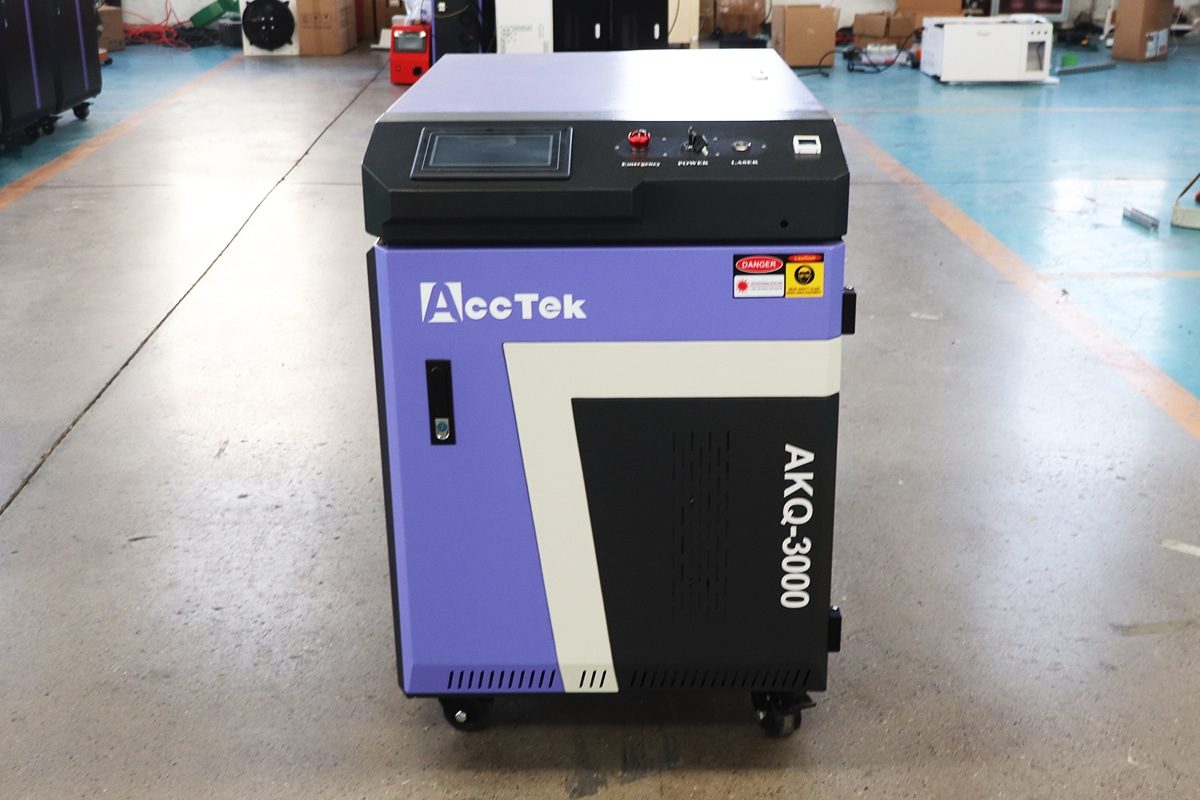
What Is Pulsed Laser Cleaning?
Pulsed laser cleaning is a modern surface-cleaning technology that uses short, high-energy laser pulses to remove unwanted materials from the surface of a workpiece. Unlike traditional cleaning methods that rely on chemicals, abrasives, water, or mechanical contact, pulsed laser cleaning removes contaminants through precisely controlled laser energy. When the laser beam reaches the surface, contaminants such as rust, paint, oxide layers, oil residues, coatings, carbon deposits, and other surface impurities absorb the laser energy and are rapidly heated, vaporized, fragmented, or detached from the underlying material.
One of the main characteristics of pulsed laser cleaning is its ability to deliver high peak power within extremely short pulse durations while maintaining relatively low average heat input. This allows the system to target unwanted surface layers efficiently without causing excessive thermal damage, deformation, or significant changes to the base material. By adjusting parameters such as pulse energy, pulse frequency, scanning speed, laser power, and spot size, operators can adapt the cleaning process to different materials, contamination levels, and surface conditions.
Because the cleaning process is non-contact, pulsed laser systems experience minimal tool wear and can be used on delicate, irregular, complex, or precision components. They can also be integrated with automated production lines, robotic systems, or handheld cleaning equipment, providing flexibility for both industrial production and maintenance applications.
Pulsed laser cleaning is increasingly used in industries such as automotive manufacturing, aerospace, electronics, mold processing, metal fabrication, shipbuilding, railway maintenance, cultural heritage restoration, and precision manufacturing. Common applications include rust removal, paint stripping, oxide removal, weld preparation, mold cleaning, coating removal, and surface preparation before bonding or painting.
Understanding how pulsed laser cleaning works, its advantages, operating parameters, applications, limitations, and equipment selection considerations can help manufacturers determine whether this technology is suitable for their specific cleaning requirements.
Table of Contents
What Pulsed Laser Cleaning Is
Pulsed laser cleaning is a surface treatment process that uses controlled bursts of laser energy to remove contaminants, coatings, oxides, residues, and other unwanted layers from a workpiece. Rather than continuously delivering energy to the surface, a pulsed laser emits energy in extremely short intervals. These pulses can produce very high instantaneous power while keeping the overall heat input relatively low, making the technology particularly suitable for applications that require precise, selective, and controlled cleaning.
The cleaning process depends on differences in how the contaminant and the underlying material absorb and respond to laser energy. With properly selected parameters, the unwanted layer can be heated, fractured, vaporized, ablated, or detached while leaving the base material largely unaffected. Because there is no physical contact between the laser source and the workpiece, the process also avoids many problems associated with mechanical wear, abrasive media, and chemical cleaning agents.
Understanding what pulsed laser cleaning is requires looking at the characteristics of pulsed laser output, how short pulses interact with contaminants, how energy is transferred, and how the process differs from other types of laser material processing.
Definition of Pulsed Laser Cleaning
Pulsed laser cleaning is a non-contact cleaning method that uses repeated short-duration laser pulses to remove unwanted substances from the surface of a material. These substances may include rust, oxide layers, paint, coatings, grease, oil, carbon deposits, adhesive residues, dirt, and other surface contaminants.
During cleaning, laser beams are directed onto the target surface and moved across the required area. The contaminants absorb part of the laser energy and undergo rapid physical or chemical changes. Depending on the material and laser parameters, the contaminant may expand, crack, melt, vaporize, decompose, or be ejected from the surface.
Unlike continuous-wave laser cleaning, which delivers laser energy continuously, pulsed laser cleaning concentrates energy into individual pulses separated by short intervals. This operating mode allows high peak power to be achieved without continuously heating the workpiece. As a result, pulsed laser cleaning systems can provide better control over heat-sensitive surfaces and applications where excessive thermal input must be avoided.
The effectiveness of pulsed laser cleaning depends on factors such as laser wavelength, pulse duration, pulse energy, peak power, repetition frequency, scanning speed, spot size, focal position, and the physical properties of both the contaminant and the substrate.
Meaning of Pulsed Laser Output
Pulsed laser output means that laser energy is emitted in a sequence of individual pulses rather than as a constant beam. Each pulse lasts for a very short period, after which there is an interval before the next pulse is produced.
This differs from continuous-wave laser output, where the laser delivers energy without interruption while the system is operating. With pulsed output, the same or even lower average laser power can produce much higher instantaneous power because the energy is concentrated into extremely short periods.
For example, pulsed lasers may have a moderate average power rating but still generate very high peak power during each pulse. This concentrated energy allows the laser to affect contaminants rapidly without continuously transferring large amounts of heat into the underlying material.
The repetition rate determines how frequently pulses are emitted. When thousands or even millions of pulses are produced every second, the cleaning process can appear continuous to the operator even though the laser is actually delivering discrete bursts of energy.
Pulsed output therefore provides a combination of high instantaneous intensity, controlled average power, and adjustable energy delivery. These characteristics are central to the precision and selectivity associated with pulsed laser cleaning.
Short-Duration Laser Pulses
The duration of each laser pulse plays an important role in determining how energy interacts with the surface. Pulsed laser cleaning systems commonly operate with pulse durations measured in nanoseconds, although other pulse durations may also be used depending on the laser technology and application.
A very short pulse transfers energy to the contaminant extremely quickly. Because the energy is delivered faster than heat can spread deeply into the surrounding material, the contaminant can experience rapid heating and expansion while the base material receives comparatively limited thermal exposure.
This short interaction time helps reduce the size of the heat-affected area and makes pulsed cleaning suitable for applications involving precision parts, molds, electronic components, thin materials, sensitive surfaces, and valuable substrates.
Short pulse durations can also promote rapid thermal expansion or ablation of the contaminant. Sudden temperature changes may create mechanical stresses within the contamination layer, causing it to crack or separate from the substrate.
The appropriate pulse duration depends on the properties of the materials involved. Hard oxide layers, paints, organic residues, and delicate surface deposits can respond differently to the same pulse length. For this reason, laser cleaning parameters should be optimized according to the specific cleaning task rather than applying one universal setting.
Pulse Energy and Peak Power
Pulse energy refers to the amount of energy delivered during a single laser pulse. It is usually expressed in units such as millijoules. Peak power describes the maximum instantaneous power generated during the pulse.
These two characteristics have a major influence on cleaning performance. When a certain amount of energy is delivered within an extremely short pulse duration, very high peak power can be produced. The resulting laser intensity can be sufficient to rapidly disrupt or remove a contamination layer.
Higher pulse energy can increase the ability of the laser to remove thick, strongly bonded, or difficult contaminants, but excessive energy may also damage or alter the substrate. Lower pulse energy may provide more delicate cleaning but can require additional passes or slower processing.
Peak power is particularly important because many laser-cleaning mechanisms depend on exceeding a threshold energy density. Once the energy reaching the contaminant exceeds this threshold, ablation, vaporization, plasma generation, rapid expansion, or fragmentation can occur.
The relationship between pulse energy, pulse duration, spot size, frequency, and scanning speed must therefore be carefully controlled. Effective laser cleaning is not simply a matter of using the highest possible power. The objective is to deliver enough energy to remove the unwanted material while remaining below the damage threshold of the substrate whenever substrate preservation is required.
Interaction Between Laser Pulses and Surface Contaminants
When a laser pulse reaches a contaminated surface, part of the energy may be reflected, while another portion is absorbed. The amount absorbed depends on factors such as wavelength, surface condition, color, composition, roughness, and temperature.
Once absorbed, the energy can cause very rapid heating of the contamination layer. Several removal mechanisms may occur simultaneously. The contaminant may vaporize directly, break into small particles, expand and separate from the substrate, or undergo thermal decomposition. In some applications, a small amount of plasma can form above the surface as material is removed.
Rapid thermal expansion can also create stress between the contaminant and the base material. If their thermal properties differ significantly, this stress can weaken the bond between the layers and promote separation.
Some contaminants also contain moisture, oil, or other substances that expand rapidly when heated. The resulting pressure can contribute to the removal process.
The exact interaction varies considerably depending on the cleaning application. Removing thin oxide layers from a metal component is different from stripping paint, removing grease, or cleaning carbon deposits. Successful processing therefore depends on matching the laser parameters to the specific contaminant-substrate combination.
Selective Removal of Unwanted Layers
One of the most important characteristics of pulsed laser cleaning is its potential for selective removal. The process can be adjusted so that contaminants absorb enough energy to be removed while the underlying material remains below its damage threshold.
This selectivity is possible because different materials have different absorption properties, ablation thresholds, thermal conductivities, melting temperatures, and responses to laser radiation. A coating or oxide layer may react strongly to a particular laser setting while the substrate reacts much less.
The laser parameters can be adjusted according to the thickness and type of unwanted layer. Operators may change pulse energy, frequency, scanning speed, focal position, overlap, cleaning width, or number of passes to control the amount of material removed.
Selective cleaning is particularly valuable when removing thin coatings, oxide films, contamination from molds, or residues from precision components. It can also be useful when a surface must be cleaned without significantly changing its dimensions or geometry.
However, selectivity is not automatic. If the energy density is too high, scanning is too slow, or too many passes are performed, the laser may begin to affect the substrate. Process testing and parameter optimization are therefore important whenever surface preservation is a critical requirement.
Non-Contact Cleaning
Pulsed laser cleaning is a non-contact process because the laser beam transfers energy to the workpiece without a cleaning tool physically touching the surface.
This eliminates many forms of mechanical wear associated with grinding wheels, wire brushes, blasting media, scrapers, or abrasive pads. The laser itself does not become dull through contact with the workpiece, and there is no need to continually replace abrasive cleaning media.
Non-contact operation also allows the laser to clean surfaces that may be difficult to reach using conventional tools. With suitable scanning optics, handheld systems, robotic equipment, or automated positioning systems, laser beams can be directed toward complex geometries, local areas, joints, edges, and irregular surfaces.
Because no mechanical force needs to be applied directly to the workpiece, the method can also reduce the risk of scratches, dents, distortion, or mechanical stress on sensitive parts.
Another advantage is process consistency. Once suitable parameters and scanning paths have been established, laser cleaning can be repeated with a high degree of control. This makes the technology suitable for integration into automated production and maintenance processes where repeatability is important.
Difference Between Cleaning and Material Processing
Although pulsed laser cleaning uses many of the same basic principles as other laser technologies, its objective differs from processes such as laser cutting, engraving, drilling, marking, and welding.
Laser cleaning is intended primarily to remove unwanted surface layers while preserving the functional base material as much as possible. The laser settings are therefore selected to target the contamination layer rather than intentionally cut, melt, reshape, or deeply modify the substrate.
Laser cutting uses sufficient energy to melt, vaporize, or otherwise separate material along a defined path. Laser engraving intentionally removes material to create visible depth or patterns. Laser marking intentionally changes the appearance or properties of the surface to produce text, codes, graphics, or identification marks. Laser welding uses concentrated energy to melt and join materials.
Pulsed laser cleaning, by contrast, usually aims to keep material removal limited to rust, oxides, coatings, deposits, residues, or other unwanted substances.
However, the boundary between cleaning and material processing depends on the parameters used. If the laser energy becomes too high or the surface is exposed for too long, the underlying material can also be melted, roughened, discolored, marked, or ablated. Proper parameter control is therefore essential for maintaining a true cleaning process rather than unintentionally changing the substrate.
Typical Cleaning Results
The results produced by pulsed laser cleaning depend on the starting surface, contaminant type, equipment, selected parameters, and desired level of cleanliness. In many applications, the process can remove visible rust, oxide layers, paint, coatings, grease, carbon deposits, and other contamination while exposing a cleaner underlying surface.
A properly optimized process can produce a relatively uniform cleaning result with limited thermal impact. The cleaned area may have a slightly different appearance from the untreated surface because contaminants and oxidation have been removed. Depending on the laser settings, minor changes in surface texture may also occur.
For surface preparation applications, laser cleaning can create a clean and controlled surface before welding, coating, painting, bonding, or other manufacturing operations. Removing oils, oxides, and residues can help improve the consistency of subsequent processes.
For precision cleaning, operators may use lower pulse energy or multiple carefully controlled passes to gradually remove contamination. For heavier rust or thick coatings, higher energy settings or repeated scanning may be required.
Not every application requires a visually polished surface. In industrial cleaning, the objective may instead be to achieve an appropriate level of oxide removal, coating removal, adhesion preparation, or contamination reduction. The desired result should therefore be defined according to the next manufacturing step and the functional requirements of the workpiece.
Pulsed laser cleaning is a controlled surface-cleaning technology that delivers laser energy in short, high-intensity pulses. These pulses can generate high peak power while limiting continuous heat input into the workpiece, allowing contaminants to be removed through mechanisms such as rapid heating, thermal expansion, ablation, fragmentation, decomposition, and vaporization.
Its key advantage is the ability to control how laser energy interacts with different layers of a surface. By carefully adjusting pulse energy, frequency, scanning speed, spot size, overlap, focal position, and other parameters, unwanted materials can often be removed selectively while minimizing effects on the underlying substrate.
Because the process is non-contact, there is no physical cleaning tool rubbing against the workpiece, which reduces tool wear and mechanical damage. The technology can also be automated and applied to complex or localized surfaces.
Unlike laser cutting, engraving, marking, or welding, pulsed laser cleaning is primarily intended to remove contamination rather than deliberately reshape or join the base material. When properly configured, it can produce clean, controlled, and repeatable surfaces suitable for maintenance, restoration, manufacturing, and surface preparation applications. Understanding these basic characteristics provides the foundation for evaluating how pulsed laser cleaning works and when it is appropriate for different industrial cleaning requirements.
How Pulsed Laser Cleaning Works
Pulsed laser cleaning works by directing a sequence of short, high-energy laser pulses onto a contaminated surface. When the laser energy reaches the workpiece, contaminants such as rust, oxides, paint, coatings, grease, carbon deposits, or other residues absorb part of the energy. Because the energy is delivered in very short bursts, the contaminant can heat rapidly and undergo thermal expansion, decomposition, vaporization, ablation, fragmentation, or other physical changes before excessive heat has time to spread deeply into the underlying material.
Several mechanisms may contribute to cleaning at the same time. Some contaminants are directly vaporized or sublimated, while others are fractured and separated by thermal stress. In higher-energy conditions, plasma may form above the surface, generating additional pressure and shockwave effects that help remove loosened particles. Repeated laser pulses progressively remove contamination, often layer by layer, until the desired level of cleanliness is reached.
A key reason pulsed laser cleaning can be selective is that contaminants and substrates often respond differently to the same laser wavelength and energy density. By controlling pulse energy, duration, repetition frequency, scanning speed, overlap, focal position, and other parameters, operators can remove unwanted layers while minimizing changes to the underlying surface. The entire cleaning process therefore depends on precisely controlling how energy is absorbed, transferred, and released at the surface.
Laser Energy Absorption
The cleaning process begins when the laser beam reaches the contaminated surface. Part of the incoming laser energy is reflected, while the remaining portion is absorbed by the materials present on the surface. The amount of energy absorbed depends on many factors, including the laser wavelength, material composition, surface roughness, color, oxidation state, coating thickness, temperature, and optical properties.
Surface contaminants frequently absorb laser radiation differently from the underlying substrate. Rust, dark coatings, carbon deposits, paint, and oxide layers may absorb a relatively high proportion of the incoming laser energy, causing them to heat rapidly. A reflective or thermally conductive substrate may absorb less energy or distribute the absorbed heat more efficiently.
The amount of energy delivered per unit area is commonly described in terms of energy density or fluence. If the energy density remains below the contaminant’s removal threshold, cleaning may be weak or incomplete. Once the threshold is exceeded, stronger effects such as thermal expansion, decomposition, vaporization, or ablation can occur.
However, increasing energy density without control can also affect the base material. Effective laser cleaning therefore requires an operating range in which the contaminant receives sufficient energy for removal while the substrate remains below the level at which undesirable melting, discoloration, roughening, or ablation occurs.
Rapid Heating of Contaminants
After absorbing laser energy, the contamination layer can experience an extremely rapid temperature rise. Because each pulse lasts only a short time, the absorbed energy is concentrated into a brief interval rather than being supplied continuously.
Rapid heating is important because it creates large temperature changes before significant heat can diffuse into the surrounding material. The contaminant may therefore reach the temperature required for decomposition, melting, vaporization, or structural breakdown while the underlying substrate experiences a much smaller temperature increase.
Different contaminants respond differently to rapid heating. Organic coatings may decompose or vaporize, while oxide layers may expand, fracture, or separate from the substrate. Oil and grease can evaporate or break down, while carbon deposits may absorb strongly and heat very quickly.
The heating rate is influenced by pulse energy, pulse duration, laser wavelength, spot size, and the thermal properties of the material. A shorter pulse can produce a faster rise in temperature and higher instantaneous intensity, while a longer pulse may allow more heat to diffuse into the substrate.
Controlling this rapid heating process is essential for achieving efficient cleaning without excessive thermal damage.
Thermal Expansion
Rapid heating causes contaminants to expand. When this expansion occurs within an extremely short period, substantial mechanical stress can develop within the contamination layer and at the interface between the contamination and the substrate.
The effect can be particularly strong when the contaminant and substrate have different coefficients of thermal expansion. One material may expand more quickly or by a greater amount than the other. This mismatch generates stress along the interface, weakening the bond between the unwanted layer and the base material.
Repeated heating and cooling from successive laser pulses can intensify this effect. Microscopic cracks may form in rust, oxide layers, coatings, or deposits. These cracks can propagate as additional pulses are applied, eventually causing pieces of the contaminant to detach.
Thermal expansion can therefore contribute to cleaning even when the contaminant is not completely vaporized. Instead of converting the entire unwanted layer into vapor, the laser may weaken its adhesion sufficiently for it to fragment and be ejected from the surface.
This mechanism is especially important for brittle contamination layers such as certain oxides and corrosion products.
Vaporization and Sublimation
When absorbed laser energy raises the temperature of a contaminant sufficiently, part of the material may change directly into vapor. In some cases, solid material may undergo sublimation, transitioning directly from a solid to a gaseous state without passing through a substantial liquid phase.
Vaporization can contribute significantly to the removal of thin coatings, organic residues, oils, surface films, and other materials that respond strongly to rapid laser heating.
Because pulsed lasers concentrate energy into very short periods, localized temperatures at the surface can become extremely high while the overall workpiece remains comparatively cool. This makes it possible to vaporize or decompose contaminants without continuously heating the entire component.
The vaporized material expands rapidly away from the surface and may carry additional particles with it. A suitable extraction system is generally used to capture fumes, vapors, dust, and particles produced during cleaning.
Complete vaporization is not always necessary or desirable. For thick contamination layers, removing all material through vaporization alone would require considerable energy. In practice, laser cleaning frequently combines vaporization with cracking, ablation, shockwave action, and particle ejection.
Laser Ablation
Laser ablation is one of the primary mechanisms involved in pulsed laser cleaning. Ablation refers to the removal of material from a surface as a result of concentrated laser energy.
When the energy density of a pulse exceeds the ablation threshold of the contaminant, the material can be rapidly heated, decomposed, vaporized, or otherwise removed. The process occurs within a very thin surface region, allowing contamination to be removed with relatively precise depth control.
Every material has its own approximate ablation threshold, depending on its optical, thermal, and physical properties. If the contaminant has a lower ablation threshold than the substrate, the laser can be adjusted so that the unwanted layer is removed while the underlying material remains largely unaffected.
This difference between thresholds forms an important basis for selective laser cleaning.
Ablation does not always mean that all removed material becomes gas. Depending on the material and energy level, ablation can produce vapor, fine particles, droplets, fragments, or plasma.
Controlled ablation is particularly useful in applications requiring precise removal of oxide films, coatings, corrosion, or residues from valuable or dimensionally sensitive components.
Plasma Formation
When laser intensity becomes sufficiently high, some of the vaporized material above the surface can become ionized, forming plasma. Plasma is a highly energized state of matter containing ions, electrons, atoms, and other particles.
During laser cleaning, plasma may appear briefly above the irradiated area as the laser interacts with the contaminant. Its formation can influence how subsequent laser energy reaches the surface and can contribute to the removal process.
Rapid expansion of the plasma creates pressure near the surface. This pressure can assist in dislodging weakened contamination and ejecting particles from the workpiece.
Plasma formation is often associated with visible light, sparks, or a brief luminous plume during laser cleaning. However, the intensity and appearance vary depending on the material, laser parameters, and cleaning conditions.
Excessive plasma can sometimes reduce cleaning efficiency because a dense plasma plume may absorb or scatter part of the incoming laser energy before it reaches the target surface. For this reason, laser parameters are normally adjusted to achieve effective removal without producing unnecessarily intense plasma.
Shockwave Effects
Rapid heating, vaporization, and plasma expansion can generate pressure waves or shockwaves near the surface. These mechanical forces can contribute significantly to contaminant removal.
When material is suddenly vaporized or plasma rapidly expands, the surrounding gas experiences a sharp increase in pressure. The resulting pressure wave travels away from the surface and can help break, loosen, or eject nearby contamination.
Shockwave effects are particularly useful when the contaminant has already been weakened by thermal expansion or ablation. Cracked oxide layers, rust particles, coating fragments, and loose deposits can be dislodged by the sudden mechanical force.
The interaction may therefore involve both thermal and mechanical cleaning effects. The laser first deposits energy, which weakens or transforms the contamination, and the resulting pressure forces assist with its physical removal.
The strength of the shockwave depends on factors such as pulse energy, pulse duration, absorption, surface condition, and the amount of material being vaporized or ionized.
Effective parameter control is important because excessively strong shockwaves or overly high energy densities may affect delicate substrates.
Particle Ejection
Not all contaminants are removed as gases. A considerable portion may leave the surface as microscopic or visible particles.
Particle ejection occurs when fragments of rust, oxide, paint, coating, carbon deposits, or other contamination are loosened by thermal stress, ablation, vapor pressure, or shockwave forces. Once the bond with the substrate is weakened, these particles can be propelled away from the surface.
The size of the particles varies according to the nature of the contamination and the cleaning parameters. Brittle oxide layers may fracture into small flakes, while coatings can break into fine debris. Other residues may produce a mixture of vapor, dust, and particles.
An extraction or filtration system is normally used near the cleaning zone to collect airborne material and prevent removed contamination from settling back onto the workpiece or spreading into the surrounding environment.
Effective particle removal is particularly important during automated cleaning because repeated redeposition could reduce surface quality or interfere with sensors and optical components.
Differences in Absorption Between Contaminants and Substrates
Selective pulsed laser cleaning is possible largely because contaminants and substrates often absorb laser energy differently.
A dark oxide layer or carbon deposit, for example, may absorb a high percentage of the laser energy, while a relatively clean metallic substrate may reflect more of the same wavelength. This means the contamination heats quickly while the base material experiences less thermal loading.
Differences can also arise from surface roughness, chemical composition, coating structure, thickness, and oxidation state. Even two materials with similar appearances may respond differently to laser radiation.
Another important difference is the damage or ablation threshold. The contaminant may begin to break down at a lower energy density than the substrate. Operators can take advantage of this difference by selecting parameters that exceed the removal threshold of the contaminant while staying below the damage threshold of the underlying material.
However, this separation between thresholds is not equally large in every application. Some contaminants and substrates have similar absorption characteristics or thermal properties, making selective cleaning more difficult.
For this reason, parameter testing is often required before processing valuable components or unfamiliar material combinations.
Repeated Pulse Interaction
A single laser pulse does not always remove all contamination. Pulsed laser cleaning normally relies on thousands or millions of repeated pulses delivered while the beam scans across the surface.
Each pulse interacts with the material remaining after the previous pulse. The first pulses may heat, crack, or weaken the upper contamination layer. Later pulses can remove the loosened material and penetrate further into the remaining contamination.
Repeated pulse interaction can therefore gradually increase the cleaning effect without requiring extremely high energy in a single exposure.
The degree of pulse overlap is an important parameter. If consecutive pulses overlap significantly, the same area receives multiple exposures. Greater overlap can increase cleaning intensity but also raises accumulated heat input. Lower overlap can increase processing speed but may leave untreated gaps if the scanning pattern is not properly designed.
Pulse repetition frequency also affects the process. Higher frequencies can deliver more pulses per second, but the energy available in each pulse and the resulting heat accumulation must be considered.
The optimal balance depends on contamination thickness, required cleaning speed, surface sensitivity, and equipment capability.
Layer-by-Layer Removal
One advantage of pulsed laser cleaning is the ability to remove contamination gradually rather than removing large amounts of material at once.
During layer-by-layer cleaning, each series of laser pulses removes a portion of the unwanted material. As the contamination becomes thinner, subsequent pulses reach progressively deeper layers until the substrate is exposed.
This controlled removal is particularly useful for thick coatings, corrosion layers, multilayer deposits, or applications where the operator wants to stop at a particular surface layer.
Multiple passes can be used instead of applying excessively high energy during a single pass. For example, the first pass may remove loose surface contamination, while later passes eliminate more strongly bonded residues.
Layer-by-layer removal also improves control over delicate cleaning tasks. Lower pulse energy combined with additional passes can sometimes provide greater precision than aggressive single-pass processing.
Automated systems may use programmed scanning patterns to ensure consistent coverage and controlled overlap across the workpiece.
The ability to remove material progressively is one reason pulsed laser cleaning is suitable for both heavy industrial cleaning and precision surface treatment.
Substrate Protection
Protecting the underlying material is one of the most important goals of pulsed laser cleaning. Although the laser can generate extremely high instantaneous power, the process can be configured so that the substrate receives limited thermal and mechanical exposure.
Substrate protection begins with selecting appropriate laser parameters. Pulse energy, pulse duration, repetition rate, scanning speed, spot size, focal position, overlap, and number of passes all influence how much energy reaches a given area.
The cleaning process should ideally operate above the removal threshold of the contaminant but below the damage threshold of the substrate. When this operating window is sufficiently wide, contaminants can be removed efficiently with minimal effect on the base material.
Short pulse durations also help limit heat diffusion. Because the energy is delivered rapidly, much of the cleaning action occurs before heat can spread deeply into the workpiece.
Fast beam scanning further reduces localized heat accumulation. Instead of holding the laser at one point, the beam continuously moves across the cleaning area.
However, pulsed laser cleaning is not automatically damage-free. Excessive pulse energy, slow scanning, incorrect focus, excessive overlap, or too many passes can cause discoloration, melting, roughening, oxidation, microstructural changes, or material removal.
For critical components, process parameters should therefore be verified through test cleaning, visual inspection, surface measurements, or other quality-control methods before full-scale production.
Pulsed laser cleaning removes unwanted surface material through a combination of optical, thermal, mechanical, and sometimes plasma-related effects. The process begins when the contamination layer absorbs energy from short laser pulses. This absorbed energy causes extremely rapid heating, which can lead to thermal expansion, cracking, decomposition, vaporization, sublimation, and laser ablation.
As vaporized material expands and plasma forms, pressure waves and shockwave effects can further loosen contamination. Fragments and particles are then ejected from the workpiece and can be collected using an appropriate extraction system.
The effectiveness and selectivity of the process depend heavily on differences in laser absorption and removal thresholds between the contaminant and substrate. When the contamination absorbs energy more strongly or has a lower ablation threshold, laser parameters can be adjusted to remove the unwanted layer while minimizing effects on the underlying material.
Cleaning normally occurs through repeated pulse interaction rather than a single exposure. Successive pulses progressively weaken and remove contamination, allowing surfaces to be cleaned layer by layer. Pulse overlap, repetition frequency, scanning speed, energy density, and the number of passes determine how aggressively material is removed.
By precisely controlling these parameters, pulsed laser cleaning can provide efficient, localized, and repeatable surface treatment with relatively low heat input. Proper parameter optimization remains essential, however, because excessive laser exposure can alter or damage the substrate. The objective is always to deliver enough energy to remove the contaminant while preserving the properties, dimensions, and surface condition required of the underlying workpiece.
Main Components of Pulsed Laser Cleaning Machines
Pulsed laser cleaning machines are made up of several interconnected systems that generate, transmit, control, focus, and safely apply laser energy to a contaminated surface. Although machine designs vary according to laser power, pulse characteristics, automation level, and intended application, most systems include a pulsed laser source, optical delivery components, a cleaning head, scanning optics, control software, a cooling system, electrical components, extraction equipment, and safety devices.
Each component has a specific role in determining cleaning efficiency, precision, stability, and operator safety. The laser source generates short pulses of energy, while the optical fiber and cleaning head deliver the beam to the workpiece. A galvanometer scanner rapidly moves the beam across the surface, and focusing optics control the energy density at the cleaning area. The control system and software allow operators to adjust parameters such as power, frequency, pulse width, scanning speed, and cleaning pattern.
Supporting components are equally important. Cooling systems help maintain stable operating temperatures, while power supplies provide consistent electrical energy. Fume extraction removes particles and vapors generated during cleaning. Safety systems, enclosures, interlocks, and protective devices reduce exposure risks associated with high-power laser radiation. Depending on production requirements, pulsed laser cleaning machines can be built as handheld, semi-automated, robotic, or fully integrated systems.
Pulsed Fiber Laser Source
The pulsed fiber laser source is the core component responsible for generating the laser energy used during cleaning. It produces laser light in a series of short pulses rather than as a continuous beam. These pulses can deliver high peak power while maintaining relatively moderate average power, making them suitable for removing rust, oxides, paint, coatings, carbon deposits, grease, and other contaminants with controlled heat input.
Fiber laser sources are commonly used because they provide good beam quality, high electrical efficiency, compact construction, and reliable long-term operation. They also require relatively little routine maintenance compared with some traditional laser technologies.
The performance of the laser source is characterized by parameters such as average power, pulse energy, pulse duration, repetition frequency, wavelength, and beam quality. These parameters determine how strongly the laser interacts with different contaminants.
Different cleaning applications require different laser source configurations. Lower-power sources may be used for precision cleaning or delicate surfaces, while higher-power systems are better suited to faster removal of heavier contamination or larger areas.
Laser Cleaning Head
The laser cleaning head is the component that directs the laser beam toward the workpiece. It contains optical and scanning components that shape, focus, and move the beam across the target area.
In handheld systems, the cleaning head is designed to be relatively lightweight and ergonomically manageable so that operators can move it over large, irregular, or difficult-to-access surfaces. In automated systems, the cleaning head may be mounted on a robot, linear axis, gantry, or other motion platform.
The cleaning head usually includes protective optics, focusing components, scanning mirrors, and sometimes integrated sensors or status indicators. Its design has a direct influence on cleaning width, scanning speed, focal distance, and accessibility.
Different cleaning heads may support different scan patterns or working widths. Some are optimized for narrow, high-intensity cleaning, while others are designed to cover larger surface areas more quickly.
A properly designed cleaning head helps maintain consistent beam delivery and protects internal optical components from dust, debris, and contamination generated during the cleaning process.
Optical Fiber
The optical fiber transfers laser energy from the fiber laser source to the cleaning head. Because the laser is generated inside the source and the cleaning head may be positioned some distance away, the fiber provides a flexible and efficient method of beam delivery.
The optical fiber used in laser cleaning machines is specifically designed to transmit high-intensity laser energy with minimal loss. It is normally protected by an outer cable structure to reduce the risk of damage from bending, abrasion, impact, or industrial operating conditions.
Fiber length affects the flexibility and working range of the equipment. A longer fiber can allow the operator or robotic cleaning head to reach larger workpieces or more distant areas, although excessive bending or improper handling should be avoided.
The connection between the laser source, fiber, and cleaning head must remain clean and properly aligned. Contamination or damage at optical interfaces can reduce beam transmission and potentially damage components.
For this reason, manufacturers generally specify minimum bending radii, handling requirements, and maintenance procedures for the delivery fiber.
Galvanometer Scanner
The galvanometer scanner, often called a galvo scanner, controls the rapid movement of the laser beam across the workpiece surface. It typically uses small, lightweight mirrors mounted on high-speed motors.
By precisely changing the angle of the mirrors, the system directs the laser beam across the cleaning area without requiring the entire cleaning head to move at the same speed. This allows extremely fast and controlled beam scanning.
Galvanometer scanners can generate different cleaning patterns, including lines, circles, spirals, rectangles, or other programmed paths. The selected pattern affects cleaning width, overlap, uniformity, and processing efficiency.
The scanning speed can usually be adjusted through the machine’s control software. Higher scanning speeds reduce the amount of energy delivered to each point, while slower scanning increases local energy exposure.
The accuracy and response speed of the galvanometer system are important for achieving consistent cleaning results. Stable scanning ensures that pulses are distributed evenly across the target area and helps prevent excessive localized heating.
Focusing Lens
The focusing lens concentrates the laser beam onto the workpiece and determines the size and energy density of the laser spot.
As the beam passes through the focusing optics, it is converged toward a focal region. Near this region, the laser intensity becomes sufficiently high to initiate cleaning mechanisms such as ablation, rapid heating, thermal expansion, and vaporization.
The focal length of the lens influences the working distance, spot size, cleaning width, and depth of focus. A shorter focal length can create a smaller, more concentrated spot, while a longer focal length can provide a larger working distance and different scanning characteristics.
Correct focal positioning is essential for consistent cleaning. If the workpiece is too far from or too close to the intended focal plane, the energy density may decrease or become uneven.
Operators may therefore adjust the working distance according to the cleaning head and lens configuration. In automated systems, fixed positioning, distance sensors, or robotic control can help maintain the correct focal relationship.
Protective Lens
The protective lens is positioned within or near the front of the cleaning head to shield more expensive optical components from contamination.
During laser cleaning, particles, smoke, vapor, dust, and fragments can be ejected from the workpiece. Without protection, these contaminants could reach the focusing lens or scanning optics and reduce optical performance.
The protective lens acts as a replaceable barrier. Because it is comparatively inexpensive and accessible, it can be inspected and replaced when contaminated or damaged.
A dirty protective lens can reduce transmitted laser power, distort the beam, create hot spots, and negatively affect cleaning quality. In severe cases, excessive contamination may cause overheating or damage.
Regular inspection is therefore an important maintenance task. The lens should be cleaned or replaced according to manufacturer recommendations, and operators should avoid touching optical surfaces directly.
Keeping the protective lens in good condition helps maintain stable laser transmission and extends the service life of internal optical components.
Control System
The control system coordinates the operation of the laser source, scanner, cleaning head, safety devices, and other machine components.
It allows the operator to start and stop the laser, select operating modes, adjust cleaning parameters, monitor machine status, and respond to faults or alarms.
Depending on the machine design, the control system may include an industrial controller, PLC, touch-screen interface, computer, or integrated electronic control unit.
Important adjustable parameters can include laser power, pulse frequency, pulse width, scanning speed, scan width, pattern, overlap, and operating time.
The control system also communicates with safety components such as emergency-stop circuits, interlocks, temperature sensors, and laser enable signals.
In automated installations, it may communicate with robotic controllers, production lines, vision systems, or external equipment.
A reliable control system improves repeatability because successful cleaning parameters can often be saved and reused for similar workpieces.
Cleaning Software
Cleaning software provides the operator interface for configuring how the laser beam scans and interacts with the surface.
Through the software, users can typically select scan patterns, adjust cleaning width, set scanning speed, modify laser power, control pulse characteristics, and save parameter combinations for different applications.
Some systems provide predefined cleaning modes for common operations, while more advanced software allows extensive customization.
The software may display operating status, alarms, parameter values, and system diagnostics. It can also simplify process optimization by allowing operators to modify settings without physically changing machine components.
For automated applications, cleaning software may work together with robot programs or motion-control software to coordinate laser scanning with movement of the cleaning head.
User-friendly software can reduce setup time and make it easier to reproduce established cleaning processes. However, operators still need to understand the effects of the parameters being changed, because unsuitable settings can cause incomplete cleaning or excessive surface exposure.
Cooling System
The cooling system removes heat generated by the laser source and other temperature-sensitive components during operation.
Although pulsed fiber lasers are relatively efficient, a portion of electrical energy is still converted into heat. If this heat is not controlled, component temperatures can rise and affect laser stability, output consistency, or service life.
Depending on the laser power and machine design, the system may use air cooling or water cooling.
Lower-power pulsed cleaning machines may use integrated air cooling, which simplifies machine construction and reduces the need for coolant maintenance. Higher-power systems may use industrial water chillers to provide more effective and stable temperature control.
A water-cooling system typically includes a chiller, pump, reservoir, temperature controller, hoses, and sensors. Coolant condition and flow should be monitored regularly.
Stable cooling helps maintain consistent laser performance during extended cleaning operations and protects sensitive internal components from overheating.
Power Supply
The power supply provides the electrical energy required by the laser source, control system, scanner, cooling equipment, extraction system, and other electrical components.
Stable electrical input is important because fluctuations or interruptions can affect machine operation and cleaning consistency. Industrial machines may include voltage regulation, circuit protection, breakers, grounding systems, and other electrical safety components.
The required supply voltage and frequency vary according to machine power, model, and destination market. Some compact cleaning systems may operate from common single-phase electrical supplies, while higher-power industrial systems may require more substantial electrical connections.
Power consumption is not determined solely by the rated laser output. The cooling system, extraction unit, control electronics, motors, and auxiliary devices also consume electricity.
Proper grounding is especially important for laser equipment because it supports electrical safety and stable operation.
Users should ensure that the facility electrical supply meets the manufacturer’s specified voltage, current, grounding, and circuit protection requirements.
Fume Extraction System
Laser cleaning can generate smoke, fumes, fine particles, dust, vaporized material, and fragments as contaminants are removed from the workpiece.
A fume extraction system captures these by-products near the cleaning area and filters them before releasing or exhausting the air.
The extraction unit may include a suction hood or nozzle, flexible ducting, fans, prefilters, particulate filters, activated-carbon filters, and other filtration stages depending on the contaminants being removed.
Effective extraction serves several purposes. It improves visibility around the cleaning zone, reduces airborne contamination, helps protect the operator, and prevents debris from settling onto nearby machinery or optical components.
Extraction requirements depend heavily on the material being cleaned. Removing rust may generate different emissions from removing paint, oil, adhesives, or specialized industrial coatings.
Some coatings can produce hazardous fumes when heated or ablated, so appropriate ventilation and filtration must be selected based on the material composition.
The extraction system should therefore be considered an integral part of the cleaning process rather than an optional accessory.
Safety System
The safety system is essential because pulsed laser cleaning machines typically use high-power lasers capable of causing serious eye or skin injury.
Safety components may include emergency-stop buttons, key switches, laser-enable controls, warning lights, interlocks, protective housings, remote interlock connections, beam shutters, access sensors, and fault monitoring.
Operators must also use laser safety eyewear appropriate for the laser wavelength and required protection level.
In automated or enclosed installations, access doors may be connected to interlocks that disable laser emission when the enclosure is opened. Warning indicators can show when the laser system is energized or emitting.
Safety systems may also monitor cooling, electrical conditions, scanning functions, and other operating parameters. If an abnormal condition is detected, the laser can be automatically disabled.
Proper operator training, controlled working areas, warning signs, and established procedures are equally important. Technical safety devices should form part of a broader laser safety program rather than being relied upon as the only form of protection.
Machine Enclosure
A machine enclosure surrounds part or all of the cleaning system and helps isolate the laser process from the surrounding work environment.
Fully enclosed systems can significantly improve safety by preventing direct or reflected laser radiation from leaving the controlled processing area. They can also help contain fumes, dust, particles, and debris.
Enclosures are especially common in automated industrial cleaning cells where workpieces are loaded into a dedicated processing area. Safety interlocks are normally connected to access doors so that the laser cannot operate when the enclosure is open.
The enclosure can also support integration of extraction equipment, viewing windows designed for the laser wavelength, cameras, lighting, sensors, robotic equipment, and fixtures.
Handheld systems may use partial protective barriers rather than complete enclosures, particularly when large workpieces must be cleaned in place.
The appropriate enclosure design depends on laser class, application, workpiece size, automation requirements, and local safety regulations.
Handheld and Automated Configurations
Pulsed laser cleaning machines are available in handheld, semi-automated, and fully automated configurations.
Handheld systems use a portable cleaning head connected to the laser source through an optical fiber. The operator manually directs the laser across the workpiece. This configuration offers considerable flexibility and is well suited to maintenance, repair, localized rust removal, mold cleaning, large structures, irregular components, and applications where workpieces cannot easily be moved.
Automated systems mount the cleaning head on a robot, gantry, linear motion system, rotary axis, or customized workstation. The movement of the laser head and workpiece can then be programmed to produce repeatable cleaning paths.
Automation is particularly useful in high-volume production because it can improve consistency, productivity, process control, and integration with upstream or downstream manufacturing operations.
Semi-automated systems combine elements of both approaches. For example, an operator may load and position the workpiece while the laser follows a programmed cleaning cycle.
The most appropriate configuration depends on production volume, part geometry, cleaning area, required consistency, cycle time, labor availability, and investment budget.
Pulsed laser cleaning machines combine laser generation, beam delivery, scanning, control, cooling, extraction, and safety technologies into a coordinated surface-cleaning system. At the center of the machine is the pulsed fiber laser source, which produces short bursts of high-peak-power laser energy. The optical fiber transfers this energy to the cleaning head, where the galvanometer scanner and focusing lens control the direction, shape, and intensity of the beam.
Protective lenses shield sensitive optics from debris, while the control system and cleaning software allow operators to regulate key process parameters and scanning patterns. The cooling system maintains stable operating temperatures, and the power supply provides reliable electrical energy to the machine and its auxiliary components.
Fume extraction is important for collecting smoke, dust, vapor, and particles generated during contaminant removal. At the same time, laser safety systems, emergency stops, interlocks, protective eyewear, warning devices, and machine enclosures reduce the risks associated with high-intensity laser radiation.
Pulsed laser cleaning equipment can also be configured for very different production environments. Handheld machines provide flexibility for repair, maintenance, and irregular workpieces, while automated and robotic systems offer greater consistency for repetitive industrial production.
Although individual components perform different functions, cleaning quality ultimately depends on how effectively they work together. Stable laser output, accurate beam scanning, clean optics, reliable cooling, proper extraction, responsive control, and comprehensive safety protection all contribute to efficient and repeatable pulsed laser cleaning.
Key Pulsed Laser Cleaning Parameters
Pulsed laser cleaning performance depends on a combination of laser, optical, scanning, and process parameters. These settings determine how much energy reaches the surface, how quickly that energy is delivered, how the beam moves across the workpiece, and how many times each area is exposed. Proper parameter selection is essential for achieving effective contaminant removal while minimizing unnecessary heating, discoloration, roughening, melting, or damage to the underlying substrate.
Important parameters include average laser power, pulse energy, peak power, pulse width, pulse frequency, wavelength, beam quality, spot size, energy density, scanning speed, cleaning width, pulse overlap, working distance, focal position, scanning pattern, and number of cleaning passes. None of these parameters operate independently. Increasing one setting can change the effect of several others, which means cleaning performance must be evaluated as a complete process rather than by considering laser power alone.
Different contaminants also require different parameter combinations. Light oxide films may need relatively gentle settings, while heavy rust, thick paint, or strongly bonded coatings may require greater pulse energy or multiple passes. The best parameters therefore depend on contaminant type, thickness, substrate properties, desired surface condition, productivity requirements, and equipment capability.
Average Laser Power
Average laser power describes the amount of laser energy delivered over time and is usually expressed in watts. It is one of the most commonly referenced specifications when comparing pulsed laser cleaning machines, but it does not by itself determine cleaning performance.
A higher average power generally allows more total energy to be delivered to the workpiece each second. This can increase cleaning productivity, especially when treating large areas or removing heavy contamination. However, high average power does not necessarily mean that individual laser pulses are more energetic. Two machines with the same average power can have very different pulse energies, pulse widths, frequencies, and peak powers.
Average power is closely related to pulse energy and pulse frequency. Increasing the repetition frequency while maintaining the same pulse energy increases average power, while reducing pulse energy at the same frequency decreases it.
For delicate cleaning tasks, lower average power may provide better thermal control. For industrial rust removal, paint stripping, or large-area processing, higher average power can improve throughput. The appropriate setting should balance cleaning speed with substrate protection and thermal management.
Pulse Energy
Pulse energy is the amount of energy contained in each laser pulse. It is usually expressed in millijoules and is one of the most important parameters affecting the intensity of pulsed laser cleaning.
Higher pulse energy means that more energy reaches the target during each pulse. This can improve the ability to break down, ablate, vaporize, or detach thick and strongly bonded contaminants. Heavy rust, oxide layers, paint, and coatings may require greater pulse energy than light surface contamination.
However, excessive pulse energy can increase the risk of damaging the substrate. If the energy delivered to a small area exceeds the material’s damage or ablation threshold, the underlying surface may become roughened, melted, discolored, marked, or partially removed.
Lower pulse energy offers gentler cleaning and may be preferable for molds, precision parts, thin components, sensitive surfaces, or valuable materials. Multiple lower-energy passes can sometimes provide better control than a single aggressive pass.
Pulse energy should therefore be selected according to the removal threshold of the contaminant and the tolerance of the substrate.
Peak Power
Peak power describes the instantaneous power reached during a laser pulse. Because pulsed laser cleaning systems deliver energy within extremely short periods, peak power can be much higher than average laser power.
Peak power is influenced primarily by pulse energy and pulse duration. If the same amount of energy is delivered in a shorter period, the instantaneous power becomes greater. This high peak power is one reason pulsed laser cleaning can remove contaminants efficiently without continuously heating the workpiece.
High peak power can produce rapid heating, ablation, vaporization, plasma formation, and strong thermal expansion. These effects help break the bond between contaminants and the substrate.
However, excessively high peak power may also increase surface damage risks, particularly when cleaning thin coatings or sensitive materials. It may generate intense plasma, strong shockwaves, or local material removal beyond the contamination layer.
Peak power should therefore be considered together with pulse duration, spot size, energy density, and substrate properties. Effective cleaning requires enough instantaneous intensity to initiate removal mechanisms without creating unacceptable changes in the underlying material.
Pulse Width
Pulse width, also called pulse duration, describes how long each laser pulse lasts. In many industrial pulsed laser cleaning systems, pulse widths are measured in nanoseconds, although equipment with different pulse-duration ranges is also available.
Shorter pulses concentrate energy into a smaller period of time, producing higher peak power and very rapid surface heating. Because energy is delivered quickly, there is less time for heat to spread deeply into the substrate. This can improve control and reduce the heat-affected region.
Longer pulses deliver energy over a greater time interval. They may produce lower peak power for the same pulse energy and allow more thermal diffusion into the workpiece.
Adjustable pulse width can be useful because different contaminants respond differently to energy delivery. Thin oxides, paint layers, carbon deposits, and corrosion products may each have different optimal pulse durations.
Selecting pulse width therefore involves balancing removal efficiency, peak power, thermal effects, and substrate protection. It should always be optimized together with pulse energy and frequency rather than considered as an isolated setting.
Pulse Frequency
Pulse frequency, or repetition rate, indicates how many laser pulses are emitted each second. It is commonly expressed in kilohertz.
A higher pulse frequency means that more pulses reach the surface during a given period. Depending on pulse energy and scanning conditions, this can increase pulse overlap and provide more uniform energy distribution.
However, increasing frequency does not automatically improve cleaning. On many laser cleaning systems, pulse energy changes as frequency changes. Very high frequencies may produce many lower-energy pulses, while lower frequencies can allow higher energy per pulse.
Pulse frequency also influences heat accumulation. If pulses arrive too quickly at the same area, insufficient cooling time may exist between pulses, causing the surface temperature to rise progressively.
Lower frequencies may produce stronger individual cleaning effects but can reduce the number of pulses delivered per unit time.
The ideal frequency depends on the contaminant, substrate, pulse energy, scanning speed, and desired productivity. Operators often adjust frequency together with scanning speed to obtain suitable pulse spacing and overlap.
Laser Wavelength
Laser wavelength describes the wavelength of the emitted laser radiation and has a major influence on how strongly different materials absorb the beam.
Pulsed fiber laser cleaning systems commonly operate in the near-infrared range. The interaction between this wavelength and the workpiece depends on the optical properties of both the contaminant and substrate.
Some contaminants absorb the laser wavelength strongly while the underlying material reflects a greater proportion of the radiation. This difference can create a useful processing window in which the contaminant reaches its removal threshold before the substrate is significantly affected.
Wavelength selection can therefore influence cleaning selectivity, especially when processing sensitive material combinations.
The same laser wavelength will not interact identically with rust, paint, oil, carbon, oxides, polymers, and different substrate materials. Surface condition, temperature, roughness, and oxidation also affect absorption.
Because wavelength is normally determined by the laser source rather than frequently adjusted by the operator, it should be considered when selecting equipment for a particular range of cleaning applications.
Beam Quality
Beam quality describes how closely the laser beam approaches an ideal beam profile and how effectively it can be focused.
A laser with good beam quality can generally be concentrated into a smaller, more uniform spot, producing more predictable energy density. This improves control over cleaning and can be especially important for precision surface treatment.
Poor beam quality can create a larger or less uniform focal spot, potentially causing uneven energy distribution across the cleaning area. Some regions may receive excessive exposure while others receive insufficient energy.
Beam quality also affects working distance, depth of focus, scanning behavior, and the ability to maintain stable cleaning intensity.
For large-area cleaning, extremely small spot size may not always be necessary because the scanner spreads the beam across a wider pattern. Nevertheless, consistent beam quality remains important for obtaining repeatable results.
Because beam quality is primarily determined by the laser source and optical design, it is generally a machine-selection consideration rather than an operator-adjustable process parameter.
Spot Size
Spot size refers to the dimensions of the laser beam at the workpiece surface. It strongly influences the amount of energy concentrated into a particular area.
A smaller spot concentrates the available laser energy into a smaller region, resulting in higher energy density. This can improve the removal of stubborn contamination but may also increase the risk of substrate damage.
A larger spot distributes the same energy over a greater area, reducing energy density. This can provide gentler cleaning and increase coverage, but insufficient intensity may fail to remove strongly bonded contamination.
Spot size depends on factors such as beam quality, focusing optics, focal length, and working distance.
In many scanning laser cleaning systems, the beam spot moves rapidly across a larger cleaning width. The effective cleaning performance therefore depends not only on the individual spot size but also on the scanning pattern and overlap between successive beam positions.
Correct spot-size selection helps balance precision, energy density, surface coverage, and cleaning productivity.
Energy Density
Energy density, often called laser fluence, describes the amount of laser energy delivered per unit area. It is one of the most important factors determining whether contamination will be removed.
For cleaning to occur efficiently, the energy density generally needs to exceed the removal or ablation threshold of the unwanted layer. Below this threshold, the contaminant may only be heated without being effectively removed.
If energy density is increased beyond the contaminant threshold, removal becomes more aggressive. However, once it approaches or exceeds the damage threshold of the substrate, the underlying material may begin to melt, roughen, discolor, ablate, or undergo other undesirable changes.
The ideal cleaning window therefore lies between these two thresholds whenever selective removal is required.
Energy density is affected by pulse energy and spot size. Concentrating the same pulse energy into a smaller area increases fluence, while spreading it across a larger area reduces it.
Maintaining appropriate energy density is especially important for precision cleaning because it directly influences removal depth, cleaning efficiency, and substrate protection.
Scanning Speed
Scanning speed describes how quickly the laser beam moves across the workpiece surface.
A slower scanning speed causes each area to receive more laser pulses and greater cumulative energy. This can improve the removal of thick or difficult contamination but also increases heat accumulation and the risk of substrate effects.
A faster scanning speed reduces the exposure time at each location and distributes laser energy across a larger area more quickly. This can improve productivity and reduce thermal input, but excessive speed may leave contamination partially removed.
Scanning speed interacts strongly with pulse frequency and pulse overlap. At a fixed frequency, slowing the scan decreases the distance between pulses and increases overlap. Increasing scanning speed spreads pulses farther apart.
For consistent cleaning, scanning speed should also match the selected cleaning width and pattern. Uneven motion can produce stripes, missed areas, or excessive local exposure.
Optimal scanning speed is therefore determined by the contaminant thickness, required cleaning depth, pulse parameters, and desired cycle time.
Cleaning Width
Cleaning width refers to the effective width covered by the scanning laser beam during each pass.
A wider cleaning width allows the system to cover more surface area and can significantly increase productivity when treating large workpieces. It is useful for applications such as rust removal from plates, cleaning structural components, or stripping coatings from broad surfaces.
However, increasing cleaning width spreads the scanning path over a larger area. Depending on laser power and scanning settings, this may reduce the amount of energy delivered to each portion of the surface.
A narrower width concentrates the available processing capacity into a smaller region. This can provide stronger cleaning and greater precision for localized contamination, weld preparation, mold cleaning, or detailed components.
Cleaning width is usually controlled through the galvanometer scanner and software. Different scan patterns may also produce different effective widths.
Selecting the correct cleaning width involves balancing surface coverage, cleaning intensity, precision, and productivity.
Pulse Overlap
Pulse overlap describes how much adjacent laser pulses overlap as the beam travels across the workpiece.
When overlap is high, each area receives energy from multiple neighboring pulses. This can create more uniform coverage and increase the cumulative cleaning effect.
However, excessive overlap can cause unnecessary heat accumulation, reduce processing speed, and increase the risk of substrate modification.
If overlap is too low, gaps may exist between individual pulse positions. These gaps can produce uneven cleaning, visible streaks, or residual contamination.
Pulse overlap is affected by pulse frequency, scanning speed, beam spot size, and scan pattern. Increasing frequency or reducing scanning speed generally increases overlap, while faster scanning decreases it.
The correct overlap should provide continuous, uniform cleaning while avoiding unnecessary repeated exposure.
Overlap is especially important when high surface consistency is required, because even relatively small differences in pulse distribution can affect the appearance and cleanliness of the processed area.
Working Distance
Working distance is the physical distance between the laser cleaning head and the workpiece surface.
Maintaining an appropriate working distance helps ensure that the beam reaches the surface with the intended size, focus, and energy density. If the cleaning head moves too close to or too far from the workpiece, the spot size and intensity may change.
Working distance is particularly important when cleaning curved, irregular, or three-dimensional parts. Variations in surface height can cause different regions to move away from the ideal optical position.
Handheld operators normally maintain the recommended distance manually, sometimes with the assistance of a guide or spacer. Automated systems may use programmed motion, distance sensors, or height-following devices.
A longer working distance can make it easier to reach recessed or complex areas and can provide greater separation between the optics and debris generated during cleaning. However, it must remain within the optical design range of the cleaning head.
Stable working distance contributes directly to consistent cleaning quality.
Focal Position
Focal position describes the location of the laser beam’s focal region relative to the workpiece surface.
At or near the focal point, the beam reaches a relatively small spot size and higher energy density. Moving the workpiece away from the focal plane causes the beam to expand and reduces the energy concentration.
Cleaning does not always need to occur exactly at the smallest focal spot. In some applications, slight defocusing can create a larger spot and more moderate energy density, providing wider or gentler cleaning.
Changing focal position can therefore be used as a process-control technique. A tightly focused beam may be useful for strongly bonded contamination, while a slightly defocused beam may improve coverage or protect a sensitive surface.
Incorrect focal positioning can cause inconsistent cleaning, particularly when surface height varies across a workpiece.
Operators should follow the optical specifications of the cleaning head and verify focal position whenever lenses, working distance, or part geometry change.
Scanning Pattern
The scanning pattern determines the path followed by the laser beam as the galvanometer moves it across the surface.
Common patterns may include straight lines, rectangles, circles, spirals, grids, waves, or other programmed shapes. Different patterns distribute laser energy differently and can therefore affect cleaning uniformity, edge quality, heat accumulation, and processing speed.
A simple line pattern may be suitable for narrow cleaning areas or weld preparation, while wider rectangular or filled patterns can cover larger surfaces.
Circular or spiral scanning may be useful for particular geometries or localized cleaning requirements.
Pattern selection should match the shape of the workpiece and the contamination. It should also ensure sufficient overlap without repeatedly exposing the same locations unnecessarily.
In automated systems, scanning patterns can be coordinated with robot or axis movement to process large three-dimensional surfaces.
Proper pattern design helps avoid untreated gaps, excessive edge exposure, visible stripes, and irregular cleaning results.
Number of Cleaning Passes
The number of cleaning passes indicates how many times the laser scans over the same area.
A single pass may be sufficient for light rust, thin oxide films, dust, or surface residues. Heavier corrosion, thick paint, multilayer coatings, or strongly bonded contamination may require multiple passes.
Additional passes increase cumulative energy input and progressively remove deeper contamination. They also make layer-by-layer cleaning possible.
Using several controlled passes can sometimes be safer than attempting complete removal with very aggressive settings during one pass. The first pass can remove loose material, while later passes clean the remaining strongly bonded layer.
However, unnecessary passes reduce productivity and increase thermal exposure. Once the contaminant has been removed, further scanning may begin to affect the substrate.
The correct number of passes should therefore be based on actual cleaning results rather than a fixed value for every application. Visual inspection, surface measurements, or automated monitoring can be used to determine when the desired cleanliness has been achieved.
Parameter Interaction
The most important principle in pulsed laser cleaning is that process parameters interact with one another. Changing one parameter frequently changes the effect of several others.
For example, increasing pulse energy raises the amount of energy delivered in each pulse, but the effect also depends on spot size. A smaller spot creates higher energy density from the same pulse energy. Likewise, increasing pulse frequency delivers more pulses per second, but whether this increases or decreases cleaning intensity depends on how pulse energy changes and how quickly the beam is scanning.
Scanning speed affects pulse overlap and cumulative exposure. Slower movement increases the number of pulses reaching each location, while faster movement reduces local exposure. Cleaning width influences how broadly the available laser energy is distributed. Focal position changes spot size and therefore affects energy density.
Pulse width influences peak power, while frequency and pulse energy together influence average power. The number of passes further changes total exposure.
Because of these interactions, selecting parameters by adjusting one setting at a time without considering the others can produce inconsistent results. Process optimization should instead focus on the complete combination of laser energy, optical conditions, scanning behavior, contamination characteristics, and substrate tolerance.
Testing is particularly important for new material combinations. Operators can begin with conservative parameters and gradually adjust power, energy, frequency, speed, focus, and passes until the desired balance between cleaning quality, productivity, and substrate protection is achieved.
The effectiveness of pulsed laser cleaning depends on precise control of multiple interrelated parameters. Average laser power determines the overall rate of energy delivery, while pulse energy and peak power influence the intensity of each interaction with the surface. Pulse width determines how quickly energy is delivered, and pulse frequency controls how often pulses are produced.
Laser wavelength and beam quality influence absorption and focusing behavior, while spot size and energy density determine how concentrated the laser energy becomes at the workpiece. Scanning speed, cleaning width, pulse overlap, and scanning pattern control how that energy is distributed across the surface.
Working distance and focal position determine whether the beam reaches the workpiece with the intended optical characteristics. The number of cleaning passes controls cumulative exposure and allows contamination to be removed progressively, layer by layer.
Most importantly, these parameters cannot be optimized independently. Pulse energy, frequency, width, spot size, scanning speed, overlap, focal position, and number of passes continuously influence one another. A setting that performs well for one contaminant and substrate combination may be unsuitable for another.
Successful pulsed laser cleaning therefore depends on establishing an appropriate processing window in which the contaminant receives sufficient energy for removal while the substrate remains protected. Careful testing and parameter optimization can achieve a balance between cleaning efficiency, surface quality, processing speed, and long-term process consistency.
Different Types of Pulsed Laser Cleaning Machines
Pulsed laser cleaning machines are available in a wide range of designs to suit different contamination levels, workpiece sizes, production volumes, mobility requirements, and surface-quality standards. Although all pulsed laser cleaning machines operate by delivering short bursts of laser energy to remove unwanted surface layers, they can differ significantly in laser power, pulse duration, cooling method, machine structure, operating mode, and degree of automation.
Some systems are designed for delicate precision cleaning, while others are built for removing heavy rust, thick coatings, or contamination from large industrial components. Low-power machines typically emphasize control and minimal thermal impact, whereas medium- and high-power systems provide greater productivity and stronger cleaning capability. Machines can also be classified according to pulse characteristics, such as nanosecond or other short-pulse technologies.
Physical configuration is another important distinction. Handheld and portable machines provide flexibility for maintenance and on-site work, while cabinet-type systems offer enclosed processing for smaller parts. Robotic and production-line systems are designed for repeatable, automated cleaning in manufacturing environments.
The most suitable machine type depends on the contaminant, substrate sensitivity, required cleaning rate, surface area, workpiece geometry, operating environment, and desired level of automation.
Low-Power Pulsed Laser Cleaning Machines
Low-power pulsed laser cleaning machines are designed primarily for precision cleaning, light contamination removal, and applications where protecting the underlying surface is especially important. These machines typically produce lower average output than industrial high-throughput systems but can still generate substantial peak power during individual pulses.
They are commonly used to remove thin oxide films, light rust, oil residues, carbon deposits, mold contamination, small coating areas, and surface impurities from precision components. Because the overall heat input can be kept relatively low, these systems are well suited to delicate parts, thin materials, tooling, electronic components, molds, and surfaces where excessive heating or roughening must be avoided.
Low-power systems also provide greater control when only a very thin unwanted layer needs to be removed. Operators can use lower pulse energy, narrow cleaning widths, and multiple controlled passes to gradually clean the surface.
Their main limitation is productivity. Cleaning large surfaces or thick contamination may take considerably longer than with higher-power machines. For this reason, low-power pulsed laser cleaning machines are generally selected when cleaning precision and substrate protection are more important than maximum processing speed.
Medium-Power Pulsed Laser Cleaning Machines
Medium-power pulsed laser cleaning machines provide a balance between cleaning precision and production efficiency. They are suitable for a broad range of industrial applications and are often chosen when users need greater cleaning speed than low-power equipment can provide without moving to the size, cost, or thermal output of high-power systems.
These machines can handle moderate rust, oxide layers, paint, coatings, grease, carbon deposits, and other common industrial contaminants. Typical applications include equipment maintenance, mold cleaning, weld preparation, automotive component cleaning, machinery refurbishment, and surface preparation before coating or bonding.
Medium-power pulsed laser cleaning systems can usually cover larger cleaning widths and remove contamination more quickly than lower-power units. At the same time, pulsed operation still allows relatively precise control over heat input.
Their versatility makes them suitable for companies that process several different workpiece types rather than one specialized application. By adjusting pulse energy, frequency, scanning speed, cleaning width, and number of passes, operators can adapt the same machine to both lighter and more demanding cleaning tasks.
High-Power Pulsed Laser Cleaning Machines
High-power pulsed laser cleaning machines are designed for high productivity and demanding industrial cleaning applications. Their greater average output allows more energy to be delivered to the workpiece each second, helping remove heavy corrosion, thick coatings, large areas of paint, stubborn oxide layers, and strongly bonded contamination more quickly.
These machines are particularly useful for large structural components, heavy machinery, shipbuilding, transportation equipment, large molds, steel structures, production equipment, and other applications where cleaning speed has a major effect on operating cost.
High-power systems can support wider scanning areas and faster processing rates, making them suitable for repetitive industrial work or applications involving large surface areas.
However, higher power also requires more careful parameter control. Excessive energy density, slow scanning, or repeated exposure can increase thermal accumulation and may alter the underlying material. Cooling, extraction, electrical supply, and safety requirements may also be more substantial.
High-power machines are therefore most appropriate when throughput is a priority, and the cleaning process can be carefully optimized to maintain acceptable surface quality.
Nanosecond Pulsed Laser Cleaning Machines
Nanosecond pulsed laser cleaning machines use laser pulses with durations measured in nanoseconds. They are among the most widely used pulsed laser cleaning systems for industrial surface cleaning because they offer an effective combination of high peak power, reliable operation, controllable heat input, and practical equipment cost.
During each nanosecond pulse, energy is delivered to the contaminant extremely quickly. This can produce rapid heating, thermal expansion, ablation, vaporization, and mechanical stress before large amounts of heat spread into the substrate.
Nanosecond systems are suitable for removing rust, oxides, paint, coatings, carbon deposits, grease, and residues from many industrial surfaces. They are commonly used for mold cleaning, weld preparation, maintenance, restoration, and manufacturing applications.
Their performance can be adjusted through pulse energy, pulse width, frequency, scanning speed, and beam overlap.
Although nanosecond pulses are short, some thermal interaction still occurs. For extremely heat-sensitive or microscopic applications, even shorter-pulse systems may offer additional control. Nevertheless, nanosecond pulsed fiber lasers provide a practical balance of cleaning effectiveness, durability, and cost for many industrial users.
Short-Pulse Laser Cleaning Systems
Short-pulse laser cleaning systems use very brief laser pulses to concentrate energy into extremely short time intervals. Depending on the technology, the pulse duration may be shorter than that of conventional nanosecond cleaning systems.
Reducing pulse duration increases peak power for a given amount of pulse energy and limits the time available for heat to diffuse into surrounding material. This can provide greater control when cleaning precision components, heat-sensitive surfaces, thin layers, or specialized materials.
Short-pulse laser cleaning systems can remove contamination through highly localized ablation and rapid material ejection while reducing the size of the thermally affected region.
They may be used in precision manufacturing, electronics, aerospace components, advanced tooling, restoration, and specialized surface preparation.
However, shorter-pulse laser technology can be more expensive and may not be necessary for ordinary industrial rust or paint removal. A conventional nanosecond system may provide better productivity and cost efficiency for general-purpose applications.
Short-pulse equipment is therefore most valuable when surface quality, extremely fine material removal, or minimal thermal influence takes priority over equipment simplicity and cost.
Air-Cooled Laser Cleaning Machines
Air-cooled pulsed laser cleaning machines use fans, heat sinks, and internal airflow rather than a circulating liquid system to control equipment temperature.
This cooling method is commonly found in compact and lower- to moderate-power pulsed laser cleaning machines. Air cooling simplifies the machine because it eliminates the need for a separate water chiller, coolant reservoir, pump, and associated hoses.
The resulting equipment is often lighter, smaller, and easier to transport. Maintenance can also be simpler because operators do not need to monitor coolant quality, water level, or chiller operation.
Air-cooled machines are therefore particularly attractive for portable, handheld, maintenance, and on-site cleaning applications.
However, air cooling has limited heat-removal capacity compared with industrial water cooling. In high-power or continuous-duty applications, cooling performance may become a limiting factor.
The operating environment is also important. Dust, restricted airflow, and high ambient temperatures can reduce cooling efficiency.
Air-cooled cleaners are generally best suited to applications where compact size, mobility, and simplified maintenance are important, and the thermal load remains within the machine’s cooling capacity.
Water-Cooled Laser Cleaning Machines
Water-cooled pulsed laser cleaning machines use a circulating liquid cooling system to remove heat from the laser source and other temperature-sensitive components.
A typical system includes an industrial chiller, coolant reservoir, pump, temperature controller, hoses, and monitoring devices. The coolant circulates through the equipment, absorbs heat, and transfers it back to the chiller.
Water cooling provides greater thermal capacity and more stable temperature control than air cooling. It is therefore commonly used in higher-power pulsed laser cleaning machines and machines intended for long periods of continuous industrial operation.
Stable temperature helps maintain consistent laser output and can support longer component life.
The disadvantage is greater system complexity. Users must monitor coolant quality, temperature, flow rate, filters, and possible leakage. The chiller also adds size, weight, electrical consumption, and maintenance requirements.
For stationary manufacturing environments or demanding high-duty-cycle applications, these disadvantages are often acceptable because of the improved thermal stability.
Water-cooled systems are therefore generally preferred when high laser power, extended operating periods, or strict temperature control are required.
Handheld Laser Cleaning Machines
Handheld pulsed laser cleaning machines allow the operator to manually move the cleaning head across the workpiece.
They are among the most flexible machine configurations because they can be used on parts that are too large, irregular, or inconvenient to place inside a fixed cleaning station. The operator can move around machinery, structures, molds, welds, corners, joints, and other localized areas.
Handheld systems are commonly used for equipment maintenance, rust removal, paint stripping, mold cleaning, weld preparation, restoration, and repair.
The cleaning head is connected to the laser source through an optical fiber, allowing the main machine to remain stationary while the operator works within the fiber’s reach.
The main advantage is flexibility, but cleaning consistency depends more strongly on operator technique. Working distance, movement speed, angle, and overlap can vary during manual use.
Training, safety procedures, appropriate laser eyewear, controlled work areas, and suitable extraction are therefore especially important.
Handheld machines are ideal for low-volume, variable, or difficult-to-automate cleaning tasks.
Portable Laser Cleaning Machines
Portable pulsed laser cleaning machines are designed to be moved easily between work areas. They may use compact housings, wheels, integrated handles, lightweight components, or suitcase-style structures.
Some portable systems also use air cooling to reduce overall size and eliminate a separate chiller.
These machines are particularly useful for field maintenance, construction sites, workshops, repair facilities, transportation equipment, cultural restoration, and applications where the workpiece cannot be transported to a fixed cleaning station.
Portable cleaners are often combined with handheld cleaning heads, providing users with a highly flexible system that can be moved close to the workpiece.
However, portability can involve compromises. Compact machines may have lower laser power, smaller cooling capacity, or shorter operating-duty capabilities than larger stationary equipment.
Users should also consider fiber length, electrical requirements, extraction equipment, and protective measures when moving the machine between locations.
A portable design is most valuable when access and mobility are more important than maximum processing speed or full automation.
Cabinet-Type Systems
Cabinet-type pulsed laser cleaning systems place the cleaning process inside a partially or fully enclosed machine structure.
The workpiece is loaded into the cabinet, positioned on a fixture or worktable, and cleaned within the controlled processing area. The laser head may be mounted on fixed optics, motorized axes, or a scanning mechanism.
The enclosure improves laser safety by containing direct and reflected radiation. It can also contain fumes, particles, and debris, making it easier to connect an integrated extraction and filtration system.
Cabinet-type systems are commonly used for smaller components, precision parts, tooling, molds, electronic components, and repetitive production tasks.
Because workpiece position can be controlled more precisely than in handheld operation, these machines can deliver more consistent cleaning results.
They can also incorporate cameras, sensors, fixtures, rotary axes, automatic doors, and programmable cleaning cycles.
Their main limitation is workpiece size. Large structures may not fit inside the enclosure.
Cabinet-type systems are therefore well suited to controlled indoor production where safety, repeatability, and cleanliness are important.
Robotic Laser Cleaning Systems
Robotic laser cleaning systems mount the cleaning head on an industrial robot and use programmed motion to move the laser across the workpiece.
The robot provides multiple axes of movement, allowing the cleaning head to follow complex three-dimensional surfaces, curves, corners, welds, and irregular geometries with high repeatability.
Robotic systems are particularly useful for automotive production, aerospace manufacturing, mold cleaning, large-component processing, weld preparation, coating removal, and other applications where consistent cleaning paths are required.
Automation reduces dependence on manual movement and can improve cycle-time consistency. Robots can also reach areas that would be awkward or tiring for operators to clean repeatedly.
The laser scanner can operate simultaneously with robot motion, allowing large areas to be processed efficiently.
Robotic cleaning requires more initial engineering than handheld equipment. Programming, fixtures, safety enclosures, extraction, workpiece positioning, and communication between the robot and laser cleaning system must all be considered.
Despite the higher investment, robotic systems can provide substantial advantages for repetitive, high-volume, or geometrically complex industrial cleaning tasks.
Automated Production-Line Systems
Automated production-line laser cleaning systems integrate pulsed laser cleaning directly into a larger manufacturing process.
Instead of treating cleaning as a separate manual operation, workpieces move automatically through a cleaning station using conveyors, robots, linear axes, rotary fixtures, transfer systems, or customized handling equipment.
The laser may remove oxide layers before welding, clean surfaces before bonding, prepare components for coating, remove residues after manufacturing, or perform another defined surface-treatment step.
Automated production-line systems provide high repeatability because cleaning parameters, workpiece position, beam paths, and cycle times are programmed and controlled.
They can also communicate with upstream and downstream equipment through PLCs, industrial networks, sensors, and manufacturing control systems.
Vision systems or sensors may verify workpiece location and help adjust cleaning paths. Process monitoring can also be added to detect faults or track production data.
These systems require the highest level of engineering and capital investment, but they can reduce labor requirements and improve throughput in high-volume manufacturing.
They are most appropriate when cleaning is repetitive, standardized, and closely connected to other automated production processes.
Pulsed laser cleaning machines can be classified according to laser power, pulse duration, cooling method, physical configuration, and level of automation. Low-power machines prioritize precision and substrate protection, while medium-power systems balance versatility and productivity. High-power systems are designed for faster processing of heavy contamination and large surface areas.
Nanosecond pulsed cleaners are widely used for general industrial cleaning because they combine strong ablation capability with manageable heat input. Other short-pulse systems can provide even greater precision for specialized applications where minimizing thermal effects is critical.
Cooling configuration also affects machine design. Air-cooled systems are compact, portable, and relatively simple, whereas water-cooled machines offer greater thermal stability for high-power and continuous-duty operation.
Handheld and portable machines provide flexibility for maintenance and irregular workpieces. Cabinet-type systems provide a more controlled and enclosed environment for smaller parts. Robotic systems improve repeatability when cleaning complex three-dimensional surfaces, while automated production-line systems integrate laser cleaning directly into high-volume manufacturing.
No single machine type is suitable for every application. The correct choice depends on contamination type and thickness, substrate sensitivity, required cleaning quality, surface area, production speed, workpiece geometry, mobility needs, duty cycle, automation level, and available investment. Matching the machine configuration to these requirements helps achieve the best balance of cleaning effectiveness, productivity, flexibility, and surface protection.
What Contaminants Pulsed Laser Cleaning Can Remove
Pulsed laser cleaning can remove a wide variety of surface contaminants by delivering short bursts of concentrated laser energy to the unwanted layer. Depending on the optical, thermal, and physical properties of the contamination, the laser can cause rapid heating, thermal expansion, cracking, vaporization, ablation, decomposition, or particle ejection. Because the process can be precisely controlled, it is suitable for both heavy industrial contamination and thin, localized deposits that require careful treatment.
Common removable contaminants include rust, corrosion products, oxide layers, paint, coatings, oil, grease, carbon deposits, soot, welding oxides, mold residues, rubber, resin, adhesives, dust, and other production-related deposits. Pulsed laser cleaning can also be used for surface preparation before welding, coating, bonding, painting, or inspection.
The effectiveness of removal depends on contaminant thickness, composition, adhesion strength, laser absorption, substrate properties, and the selected process parameters. Some contaminants can be removed in a single pass, while thick or strongly bonded layers may require several passes. In all cases, parameters such as pulse energy, frequency, scanning speed, spot size, overlap, and focal position must be adjusted to achieve sufficient removal while minimizing unnecessary changes to the underlying material.
Rust
Rust is one of the most common contaminants removed by pulsed laser cleaning. It forms when iron or steel reacts with oxygen and moisture, producing corrosion products that adhere to the surface and can interfere with welding, coating, painting, inspection, and mechanical performance.
Rust often absorbs laser energy differently from the underlying metal. When pulsed laser energy is applied, the rust layer experiences rapid heating, expansion, cracking, and ablation. Portions of the corrosion layer may vaporize, while other fragments are broken apart and ejected from the surface.
Light surface rust can often be removed relatively quickly, while thick or deeply developed rust may require slower scanning, higher pulse energy, narrower cleaning widths, or multiple passes.
Laser cleaning is particularly useful for localized rust removal because the beam can be directed only at affected areas. This reduces unnecessary treatment of surrounding surfaces and can help preserve dimensional accuracy and surface condition when suitable parameters are used.
Corrosion Products
Corrosion products include the compounds and deposits formed when a material reacts chemically with its surrounding environment. Although rust is a familiar form of corrosion, other metals can develop oxides, hydroxides, salts, and additional corrosion-related compounds.
These deposits may reduce electrical conductivity, interfere with coating adhesion, affect inspection results, or compromise the appearance and performance of components.
Pulsed laser cleaning removes corrosion products by taking advantage of differences in absorption and ablation behavior between the unwanted layer and the substrate. Rapid laser heating can weaken the bond between corrosion deposits and the underlying surface, while repeated pulses gradually remove the layer.
The appropriate cleaning parameters depend strongly on the type and thickness of corrosion. Loose deposits may be removed easily, while dense or strongly bonded corrosion products require more carefully controlled energy.
For sensitive components, lower pulse energy combined with multiple passes can provide better control than aggressive single-pass cleaning.
Oxide Layers
Oxide layers form naturally or during manufacturing when surfaces react with oxygen. Some oxide films are extremely thin, while others can become thick and strongly bonded.
Pulsed laser cleaning can remove oxide layers from surfaces before welding, coating, bonding, electrical contact, inspection, or other manufacturing operations. The laser rapidly heats the oxide, causing thermal stress, fracture, ablation, and separation from the substrate.
Selective oxide removal is possible when the oxide layer absorbs laser energy more strongly or has a lower removal threshold than the underlying material.
The process can be adjusted according to oxide thickness and surface requirements. Thin films may require low pulse energy and high scanning speeds, while heavier oxide scales may need greater energy input or several cleaning passes.
Careful parameter control is important because excessive exposure can begin to alter the cleaned substrate after the oxide has been removed.
Paint
Pulsed laser cleaning can remove many types of paint from industrial components, tools, machinery, structures, and localized repair areas.
Paint usually contains pigments, binders, fillers, and other compounds that absorb laser energy. Rapid heating can cause the paint layer to decompose, vaporize, blister, fracture, or separate from the substrate.
Thin paint layers may be removed in one pass, while thick or multilayer systems often require repeated scanning. Layer-by-layer removal can be particularly useful when the objective is to strip paint without significantly affecting the underlying surface.
Laser paint removal can also be highly localized. This makes it useful for preparing weld zones, removing coatings around fasteners, exposing inspection areas, or stripping only selected sections of a component.
However, paint composition must be considered carefully because laser interaction can generate fumes and particles. Appropriate extraction and filtration are therefore important, especially when processing coatings containing hazardous ingredients.
Powder Coatings
Powder coatings are durable protective and decorative finishes commonly applied to industrial products. Once cured, they can form hard, strongly bonded layers that may be difficult to remove using conventional methods.
Pulsed laser cleaning can remove powder coatings through a combination of rapid heating, thermal decomposition, ablation, and mechanical separation.
Because powder coatings can vary significantly in chemistry and thickness, cleaning parameters must be optimized for each application. Thick coatings may require multiple passes, while thinner layers can often be removed more rapidly.
Controlled laser cleaning is useful when only selected areas of powder coating need to be removed, such as weld zones, grounding points, repair locations, or areas requiring rework.
Fume extraction is important because the coating may release smoke, vapors, and fine particles as it is decomposed or ablated.
Protective Coatings
Protective coatings are applied to components to reduce corrosion, chemical attack, wear, moisture exposure, or environmental degradation. These coatings may include primers, anti-corrosion layers, polymer films, sealants, or specialized industrial finishes.
Pulsed laser cleaning can remove many protective coatings when repair, inspection, welding, bonding, repainting, or recoating is required.
The laser can be adjusted to remove the coating progressively while limiting interaction with the substrate. This selective removal is especially useful when only a local area needs to be exposed rather than stripping the entire component.
Different coating chemistries respond differently to laser radiation, so pulse energy, frequency, scanning speed, and number of passes should be tested before full-scale processing.
Some coatings may generate hazardous decomposition products, making ventilation and extraction an important part of the cleaning system.
Oil
Oil contamination is common on machined parts, industrial equipment, tooling, and components handled during manufacturing.
Pulsed laser cleaning can remove thin oil films by rapidly heating and vaporizing or decomposing the oil. Because oil often forms only a very thin layer, relatively moderate laser exposure may be sufficient.
The process can be useful before welding, bonding, coating, inspection, or assembly, where residual oil may negatively affect downstream quality.
However, heavy pools of oil are generally less suitable for direct laser treatment than thin surface films. Excess liquid should normally be removed before laser cleaning to improve efficiency and reduce smoke generation.
Extraction is also important because heated oil can produce fumes and vapors.
Laser cleaning is particularly valuable when oil must be removed from localized regions without using solvents or introducing additional chemical residues.
Grease
Grease is thicker and more viscous than oil and can adhere strongly to industrial surfaces. It may contain lubricants, additives, dirt, metal particles, and other contaminants.
Pulsed laser cleaning can remove thin or moderate grease residues by heating, decomposing, and vaporizing the organic material. Repeated pulses can progressively break down and remove the contamination.
For heavy grease deposits, mechanical wiping or preliminary degreasing may improve efficiency before laser treatment. Laser cleaning is generally most effective when removing the remaining film rather than very thick accumulations.
Grease removal is useful before welding, coating, bonding, or surface inspection because residual lubricants can interfere with process quality.
Because grease can produce smoke and decomposition products when exposed to laser energy, local extraction should be positioned close to the cleaning area.
Carbon Deposits
Carbon deposits commonly build up on molds, engines, exhaust components, industrial tools, production equipment, and surfaces exposed to combustion or high-temperature processes.
Carbon often absorbs laser radiation strongly, making it well suited to pulsed laser cleaning.
When laser pulses reach the deposit, rapid heating can cause ablation, fragmentation, vaporization, and ejection. Because the carbon layer may absorb significantly more energy than the substrate, selective removal can often be achieved with suitable settings.
Laser cleaning is especially useful for intricate components and molds where abrasive cleaning could damage detailed surfaces or alter dimensions.
Thick, hardened carbon deposits may require multiple passes. The operator can gradually remove the contamination until the desired cleanliness is achieved.
Extraction is important because carbon cleaning can generate fine black particles and airborne debris.
Soot
Soot consists mainly of fine carbon-rich particles produced by incomplete combustion. It can accumulate on machinery, exhaust systems, industrial equipment, molds, fire-damaged surfaces, and historical objects.
Because soot is typically dark and highly absorptive, it can respond strongly to laser energy.
Pulsed laser cleaning can remove soot by heating and ejecting the particles from the surface. Thin soot deposits may require relatively low energy, making controlled laser cleaning suitable for surfaces that need gentle treatment.
The process can be particularly valuable when soot has entered fine surface features or when chemical cleaning is undesirable.
However, delicate or historically significant substrates require careful parameter testing because the laser must remove the soot without changing the original material beneath it.
Welding Oxides
Welding oxides form when heated material reacts with oxygen during welding. They may appear as discoloration, scale, oxide films, or heat tint near the weld zone.
Pulsed laser cleaning can remove these oxides before subsequent welding, coating, inspection, or finishing.
The laser can be scanned directly along the weld seam and surrounding heat-affected area, allowing highly localized treatment. This is especially useful in automated manufacturing, where the cleaning head can follow a programmed weld path.
The oxide layer absorbs laser energy and undergoes rapid heating, cracking, and ablation. Proper parameter control allows the oxide to be removed while minimizing unnecessary modification of the welded surface.
Laser cleaning can also be used before welding to remove pre-existing oxides and after welding to improve surface cleanliness and appearance.
Mold Residues
Molds used in rubber, plastic, composite, tire, and other manufacturing processes can accumulate release agents, carbon, polymer deposits, oils, and other residues.
Pulsed laser cleaning is particularly well suited to mold maintenance because it is non-contact and does not require abrasive media to touch the mold surface.
The laser can remove contamination from cavities, patterned surfaces, grooves, and detailed features while reducing the risk of mechanical wear.
Cleaning parameters can be adjusted to preserve the mold geometry and surface finish. In many cases, only the residue absorbs enough energy to be removed while the mold material remains largely unaffected.
Laser mold cleaning can also reduce downtime because the process can sometimes be performed without extensive disassembly.
For automated manufacturing, robotic laser systems can follow complex mold geometries and reproduce the same cleaning path repeatedly.
Rubber Residues
Rubber residues can remain on molds, production tools, rollers, fixtures, and other equipment used in tire and rubber manufacturing.
These residues may become hardened or carbonized after repeated heating cycles, making conventional cleaning difficult.
Pulsed laser energy can heat and break down rubber residues, causing them to ablate, fragment, or separate from the underlying surface.
Because rubber deposits often absorb laser energy strongly, they can sometimes be removed without aggressive treatment of the substrate.
This application is particularly useful for molds with detailed patterns, where abrasive blasting could gradually wear away fine features.
Thick or heavily carbonized rubber residues may require several passes, and suitable extraction is necessary to capture smoke, particles, and decomposition products generated during cleaning.
Resin
Resins may remain on molds, tools, fixtures, and production equipment used in composite, adhesive, casting, and polymer manufacturing.
Once cured, resin can form a hard and strongly bonded surface layer. Pulsed laser cleaning can remove many resin deposits through localized heating, decomposition, cracking, and ablation.
Layer-by-layer removal provides useful control when the resin thickness varies across the workpiece.
Laser cleaning is particularly attractive for molds and precision tooling because no abrasive medium needs to contact the surface.
However, resin chemistry varies widely. Thermosetting, thermoplastic, epoxy, polyester, and other resin systems can respond differently to laser energy. Process testing is therefore important.
Fume extraction should also be used because thermal decomposition of resin can generate smoke and potentially hazardous compounds.
Adhesives
Adhesive residues can remain after labels, tapes, films, bonded components, or protective materials are removed.
Pulsed laser cleaning can break down and remove certain adhesive layers by rapidly heating the organic material. The residue may soften, decompose, vaporize, or be ejected as small particles.
This method is useful when solvents are undesirable or when adhesive must be removed from a localized area before rebonding, coating, welding, or inspection.
The effectiveness of laser removal depends on adhesive chemistry, thickness, color, and thermal behavior. Some adhesives absorb laser radiation more effectively than others.
Low-energy settings may be appropriate for thin residues, while thicker or aged adhesive layers may require repeated scanning.
Because some adhesives can release irritating or hazardous fumes during laser treatment, adequate extraction and material identification are important.
Organic Deposits
Organic deposits include a broad range of contaminants containing carbon-based compounds, such as oils, biological residues, polymers, food-processing deposits, lubricants, and industrial process residues.
Many organic materials absorb laser energy effectively and can be removed through thermal decomposition, vaporization, and ablation.
Pulsed laser cleaning is especially useful when only a thin surface layer must be removed without introducing solvents or water.
The process can be precisely localized and controlled, making it suitable for maintenance, manufacturing, tooling, and specialized restoration applications.
However, the composition of organic contamination should be understood before cleaning because some materials can generate hazardous vapors when heated. Proper ventilation and filtration are therefore essential.
Parameter selection should also account for substrate sensitivity, since organic deposits may sometimes require less energy than corrosion or oxide layers.
Surface Films
Surface films are thin layers that may form through oxidation, chemical reactions, lubrication, manufacturing processes, environmental exposure, or handling.
These films can be difficult to remove mechanically because they may be extremely thin and uniform.
Pulsed laser cleaning allows controlled removal by delivering enough energy to disrupt the film while limiting penetration into the substrate.
Applications may include preparing surfaces for bonding, coating, electrical contact, welding, inspection, or precision assembly.
Thin films generally require careful parameter optimization because excessive energy can reach the substrate almost immediately after the contamination is removed.
High scanning speeds, moderate pulse energy, and controlled overlap are often used to reduce unnecessary exposure.
The ability to remove very thin layers selectively is one of the main advantages of pulsed laser cleaning over more aggressive mechanical processes.
Dust and Particles
Dust and loosely attached particles can accumulate on industrial components, tooling, precision surfaces, molds, and production equipment.
Although simple air blowing or wiping may be sufficient for some applications, laser cleaning can be useful when particles are strongly attached, embedded in surface features, or combined with other contamination.
Laser pulses can rapidly heat the particles or the interface beneath them, creating thermal expansion and mechanical forces that cause the particles to detach.
Shockwave effects generated during laser interaction can also assist in ejecting loosely bonded debris.
Because dust is generally easier to remove than thick coatings or corrosion, relatively gentle laser settings may be sufficient.
Extraction should be used to capture the removed particles so that they do not settle back onto the cleaned surface.
Production Residues
Production residues include contamination generated during machining, forming, casting, welding, molding, assembly, heat treatment, coating, and other manufacturing operations.
Examples can include lubricants, release agents, oxides, carbon, powders, metal fines, polymer residues, and process films.
Pulsed laser cleaning can remove these residues before the next manufacturing step, helping create a more consistent surface condition.
This can be particularly useful before welding, bonding, coating, painting, inspection, or precision assembly, where residual contamination can reduce process reliability.
Automated laser cleaning systems can be integrated directly into production lines so that each component receives the same programmed treatment.
Because production residues vary greatly, process parameters should be established specifically for the manufacturing operation and workpiece material.
Thin Contamination Layers
Thin contamination layers are especially well suited to pulsed laser cleaning because the process allows precise control over material removal depth.
Examples include light oxide films, thin carbon deposits, minor adhesive residues, surface films, light corrosion, and microscopic production contamination.
Rather than applying high energy, operators can use moderate pulse energy, high scanning speeds, or several carefully controlled passes.
The objective is to exceed the removal threshold of the contamination while remaining below the level that could alter the substrate.
Thin-layer cleaning is important in precision manufacturing because even a small amount of residue can affect adhesion, electrical conductivity, welding, coating quality, or surface inspection.
The controllability of pulsed laser cleaning systems makes them particularly useful where conventional abrasive methods would remove too much material.
Localized Contamination
Localized contamination refers to unwanted material limited to specific areas rather than covering the entire workpiece.
Examples include rust around fasteners, paint near a weld seam, oil around a joint, oxide on an electrical contact, adhesive in a repair area, or contamination concentrated around a manufacturing feature.
Pulsed laser cleaning is highly suitable for these situations because the beam can be directed precisely at the affected region.
The scanning width and pattern can be adjusted so that only the contaminated area is treated, reducing unnecessary exposure of nearby surfaces.
In automated applications, cameras, sensors, or programmed coordinates can guide the laser to defined cleaning zones.
Localized cleaning can reduce processing time, energy consumption, and unnecessary material treatment compared with cleaning an entire component.
It is particularly valuable for repair, maintenance, selective coating removal, weld preparation, inspection, and rework operations.
Pulsed laser cleaning can remove a broad range of inorganic, organic, industrial, and production-related surface contaminants. Common applications include removing rust, corrosion products, oxide layers, paint, powder coatings, protective coatings, oil, grease, carbon deposits, soot, welding oxides, mold residues, rubber, resin, adhesives, surface films, dust, particles, and other manufacturing residues.
The process is particularly effective when contaminants absorb laser energy differently from the underlying material. Rapid heating, thermal expansion, ablation, vaporization, cracking, shockwaves, and particle ejection can then separate the unwanted layer from the substrate.
Cleaning performance depends on contaminant composition, thickness, adhesion strength, substrate properties, and laser parameters. Light contamination and thin films may require only gentle processing, while heavy rust, thick coatings, or strongly bonded residues can require greater pulse energy or multiple passes.
One of the main strengths of pulsed laser cleaning is its ability to treat both broad contamination and highly localized areas. Operators can adjust cleaning width, pulse energy, scanning speed, overlap, and number of passes according to the condition of the workpiece.
Although laser cleaning is versatile, not every contaminant should be processed using the same settings. Material identification, parameter testing, suitable fume extraction, and appropriate safety measures remain essential for achieving effective removal while preserving the required condition of the underlying surface.
What Materials Can Be Cleaned with Pulsed Lasers
Pulsed laser cleaning can be applied to a wide range of metals and selected nonmetallic materials, provided that the laser parameters are properly matched to the optical, thermal, and physical properties of the workpiece. The process is especially effective on metal surfaces because many common contaminants, such as rust, oxide layers, paint, carbon deposits, grease, and production residues, respond differently to laser energy than the underlying substrate.
Carbon steel, stainless steel, aluminum, copper, brass, titanium, nickel alloys, cast iron, and tool steel are among the most commonly cleaned materials. Pulsed lasers are also used on galvanized surfaces, precision metal components, molds, composite materials, and selected nonmetallic surfaces. Even reflective or heat-sensitive materials can often be treated successfully when pulse energy, wavelength, scanning speed, focal position, overlap, and number of passes are carefully controlled.
Material compatibility depends on more than the base material alone. Surface finish, coating thickness, reflectivity, thermal conductivity, melting temperature, contamination type, and desired post-cleaning condition all affect the appropriate process window. A laser setting that works well for removing rust from carbon steel may be unsuitable for aluminum, copper, or a delicate composite surface.
For this reason, successful pulsed laser cleaning requires evaluating both the contaminant and the substrate as a combined system. Parameter testing is particularly important when working with valuable, thin, reflective, coated, or heat-sensitive components.
Carbon Steel
Carbon steel is one of the most common materials cleaned with pulsed lasers. It is widely used in machinery, structural fabrication, automotive components, manufacturing equipment, tools, and industrial assemblies, where rust, mill scale, paint, oil, grease, and welding oxides can accumulate.
Pulsed laser cleaning is particularly effective for rust removal from carbon steel because corrosion products often absorb laser energy more strongly than the underlying metallic surface. The laser can rapidly heat, fracture, ablate, and eject the rust while minimizing material loss from the steel when suitable parameters are used.
The technology is also useful for preparing carbon steel before welding, painting, coating, or bonding. Localized areas can be cleaned without treating the entire component.
Heavy corrosion may require multiple passes, slower scanning, or higher pulse energy, while light rust or surface films generally require less aggressive settings. Careful parameter control helps prevent excessive heating, discoloration, or unwanted surface roughening.
Stainless Steel
Stainless steel can be effectively cleaned with pulsed lasers to remove oxides, heat tint, welding discoloration, grease, carbon deposits, paint, and other surface contamination.
Because stainless steel is frequently used where appearance, corrosion resistance, and surface quality are important, cleaning parameters should be selected carefully to avoid altering the passive surface condition or producing excessive heat effects.
Laser cleaning is commonly used before and after welding. Before welding, it can remove oils, oxides, and residues that might interfere with weld quality. After welding, it can remove heat tint and oxide layers from the weld zone.
The non-contact nature of pulsed cleaning is also useful for polished or precision stainless steel parts because no abrasive tool needs to contact the surface.
However, excessive laser exposure may cause discoloration, roughening, oxidation, or local microstructural changes. Lower energy density, faster scanning, and controlled pulse overlap may therefore be preferable when maintaining surface appearance is critical.
Aluminum
Aluminum can be cleaned with pulsed lasers, but its high reflectivity and thermal conductivity require careful parameter selection.
Typical applications include removing oxides, paint, coatings, oils, adhesives, and production residues from aluminum components. Laser cleaning can also prepare aluminum surfaces before welding, bonding, coating, or inspection.
Aluminum oxide and the underlying metal can respond differently to laser radiation, which can make selective oxide removal possible under suitable conditions.
However, aluminum rapidly conducts heat away from the irradiated area, and its relatively low melting temperature compared with some steels means that excessive local energy can cause melting, pitting, discoloration, or surface texture changes.
The reflective nature of aluminum also affects how much laser energy is absorbed initially. Surface oxidation, roughness, and contamination can significantly change absorption.
For this reason, aluminum cleaning usually requires careful testing of pulse energy, focal position, scanning speed, and overlap, especially on thin, polished, or precision components.
Copper
Copper can be cleaned using pulsed lasers to remove oxides, carbon deposits, coatings, oils, surface films, and other contaminants.
Its high thermal conductivity allows heat to spread rapidly away from the interaction zone, while its reflectivity at common fiber-laser wavelengths can reduce initial absorption. These characteristics can make copper more challenging to process than darker or more absorptive materials.
Nevertheless, surface oxides and contaminants often absorb laser energy differently from clean copper, allowing selective cleaning under appropriate conditions.
Laser cleaning may be used on copper components before electrical connection, soldering, brazing, welding, bonding, or coating. Removing surface oxides and contamination can improve consistency in these downstream processes.
Because clean copper can become highly reflective after contaminants are removed, the interaction may change during the cleaning cycle. Parameters should therefore be selected to avoid unnecessary exposure once the clean substrate is revealed.
Brass
Brass, an alloy primarily composed of copper and zinc, can be cleaned with pulsed laser cleaning systems for applications involving oxidation, tarnish, paint, residues, oil, and surface contamination.
The process can be useful for industrial components, decorative parts, fittings, instruments, molds, and restoration work.
Brass surfaces can vary significantly in composition, finish, and reflectivity. Polished brass may reflect a large proportion of incident laser energy, while tarnished or oxidized surfaces may absorb more strongly.
Pulsed cleaning can selectively remove tarnish and deposits when the laser settings are kept within a suitable processing range.
Excessive laser intensity should be avoided because overheating can alter the surface appearance, roughness, or alloy condition. This is especially important for decorative or precision components.
For sensitive brass parts, lower pulse energy and multiple controlled passes can provide better surface preservation than aggressive single-pass cleaning.
Titanium
Titanium can be cleaned with pulsed lasers to remove oxide layers, surface contamination, paint, oils, residues, and process deposits.
It is widely used in aerospace, medical, chemical-processing, and high-performance manufacturing applications where surface condition can be critical.
Laser cleaning is attractive for titanium because it is non-contact and can be precisely localized. This reduces the risk of mechanical contamination or abrasion from cleaning tools.
However, titanium is chemically reactive at elevated temperatures and can develop oxide layers when exposed to excessive heat in air. For this reason, controlling thermal input is particularly important.
Short pulse durations, appropriate scanning speeds, and carefully selected energy densities can help remove contamination while limiting unwanted oxidation or surface alteration.
For critical aerospace or medical components, cleaning parameters should be validated through testing and inspection to ensure that required surface properties are maintained.
Nickel Alloys
Nickel alloys are commonly used in aerospace, power generation, chemical processing, marine equipment, and other demanding environments because of their heat resistance and corrosion performance.
Pulsed laser cleaning can remove oxides, coatings, carbon deposits, corrosion products, and process residues from nickel-alloy surfaces.
The process is particularly useful before welding, coating, inspection, repair, or component refurbishment, where a controlled and repeatable surface condition is required.
Different nickel alloys can have different compositions, thermal properties, and surface responses, so cleaning parameters should not be assumed to be interchangeable.
Some high-temperature oxides can be strongly bonded and may require multiple passes or increased pulse energy. At the same time, excessive exposure can alter surface roughness or local material properties.
For high-value components, process qualification is important to establish a suitable cleaning window between effective contaminant removal and substrate protection.
Cast Iron
Cast iron surfaces can be cleaned with pulsed lasers to remove rust, corrosion products, paint, carbon deposits, oil, grease, and production residues.
Common applications include engine components, machine bases, molds, tooling, industrial equipment, and restoration projects.
Cast iron often has a relatively rough and porous surface compared with polished metals. Contaminants can become trapped within surface irregularities, which may require multiple cleaning passes or adjusted scanning patterns.
Laser cleaning can remove surface contamination without the abrasive wear associated with blasting or grinding.
However, different types of cast iron have different graphite structures, hardness, and thermal behavior. The surface condition should therefore be evaluated before setting aggressive laser parameters.
For heavily corroded cast-iron components, laser cleaning can progressively expose the original surface while allowing the operator to monitor the extent of material removal.
Tool Steel
Tool steel can be cleaned effectively with pulsed lasers, particularly in applications involving molds, dies, cutting tools, forming tools, and precision production equipment.
Common contaminants include oxidation, carbon deposits, release agents, resin, rubber residues, grease, coatings, and production buildup.
Because tool steel components often have carefully machined, polished, textured, or hardened surfaces, maintaining dimensional accuracy and surface finish is important.
Pulsed laser cleaning is well suited to these requirements because it can remove contamination without direct mechanical contact.
Molds and dies can often be cleaned repeatedly without the gradual abrasive wear associated with blasting or manual grinding.
However, excessive energy should still be avoided because localized overheating can affect surface hardness, texture, or appearance. Proper pulse energy, scanning speed, focal position, and number of passes help maintain the original tool surface.
Galvanized Surfaces
Galvanized surfaces are coated with a protective zinc layer to reduce corrosion, and they require particular care during laser cleaning.
Pulsed lasers can be used to remove paint, oil, contamination, or selected surface films from galvanized components, but the objective must be clearly defined before processing.
If the goal is to preserve the zinc coating, laser energy should remain below the level that significantly melts, vaporizes, or removes the zinc layer. Because zinc has different thermal properties from steel and a relatively low boiling temperature, excessive exposure can quickly damage the galvanized coating.
In other applications, the laser may intentionally remove zinc from a localized area before welding or another manufacturing process.
The same equipment can therefore be used for either cleaning while preserving the coating or selective coating removal, depending on parameters.
Testing is especially important to distinguish between contamination removal and unwanted removal of the protective zinc layer.
Precision Metal Components
Pulsed laser cleaning is highly suitable for precision metal components because of its controllability, localized processing capability, and non-contact operation.
Precision parts may require removal of thin oxide layers, machining oils, adhesive residues, carbon deposits, microscopic contamination, or production films before assembly, bonding, welding, coating, or inspection.
Because component tolerances can be very tight, conventional abrasive cleaning may be unsuitable if it removes material or changes surface geometry.
A pulsed laser can be adjusted to deliver controlled energy to specific areas while limiting effects on surrounding surfaces.
Low pulse energy, short pulse durations, high scanning speeds, and carefully controlled overlap are often used for sensitive components.
Automated systems can also follow programmed cleaning paths to improve repeatability between parts.
For critical components, dimensional inspection, surface roughness measurements, or other quality checks may be used to confirm that the cleaning process has not adversely affected the workpiece.
Mold Surfaces
Mold surfaces are among the most common applications for pulsed laser cleaning. Injection molds, tire molds, rubber molds, composite molds, casting molds, and other tooling can accumulate carbon, rubber, resin, release agents, oils, and process residues.
Laser cleaning removes these deposits without direct mechanical abrasion, helping protect engraved details, textures, fine grooves, and dimensional features.
The beam can be scanned over the mold surface manually or with robotic equipment. Complex cavities and patterned areas can be cleaned by adjusting the scanning path and working distance.
Because molds can be expensive and require precise surface characteristics, the laser parameters should be carefully optimized to remove residues without modifying the tool material.
Regular laser cleaning can also reduce the need for aggressive chemical or abrasive maintenance methods.
For automated manufacturing environments, robotic pulsed laser cleaning machines can repeatedly clean the same mold areas using programmed paths.
Composite Materials
Selected composite materials can be cleaned with pulsed lasers, but they generally require more careful parameter control than metals.
Composites may contain fibers, resins, coatings, adhesives, and multiple layers with very different thermal and optical properties. Carbon-fiber-reinforced polymers, glass-fiber composites, and other engineered materials can respond differently to the same laser exposure.
Laser cleaning may be used to remove paint, adhesives, surface contamination, release agents, or residues before bonding, coating, repair, or inspection.
The main challenge is avoiding damage to the matrix material or reinforcement fibers. Excessive laser energy can char, melt, delaminate, or weaken polymer-based matrices.
Short pulse durations, lower energy density, rapid scanning, and precise process control are often necessary.
Because composite structures vary significantly, compatibility should be verified for the exact material system rather than assuming that all composites can be cleaned using the same parameters.
Selected Nonmetallic Surfaces
Pulsed laser cleaning is not limited to metals. Certain nonmetallic surfaces can also be treated when their optical and thermal properties are suitable.
Potential applications include selected ceramics, stone, glass, polymers, composites, and historical or architectural materials.
Laser cleaning can remove soot, organic deposits, coatings, surface films, dirt, biological residues, or other contamination from these surfaces.
However, nonmetallic materials often respond very differently from metals. Ceramics may be brittle, glass can develop thermal stress, polymers may melt or char, and natural stone can contain multiple minerals with different absorption characteristics.
For this reason, laser parameters must be carefully matched to the substrate.
Lower energy density, shorter pulses, defocused beams, and multiple gentle passes may be used to reduce the risk of cracking, discoloration, melting, or surface modification.
Testing is especially important for valuable, decorative, historical, or heterogeneous materials.
Reflective Materials
Reflective materials such as aluminum, copper, brass, and certain polished metals can be cleaned with pulsed lasers, but they present additional process challenges.
A reflective surface returns a greater percentage of the incoming laser radiation rather than absorbing it. This can reduce cleaning efficiency and make energy transfer less predictable.
However, contaminants and oxide layers on the surface often absorb more energy than the clean substrate. This difference can actually support selective cleaning because the contamination responds strongly while the underlying reflective material absorbs less.
As the contamination is removed, the increasing reflectivity of the exposed substrate can change the process behavior.
Laser cleaning systems and optics must also be designed to safely manage reflected radiation.
Careful control of angle, focal position, pulse energy, and scanning speed is essential when processing highly reflective surfaces.
Suitable machine design and parameter optimization can allow effective cleaning while reducing the risks associated with back reflections and localized overheating.
Heat-Sensitive Materials
Heat-sensitive materials can often benefit from pulsed laser cleaning because short pulses limit the amount of time available for heat to spread into the workpiece.
Thin metal sheets, precision components, coated materials, composites, and certain nonmetallic substrates may be vulnerable to warping, discoloration, melting, or thermal degradation if excessive heat is applied.
Pulsed cleaning can reduce these risks by concentrating energy into short interactions and rapidly moving the beam across the surface.
Lower average power, appropriate pulse energy, high scanning speed, reduced overlap, and multiple gentle passes can further limit heat accumulation.
However, pulsed operation does not automatically eliminate thermal effects. If the beam moves too slowly or the same area receives too many pulses, heat can still accumulate.
For sensitive substrates, thermal limits should therefore be established through testing, and the process should be monitored carefully during cleaning.
Factors That Determine Material Compatibility
Material compatibility in pulsed laser cleaning depends on a combination of optical, thermal, mechanical, and process-related factors.
One of the most important factors is laser absorption. The contaminant should ideally absorb enough energy to reach its removal threshold before the substrate reaches its damage threshold. A large difference between these thresholds makes selective cleaning easier.
Thermal conductivity also matters. Materials such as copper and aluminum spread heat rapidly, while other materials retain more heat near the surface. Melting temperature, vaporization temperature, thermal expansion, and heat capacity also affect how the substrate responds.
Surface reflectivity, roughness, color, oxidation, and existing coatings can significantly change absorption. The same material may therefore behave differently before and after cleaning.
Workpiece thickness and geometry are also important. Thin components can heat more quickly than massive parts, while curved or irregular surfaces may cause changes in focal distance.
Contaminant type and thickness must be considered together with the substrate. Thick paint, light oxide, rust, grease, and carbon deposits all require different process settings.
Finally, the acceptable post-cleaning surface condition determines how aggressive the process can be. A rough industrial component may tolerate slight surface modification, while a polished mold, aerospace component, or precision part may require almost no measurable change.
Compatibility should therefore be confirmed through controlled testing whenever the substrate is unfamiliar, valuable, coated, reflective, thin, or thermally sensitive.
Pulsed laser cleaning can be used on a broad range of materials, including carbon steel, stainless steel, aluminum, copper, brass, titanium, nickel alloys, cast iron, tool steel, galvanized surfaces, precision metal components, and mold surfaces. Selected composite and nonmetallic materials can also be cleaned when their thermal and optical characteristics are compatible with the laser process.
Metals are particularly well suited to pulsed laser cleaning because contaminants such as rust, oxides, paint, carbon deposits, and surface films often absorb laser energy differently from the underlying substrate. This difference can create a processing window in which the unwanted layer is removed while the base material remains largely unaffected.
Reflective materials such as aluminum and copper require additional care because they absorb less laser energy when clean, while heat-sensitive materials require tight control of cumulative thermal exposure. Galvanized, polished, coated, and precision surfaces also demand careful parameter optimization when the original surface must be preserved.
Material compatibility depends on laser absorption, thermal conductivity, melting temperature, surface reflectivity, substrate thickness, geometry, contaminant properties, and the required final surface condition. Pulse energy, pulse width, scanning speed, overlap, focal position, cleaning width, and number of passes must therefore be selected as a coordinated set of parameters.
With appropriate testing and process control, pulsed laser cleaning can provide precise and repeatable cleaning across a wide variety of materials while minimizing unnecessary mechanical or thermal effects on the workpiece.
Compare Pulsed Laser Cleaning with Continuous-Wave Laser Cleaning
Pulsed laser cleaning and continuous-wave (CW) laser cleaning use concentrated laser energy to remove rust, oxides, paint, coatings, carbon deposits, and other surface contaminants, but they deliver that energy in fundamentally different ways. Pulsed laser cleaning systems emit laser energy in short, high-intensity bursts separated by intervals, while continuous-wave laser cleaning systems produce a nearly uninterrupted laser beam during operation. This difference influences peak power, average power, heat input, cleaning speed, precision, and the risk of affecting the substrate.
Pulsed laser cleaning generally provides greater control over energy delivery. Its short pulses can generate high peak power while limiting overall thermal input, making it particularly suitable for precision cleaning, thin contamination layers, molds, sensitive components, and applications where preserving the original surface is important. Continuous-wave cleaning typically relies on higher average power and sustained energy delivery, allowing it to remove heavy rust, thick paint, and large-area contamination at high processing speeds.
Neither technology is universally better. High-power CW laser cleaning systems can be more economical for aggressive cleaning of large steel structures, while pulsed laser cleaning systems may be preferable for high-value components where surface quality and substrate protection outweigh maximum throughput. Understanding the differences in laser output, thermal behavior, cleaning performance, cost, and application requirements is therefore essential when selecting between the two technologies.
Laser Output Mode
The fundamental difference between pulsed and continuous-wave laser cleaning is the way laser energy is emitted.
A pulsed laser delivers energy as a sequence of individual pulses. Each pulse lasts only a short period and is followed by an interval before the next pulse. Although thousands or millions of pulses may be generated every second, the energy delivery remains discontinuous at the microscopic level.
Continuous-wave laser cleaning delivers laser energy continuously while the laser is operating. Instead of concentrating energy into separate pulses, the system maintains a relatively stable output as the beam moves across the workpiece.
This difference affects how the surface responds. Pulsed output produces brief, intense interactions that can trigger ablation, rapid thermal expansion, fragmentation, and particle ejection. Continuous-wave output creates more sustained heating, which can soften, melt, burn, vaporize, or detach contamination.
The pulsed approach therefore generally favors controlled and selective removal, whereas continuous-wave cleaning tends to favor high-rate removal of heavier contamination over larger surface areas.
Pulse Duration
Pulse duration is a defining parameter of pulsed laser cleaning. It describes how long each pulse lasts. Industrial pulsed laser cleaning machines commonly operate with nanosecond-scale pulses, although systems with shorter pulse durations are also available.
Because the pulse exists for only a very short period, large amounts of energy can be delivered before significant heat spreads deeply into the surrounding material. This helps concentrate the cleaning effect near the surface.
Continuous-wave lasers do not have an equivalent individual pulse duration during normal CW operation because the laser beam remains continuously active. The material therefore receives energy for as long as the beam remains over a particular area.
The shorter interaction time of pulsed lasers is one reason they are generally better suited to applications where heat input must be tightly controlled. CW laser cleaning systems rely more strongly on scanning speed, beam size, power, and working distance to regulate how long any particular area receives laser energy.
Peak Power
Pulsed laser cleaning systems can produce extremely high peak power even when their average laser power is relatively modest. Energy is concentrated into very short pulses, so instantaneous power during each pulse can be substantially higher than the machine’s average output.
This high peak power can cause contaminants to undergo rapid heating, thermal expansion, ablation, vaporization, and fragmentation. The strong instantaneous interaction allows effective removal without continuously heating the substrate.
Continuous-wave lasers generally have much lower peak power relative to a comparable pulsed process because their output is distributed continuously over time. Their cleaning capability instead depends heavily on high average power and sustained heating.
High peak power gives pulsed laser cleaning systems an advantage when removing thin or strongly bonded contamination while limiting overall thermal exposure. However, peak power must still be controlled because excessive intensity can roughen, mark, or ablate the substrate.
Average Power
Average power represents the amount of laser energy delivered over time. Continuous-wave cleaning machines are commonly available with relatively high average laser powers, making them attractive for high-throughput industrial cleaning.
Pulsed laser cleaning machines can have lower average power while still producing high peak power. This allows them to generate strong instantaneous cleaning effects without continuously transferring large amounts of heat into the workpiece.
Higher average power generally supports faster removal of large quantities of contamination. This is why CW laser cleaning systems are often used for heavy rust, thick paint, large steel structures, and broad surface areas.
However, average power alone does not determine cleaning capability. Pulsed laser cleaning systems with lower average power may outperform CW laser cleaning systems in a precision application because their pulse energy and peak power are better suited to removing a thin layer selectively.
Machine selection should therefore consider how the power is delivered rather than comparing laser wattage alone.
Heat Input
Heat input is one of the most important differences between the two technologies.
Pulsed laser cleaning delivers energy during extremely short intervals. The contaminant can reach a high temperature rapidly, but the pauses between pulses and short interaction times can limit the amount of heat conducted into the substrate.
Continuous-wave cleaning applies energy continuously. As the beam passes over the surface, heat has more time to move from the contamination into the workpiece. This can produce a larger thermally affected region.
For thick steel structures and robust industrial components, this additional heat input may be acceptable. It can even contribute to efficient removal of heavy coatings or corrosion.
For thin sheets, precision components, polished molds, heat-treated surfaces, composites, or other heat-sensitive materials, excessive heat can cause discoloration, distortion, changes in surface texture, or changes in material properties.
Pulsed cleaning is therefore generally preferred when minimizing thermal input is an important processing requirement.
Thermal Accumulation
Thermal accumulation occurs when heat is introduced faster than the workpiece can dissipate it.
CW laser cleaning has a greater tendency toward thermal accumulation because laser energy is supplied continuously. Slow scanning, high power, small beam size, or repeated passes can progressively raise the temperature of the workpiece.
Pulsed lasers provide intervals between individual pulses, allowing some heat to dissipate before subsequent energy arrives. Short pulse durations also limit the time available for heat conduction during each interaction.
However, pulsed laser cleaning is not completely free from heat accumulation. Very high repetition frequencies, excessive pulse overlap, slow scanning, or repeated passes can still raise the substrate temperature.
For both technologies, scanning speed and process optimization remain important. Nevertheless, pulsed laser cleaning systems generally provide a wider degree of thermal control, especially when delicate surfaces must be preserved.
Cleaning Precision
Pulsed laser cleaning generally provides greater precision because energy can be delivered in controlled, short-duration interactions.
Operators can adjust pulse energy, frequency, pulse width, spot size, scanning speed, pattern, overlap, and number of passes to remove contamination gradually. This makes it possible to treat thin layers or localized areas with relatively fine control.
Pulsed laser cleaning can also operate close to the contaminant’s removal threshold while remaining below the damage threshold of the substrate.
Continuous-wave systems can also produce controlled cleaning, especially when combined with high-speed scanners and carefully selected parameters. However, continuous energy delivery generally makes them less suitable for extremely delicate or depth-sensitive applications.
For molds, precision components, electronic parts, selective coating removal, restoration, and high-value surfaces, the greater controllability of pulsed laser cleaning systems is usually an important advantage.
Cleaning Speed
Continuous-wave laser cleaning generally has an advantage in raw cleaning speed when processing heavy contamination over large surface areas.
High average power allows CW systems to deliver substantial energy continuously. When removing thick rust, paint, or coatings from robust workpieces, this can result in high material-removal rates and wide cleaning coverage.
Pulsed laser cleaning systems can also achieve high productivity, particularly at higher average powers, but they are often selected for control rather than maximum removal rate.
Cleaning speed depends on more than laser type. Contaminant thickness, laser power, cleaning width, scanning speed, number of passes, absorption characteristics, and required final cleanliness all influence productivity.
CW laser cleaning systems may clean heavily rusted structural steel faster, while pulsed laser cleaning systems may complete a precision cleaning task more efficiently because it avoids surface damage, rework, or additional finishing.
The appropriate comparison should therefore consider acceptable cleaning quality as well as square meters cleaned per hour.
Substrate Protection
Substrate protection is one of the strongest advantages of pulsed laser cleaning.
The high peak power of each pulse can remove contaminants rapidly, while the short pulse duration limits the time available for heat to diffuse into the underlying material. If the contaminant and substrate have sufficiently different removal thresholds, the laser can selectively remove the unwanted layer with minimal effect on the base material.
CW laser cleaning systems deliver sustained thermal energy, which makes substrate protection more dependent on scanning speed, beam movement, power density, and operator control.
For thick steel plates or heavy industrial structures, this difference may not be particularly important. For thin materials, polished surfaces, precision tooling, molds, aerospace components, and valuable parts, however, limiting substrate modification can be critical.
Pulsed laser cleaning systems are therefore generally preferred when maintaining dimensions, surface texture, hardness, appearance, or other substrate properties is a primary requirement.
Surface Damage Risk
Both pulsed and continuous-wave lasers can damage a surface if unsuitable parameters are used, but the type and probability of damage can differ.
CW laser cleaning can produce excessive heating, melting, discoloration, oxidation, warping, or changes in surface texture if the beam moves too slowly or the power is too high. This risk is particularly significant on thin or thermally sensitive materials.
Pulsed laser cleaning systems typically reduce thermal damage risk because of their short interaction times. However, high pulse energy or excessive fluence can cause microscopic ablation, pitting, roughening, or marking.
The idea that pulsed laser cleaning is completely non-damaging is therefore incorrect. It simply offers greater control over how much energy is deposited and how long the material is exposed.
Regardless of laser type, proper parameter testing is essential whenever maintaining the original surface condition is important.
Rust Removal Performance
Both technologies can remove rust effectively, but their strengths differ depending on rust thickness and substrate requirements.
Pulsed laser cleaning machines are highly effective for light to moderate rust, localized corrosion, precision components, and applications where the underlying surface must remain largely unchanged. Rust can absorb the pulsed energy strongly and be removed through ablation, fragmentation, rapid expansion, and particle ejection.
CW lasers are particularly effective for heavy rust and large corroded surfaces. Their higher average power and sustained energy delivery can remove substantial amounts of corrosion quickly.
For example, cleaning extensive corrosion from large structural steel components may favor high-power CW laser cleaning machines because processing speed is the main concern. Cleaning rust from a precision mold or machined component may favor a pulsed laser because surface preservation is more important.
Rust removal performance should therefore be evaluated according to both contamination severity and acceptable substrate impact.
Paint Removal Performance
Both pulsed and CW lasers can remove paint, but paint thickness and surface sensitivity strongly influence which technology is preferable.
Pulsed lasers can remove paint gradually, often layer by layer. This makes them suitable for selective paint stripping, localized repair areas, precision components, and situations where the substrate should experience minimal heat.
CW lasers can be highly productive when removing large areas of thick paint from durable metal surfaces. Continuous energy rapidly heats and decomposes the coating, allowing broad areas to be stripped efficiently.
For applications such as removing paint from large steel structures, CW laser cleaning systems may offer better throughput. For aerospace components, precision equipment, or selective coating removal around weld zones, pulsed laser cleaning systems may provide better control.
Regardless of laser type, paint can produce smoke, particles, and decomposition products, so suitable extraction and filtration are important.
Thick Contamination Removal
Continuous-wave cleaning generally has an advantage when the main requirement is removing thick contamination quickly.
Heavy rust, multiple paint layers, thick coatings, scale, and substantial production deposits require considerable total energy. High-power CW laser cleaning systems can continuously supply this energy and achieve high removal rates.
Pulsed laser cleaning systems can also remove thick contamination, but multiple passes may be needed. This can reduce productivity and increase processing time.
However, pulsed laser cleaning may still be preferable when the thick layer covers a valuable or sensitive substrate. Several controlled passes can progressively remove the contamination while reducing the likelihood of overheating or damaging the base material.
The choice therefore depends on whether maximum removal speed or controlled substrate preservation has greater priority.
Delicate Surface Cleaning
Pulsed laser cleaning is generally the preferred technology for delicate surfaces.
Its short-duration pulses allow energy to be deposited rapidly into contaminants while limiting prolonged heating of the underlying material. Low pulse energy, high scanning speeds, controlled overlap, and multiple gentle passes can provide precise layer-by-layer removal.
Applications may include precision molds, electronic components, thin materials, polished surfaces, valuable tooling, aerospace parts, selected composites, and restoration work.
CW laser cleaning can be more difficult to control on delicate surfaces because energy continues to enter the material throughout the interaction. Even brief reductions in scanning speed can increase local heating.
This does not mean CW laser cleaning cannot be used for precision work, but pulsed laser cleaning systems generally offer a larger process window when substrate preservation is essential.
Equipment Cost
Equipment cost varies significantly according to laser power, laser source, pulse characteristics, cooling system, machine structure, automation level, safety equipment, and manufacturer.
For comparable general industrial applications, pulsed laser cleaning systems often have a higher cost per watt of average laser output because producing controlled high-energy pulses requires more specialized laser technology.
High-power CW fiber laser sources can provide large amounts of average power relatively economically, which can make CW laser cleaning machines attractive for heavy-duty applications where high throughput is required.
However, comparing equipment based only on power and purchase price can be misleading. Lower-power pulsed laser cleaning systems may provide the required cleaning quality without additional finishing or substrate repair, making it economically preferable for precision work.
Automation also has a major influence on capital cost. A robotic cleaning cell or fully enclosed automated system can cost substantially more than a basic handheld machine regardless of whether the laser source is pulsed or continuous-wave.
Operating Cost
Both pulsed and CW laser cleaning systems can offer relatively low consumable requirements compared with cleaning processes that continuously use abrasive media or chemicals.
Operating expenses can include electricity, protective lenses, filters, fume-extraction maintenance, cooling-system operation, optical maintenance, and periodic replacement of wear components.
CW laser cleaning machines with higher average laser power generally consume more electricity during operation and may require more substantial cooling. However, their faster cleaning rate can reduce labor time and operating hours per workpiece.
Pulsed laser cleaning systems may consume less power for precision tasks, but slower cleaning of heavy contamination can increase processing time.
Operating cost should therefore be evaluated according to cost per finished component or cleaned area rather than electricity consumption alone.
Potential savings from reduced chemical purchases, abrasive disposal, rework, substrate damage, and downtime should also be considered when comparing the two laser technologies.
Suitable Applications
Pulsed laser cleaning is particularly suitable for applications requiring precision, controlled heat input, selective removal, or substrate protection. Typical uses include mold cleaning, oxide removal before welding, weld cleaning, precision component cleaning, localized paint removal, electronic manufacturing, aerospace maintenance, selective coating removal, tooling maintenance, and restoration.
It is also suitable for removing thin contamination layers where aggressive treatment would unnecessarily affect the underlying material.
Continuous-wave laser cleaning is better suited to applications where high removal rates and large-area coverage are the primary objectives. These can include heavy rust removal, large-scale paint stripping, structural steel maintenance, shipbuilding, heavy machinery refurbishment, large component cleaning, and industrial surface preparation.
There is some overlap between the two technologies. Either system may be capable of completing certain tasks, but differences in processing speed, surface quality, thermal effects, and operating cost can make one approach more practical than the other.
How to Choose Between Pulsed and Continuous-Wave Cleaning
Choosing between pulsed and continuous-wave laser cleaning should begin with the contaminant, substrate, required surface quality, and production target.
Pulsed laser cleaning is generally the better choice when the substrate is valuable, thin, polished, dimensionally precise, heat-sensitive, or easily damaged. It is also preferable when contamination is relatively thin, cleaning must be highly localized, or the process requires selective layer removal.
Continuous-wave cleaning becomes attractive when large amounts of contamination must be removed from durable surfaces. Heavy rust, thick paint, large steel structures, and broad cleaning areas often favor high-power CW laser cleaning systems because throughput is more important than extremely fine surface control.
Cleaning speed should be considered together with acceptable surface condition. A faster process offers little benefit if it causes discoloration, excessive roughness, deformation, or additional finishing work.
Equipment and operating costs should also be evaluated over the entire production cycle. This includes laser power, cooling, electricity, labor, extraction, maintenance, cycle time, potential automation, and any rework required after cleaning.
When application requirements are uncertain, sample testing is one of the most reliable ways to make a selection. The same workpiece can be tested using different laser technologies and parameters, allowing cleaning speed, surface condition, heat effects, and removal quality to be compared directly.
Pulsed laser cleaning and continuous-wave laser cleaning are both effective industrial surface-cleaning technologies, but their different energy-delivery modes make them suitable for different priorities. Pulsed lasers deliver short bursts of high-peak-power energy, while CW lasers provide sustained laser output.
Pulsed cleaning generally offers lower heat input, reduced thermal accumulation, greater process precision, and better control over substrate protection. These characteristics make it particularly suitable for thin contamination layers, precision components, molds, localized cleaning, heat-sensitive materials, and applications where maintaining the original surface condition is critical.
Continuous-wave cleaning usually provides higher average power and faster removal of large quantities of contamination. It is especially effective for heavy rust, thick paint, robust metal surfaces, large structures, and applications where cleaning speed and coverage are the primary requirements.
Pulsed laser cleaning systems often involve a higher equipment cost relative to their average power, while CW laser cleaning systems can offer cost-effective high-power processing. However, the true economic comparison also depends on cycle time, labor, energy consumption, surface damage, rework, maintenance, and production volume.
Neither technology should be selected solely according to laser wattage. Contaminant thickness, substrate sensitivity, required surface quality, cleaning area, productivity targets, thermal tolerance, and automation requirements all need to be considered. In general, pulsed laser cleaning favors precision and surface protection, while continuous-wave laser cleaning favors aggressive, high-speed cleaning. Selecting the appropriate technology ensures that cleaning performance, productivity, surface quality, and overall cost remain properly balanced.
Compare Pulsed Laser Cleaning with Traditional Cleaning Methods
Pulsed laser cleaning differs significantly from traditional surface-cleaning methods because it removes contaminants using controlled laser energy rather than abrasive media, chemicals, mechanical contact, or cleaning fluids. Conventional processes such as sandblasting, shot blasting, chemical cleaning, grinding, wire brushing, dry ice cleaning, and ultrasonic cleaning can all be effective, but each has different requirements for consumables, labor, waste handling, surface protection, and process control.
One of the main advantages of pulsed laser cleaning is that it is a non-contact process. The laser beam can remove rust, oxides, paint, coatings, carbon deposits, grease, and other contamination without a cleaning tool physically rubbing against the workpiece. This can reduce mechanical wear, minimize secondary waste, and provide more precise control over localized or sensitive surfaces.
Traditional cleaning methods may still be preferable in certain situations. Sandblasting and shot blasting can process large, heavily corroded surfaces quickly, chemical cleaning can reach complex internal areas, grinding can remove heavy material aggressively, and ultrasonic cleaning is highly effective for small components immersed in liquid.
The most appropriate method depends on contamination type, workpiece geometry, required surface finish, production volume, environmental requirements, automation needs, and total operating cost. Comparing these technologies across the same criteria helps determine where pulsed laser cleaning provides the greatest practical advantage.
Pulsed Laser Cleaning Versus Sandblasting
Sandblasting removes contaminants by propelling abrasive particles at high velocity against the workpiece. The impact breaks away rust, paint, scale, and other unwanted material while also changing the surface texture.
Pulsed laser cleaning removes contamination through laser absorption, rapid heating, thermal expansion, ablation, and particle ejection. Because no abrasive particles strike the surface, the process can be more selective and produces less mechanical wear.
Sandblasting is highly effective for large steel structures, heavy corrosion, thick coatings, and applications where a roughened surface is desirable before painting or coating. It can also achieve high cleaning rates over broad areas.
However, blasting media must be supplied, collected, separated, and eventually replaced or disposed of. Dust generation can also be substantial.
Pulsed laser cleaning generally produces less secondary waste because no blasting media are introduced. It also offers better control for localized cleaning and precision components. Its limitations include higher initial equipment cost and potentially slower processing of very large, heavily contaminated surfaces.
Pulsed Laser Cleaning Versus Shot Blasting
Shot blasting is similar to sandblasting but usually uses metallic shot or other durable particles propelled mechanically or pneumatically against the surface.
It is widely used to remove rust, scale, coatings, and surface contamination from steel components. It can also intentionally roughen or strengthen surfaces depending on the process.
Pulsed laser cleaning differs because it does not rely on particle impact. The laser removes only the targeted contamination when suitable parameters are used, making it possible to preserve surface dimensions and fine details more effectively.
Shot blasting is highly productive for large batches of robust parts and is often integrated into industrial production lines. However, the blasting media gradually wear, generate dust, and require separation and maintenance.
Laser cleaning avoids media handling and can be easier to apply selectively. It is particularly useful when only specific regions require treatment, such as weld zones or localized corrosion.
Shot blasting generally remains more economical for aggressive, high-volume cleaning of robust parts, while pulsed lasers provide greater precision and reduced mechanical impact.
Pulsed Laser Cleaning Versus Chemical Cleaning
Chemical cleaning uses acids, alkalis, solvents, detergents, or specialized formulations to dissolve, loosen, or react with contaminants.
It can be highly effective for removing oil, grease, rust, oxides, coatings, and residues, particularly when contaminants cover complex geometries or internal surfaces that are difficult to reach mechanically.
Pulsed laser cleaning avoids direct use of chemical cleaning agents. The laser targets the contamination through controlled energy delivery, reducing the need for chemical storage, mixing, handling, rinsing, and disposal.
Chemical cleaning can process multiple parts simultaneously when they are immersed in tanks, making it efficient for certain production environments. However, chemical baths require concentration control and eventually generate contaminated liquids that must be treated or disposed of.
Laser cleaning produces mainly fumes and particulate residues, which can be captured through extraction and filtration.
For localized cleaning, pulsed lasers often offer much greater control. Chemical methods remain useful for complex internal geometries or applications requiring complete immersion, while lasers are attractive when minimizing chemical use and wastewater is a priority.
Pulsed Laser Cleaning Versus Grinding
Grinding removes unwanted material using abrasive wheels, discs, belts, or other rotating tools. It is commonly used to remove heavy rust, weld scale, paint, coatings, and surface defects.
Grinding is simple, widely available, and highly effective when aggressive material removal is required. It can remove contamination together with part of the underlying substrate.
Pulsed laser cleaning is more selective. Instead of mechanically removing both contamination and base material, the laser can be adjusted to target only the unwanted surface layer.
This makes laser cleaning better suited to precision parts, molds, thin materials, and components where maintaining dimensions is important.
Grinding tools wear continuously and require regular replacement. They also generate dust, sparks, vibration, noise, and mechanical forces.
Laser cleaning eliminates abrasive-tool contact and can be automated more easily for repetitive surface treatment. However, grinding equipment is generally cheaper to purchase and may remain more economical for occasional heavy-duty maintenance work.
Pulsed Laser Cleaning Versus Wire Brushing
Wire brushing removes loose rust, scale, paint, and deposits by mechanically scraping the surface using manual or powered wire brushes.
It is inexpensive, simple, and convenient for small maintenance jobs. Operators can use handheld brushes or powered wheels without sophisticated equipment.
However, wire brushing depends heavily on operator effort and technique. Results can vary according to pressure, angle, brush condition, and access to the contaminated area.
Pulsed laser cleaning provides much more controllable energy delivery. Once parameters are established, the process can be repeated consistently without relying on physical brushing pressure.
Wire brushes gradually wear and may leave broken wire fragments or embedded contamination on the surface. They can also scratch or alter softer substrates.
Laser cleaning avoids these contact-related effects and can reach fine details using a focused beam.
For simple, low-cost manual cleaning, wire brushing may remain practical. For repetitive, precision, or automated cleaning, pulsed laser cleaning systems generally offer greater consistency and process control.
Pulsed Laser Cleaning Versus Dry Ice Cleaning
Dry ice cleaning propels solid carbon dioxide pellets or particles against a contaminated surface. The particles cool the contamination, create thermal stress, and sublimate into gas after impact.
One advantage is that the dry ice itself leaves little solid blasting-media residue. However, the removed contamination remains as waste and must be collected.
Pulsed laser cleaning also avoids introducing abrasive media but uses laser energy rather than particle impact.
Dry ice cleaning is useful for removing grease, adhesives, mold residues, food-production deposits, and contaminants from machinery that may be sensitive to water or abrasive media.
Laser cleaning generally provides greater control over localized treatment and can remove rust and oxides more effectively in many metallic applications.
Dry ice systems require a continuous supply of dry ice and compressed air. Laser cleaning systems mainly require electricity, optics maintenance, and extraction.
Dry ice cleaning can be advantageous for large, irregular equipment and contamination that responds well to thermal shock, while pulsed laser cleaning is often preferable for precise surface preparation and metallic contamination removal.
Pulsed Laser Cleaning Versus Ultrasonic Cleaning
Ultrasonic cleaning uses high-frequency sound waves in a liquid bath to create microscopic cavitation bubbles. When these bubbles collapse, they generate localized forces that loosen contamination from immersed components.
It is highly effective for small parts, complex geometries, holes, recesses, and internal features that are difficult to reach with direct-line cleaning methods.
Pulsed laser cleaning requires optical access to the surface. If the laser beam cannot reach a hidden internal feature, it cannot clean that area directly.
However, laser cleaning does not require immersion, cleaning fluid, rinsing, or drying. It can process large components and localized areas that would be impractical to place inside an ultrasonic tank.
Ultrasonic systems are excellent for removing oils, particles, polishing compounds, and fine residues from precision parts. Pulsed lasers are generally more suitable for rust, oxides, coatings, paint, carbon deposits, and localized surface preparation.
The two methods are therefore often complementary rather than direct substitutes.
Contact Versus Non-Contact Cleaning
Many traditional cleaning methods rely on physical contact. Grinding wheels, wire brushes, blasting particles, and some wiping processes physically strike or rub against the workpiece.
Contact can be beneficial when aggressive removal or intentional surface roughening is required, but it can also introduce scratches, wear, dimensional changes, or mechanical stress.
Pulsed laser cleaning is non-contact. The laser beam transfers energy without requiring a tool to touch the workpiece.
This is particularly advantageous for precision parts, thin materials, delicate surfaces, molds, engraved features, and components that could be damaged by mechanical forces.
Non-contact cleaning also reduces tool wear because there is no abrasive cutting edge or brushing surface gradually deteriorating.
However, the laser still changes the contaminant through thermal and ablation mechanisms, so non-contact does not mean zero surface effect. Incorrect parameters can still cause roughening, discoloration, or material removal.
Consumable Requirements
Traditional cleaning processes can require substantial consumables.
Sandblasting and shot blasting require abrasive media. Grinding requires wheels, belts, or discs. Wire brushing requires replacement brushes. Chemical cleaning consumes solvents, acids, detergents, or other solutions. Dry ice cleaning requires a continuous supply of carbon dioxide pellets. Ultrasonic systems require cleaning fluids that must be maintained and replaced.
Pulsed laser cleaning has relatively low consumable requirements. The primary operating input is electricity.
Consumable components may include protective lenses, filters in the fume-extraction system, cooling fluids in some machines, and occasional replacement optical or maintenance parts.
This can simplify inventory management and reduce dependence on ongoing material supply.
However, low consumable use does not mean maintenance-free operation. Laser optics, extraction filters, cooling systems, and safety components still require regular inspection and servicing.
Waste Generation
Waste generation is an important difference between laser cleaning and many conventional methods.
Abrasive blasting produces a mixture of used blasting media and removed contamination. Grinding creates abrasive dust and removed substrate material. Chemical cleaning produces contaminated liquids and rinsing wastewater. Wire brushing generates metal debris and removed contaminants.
Pulsed laser cleaning generally produces only the material removed from the surface, primarily as particles, dust, smoke, or vapor. No additional abrasive medium is mixed into the waste stream.
This can significantly reduce the total amount of solid waste generated.
However, laser cleaning does not eliminate waste. The removed contaminants still need to be captured, filtered, and disposed of properly.
If hazardous paint, heavy-metal contamination, or toxic coatings are removed, the captured dust and filters may still require controlled disposal.
Surface Damage
Traditional methods vary significantly in their potential to damage substrates.
Grinding and aggressive wire brushing can remove base material and leave scratches. Sandblasting and shot blasting intentionally impact the surface and can alter roughness or dimensions. Chemical cleaning can cause etching or corrosion if concentration and exposure time are poorly controlled.
Pulsed laser cleaning can provide lower surface damage when parameters are optimized because the laser can selectively target contamination.
Short pulse durations also help limit heat diffusion into the substrate.
However, excessive fluence, slow scanning, incorrect focus, or repeated exposure can still cause melting, pitting, discoloration, roughening, or ablation.
The relative advantage of laser cleaning is therefore not that damage is impossible, but that the process provides a wide range of adjustable parameters for controlling how much the surface is affected.
Cleaning Precision
Pulsed laser cleaning offers excellent precision because the beam can be focused and scanned over carefully defined areas.
Operators can control cleaning width, pattern, scanning speed, pulse energy, frequency, overlap, and number of passes. This allows local contamination to be removed without treating surrounding surfaces.
Traditional methods such as grinding, wire brushing, and blasting generally have less precise boundaries because mechanical tools or particles affect a larger area.
Chemical cleaning can also be difficult to localize unless masking is used.
Laser cleaning is therefore particularly useful for weld preparation, selective coating removal, mold cleaning, electrical contacts, precision components, and repair areas.
Automated laser cleaning systems can achieve even greater repeatability by following programmed paths and treating the same area consistently on every workpiece.
Labor Requirements
Labor requirements vary according to the cleaning method and level of automation.
Manual grinding and wire brushing can require substantial operator effort, especially over large surfaces. Sandblasting also requires trained operators and considerable setup, protective equipment, media handling, and cleanup.
Chemical cleaning may require workers to prepare solutions, load parts, monitor treatment, rinse components, and manage waste.
Handheld laser cleaning still requires an operator, but there is no abrasive-media loading or chemical preparation. Setup can therefore be simpler for certain applications.
Automated pulsed laser cleaning can significantly reduce direct labor by integrating the process with robots, gantries, or production lines.
However, trained personnel are still needed for parameter development, machine setup, safety management, inspection, and maintenance.
Automation Capability
Pulsed laser cleaning is highly compatible with automation because laser output and beam movement can be controlled electronically.
Cleaning heads can be mounted on industrial robots, linear axes, gantries, CNC systems, or custom automated stations. Process parameters can be stored and reproduced for each workpiece.
Cameras, sensors, and production-control systems can also be integrated to identify parts, verify positioning, or monitor cleaning results.
Traditional methods can also be automated. Shot-blasting machines, automated grinding systems, chemical lines, and ultrasonic cleaning systems are widely used in mass production.
However, laser cleaning has an advantage in applications requiring flexible digital control. Changing the cleaning path may require only software or robot program changes rather than new abrasive fixtures, chemical tanks, or mechanical tooling.
This flexibility can be valuable for production environments processing multiple part designs.
Environmental Impact
The environmental impact of a cleaning process depends on energy consumption, consumables, emissions, waste, water use, and disposal requirements.
Pulsed laser cleaning eliminates the need for blasting media and can reduce or eliminate chemical cleaning agents and process water. This can lower secondary waste generation and simplify waste management.
Chemical cleaning may produce contaminated wastewater or hazardous liquid waste. Abrasive blasting generates large quantities of spent media, while grinding creates dust and worn abrasive materials.
Dry ice cleaning avoids solid blasting-media residue but depends on compressed air and a continuous supply of carbon dioxide.
Laser cleaning still has environmental considerations. It consumes electricity and can generate fumes and fine particles that require filtration. Filters and captured contaminants must eventually be disposed of.
Its environmental advantages are therefore strongest when replacing processes with large consumable, chemical, or wastewater requirements.
Long-Term Operating Cost
The long-term operating cost of a cleaning method includes more than the initial machine purchase price.
Traditional equipment such as grinders, wire brushes, or basic blasting systems can have relatively low upfront costs, but ongoing expenses may include abrasives, blasting media, replacement tools, chemicals, water, dry ice, labor, waste disposal, and cleanup.
Pulsed laser cleaning machines usually require a higher initial investment. However, their consumable requirements are relatively low, and major operating inputs are generally electricity, extraction filters, optics maintenance, and cooling-system servicing.
Automation can further reduce labor costs in repetitive production.
Long-term economics depend strongly on utilization. Laser cleaning systems used only occasionally may not justify the investment, while a machine operating every day may recover its higher purchase cost through lower consumables and labor.
Surface damage and rework should also be included in cost calculations. A slower but more controlled cleaning process may be economically preferable if it reduces scrapped parts, repair work, or post-cleaning finishing.
Pulsed laser cleaning offers a fundamentally different approach from traditional cleaning technologies. Instead of relying on abrasive impact, chemicals, mechanical contact, cleaning liquids, or disposable media, it uses short, controlled laser pulses to remove unwanted surface layers.
Compared with sandblasting and shot blasting, pulsed laser cleaning produces less secondary waste and offers greater control over localized areas, although blasting may remain faster and more economical for large, heavily corroded structures. Compared with chemical cleaning, laser cleaning avoids chemical baths and wastewater but cannot reach hidden internal surfaces without optical access. Compared with grinding and wire brushing, it reduces mechanical wear and dimensional changes while providing more repeatable results.
Dry ice cleaning also offers relatively clean processing but requires a continuous consumable supply, while ultrasonic cleaning remains particularly effective for small parts and complex internal geometries that can be immersed.
Across these comparisons, pulsed laser cleaning generally provides advantages in non-contact operation, low consumable use, reduced waste, cleaning precision, automation capability, and substrate protection. Its main disadvantages are higher initial equipment cost, the need for laser safety controls, and potentially slower removal of extremely heavy contamination.
The best cleaning method ultimately depends on contamination thickness, surface sensitivity, workpiece size, geometry, production volume, required cleanliness, labor availability, environmental requirements, and long-term operating cost. Pulsed laser cleaning is especially valuable where precision, repeatability, reduced consumables, and controlled surface treatment are more important than the lowest initial equipment price.
Advantages of Pulsed Laser Cleaning
Pulsed laser cleaning offers a range of advantages for industrial maintenance, manufacturing, surface preparation, restoration, and precision cleaning. Its main strength comes from the way energy is delivered: short, controlled laser pulses interact with contaminants over extremely brief periods, allowing rust, oxides, paint, coatings, carbon deposits, grease, and other unwanted layers to be removed with relatively limited heat transfer to the underlying material.
Compared with many mechanical, chemical, or abrasive methods, pulsed laser cleaning provides greater control over where and how material is removed. The beam can be precisely scanned over selected areas, adjusted for different contamination levels, and integrated into automated production systems. Because no abrasive media or direct mechanical contact is required, the process can reduce tool wear, secondary waste, and the need for post-cleaning operations.
Another important advantage is repeatability. Once suitable parameters are established, the same laser settings and scanning patterns can be reproduced across multiple components, helping maintain consistent surface quality. Pulsed laser cleaning is therefore particularly attractive for applications involving high-value workpieces, delicate surfaces, localized contamination, complex geometries, or processes that require precise and repeatable surface preparation.
High Cleaning Precision
Pulsed laser cleaning provides a high level of precision because the laser beam can be focused and scanned over narrowly defined areas. Operators can control pulse energy, scanning speed, cleaning width, focal position, overlap, and the number of passes to adjust exactly how much energy reaches the surface.
This makes it possible to remove thin contamination layers or treat small areas without unnecessarily affecting surrounding regions. Precision is especially valuable when cleaning molds, weld zones, electronic components, tooling, aerospace parts, and other components with detailed features.
The scanning system can also create repeatable patterns with clearly defined boundaries. In automated applications, programmed coordinates allow the laser to clean the same location on every workpiece.
Compared with broad mechanical or chemical cleaning processes, this level of control helps reduce unnecessary surface treatment and makes pulsed laser cleaning suitable for applications where dimensional accuracy and localized processing are important.
Selective Material Removal
One of the most important advantages of pulsed laser cleaning is its ability to selectively remove unwanted layers while leaving the underlying material largely intact.
Selective removal is possible because contaminants and substrates often have different laser absorption characteristics and removal thresholds. Rust, paint, oxides, carbon, or coatings may absorb sufficient energy to undergo ablation or fragmentation before the base material reaches its own damage threshold.
Operators can adjust pulse energy, pulse width, scanning speed, focal position, and overlap to remain within this processing window.
This is particularly useful when only one layer needs to be removed, such as paint from a weld area, oxide from a contact surface, or residue from a mold.
Selective cleaning reduces unnecessary material loss and can preserve dimensions, surface texture, markings, and functional features that might otherwise be affected by grinding, blasting, or aggressive chemical treatment.
Minimal Substrate Damage
Pulsed laser cleaning can minimize substrate damage when parameters are properly optimized. Rather than mechanically scraping or blasting the surface, the laser transfers controlled energy to the contamination layer.
The short duration of each pulse helps confine much of the interaction to the surface. If the contaminant reaches its removal threshold before the underlying material reaches its damage threshold, the unwanted layer can be removed with limited effect on the substrate.
This is particularly valuable for precision components, expensive molds, thin sheets, polished surfaces, delicate tooling, and high-value parts.
Traditional abrasive cleaning methods may scratch, roughen, erode, or gradually change dimensions. Pulsed laser cleaning avoids direct abrasive contact and therefore reduces this type of mechanical damage.
However, correct parameter selection remains essential. Excessive pulse energy, slow scanning, or repeated exposure can still cause roughening, discoloration, or ablation. The advantage lies in the high degree of control available to prevent these effects.
Low Heat Input
Pulsed laser cleaning generally produces lower overall heat input than continuous energy-based cleaning processes because energy is delivered in short bursts rather than continuously.
Each pulse produces rapid localized heating, but the interaction lasts only briefly. This limits the amount of time available for heat to spread deeply into the surrounding material.
Reduced heat input is especially important for thin workpieces, precision parts, hardened surfaces, composites, polished components, and materials that may distort or change properties if overheated.
Operators can further reduce thermal effects by increasing scanning speed, lowering pulse energy, reducing overlap, or using multiple gentle passes instead of one aggressive pass.
Although heat accumulation can still occur if parameters are poorly selected, pulsed laser cleaning systems generally provide greater thermal control than continuous-wave cleaning.
This makes them suitable for applications where maintaining dimensional stability, surface condition, or heat-sensitive material properties is a priority.
Non-Contact Processing
Pulsed laser cleaning is a non-contact process, meaning the cleaning tool does not physically touch the workpiece.
Laser energy is delivered through a beam, eliminating direct mechanical force between the cleaning equipment and the surface. This can reduce the risk of scratches, dents, abrasion, deformation, or tool marks.
Non-contact processing is particularly useful for fragile parts, thin materials, intricate mold surfaces, delicate features, and components that cannot tolerate pressure from grinding wheels or brushes.
It also allows the laser to process irregular shapes and recessed areas that may be difficult to reach with conventional contact tools.
Because the laser beam itself does not wear through contact, cleaning performance is not affected by gradual deterioration of an abrasive tool.
This helps improve process stability and reduces the need to stop production to replace worn grinding discs, brushes, or blasting media.
No Abrasive Media
Pulsed laser cleaning does not require sand, shot, grit, beads, or other abrasive blasting media.
This eliminates the need to purchase, store, transport, recycle, separate, and dispose of large quantities of cleaning media. It also reduces the amount of secondary waste generated during surface treatment.
Abrasive media can sometimes become embedded in a workpiece or contaminate sensitive surfaces. Laser cleaning avoids introducing these foreign particles.
The absence of abrasives also makes the process better suited to precision components and surfaces where maintaining original texture or dimensions is important.
Work areas can be easier to maintain because there is no large volume of spent blasting material to collect after cleaning.
Although laser cleaning still produces contaminants removed from the workpiece, these generally represent a smaller waste stream than processes in which the removed material becomes mixed with large quantities of abrasive media.
Reduced Chemical Use
Pulsed laser cleaning can significantly reduce or eliminate the need for chemical cleaners, solvents, acids, alkalis, or stripping agents in many surface-cleaning applications.
The laser removes contamination using controlled energy rather than dissolving it chemically. This can simplify chemical storage, handling, mixing, rinsing, and disposal requirements.
Reduced chemical use can also lower the risk of residues remaining on the cleaned surface. This is particularly useful before welding, bonding, coating, or other operations where chemical contamination could affect process quality.
Eliminating or reducing chemical baths also minimizes wastewater generation and can simplify environmental management.
However, laser cleaning does not eliminate all safety considerations. Fumes and particles generated by ablation still need suitable extraction and filtration.
The main advantage is that the process can achieve many cleaning tasks without continuously consuming liquid chemicals or producing large volumes of contaminated rinsing water.
Minimal Secondary Waste
Pulsed laser cleaning generally produces relatively little secondary waste because it does not introduce abrasive media, chemical baths, or cleaning liquids into the process.
The waste stream mainly consists of the material removed from the workpiece, which may appear as dust, fine particles, fumes, vapors, or fragments.
This can substantially reduce waste volume compared with sandblasting, where contaminants become mixed with large quantities of spent abrasive, or chemical cleaning, which can generate contaminated liquids and wastewater.
Lower waste volumes simplify collection, transportation, and disposal.
A properly designed extraction system can capture airborne particles and fumes close to the cleaning zone, helping keep the working area cleaner.
Hazardous contaminants still require appropriate disposal procedures, particularly when removing lead-containing paint, toxic coatings, or heavy-metal residues. Laser cleaning reduces secondary waste, but it does not change the hazardous nature of the material originally present on the workpiece.
Low Consumable Requirements
Pulsed laser cleaning has relatively low consumable requirements compared with many conventional cleaning methods.
The primary operating input is electricity. Routine consumables typically include protective lenses, extraction filters, and possibly coolant or maintenance items depending on machine design.
There is no continuous need to purchase grinding discs, wire brushes, blasting media, chemical stripping agents, or dry ice.
This can simplify inventory management and reduce dependence on recurring material supplies.
Protective optical components do need regular inspection because dust and debris can reduce laser transmission or cause localized heating. Extraction filters also need replacement according to contamination levels and operating hours.
Even with these maintenance requirements, the overall consumable demand can be significantly lower than processes that depend on disposable cleaning materials.
For frequently used industrial equipment, reduced consumable consumption can contribute to lower long-term operating costs.
High Repeatability
Pulsed laser cleaning provides excellent repeatability because key process parameters can be electronically controlled and saved.
Once a suitable combination of pulse energy, frequency, scanning speed, width, focal position, and pattern has been established, the same settings can be reused for similar workpieces.
Automated systems can reproduce not only the laser parameters but also the exact beam path and processing position.
This reduces variability between individual parts and between different operators.
Repeatability is especially valuable in manufacturing processes where surface condition affects welding, coating, bonding, electrical contact, or inspection quality.
Traditional manual methods such as grinding or wire brushing often depend strongly on operator pressure, movement speed, tool condition, and technique. Laser cleaning reduces many of these variables.
Consistent parameter control makes the process easier to standardize, document, and incorporate into quality-management procedures.
Easy Parameter Control
Modern pulsed laser cleaning machines allow operators to adjust multiple process parameters through software or a control interface.
Typical settings include average power, pulse energy, pulse frequency, pulse width, scanning speed, cleaning width, pattern, overlap, and sometimes focal conditions.
This flexibility makes it possible to adapt one machine to different contaminants and substrates.
For example, light surface oxidation may require gentle parameters, while heavier rust or coatings may require greater energy or additional passes. A narrow cleaning width can be selected for localized treatment, while wider scanning can improve productivity on large areas.
Saved parameter recipes can also simplify repeat jobs and reduce setup time.
Easy adjustment does not eliminate the need for process knowledge, but it gives operators a high degree of control over cleaning intensity and surface results.
This adaptability is one reason pulsed laser cleaning systems can serve many different applications within the same facility.
Localized Cleaning
Pulsed laser cleaning can target only the areas that actually require treatment.
The scanning beam can be limited to a specific weld seam, joint, fastener, repair zone, electrical contact, coated section, or area of localized corrosion.
This avoids cleaning the entire workpiece when only a small portion is contaminated.
Localized treatment can reduce processing time, energy consumption, and unnecessary exposure of surrounding surfaces.
It is especially useful before welding, where paint or oxide may need to be removed only along the weld path. Similar benefits apply to bonding, inspection, repair, coating preparation, and selective coating removal.
Digital scanning patterns allow the cleaning boundary to be adjusted without mechanical masking in many applications.
Automated systems can also clean predefined locations based on part coordinates, making localized laser treatment highly compatible with repetitive manufacturing.
Ability to Clean Complex Surfaces
Pulsed laser cleaning can be applied to curved, irregular, textured, patterned, and geometrically complex surfaces.
Handheld cleaning heads allow operators to follow contours and reach localized features on machinery, molds, structural components, and other irregular workpieces.
Robotic systems provide even greater flexibility by moving the cleaning head through multiple axes around three-dimensional parts.
Galvanometer scanners rapidly move the laser spot within the cleaning field, while robot or machine motion positions that field across larger surfaces.
Laser cleaning is particularly useful for molds because detailed grooves, textures, cavities, and patterns can be cleaned without direct abrasive contact.
However, the laser requires optical access to the target area. Completely hidden internal surfaces may still require another cleaning method.
For surfaces that can be reached by the beam, flexible scanning and motion control provide considerable capability for complex geometry.
Reduced Mechanical Wear
Because pulsed laser cleaning does not rely on physical contact, it produces very little mechanical wear on the workpiece or cleaning tool.
Grinding discs, wire brushes, and blasting media gradually wear during operation. They can also erode the substrate after repeated cleaning cycles.
Laser cleaning avoids these impact and friction mechanisms. This can be especially beneficial for molds, tooling, dies, precision fixtures, and expensive production components that require frequent cleaning.
Repeated abrasive cleaning may gradually alter fine textures, edges, or dimensional features. Pulsed laser cleaning can reduce this long-term degradation when appropriate settings are used.
The laser beam itself does not become dull or lose cutting edges, helping maintain more consistent performance.
Mechanical components within the machine still require routine maintenance, but the cleaning interaction does not depend on a consumable tool physically rubbing against the workpiece.
Automation Compatibility
Pulsed laser cleaning is well suited to automation because both laser output and scanning movement can be electronically controlled.
The cleaning head can be mounted on CNC axes, linear motion systems, gantries, conveyors, or custom automated workstations.
Cleaning parameters can be linked to production recipes so that different components receive predefined treatment automatically.
Sensors, cameras, PLCs, and manufacturing systems can also be integrated to coordinate part positioning, laser activation, extraction, and quality monitoring.
Automation helps reduce variation caused by manual movement and can increase productivity in repetitive applications.
It also makes laser cleaning easier to integrate before welding, coating, bonding, assembly, or inspection as part of a continuous production process.
The absence of abrasive media or chemical baths can simplify automation because there are fewer consumables to handle and replenish during the cycle.
Robotic Integration
Industrial robots can be combined with pulsed laser cleaning heads to process large, complex, or three-dimensional components.
A multi-axis robot can position the cleaning head at different angles and maintain an appropriate working distance while following curved surfaces, weld seams, cavities, and irregular geometries.
Robotic systems are particularly useful in automotive, aerospace, mold maintenance, heavy manufacturing, and automated surface-preparation applications.
The laser scanner can operate simultaneously with robot motion, allowing the beam to clean a local area while the robot moves across the larger workpiece.
Programs can be stored and reused, providing repeatable cleaning paths across multiple components.
Robotic integration also allows cleaning to be performed inside enclosed safety cells, reducing direct operator exposure to laser radiation.
Although the initial engineering and equipment cost is higher, robotic cleaning can improve consistency, reduce manual labor, and support high-volume production.
Consistent Cleaning Quality
Pulsed laser cleaning can produce highly consistent results when machine parameters, working distance, and scanning paths are properly controlled.
Electronic parameter settings reduce variation in energy delivery, while galvanometer scanners provide predictable beam movement.
In automated systems, the same cleaning path can be repeated for every component, helping maintain uniform treatment across production batches.
This consistency is important where surface cleanliness directly influences downstream processes such as welding, coating, bonding, painting, or electrical connection.
Manual abrasive cleaning can vary according to operator pressure, tool condition, movement speed, and fatigue. Laser cleaning reduces many of these variables.
Consistency still depends on maintaining clean optics, stable laser output, correct focal position, and appropriate workpiece positioning.
With proper process control and maintenance, pulsed laser cleaning can provide repeatable surface conditions over extended production runs.
Reduced Post-Cleaning Work
Pulsed laser cleaning can reduce the amount of work required after the cleaning step.
Because no blasting media are introduced, there is generally less need to remove embedded abrasives or large quantities of loose media from the workpiece. Similarly, the absence of chemical cleaners can eliminate rinsing, neutralization, and drying stages in many applications.
Localized laser cleaning also reduces the need to mask large areas or restore surrounding surfaces after treatment.
When parameters are correctly optimized, the cleaned surface may be ready for the next operation, such as welding, bonding, coating, painting, inspection, or assembly.
This can shorten the overall production cycle and reduce handling between process stages.
Fume extraction and debris collection are still required, and some applications may require final inspection or light cleaning. Nevertheless, the reduction of secondary cleaning, rinsing, drying, or abrasive removal can simplify the overall workflow.
Pulsed laser cleaning provides a combination of precision, controllability, low consumable use, and non-contact processing that makes it attractive for a wide range of industrial applications. Its short, high-intensity pulses can selectively remove contamination while limiting heat transfer and mechanical effects on the underlying substrate.
High cleaning precision and selective removal make the technology suitable for thin contamination layers, localized treatment, precision components, molds, and high-value surfaces. Low heat input and the absence of direct mechanical contact help reduce the risks of distortion, abrasion, and dimensional changes.
Because pulsed laser cleaning does not require abrasive media and can significantly reduce chemical use, it also produces less secondary waste and requires fewer recurring consumables. These advantages can simplify maintenance, waste management, and long-term operation.
Digital parameter control provides high repeatability and consistent cleaning quality, while compatibility with robots, CNC axes, and automated production lines makes the technology well suited to modern manufacturing environments. Complex and localized surfaces can be treated without extensive masking or physical tooling.
Pulsed laser cleaning can also reduce post-cleaning work by eliminating many rinsing, drying, abrasive-removal, and secondary surface-treatment steps. Although appropriate equipment selection, extraction, safety controls, and parameter optimization remain necessary, the technology offers a strong combination of surface protection, process consistency, automation potential, and operational efficiency.
Limitations of Pulsed Laser Cleaning
Pulsed laser cleaning offers high precision, low consumable requirements, and excellent control over surface treatment, but it also has several limitations that should be considered before selecting the technology. Its suitability depends on workpiece size, contamination thickness, surface geometry, material properties, productivity requirements, safety conditions, and available investment.
Compared with some conventional cleaning methods, pulsed laser cleaning systems can require a higher initial equipment cost and may be slower when treating extremely large surfaces or very thick contamination. The laser also requires direct optical access to the target area, making deep cavities, hidden surfaces, and complex internal features more difficult to clean. Process quality is highly dependent on correct parameter selection, and unsuitable settings can cause incomplete cleaning, discoloration, roughening, or substrate damage.
Safety and environmental controls are also necessary. High-power laser radiation requires appropriate protective measures, while fumes, particles, and vapors generated during ablation must be captured using suitable extraction equipment. Operators require training not only in machine operation but also in parameter optimization and laser safety.
For automated production, pulsed laser cleaning can provide excellent repeatability, but robotic integration, enclosures, sensors, and motion systems add engineering complexity and cost. Understanding these limitations helps determine whether pulsed laser cleaning is technically and economically appropriate for a particular application.
Higher Initial Investment
One of the main limitations of pulsed laser cleaning is its relatively high initial equipment cost compared with simple mechanical cleaning methods such as wire brushing, grinding, or basic abrasive blasting.
Complete pulsed laser cleaning systems may include the laser source, scanning head, control system, cooling equipment, safety devices, enclosure, extraction system, and other supporting components. Higher-power machines or systems with adjustable pulse characteristics can require greater investment.
Automation further increases the initial cost. Robotic arms, fixtures, machine vision, safety cells, programmable motion systems, and production-line integration can significantly increase the overall project budget.
However, initial purchase price should not be evaluated in isolation. Laser cleaning can reduce recurring expenses related to abrasives, chemicals, replacement tools, wastewater treatment, and labor.
For companies with frequent cleaning requirements, these operating savings may offset part of the higher capital cost over time. For occasional cleaning tasks, however, purchasing a dedicated pulsed laser cleaning system may be harder to justify economically.
Limited Speed on Very Large Surfaces
Pulsed laser cleaning can be highly productive for localized areas, precision parts, and moderate-sized workpieces, but processing extremely large surfaces may take considerable time.
The laser cleans only the area covered by the scanning beam. Even when a relatively wide cleaning pattern is used, large structures such as storage tanks, ship panels, bridges, or extensive steel surfaces may require many scanning passes.
High-power continuous-wave laser cleaning systems, abrasive blasting, or automated blasting equipment may provide greater surface coverage when the primary objective is removing contamination from very large areas as quickly as possible.
Increasing the cleaning width or scanning speed can improve pulsed laser productivity, but excessive increases may reduce the amount of energy delivered to each area and result in incomplete removal.
For large-scale cleaning applications, productivity should therefore be evaluated using realistic surface-area tests rather than laser power alone.
Reduced Efficiency on Very Thick Contamination
Very thick rust, multilayer paint, heavy scale, hardened deposits, and thick coatings can reduce the efficiency of pulsed laser cleaning.
Pulsed lasers are particularly effective when controlled layer-by-layer removal is required. However, thick contamination contains a large amount of material, which means substantial total energy is needed to remove it completely.
Several passes may be necessary. The first pass may remove loose or upper layers, while later passes progressively reach deeper contamination.
This increases processing time and may reduce the economic advantage of pulsed cleaning compared with more aggressive methods such as abrasive blasting, grinding, or high-power continuous-wave laser cleaning.
In some cases, a hybrid approach can be more practical, with bulk contamination removed using another method and the pulsed laser used for final precision cleaning.
The best solution depends on contamination thickness, substrate sensitivity, surface-quality requirements, and acceptable cycle time.
Line-of-Sight Requirement
Pulsed laser cleaning requires the laser beam to reach the surface directly. This line-of-sight requirement can limit its effectiveness on hidden or obstructed areas.
External surfaces, accessible joints, exposed mold features, and visible corrosion can generally be cleaned easily. However, contamination behind structural features or inside areas that the beam cannot physically reach remains inaccessible.
Mirrors, specialized optics, robotic positioning, or customized cleaning heads can improve access in some applications, but they cannot eliminate all geometric limitations.
This distinguishes laser cleaning from processes such as chemical immersion or ultrasonic cleaning, where cleaning action can reach submerged internal surfaces and complex channels.
The line-of-sight requirement should therefore be considered carefully when evaluating components with internal passages, enclosed cavities, overlapping assemblies, or hidden contamination.
Difficulty Cleaning Deep Cavities
Deep cavities, narrow recesses, blind holes, and enclosed internal features can be challenging for pulsed laser cleaning.
The cleaning head must maintain an appropriate angle and working distance so that sufficient laser energy reaches the target surface. In a deep cavity, surrounding walls may block the beam or prevent the cleaning head from reaching the required orientation.
The focal position can also become difficult to maintain. If the target surface lies too far outside the intended focal region, the spot becomes larger, and the energy density decreases.
Reflected radiation inside confined geometries may introduce additional process and safety considerations.
Robotic positioning and specialized optical heads can improve access to some recessed features, but highly enclosed geometries may still be better suited to ultrasonic, chemical, or other indirect cleaning processes.
For complex components, accessibility should be evaluated before selecting laser cleaning as the primary method.
Sensitivity to Incorrect Parameters
Pulsed laser cleaning is highly controllable, but this advantage also means that performance is sensitive to parameter selection.
Pulse energy, frequency, pulse width, scanning speed, cleaning width, overlap, focal position, and number of passes all influence the result.
If the energy is too low, contamination may remain partially attached. Excessive scanning speed can leave untreated areas, while too little pulse overlap can produce streaks or inconsistent cleaning.
At the opposite extreme, excessive energy density, slow scanning, high overlap, or unnecessary repeated passes can begin to affect the substrate.
Parameter interaction can make optimization more complicated. Changing frequency, for example, may also change pulse energy depending on the laser source. Changing focal position alters spot size and therefore energy density.
Operators must therefore understand how the settings interact rather than simply increasing power when cleaning performance is insufficient.
Reflective Surface Challenges
Highly reflective materials such as aluminum, copper, brass, and polished metals can present additional challenges for pulsed laser cleaning.
A clean reflective surface may absorb relatively little energy at common fiber-laser wavelengths. As a result, the interaction can change significantly as contamination is removed and the underlying reflective substrate becomes exposed.
Contaminants such as oxides or carbon deposits may initially absorb the laser strongly, while the clean material beneath reflects much more energy. This difference can support selective cleaning, but it also requires appropriate parameter control.
Reflected laser radiation can create safety concerns and may affect optical components if the system is not designed to handle back reflections.
Beam angle, focal position, pulse energy, surface condition, and cleaning-head design all become especially important when processing reflective workpieces.
Compatible equipment and controlled testing are recommended before cleaning highly polished or strongly reflective materials.
Need for Process Testing
Pulsed laser cleaning does not have one universal parameter set that works equally well on every material and contaminant.
Rust thickness, paint chemistry, oxide composition, coating color, substrate reflectivity, surface roughness, thermal conductivity, and workpiece thickness all influence laser interaction.
For unfamiliar combinations, trial cleaning is usually necessary to identify an effective processing window.
Testing may involve adjusting pulse energy, frequency, scanning speed, width, focal position, and number of passes while inspecting the resulting surface.
For critical components, evaluation may go beyond visual appearance. Surface roughness, dimensions, hardness, coating adhesion, metallurgical condition, or other characteristics may need to be checked.
Process testing takes time and requires suitable knowledge, especially during initial application development.
However, once stable parameters are established, they can often be stored and reused for repeated production.
Laser Safety Requirements
Pulsed laser cleaning systems typically use high-power laser radiation that can pose serious risks to the eyes and skin.
Direct exposure is dangerous, and reflected radiation can also present hazards, particularly when cleaning metallic or polished surfaces.
Appropriate safety measures may include laser-rated protective eyewear, controlled work zones, warning signs, interlocks, emergency stops, beam barriers, protective enclosures, key-controlled activation, and restricted access.
Fully enclosed automated systems generally provide greater control over laser radiation than open handheld applications.
Handheld cleaning requires particularly careful operating procedures because the beam direction changes as the operator moves the cleaning head.
Safety requirements can increase installation complexity and cost, especially in facilities that have not previously operated industrial laser equipment.
Training, risk assessment, and compliance with applicable laser safety standards should therefore be included when planning pulsed laser cleaning installations.
Fume and Particle Generation
Laser cleaning removes contamination rather than making it disappear. During ablation, material can be converted into fumes, vapors, dust, fine particles, fragments, and sometimes plasma.
Rust removal may generate oxide particles, while paint, resin, adhesives, grease, and other organic contamination can produce smoke and decomposition products.
The exact emissions depend on what is being removed. Some coatings may contain substances that create hazardous fumes when heated.
Without adequate extraction, airborne contamination can reduce visibility, expose operators to harmful substances, settle on surrounding machinery, or contaminate laser optics.
The environmental and occupational characteristics of the removed material should therefore be evaluated before cleaning.
Laser cleaning often produces less secondary waste than abrasive or chemical processes, but the generated airborne material still requires appropriate collection and management.
Need for Extraction Equipment
Because pulsed laser cleaning generates airborne particles and fumes, an appropriate extraction system is normally required.
The extraction nozzle or hood should be positioned close enough to the cleaning area to capture emissions before they spread through the workplace.
Depending on the contaminant, filtration may involve prefilters, fine-particle filters, activated-carbon stages, or specialized systems for hazardous materials.
Extraction equipment adds to the overall machine cost, floor-space requirements, electricity consumption, and maintenance workload.
Filters also become consumable items and must be inspected and replaced periodically.
In automated cells, extraction can usually be integrated directly into the machine enclosure. Handheld cleaning can be more difficult because the cleaning position continuously changes.
Although extraction increases system complexity, it is essential for maintaining clean working conditions and reducing exposure to airborne contaminants.
Operator Training Requirements
Pulsed laser cleaning equipment requires trained operators.
Training should include basic machine operation, parameter adjustment, focal positioning, cleaning-head handling, extraction-system use, emergency procedures, and laser safety.
Operators also need to understand the effect of process parameters. Simply increasing laser power may not improve cleaning and can instead damage the workpiece.
Handheld applications require additional attention to movement speed, working distance, scanning angle, overlap, and beam direction.
Training becomes even more important when cleaning different materials, because aluminum, carbon steel, stainless steel, copper, composites, and coated surfaces do not respond identically.
Automated equipment can reduce reliance on manual technique once a process is established, but trained personnel are still needed for setup, programming, quality control, and maintenance.
The learning requirement is therefore greater than for basic manual tools such as wire brushes or grinders.
Possible Surface Discoloration
Surface discoloration can occur during pulsed laser cleaning if the workpiece receives excessive thermal exposure or undergoes oxidation.
Metals such as stainless steel, titanium, aluminum, and certain alloys can develop visible color changes if surface temperatures become too high.
Discoloration may also occur if the laser alters an existing oxide layer or creates a new thin oxide film.
In some industrial applications, minor color variation may have little functional importance. In decorative, polished, aerospace, precision, or visible components, however, appearance can be a significant quality requirement.
Reducing pulse energy, increasing scanning speed, adjusting overlap, modifying focal position, or limiting the number of passes can help control discoloration.
Cleaning trials should be performed whenever surface appearance is critical.
The possibility of discoloration demonstrates that pulsed laser cleaning should not automatically be regarded as completely thermally neutral.
Risk of Substrate Damage from Excessive Energy
Although pulsed laser cleaning can offer excellent substrate protection, excessive laser energy can still damage the underlying material.
If the energy density exceeds the substrate’s damage or ablation threshold, the laser may begin to remove base material rather than only contamination.
Possible effects include roughening, pitting, melting, marking, discoloration, microstructural changes, or changes in surface hardness.
The risk is particularly important when cleaning thin materials, precision components, polished surfaces, coatings that must remain intact, or materials with relatively low thermal tolerance.
Damage can result from excessive pulse energy, slow scanning, incorrect focal position, high pulse overlap, or too many cleaning passes.
The safest approach is to establish a processing window in which the contaminant is removed effectively while the substrate remains below its damage threshold.
For critical applications, surface inspection and qualification should be part of process development.
Automation Integration Costs
Pulsed laser cleaning is highly compatible with automation, but integration can require substantial additional investment.
Robotic laser cleaning systems may include an industrial robot, positioner, fixtures, safety enclosure, extraction unit, sensors, vision equipment, PLC, communication interfaces, and specialized programming.
Production-line integration may also require conveyors, part identification, automatic loading, quality monitoring, and synchronization with upstream and downstream processes.
Engineering costs can be high, especially for complex three-dimensional workpieces or applications with many product variations.
Automation becomes more economically attractive when production volumes are high, and the cleaning process is repetitive.
For low-volume or frequently changing work, a handheld system may provide greater flexibility at a lower investment.
Companies should therefore compare the expected labor savings, throughput improvements, quality consistency, and production volume against the cost of robotic or automated integration.
Pulsed laser cleaning provides many advantages, but its limitations must be considered when evaluating whether it is the most appropriate cleaning technology for a particular application. One of the main barriers is the higher initial investment compared with simple mechanical cleaning methods. Robotic integration, enclosures, extraction systems, and automation can increase this investment further.
Processing speed can also become a limitation on extremely large surfaces or when removing very thick rust, scale, paint, or coatings. Multiple passes may be required, making abrasive blasting or high-power continuous-wave cleaning more productive in certain heavy-duty applications.
Because laser cleaning requires direct optical access, deep cavities, hidden surfaces, and enclosed internal features can be difficult or impossible to reach. Highly reflective materials also require additional care because absorption and back reflection can affect both processing performance and safety.
Process quality depends strongly on correct parameter selection. Excessive energy can damage or discolor the substrate, while insufficient energy can leave contamination behind. This makes initial testing and operator training important, especially for unfamiliar materials or critical components.
Laser radiation, fumes, and particles also require appropriate safety controls, extraction, filtration, and operating procedures.
These limitations do not reduce the value of pulsed laser cleaning, but they define where the technology is most effective. Careful evaluation of surface area, contamination thickness, geometry, substrate sensitivity, productivity targets, safety requirements, and automation costs helps determine whether pulsed laser cleaning offers the right balance of precision, performance, and long-term economic value.
Main Applications of Pulsed Laser Cleaning
Pulsed laser cleaning is used across a wide range of industrial, manufacturing, maintenance, and restoration applications because it can remove contaminants selectively while limiting mechanical contact and heat input. By delivering short bursts of high-intensity laser energy, the process can remove rust, corrosion products, oxide layers, paint, coatings, carbon deposits, oil, grease, weld discoloration, mold residues, and other unwanted surface materials.
One of the main strengths of pulsed laser cleaning is its flexibility. The same basic technology can be applied to heavy industrial maintenance, precision component cleaning, weld preparation, mold maintenance, coating preparation, and localized restoration work. Cleaning intensity can be adjusted by changing pulse energy, pulse frequency, scanning speed, focal position, cleaning width, and number of passes.
The process is particularly valuable when the underlying material must be preserved. Unlike grinding or blasting, there is no abrasive tool physically contacting the workpiece. This makes pulsed laser cleaning suitable for molds, precision parts, aerospace components, automotive components, electronic assemblies, and other surfaces where excessive material removal or dimensional changes would be undesirable.
Its compatibility with handheld equipment, robots, gantry systems, and automated production lines also allows the technology to serve both maintenance and high-volume manufacturing environments.
Rust and Corrosion Removal
Rust and corrosion removal are among the most common applications of pulsed laser cleaning. Iron and steel components exposed to moisture, oxygen, chemicals, or outdoor environments can gradually develop corrosion products that reduce appearance, interfere with coating adhesion, and complicate welding or inspection.
Pulsed laser energy can rapidly heat and ablate the corrosion layer. Thermal expansion, cracking, vaporization, and particle ejection help separate rust from the underlying material.
Light surface rust can often be removed quickly, while thick or deeply developed corrosion may require multiple passes or slower scanning.
Laser cleaning is particularly useful when corrosion is limited to specific areas. The operator can clean only affected zones rather than treating the entire component.
Applications include machinery maintenance, structural steel refurbishment, automotive parts, tools, pipelines, marine components, and production equipment. The process can also prepare corroded surfaces for painting, coating, welding, or dimensional inspection.
Oxide Removal
Oxide layers can form naturally through exposure to air or during manufacturing processes such as heating, welding, casting, or heat treatment.
Pulsed laser cleaning can remove these oxide films without relying on chemical pickling or abrasive grinding. The oxide layer absorbs laser energy and experiences rapid heating, thermal stress, fracture, and ablation.
Thin oxides may be removed with relatively low energy, while heavier oxide scale may require multiple passes.
Oxide removal is especially important before welding, coating, bonding, electrical contact, or precision assembly because surface oxides can interfere with adhesion, conductivity, and metallurgical consistency.
Laser cleaning allows oxide removal to be localized to the specific area where it is needed. This can reduce unnecessary treatment of surrounding surfaces and simplify integration into production processes.
Paint Stripping
Pulsed laser cleaning can remove paint from metal and selected nonmetallic surfaces by heating and decomposing the coating.
Paint layers may blister, fragment, vaporize, or ablate as the laser scans across the surface. Thin coatings can sometimes be removed in a single pass, while thicker or multilayer paint systems may require gradual layer-by-layer treatment.
Laser paint stripping is particularly useful when only a localized section needs to be exposed. Examples include weld areas, repair zones, inspection points, fastener locations, or electrical contact areas.
Compared with chemical stripping, laser cleaning eliminates the need for solvent baths and rinsing. Compared with grinding or blasting, it provides more precise control over the treated area.
Because paint can generate smoke and potentially hazardous decomposition products, appropriate fume extraction and filtration are important.
Coating Removal
Pulsed lasers can remove a wide variety of protective, functional, and decorative coatings from industrial components.
Depending on the coating composition, removal may occur through ablation, thermal decomposition, vaporization, cracking, or delamination.
The process is particularly useful when coating removal must be selective. Instead of stripping the entire component, the laser can expose only areas required for welding, bonding, repair, electrical contact, inspection, or recoating.
Coating thickness and optical properties strongly influence cleaning performance. Thick or highly resistant coatings may require additional passes.
Pulsed cleaning can also support controlled layer removal where multiple coatings are present. By adjusting process parameters, operators may gradually remove upper layers while reducing unnecessary interaction with the substrate.
Pre-Weld Cleaning
Pre-weld cleaning removes contaminants from surfaces before welding to help improve weld consistency and reduce defects.
Oil, grease, rust, oxides, paint, coatings, and production residues can interfere with weld penetration, create porosity, increase spatter, or introduce unwanted elements into the weld pool.
Pulsed laser cleaning can precisely treat the weld path without mechanically grinding the surrounding area. The cleaning width can be adjusted to match the joint configuration.
In automated manufacturing, the cleaning head can be integrated before a robotic welding station, allowing every component to receive consistent preparation.
Because no abrasive media are used, there is less risk of introducing blasting particles or grinding residues into the weld zone.
Laser pre-cleaning is especially useful in automotive, aerospace, battery manufacturing, metal fabrication, and other applications where reliable weld preparation is important.
Post-Weld Cleaning
After welding, the weld area may contain oxides, discoloration, spatter residues, carbon deposits, or other surface contamination.
Pulsed laser cleaning can be used after welding to improve surface cleanliness and appearance. The laser can follow the weld seam and surrounding heat-affected area while avoiding unnecessary treatment of the rest of the workpiece.
Post-weld cleaning may be performed before painting, coating, inspection, passivation, or further assembly.
The non-contact nature of the process is useful when the weld geometry is delicate or when excessive grinding could modify the weld profile.
Automated systems can combine welding and laser cleaning in one production cell, allowing the cleaning operation to follow immediately after welding.
Welding Oxide Removal
Welding oxide removal is a more specific post-weld application focused on removing heat tint, oxide scale, and surface discoloration created by high welding temperatures.
These oxides may appear around weld seams on stainless steel, titanium, and other alloys.
Pulsed laser energy can remove the oxide layer through selective ablation while limiting interaction with the underlying metal.
This process can be precisely confined to the weld zone, making it useful for components where surface appearance and cleanliness are important.
The required laser settings depend on oxide thickness, material type, and the desired final surface condition.
When parameters are properly optimized, laser cleaning can provide repeatable oxide removal without the need for aggressive grinding or chemical treatment.
Mold Cleaning
Industrial molds can accumulate release agents, carbon deposits, polymer residues, rubber, resin, oils, and other production buildup over time.
Pulsed laser cleaning is particularly attractive for mold maintenance because it removes contaminants without abrasive contact.
This helps preserve fine textures, engraved patterns, cavities, grooves, and dimensional features that could gradually wear if repeatedly blasted or mechanically brushed.
Laser cleaning can be performed manually using a handheld system or automatically with robotic equipment.
Because the process is dry, molds may require less post-cleaning drying or chemical residue removal.
Applications include rubber molds, plastic molds, composite molds, casting molds, and forming tools.
Tire Mold Cleaning
Tire molds accumulate rubber residues, carbon deposits, release agents, and other materials during repeated production cycles.
These deposits can block fine patterns and vent holes or affect the quality of the molded tire surface.
Pulsed laser cleaning can remove residues while minimizing wear on the mold itself. This is important because tire molds contain detailed tread patterns, lettering, and precision features that must remain dimensionally accurate.
Laser cleaning can reach many complex surfaces through careful beam scanning and suitable positioning.
Robotic systems can be programmed to follow the mold geometry and reproduce the same cleaning process consistently.
Compared with abrasive cleaning, laser treatment can reduce gradual erosion of fine mold details and extend the usable life of expensive tooling.
Injection Mold Cleaning
Injection molds used for plastics and polymers can accumulate resin, additives, release agents, carbon deposits, and other residues.
Pulsed laser cleaning can remove this buildup without mechanical scraping or aggressive chemical treatment.
The process is especially useful for polished molds, textured surfaces, detailed cavities, and precision features where abrasive cleaning could alter surface quality.
Cleaning parameters can be adjusted according to residue thickness and mold material.
For frequently used molds, laser cleaning can reduce maintenance time and help maintain consistent production quality.
Automated systems can also be integrated into mold-maintenance workflows to provide repeatable cleaning paths.
Carbon Deposit Removal
Carbon deposits can accumulate on engine parts, molds, exhaust components, production tools, combustion equipment, and high-temperature machinery.
Because carbon typically absorbs laser energy strongly, pulsed laser cleaning can remove these deposits efficiently.
Rapid heating causes the carbon layer to ablate, fragment, or vaporize. The resulting particles and fumes can then be captured through extraction.
Carbon removal can be performed on localized areas or complex components without using abrasive media.
This makes laser cleaning especially useful where the underlying surface must maintain precise dimensions or texture.
Heavy, hardened carbon deposits may require multiple passes, but the process can be progressively adjusted to expose the clean substrate without unnecessary material removal.
Oil and Grease Removal
Oil and grease commonly contaminate machined parts, tools, production equipment, welded components, and maintenance surfaces.
Pulsed laser cleaning can remove thin oil and grease films through rapid heating, decomposition, and vaporization.
This is particularly useful before welding, bonding, coating, or inspection, where hydrocarbon residues could interfere with downstream processes.
Heavy pools or thick accumulations of grease are generally better reduced mechanically before laser treatment. The laser can then remove the remaining surface film.
Because organic contamination can generate smoke and vapors, extraction is necessary.
Laser cleaning provides a dry alternative to solvent-based degreasing for many localized or precision applications.
Surface Preparation Before Coating
A clean and properly prepared surface is essential for good coating adhesion.
Rust, oxide layers, oil, grease, dust, old coatings, and other contamination can prevent new coatings from bonding consistently.
Pulsed laser cleaning can remove these unwanted layers and produce a controlled surface condition before painting, powder coating, thermal spraying, or applying protective finishes.
The process can be adjusted to clean only selected areas or entire components.
Unlike chemical cleaning, it does not normally leave rinsing residues, and unlike abrasive blasting, it does not introduce foreign media.
However, the desired surface roughness must be considered. Some coatings benefit from a deliberately roughened surface, while pulsed laser cleaning may produce a different surface profile depending on the selected parameters.
Surface Preparation Before Bonding
Adhesive bonding depends heavily on surface cleanliness.
Oil, grease, oxides, release agents, films, and microscopic residues can reduce adhesion strength and create inconsistent bond quality.
Pulsed laser cleaning can remove these contaminants in a controlled and repeatable manner.
It can also treat a specific bonding region without affecting the rest of the component.
This is particularly useful in automotive, aerospace, electronics, composite manufacturing, and precision assembly.
The cleaning process can be automated so that each bonding surface receives the same programmed treatment.
For certain applications, laser treatment can also modify the surface condition in ways that improve bonding performance, but parameters must be carefully controlled to avoid excessive substrate modification.
Precision Component Cleaning
Precision components often require very controlled cleaning because dimensional accuracy, surface finish, and functional features must be preserved.
Pulsed laser cleaning can remove thin oxides, carbon deposits, machining residues, adhesives, oils, or microscopic contamination with relatively low heat input.
The process can be focused on very small regions and can use multiple gentle passes rather than aggressive material removal.
Applications include precision tooling, medical components, aerospace parts, electronic assemblies, optical equipment, and high-value machined components.
Automated positioning and scanning systems can improve repeatability further.
Because the process is non-contact, it avoids mechanical pressure that could scratch, bend, or distort delicate parts.
Automotive Manufacturing
Pulsed laser cleaning is used in automotive manufacturing for weld preparation, oxide removal, coating removal, adhesive preparation, mold cleaning, battery-component processing, and production equipment maintenance.
Components can be cleaned before welding or bonding to help improve joint consistency.
Localized paint or coating removal can expose precise areas for electrical grounding or welding without treating the entire part.
Laser cleaning also supports automated production because cleaning heads can be mounted on robots and integrated with manufacturing cells.
Repeatable parameter control is valuable in automotive production, where large numbers of similar components must receive consistent surface treatment.
Maintenance teams can also use portable or handheld laser cleaning machines on molds, fixtures, and production equipment.
Aerospace Manufacturing
Aerospace manufacturing often involves high-value components and strict surface-quality requirements, making controlled cleaning especially important.
Pulsed laser cleaning can remove oxides, coatings, paint, carbon deposits, adhesives, and production residues from selected aerospace components.
It can also prepare surfaces before bonding, welding, coating, inspection, or repair.
The ability to remove contamination selectively while limiting mechanical and thermal effects is particularly useful for lightweight alloys, precision parts, and complex assemblies.
However, aerospace applications generally require process qualification and careful validation. Surface roughness, dimensional accuracy, metallurgical condition, and other properties may need to be verified after cleaning.
Robotic laser cleaning systems can provide consistent treatment for repetitive components.
Shipbuilding
Shipbuilding and marine maintenance involve large steel structures that are frequently exposed to corrosion, paint deterioration, salt deposits, and harsh environmental conditions.
Pulsed laser cleaning can be used for localized rust removal, coating removal, weld preparation, repair work, and maintenance of machinery or structural components.
Handheld equipment can be particularly useful in areas where large blasting systems are inconvenient.
Laser cleaning also reduces the need for abrasive media, which can simplify cleanup in confined shipyard environments.
However, extremely large hull surfaces or very heavy corrosion may be processed faster with abrasive blasting or high-power continuous-wave laser cleaning systems.
Pulsed cleaning is therefore especially valuable for precision or localized marine maintenance rather than every large-area cleaning task.
Railway Maintenance
Railway equipment is exposed to weather, vibration, dirt, grease, corrosion, paint degradation, and repeated mechanical wear.
Pulsed laser cleaning can remove rust, oxides, coatings, grease, and other contamination from rail components, vehicle parts, bogies, wheel assemblies, maintenance equipment, and selected track-related components.
Localized cleaning can be used before welding, inspection, bonding, repainting, or repair.
Portable laser cleaning systems are useful for maintenance environments because they can be moved between work areas.
Automated or robotic cleaning can also support repetitive refurbishment tasks.
Because railway components can vary significantly in size and condition, parameter selection should be adapted to contamination thickness and substrate requirements.
Electronics Manufacturing
Electronics manufacturing often requires precise, localized cleaning with minimal mechanical force.
Pulsed laser cleaning can remove thin oxides, organic residues, coatings, adhesives, and production films from connectors, contacts, housings, battery components, and selected electronic assemblies.
The laser can target very small areas without immersing the entire part in chemicals.
This is especially valuable before soldering, bonding, welding, coating, or electrical contact formation.
Low pulse energy and carefully controlled scanning are typically used to avoid thermal damage to sensitive components.
Automated positioning systems can provide the repeatability required for high-volume electronics manufacturing.
Energy Equipment Maintenance
Energy-generation and power-distribution equipment can develop corrosion, oxides, coatings, carbon deposits, oils, and environmental contamination.
Pulsed laser cleaning can be used on turbines, generators, pipelines, electrical equipment, wind-energy components, power-plant machinery, and other energy-related assets.
Applications include maintenance cleaning, coating preparation, weld preparation, corrosion removal, inspection preparation, and refurbishment.
Portable equipment can be useful for field maintenance, while automated systems may be used in manufacturing facilities.
Because energy-sector components are often high-value and difficult to replace, controlled cleaning can reduce the risk of unnecessary substrate removal.
The exact process must be adapted to the material, contamination type, component geometry, and safety requirements.
Metal Fabrication
Metal fabrication is one of the broadest application areas for pulsed laser cleaning.
Fabricators can use the technology before welding to remove rust, oil, paint, and oxides, or after welding to remove discoloration and surface residues.
It can also prepare parts before painting, powder coating, bonding, inspection, or assembly.
Laser cleaning is useful for carbon steel, stainless steel, aluminum, and other materials when parameters are correctly selected.
Handheld systems provide flexibility for low-volume and varied work, while robotic systems can be integrated into repetitive production.
Because no abrasive media are needed, laser cleaning can help reduce cleanup and consumable handling in fabrication workshops.
Restoration and Conservation
Pulsed laser cleaning is also used in restoration and conservation where unwanted deposits must be removed without unnecessarily damaging the original material.
Applications can include removing soot, corrosion products, dirt, coatings, and surface deposits from historical metalwork, stone, architectural elements, sculptures, and selected cultural objects.
The high level of control offered by pulsed lasers makes it possible to treat small areas gradually and monitor the surface as cleaning progresses.
Lower pulse energies and multiple gentle passes are often used to avoid removing original material.
However, restoration work requires careful testing because historical objects may contain unknown materials, previous repairs, aged coatings, or heterogeneous surfaces.
Laser cleaning should therefore be carried out with appropriate conservation expertise whenever culturally significant objects are involved.
Pulsed laser cleaning is used in a wide range of applications because it combines selective material removal, non-contact processing, adjustable heat input, and precise beam control. Common uses include rust and corrosion removal, oxide removal, paint stripping, coating removal, weld preparation, post-weld cleaning, carbon removal, mold maintenance, and surface preparation.
In manufacturing, the technology can prepare surfaces before welding, coating, bonding, inspection, or assembly. It is particularly valuable when contaminants must be removed from localized areas without mechanically affecting surrounding surfaces.
Mold cleaning is another important application, including tire molds and injection molds, where preserving detailed textures and dimensional accuracy is critical. Precision component cleaning benefits from the low mechanical impact and fine parameter control of pulsed systems.
Industries using pulsed laser cleaning include automotive manufacturing, aerospace, shipbuilding, railway maintenance, electronics, energy equipment, metal fabrication, and restoration. Handheld systems provide flexibility for maintenance and repair, while robotic and automated systems offer repeatability for production environments.
The suitability of pulsed laser cleaning depends on contaminant type, thickness, surface area, workpiece geometry, substrate sensitivity, required cleaning quality, and productivity targets. When these factors are matched with appropriate laser parameters, pulsed laser cleaning can provide efficient and repeatable surface treatment while reducing reliance on abrasive media, aggressive mechanical tools, and chemical cleaning processes.
How Pulsed Laser Cleaning Affects Surface Quality
Pulsed laser cleaning does more than remove visible contamination. It can also influence surface roughness, texture, cleanliness, oxidation state, dimensional accuracy, adhesion behavior, weldability, and even the near-surface condition of the substrate. The degree of change depends strongly on laser parameters, contaminant characteristics, substrate properties, and the number of cleaning passes.
When the process is properly optimized, pulsed laser cleaning can remove rust, oxides, paint, coatings, carbon deposits, and production residues while leaving the underlying material largely unchanged. Short pulse durations and controlled scanning help limit heat accumulation and reduce unnecessary material removal. This makes the technology suitable for precision components, molds, welded parts, automotive and aerospace components, and surfaces that will later be bonded, coated, or painted.
However, excessive pulse energy, slow scanning, excessive overlap, incorrect focusing, or too many passes can modify the substrate. Possible effects include roughening, discoloration, oxidation, melting, microstructural changes, or dimensional loss. For this reason, surface quality should be evaluated according to the requirements of the next manufacturing step rather than appearance alone. A surface that looks clean may still have unsuitable roughness, residual contamination, or thermal effects.
Surface Roughness
Surface roughness describes the small-scale peaks and valleys present on a material surface. Pulsed laser cleaning can either preserve, reduce, or increase roughness depending on the original surface condition and selected parameters.
When laser energy is primarily absorbed by the contaminant, the underlying material may experience very little change. This is desirable for polished molds, precision components, and finished surfaces where the original roughness must be maintained.
Higher energy density can begin to remove microscopic amounts of substrate material, creating additional surface texture and increasing roughness. In some applications, a moderate increase in roughness may actually be beneficial because it improves mechanical interlocking for coatings or adhesives.
However, excessive roughening can reduce appearance, dimensional precision, fatigue resistance, or sealing performance. Surface roughness should therefore be matched to the intended application rather than simply minimized.
Surface Texture
Surface texture includes the broader pattern, directionality, and microscopic structure of the cleaned surface.
Laser scanning can sometimes leave directional patterns corresponding to the movement of the beam, especially when pulse overlap or scan spacing is not properly optimized. Uneven scanning may produce visible stripes or areas with different textures.
When parameters are well controlled, the resulting texture can be highly uniform. This is particularly important for molds, decorative components, bonding surfaces, and precision parts.
The original texture can often be preserved when contamination is removed selectively. However, aggressive laser settings may modify polished, machined, blasted, or textured surfaces.
For surfaces with functional patterns, such as tire molds or injection molds, cleaning parameters should be selected to remove residues without smoothing, deepening, or altering the original features.
Surface Cleanliness
Surface cleanliness is one of the primary quality indicators after pulsed laser cleaning.
A clean surface should have the required amount of rust, oxide, coating, oil, carbon, particles, or other contamination removed according to the intended application.
Visual cleanliness alone may not always be sufficient. Very thin films of oil, oxide, or organic residue can remain even when the surface appears clean.
For critical processes such as welding, adhesive bonding, coating, electrical contact, or vacuum applications, residual contamination may need to be measured using more sensitive methods.
Cleaning quality depends on pulse energy, scanning speed, overlap, number of passes, and contamination thickness. Insufficient energy may leave residue, while excessive exposure can begin to affect the substrate.
The appropriate cleanliness level should therefore be defined according to the functional requirements of the next process.
Removal Depth
Removal depth describes how deeply the laser removes material from the surface.
In pulsed laser cleaning, the objective is generally to remove only the contaminant layer. Because each pulse affects a relatively thin surface region, the process can support controlled layer-by-layer removal.
Thin oxide films or surface residues may require only very shallow removal, while thick coatings or heavy corrosion require greater cumulative depth.
Removal depth increases with pulse energy, energy density, pulse overlap, slower scanning, and repeated passes.
If cleaning continues after the contaminant has been removed, the laser may begin to remove substrate material. This is particularly important for thin parts, precision components, and surfaces with tight dimensional tolerances.
Controlled removal depth is one of the main advantages of pulsed laser cleaning, but it requires careful parameter optimization.
Heat-Affected Zone
The heat-affected zone is the region where the material experiences thermal effects without necessarily melting or being removed.
Pulsed laser cleaning generally produces a smaller heat-affected zone than continuous-wave processes because energy is delivered in short bursts.
The short interaction time limits heat conduction into the workpiece, helping preserve the underlying material.
However, a heat-affected region can still develop if pulse frequency is high, scanning is too slow, overlap is excessive, or multiple passes are performed without sufficient cooling.
The size and severity of the heat-affected zone depend on the substrate’s thermal conductivity, thickness, heat capacity, and temperature sensitivity.
Minimizing thermal effects is especially important for hardened steels, thin sheets, titanium alloys, precision components, and heat-treated materials.
Thermal Stress
Rapid heating and cooling during laser cleaning can create thermal stress within the surface and near-surface region.
These stresses result from temperature gradients, thermal expansion, and differences in how quickly different regions heat and cool.
In many cleaning applications, thermal stress contributes positively by helping crack and detach contamination.
However, excessive thermal stress may affect the substrate, particularly if it is brittle, thin, coated, or already contains residual stress.
Repeated exposure at high energy levels can increase the possibility of microcracking, distortion, or changes in surface condition.
Short pulses and rapid scanning help reduce thermal stress by limiting total heat input.
For critical components, parameters should be validated to ensure that the cleaning process does not introduce unacceptable thermal effects.
Microstructural Changes
If the substrate experiences sufficiently high temperatures, pulsed laser cleaning can alter the microstructure of the near-surface material.
Possible effects include localized melting, resolidification, phase transformation, grain changes, or changes in hardness.
Under properly optimized cleaning conditions, these effects can often be minimized because energy is concentrated primarily in the contaminant layer.
However, excessive fluence or repeated exposure can transfer more energy into the substrate.
Microstructural changes are especially important for heat-treated steels, titanium alloys, nickel alloys, aerospace components, and other materials where mechanical properties depend strongly on microstructure.
For critical applications, metallographic examination, hardness testing, or other material characterization methods may be used to confirm that cleaning has not adversely changed the substrate.
Surface Oxidation
Laser cleaning can remove existing oxide layers, but under certain conditions it can also cause new oxidation.
When a metal surface is heated in the presence of oxygen, a new oxide film may form. The likelihood of this occurring depends on surface temperature, exposure time, material type, and surrounding atmosphere.
Stainless steel, titanium, and other reactive metals can be particularly sensitive to heat-related oxidation.
High pulse energy, slow scanning, or repeated passes can increase surface temperature and promote oxide formation.
In some applications, a very thin oxide layer may have little practical effect. In others, particularly bonding, welding, electrical, or appearance-sensitive applications, newly formed oxides may be undesirable.
Reducing thermal input and optimizing scanning parameters can help minimize reoxidation after cleaning.
Surface Discoloration
Discoloration can appear when the laser alters the oxide thickness, surface chemistry, or thermal condition of the substrate.
Metals such as stainless steel and titanium can develop yellow, blue, brown, or other heat-related colors when exposed to excessive thermal energy.
Aluminum and other materials may also show changes in appearance due to oxidation or surface modification.
Discoloration does not always mean that the material has suffered serious damage, but it can indicate that the surface has experienced more thermal exposure than intended.
For decorative, polished, or visible components, appearance requirements may make even minor discoloration unacceptable.
Scanning speed, pulse energy, overlap, focal position, and number of passes can be adjusted to reduce thermal color changes.
Dimensional Accuracy
One of the advantages of pulsed laser cleaning is that it can preserve dimensional accuracy when the contaminant is removed selectively.
Because there is no grinding wheel, abrasive blast, or cutting tool physically removing the substrate, material loss can be very small.
This is important for molds, dies, precision-machined parts, sealing surfaces, and components with tight tolerances.
However, dimensional changes can still occur if laser energy is high enough to ablate the underlying material.
Repeated cleaning over the same area may gradually remove small amounts of substrate if parameters are too aggressive.
For high-precision components, dimensional measurements before and after cleaning can confirm that tolerances remain within acceptable limits.
Substrate Material Loss
Substrate material loss occurs when laser exposure continues after contamination has been removed or when energy density exceeds the substrate’s ablation threshold.
Ideally, the cleaning process operates within a window where the contaminant is removed, but the base material remains unaffected.
If this process window is narrow, careful parameter control becomes especially important.
Material loss may appear as microscopic pitting, roughening, shallow ablation, or visible surface erosion.
Although the amount removed may be very small, repeated cleaning cycles can become significant for precision tooling or thin components.
Lower pulse energy, higher scanning speeds, controlled overlap, and appropriate pass counts can help minimize substrate loss.
Surface Activation
Pulsed laser cleaning can sometimes increase surface activity by removing passive films, oxides, organic contamination, and other barriers.
A freshly cleaned surface may have higher surface energy and better wettability, which can be beneficial for subsequent coating, bonding, or painting.
Laser treatment can also create fine microtexture that increases the effective surface area.
These changes can improve interaction between the substrate and an adhesive or coating.
However, surface activation can be temporary. Clean surfaces may begin to reoxidize or adsorb contamination from the surrounding environment.
For processes that depend on high surface activity, bonding or coating should ideally occur within an appropriate time after cleaning.
Coating Adhesion
Pulsed laser cleaning can improve coating adhesion by removing contaminants that interfere with the bond between the coating and substrate.
Rust, oxide layers, grease, dust, old coatings, and production residues can all weaken adhesion.
Laser cleaning can create a cleaner and more consistent surface while also modifying roughness in a controlled manner.
In some applications, a moderate increase in surface roughness improves mechanical interlocking and coating performance.
However, excessive roughness or thermal damage may reduce coating uniformity.
The ideal surface condition depends on the coating system. Paint, powder coatings, thermal spray coatings, and other finishes may require different levels of cleanliness and roughness.
Adhesion testing can be used to confirm that the laser-cleaned surface meets application requirements.
Bonding Performance
Adhesive bonding is highly sensitive to surface contamination, chemistry, and energy.
Pulsed laser cleaning can improve bonding performance by removing oils, oxides, release agents, adhesives, and thin organic films from the bonding area.
It can also increase surface energy and create controlled microtexture, helping the adhesive wet and mechanically engage with the substrate.
Localized laser processing is particularly useful because only the bond area needs to be treated.
This approach is used in automotive, aerospace, electronics, composites, and precision assembly.
However, excessive energy can damage the bonding surface or create an undesirable oxide layer.
Bond-strength testing should therefore be performed during process development to verify that the selected laser parameters improve rather than reduce bonding performance.
Weld Quality
Surface cleanliness has a direct influence on welding quality.
Rust, oil, paint, oxides, and other contaminants can contribute to porosity, spatter, unstable arcs, inclusions, poor penetration, or inconsistent weld appearance.
Pulsed laser cleaning before welding can remove these contaminants and provide a more uniform surface condition.
Cleaner weld zones can improve process stability and reduce the introduction of unwanted substances into the weld pool.
Laser cleaning can also be used after welding to remove oxides and discoloration without aggressive mechanical grinding.
However, pre-weld laser parameters should not unnecessarily damage or modify the joint surface.
For critical welds, welding tests should be performed using the cleaned condition to confirm improvements in penetration, porosity, strength, and overall weld quality.
Fatigue Performance
Fatigue performance describes how well a component withstands repeated cyclic loading.
Surface condition can significantly influence fatigue life because scratches, pits, microcracks, roughness, and residual stresses can act as stress concentrators.
Properly controlled pulsed laser cleaning can preserve the substrate and remove corrosion or contaminants that might otherwise contribute to fatigue problems.
However, aggressive laser treatment that produces excessive roughness, microcracks, melting, or residual thermal stress could negatively affect fatigue performance.
This is particularly important for aerospace components, structural parts, springs, gears, and other components exposed to repeated loading.
For fatigue-critical applications, laser cleaning parameters should be qualified carefully, and mechanical testing may be required to confirm that the process does not reduce service performance.
Importance of Parameter Optimization
Parameter optimization is the most important factor in controlling how pulsed laser cleaning affects surface quality.
Pulse energy, peak power, pulse width, frequency, spot size, scanning speed, overlap, working distance, focal position, pattern, and number of passes all interact.
Insufficient energy may leave contamination behind, while excessive energy may roughen, discolor, melt, oxidize, or ablate the substrate.
The optimal parameter window depends on both the contaminant and the base material.
Process development should begin with conservative settings and gradually increase cleaning intensity while monitoring the surface.
For production applications, validated parameter sets can be stored and reused to maintain consistent quality.
Optimization should focus not only on achieving a visually clean surface but also on meeting functional requirements for roughness, dimensions, adhesion, welding, fatigue resistance, or surface chemistry.
Methods for Evaluating Cleaning Quality
Cleaning quality can be evaluated using several methods depending on the application and required level of control.
Visual inspection is the simplest method and can identify remaining rust, paint, discoloration, streaking, or uneven cleaning.
Surface roughness instruments can measure changes in texture before and after treatment. Optical microscopy can reveal pits, cracks, residues, or surface morphology.
Dimensional measurement can confirm that material loss remains within tolerance.
For critical applications, more advanced methods may include scanning electron microscopy, elemental analysis, spectroscopy, surface-energy measurement, contact-angle testing, hardness testing, or metallographic examination.
Coating adhesion tests can evaluate preparation quality before painting or coating, while bond-strength tests can verify adhesive performance.
For welded applications, weld inspection, tensile testing, bend testing, or metallurgical analysis may be used.
The evaluation method should match the functional requirement of the cleaned surface rather than relying solely on appearance.
Pulsed laser cleaning can significantly influence surface quality, both positively and negatively. When parameters are properly optimized, the process can remove contamination while maintaining dimensional accuracy, limiting substrate loss, controlling heat input, and preserving the original surface condition.
Surface roughness and texture can remain largely unchanged or be intentionally modified to improve coating or bonding performance. Cleaning can also increase surface activity and remove oxides, oils, residues, and other contaminants that interfere with welding, coating, or adhesive bonding.
At the same time, excessive energy can create undesirable effects such as roughening, discoloration, oxidation, material loss, thermal stress, or microstructural changes. These risks are especially important for thin, polished, heat-treated, fatigue-critical, or high-value components.
Surface quality therefore depends strongly on pulse energy, frequency, pulse width, spot size, scanning speed, overlap, focal position, and number of passes. The goal is to achieve sufficient contaminant removal while remaining below the substrate’s damage threshold.
Cleaning quality should be evaluated according to the intended function of the surface. Visual inspection may be sufficient for basic maintenance, while precision manufacturing may require measurements of roughness, dimensions, chemistry, adhesion, bond strength, weld quality, hardness, or microstructure. Proper parameter development and quality verification allow pulsed laser cleaning to provide repeatable surface conditions while minimizing unwanted effects on the underlying material.
Factors That Affect Pulsed Laser Cleaning Performance
Pulsed laser cleaning performance is influenced by a combination of contaminant characteristics, substrate properties, laser parameters, scanning conditions, equipment setup, operator technique, and the surrounding environment. Achieving effective cleaning is not simply a matter of increasing laser power. The process must deliver enough energy to remove the unwanted layer while avoiding excessive heating, discoloration, roughening, melting, or ablation of the underlying material.
The contaminant itself plays a major role. Rust, paint, oxide layers, oil, carbon deposits, adhesives, and coatings differ in thickness, absorption, adhesion strength, and thermal behavior. At the same time, the substrate determines how much laser energy is absorbed, reflected, or conducted away from the interaction area. Carbon steel, stainless steel, aluminum, copper, titanium, composites, and other materials therefore require different processing conditions.
Laser settings such as average power, pulse energy, pulse width, repetition frequency, energy density, spot size, scanning speed, overlap, and focal position determine how energy is delivered to the workpiece. Cleaning width, pattern, and number of passes determine how this energy is distributed over the surface.
Consistent performance also depends on maintaining the correct working distance, using effective fume extraction, applying proper operator technique, and controlling environmental conditions. Because all of these factors interact, parameter optimization should consider the entire cleaning process rather than any single setting.
Type of Contaminant
The type of contaminant is one of the most important factors affecting pulsed laser cleaning performance. Rust, oxide layers, paint, powder coatings, grease, oil, carbon deposits, resin, adhesives, and production residues all interact with laser energy differently.
Some contaminants absorb the laser wavelength strongly and can be removed efficiently with relatively moderate energy. Dark materials such as carbon deposits often absorb laser radiation effectively, while certain transparent or reflective coatings may require different settings.
The physical removal mechanism can also vary. Rust and brittle oxide layers may crack and fragment under rapid thermal expansion, while organic coatings may decompose, vaporize, or ablate.
Contaminant chemistry can further influence fume generation and cleaning residue.
For this reason, process parameters should be matched to the specific contaminant rather than applying one universal setting to every cleaning task.
Contaminant Thickness
Contamination thickness directly affects the amount of energy and processing time required for complete removal.
Thin oxide films, light rust, and surface residues may be removed in a single pass. Thick corrosion, multilayer paint, heavy scale, or strongly accumulated carbon deposits may require several passes.
Increasing pulse energy or slowing the scanning speed can increase removal intensity, but excessively aggressive settings may damage the substrate.
For thick contamination, gradual layer-by-layer removal is often preferable. The first pass removes the upper layer, while subsequent passes progressively expose deeper material.
Cleaning thickness can also vary across a single workpiece, meaning one fixed parameter set may clean some areas more aggressively than others.
When contamination thickness is highly uneven, multiple controlled passes or adaptive cleaning strategies can help improve consistency.
Contaminant Adhesion Strength
The strength of the bond between the contaminant and substrate influences how easily the unwanted layer can be removed.
Loose rust, dust, soot, and poorly bonded coatings generally require less energy than tightly adherent oxides, cured paint, hardened resin, or strongly bonded corrosion products.
Laser cleaning weakens adhesion through rapid heating, thermal expansion, ablation, and pressure effects. When adhesion is weak, only moderate energy may be necessary to eject the contamination.
Strongly bonded layers may require higher pulse energy, slower scanning, increased overlap, or repeated passes.
The interface between contaminant and substrate is therefore just as important as the contaminant itself.
If the adhesion strength is very high and the removal threshold approaches the damage threshold of the substrate, the available processing window becomes narrower and more careful parameter optimization is required.
Contaminant Color and Absorptivity
Color and optical absorptivity strongly influence how much laser energy a contaminant receives.
Dark surfaces generally absorb more incident laser radiation than light or highly reflective surfaces at many commonly used laser wavelengths. Carbon deposits, dark rust, and some paints can therefore react strongly to the laser.
A highly reflective or transparent contaminant may absorb less energy, making removal more difficult.
Absorptivity can also change during cleaning. As a dark contaminant is removed and a reflective metallic substrate becomes exposed, the amount of laser energy absorbed by the surface may decrease significantly.
This can support selective cleaning because the contaminant absorbs strongly while the clean substrate reflects more energy.
However, color alone does not determine absorption. Chemical composition, roughness, oxidation, wavelength, and surface temperature also affect how the material interacts with laser radiation.
Base Material
The base material determines the acceptable cleaning window and how aggressively the laser can be applied.
Carbon steel, stainless steel, aluminum, copper, brass, titanium, nickel alloys, composites, and nonmetallic materials all have different absorption characteristics, thermal conductivities, melting temperatures, and damage thresholds.
A parameter set that works effectively on carbon steel may cause discoloration or melting on aluminum. Copper may reflect more laser energy, while titanium may be more sensitive to heat-related oxidation.
The substrate also determines whether slight changes in roughness or appearance are acceptable.
Heavy structural steel may tolerate aggressive cleaning, while a precision mold, aerospace component, or polished surface may require very conservative settings.
Successful cleaning therefore depends on matching the laser parameters not only to the contaminant but also to the properties and functional requirements of the underlying material.
Surface Reflectivity
Surface reflectivity affects how much incoming laser energy is absorbed by the workpiece.
Highly reflective materials such as copper, aluminum, brass, and polished metals can return a substantial portion of the laser radiation rather than absorbing it.
This can reduce initial cleaning efficiency and make energy transfer more sensitive to angle, surface condition, and contamination.
Oxides, rust, coatings, and rough surfaces often absorb more strongly than clean polished metal. As cleaning progresses, the exposed substrate may become increasingly reflective.
This changing reflectivity can reduce further laser interaction and help protect the clean surface, but it can also affect process consistency.
Reflected radiation must also be considered from a safety and equipment perspective. Suitable optics, machine design, working angles, and protective measures are important when cleaning highly reflective materials.
Thermal Conductivity
Thermal conductivity determines how quickly absorbed heat spreads away from the laser interaction zone.
Materials with high thermal conductivity, such as copper and aluminum, rapidly distribute heat into the surrounding workpiece. This can make it more difficult to achieve the local temperature needed for contaminant removal unless sufficient energy density is used.
Materials with lower thermal conductivity retain more heat near the treated surface. This can improve contaminant removal but may also increase the risk of heat accumulation and surface damage.
Workpiece thickness also affects thermal behavior. A large metal component can absorb and dissipate more heat than a thin sheet made from the same material.
Pulse duration, scanning speed, repetition frequency, and overlap should therefore be adjusted according to how efficiently the substrate conducts heat.
Surface Roughness
Surface roughness affects laser absorption, beam reflection, contamination adhesion, and cleaning uniformity.
A rough surface can scatter incident laser radiation and may absorb energy differently from a polished surface. Contaminants can also become trapped in grooves, pits, pores, or machining marks, making them more difficult to remove.
Smooth surfaces usually allow more predictable beam interaction but may be more reflective.
Highly textured molds or cast components may require different scanning directions or additional passes to reach contamination within recessed features.
Surface roughness can also change during cleaning if the laser begins to interact with the substrate.
The original and desired post-cleaning roughness should therefore be considered when selecting pulse energy, scanning speed, and the number of passes.
Laser Power
Average laser power influences how much total energy the system can deliver per unit time.
Higher power can increase cleaning productivity, particularly when treating large surfaces or removing substantial contamination.
However, increasing power does not automatically improve cleaning quality. Excessive power can increase heat accumulation, especially when combined with slow scanning or high pulse overlap.
Lower power may provide better control for delicate parts, thin materials, and precision cleaning.
Average power should also be considered together with pulse energy and repetition frequency. Two machines with the same average power can produce very different cleaning results if their individual pulse characteristics differ.
The appropriate laser power depends on contamination thickness, cleaning area, substrate sensitivity, and required production speed.
Pulse Energy
Pulse energy determines how much energy is contained in each laser pulse.
Higher pulse energy generally produces a stronger interaction with the contamination and can improve removal of heavy rust, thick oxides, and strongly bonded coatings.
However, if pulse energy becomes too high, the substrate may also be affected. Pitting, roughening, melting, discoloration, or material ablation can occur.
Lower pulse energy is generally more suitable for thin contamination and sensitive surfaces.
Multiple low-energy passes can sometimes achieve better results than one aggressive high-energy pass because they allow contamination to be removed progressively.
Pulse energy should therefore be selected according to both the contaminant’s removal threshold and the substrate’s damage threshold.
Pulse Width
Pulse width determines how long each laser pulse lasts.
Shorter pulses concentrate energy into a shorter time interval and can generate higher peak power. This encourages rapid ablation, thermal expansion, and contaminant fragmentation while reducing the time available for heat to spread into the substrate.
Longer pulses provide more time for thermal conduction and can increase heating effects.
Different contaminants respond differently to pulse duration. Brittle oxide layers, paint, carbon deposits, and organic residues may have different optimal pulse widths.
Adjustable pulse-width systems provide greater flexibility because operators can tune energy delivery to the application.
Pulse width should always be considered together with pulse energy because changing pulse duration changes peak power and the thermal character of the cleaning process.
Repetition Frequency
Repetition frequency determines how many laser pulses are produced each second.
A higher frequency increases the number of pulses delivered during a given period and can produce smoother, more continuous cleaning coverage.
However, high repetition rates can also increase heat accumulation if consecutive pulses interact with the same area before it has time to cool.
Depending on the laser source, increasing frequency may reduce the energy available in each pulse.
Lower frequencies can provide higher individual pulse energy but fewer pulses per second.
Frequency also influences pulse spacing and overlap when combined with scanning speed.
The most effective setting depends on contaminant thickness, required cleaning intensity, scanning velocity, and the thermal tolerance of the workpiece.
Energy Density
Energy density, or fluence, is one of the most important parameters controlling cleaning performance because it describes how much pulse energy is delivered to a given surface area.
If energy density remains below the contaminant’s removal threshold, the unwanted layer may only heat without being effectively removed.
Once the threshold is exceeded, ablation, vaporization, cracking, or particle ejection can occur.
If energy density becomes too high and reaches the substrate’s damage threshold, the base material can also be affected.
Effective pulsed laser cleaning therefore aims to operate within a suitable window between contaminant removal and substrate damage.
Energy density depends on pulse energy and spot size, so any change in focusing conditions can significantly alter cleaning intensity.
Spot Size
Spot size influences how concentrated the laser energy becomes on the surface.
A smaller spot concentrates pulse energy into a smaller area, producing higher energy density and stronger cleaning action.
A larger spot distributes energy across a broader area, reducing intensity but potentially increasing coverage.
Spot size is influenced by beam quality, focusing lens, working distance, and focal position.
For stubborn contamination, a smaller spot can increase removal efficiency. For delicate surfaces or wide-area cleaning, a larger or slightly defocused spot may provide gentler treatment.
Because spot size directly influences energy density, even relatively small changes in focus can noticeably change cleaning results.
Scanning Speed
Scanning speed determines how quickly the laser beam travels across the workpiece.
Slower scanning exposes each region to more pulses and increases cumulative energy input. This can improve removal of thick or strongly bonded contamination.
However, excessive slowing can increase thermal accumulation and substrate damage.
Faster scanning reduces exposure at each point and can improve productivity while limiting heat input. If scanning is too fast, however, contamination may remain.
Scanning speed interacts closely with repetition frequency and pulse overlap. At the same frequency, slower movement places pulses closer together, while faster movement increases spacing.
The optimum speed should provide sufficient energy for complete removal without unnecessary repeated exposure.
Cleaning Width
Cleaning width determines how much surface area is covered by the scanning pattern during each pass.
A wider cleaning width increases area coverage and can improve productivity on large surfaces.
However, spreading the scanning path over a wider region can reduce the energy delivered to each portion of the surface, particularly if laser power remains unchanged.
A narrower cleaning width concentrates the available processing energy and can provide stronger or more precise cleaning.
Localized rust, weld preparation, and detailed mold cleaning often benefit from narrower widths, while broad surface treatment may favor wider patterns.
The selected width should balance productivity, energy distribution, and cleaning intensity.
Pulse Overlap
Pulse overlap describes the degree to which consecutive laser pulses cover the same area.
Sufficient overlap helps create uniform cleaning by preventing untreated gaps between pulses.
Higher overlap increases cumulative exposure and can strengthen contaminant removal. However, excessive overlap can cause unnecessary heat accumulation, reduce processing speed, and increase the risk of substrate modification.
Low overlap may leave visible stripes or incomplete cleaning.
Overlap depends on spot size, repetition frequency, and scanning speed.
The correct value should provide continuous coverage while avoiding excessive repeated irradiation of the same surface location.
Scanning Pattern
The scanning pattern determines how laser energy is distributed geometrically across the workpiece.
Straight lines, rectangles, circles, spirals, grids, or other programmed patterns can be used depending on machine capability and part geometry.
Different patterns produce different levels of overlap and heat distribution.
A simple line pattern may be effective for weld seams or narrow strips, while filled rectangular patterns are useful for wider surfaces.
Complex or curved surfaces may benefit from patterns that better follow the geometry.
Poorly selected patterns can create uneven edges, hot spots, streaks, or missed areas.
The pattern should therefore be chosen according to contamination distribution, part shape, cleaning width, and required surface uniformity.
Number of Passes
The number of cleaning passes determines the cumulative amount of laser exposure applied to the surface.
Light contamination may require only one pass, while heavy rust, thick paint, and multilayer coatings may need several.
Multiple passes allow contamination to be removed gradually and can provide greater control than using excessively high energy during a single pass.
However, once the contaminant is removed, additional passes begin to expose the substrate directly.
Unnecessary repeated processing can therefore cause roughening, discoloration, oxidation, or material loss.
The appropriate pass count should be determined by actual cleaning results and the required final surface condition.
Focal Position
Focal position determines where the laser beam reaches its intended concentration relative to the workpiece.
At or near focus, the beam typically has a smaller spot and higher energy density.
Moving away from focus increases spot size and reduces intensity.
This means focal position can be intentionally adjusted to change cleaning behavior. Strongly bonded contamination may benefit from higher energy density near focus, while delicate surfaces may benefit from controlled defocusing.
Incorrect focal position can cause inconsistent cleaning, particularly on curved or uneven surfaces.
Maintaining a stable focal relationship is therefore essential for repeatable surface quality.
Working Distance
Working distance is the distance between the cleaning head and workpiece.
Changes in this distance can alter focal position, spot size, scanning width, and energy density.
Handheld operators may unintentionally vary working distance as they move across irregular surfaces, which can produce inconsistent cleaning intensity.
Guides, spacers, or support structures can help maintain a more stable distance.
Automated systems can use programmed motion or sensors to follow three-dimensional surfaces and maintain the required distance.
Correct working distance also protects the cleaning head from excessive proximity to debris and helps ensure that the optical system operates as designed.
Operator Technique
Operator technique can significantly influence the performance of handheld pulsed laser cleaning.
Movement speed, working distance, cleaning angle, scan overlap, and the amount of time spent on a particular area all affect energy exposure.
An inexperienced operator may move too slowly, creating excessive heat, or too quickly, leaving contamination behind.
Inconsistent working distance can also change spot size and energy density.
Proper training helps operators maintain steady movement and recognize when the surface has reached the required level of cleanliness.
Automated systems reduce dependence on manual technique, but correct setup and programming remain important.
Standardized operating procedures can improve repeatability when several operators use the same equipment.
Fume Extraction Efficiency
Effective fume extraction can influence both cleaning performance and working conditions.
Laser cleaning generates particles, smoke, vapors, and debris. If these products remain above the surface, they can partially absorb or scatter the incoming laser beam.
Heavy smoke or particle clouds may therefore reduce the amount of energy reaching the contamination.
Debris can also settle back onto the cleaned surface or contaminate protective optics.
An extraction nozzle positioned close to the processing area removes emissions before they accumulate.
Proper airflow improves visibility, protects equipment, and helps maintain more consistent beam interaction.
Filters and extraction ducts should be maintained regularly because reduced airflow can gradually affect both process quality and operator safety.
Environmental Conditions
The surrounding environment can influence laser cleaning performance and equipment reliability.
Ambient temperature affects cooling-system efficiency and component operating temperatures. Very hot environments can increase thermal load, while very cold conditions may create condensation or coolant-related problems.
Dusty environments can contaminate protective lenses, optical components, filters, and cooling systems.
Humidity can contribute to condensation or renewed corrosion on freshly cleaned metal surfaces.
Air movement can affect the behavior of fumes and particles around the cleaning zone.
Outdoor operation introduces additional variables such as wind, rain, sunlight, temperature changes, and unstable working conditions.
Clean, controlled industrial environments generally provide the most repeatable results. Where field cleaning is necessary, equipment protection, extraction positioning, and parameter verification may need additional attention.
Pulsed laser cleaning performance depends on a complex interaction between the contaminant, substrate, laser settings, scanning conditions, equipment setup, operator behavior, and working environment. The contaminant’s type, thickness, adhesion strength, color, and absorptivity determine how readily it responds to laser energy, while the base material’s reflectivity, thermal conductivity, and surface roughness influence how much of that energy reaches or affects the substrate.
Laser power, pulse energy, pulse width, repetition frequency, energy density, and spot size determine the intensity and duration of the laser-surface interaction. Scanning speed, cleaning width, overlap, pattern, and number of passes determine how this energy is distributed across the workpiece.
Focal position and working distance further influence spot size and energy density, making correct optical setup essential. For handheld cleaning, operator technique can introduce significant variation, while automation can improve consistency by controlling motion and positioning.
Fume extraction also contributes to stable performance by removing smoke and particles that could interfere with the beam or redeposit on the surface. Environmental conditions such as temperature, humidity, dust, and airflow can affect both machine operation and cleaning consistency.
Because these factors are closely interconnected, the best cleaning results come from treating the process as a complete system. Parameter optimization should balance contaminant removal, cleaning speed, thermal control, surface quality, and substrate protection. Careful testing and standardized operating conditions help achieve consistent, efficient, and repeatable pulsed laser cleaning.
Summary
Pulsed laser cleaning is an advanced surface-cleaning technology that uses short, high-energy laser pulses to remove rust, corrosion products, oxides, paint, coatings, carbon deposits, oil, grease, and other contaminants from a wide range of materials. Unlike traditional abrasive, chemical, or mechanical cleaning methods, it is a non-contact process that can selectively remove unwanted surface layers while minimizing damage, heat input, and material loss from the underlying substrate.
The effectiveness of pulsed laser cleaning depends on how laser energy interacts with both the contaminant and the base material. Rapid energy absorption can cause thermal expansion, ablation, vaporization, fragmentation, plasma formation, and particle ejection. Differences in absorption and removal thresholds between the contamination and substrate allow the process to achieve precise, layer-by-layer cleaning when parameters are properly controlled.
Key parameters include average power, pulse energy, peak power, pulse width, repetition frequency, energy density, spot size, scanning speed, overlap, focal position, cleaning width, and number of passes. These parameters are closely interconnected, so successful cleaning requires careful optimization rather than simply increasing laser power.
Pulsed laser cleaning is widely used for rust and oxide removal, paint and coating stripping, mold cleaning, weld preparation, post-weld cleaning, surface preparation before bonding or coating, and precision component cleaning. Applications extend across automotive manufacturing, aerospace, electronics, shipbuilding, railway maintenance, energy equipment, metal fabrication, and restoration.
Its major advantages include high precision, low consumable requirements, minimal secondary waste, reduced chemical use, strong automation potential, and excellent substrate protection. However, limitations such as higher initial cost, line-of-sight requirements, slower processing of very large or heavily contaminated surfaces, laser safety requirements, and the need for fume extraction must also be considered.
Ultimately, pulsed laser cleaning is most valuable when cleaning quality, repeatability, selective removal, and surface preservation are important. Proper equipment selection, parameter testing, operator training, and process control are essential for achieving safe, efficient, and consistent cleaning results.
Get Laser Cleaning Solutions
Choosing the right pulsed laser cleaning system requires more than simply selecting laser powers. Contaminant type and thickness, base material, surface sensitivity, required cleaning speed, workpiece geometry, operating environment, and automation requirements all influence which machine configuration and laser parameters will provide the best results. Solutions designed for precision mold cleaning, for example, may differ significantly from those intended for rust removal, coating stripping, weld preparation, or industrial equipment maintenance.
AccTek Group is a professional manufacturer of intelligent laser equipment, providing laser cleaning solutions for a wide range of industrial surface-treatment applications. Whether you need to remove rust, corrosion, oxide layers, paint, coatings, carbon deposits, oil, grease, or production residues, our team can help evaluate your application and recommend suitable equipment according to your cleaning requirements.
Our laser cleaning solutions can support different production environments, from flexible handheld cleaning for maintenance and localized processing to automated systems for repetitive industrial production. Factors such as laser power, pulse energy, cleaning width, cooling method, scanning configuration, working distance, and process efficiency can be considered according to your workpiece and desired surface quality. Robotic and customized automation options can also be evaluated for applications requiring consistent cleaning paths, high repeatability, and integration with existing manufacturing lines.
Selecting appropriate equipment should always be supported by actual application requirements. Providing information about your workpiece material, contaminant type, contamination thickness, cleaning area, required cycle time, and desired final surface condition allows a more accurate solution to be developed.
If you are considering pulsed laser cleaning for maintenance, manufacturing, surface preparation, or automated production, contact AccTek Group to discuss your application. Our team can help you compare equipment configurations, evaluate cleaning requirements, and select laser cleaning solutions that balance cleaning quality, productivity, substrate protection, and long-term operating efficiency.