

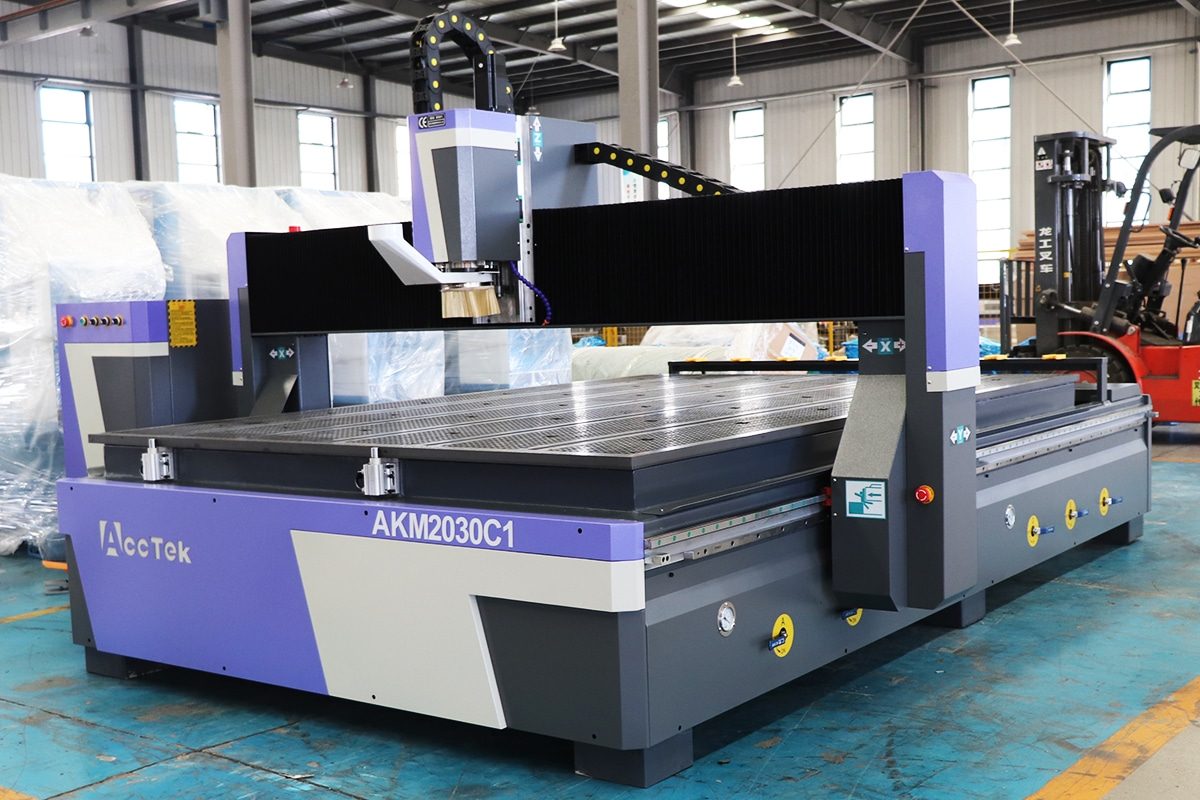
Understanding the Basics: What Are 5-Axis CNC Routers?
The term “5-axis” refers to the number of directions in which the cutting tool can move or rotate. In a 5-axis CNC router:
- X-Axis: Moves the tool side-to-side (left to right)
- Y-Axis: Moves the tool front-to-back
- Z-Axis: Moves the tool up and down
- A-Axis: Rotates around the X-axis (tilts the spindle side-to-side)
- B-Axis: Rotates around the Y-axis (tilts the spindle forward and backward)
Core Components of 5-Axis CNC Routers
At the heart of every 5-axis CNC router is a collection of precision-engineered components that work seamlessly together to deliver complex, high-speed, and multi-directional machining. Unlike simpler 3-axis systems, 5-axis CNC routers require more advanced construction and coordination to support their additional movements. Each component—mechanical, electrical, and software-based—plays a critical role in ensuring performance, stability, and accuracy.
- Machine Frame: The machine frame is the structural backbone of the CNC router. It supports all moving components and must be extremely rigid to prevent vibration, deformation, or misalignment during high-speed operations. Typically made from welded steel or cast iron, a robust frame ensures dimensional stability and enhances machining precision, especially when dealing with heavy-duty materials or complex 5-axis movements.
- Spindle: The spindle is the cutting head of the CNC router and is responsible for holding and rotating the cutting tool at high speeds. In 5-axis CNC routers, the spindle must be capable of precise tilting and rotation along additional axes (A and B). High-performance spindles feature variable speed control, automatic tool change capability, and high torque output to accommodate a wide range of materials, from soft woods to hardened alloys.
- Linear Guides and Ball Screws: Linear guides and ball screws ensure smooth, precise linear movement along the X, Y, and Z axes. Linear guides reduce friction and wear while maintaining alignment. Ball screws convert rotational motion into linear motion with high accuracy and minimal backlash. Together, they enable fast, repeatable movement with the tight tolerances required for 5-axis precision machining.
- Control System: The control system is the CNC router’s brain. It interprets G-code instructions and synchronizes movement across all five axes in real time. Advanced control systems support 5-axis kinematics, toolpath optimization, safety interlocks, and user-friendly interfaces. Some systems are open-architecture for customization, while others are proprietary with integrated CAD/CAM compatibility.
- Servo Motors and Drives: Servo motors provide precise motion control for each axis, including the rotational A and B axes. They are paired with drives that regulate power delivery and enable closed-loop feedback for high accuracy. High-end 5-axis CNC routers often use AC servo motors with encoders to deliver fast acceleration, deceleration, and positional repeatability even under load.
- Workholding System: Workholding systems, such as vacuum tables, vises, or custom jigs, secure the workpiece during machining. In 5-axis systems, the workholding must be robust and flexible enough to accommodate changing tool angles and multi-sided access. Some advanced machines feature trunnion tables or rotary axes to hold and rotate the workpiece itself, enhancing access to complex geometries.
- Feedback Sensors: Feedback sensors—such as encoders, linear scales, and proximity switches—monitor the position and condition of various components. These sensors enable real-time error correction and help maintain accuracy over long machining cycles. They are especially crucial in 5-axis routers, where slight positional deviations can compromise the final part geometry.
How 5-Axis CNC Routers Work
At the heart of a 5-axis CNC router’s functionality is simultaneous multi-axis movement. Here’s how the process typically unfolds:
- Digital Design Input (CAD): The process begins with a 3D digital model created in CAD (Computer-Aided Design) software. This model defines the geometry, surface contours, and features of the part to be machined.
- Toolpath Generation (CAM): The CAD file is then imported into CAM (Computer-Aided Manufacturing) software, where a toolpath is created. This toolpath includes detailed instructions for tool movements, speeds, and angles required to machine the part. The CAM software specifically generates 5-axis strategies, ensuring the cutting tool maintains optimal contact with the surface throughout the machining process.
- Post-Processing and G-Code: The CAM-generated toolpath is converted into G-code using a post-processor tailored for the specific 5-axis CNC router and its control system. This G-code includes instructions for linear and rotational movements, spindle speed, feed rate, and tool changes.
- Execution by CNC Controller: The machine’s CNC controller reads the G-code and coordinates movement along the X, Y, Z linear axes and A, B rotational axes in real time. This simultaneous movement allows the tool to approach the material from various angles without repositioning the workpiece manually.
- Cutting Operations: During operation, the cutting tool continuously adjusts its angle and position relative to the surface being machined. For example, when creating a contoured surface or undercut, the tool may tilt (A-axis), rotate (B-axis), and move linearly all at once to maintain contact and achieve the desired geometry with high accuracy.
- Feedback and Adjustments: Integrated feedback systems and sensors constantly monitor position, torque, and spindle speed to ensure accurate execution. If discrepancies are detected, the system makes micro-adjustments to correct errors in real time.
Differences Between 3-Axis, 4-Axis, and 5-Axis CNC Routers
3-Axis CNC Routers
- How They Work: 3-axis CNC routers operate on three linear axes—X (left to right), Y (front to back), and Z (up and down). The cutting tool moves in these directions to shape material on a single plane.
- Applications: Ideal for flat or moderately contoured parts, such as signs, cabinetry, and simple molds. They are well-suited for 2D and shallow 3D carving tasks.
- Limitations: 3-axis CNC routers cannot tilt the tool or access complex angles. Multiple setups are needed to machine different sides, which can lead to alignment errors and increased production time.
4-Axis CNC Routers
- How They Work: 4-axis CNC routers add a rotational axis—commonly the A-axis (rotation around the X-axis)—to the three linear axes. This allows the workpiece or spindle to rotate during machining.
- Applications: Useful for machining round objects, such as chair legs, columns, and cylindrical parts. Also suitable for engraving on curved surfaces and rotary carving.
- Advantages Over 3-Axis: With the ability to rotate the part or tool, 4-axis CNC routers reduce the need for repositioning and allow for more complex shapes.
- Limitations: Still lacks full flexibility, especially when approaching multiple angled surfaces or performing compound angled cuts, which limits the machining of complex 3D parts.
5-Axis CNC Routers
- How They Work: 5-axis CNC routers feature three linear axes (X, Y, Z) plus two rotational axes—typically A-axis (rotation around X-axis) and B-axis (rotation around Y-axis). This allows the cutting tool to approach the workpiece from virtually any direction.
- Applications: Ideal for complex and highly contoured 3D parts, undercuts, molds, aerospace components, medical implants, and intricate furniture designs.
- Key Benefits:
- Reduced Setup Time: Multiple sides can be machined in one operation.
- Enhanced Accuracy: Fewer repositionings reduce errors.
- Improved Surface Finish: Tool maintains optimal angle, minimizing deflection.
- Challenges: More expensive and complex to operate, requiring skilled programming, sophisticated control systems, and advanced maintenance practices.
Advantages of 5-Axis CNC Routers
5-axis CNC routers offer a significant leap in capability over their 3-axis and 4-axis counterparts. Their ability to move a tool or workpiece along five independent axes simultaneously unlocks new levels of precision, speed, and flexibility. These machines are especially valuable in industries that demand intricate shapes, tight tolerances, and efficient production workflows. Whether you’re working with metals, composites, or wood, 5-axis CNC routers streamline operations and elevate product quality.
- Complex Geometry Machining: One of the most compelling benefits of 5-axis CNC routers is their ability to machine intricate, contoured, or organic geometries in a single setup. Unlike 3-axis CNC routers, which require re-fixturing and multiple orientations, 5-axis systems can approach the workpiece from nearly any angle. This enables the creation of undercuts, deep cavities, compound curves, and freeform surfaces often found in aerospace, automotive, and medical applications.
- Reduced Setup Time: 5-axis CNC routers drastically cut down on setup time by minimizing the need for manual repositioning. Traditional machines require multiple fixtures or setups to reach different faces of a part, increasing labor and the risk of error. In contrast, 5-axis CNC routers can access multiple surfaces in one pass, streamlining the process and boosting throughput, especially for small production runs or custom parts.
- Improved Surface Finish: With simultaneous multi-axis movement, the cutting tool can maintain an optimal angle relative to the surface, reducing tool deflection and vibration. This results in smoother surface finishes, especially on complex 3D surfaces. Better surface quality not only reduces the need for secondary finishing operations but also enhances the overall aesthetic and functional performance of the part.
- Increased Tool Life: Because the tool remains properly aligned with the cutting surface during machining, there’s less lateral force and wear on the tool. This optimal cutting condition reduces heat buildup and stress on the cutting edge, extending the tool’s usable life. Fewer tool changes mean lower consumable costs and less machine downtime.
- Enhanced Accuracy: Fewer setups translate to fewer opportunities for cumulative errors in positioning and alignment. 5-axis CNC routers maintain consistent tolerances across complex parts, ensuring high precision in every cut. Integrated feedback systems and real-time positional adjustments further contribute to their accuracy, making them ideal for high-precision applications such as mold making or turbine blade production.
- Better Material Utilization: With the ability to approach the workpiece from any angle, 5-axis CNC routers can perform more efficient nesting and minimize stock waste. This is especially valuable when working with expensive materials like titanium, carbon fiber, or exotic hardwoods. Optimized cutting strategies allow manufacturers to get the most out of each blank or slab, improving material yield and reducing costs.
Disadvantages of 5-Axis CNC Routers
While 5-axis CNC routers offer remarkable capabilities, they are not without challenges. The same complexity that gives them their versatility also brings higher costs, steeper learning curves, and demanding technical requirements. These factors make 5-axis CNC routers more suitable for advanced manufacturers with the resources and expertise to manage them effectively. Understanding the disadvantages is critical for evaluating whether a 5-axis system is the right fit for your production environment.
- Higher Cost: 5-axis CNC routers are significantly more expensive than 3-axis or 4-axis CNC routers, both in terms of initial purchase price and operational overhead. The advanced hardware, precise components, and sophisticated control systems contribute to the high investment. Additionally, tooling, accessories, and specialized fixturing can further increase costs. For small workshops or budget-conscious operations, the expense may outweigh the benefits.
- Steeper Learning Curve: Operating 5-axis CNC routers requires specialized knowledge and skills. Unlike 3-axis CNC routers, which are relatively straightforward to use, 5-axis systems involve understanding complex axis interactions, tool orientation strategies, and real-time motion control. Operators and programmers must undergo advanced training to use the machine safely and effectively, which may require significant time and financial investment.
- Programming Complexity: Programming for 5-axis CNC routers is inherently more complicated. It involves calculating toolpaths across multiple planes and managing angular movements. Simple operations become more involved due to the additional degrees of freedom. Even small errors in code or setup can result in collisions or defective parts. Skilled CAM programmers and reliable simulation software are essential to avoid costly mistakes.
- Software Requirements: 5-axis machining requires powerful and specialized CAM (Computer-Aided Manufacturing) software capable of generating accurate 5-axis toolpaths. These software packages are more expensive than standard 3-axis solutions and may require regular updates, licensing fees, and compatibility checks. Additionally, not all CAD models are optimized for 5-axis processing, which may necessitate design adjustments or reformatting.
- Maintenance and Downtime: The complexity of 5-axis CNC routers increases the potential for mechanical and electrical issues. With more moving parts—especially rotary components like the A and B axes—maintenance requirements are more rigorous. Downtime for repairs or calibration can be longer and more costly. Preventive maintenance is essential, but even then, unexpected issues can disrupt production schedules.
- Space Requirements: Due to their larger footprint and need for rotational clearance, 5-axis CNC routers often require more floor space than simpler machines. This includes room for operator access, safety zones, and peripheral equipment such as dust extraction systems, tool changers, or material handling solutions. For smaller workshops, accommodating a 5-axis system may involve significant reconfiguration or expansion.
Applications Across Industries
5-axis CNC routers are valued across a wide range of industries for their ability to machine complex shapes with exceptional accuracy and efficiency. Their ability to cut, shape, and finish parts from multiple angles in a single setup makes them indispensable in sectors that demand high precision, intricate geometry, and rapid production cycles. From aerospace engineering to artistic sculpture, these machines enable advanced manufacturing capabilities that are often impossible to achieve with traditional 3-axis systems.
- Aerospace Industry: The aerospace sector demands components with tight tolerances, complex contours, and lightweight construction. 5-axis CNC routers are essential for machining turbine blades, structural components, and aerodynamic surfaces. Their ability to handle hard materials like titanium and aluminum alloys while maintaining dimensional accuracy ensures compliance with strict aerospace standards.
- Automotive Industry: In automotive manufacturing, 5-axis CNC routers are used to create engine components, transmission housings, chassis elements, and custom body parts. Their flexibility allows manufacturers to efficiently machine both functional and aesthetic parts. They are also instrumental in producing molds for car panels, light housings, and interior trim components with high repeatability and finish quality.
- Medical Devices: The medical field requires small, intricate, and highly precise components for implants, surgical instruments, and diagnostic equipment. 5-axis CNC routers are ideal for producing custom orthopedic implants, dental prosthetics, and tools from biocompatible materials like stainless steel, PEEK, and titanium. The ability to machine complex geometries in a sterile, efficient manner is crucial for patient safety and regulatory compliance.
- Prototyping: Product development and innovation rely heavily on rapid prototyping. 5-axis CNC routers allow designers and engineers to quickly produce highly detailed and functional prototypes from a wide range of materials. This accelerates design iterations, helps validate fit and function, and shortens time-to-market. The ability to machine multi-faceted prototypes without repositioning makes these machines ideal for R&D environments.
- Marine Industry: In the marine sector, 5-axis CNC routers are used for crafting large composite molds, structural parts, propellers, and hull components. Their capacity to handle oversized materials and generate smooth, curved surfaces is essential for building hydrodynamic and structurally sound marine vessels. They also streamline the fabrication of interior cabinetry and custom fittings used in yachts and naval ships.
- Arts and Sculptures: Artists, sculptors, and designers use 5-axis CNC routers to translate digital models into physical works with stunning detail. Whether working with wood, stone, foam, or resin, these machines can create intricate 3D forms, textures, and reliefs. This enables large-scale installations, replicas, and artistic pieces that would be difficult or impossible to achieve by hand or with simpler machines.
- Mold and Die Making: Mold and die making requires exceptional surface finish, complex cavity design, and dimensional precision. 5-axis CNC routers enable efficient machining of molds for injection molding, casting, and thermoforming. The ability to reach deep cavities and create undercuts without manual repositioning ensures accuracy and consistency, reducing post-processing time and improving product quality.
How to Choose the Right 5-Axis CNC Routers
Type of Work
Start by assessing the nature of the parts you plan to produce. Are you machining large aerospace components, small medical implants, artistic sculptures, or custom molds? The material type, part size, required tolerances, and level of geometric complexity will heavily influence the type of 5-axis router you need. For example:
- Large workpieces may require a gantry-style CNC router.
- High-precision parts demand machines with ultra-rigid frames and high-speed feedback systems.
- Soft materials like foam or wood may not require the same rigidity or power as hard metals.
Machine Configuration
5-axis CNC routers come in several configurations, including:
- Trunnion-style, where the workpiece rotates and tilts.
- Head-tilt style, where the spindle itself moves along the rotational axes.
Software Compatibility
5-axis machining requires advanced CAM (Computer-Aided Manufacturing) software capable of generating precise toolpaths for complex geometries. Ensure the router is compatible with your existing CAD/CAM software or consider upgrading to packages specifically designed for multi-axis programming, such as Mastercam, Fusion 360, or HyperMILL. Look for systems that offer:
- Post-processors tailored for your machine
- 5-axis simulation and collision detection
- Intuitive interfaces for faster learning and fewer programming errors
Spindle Power and Speed
The spindle is the heart of the cutting system. Its power (measured in kilowatts or horsepower) and rotational speed (RPM) must match the demands of your material and tooling. For example:
- Hard metals like titanium require high torque and lower RPMs.
- Soft materials like plastic or wood benefit from high-RPM spindles.
Support and Training
Given the technical complexity of 5-axis routers, strong manufacturer support is crucial. Evaluate the vendor’s ability to provide:
- Installation and commissioning assistance
- In-depth operator and programmer training
- Ongoing technical support and troubleshooting
- Spare parts availability and response time
Budget and Long-Term ROI
While 5-axis CNC routers demand a high upfront investment, their return on investment (ROI) can be substantial if aligned with the right applications. Consider:
- Not just the initial cost, but also maintenance, tooling, software, and operator training.
- Operational savings, such as reduced setup time, fewer fixtures, and less rework.
- Potential to take on more complex, higher-margin jobs that are otherwise unfeasible with lower-axis machines.