

Oscillating Knife Cutting Machine Buying Guide
An oscillating knife cutting machine is a powerful tool designed for precision cutting across a wide range of flexible materials, including foam, rubber, leather, textiles, cardboard, and composites. Whether you’re in packaging, automotive, signage, apparel, or upholstery, the right machine can drastically improve cutting accuracy, speed, and consistency while reducing waste and labor costs.
But with so many models and features on the market, choosing the right oscillating knife cutting machine isn’t straightforward. Machine specifications, blade types, cutting area, software compatibility, and material versatility all play a role in determining which model fits your needs. What works for a small workshop may not suit a large-scale production line—and vice versa.
This buying guide breaks down everything you need to know before investing. We’ll walk you through the critical considerations, from machine size and cutting speed to automation features and service support. By the end, you’ll have a clear understanding of what to look for and how to align your purchase with your production goals. Whether you’re buying your first machine or upgrading an existing setup, this guide is built to help you make a smart, informed decision that pays off in efficiency and output.
Table of Contents
Understanding Oscillating-Knife Technology
Oscillating knife cutting machines are designed to deliver precise, clean cuts on a wide variety of soft to semi-rigid materials. Unlike rotary or laser cutting machines, these machines use a straight-edged blade that rapidly moves (or “oscillates”) up and down at high frequencies, slicing through material with minimal heat, friction, or distortion. This makes them ideal for applications requiring precision without compromising material integrity.
How the Mechanism Works
At the heart of oscillating knife technology is the reciprocating blade. Driven by an electric or pneumatic actuator, the blade oscillates at speeds up to tens of thousands of strokes per minute. The vertical motion of the blade—combined with controlled horizontal movement via a CNC (computer numerical control) system—allows for detailed contour cutting. Pressure, depth, and blade speed are all adjustable, depending on the material type and thickness.
Common Machine Architectures
Oscillating knife cutting machines come in several formats:
- Flatbed CNC Cutters: Most common type, offering a large working area for sheet materials.
- Conveyor-Based Systems: Ideal for continuous production, especially in the textile and packaging industries.
- Compact Benchtop Models: Designed for prototyping or low-volume work in small workshops or R&D settings.
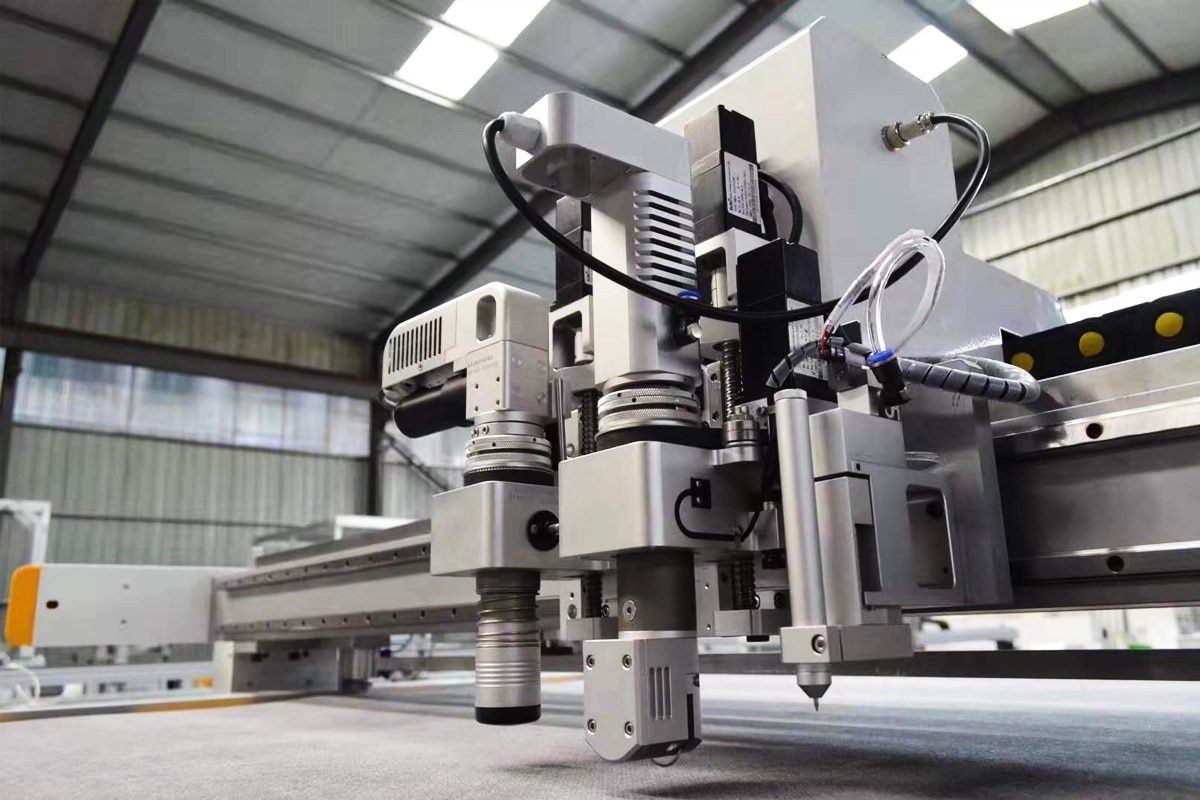
- Multi-Tool Systems: Combine oscillating knives with drag knives, creasing wheels, or routing tools for greater versatility.
The machine’s frame rigidity, motion control system, and software integration all influence cutting precision and repeatability.
Types of Oscillating Knives
There are two main types:
- Electric Oscillating Knives (EOT): Powered by a high-speed motor, they offer finer control and are generally quieter, suitable for a wide range of soft and medium-density materials.
- Pneumatic Oscillating Knives (POT): Driven by compressed air, these are more powerful and suited for thicker or denser materials like heavy rubber or multi-layer composites.
Blade shape and size also vary, including straight, serrated, or curved tips tailored for specific materials or cutting tasks.
Material Compatibility & Industries
Oscillating knife cutting machines excel at processing materials that are too soft for milling yet too tough for laser cutting. These include:
- Foam (EVA, PE, PU)
- Rubber and neoprene
- Leather and synthetic fabrics
- Corrugated cardboard and honeycomb board
- Textiles, felt, and fiberglass
- Composites and gasket materials
Industries that rely heavily on this technology include:
- Packaging: For die-less cutting of boxes, inserts, and protective packaging.
- Automotive: For carpets, gaskets, insulation, and interior trim.
- Apparel & Textiles: For precise fabric cutting without fraying.
- Signage & Display: For vinyl, cardboard, and foamboard.
- Upholstery & Furniture: For cutting leather, fabric, and cushioning foam.
Oscillating knife cutting machines are engineered for speed, precision, and adaptability across a diverse range of materials and applications. By understanding how the mechanism works, the machine architectures available, the different types of oscillating knives, and what materials they’re best suited for, buyers can better match machine capabilities with operational needs. Whether you’re cutting packaging foam, technical textiles, or layered composites, the right oscillating knife system offers a clean, efficient solution.
Mapping Your Job Mix
Before choosing an oscillating knife cutting machine, it’s essential to define your production requirements clearly. This means understanding the mix of materials, volume patterns, and quality expectations that define your daily operations. Skipping this step often leads to mismatched machines—either overbuilt and too expensive or underpowered and inadequate. A precise job-mix analysis helps ensure that the machine you invest in can deliver consistent results and long-term ROI.
Define Core Materials
Start by identifying the primary materials you cut—both now and in the foreseeable future. Consider:
- Material Type: Foam, rubber, leather, textiles, cardboard, vinyl, gaskets, composites, etc.
- Material Properties: Thickness, density, flexibility, surface texture, and layering requirements.
- Abrasiveness & Toughness: Some materials wear out blades faster or require more powerful oscillation and pressure settings.
- Special Handling Needs: Delicate fabrics may require vacuum hold-downs; sticky materials may need anti-stick coatings or specific blade types.
Machines designed for soft foam won’t necessarily handle dense rubber or multi-layer composites without modifications or tool swaps. The more specific you are about materials, the more accurately you can match blade types, motors, and support systems.
Volume & Batch Patterns
Cutting requirements vary widely between low-volume prototyping and high-volume production. Clarify:
- Daily/Weekly Output Goals: Square meters or units per shift.
- Batch Sizes: Are you running large batches of the same design or many short runs of different parts?
- Changeover Frequency: High-mix, low-volume environments benefit from quick-change tooling and intuitive software interfaces.
- Production Rhythm: Is the workflow continuous, on-demand, seasonal, or project-based?
Conveyor-fed systems and auto-nesting software are valuable for high-throughput environments, while benchtop machines may suit short-run or custom-cut operations better.
Accuracy & Edge Quality Targets
Not all cutting applications demand the same level of precision. Define what your customers or internal processes require:
- Tolerances: Are your parts used in final assemblies where even minor dimensional variation causes issues?
- Edge Finish: Is a clean, smooth edge important for aesthetic or functional reasons (e.g., seals, upholstery, signage)?
- Repeatability: Can the machine consistently reproduce the same part, day after day, without deviation?
For industries like automotive, aerospace, or medical textiles, precision and repeatability are non-negotiable. In contrast, packaging inserts or foam cushions may allow for more lenient tolerances.
Mapping your job mix is the foundation of a smart machine purchase. By clearly defining your core materials, production volume patterns, and quality expectations, you narrow the field to machines built for your actual workload, not just theoretical capabilities. This ensures you invest in an oscillating knife cutting machine that performs well, lasts long, and supports your business growth without constant upgrades or compromises.
Key Specification Checklist
Once you’ve mapped out your job mix, it’s time to evaluate the machine specs that determine real-world performance, reliability, and adaptability. Oscillating knife cutting machines vary widely in build quality, capability, and software integration. Choosing the right one isn’t about chasing the highest numbers—it’s about selecting the right combination of specs that align with your materials, workflows, and production goals. This checklist covers the most critical specifications to consider when evaluating machines:
Cutting Area
- Definition: The maximum width and length the machine can cut in a single setup.
- What to Look For: Match the cutting area to your largest material sheets or pattern sizes. If you handle roll-fed material, ensure compatibility with automated feeding or conveyors.
- Tip: Bigger isn’t always better—oversized tables waste space and cost more unless fully utilized.
Drive System & Speed
- Definition: The mechanical system (usually servo-driven) that controls X/Y motion, and how fast the machine moves the cutting head.
- What to Look For: Look for precision linear guides, belt vs. rack-and-pinion drives, and acceleration rates. Faster machines increase throughput, but only matter if you can feed and finish parts at that speed.
- Tip: Smooth motion and fine control are just as important as speed for accuracy.
Stroke Frequency & Amplitude
- Definition: How many oscillations per minute (typically 6,000–20,000+), and how deeply the blade moves with each stroke.
- What to Look For: Higher frequencies with adjustable amplitude allow the oscillating knife cutting machine to adapt to different material densities and thicknesses.
- Tip: For dense or thick materials, amplitude (stroke depth) matters more than raw speed.
Tool Head Modular Ecosystem
- Definition: The system of interchangeable tools that attach to the machine’s cutting head.
- What to Look For: Ability to swap between oscillating knife, drag knife, V-cut tool, creasing wheels, pen plotter, and router—all ideally auto-recognized by software.
- Tip: A modular system extends the life and versatility of your machine investment.
Vacuum Capacity
- Definition: The suction system that holds materials flat and steady on the cutting bed.
- What to Look For: Strong, zoned vacuum with adjustable power. Critical for thin, flexible, or slippery materials.
- Tip: Poor vacuum hold-down leads to inaccurate cuts and material slippage.
Machine Frame & Damping
- Definition: The rigidity of the machine’s base and how well it absorbs vibration.
- What to Look For: Heavy-duty steel or aluminum construction, welded or bolted structures, and internal damping elements.
- Tip: A solid frame minimizes chatter and boosts cutting precision, especially at high speeds.
Software & Nesting Algorithms
- Definition: The CAD/CAM platform and logic that converts design files into cut paths and material layouts.
- What to Look For: User-friendly software with auto-nesting, tool path optimization, and integration with industry file formats (DXF, AI, PLT, etc.).
- Tip: Good nesting software can reduce material waste by 10–20%, significantly impacting cost.
Vision & Registration
- Definition: Systems that use cameras or sensors to align cuts with printed graphics or pre-cut materials.
- What to Look For: Optical recognition, fiducial mark detection, and smart compensation for material skew/stretch.
- Tip: Essential for signage, textiles, or any application with pre-printed or patterned materials.
Safety & Ergonomics
- Definition: Features that protect operators and make the machine easier to use.
- What to Look For: Emergency stops, safety light curtains, easy blade access, touchscreens, ergonomic loading height.
- Tip: A safer machine improves productivity and reduces downtime due to accidents or fatigue.
Support & Consumables
- Definition: The ongoing service, maintenance, and replacement parts ecosystem around the machine.
- What to Look For: Local technical support, warranty terms, blade availability, training resources, and software updates.
- Tip: A great machine with poor support quickly becomes a liability. Choose a vendor with a track record of post-sale service.
The right oscillating knife cutting machine is more than the sum of its parts—it’s a balanced combination of mechanical power, software intelligence, material handling, and support infrastructure. Use this checklist as a benchmark to evaluate each model on your shortlist. Prioritize what matters most for your job mix, and don’t get distracted by specs that look good on paper but won’t benefit your specific operation. A well-matched machine should boost your precision, speed, and profitability from day one.
Total Cost of Ownership Calculation
Buying an oscillating knife cutting machine is a capital investment, but the purchase price alone doesn’t reflect the real cost. To make a financially sound decision, you need to look beyond the sticker price and evaluate the Total Cost of Ownership (TCO) over the machine’s expected life. This includes everything from energy and maintenance costs to labor efficiency and eventual resale value. A lower-cost machine might end up being more expensive in the long run, while a premium system could pay for itself faster through performance and reliability.
Capital Expenditure (CapEx)
- Definition: The upfront cost of purchasing the machine, including accessories, installation, and training.
- Considerations:
- Base machine price
- Tool heads and optional modules
- Delivery, setup, and calibration
- Software licenses and upgrades
- On-site training for operators
- Tip: Don’t underestimate setup costs—poor installation or untrained operators can lead to early issues and inefficiencies.
Operating Expenses (OpEx)
- Definition: The ongoing costs required to keep the machine running over time.
- Considerations:
- Electricity and compressed air usage (especially for pneumatic models)
- Blades, cutting mats, and other consumables
- Scheduled maintenance (lubrication, calibration, belt replacements)
- Software subscriptions or updates
- Replacement tools or heads over time
- Tip: Some machines have lower wear-and-tear due to better build quality or optimized motion systems—this adds up over the years.
Labor Considerations
- Definition: The human cost of running and supporting the machine, including setup, operation, and material handling.
- Considerations:
- Operator skill level required (intuitive software can reduce training time)
- Time spent on loading/unloading and job setup
- Downtime due to tool changes or machine issues
- Automation features that reduce manual intervention (e.g., auto-nesting, conveyor feeds, quick-change tools)
- Tip: Machines that streamline workflow may cost more up front, but reduce labor needs and increase output per worker.
Depreciation & Resale
- Definition: The decline in value of the machine over time, and its potential resale or trade-in value.
- Considerations:
- Expected lifespan (5–10+ years, depending on usage and build quality)
- Brand reputation and secondhand demand
- Maintenance record and upgradeability
- Tip: Well-maintained machines from reputable brands retain more value and can be sold or traded in to offset future upgrades.
Understanding the Total Cost of Ownership gives you a clearer picture of long-term value, not just initial expense. A machine that costs more up front might save you significantly in operating costs, downtime, and labor over time. Evaluate each machine not only as a purchase, but as an asset—one that must deliver productivity, quality, and efficiency throughout its lifecycle. Making buying decisions based on TCO rather than just CapEx leads to smarter investments and stronger margins.
Step-by-Step Selection Framework
Choosing the right oscillating knife cutting machine involves more than comparing specs on paper—it’s a strategic decision that impacts quality, efficiency, and profitability. To avoid costly missteps, buyers should follow a clear, structured process that brings together technical, operational, and financial perspectives. This step-by-step selection framework ensures that your final choice is not only functionally sound but also aligns with your long-term production goals.
Assemble a Cross-Functional Team
- Why It Matters: Machine decisions affect multiple departments—production, engineering, procurement, IT, and safety. Leaving the choice to a single stakeholder can lead to overlooked risks or incompatible features.
- Who to Include:
- Operators and floor supervisors (for usability and workflow)
- Engineers or production planners (for technical requirements)
- Procurement or finance (for budget and ROI)
- Maintenance staff (for serviceability and uptime)
- Tip: Involve end users early—they often catch practical issues others miss.
Translate Work Orders into Test Files
- Why It Matters: It’s not enough to ask a vendor, “Can this machine cut foam or leather?”—you need to test your actual parts.
- What to Do:
- Convert representative job files (DXF, AI, PDF, etc.) into cutting files
- Include common nesting layouts, small details, or multi-layer jobs
- Tip: Make sure test files represent your most complex or demanding jobs, not just easy ones.
Request a Live Demo on Your Material
- Why It Matters: Specs don’t show how a machine handles real-world conditions like material stretch, static, or irregular edges.
- What to Ask For:
- A live demo using your actual material samples
- Comparison of cut speed, edge quality, vacuum hold, and cleanup
- Videos or in-person visits if an on-site demo isn’t feasible
- Tip: Request unedited video footage or live-streamed sessions to get a true performance snapshot.
Perform a Life-Cycle Risk Audit
- Why It Matters: Machines often fail not from poor performance, but from weak support, supply delays, or unanticipated wear.
- Audit Includes:
- Supplier track record and customer service responsiveness
- Spare part availability and lead times
- Blade/tool longevity under your usage
- Frequency of service interventions or failures
- Tip: Ask for customer references and talk to existing users about breakdown history.
Draft a Total Cost of Ownership Spreadsheet
- Why It Matters: A higher-priced machine may offer a better return if it reduces labor, waste, or downtime.
- What to Include:
- CapEx, OpEx, maintenance, blades/tools, energy use, labor time
- Useful life estimate and projected resale value
- Tip: Use side-by-side comparisons for multiple vendors to make cost drivers visible.
Negotiate Service Level Agreements (SLAs)
- Why It Matters: Even the best machines need support. Without clear service terms, downtime can become costly fast.
- What to Negotiate:
- Guaranteed response times for tech support
- On-site repair timeframes
- Spare part availability
- Preventive maintenance schedules
- Tip: Lock in key SLAs at the time of purchase, not after issues arise.
Inspect Compliance Certificates
- Why It Matters: Regulatory and safety compliance is essential, especially for exporting, insuring, or operating in regulated industries.
- What to Check:
- CE, UL, or ISO certifications
- Electrical and safety standards
- Machine manuals in the local language
- Workplace safety integration (emergency stops, shields, interlocks)
- Tip: Confirm that all accessories and add-ons meet the same compliance standards, not just the base machine.
A well-structured selection process reduces the risk of regret and maximizes your return on investment. By involving key stakeholders, validating performance on real jobs, and addressing long-term costs and risks, you build confidence in your buying decision. This step-by-step framework transforms the selection process from guesswork into a strategic business decision, backed by data, testing, and real-world fit.
Advanced Buying Considerations
For buyers with complex production environments or long-term strategic goals, surface-level specs aren’t enough. Once you’ve nailed the basics, it’s time to evaluate advanced features that influence integration, scalability, and sustainability. These considerations help ensure your oscillating knife cutting machine doesn’t just meet current needs—it becomes a reliable asset that evolves with your business.
Integration with Upstream & Downstream Processes
- Why It Matters: A cutting machine doesn’t operate in isolation. It’s part of a workflow that may include design, printing, lamination, inspection, assembly, or packaging.
- What to Look For:
- Compatibility with MES/ERP systems for job tracking and automation
- Barcode or QR code scanning for job recall and part identification
- Integration with conveyors, stackers, pick-and-place robots, or print systems
- Tip: Choose a system that supports open architecture and easy API connectivity—this reduces customization costs later.
Multi-Layer & Kiss-Cut Operations
- Why It Matters: Some industries require precise depth control to cut through only certain layers, common in sticker production, gasket manufacturing, or layered foam assembly.
- What to Look For:
- Z-axis precision control for consistent partial-depth cuts
- Blade types and sensors that handle variable material resistance
- Automatic pressure compensation for uneven materials or surfaces
- Tip: Test kiss-cut accuracy on your real materials. Inconsistent depth control can ruin batch runs or damage substrates.
Environmental Controls
- Why It Matters: Cutting performance can be impacted by external factors like humidity, temperature, and static buildup, especially when working with textiles, films, or foams.
- What to Look For:
- Built-in static eliminators or ionizers
- Dust extraction or vacuum filtration systems to keep the cutting area clean
- Climate-compatible components for extreme temperatures or moisture-prone environments
- Tip: Discuss operating environment with your supplier—climate control may be essential for accuracy and blade life.
Future-Proofing for New Materials
- Why It Matters: Material trends are constantly evolving, especially in sustainable packaging, smart textiles, and composite manufacturing. Your machine should adapt as your material list grows.
- What to Look For:
- Modular tool heads and firmware upgrade paths
- Support for new blade geometries or pressure ranges
- Software that allows quick configuration for unfamiliar substrates
- Tip: Ask the vendor about recent updates and how they’ve supported new material challenges in other customer applications.
Sustainability & Energy Recovery
- Why It Matters: Energy use, waste reduction, and sustainability targets are increasingly part of procurement decisions, especially in certified or regulated industries.
- What to Look For:
- Energy-efficient motors and drives with low standby consumption
- Waste-reducing features like smart nesting or offcut recovery systems
- Regenerative braking or energy reuse technologies in high-end systems
- Tip: Sustainability isn’t just about optics—it often leads to real cost savings in energy and material consumption.
Advanced buying considerations give forward-thinking businesses a competitive edge. By focusing on integration, specialty cutting capabilities, environmental resilience, material adaptability, and sustainability, you’re not just buying a machine—you’re building a smarter, more future-ready production system. These features may not be required on day one, but they could make all the difference as your operation scales or pivots to meet new demands.
Implementation Roadmap
Buying the right oscillating knife cutting machine is just the beginning. A successful implementation ensures that the equipment delivers maximum productivity from day one and scales with your workflow over time. Without a clear plan, even the best machine can fall short due to poor integration, untrained operators, or skipped maintenance.
Site Preparation
- Why It Matters: Your new machine won’t perform to spec if your facility isn’t ready for it. Site prep affects everything from machine stability to air flow and operator safety.
- Checklist:
- Adequate floor space and structural support (especially for large or heavy machines)
- Power supply and grounding based on machine specs
- Compressed air lines for pneumatic tools (if required)
- Dust extraction or vacuum plumbing
- Lighting, ventilation, and environmental controls
- Material staging zones for raw input and finished parts
- Tip: Coordinate with the vendor for a pre-install inspection or digital layout plan to avoid delays and costly rework.
Training & Change Management
- Why It Matters: Even intuitive machines require skilled operation. Training isn’t just about buttons—it’s about understanding workflows, safety, and troubleshooting.
- Components:
- Hands-on training for operators and supervisors
- Software and file preparation guidance for designers and engineers
- Maintenance and diagnostics training for technicians
- Job role updates and shift coordination if workflow changes
- Change Management:
- Communicate early and clearly about why the machine is being introduced
- Involve frontline staff in the process to encourage buy-in
- Schedule transition time and trial runs before going full production
- Tip: Keep training ongoing. Offer refreshers, especially when onboarding new employees or updating tools/software.
Preventive Maintenance Schedule
- Why It Matters: Preventive maintenance keeps your machine in top condition, reduces unplanned downtime, and extends the lifespan of key components.
- What to Include:
- Daily/weekly checks (blade condition, vacuum seals, debris cleanup)
- Monthly lubrication, belt tension checks, and calibration routines
- Vendor-recommended replacement intervals for blades, mats, filters, etc.
- Documentation of service logs and error codes
- Tip: Build maintenance into your production calendar, not as an afterthought. Missed maintenance is a leading cause of long-term performance issues.
KPI Tracking
- Why It Matters: You can’t improve what you don’t measure. Tracking performance helps validate ROI, identify bottlenecks, and optimize processes over time.
- Key Metrics to Track:
- Cutting speed vs. quoted specs (real-world vs. theoretical)
- Material yield and scrap rates (especially with nesting software)
- Downtime (planned vs. unplanned)
- Tool longevity (blade life per material type)
- Labor hours per job or square meter of material
- Tip: Set baseline metrics before installation, then track improvements at 30-, 90-, and 180-day intervals. Use data to refine processes and justify future upgrades.
A smooth implementation sets the foundation for long-term success with your oscillating knife cutting machine. From preparing the site and training your team to scheduling maintenance and tracking KPIs, every step plays a role in maximizing performance and uptime. The goal isn’t just to get the machine running—it’s to make it a fully integrated, continuously improving part of your production system.
Common Pitfalls and How to Avoid Them
Even experienced buyers can make costly mistakes when selecting or implementing an oscillating knife cutting machine. These machines are highly capable, but they also come with technical and operational nuances that, if overlooked, can lead to reduced performance, downtime, and wasted investment.
Ignoring Stroke-Frequency Limits
- The Problem: Buyers often assume that higher stroke frequency (oscillations per minute) always equals better cutting performance. But exceeding material-appropriate limits leads to premature blade wear, overheating, or material tearing.
- The Fix: Match the stroke frequency and amplitude to the specific material and thickness. Ensure the machine allows fine-tuned control over these settings and that operators understand how to adjust them.
Under-Specifying Vacuum
- The Problem: Weak or poorly zoned vacuum systems fail to hold materials flat—especially thin, flexible, or slippery substrates—causing miscuts or ruined parts.
- The Fix: Choose a machine with adjustable vacuum zones and sufficient suction capacity for your thickest and lightest materials. Test vacuum hold during demos using your real-world setups.
Over-Relying on Vendor Samples
- The Problem: Demos and sample cuts provided by vendors can be overly optimized, using ideal conditions and carefully prepped material. This doesn’t reflect day-to-day realities.
- The Fix: Bring your material, designs, and cutting challenges to live demos. Insist on cutting worst-case scenarios, like multi-layer foam, intricate detail cuts, or warped stock.
Neglecting Software Lock-In
- The Problem: Some machines rely on proprietary design or nesting software with limited export options, high annual fees, or restrictions that make it hard to switch systems later.
- The Fix: Ask about licensing models, compatibility with common file formats (DXF, SVG, AI, etc.), and whether the software is cloud-based or local. Prefer open or widely supported platforms to maintain flexibility.
Skipping Spare Blade Stock
- The Problem: New users often underestimate how quickly blades wear out, especially when cutting dense or abrasive materials. Running out mid-shift can stall production.
- The Fix: Keep a buffer stock of blades for each material type in use. Create a usage log to track average blade life and reorder based on consumption trends, not emergencies.
Undervaluing Ergonomics
- The Problem: Machines that are difficult to load, clean, or operate lead to slower throughput, increased operator fatigue, and even safety incidents.
- The Fix: Prioritize ergonomic features such as low-friction work surfaces, accessible tool heads, easy-to-read interfaces, and safe blade change systems. Always involve operators in machine evaluations.
Missing Regulatory Nuances
- The Problem: Some machines may lack certifications required for your region or industry (CE, UL, ISO), which can create legal, insurance, or customer compliance issues.
- The Fix: Request full documentation on compliance, including certificates for both the machine and accessories. If you export, confirm that all systems meet the destination country’s standards.
Avoiding these common pitfalls comes down to preparation, critical thinking, and asking the right questions, not just relying on spec sheets or sales demos. By understanding stroke-frequency limits, ensuring strong vacuum capacity, vetting software freedom, and preparing for real-world use, you’ll make a more informed and sustainable investment. A little extra diligence upfront can save you thousands in downtime, rework, or system upgrades down the line.
Summary
Choosing the right oscillating knife cutting machine is a strategic investment that impacts every part of your production process—from material efficiency and output speed to operator workload and long-term operating costs. This guide has walked through every critical aspect of the buying journey: understanding the cutting mechanism, mapping your job mix, evaluating technical specifications, calculating total cost of ownership, and planning for successful implementation.
We’ve also covered advanced considerations like system integration, multi-layer cutting, sustainability, and future-proofing, along with common pitfalls to avoid, such as undersized vacuum systems, over-reliance on vendor samples, or overlooking software limitations.
The best machine for your operation isn’t necessarily the biggest or most expensive—it’s the one that aligns with your materials, production volume, quality standards, and workflow. A step-by-step selection framework, backed by real-world testing, cross-functional input, and thorough ROI planning, is key to making the right choice.
Whether you’re purchasing your first cutting machine or upgrading your production line, take the time to assess your needs in depth. A well-chosen oscillating knife cutting machine will not only boost productivity, but it will also enhance flexibility, reduce waste, and set your operation up for scalable, long-term success.
Get Oscillating Knife Cutting Solutions
When you’re ready to invest in precision, reliability, and performance, working with an experienced manufacturer makes all the difference. AccTek Group is a trusted leader in intelligent laser and cutting equipment, offering tailored oscillating knife cutting solutions for businesses across packaging, textiles, automotive, signage, and more.
With years of industry experience, AccTek Group delivers machines that combine robust mechanical design, intuitive software, and modular tool systems, giving you the flexibility to handle a wide range of materials and applications. Whether you’re cutting foam, leather, cardboard, rubber, or composites, AccTek Group machines are engineered for clean edges, tight tolerances, and maximum material yield.
AccTek Group supports every step of your journey—from application analysis and test cuts to installation, training, and after-sales service. You’ll benefit from responsive technical support, smart software integration, and scalable machine options that grow with your production needs.
If you’re looking for a cutting system that balances advanced features with long-term value, AccTek Group can provide a solution built around your workflow and materials. Don’t settle for a one-size-fits-all machine—get a solution that fits your business. Contact AccTek Group today to explore the right oscillating knife cutting system for your operation.